


Why does it matter to lender if our home is house, condo or townhome?
Question of the week: Why does it matter if our home is a house, condo or townhome?
Answer: Because of data analysis of defaults and foreclosures.
All of the above, house, condo and townhome, are under the general classification of single unit dwellings. As showing in the name, these types of dwellings are meant for one-family occupation. However, they are not the same legally.
Huh?
Legally, what do you own when you own with a house, a condo or a townhome? Legally, what obligations do you incur, or have put upon you, when you own a house, a condo or a townhome? Is a townhome a legal type of dwelling or a style? Are apartment style units the only condos?
With each of these types of properties you own something different, let’s take a look.
For mortgage purposes the different classifications for lenders are single-family residences (aka houses), condominiums, and Planned Urban Developments (aka PUDs). Depending on the historical rates of default and foreclosure for each classification the cost of a mortgage can be higher than the baseline dwelling cost.
The baseline dwelling is a free standing, i.e. detached, house, generally referred to in mortgage-speak as SFR, or Single-Family Residence. The owner of the property owns the land and all structures and improvements on the property and, unless deeded to some other entity in the past, all mineral rights to what is below ground.
The title for an SFR will state the page, lot and parcel number of the subject property and everything on that parcel is owned wholly by the owner(s) listed on the deed.
Townhomes get a bit confusing, especially for dedicated mortgage professionals trying to get an accurate rate quote and qualification to borrowers who say they are buying, or refinancing, a “townhome.” To be fair not only are borrowers confused by the meaning of “townhome,” but so are real estate professionals. This is because in the lending world “townhome” is a type of building design, not a legal form of ownership, or title.
A row of multi-story dwellings sharing adjacent walls are commonly referred to as “townhomes.” They share many characteristics of detached single-family residences, but what they do not share is full ownership of everything they own.
Because townhome is style of dwelling, it is important for lenders to know what the title of a subject property that is in the townhome style shows is being owned and by whom.
Like the SFR, or detached home, a PUD typically has no rate-cost adjustment because of its property classification.** When you own a PUD, you own the structure and the land below the structure. For your dwelling, you own the interior and exterior walls, the roof and the foundation. Where the ownership varies is that typically there is also shared ownership of common grounds, facilities such as clubhouses or garages, and an association. For pricing a mortgage, PUDs are priced the same as SFRs.
Not all townhome style properties are PUDs however, many of them, actually most in Southern California, are condominiums. As are many detached dwellings that look like single-family residences.
Condominiums are shared ownership of land and improvements. The overwhelming majority of condos are apartment like in appearance, however appearances can be deceiving.
When you own a condominium, you share in a partial ownership of the entire property and, through the homeowners association, responsible for all the maintenance and upkeep of the property and improvements that are commonly owned. What do you own that is not joint? When you stand inside your unit and look around, everything you see you own, what you do not see is common ownership. For instance, you own the kitchen cupboards, but not the studs holding up the cabinets. You own the sink but not the pipes in the walls that bring you water and take away waste. You own your wood floors and carpeting, but not the subfloors beneath.
As mentioned, many townhome style properties are condominiums due to how the properties are titles and who owns what. As well, there are free-standing dwellings in many parts of the region that from appearance would seem to be single-family residences or PUDs, but in fact are condos.
This matters because pricing for condominiums is higher than for SFRs and PUDs. As discussed in prior WR&MUs, lenders have pricing adjustments for risk based on the loan-to-value (LTV) of a mortgage. The higher the LTV the higher the price for the same rate. The lower the credit score the higher the price. Non-owner occupied properties have a higher price. Condominiums have a higher price for all transactions over 75% loan-to-value, generally about 0.75 points (0.75% of the loan amount, or $750 per $100,000 in loan). This can translate to up to one-quarter of one percent higher interest rate (0.25%, i.e. from 3% to 3.25%).
Why do condominium units have higher costs? Because of the risk associated with them. Condos have higher foreclosure rates than SFRs and PUDs. As well, they generally are converted to income property more frequently than SFRs and PUDs, which can be problematic if a large percentage of a complex is tenant occupied as opposed to owner-occupied. Prices in complexes that become heavily tenant occupied are more inclined to see slower price growth, and faster price decline, than heavily owner-occupied complexes as absentee landlords are more like to sell units under market, or let properties go in foreclosure.
When you own a home you are loose business partners with your neighbors. Loud music, unkept lawns or houses, cars on the lawn, impact the values of immediate homes surrounding the lousy neighbor, but overall the values in a neighborhood are not impacted by a few bad neighbors. In a condominium complex you are intimate business partners with every owner. You share a homeowners association that is responsible for collecting monthly assessment fees, maintaining the grounds and structures, being responsible financial stewards to ensure funds will be available to replace roofs and plumbing, paint the exterior on a regular basis and generally ensure the complex is in good shape to retain values. A poor HOA board and management can result in financial troubles that require large assessments from owners to correct, and lead to prices stagnating or deteriorating as potential buyers see the financial reports and walk away.
Lenders are wary of entering into business relationships with all of your HOA partners and neighbors as they know they have little to no control of the situation and as a result the value of their collateral is at risk.
When speaking with clients about a purchase or refinance we always check to see what type of property we are working with to be accurate on rate and cost quotes. This is from making errors in the past when a borrower, or agent, tells us a property is a “townhome,” and not a condo only to discover when the title report arrived that the property is a condominium and the cost of the rate is higher than we initially discussed.
While your enjoyment of your home will not differ if it is a house, condo or townhome in how it is titled, your mortgage may differ.
Sidebar From this commentary it may appear that I am not a fan of condos and advise clients to not purchase condominium units. To the contrary, I am a believer in condos and the great value they provide many homebuyers and owners. Most complexes are well maintained and have active, engaged HOA board members and property owners who ensure the quality of the property and that values reflect the health of the organization and its members. There are many benefits to owning a condo as opposed to a home that are perfect fits for many looking to own their own home.
Have a question? Ask me!
Concern over increases in positive Covid-19 tests across the country has the markets spooked this week. After the sharp rebound in employment and sales, investors (and non-investors) are concerned the increase in positive C-19 cases will cause many governments to shut down parts of their local economies again. As result equity markets, stocks, have dropped this week and mortgage rates have softened a bit.
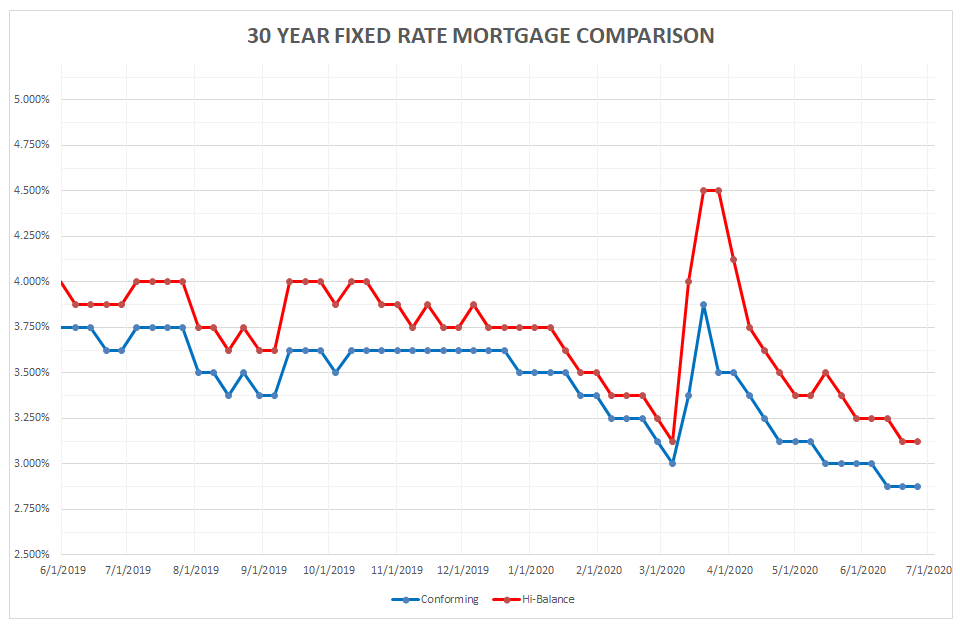
Rates for Friday June 26, 2020: Rates are flat from last Friday for our benchmark quote (see fine print below), however a bit softer for lower LTVs or higher FICOs. We are still seeing large disconnect in the high-balance market from purchases and refinances. Call for details and quotes.
FIXED RATE MORTGAGES AT COST OF 1.25 POINTS LOCKED FOR 45 DAYS:
30 year conforming 2.875% Flat
30 year high-balance conforming 3.125% Flat
Please note that these are base rates and adjustments may be added for condominiums, refinances, credit scores, loan to value, no impound account and period rate is locked. Rates are based on 20% down with 740 FICO score for purchase mortgages.
Anyone ready for a road-trip or family vacation? Even though we have been cooped up together since our oldest returned home in mid-March, I think the Smiths are ready to be cooped up in a different location. Personally, I am itching to pack up the Honda Odyssey and start driving around the state and country on small county roads, eating in local diners and restaurants and staying in a series of Best Westerns in the middle of not-much. On the plus side we, like many families, are saving money from no Spring Break or summer vacations, but….
Have a great week,
Dennis
Past Weekly Rate & Market Updates can be found on my blog page at my website www.DennisCSmith.com/my-blog


