

Where are rates headed?
Question of the week: Where are rates headed?
Answer: That is the multi-hundred billion, or several trillion, dollar question being asked around the globe.
The Federal Reserve gets a tremendous amount of attention, and credit and blame, for interest rates, sort of like an NFL quarterback. Yes, they control the proverbial football and can hand-off, run, or throw the ball. The last of which has three results, two bad (a completed pass, an incomplete pass, or an interception).
The Federal Reserve is supposed to be apolitical and independent from all branches of the government. “Supposed” is the key word since the debates to establish the central bank in 1913 when the Federal Reserve Act was signed by Woodrow Wilson.
As with the First Bank of the United States (1791-1811) and the Second Bank of the United States (1816-1836), the Federal Reserve Act, and later the bank itself, was strongly opposed by those who felt a central bank would concentrate too much economic power in the hands of the major bankers and the federal government. Due to its ability to determine what banks paid for borrowing from each other and the Fed, there was, and is, concern that a central bank could manipulate money supply and cause inflation, deflation, thereby impacting how much money people could earn, spend and save due to the economic impact on labor and wages.
The concerns from the late 18th Century remain concerns for many persons today, most notably the person who sits behind the Resolute Desk in the Oval Office at 1600 Pennsylvania Avenue.
Today the Federal Reserve only controls one interest rate, the federal funds rate (also called the Fed’s benchmark rate), which is the rate banks charge each other for overnight loans.
All other interest rates in our economy move according to supply and demand, which are the result of expectations of future economic conditions from those looking to borrow or lend.
The fed funds rate is the basis for many of those expectations, and some rates do move in the same direction and amount as the Fed’s benchmark rate, most notably since the 1980’s the prime rate.
Prime rate was a term that given to the rate that banks charged their best and strongest customers. Banks would set their prime rates independently depending on their local competition and desire to lend more or less. By the mid-1980’s when there was major financial deregulation and the infamous Paul Volcker was chair of the Fed as it changed monetary policy, all banks’ prime rates fell in line with the fed funds rate, moving the same amount and direction, with a pretty standard margin of 3% above the Fed’s rate.
The Fed’s mission is to promote a healthy, stable economy and financial system in the United States, promoting the highest level of employment without causing inflation.
Because this, the Fed determines whether to raise or cut rates depending on inflation and employment. Essentially when the economy is strong and growing quickly the Fed will raise rates, when it is slow and shrinking it will lower rates.
Currently we have seen the Fed cutting rates since last August, having dropped the benchmark rate 1% from August to January of this year. It started cutting rates as inflation was cooling, employment was stable, not shrinking nor growing abnormally.
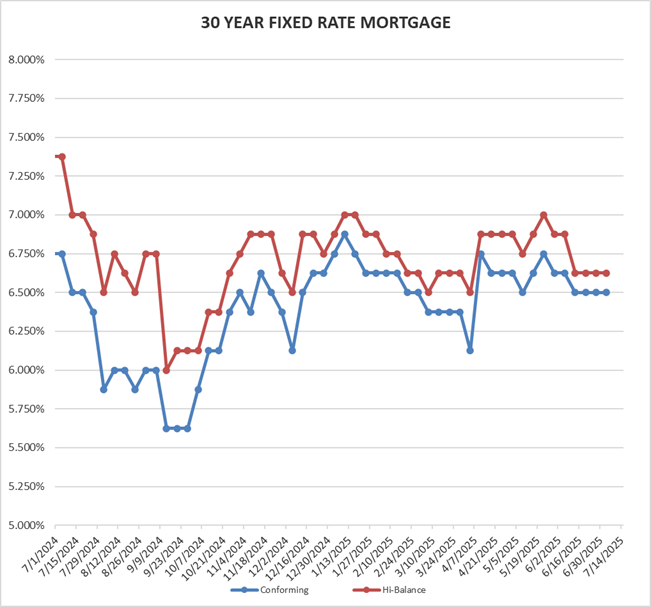
During this same period, the 30-year conventional mortgage (as priced below) has increased from 6% to 6.5% (after dipping to 5.375% in September). Evidence that the Federal Reserve does not control mortgage rates.
Enough with the background, answer the question.
Depending on the economic background and philosophy/ideology of the economist, banker, analyst, politician, advisor, mortgage hack who writes a weekly e-newsletter, rates should go up, go down or remain the same.
There is no strong consensus as to where rates for consumers and businesses will go in the near and medium future; with the exception of those whose outstanding debt is based on the prime rate. (Betting is very heavy the Fed will lower its rate in September, leading to a drop in the prime rate, therefore lower rates for those with equity lines or other loans tied to the prime rate.)
Back to employment and inflation being the two primary factors in the rate decision making for the Fed.
Typically, these are linked with higher job growth and wages leading to higher inflation as more people are making more money so they can buy more goods and services.
If supply of these goods and services do not keep up with the increasing demand prices go up, inflation.
If employers are laying off workers, decreasing wages, or closing, there are fewer people making fewer dollars and unable to purchase as many goods and services, supply exceeds demand and prices drop, deflation.
In the first case the Fed raises rates to cool labor markets and stem inflation by making it more expense to borrow money, or to pay more for money already borrowed, restricting the flow of money and slowing the economy.
In the second case the Fed lowers rates to make borrowing cheaper, thus encouraging borrowing to expand, buy, hire, creating economic activity that will grow the labor force and push prices up.
Since I have already gone deep into the weeds, I will not get into the Fed’s manipulation of money supply and rates by other means—just know that it does and can usually in line with its desire to raise or lower rates.
Investors and lenders generally “bet,” i.e. invest or loan, based on what they predict the Fed will do with its benchmark rate. If economic data is showing growth and strength, they bet that the Fed will hold or raise rates; if data is showing slowing or contraction of the economy, they bet the Fed will hold or lower rates.
Mortgage rates are determined by the Mortgage-Backed Securities markets (MBS). The bell-weather mortgages the pretty much set the market for all other rates are those purchased by Fannie Mae and Freddie Mac (GSEs for short). In recent years, approximately 505 of all outstanding mortgages are either guaranteed by Fannie Mae or Freddie Mac. Because of their market share, the price at which they sell their mortgages to investors determine interest rates for almost all mortgage products.
You have $1M and want to invest in a fixed rate asset. You can purchase debt from the United States government, that has always been considered the safest investment since the U.S. Treasury has never defaulted on a debt, you can invest in local municipal bonds, which may be somewhat safe, but with some risk, you can invest in corporate bonds, which depending on the company may be somewhat safe, or risky, you can also invest in mortgages sold by Fannie Mae or Freddie Mac, which are extremely safe due to their backing by the U.S. Treasury.
While MBS issued by the GSEs are extremely safe due to their federal backing, they provide returns that are higher than U.S. Treasury debt.
When MBS prices rise, mortgage rates go lower. When MBS prices drop, mortgage rates go higher.
Since last summer, economic data has shown an economy that is resisting inflation dropping, increasing the number of jobs and wages, and creating expectations that rates will not drop in the future as the economic data the Fed considers most important for its rate decisions do not show slowing labor markets and slowing prices.
Predictions, expectations, guessing, as to where rates will go in the future are mixed because different viewpoints have different ideas about the impact of the federal government’s deficits, tariffs impact on trade, prices and employment, what impact new government regulations and policies from taxation to restrictions, or lack-thereof will have on private sector and consumer behaviors, and ultimately whether inflation and labor markets will grow, shrink or slow based on all of the above.
So far, those tariffs that have been implemented have not had the inflationary impact many have anticipated. While some businesses have been harmed with the cost of their goods slowing sales, overall the labor markets have not felt the impact expected from the tariffs.
That said, many are waiting for the other shoe to drop as the deadline for when proposed tariffs will go into effect for many trading partners has been pushed out again, this time to August 1st.
Historically, after our period of very high rates compared to the very long period of very low rates prior, we should expect rates to decrease in the near and medium terms. That said, until the unprecedented, in modern times, tariffs that may be imposed on trading partners, and their reciprocation, are in full effect we still do not know the full impact on our economy.
While there are divisions as to the impact if/when all tariffs are in effect, many of us feel that they will lead to higher prices and lower employment which can lead to stagnation. If this is the case, rates will likely rise in the short term as inflation is usually more of a long-term threat to the economy than higher unemployment—the Fed has acknowledged this with its comments during the early period of its rate increases from March 2022 to August 2023 when members said they can accept much higher unemployment if necessary to lower inflation.
If a period of time passes, one- possibly two-quarters, post-tariffs implementation that shows mild inflation and stable job markets, rates will come down.
You didn’t answer the question.
I find the question unanswerable in a definitive manner due to the number and complexity of factors involved that have no similar basis in the last several decades.
Pressed to make a prediction my stance is rates remain in the same range, plus-minus 0.25% (one-quarter of one percent) at least until September. At that point if the Fed does as currently anticipated, and lowers rates by 0.25%, mortgage rates will fall incrementally. After that we will have 3rd quarter GDP and data prices and labor following a few months of the tariffs. Those will determine rates to the end of the year and early 2026.
Have a question? Ask me!
Last Thursday the jobs report for June was a surprise on the headline number as is showed the economy added 144,000 job for the month, more than the 144,000 added in May and well ahead of the 110,000 forecasted. The big number was met with investors predicting the Fed will not raise its benchmark rate later this month due to the continuing strong labor market, but they feel the chances are very high for a rate cut in September.
Not great, is the data breakdown. Of the 144,000 jobs, only 74,000 were in the private sector, and 59,000 of those in social services or healthcare, the rest were government hires, predominantly state and local. This is not good news as the private sector drives our economy, providing the source for dollars spent beyond what is printed by the government. A decline in government jobs has no where near the same impact as a similar reduction in private sector jobs.
Another anomaly in the data was the reduction in the unemployment rate from 4.2% in May to 4.1% in June and much lower than predictions of a 4.3% rate. The anomaly is not that the drop is because people dropping off the unemployment roles due to new jobs, but rather the rate dropped because more people dropped out of the labor market and quit looking for jobs. The unemployment rate does not measure how many people are not working, but how many people are looking to work.
Rates for Friday July 11, 2025: With the short week last week, little economic data this week, indecision about tariffs, natural disasters, and more, rates are stable for the third week in a row, the longest such streak since March.
FIXED RATE MORTGAGES AT COST OF 1.25 POINTS LOCKED FOR 45 DAYS FOR PURCHASE TRANSACTIONS:
30-year conforming 6.50% Flat
30-year high-balance conforming 6.625% Flat
Please note that these are base rates and adjustments may be added for condominiums, refinances, credit scores, loan to value, no impound account and period rate is locked for 45 days. Rates are based on 20% down with 740 FICO score for purchase mortgages.
I celebrated another tour around the sun this past weekend, yes I celebrate and do not bemoan this annual event as I’d rather be here with everyone than not. My body definitely feels the wear and tear of 63 years, but it still surprises me to look in the mirror and not see someone much younger. The surprise is even greater for my body being unable to do the same things it was capable of doing many years ago as well—with the exception of being a klutz capable of self-harm and breaking innocent objects and body parts.


