


With the low rates, should we take out some cash for use later?
Question of the week: With rates so low we should we take out some cash with a new mortgage now for use later?
Answer: This has been a popular question lately and as with many Questions of the Week there are multiple answers depending on your situation. As well the question is best answered using more follow up questions.
When will you need the money? Is there a definite timing for using the money? One client is considering accessing equity today for future college costs, which will start in 2-3 years. Another is planning on extensive remodel for their home beginning early next year or in the spring. Yet another is looking for JIC money—Just In Case—and may never need the money to cover a potential emergency or major expense such as a new roof or plumbing work.
What is your current mortgage? Is the rate on your current mortgage as low or lower than the current rate you can obtain with a cash-out refinance? Will taking the cash-out push your mortgage balance over one of the tiers that increase rates/pricing (either $510,400 or $765,600)? Do you have a primary mortgage and a second or equity line?
What is your home’s value? After the refinance and increasing your loan balance what will your loan-to-value be? One of the primary factors in the rate/price of your refinance are what will the loan-to-value be. Rates are higher if you are funding a cash-out refinance as opposed to a rate and term refinance (just lowering, or fixing, the interest rate and payment on your mortgage). The higher the loan to value the higher the rate. For example, the rate for a cash-out refinance can be up to 1% higher in certain circumstances for a loan-to-value at 80% of your homes value as opposed to 60% loan-to-value.
If someone has a delayed need for the funds from a cash-out refinance my typical advice for them is to wait until they have more immediate use for the funds, see what long term mortgage rates are at that time and if it makes sense to do a cash-out refinance at that time; or perhaps an equity line of credit (HELOC) may be a better solution for them. Depending on your current rate, refinance now to lower your primary mortgage payment and save money until that time comes. If you pull funds out now that you will probably not use in two or more years, or ever, then consider the additional interest costs during that period for funds you have sitting in the bank.
Over the years, and especially lately, we have funded many refinances for families consolidating their outstanding HELOCs and their mortgages into a new loan that lowers their total payment and fixes the rate on their HELOC by eliminating it. Due to HELOCs having an adjustable rate, many families want to eliminate future rate risk with their equity lines and pay them off with a low fixed rate loan. This can be a difficult decision for many as the Prime Rate (basis for HELOC rates) is very low right, as well the minimum payment on many HELOCs is interest only; which means in some cases refinancing and paying off a HELOC may result in a higher payment since the new loan will be paying principal and interest on the amount of the mortgage that was interest only.
Some people are uncomfortable not knowing what their borrowing costs may be in the future and since rates are so low would rather take advantage of historic low rates to obtain the funds they will need at a future date, pay the interest on the unused money to avoid future rate risk. The math may show they end up paying more for the funds in the long run even with higher interest rates in the future, but that is what they are comfortable doing.
Everyone’s situation is slightly different, and everyone has their own comfort level with current stability versus future risk. Depending on your situation, when and for what you need the additional funds and your comfort level for future rate risk a cash-out refinance today may be a good move, otherwise perhaps just lower your rate and payment today and tackle the cash-out issue in the future when the funds are needed.
Keep in mind, even with rates at historic lows, the rates on refinances are higher than they are for purchases, and cash-out refinance are higher still. So while the rates are still very low, the rate to accomplish your objective by pulling cash out of your home will be higher than a rate and term refinance and a purchase mortgage.
Give me a call to assess your situation and needs and find the program that matches best for you.
Have a question? Ask me!
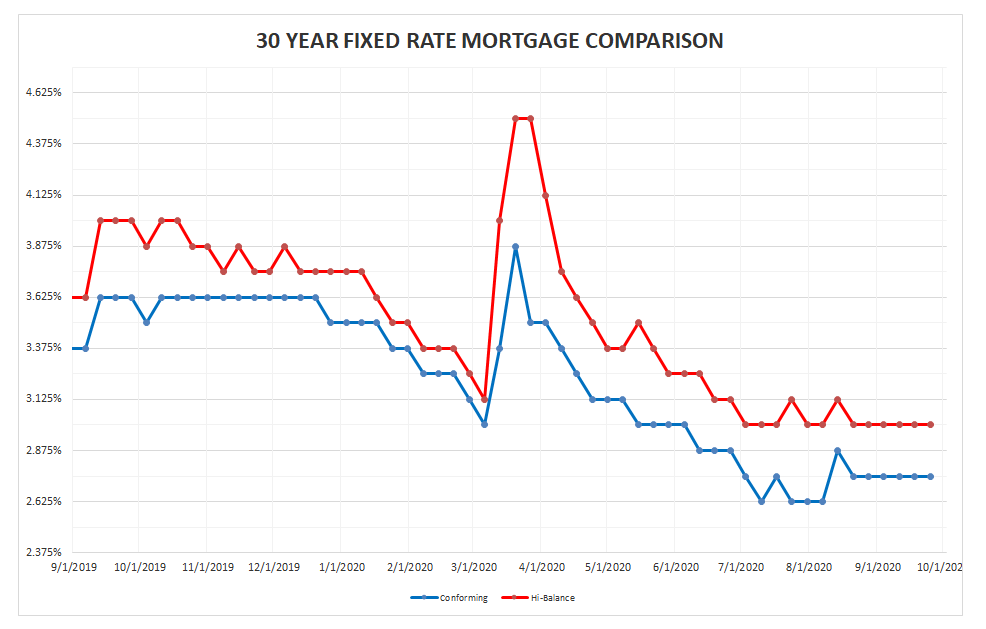
Rates for Friday September 25, 2020: Not a lot of economic this week that influenced rates. Markets have been a bit jittery as investors watch Congress to see if another stimulus bill can be agreed to by the two parties ahead of the election—or possibly before the 166th Congress adjourns and new members are sworn into office in January.
Please note rates are for purchase transactions, refinance rates are higher, please call for quotes to meet your situation.
FIXED RATE MORTGAGES AT COST OF 1.25 POINTS LOCKED FOR 45 DAYS FOR PURCHASE TRANSACTIONS:
30 year conforming 2.75% Flat
30 year high-balance conforming 3.00% Flat
Please note that these are base rates and adjustments may be added for condominiums, refinances, credit scores, loan to value, no impound account and period rate is locked. Rates are based on 20% down with 740 FICO score for purchase mortgages.
Now that Fall is upon us, the Covid-19 pandemic policies have officially been in effect for four seasons, having started in mid-March before Winter turned into Spring. The more entrenched a new behavior becomes the harder it is to return to prior behavior, or change again to another behavior. When the pandemic is over, and it will be over, what behaviors will be retained by each of us and society as a whole? What will you, me, us, do better as a result of the pandemic? What changes will we have accepted that make our lives a little less better than they were prior to the pandemic?
For many months the topic was how businesses will be adapting and having more of their employees working from home/off-site. Lately there have been many articles and commentaries about how many businesses will want most, or all, of their employees back as they have seen a decline in productivity, they attribute to the remote work environment. It should be noted nothing I have read has been able to correlate the decline to the atmosphere of the remote environment including kids at home going to school—which reduces everyone’s productivity including the students.
What adaptions in behavior have you made that will remain post-pandemic? How will you assess what you need for your “normal” once the economy and society open back up?
Deep thoughts for a beautiful semi-summer/semi-Southern California autumn Friday.
Have a great week,
Dennis
Past Weekly Rate & Market Updates can be found on my blog page at my website www.DennisCSmith.com/my-blog


