


Why is mortgage insurance a good thing?
Question of the week: Why is mortgage insurance a good thing?
Answer: Long time readers of the WR&MU will recognize this question as one I re-circulate every few years, the last time being March 2019. When last answered it was a follow up to the Question of the Week from the prior Friday, Should we wait until we have 20% down payment to purchase our new home? The 20% down payment question came about as a result of a survey from the California Association of Realtors, and my own experiences speaking with potential buyers and setting them up for homeownership.
The number one reason, prior to spike in rates in 2022, home purchases are delayed is potential buyers feeling they need to save more for a down payment. Drilling deeper, most feel they need 20% down payment to purchase a home because they do not want mortgage insurance.
To which I answer, putting 20% down to avoid mortgage insurance is a waste of money and a terrible return on investment.
Mortgage insurance is a good thing, let me amend that, mortgage insurance is a great thing because it saves you money.
But Dennis, mortgage insurance costs money.
Moving forward to save my carpal tunnel syndrome we will use MI, or PMI, instead of typing mortgage insurance.
For those who just want numbers, skip below for real examples of saving money with mortgage insurance.
Before we begin the conversation of why mortgage insurance is good (great), let’s examine what MI is. For those new to the conversation, MI is not insurance that pays off the loan if you pass away or become disabled—there are life insurance and/or disability insurance policies you can get to cover the mortgage to protect your home and family should something happen.
The purpose of MI is not to insure you, but to insure your lender should you default and go into foreclosure. Between the missed payments, legal fees, professional fees, loss of value due to foreclosure sale and other costs, a lender will average about 35% of the value of the property. Because of this if you have less than 20% down the lender will require MI that covers the difference between your initial down payment and 35% of the purchase price.
For example, if you are purchasing a home with 5% down the lender will require 30% coverage from a MI company, if you put 10% down coverage of 25% will be required, and if you put 15% down coverage will be 20%.
Even with this protection, should a home go into foreclosure there will likely be losses to the lender. Consider the process and losses. It typically takes about eight to nine months for a home in California to be foreclosed on after the first missed payment. Once you miss a payment by more than 30 days, i.e., you do not make your September 1st payment by October 1st, you are in default of the note. To cure the default, you need to make all payments due plus late payments. So, if you miss the September payment you have until October 30th to make the September payment plus the late fee and the October payment plus the late fee, if applicable.
If you are unable to cure the default at some point the lender must make a foreclosure avoidance assessment to discuss with you the circumstances that led to your default and if there is any way to avoid foreclosure. If there is no agreement between you and the lender to continue with the mortgage, or a modification, the lender can then record a Notice of Default (NOD) with the county recorder in which the property is located no sooner than 30 days after the initial contact for the assessment. After 90 days or more have passed since the filing of the NOD the lender can then record a Notice of Sale informing you that the lender intends to sell the property at auction in 21 days or more. At auction, the lender will sell to the highest bidder who must have cash or a cashier’s check, it is very likely that the first bid will be placed by the lender for the outstanding balance due plus foreclosure costs. At the fastest a foreclosure can occur within about 200 days of the first missed payment, however they generally take about 60 to 90 days longer—or depending on circumstances can take much, much longer.
If you purchased a home for 5% down and a $400,000 mortgage with MI and are foreclosed on the lender will be reimbursed for losses up to 30% of the loan amount, $120,000, by the MI company. With the cost of foreclosure being 25-30% of the mortgage balance, you can see the lender’s recovery through a mortgage insurance policy likely will still leave a loss to the lender.
There are different methods of paying for MI. You can pay monthly, a full premium upfront, or fund a “no PMI” mortgage that is a loan that is self-insured by the lender due to a higher interest rate on the mortgage. Of the different types of payments, the most popular is the monthly payment, primarily for two reasons. First and foremost, it is able to be removed from the mortgage for most transactions after you have made 24 consecutive on-time payments and can show evidence that you have at least 22% equity in the property you can request the PMI and its payments be removed from you loan (caution, do not just engage an appraiser, contact your lender with your request and get a list of approved appraisal management companies to contact for an appraisal).
To reiterate, due to the ability to cancel the premium as soon as 24-months after closing, the monthly MI premium is usually the best option for borrowers.
That is the purpose of the mortgage insurance, what is your benefit?
First and foremost, the rate for a 30-year fixed rate mortgage is higher with 20% down than with less than 20% down. Yes, higher. Why? Because if a loan defaults at 80% loan-to-value without MI the lender’s losses are considerably higher than if the loan is insured. More risk, higher rate.
A second benefit, is that you can purchase a home with as little as 3% down, or 5%, 10%… In California, and most real estate markets, being able to purchase a home without having to save 20% of the payment is tremendous benefit. Doing the math, for a $665,000 home you can purchase a home with only 3% down payment, a $680,000 with only 5%, or higher prices with as little as 10% down. (Note, for separate discussion, with FHA a home can be purchased in high cost areas for $1,000,000 with 3.5% down—however the mortgage insurance is for the life of the loan).
What is the advantage to purchasing a home with less than 20% down? Not having to wait to save the 20% down payment and missing the opportunity of home ownership for perhaps several years—or ever. Consider how long it will take you to save a 20% down payment on your current income, even if you are able to eliminate all your debts—which delays your ability to save. Two years? Three? Five? Ten? During this period will housing prices be stagnant, or increasing faster than your income increases? As you try to save the amount you need to save will continue to increase creating a longer delay in your ability to purchase.
If you know you are going to receive a large financial windfall in the very near term, which I define as less than six months, from a lawsuit settlement, sale of a major asset such as a company, boat or other property, or an inheritance, you may be able to shorten your ability to gather the 20% down. But for most families this is not the case and they should be open and favorable to purchasing a home using a lower down payment and mortgage insurance. If this is the case, I would still advise putting less down and obtaining PMI; after 24-months if your home value has not appreciated enough to remove the MI do the math to determine whether to use the windfall funds to pay down the mortgage to remove the MI—assuming the funds are still available and not spent elsewhere.
The monthly cost of mortgage insurance is a lot less than most potential homebuyers think it will be, and MI is cheaper today than for non-government loans than in the past (MI for government loans is higher today than it was several years ago).
For a $680,00 purchase, here are the monthly costs for a borrower with 740 credit score in California purchasing a home with a 30-year fixed rate mortgage for different down payment amounts (rates subject to change depending on details of transaction and borrower):
- 5% down has a monthly PMI payment of $210 (premium 0.39%)
- 10% down has a monthly PMI payment of $112 (0.22%)
- 15% down has a monthly PMI payment of $63 (0.13%)
Loan amounts and mortgage payments for the above calculations with today’s rate of 5.125% including the PMI payment:
- 5% down ($34,000), loan amount $646,000, $3725 payment
- 10% down ($68,000), loan amount $612,000, $3420 payment
- 15% down ($102,000), loan amount 578,000, $3210 payment
Today the rate for a $680,000 purchase price with 20% down ($136,000) is 5.375%, he monthly payment is $3045 per month. As mentioned above, the rate is higher for 20% down than with less than 20% down.
This chart shows the difference in cash for down payment, total monthly payment, adjusted interest rate (MI rate added to mortgage rate), and “recovery period.” The recovery period is the amount of time it will take you to save the difference in down payment if you chose the 20% option*.
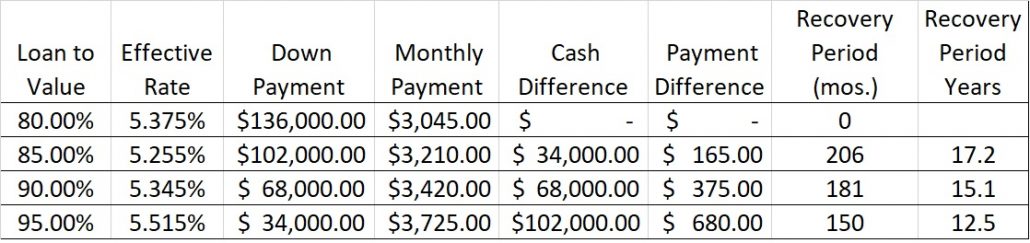
*Recovery period for taking 10% down option instead of 20% down option: Saving of $68,000 divided by $165 per month savings if you put 20% down. In this example, if you purchase your home with 20% down and I purchase the home next door at the same price, closing at the same time, you will be paying $375 less per month than I will. Every month we get together for a “great to be neighbors” cocktail, at the meeting you put $375 into a Home Depot bucket. After 181 months (just over 15 years) you will have saved the $68,000 I saved when we purchased our homes by putting 10% down.
This math shows why I think MI is better than good, it is great.
- It reduces the amount of time you may need to save for a down payment
- If you have enough money for a 20% down payment, it provides you with significant cash savings in your accounts to use for other purposes
- It provides a lower interest rate
- It is removable as soon as 24 months, greatly reducing the monthly payment savings you would receive if you put 20% down, further extending the recovery period
These calculations do not take into account the possibility of refinancing in the future, which can produce further savings and financial advantages for borrowers who put less than 20% down for the purchase of their new home.
Not waiting to save 20% down and using PMI to purchase a home may reduce the amount of home and mortgage you may qualify for, but it can greatly reduce the amount of time it will take for you to purchase your new home.
The best time to contact me about your ability to qualify for purchasing a new home is as soon as you decide you would like to purchase a new home. The sooner we discuss your financial situation the sooner we can work on a plan to homeownership that encompasses your available funds, if any, your income, debts, credit rating and what will need to happen, if anything, so you are able to purchase your new home. Perhaps it is a savings plan, or a debt reduction plan, or a credit rehabilitation plan, whatever may be holding you back from purchasing a new home the sooner we discuss your options the sooner you will be able to purchase your new home. Call me and let’s set up an appointment, or click here to schedule on my calendar!
Have a question? Ask me!
It is economic data dump week. Inflation, spending, wages, economic growth, plus an insight to the Fed all impacted markets this week. Overall the economic data was somewhat positive.
Employers are not engaged in large layoffs as seen by initial unemployment claims, which dropped from last week. While some company’s announcements of large layoffs are in the news, across the employment market hiring and firing appears to be steady.
The economy did not shrink as much as first reported last month. The first revision of 2nd quarter GDP showed the economy contracted 0.6%, lower than the initial report of 0.9% economic contraction. Revisions were due to upward revisions in estimates for consumer spending, business spending on inventories, and higher profits from businesses.
The Federal Reserve’s preferred index for measuring inflation, the Personal Consumer Price Index (PCE, which is weird as it should be PCPI) showed prices dropped 0.1% in July and year over year the increase was 6.3% after showing 6.8% annual growth in June. The PCE differs from the more widely reported CPI as it takes into account consumers changes in spending behavior to adjust for rising prices. The decline in July was almost solely due to lower gas prices. Because this is the inflation index used by the Fed, a reduction is good news for the Fed to stop increasing rates sooner rather than later.
Consumer spending was positive in July, despite the drop in gasoline prices (consumer spending is based on dollars spent not units purchased, hence lower prices at the pump result in lower consumer spending even if more gallons are purchased). After inflation spending rose 0.2%, with most of the increase in spending on housing, hotels, travel and utilities. While spending outpaced inflation, wages did not, as workers continue to see a deterioration in the purchasing power of their paychecks, even after raises.
Jackson Hole’s posh hotels are housing the Federal Reserve’s annual meetings. This week Fed Chair Jerome Powell spoke about the Fed’s intentions and outlook, and it was not positive for those looking for an end to higher rates. Powell stated the Fed would not stop its rate increases until inflation is down at, or near, its 2% target (see above, current rate is 6.3%). Further, he knows the Fed policy will cost jobs and growth, and there will be “pain to households and businesses.” Forecasting a “sustained trend of below trend growth,” Powell essentially not only put another 0.75% hike to the benchmark rate in September on the table, he pretty much announced it will happen.
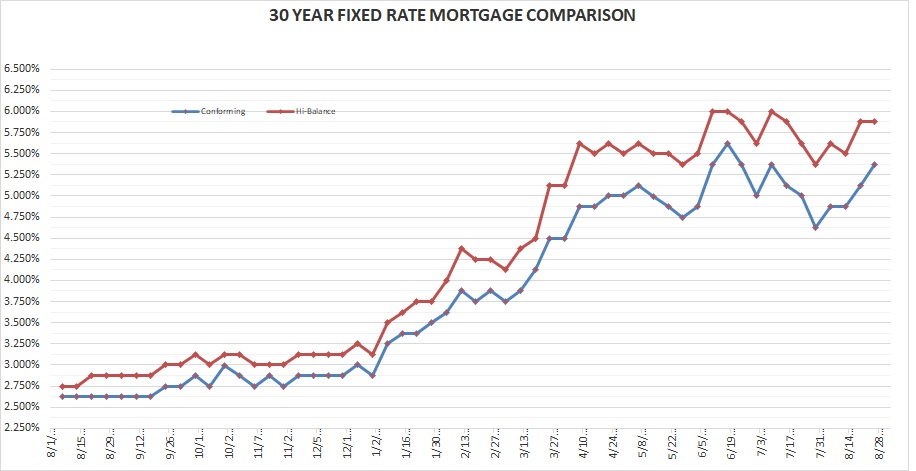
Rates for Friday August 26, 2022: After three weeks of dropping rates in July, August ends with rates rising three of the last four weeks. The mixed signals in the economy, positive spending, slowing inflation, strong hiring, lower real wages, normally would have the markets bouncing in a narrow range. Comments from the Chair of the Federal Reserve that its policy is to not worry about the economy but only inflation put markets on the defensive and pushing rates up for mortgages.
FIXED RATE MORTGAGES AT COST OF 1.25 POINTS LOCKED FOR 45 DAYS FOR PURCHASE TRANSACTIONS:
3730-year conforming 5.25% Up 0.25%
30-year high-balance conforming 5.875% Flat
Please note that these are base rates and adjustments may be added for condominiums, refinances, credit scores, loan to value, no impound account and period rate is locked. Rates are based on 20% down with 740 FICO score for purchase mortgages.
Public service announcement this week for the closing of the WR&MU. Yesterday I under went a procedure everyone over the age of 50 should have on a routine basis, starting at 50, based on your doctor’s recommendation, I had a colonoscopy. Colorectal cancer is very treatable if caught somewhat early, if not caught it can be fatal—as our family learned when my mother passed away from colorectal cancer a little over 40-years ago. At that time colonoscopies were not something everyone was encouraged to get, and being she was under fifty at the time she likely would not have had one anyway.
Given that there is a history in our family of colorectal cancer, my sister, brother and I are very diligent to ensure we undergo colonoscopies on a regular basis, and have done so since we were in our mid-30’s. While the prep is not a pleasant experience, the procedure itself is very easy and painless.
Breast exams for women, prostate exams for men, and colonoscopies for everyone should be part of your medical routines as all three can result in early treatment and positive outcomes should cancers be detected. Call your doctor and see what your schedule for these exams should be. I want you to be around to read the WR&MU for many, many years!
Have a great week,
Dennis
Past Weekly Rate & Market Updates can be found on my blog page at my website www.DennisCSmith.com/my-blog


