

Question of the week: What does the Federal Reserve announcement mean for mortgage rates?
Question of the week: What does the Federal Reserve announcement mean for mortgage rates?
Answer: Higher mortgage rates.
Follow up questions are when will rates be higher and how much higher will they go?
These questions are harder to answer as there are so many variables that can enter the equation in the future.
For those who do not read the business pages of the newspaper, or have business and financial sites on their social media feeds, let’s review the premise of our question of the week.
In March 2020 the Federal Reserve dropped its short-term interest rates to near zero in response to the impact the pandemic had on the economy.
Aside: Also known as the “benchmark” rate, the Fed sets a target rate for what is known as the Federal Funds Rate. The Fed funds rate is what banks that are members of the Federal Reserve charge each other to borrow money to cover their reserve requirements. When the rate is at “near zero,” that means the target rate is 0.00-0.25%.
In June 2020 through October 2021, the Fed initiated what is known as “quantitative easing,” or QE, following a financial policy that the Fed engaged in starting in 2009 as a response to the Great Recession, and continued the practice until October 2014.
Quantitative easing is the term used for the Federal Reserve purchasing interest rate related financial instruments, more specifically U.S. Treasury debt, in the form of bonds and notes issued by the Treasury, and Mortgage Backed Securities (MBS) which are generically put into “bonds” for ease of explanations. It should be noted, the MBS the Fed buys are almost solely those issued by Fannie Mae and Freddie Mac. By purchasing these instruments, the Fed is supporting low interest rates with the intent of stimulating the economy.
The support occurs because as a buyer, the Fed is creating demand. For fixed rate financial instruments, aka bonds, the lower the price the higher the rate, the higher the price the lower the rate. If the Treasury issues bonds and there are no buyers, the price of the bonds will have to drop until investors see value in their investment, this causes rates to increase. The Fed becomes a big buyer, therefore pushing the price on the bonds higher, and the rates lower.
When the Fed announced its QE program in March 2020, it stated it would purchase $80 billion of Treasury debt and $40 billion of mortgages, every month. This activity by the Fed has helped keep interest rates extremely low as the economy recovered from the pandemic, and as the economy and inflation grew.
In September the Fed announced that it would “taper” its purchases on a monthly basis with the objective of ending the QE program in June 2022. It also stated that it expected to raise the target rate for Fed Funds rate once in 2022, probably in September. Investors and markets reacted to a shallow ramp down of the asset purchases that would take eight to nine months before the Fed was out of the bond and mortgage markets, and its benchmark rate remaining near zero for almost a year.
Many felt the Fed should have started its tapering process earlier in the year as inflation started to increase at a more rapid rate. Early in the current inflation cycle, and until this week, the Fed called the spike in prices “transitory” and that there would be a cooling down of inflation as the economy fully recovered from the pandemic, employment normalized with wage growth leveling off with prices. For this reason, the point of view that inflation was “transitory,” the Fed held on to its stated schedule of tapering QE purchases and retaining its target rate near zero.
On Wednesday the Fed announced it was speeding up the tapering process of its bond buying, with the objective of ending the process in March 2022 instead of June. As well, and perhaps of greater impact on rates to businesses and consumers, it announced it was stepping up its planned rate increases.
The new rate schedule for the Fed is to increase the Fed Funds rate target to 0.9% with three rate increases by the end of 2022. In 2023, three more rate increases will push the rate to 1.6% and one more increase in 2024 will set the rate at 2.1%.
Keep in mind the announced rates and schedules are not contracts, are not written in stone and can be changed by the Federal Reserve governors at any time depending on the economy and world events. The announced tapering schedule and rate increases are the Fed’s plan based on current economic data, particularly inflation that is well over 6%, and economic recovery.
In its announcement, the Fed has changed its prediction of inflation for 2022 to be 2.6%, up from 2.1% estimate, and for GDP to slow to 4%.
Some long-term background that is foundational to the Fed’s actions. First, the Fed’s target rate for inflation is around 2-2.25%. Second, it feels a “neutral” rate for its benchmark rate is around 2.5%, just above the rate of inflation. If these two targets are met it is expected that the economy will have steady, sustained growth in the 3-4% range.
So, what does this mean for Americans in the market for a mortgage? It means increasing rates, certainly into the 1st quarter of 2022, and likely longer. I have said for some time that rates need to be higher than that are, perhaps up to 1% higher, but at least 0.50-0.75% higher. From my viewpoint, this is likely to happen in 2022, perhaps by the Easter, more assuredly by Independence Day.
Will higher rates be bad for the economy, homeowners, businesses and consumers? I think not. From 2017 through 2019, GDP was over 4%, and mortgage rates ranged from around 3.75% to 4.5% for most of the period, and inflation was in the 2% range.
The challenge for our economy is slowing the rate of inflation, maintaining high rates of employment and labor participation, and not over cooling the economy such that a slide into a recession is the result. Which would lead to lower interest rates and a new economic cycle.
Keep in mind, the mortgage rate you pay is not dependent on the Federal Reserve. Well, lately it has been since the Fed has been absorbing some of the mortgages funded and sold on the secondary markets. In general, your mortgage rate is dependent on open markets and investors, it is their beliefs as to what will happen next in the economy that determines their actions of either buying bonds and mortgages, pushing prices up and rates down; or selling which pushes prices down and rates up.
The Fed announcement has investors expecting higher interest rates, and their expectations will guide their actions, and their actions will fill their expectations. The result, an increase in rates.
All of this said, or written, it can go the other way pretty quickly based on political, social, economic, or biological events. If an event, or series of events, occur that puts our economy back into a tremendous drop in economic activity, the Fed can reinstitute another QE program, drop its rate and shift into stimulus mode. At the same time, knowing this is what the Fed will likely do, investors will push rates down on their own.
Finally, how much of an impact has the Fed’s quantitative easing policy really had in real numbers? Consider the Federal deficit in 2021 totaled approximately $2.77 trillion dollars. Of this amount the Federal Reserve purchased about 35% of the debt issued. For mortgages, the total U.S. mortgage market is approximately $1.1 trillion and the Fed purchased approximately 44% of the market. Those are significant numbers that will need to be absorbed by other entities, pension funds, mutual funds, private investors, local, state and foreign governments. Depending on how much non-Fed investors wish to purchase of these long-term bonds, rates could move up slowly or quickly.
Have a question? Ask me!
How much is too much? Some more data on the Fed. In the 3rd quarter of 2008, before the Fed began its initial QE program in reaction to the Great Recession, the Fed’s total assets were $476 billion. At the end of 2021, after six years of bond purchases following the Great Recession and going on over twenty months of purchases due to the pandemic economy, the Fed’s balance sheet is at $5.91 trillion, a twelve-fold increase. Others debt that has been purchased and retained by the Fed has grown to 25% of GDP.
Considering that most of the holdings are debt issued by the U.S. government, and the percentage debt the Fed has purchased, the Fed has been the primary enabler of higher and higher Federal deficits, financed with low rates created by the quasi-government agency. Currently the outstanding debt is 125% of our economy’s GDP. And growing.
Putting a charge and urgency into the Fed to speed up its plan to push rates higher and stem inflation was data that the Producer Price Index increased to a 9.6% annualized rate in November. If wholesalers and manufacturers are paying 9.6% more for their supplies, how much of that flows through to consumers?
The headline number is good, the real number not so much. Retail sales for November were reported to be 0.3% higher than October’s sales. Pretty decent growth on the face of it. However, with an increase in prices of 0.8% inflating the sales numbers, retail sales in volume appears to have declined 0.5% for the month—not great news for a month that is traditionally higher for retailers due to the beginning of holiday purchases by consumers.
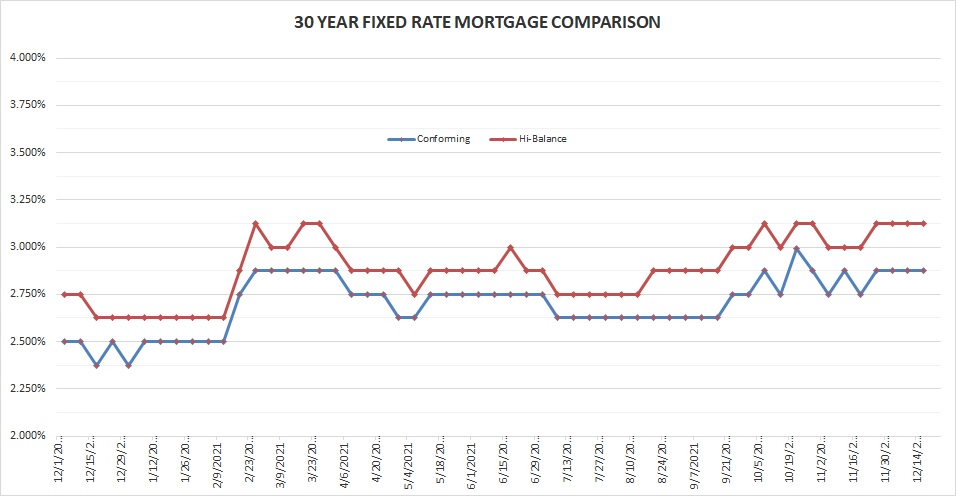
Rates for Friday December 13, 2021: With all the announcements of the new Covid-19 variant, Omicron, spreading rapidly, and mandates for masks and proof of vaccinations increasing across the country, the concern is another lockdown of the economy. This concern, plus economic data hinting at a slow down in consumer spending (about 65-70% of our economy), investors are looking past the Fed announcement this week. What does this mean, in “normal” times the Fed announcement would spike rates. In today’s times rates are flat for the third straight Friday.
FIXED RATE MORTGAGES AT COST OF 1.25 POINTS LOCKED FOR 45 DAYS FOR PURCHASE TRANSACTIONS:
30 year conforming 2.875% Flat
30 year high-balance conforming 3.125% Flat
Please note that these are base rates and adjustments may be added for condominiums, refinances, credit scores, loan to value, no impound account and period rate is locked. Rates are based on 20% down with 740 FICO score for purchase mortgages.
I have been asking parents this past week if their kids are more excited for the two weeks off they will have from school starting on Monday, or the presents they expect to get next Saturday. There appears to be a direct correlation to the age of the children and where there excitement lies.
Our two come home from Boston and New York next week for their winter breaks of about four weeks. Leslie said last week, “the closer it is to their being home the more excited I get to see them.” I agree. I want to put a big bow around each of them and sit under Leslie and my stockings next Saturday morning, as their being home is the best gift we can wish for. (Grammarians, I have a hard time writing “for which we can wish.” I’m sure that is not correct either…)
Have a great week,
Dennis
Past Weekly Rate & Market Updates can be found on my blog page at my website www.DennisCSmith.com/my-blog


