Will rates go lower?
Question of the week: Will rates go lower?
Answer: {shakes Magic 8 Ball} I do not see rates being able to go much lower. There are several factors, but the primary one in my opinion is the cost of originating mortgages and the rate of return from the rates paid on the mortgages.
When looking at the flow of money through the mortgage process there are several slices taken out of a mortgage payment before it reaches the ultimate investor. For conventional loans, the loan servicer takes a small bite, then Fannie or Freddie take a bite and then the remaining amount of the interest is provided to the investor.
Who is the loan servicer? Commonly referred to as “the lender,” loan servicers are the entities that collect mortgage payments. Sometime the servicer is also the original lender, but very often it is a different company—and not always a bank. Mortgage servicing is a segment of the mortgage industry that is regulated and enables mortgage lenders to relieve themselves of the costs of a collections, or servicing, department by selling the servicing rights to the mortgages they fund.
Just as conventional mortgages are sold to Fannie Mae or Freddie Mac to provide liquidity, many mortgage lenders also sell the servicing of their mortgages to other companies. The servicing company then sets up the borrowers’ accounts and collects the monthly payment for principal and interest, and if the loan is so set up property taxes and insurance payments are collected as well.
The servicer then forwards the payments to Fannie or Freddie, and if collect the property taxes to county tax assessors and insurance premiums to insurance companies. If payments are not made the servicer has a collections department which will then proceed through the steps of attempting collection, working out a payment schedule with borrowers. If necessary, this department start the foreclosure process and see it through to conclusion—either foreclosure or all past due payments and charges paid in full by the borrower or from their sale of the property.
Servicing charges generally range from 0.25% to 0.50% of the loan remaining loan balance, so the longer the loan is serviced the less the servicer gets paid for the servicing as the principal drops.
Following the flow of the funds, as discussed through the years of the WR&MU, after lenders sell their loans to Fannie or Freddie, those entities package mortgages into big bundles called Mortgage Backed Securities (MBS) which are then sold to investors. You can purchase MBS through broker-dealers, depending on how much you can invest either into large pools, or purchase shares in mutual funds or ETFs that hold MBS in their portfolios.
Once the MBS are sold to investors the investors want to get paid, which they are as monthly principal and interest payments are made by borrowers to servicers who then pass funds along to Fannie or Freddie who then pass payments onto MBS investors. For this Fannie and Freddie take a slice of the payment as well, retaining a portion of the interest payment. I have been unable to find out how much this portion is, my assumption is that it is near 0.25% of the payment as well.
Let’s look at a $500,000 mortgage with a rate of 4% and a payment of $2387 per month. The payment is made and the servicer retains $104 of the payment and sends $2283 to Fannie Mae. Fannie retains $104 and sends $2179 to the investor. The principal part of the payment is $720, so the investor is collecting $1459 in interest. This reflects a return of 3.5%.
Now let’s look at the same mortgage with a rate of 3% and a payment of $2108 per month. The seller retains the same $104 and Fannie Mae its $104. Of the $2108 payment Fannie passes $1900 to the investor, of which $858 is principal, therefore the investor collects $1042 in interest. This is a return of 2.5%.
How much demand will there be for 30-year investments with returns of 2.5% or lower?
As discussed in our May 1st WR&MU, mortgage servicers were on the brink of collapse in April after the CARES Act passed requiring servicers to grant forbearances to homeowners who requested them while still having to advance payments to Fannie and Freddie. This cash flow risk increases the return desired by everyone through the industry, which puts upward pressure on rates.
It is estimated that around 5 million homeowners across the nation are currently in forbearance, about 9% of outstanding mortgages. This has pulled billions of dollars per month out of cash-flow through the servicing industry, and to investors. What is next? These 5 million homeowners will be faced with a settlement statement from their servicers for a lump-sum amount that will be due when the forbearance period is over.
Most servicers will then proceed to contact borrowers to work out payment modifications that will pay down/off the outstanding balance that will be in addition to their contracted payment. Other servicers may, can, will, file notices of default and begin the process of foreclosing.
What will homeowners do? Will their income be sufficient to afford a higher mortgage payment for the next year or two? Will they have enough equity to sell their home to payoff the mortgage and back amounts due?
Whatever decisions are made, there are costs to servicers that are more expensive than normal mortgage payment collections. At a time when their receipts are down.
One more factor. Many of the mortgages being paid off in the current refinance cycle were made less than a year ago. It generally takes about one year for a loan servicer to recoup the acquisition costs. For all their mortgage clients that pay off in less than a year the company loses money.
As shown above, the very rough calculations on payments and the flow of funds from borrower to investor do not take into account many other variables such as purchasing the MBS at premium or discount. However, they show how investor return on investment is greatly impacted by payment collections.
As can also be seen, there is a tremendous amount of costs and decline in cash-flow for servicers that has them operating on razor thin margins with little room for more disruption.
As a result of these pressures, from investors to servicers, the mortgage markets should be at, or very near, the lowest rates can go and still have a functioning industry with smooth flow between investors, agencies, lenders, and borrowers of funds borrowed, funds loaned, payments made and payments collected.
Finally, there is very little left that the Federal Reserve, or the Federal government, can do to further reduce rates in the retail sector. Actions already taken by both the government and the Fed through the mortgage industry into disarray in March, when we saw mortgage rates spike around 1% in less than two weeks. There are no actions left they can take that would lead to lower rates.
As stated many times over the years, mortgage rates are not dependent on the Federal Reserve’s rates, but rather on investors and what they are willing to pay for Mortgage Backed Securities. As also mentioned through the years, in certain markets lenders keep rates higher than the MBS markets are willing to take to control their volume flow and also to mitigate their risk. With rates at their current levels both factors are in play as MBS investors are looking at extremely low returns and the mortgage industry is looking at reductions in payments, government policy enabling further reductions in payments. Not mentioned in the above is the very complex system of lenders hedging rate locks and pipelines being disrupted due to the Fed’s actions.
Finally, (thank goodness thinks the reader…) long time readers know that rates are dependent on the economy and overall economic activity. As well, they know that 65-70% of our nation’s economy is consumer spending. With the country opening up at different speeds across the company, consumers are beginning to spend, people are going back to work, economic activity is slowly increasing.
As this continues there will be upward pressure on rates. Maybe not enough to cause rates to increase to pre-Covid levels, but enough to provide a floor below which rates will not drop.
Can rates go lower? Yes, but if they do it is my opinion that any drop will be incremental from where we are today.
I hope I am right as if they do drop significantly more (one-half percent or more) that will mean our economy is in really bad shape.
Have a question? Ask me!
The big number this week was 17.7%. That was the growth in retail sales in May from April. Sales in April dropped 14.7% from March, and the consensus was for sales growth of 8.5% as commercial establishments across the country opened up. Auto sales were a big part of the jump in sales, up 44%. That increase is only about a quarter of the increase in clothing stores sales, which were up a staggering 188%. As a benchmark, May 2020 retail sales were 6% below sales in May 2019 so there is a way to go for the retail industries to get back to pre-Covid activity. In normal times this news would spike interest rates, but these are not normal times as you know.
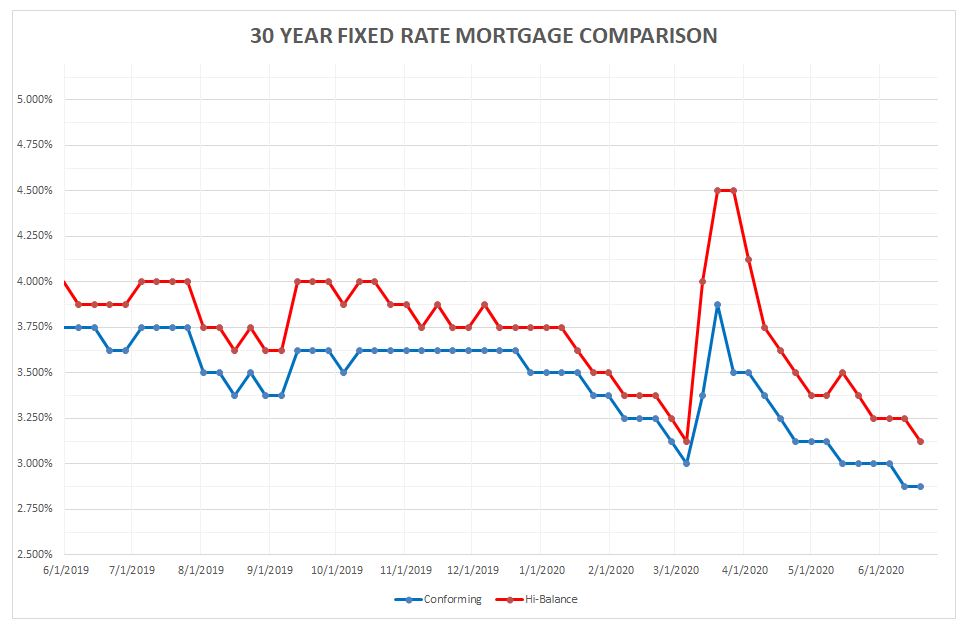
Rates for Friday June 19, 2020: Thirty-year fixed rate mortgage rates are at their lowest since 1971, as discussed above will they go lower? Market indicators and projections are rates remain very close to today’s rates for the near future. We are still seeing large disconnect in the high-balance market from purchases and refinances. Call for details and quotes.
FIXED RATE MORTGAGES AT COST OF 1.25 POINTS LOCKED FOR 45 DAYS:
30 year conforming 2.875% Flat
30 year high-balance conforming 3.125% Down 0.125%
Please note that these are base rates and adjustments may be added for condominiums, refinances, credit scores, loan to value, no impound account and period rate is locked. Rates are based on 20% down with 740 FICO score for purchase mortgages.
Monday, I went to my office for the second time in over 90 days, my last visit was very briefly, less than two hours around day 60 of being working from the home office. As I left for the office Monday morning I said to Leslie, “I think this is the first time in four weeks or more that I have long pants on.” I have no records or concrete proof, but it is likely the longest I went wearing only shorts since the last semester of my senior year in college (1984).
The work-at-home policies have killed the dry cleaning industry since no one dry cleans shorts, pajamas or sweats.
Have a great week,
Dennis
Past Weekly Rate & Market Updates can be found on my blog page at my website www.DennisCSmith.com/my-blog