


Can my parents benefit from helping us buy our new home?
Question of the week: Can my parents benefit from helping us buy our new home?
Answer: Yes.
This came up in a conversation this morning with second-generation real estate agent Paige this morning in discussions regarding a couple of her clients who were in need of more funds to purchase the homes.
Both couples have parents that are retired and have funds available to assist but are reticent for various reasons that are common to many parents who would like to assist their children in purchasing a home but feel uncomfortable separating funds from their savings or retirement.
The biggest reason is not willing to deplete cash from their accounts that they need, or may need, for their own living expenses and retirement.
Some parents have funds available, but they are in retirement account(s), typically an IRA, and are not willing to pay income tax on funds to assist with closing costs for the home purchase.
“Fairness” is an issue that also comes up with parents helping a child with a home purchase. Fairness to other children and providing assistance for one child and how it may affect any division of assets with other children.
Historically, most parents provide a gift to their children purchasing a home. Some prepare the necessary tax forms to account for the funds gifted as an early distribution from their estate, to be reconciled when the parents pass away and their trust is to be distributed to their beneficiaries within the tax exemption limits of estates ($13.61 million in 2024, note the limit put in place in the 2017 Tax Cut and Jobs Act expires in 2025 unless extended by Congress).
This straight cash transfer is the what some, many, parents are reluctant to do, not only because it is purely beneficent to their child and presents no benefit to them, but also restricts cash they have available for their own needs.
The solution I presented to Paige to bring to her clients is the parents making a loan to their children as part of the transaction. Not just a handshake loan, as this can create some issues later, but a legal obligation with a note spelling out repayment terms and a trust deed recorded against the property.
This benefits the parents as they can collect monthly payments* from their children, and have in the note a specific time it must be paid off. For instance, a loan of $100,000 with a rate of 5% to be paid with minimum interest only payments every month with the entire balance to be paid within 5-years. The parents collect 5% per year on the loan, perhaps outperforming some of their investments over the time, and know that they will receive the principal amount back in a few years. If they pass away before the 5-year period, the obligation is owned by the estate and is settled through trust/estate being finalized. *see below regarding “after closing.”
If the parent’s funds for assisting their child are in a retirement account, they can make loan from their IRA, with the IRA being the beneficiary of the note, collecting the monthly payments and having the final payment of the outstanding balance to the IRA**. Just like other investments in the IRA account, the income received from the monthly payments are tax free. If the parents are of the age they must take required minimum distributions (RMD), the payments back to the IRA can be used to pay RMDs, whether in full or partially; i.e. the note taking funds out of the account may/should not jeopardize not being able to make the required annual RMD.
**Before entering this transaction using an IRA consult with your tax preparer to ensure you take the proper steps to ensure you are in compliance with state and federal tax regulations and do not have an income tax, and/or penalty depending on your age.
For the children purchasing the new home, here is the impact on them, during the transaction and after.
During the transaction, the loan and its payments must be included in calculations for qualifying debt-to-income ratios and loan-to-value used to determine interest rate.
Regarding the latter, there must be some down payment for the transaction, i.e. the parents cannot make a loan for 20% of the purchase price and the kids obtain a loan for the other 80%.
Example: Purchase price $800,000, kids have available 5% for down payment and enough for closing costs. Parents agree to loan them $120,000 at 5% for 5-years with interest only payments. They apply for a loan of $640,000.
Assume a 7.375% interest rate on the primary mortgage, the payment is $4420 per month, add the $500 for the interest payments to the parents and the total obligations for the mortgages is $4920 per month.
If the kids purchased the home with just the 5% down, obtaining a loan for $760,000, the rate would be about 6.75% (see prior WR&MU regarding lower rates for some loan-to-values with mortgage insurance) and there would be mortgage insurance required on the mortgage.
The mortgage payment would be $4930 per month, add mortgage insurance of $285 per month and the total payment for the mortgage is $5215 per month; higher than the other transaction by the cost of the mortgage insurance.
For the transaction, the loan from the parents results in a lower payment, which makes qualifying a bit easier, and the parents are receiving a steady income from their loan.
It is very important for the funds provided by the parents to be in the terms of a loan, if it does not impact qualifying, due to what will occur in the future when the children pay off the loan.
Above we discussed the most common assistance parents give their children is a straight gift, for some families the gift is a “gift;” the kids expect to pay their parents back in the future.
Let’s look at two cases using the above scenario. Parents gifted $120,000 to Cain for his home purchase with an expectation from both parties that at some point Cain would repay the money; a few years later the parents loaned $120,000 to Abel under the terms in our scenario above.
Four years after purchasing the home with his 6.875% mortgage, Cain wants to refinance as rates have dropped and his equity has increased enough that refinancing his primary mortgage and obtaining funds from the transaction to repay his parents “gift,” his loan-to-value is 80%.
Because he is taking cash out of his property to repay his parents, Cain’s refinance is a “cash-out” refinance, which will have a rate of 5.625%.
Abel also wants to refinance at the same time, he too has 80% loan-to-value if he refinances his primary mortgage balance and includes the loan balance he owes his parents.
Because the $120,000 from his parents was a loan, and the loan was used to purchase the property, and that Abel can show he made on-time payments every month for the mortgage, his refinance is considered “rate and term,” which will have a rate of 5.00%.
In the end, having a “gift” from parents become a loan, the children save money every month on their total payment, as it is lower than purchasing with mortgage insurance provided the payment to mom and dad is interest only, and when it comes time to refinance and repay mom and dad their refinance rate is considerably lower than if they were to pull cash out of their home.
Mom and dad benefit because they receive some monthly income, their money is somewhat secured as it is lien against the property, which benefits their estate and other beneficiaries should they pass away before the loan is repaid. If funds come from a retirement account, the income is tax free as long as payments are made directly to the IRA.
Before finalizing and committing to parental support for your new home purchase I strongly advise your parents consult with their tax preparer.
To schedule an initial meeting by phone or Zoom, click here for my calendar, please feel free to forward to a friend or family member!
Have a question? Ask me!
Downward momentum stalls for rates as the job market is a bit hotter than desired. The Labor Department published data for November showing the economy added 199,000 jobs for the month—a high number but tempered somewhat by about 50,000 striking workers in Hollywood and the auto industry returned to work. What is not tempered is that wage growth is still strong at 4%, well above the 3% growth rate the Fed has said it needs to see to take future increases off the table. Markets reacted by reversing gains earlier in the week.
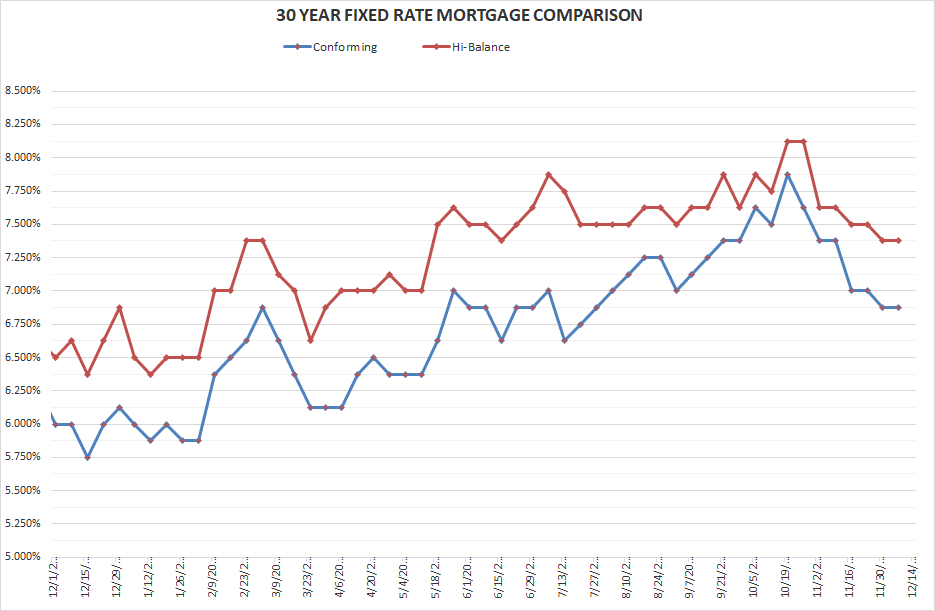
Rates for Friday December 8, 2023: Rates hold steady from last Friday after dipping earlier in the week. Markets still not sure if Fed will hold that line on rate increases, and beginning to speculate how many, if any, rate decreases the Fed may make in 2024.
FIXED RATE MORTGAGES AT COST OF 1.25 POINTS LOCKED FOR 45 DAYS FOR PURCHASE TRANSACTIONS:
30-year conforming 6.875% Flat
30-year high-balance conforming 7.375% Flat
Please note that these are base rates and adjustments may be added for condominiums, refinances, credit scores, loan to value, no impound account and period rate is locked. Rates are based on 20% down with 740 FICO score for purchase mortgages.
The turmoil in our country for those of Jewish faith and ancestry since the barbaric attacks by Hamas two months to the day of the first night of Hanukkah have many, rightfully, concerned for the well-being of their family, friends, and other Jews worldwide.
The origins of Hanukkah, simplistically Mattathius leading a revolt against Antiochus who, as part of outlawing Judaism, ordered and altar to Zeus erected in the Temple of Jerusalem and Jews to make a sacrifice to Zeus. The rebellion was successful and after three years, in 164 BCE, the Temple of Jerusalem was liberated and rededicated and the festival of Hanukkah began to celebrate.
For the past 2100 plus years there have been several periods when kings, dictators, people, have tried to rid the world of Judaism and Jews. We are witnessing yet another attempt by Hamas and its supporters who proclaim here, and abroad, their stated goal, many of those supporters in our own country.
It is my hope that next year, or a year in the very near future, when Jews around the world light their candles to celebrate the Festival of Lights that the world is once and for all rid of those who are committed to preventing Hanukkah, and its celebrants, from performing their annual rituals of lighting their menorahs from happening.
Happy Hanukkah, for those celebrating I hope you do so in joy and peace, this year and every year.
Have a great week,
Dennis
Past Weekly Rate & Market Updates can be found on my blog page at my website www.DennisCSmith.com/my-blog


