


What next for the economy and real estate?
Question of the week: What next for the economy and real estate?
Answer: When the Federal Reserve began increasing its benchmark interest rate in March 2022 when inflation jumped to 9.2%, up almost 3% from December 2021, it announced it was going to be increasing rates to bring down inflation and would continue to do so until inflation hit the Fed’s target rate of inflation of 2%.
At the time the Federal Funds rate (what banks charge each other to borrow money), was 0.25-0.50% (the Fed rate is always a one-quarter of one-percent range). The Fed systematically increased its rate until July 2023 when it hiked the rate to 5.25-5.50%, at which point inflation had fallen to 3.2% on an annual basis. Stating that inflation was heading in the right direction, and not wanting to choke off economic growth and harm employment markets, the Fed paused rate hikes.
In September of this year, commenting that inflation was cooling and wanting to support economic growth, the Fed lowered its bench mark rate 0.50%, announced a few more cuts in 2024 and likely would cut up to five times in 2025.
This week the Fed did lower its benchmark rate, by 0.25%, to 4.25-4.5%. However, with the announcement of the rate cut, Fed Chair Jerome Powell announced that there would probably be only two rate cuts in 2025 as the economy, and inflation, were a bit more robust than the Fed felt comfortable with if rates were to go even lower.
Markets did not react favorably to the news and interest rates popped and stocks prices dropped having priced into their buy-sell decisions earlier in the year a decline of about 1.0-1.25% in the Fed Funds rate in 2025; Powell’s comments foretell perhaps only a 0.50% rate reduction.
Supporting fewer cuts in 2025, Powell said, was the expectation that inflation in 2025 to be 2.5%, up from estimated 2.4%. While he feels that rates are high enough to lower inflation, he feels the rates are low enough to not push unemployment higher.
Keep in mind, as has been written in the WR&MU for many, many years, good economic news moves rates higher, bad economic news moves rates lower.
That said, this week economic data for November was a bit mixed but supportive of the Fed’s plan moving forward for fewer rates cuts next year.
Our economy is driven by consumer spending, making up 65-70% of the economy. In November retail sales were up a very strong 0.70% from October, which was also strong. New vehicles drove the increase in sales spiking 2.6% from October, taking auto sales out of the data and retail sales still increased a decent 0.20% for the month. A downside in the data was a drop in restaurant sales, down 0.4%, dining out is a sign of consumer confidence as if uncertain about their future families will cut dining out from their budgets.
More strong data came with the second revision to GDP for the 3rd quarter, prior data estimated the economy grew at a rate of 2.8%, on Wednesday the estimate was raised to 3.1% growth for the quarter. Current estimates for 4th quarter growth are at 3%; if this is true then it will be the first time, ex-pandemic, that the economy has grown 3% or more for three straight quarters since 2014.
Retail sales and GDP data were not positive to markets as strong growth means higher rates, and supported higher rates in 2025 than previously expected.
Cooling some of the heat from the sales and growth data was the Personal Consumption Expenditures (PCE), which is the Fed’s preferred gauge of inflation. Surprising everyone, the index showed prices rose only 0.1% in November, the lowest increase in three months. Year over year the index rose from 2.3% to 2.4%, away from the Fed’s target, but overall the news was welcome by markets as if the trend continues it cracks a bit of an opening in the Fed’s intentions for next year to perhaps have more than two rate cuts.
The economy is growing at a robust rate, consumers are buying goods and services, wages are outpacing inflation, and employment is steady. And, a big and, it looks like inflation, if not dropping is stabilizing. Absent a major event there is no reason to see moderate to strong growth continuing.
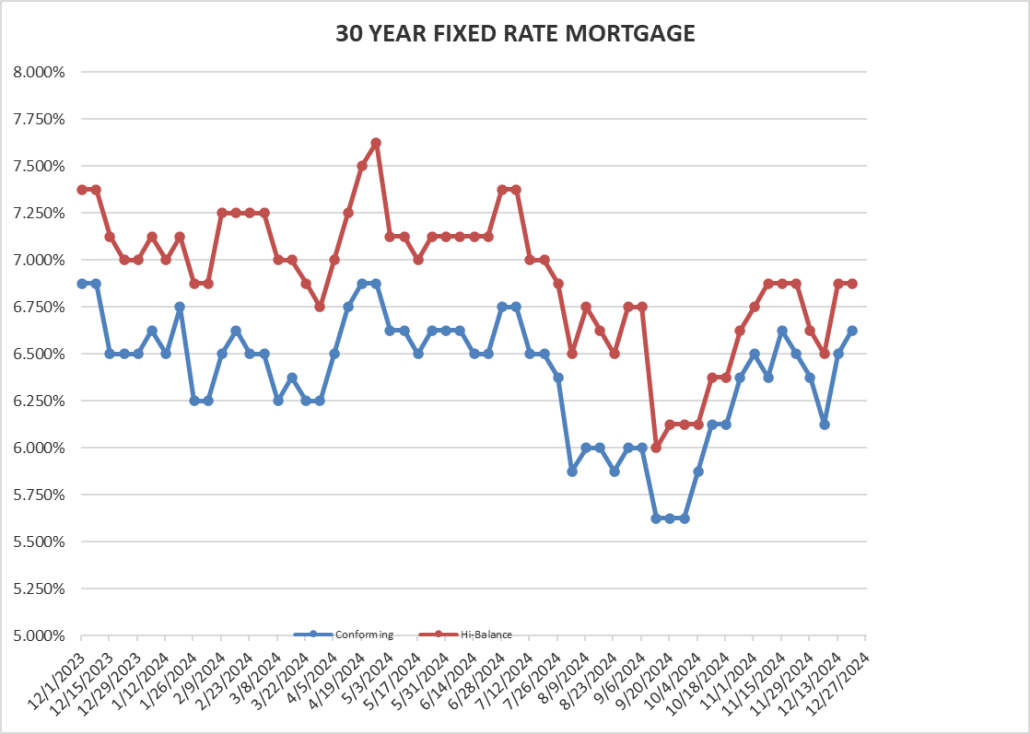
All of this news does not support lower rates, but neither does it support rates climbing in the future—i.e. stable rates for some time. Looking ahead, I see rates near 6.5% into the 1st quarter next year, and perhaps beyond.
Home sales had their biggest year over year in three years in November due to increase in supply. That said, it is the second straight year of slow sales; previously owned home sales in 2024 will very likely be at their lowest level since 1995.
Home sales are almost entirely dependent on interest rates, and as been discussed in prior WR&MU, the lack of homeowners reticent, more like fully resistant, to selling their homes with mortgages near 3% to purchase a new home with a mortgage has been a primary factor in low home sales. No inventory leads to no home sales.
Looking forward, with the economy likely not contracting enough to push interest rates significantly lower, there cannot be an expectation for a large increase in inventory from move up homeowners. With the lack of inventory, supply and demand will keep upward pressure on prices.
If you are waiting for lower rates to purchase a new home, you better be ready to move quickly on any dips because as a long-term prospect you may be waiting a long time. If you are waiting for lower prices, the wait is very likely longer—or non-existent absent a major event.
Schedule an appointment to discuss your options if you are considering purchasing a new home or property or refinancing an existing one and want to know the mortgage options available to you.
Have a question? Ask me!
Rates for Friday December 20, 2024: The cumulation of this week’s data and Fed news pushes the conventional rate a bit higher from last Friday.
FIXED RATE MORTGAGES AT COST OF 1.25 POINTS LOCKED FOR 45 DAYS FOR PURCHASE TRANSACTIONS:
30-year conforming 6.625% Up 0.125%
30-year high-balance conforming 6.875% Flat
Please note that these are base rates and adjustments may be added for condominiums, refinances, credit scores, loan to value, no impound account and period rate is locked. Rates are based on 20% down with 740 FICO score for purchase mortgages.
‘Tis the season for our family to be together. Our youngest, who finished her college classes and career on Monday, flew in from New York on Wednesday, and our oldest with boyfriend in tow arrives tonight from Boston. Last week I sent them the 10-day forecast showing mid-70’s for them, both replied enthusiastically. On Wednesday the younger left cold and rainy, today the elder is leaving in the snow.
California girls very happy to get California weather.
I hope you and your families have merry Christmases and happy Hanukahs.
Have a great week,
Dennis


