


Did FHA allow discrimination in home loans and sales?
Question of the week: Did FHA allow discrimination in home loans and sales?
Answer: This week’s question is in honor of Juneteenth, which became a federal holiday in 2021. It commemorates June 19, 1865 when Union troops arrived in Galveston, Texas to announce the end of the Civil War and ensure the last slaves in the United States were freed.
In answer to the question of the week, yes; FHA did allow discrimination in home loans and sales.
The Federal Housing Authority was created in 1934 as part of President Franklin Roosevelt’s “Alphabet Soup Agencies,” created as part of his New Deal.
The primary purpose of the FHA was to make homeownership more accessible by insuring mortgages approved and funded by FHA under their guidelines. Affordability and accessibility expanded greatly as FHA mortgages required very small down payments, three-percent (3.0%) and were 30-year fixed rate loans. Low down payments and low monthly payments due to the extremely long amortization period broke open the housing market to millions of American families. But…
Besides the positive aspects of low-down, low-payment, fully insured mortgages, FHA’s underwriting policies also reinforced racial segregation.
FHA engaged in redlining, marking neighborhoods with Black and other minority populations (which could include those of Asian, Italian, Irish, Hispanic or Jewish descent among other ethnicities) as “high-risk” for lending.
Until the landmark Shelley v. Kraemer Supreme Court decision state courts enforced racially restrictive housing covenants. In 1948 the Court ruled that judicial enforcement of the covenants violate the Equal Protection Clause.
Guidelines used by FHA favored neighborhoods with covenants that maintained “racial homogeneity,” supporting the use of deed restrictions that prevented homes from being sold to minorities. Because the FHA was not making judicial decisions, it did not change its policies because of the ruling in Shelley.
Unless a neighborhood, or individual seller, was taken to court by potential buyers to sue under the Equal Protection Clause, restrictive covenants remained in effect, and home buyers could use FHA financing.
At this point we need to mention that the Veteran’s Administration, created in 1944 under the GI Bill, also enabled discriminatory lending against veterans. When created in 1944, the VA, unlike FHA at the time, did not directly make loan decisions or fund mortgages, it guaranteed loans.
As a benefit of serving in the armed forces, the GI Bill authorized the VA to guarantee 30-year fixed rate mortgages to veterans with no money down. Loan decisions were originated, approved and funded by local banks, real estate professionals, savings and loans and other lenders, many of whom support segregated neighborhoods and homeownership.
In the late 1940’s and well into the 1950’s suburbia exploded across the United States, creating millions of homes in neighborhood developments to house returning veterans and their families. Access to the new housing was, in staggering percentages, not available to minorities, even those who fought to against tyranny in World War II to provide freedom to hundreds of millions in other nations.
The historically economic impact of federal agencies not only ignoring racial covenants and discriminatory lender practices but aiding and abetting such practices, is the inability for the building of transferable wealth for generations through the inheritance of home equity.
Consider a Black, or Hispanic, or Asian family, the husband has returned from serving in the Army in 1945. While he was gone his wife worked in a textile company that made uniforms for the troops. They want to purchase a home for $12,000 in a new neighborhood with no money down and a mortgage payment of about $80 per month. But cannot because of covenants stating “No person whose blood is not entirely that of the Caucasian race shall use or occupy any building on any lot, except domestic servants employed by a white occupant.” (actual covenant from Southern California subdivisions*)
Over the years the home value increases. They were not able to sell the home in the 1960’s for $25-30,000 and purchase a bigger home and continue to grow equity. They were not able to tap equity to open a business, pay for college for children, purchase additional property for themselves or children.
When they passed away they did not have tens, hundreds, of thousands of dollars they could pass onto their children and grandchildren, enabling them to accumulate more wealth.
It is estimated that American homeowners have approximately $35 trillion in home equity, about 70% of which is owned by White Americans. Had minorities not been discriminated against by federal agencies, would the amount of equity by higher? Debatable due to many factors of supply and demand impacting prices and affordability. Would minority families have significantly more home equity today absent federal guidelines that prevented opportunities to build equity over the past ninety plus years? Absolutely.
It was not until the Civil Rights Act of 1968, which included the Fair Housing Act prohibiting discrimination in housing and mortgage lending based on race, color, religion, and national origin (later expanded to additional protected classes) that racial covenants and discrimination in lending practices were illegal.
But illegal in law is not the same as absent from practice. Despite the law, many home sellers and real estate professionals continued to redline and discriminate against minority buyers.
Anecdotally, I was driving around one weekend in the early 1990’s visiting open houses looking to meet agents and generate referrals, when I saw a for sale sign from a well-known company in the area and the broker owner, who was in her mid-60’s, was the agent holding the house open. The house was in her neighborhood, part of which was on a waterway, and as I was walking in a Black couple was walking out. I waited until the couple left, handing them a card as they did so, of course, and commented that it seemed they liked the house, making positive small talk. To which she replied, “they may but I’m not going to the them buy it; we’ll find another buyer.”
I was shocked, perhaps not that she was thinking that way as I had known her for a while, but that she said it. It made me uncomfortable not only for her saying it but thinking I would agree.
Martin Luther King Jr. said, “The arc of the moral universe is long, but it bends toward justice.” The bend continues.
*When I started in the industry in 1987 it was not unusual to see these covenants on homes that were the subjects of our business. While no longer legal, the homes had not transferred since the Civil Rights Act of 1968.
To schedule an initial meeting by phone or Zoom, click here for my calendar, please feel free to forward to a friend or family member!
Have a question? Ask me!
Retail sales boomed in May, up 0.9%, well above the impact inflation had on sales, which supports stronger employment and GDP growth in the second quarter. In a vacuum the news would push rates higher, but economic vacuums do not exist.
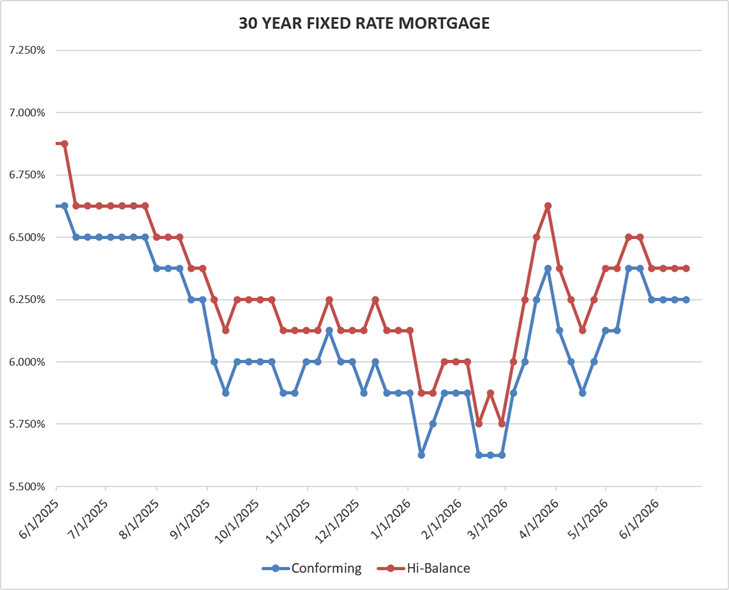
Rates for Friday June 19, 2026: Economic data may indicate higher rates, but the foundation for a peace deal with Iran and tankers of oil cruising through the Strait of Hormuz has rates holding steady from last week.
FIXED RATE MORTGAGES AT COST OF 1.25 POINTS LOCKED FOR 45 DAYS FOR PURCHASE TRANSACTIONS:
30-year conforming 6.25% Flat
30-year high-balance conforming 6.375% Flat
Please note that these are base rates and adjustments may be added for condominiums, refinances, credit scores, loan to value, no impound account and period rate is locked. Rates are based on 20% down with 740 FICO score for purchase mortgages.
I don’t know who is more excited, Sammy or myself. Leslie returns in the wee hours tonight (tomorrow?) from her trip with our daughter to Rome and Sicily. A bonus is our youngest, who was the purpose of the trip due as a graduation present, will be staying for all of next week.
A great Father’s Day gift!
Dennis


