


Why should we keep our current home if we are moving out of state?
Question of the week: Why should we keep our current home if we are moving out of state?
Answer: This is a question of the week we revisit every two to three years as the continues to be an exodus of homeowners from California to other states. Whether they are retirees or wage earners who have re-located when their employer moved out of state or have sought new employment outside of California, the primary factors for most of those relocating are cost of living and taxes.
When I am speaking with homeowners in California who are relocating out of state a common refrain is, “you should see how much more house we get for so much less cost…” Or, “we can sell our home here and buy one in fill in a state with no mortgage.” That is an attractive lure, especially since the greatest expense most families have is housing. What if your housing costs were eliminated, and your taxes were lower, and the costs of other goods and services were lower than what you are used to paying in California? How much more financial freedom and less stress would you have? Those are the questions being asked and answered for those considering an out of state relocation, analyzed with factors like fantastic weather, friends, family and community, and other ties to California.
But should you sell your home in California to finance your new life in your new state, or greatly reduce your mortgage costs?
Maybe, maybe not.
California is surrounded by states that have lower tax rates and lower property values. One popular destination is Nevada. There is no personal income tax in Nevada, its property tax is among the lowest in the nation, and while the sales tax is near or over 8% in most cities, that is offset by the other low tax rates, and still lower than most areas in California (such as the 10.25% in Long Beach).
There are many other states around the country with lower taxes, lower cost of living and much lower costs for homes. For those who are retired the ability to stretch retirement income and savings to live more comfortably financially, and use their equity from the sale of their home in California to purchase a comparable home in another state with a very small, or no, mortgage significantly helps stretch their retirement dollars.
For those still in their working years, with or without children, the lower cost of living and often lower congestion and density is enticing. Yes, their wages may be lower, but comparable when all other costs of living are factored into their home economics. If they are not homeowners, they see the opportunity to purchase a home, which may be out of reach in California. If they are homeowners, they see that they too can sell their home in California and have a significant down payment for a home in their new state.
But what happens if you sell your home in California, move to Nevada, Washington, Texas or some other state, and you feel you made a mistake, you miss California and want to return?
We have had many clients of the years where this has happened. They sell their home in California, net a nice amount of cash from their home and purchase their new home with 30-40-50% down, or more. Be it the culture, the climate, their employment not being satisfying, or missing friends and family, after a few years they decide they want to return to California.
Then they do the math. Their home in Nevazonaexas has not appreciated much. It will cost them 7-8% to sell their home and are looking at netting about what they put into the home for down payment and closing costs—maybe depending on appreciation in the area.
Meanwhile, back in California, they find out they are having a hard time qualifying to purchase a home comparable to what they sold, or if they do, they are paying a higher price and have a higher mortgage than they had when they sold their prior home, plus the property tax will be higher and based on their purchase price.
It is a difficult conversation we have going through the math and telling past clients looking to move back to California that what they qualify to purchase is smaller than the home they sold not too many years ago, or the same size home in a different neighborhood.
We have had clients who have moved out of state and retained their homes in California and converted them to rentals. Perhaps refinancing before they left the state to obtain some funds to purchase a home in their new state, or waiting to purchase until they know they are in Nevazonaexas to stay.
If they do make the decision to stay, they can either continue to rent their former home and retain it as an investment, or they can sell the home and take the proceeds to either purchase a new home in their new state, or payoff their mortgage, or invest the money and perhaps shorten their time until they retire.
If they decide they do not wish to live in Nevazonaexas any longer, they simply need to give their tenants notice they are returning to California and need them to vacate proprerty. They gave relocation a shot, it did not work out for them and they are able to return to their former home without having to worry about if they can afford to purchase a home in California.
A time frame for the decision is just under three years, assuming you have lived in your current home for two years or more. Current federal tax regulations state that is you have lived in a property for two of the previous five years and sell the home you are eligible for the homeowners’ exclusion for calculation of capital gains tax. This exclusion is $500,000 in gain for married couples and $125,000 for single tax filers. This is tremendous tax break, and the two-in-five rule enables you to try out a new location before you sell your home in California and fully commit to your new home. If you sell the property have the five year period, all of your gain will be taxed at the long term capital gains rate.
NOTE After a very similar question and answer of the week several years ago, friend and CPA Blake Christian sent me the following:
“Just one caution for higher net worth clients – CA will factor in the retained house as evidence that the taxpayers have retained their CA “domicile” even though they are no longer “residents”. CA might still tax their income. We are fighting a $250K case like that right now. The taxpayer moved 5 years ago!!”
If you own your home in California and are moving out of state my advice is that you seriously consider the option of retaining your current home for a period of time after you move just in case it does not work out and you want to return to California in the future.
If you want me to help you with the math of relocation please do not hesitate to contact me.
To schedule an initial meeting by phone or Zoom, click here for my calendar, please feel free to forward to a friend or family member!
Have a question? Ask me!
Prices rising slower. I prefer this statement regarding inflation data this week than the more common, “inflation is dropping.” Which is true, but for many people not fully understanding of economics and terminology think “inflation is dropping,” means prices are dropping; they are not, but prices are increasing as a slower rate. In May the Consumer Price Index (CPI) increased by only 0.1% from April, mostly due to lower gasoline prices The prior month-to-month increase was 0.4%, so price increases are slowing. Year-over-year, CPI shows inflation up 4.0% from May 2022, the annual inflation rate in April was 4.9%; the May data shows a healthy drop in inflation from April. This data was very positive for mortgage rates, as it gave great support for the Federal Reserve to take a pause in raising its benchmark interest rate.
While the total basket of goods and services used for the CPI data is showing slower price increases, the “core” data (omitting food and energy prices) remained steady at a 0.4% month over month increase in prices. The core inflation rate is still over 5% (5.3%) dropping from 5.5% annual rate the prior month. While the data is the sub-headline to the over all CPI data, the stubborn core rate not dropping as quickly as the over all inflation gauge gives some concern as to the long-term view of inflation, and therefore mortgage rates.
As expected, especially after the CPI data, the Federal Reserve Open Market Committee (FOMC) announce that it did not increase its benchmark interest rate; the first time at one of its meetings since March 2022 the was no increase in the rate. In statements following the meeting, Federal Reserve Chair Jerome Powell was fairly clear that we can expect two more rate increase before the end of 2023. This statement, along with other economic data, keep reading, has investors and markets a bit jittery and volatile, providing no stability to mortgage rates looking forward knowing the Fed’s target rate of inflation of 2% is still a long way off.
Consumers continue to mess with rates. Consumer spending is 65-70% of our economy. Consumers drive inflation, the more goods and services they demand the more prices increase. Retail sales are approximately one-third of consumer spending, so 21-24% of our economy. Consumers surprised Wall Street economists in May as retail sales increased 0.3% from April—the economists forecast that sales would drop 0.2%. May showed consumers are spending more on services, hotels, airlines, bars and restaurants, all of which are about the same levels as before the pandemic. Spending more on services, which are wants and not needs, indicates consumers are confident in the economic future and not changing their spending habits significantly due to higher prices and rates. The news is not positive for mortgage rates.
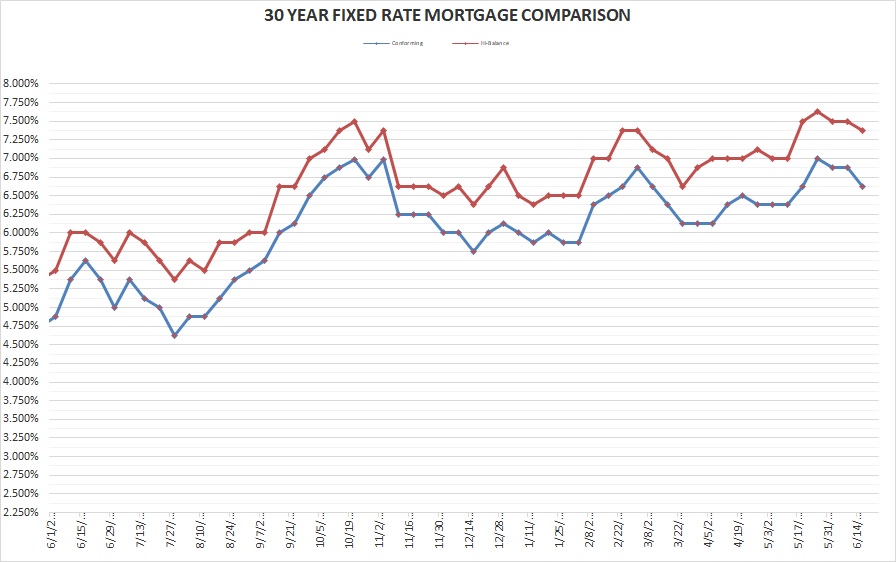
Rates for Friday June 16, 2023 The CPI data and Fed announcement of no rate increase pushed rates down this week from last, the conforming rate at its lowest in four weeks.
FIXED RATE MORTGAGES AT COST OF 1.25 POINTS LOCKED FOR 45 DAYS FOR PURCHASE TRANSACTIONS:
30-year conforming 6.625% Down 0.25%
30-year high-balance conforming 7.375% Down 0.125%
Please note that these are base rates and adjustments may be added for condominiums, refinances, credit scores, loan to value, no impound account and period rate is locked. Rates are based on 20% down with 740 FICO score for purchase mortgages.
The Los Angeles area has many world class golf courses. This week the U.S. Open is being played at the Los Angeles Country Club. It is the first time since 1948 a U.S. Open has been held in the Los Angeles area. Since the last U.S. Open in Los Angeles, the greater LA region has hosted:
- 6 World Series, five for the Dodgers (could have been six but 2020 World Series had all game played in Arlington, Texas, home of the Rangers) and one for the Angels.
- 5 Stanley Cups, three for the Kings and two for the Ducks
- 25 NBA Championships (could be 26 but 2020 championship was in the bubble in Orlando)
- 1 Men’s FIFA World Cup
- 2 Women’s FIFA World Cups
- 2 PGA Championships
It is hard to argue that Los Angeles is not a premier championship venue, as shown by the 41 major championships taking place in the area in the last 75 years, most of them since the after the Dodgers moved to LA in 1956 and the Lakers in 1960.
Why has it taken the United States Golf Association 75 years to host their premier tournament, one of four major tournaments in golf, in LA?
It is great to see Los Angeles Country Club for the first time, a great course that thousands of golfers in Southern California would love to play (including this one!). The course has held some amateur tournaments in recent years, but those tourneys had significantly fewer viewers than the Open will have.
Opposite of the Rose Bowl, which teases Midwesterners and Northeasterners with gorgeous, sunny, 70 degree weather in January, this week’s Open is not going to draw any one to the area with our unusually gloomy-all-day weather we have experienced for the last several weeks (or is it month’s?).
Happy Father’s Day to the other Dads out there. Hopefully, those who are golf fans like me will be treated to an exciting final round that we will catch the ending as we mind the meat on the grill while the final players are finishing!.
Have a great week,
Dennis
Past Weekly Rate & Market Updates can be found on my blog page at my website www.DennisCSmith.com/my-blog


