

If our home is completely or partially destroyed, what can we do?
Question of the week: If our home is completely or partially destroyed, what can we do?
Answer: Similar to after a significant earthquake, the wildfires in Southern California have homeowners wondering what if….
What if our home is destroyed, or unlivable, due to a natural disaster, fire, or other reasons? What can we do?
The primary factor in what you can do is to examine your risk mitigation, i.e. your insurance coverage.
There are three different policies that cover damage to your home from various factors, depending on your coverage and policy will present the options you have if your home is severely damaged.
If you have a mortgage, your lender will require a homeowner’s policy to protect their collateral for the loan. Your homeowner’s policy will have your lender listed as “loss payee,” meaning any funds that are distributed by your insurance company will list the lender as a payee on the funds. Meaning, they have to co-endorse any check.
This is to ensure that you either rebuild the property and therefore regain the value of the lender’s collateral; or that you sign the proceeds over to the lender to pay off the loan balance, with any funds remaining going to you. If your loan balance is more than the amount of the insurance payment, you then must decide to either continue making payments on the mortgage, or walk away and let the lender foreclose on the remaining balance.
Your options: rebuild, repay, or release, the property, depends on many factors, among them loan balance, loan payment, after value of property if rebuild. The last factor, after value, will largely depend on your neighborhood and area and what other property owners decide to do with their damaged properties. Are you the only one rebuilding? What is being reconstructed around you?
With the new California law that bypasses local building regulations, if you are in a designated area, primarily within a “major transportation corridor,” you, or your neighbors, can build multi-family dwellings on single-family lots. Will your neighbors sell their properties for land value to developers who will put a 4-unit property next door to you? Will neighbors decide to walk away, leading to a lot of foreclosures on vacant lots or severely damaged properties, that will be purchased by developers?
What is best in the long run for you and your family? Rebuild, repay, or release? Will you rebuild your home, or something else, with the funds from the insurance company? Will you use the funds to payoff off the mortgage and then determine what to do with your free and clear property? Or will you release the property to the lender, having the loan foreclosed and moving on?
Do you have earthquake insurance? Many property owners with a large amount of equity do, those with little equity do not; this is mainly because of the high premiums and high deductibles for earthquake insurance—how much are you paying to protect how much value?
Earthquake insurance is not mandatory by most lenders, therefore if you do have it you do not need to list the lender as loss payee. Because of this, if you home is damaged in an earthquake you can determine to what extent you want to repair/rebuild, versus taking the funds and moving on—leaving your mortgage behind for the lender to foreclose. Because the lender is not part of the claim payment, your net proceeds after your deductible could be large enough to purchase a new home with cash or a sizeable downpayment that would mitigate a higher interest rate due to a foreclosure—depending on where you are buying.
If you do not have earthquake, but your home catches fire as a result of broken gas line or other factor, and your home sustains fire damage, you may (should? Check with your agent) be able to make a claim on your homeowner’s policy covering fire damage.
Homeowners in certain areas who have mortgages are required to have flood insurance. If you do not have flood insurance and your home and property is damaged by water that comes up from the ground, i.e. a flood, your homeowner’s policy will not cover the damage—which is why lenders require flood coverage if your home is located in a federal flood zone. Because the coverage is required as part of your mortgage, the lender is listed as lost payee and you will have the same decision process as if your property was severely damaged by fire regarding rebuild, repay, release.
A decision does not need to be made immediately. Review your policy(s) with your agent to determine what coverage you have beyond rebuilding/repairing your property. Your policy should have replacement housing coverage, paying for “like” housing for you and your family for up to two years. This should free up funds so you can continue to pay your mortgage while you make your decision, and if rebuilding hopefully cover your housing until construction is complete and you can return to your home.
Your mortgage company may give you time as well. While there is no clause in standard mortgage contracts that requires lenders to provide you with a forbearance due to your inability to occupy your home as a result of a disaster, some (many?) may voluntarily provide you with a forbearance for a certain time frame, perhaps up to six months. A forbearance suspends mortgage payments and interest accrual, adding the missed payments to the end of your mortgage. I.e. if you have 240 months left on your mortgage and it is due to be paid off in January 2045, and you are provided a 6-month forbearance with payments to continue in July, your mortgage will still have 240 payments left but will be scheduled to pay off in July 2045.
Losing a home is similar in many respects to losing a family member. There is grief, which must be gone through to fully heal. However, when you are likely to be grieving the most, soon after the loss, you must deal with details and paperwork that are time consuming, frustrating, and push your ability to grieve aside. Taxes, permits, credit obligations, housing, even utilities, and mail, and more have to be dealt with as the world continues to turn and day-to-day responsibilities must be met.
Knowing what coverages you have from your insurance policy is a priority if your home is damaged. Not only to be able to assist you in determining your options, but also to provide some peace of mind knowing you are covered for some potentially major expenses.
Finally, our culture is one of finding “bargains,” getting the “best deal,” looking for a lower price for an item or service. Insurance coverage is not an area to look for a deal, which can come with reduced coverage when you need more. In the coming months, unfortunately, too many homeowners going through tremendous loss may discover the good-deal insurance is not such a good deal.
Schedule an appointment to discuss your options if you are considering purchasing a new home or property or refinancing an existing one and want to know the mortgage options available to you.
Have a question? Ask me!
Inflation data had a positive impact on interest rates this week. The Consumer Price Index showed a 0.4% increase in December, a 2.9% for the year, with the core rate (energy and food removed from data) grew 0.2% for the month and 3.2% for the year. While the numbers are higher than the Federal Reserve target of 2% inflation, investors reacted positively as the core rate, the primary inflation measure for the Fed, was the lowest increase in six months and the year-over-year rate dipped from 3.3% in November. The data allayed some concerns that instead of lowering its benchmark interest rate later this year it may actual increase the rate.
Cash registers were ringing in December, with retail sales up 0.4% from November’s very robust 0.8% increase in sales. Year over year, retail sales grew up 4.0%, well above the CPI rate of inflation. While December’s increase in sales was due in part to heavy discounts from retailers to entice customers, consumers were spending at a rate to give the economy momentum into 2025, portending another year of economic growth.
While inflation may be cooling, the key word is “may,” consumers are not feeling any great relief for their wallets and pocketbooks. Since January 2020 nominal inflation is up 23%. The primary cause is the amount of money circulating in our economy due to federal spending and the Federal Reserve’s monetary policy. Since 2019 federal spending is up 52% and the deficit has grown by $849 billion, resulting in our federal debt to grow by 50% since 2020. With the spending and borrowing increasing, and interests climbing due in large part to the Federal Reserve hiking its benchmark interest rate, the interest payments on our national debt is almost three times higher today than it was five years ago. How much is it? Three billion dollars a day. A Day. That amounts to $1.095 trillion dollars a year, just in interest payments.
Looking ahead, with so much debt being issued to pay for our government spending, and in part to cover interest payments, the prospects for significantly lower rates in the coming year are slim.
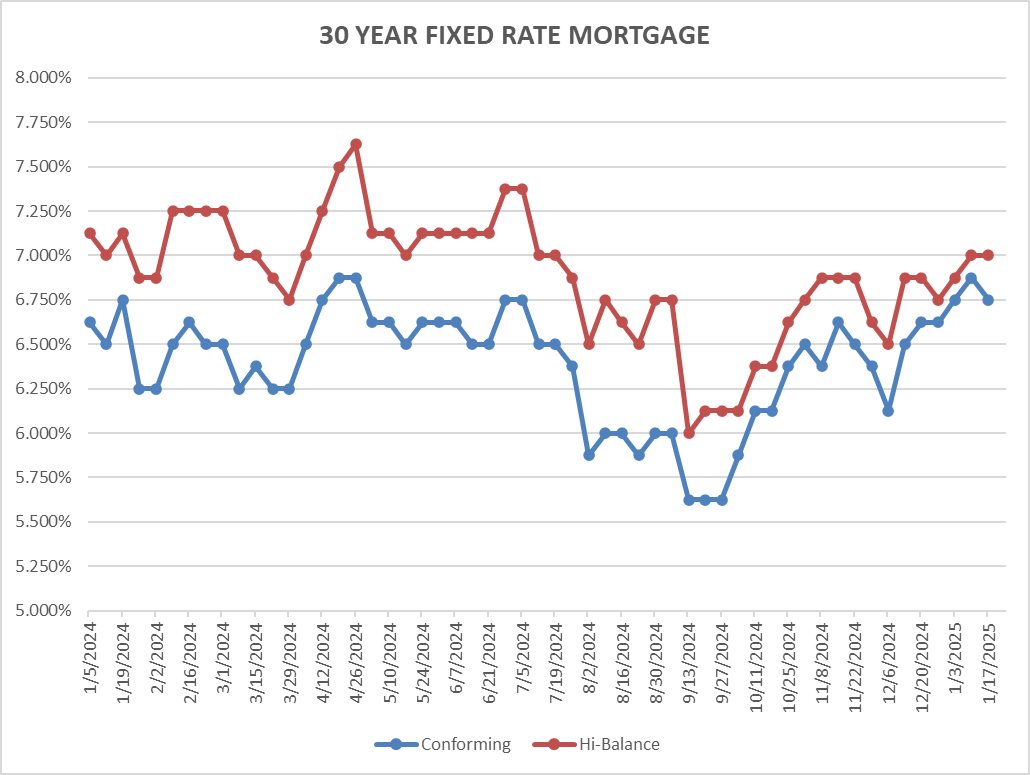
Rates for Friday January 17, 2025: Rates dropped week to week for the first time in six weeks as investors reacted positively to the CPI data. Whether the downward trend continues is what matters.
FIXED RATE MORTGAGES AT COST OF 1.25 POINTS LOCKED FOR 45 DAYS FOR PURCHASE TRANSACTIONS:
30-year conforming 6.75% Down 0.125%
30-year high-balance conforming 7.00% Flat
Please note that these are base rates and adjustments may be added for condominiums, refinances, credit scores, loan to value, no impound account and period rate is locked. Rates are based on 20% down with 740 FICO score for purchase mortgages.
Thankfully, the weather has been cooperating the last few days to assist the firefighters in Southern California as a marine layer has formed. The Eaton fire is 65% contained and the Palisades fire is 32% contained as I write this. Firefighters, and residents, are holding their breaths for the coming week as high temperatures and winds are expected Monday.
Everyone is looking forward to the fires getting knocked out and the recovery process able to begin.
Have a great week,
Dennis


