
What should we offer?
Question of the week: What price should we offer?
Answer: This is a question we cover every couple of years and my answer has been pretty consistent. Offer what you can afford and what the seller will accept.
It is in our nature to want to negotiate and get a “bargain.” Why buy a pair of Nike Air shoes at one store for $100 when you can get the same shoe online or at another store for $95? Convenience?
The auto industry is set up to haggle, negotiate and make car buyers feel good when they can brag that they knocked several thousand dollars of the sticker price. Nobody brags around the office water cooler, “hey the guy would have taken $400 but I paid $500!”
Amazon, eBay and other internet vendors have reinforced, actually strengthened our primal instincts at getting a deal. Everything is more commoditized today than in the past.
But should this urge to buy as low as possible be followed when you are purchasing your new home?
Let’s look at the cost-benefit of haggling with a seller.
You have been prepping to purchase a home for several months. We have met and gone through your financial information and I am ready to provide a pre-approval package to your real estate agent when you find the right home and decide to write an offer.
You look at several properties in different areas of different sized and amenities, all within a defined price range. You finally find the property you want. It checks all your boxes and as you walk through you can imaging your family living in the home. The price is right in your qualifying range. You know you can make the payments and you have more than enough in your accounts for down payment and closing.
So, what do you offer when you find the house you want to buy? My advice is always, offer what it takes to buy the home you want.
“But what if the seller would take less?”
What if they won’t and accept someone else’s offer?
Let’s take a look at the math of a sale for the buyer and seller on a property listed for $625,000.
For the seller, the costs of the transaction are about 7-8% depending on the commission he agreed to pay the real estate agents when he listed his home for sale, let’s use the higher amount. If he sells for $625,000 his costs are $50,000, his proceeds therefore are $575,000. If he sells his home for $600,000 his costs are $48,000 and his proceeds are $552,000. He sells his home for $25,000 less than his asking price and his proceeds are $23,000 less than had he sold the home for $625,000.
For a buyer on a $625,000 sales price, if he were to put 20% down that would be $125,000, and the loan amount would be $500,000. If the interest rate is 3.75% on a 30 year fixed rate his monthly payment would be $2316 per month.
The buyer however wants to see if he can get the property for a bit less and offers the seller $600,000. The buyer’s down payment would be $120,000, just $5000 less than if the offer was $625,000. His monthly mortgage payment would be $2326 on his $480,000 mortgage, $93 less per month than the $625,000 transaction.
The seller is out $23,000 with the lower price, while the buyer is saving only $5000 in cash. The buyer is also paying $93 less per month, a little over $1100 per month. The question for the buyer, is it worth losing the home you want for $5000 out of pocket and an additional $93 per month?
What do you spend $90 per month on? If you stop by an internationally known coffee purveyor you every morning on your way to work you are spending about $90 per month. If you don’t brown bag your lunch every day you are spending more than $90 per month.
There is another aspect beyond the cash in or out of pocket in the above scenario. There is good will. What is good will worth?
It is not uncommon in a real estate transaction on a previously owned home for the home inspector to present a report to the buyer with a list of issues with the property, many minor and a few less than minor. It is also not uncommon for the buyer to ask the seller for a credit to cover the costs to correct some of the issues with the property that they buyer will fix after he owns the home.
If the seller gives a credit to the buyer in escrow it is usually applied to offset closing costs, and not to lower the price. This is to the advantage of the buyer. For the seller it does not matter that much if the credit applies to buyer costs or sales price; as we saw above a reduction in sales price takes a lot of money out of the seller’s proceeds, about the same as a straight credit will.
For the buyer, as we saw above, any change in sales price has a small impact on the amount of cash needed to close, but a credit for costs is a direct dollar for dollar savings. For example, the buyer is putting 20% down, and the seller has agreed to a $5000 credit in lieu of making repairs requested by the buyer, the buyer is saving $1000 in cash—to make repairs that are estimate at $5000. If the $5000 is credited to offset closing costs the buyer saves $5000 in cash.
Back to goodwill. If the buyer was able to negotiate the seller down several thousand dollars from the price the seller really wanted, and then comes to the seller for several more thousand dollars, what is the mindset of the seller?
Yes, you may be able to purchase the home you want for less than the seller is asking. But before making that lower offer, consider the risk of not getting the home you want and the difference in how the math impacts you on a cash and payment basis. More often than not you will likely find the risk of losing the home you want is more than the cost of obtaining it.
Have a question? Ask me!
It was an interesting week. It was interesting in many respects, but I am referring to the news and information that impacts mortgage rates. In regards to economic data the Consumer Price Index for November showed strong growth at 0.3% for the month and pushed the annual inflation rate from 1.8% to 2.1%, the highest in twelve months. While rising prices are typically a push for higher rates, this weeks announcement did not have a large impact because the annual rate is in the Fed’s desired inflation rate. The other major piece of economic data was that retail sales in November were well below expectations at 0.2% growth from October (which was revised up to a very good 0.4% growth). A major reason for the somewhat disappointing showing was the late Thanksgiving this year, likely pushing a lot of holiday shopping into December. Since the consumer is 65-70% of our economy lackluster retail sales can be a concern, most investors held off on reacting to the news until they see how December sales go.
While the economic data is interesting to data geeks like me, political news has had more of an impact this week. As one commentator put it, “the news this week has been swirling like a dust storm making it hard to see where investors are going.” Early in the week Congress and the White House agreed on a new economic treaty with Mexico and Canada that will replace NAFTA, which is positive news for the economy. Yesterday the White House announced that the U.S. has signed a trade agreement with China resolving some of the disputed trade policies and not too long ago China followed with its own announcement that an agreement has been reached. Behind this backdrop of cooperation between Capitol Hill and Pennsylvania Avenue is the ultimate in non-cooperation as the House Judiciary Committee has sent articles of impeachment to the House for a vote, where it almost certainly pass on straight party lines initiating a trial in the Senate.
As mentioned often in the WR&MU, investors do not like uncertainty and when this happens they tend to flee to safety—which means fixed rate returns of bonds and investments like mortgages. The trade agreement announcements, being good for the economy pushed on rates to climb. Even though expected the breaking news of the impeachment proceeding has caused investors to pull back and they are pushing rates back down a bit.
Ignored in all the data, news and commentary is that earlier this week Fed Chairman Jerome Powell announcing that the Fed is looking to do nothing with rates in 2020. This takes pressure of rates for each economic announcement and creates stability, which is good news for those planning on purchasing a new home in 2020.
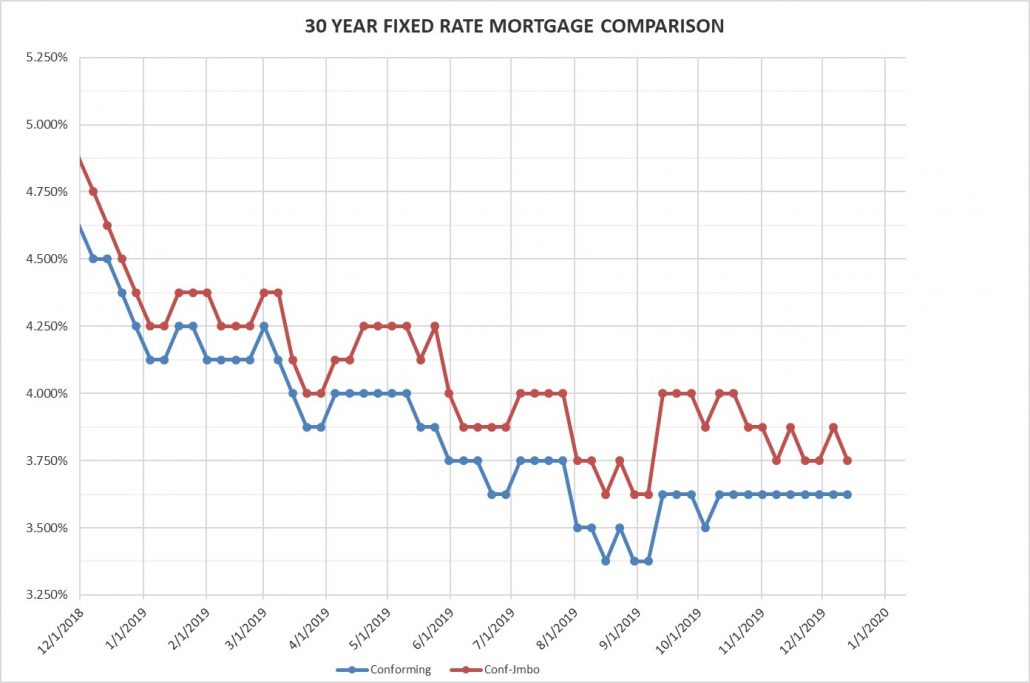
Rates for Friday December 13, 2019: After a spike yesterday and a gentle decent so far today rates are the same for conforming as there were last Friday, and the conforming rate is the same for the ninth consecutive Friday; I cannot recall this ever happening. The high balance rate slipped back down this week, continuing its see-saw course of the last few weeks.
FIXED RATE MORTGAGES AT COST OF 1.25 POINTS LOCKED FOR 45 DAYS:
30 year conforming 3.625% Flat
30 year high-balance conforming 3.875% Up 0.125%
Please note that these are base rates and adjustments may be added for condominiums, refinances, credit scores, loan to value, no impound account and period rate is locked. Rates are based on 20% down with 740 FICO score for purchase mortgages.
I think one of my favorite parts of Christmas is walking in the house at the end of the day, or coming downstairs in the morning, and smelling the freshness of pine from the tree in our front room. That may be a major subconscious allure to the mountains as the olfactory memory we have smelling the pine trees and creating the memory of Christmas time with family and home.
Have a great week,
Dennis
Past Weekly Rate & Market Updates can be found on my blog page at my website www.DennisCSmith.com/my-blog