


What are some areas we should review to start the year?
Question of the week: What are some areas we should review to start the year?
Answer: If the question of the week looks familiar, it is as it is one we ask at, near the beginning of every year; because it is that important. Over the next few weeks, or months depending on your particular situation, you will be gathering statements, forms, and information to prepare your tax returns. While you have all this information in the same place it is a good time to also review various areas of your economic life to see what may need updating, or changing.
Here are some of the areas I suggest you review:
- Retirement Did you alter your retirement withholdings in 2021? Do you need to increase or decrease your deductions for your 401(k)? The maximum contribution for 2022 is $20,500, up $1000 from 2021, and the first increase since 2020. If you are over 50 the “catch up” contributions also remain the same at $6500 for a total contribution (pre-tax) of $27,000.
Are you self-employed or work for an employer who does not have a retirement plan so you contribute to some type of IRA? Review your 2021 income and contributions and determine based on estimated income in 2022 whether you need to adjust your monthly or quarterly contributions to your IRA. If you do not make regular contributions to your IRA I strongly recommend it so you can take advantage of “dollar cost averaging.” Those who did so in 2021 saw gains overall through the year that those waiting to make full contribution in April 2022 when they file their taxes.
With the Dow Jones Industrial Average climbing around 19% in 2021 those who invested in their 401(k) throughout the year saw a nice gain in their retirement savings. Those who started contributing early in the year to their self-directed retirement accounts we able to see excellent gains on early contributions, reiterating what is stated above.
- Insurance Is your hazard insurance policy current and accurately reflecting the replacement value of your home? Is your life insurance coverage adequate? Are you home, auto, life insurances with the same company allowing you to take advantage of bundled discounts?
- Estate Planning Do you have an estate plan? Is it current and reflective of your current assets and wishes? Do you own property but do not think you need any family planning because you are single? Everyone with assets should have an estate plan, especially if they own real estate in California (or any other state with inheritance taxes). If you have an estate plan and family trust when was the last time you had it reviewed? Have your children become adults since the trust was last reviewed and amended? What about your wishes for you when you pass on to the next dimension, are they the same as they were when you initiated your trust?
- Debt Have you increased your debt in the past twelve months? Do you have a plan to pay it down and off? Can you restructure your debt to lower the overall interest rates being charged or the monthly cash flow required to manage the debt and keep payments current? Was your 2020 resolution to pay down/off debt but were unable to do so? Call me and we can discuss potential plans to help you achieve this goal in 2021.
- Mortgage Do you need a review of your current mortgage and options? Call me!
These are not fun or sexy issues for most people to be tackling, but like changing the batteries in your smoke detectors you need to regularly review and update these critical areas of your home economics. If you have any questions or looking for qualified professionals to assist you, please do not hesitate to contact me.
Have a question? Ask me!
Data from the Labor Depart disrupts markets today. There were concerns that employment would decline in January due to workers missing work due to the omicron variant (almost 8 million workers did miss work in the month due to omicron). The concerns were greatly unfounded as employers added 476,000 jobs in January. Further, those looking for work increased pushing the unemployment rate up to 4% from 3.9% in December. What at first look appears to be a surge in hiring in January compared to December, turns out to be a slight decline. This is because the Labor Department also issued revisions to jobs data from November and December, and the revisions were enormous. November’s employment increased from the prior estimate of 290,000 new jobs to 647,000; December’s revision changed the estimate from 199,000 to 510,000. The news is bad for mortgage rates.
With almost 11 million job openings reported by employers, it is little surprise that hourly earnings increased 0.7% in January, up 5.7% from last January. Employers are pushing their wages higher to attract workers in an extremely competitive market. With wage increases well below inflation, employers are facing the challenge of being able to produce their goods and services with enough workers while charging for the goods and services an amount to attract customers and close sales while being profitable.
The jobs data is concerning for investors. It is almost a certainty the Federal Reserve will raise its benchmark interest rate in March. Typically, the Fed moves rates in 0.25% (one-quarter of one percent) increments. Because of the strength of the employment market the possibility that the Fed will raise its rate by 0.50% (one-half of one percent) in March.
Typically, the prime rate moves in conjunction with the Fed Funds rate. If the Fed increases its rate 0.25%, prime increases 0.25%. Fed drops 0.50%, prime drops 0.50%. I bring this up because the last time the Fed increased its rate by 0.50% was in May 2000, increasing the rate from 6.0% to 6.5%; interestingly the prime rate did not change for almost a year when it increased from 8.75% to 9.00% in January 2001.
Why is this relationship between the prime rate and Fed rate important? Because while the Fed does not directly impact mortgage rates, it does indirectly impact rates for consumers since the prime rate generally changes in conjunction with the Fed funds rate. Home Equity Lines of Credit, auto loans, credit card rates, school loans, are generally tied to the prime rate. Some are directly tied, especially HELOCs which use the prime rate as the basis for homeowners’ rates. Other creditors may not be directly tied to the prime rate, but increase and decrease their rates when the prime rate moves.
For my fellow data geeks, the last time the prime rate increased more than 0.25% in one move was in November 1994 when it moved from 7.75% to 8.50%. In 1994 the rate increased four times in this order, 6.25% to 6.75% (April) to 7.25% (May) to 7.75% (August) to 8.50% (November); a 2.25% jump in eight months. During this period the Fed raised rates in each of those months from 3.5% to 5.5%, slightly less than the prime increased during the period.
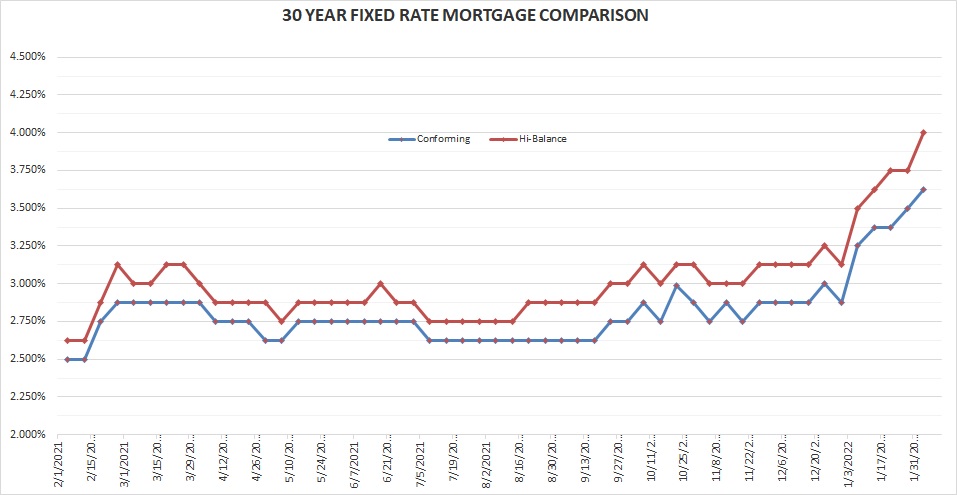
Rates for Friday February 4, 2022: Rates are from last Friday. The conforming rate increases for the second week in a row. The high-balance conforming rate increases due to market conditions, as well as the increase in loan level pricing adjustments coming to bear for lenders. The high balance rate is at its highest since the Covid spike in March 2020, the highest in a “normal” market since October 2019. The conforming rate at its highest since December 2019.
FIXED RATE MORTGAGES AT COST OF 1.25 POINTS LOCKED FOR 45 DAYS FOR PURCHASE TRANSACTIONS:
30 year conforming 3.625% Up 0.125%
30 year high-balance conforming 4.00% Up 0.25%
Please note that these are base rates and adjustments may be added for condominiums, refinances, credit scores, loan to value, no impound account and period rate is locked. Rates are based on 20% down with 740 FICO score for purchase mortgages.
A bit of a geeky economic round up this week, or perhaps I should say more so than usual. For newer readers, or those who need some refreshing on their knowledge, here are some links that may prove helpful to prior WR&MU’s covering the Fed, rates, fees, etc:
- Regarding loan level pricing adjustments impacting high-balance rates.
- Federal Reserve and the rate it controls and recent actions.
- What impacts mortgage rates.
For readers who are big football fans, what are you going to do on Sunday with no football after over 20 weeks? (Correct, I do not consider the Pro Bowl a real game) A rather large honey-do list can accumulate from September through January!
Have a great week,
Dennis
Past Weekly Rate & Market Updates can be found on my blog page at my website www.DennisCSmith.com/my-blog


