


Why is our mortgage rate impacted by others in forbearance on their mortgage
Question of the week: Why is our mortgage rate impacted by others who have a forbearance on their mortgage?
Answer: Last week in the middle, or economic, section of the WR&MU I mentioned new policies enacted by the Federal Housing Finance Authority (FHFA) for collection of loan payments for Fannie Mae mortgages from mortgage servicers. For those who do not want to click back to the update here is a refresher, for those who do click back, this refresher is more in-depth than what I wrote last week.
Fannie Mae and Freddie Mac are called “GSE,” or Government Sponsored Enterprises. They are quasi-government organizations that operate somewhat independently but under government supervision and control. Fannie and Freddie became GSE as a result of the market crash in 2008 when as part of the TARP (Troubled Asset Relief Program) was created to purchase bad, or the term of the times “toxic,” assets from financial institutions.
In many cases instead of purchasing the assets the United States Treasury purchased significant portions of institutions which would be sold back as the funds used to support the institutions were paid back; in the then popular vernacular, when the bail-out was repaid. (A term back in the vernacular today.)
Fannie and Freddie were taken over by a new government agency, the Federal Housing Finance Authority and when that occurred the United States Treasury backed all mortgages funded by Fannie and Freddie who became GSE. Just like the GSE did before, when they were privately owned, the purchased mortgages were bundled into Mortgage Backed Securities (MBS) and sold to investors. The difference being is that the risk on purchasing MBS funded by the GSE was diminished to near zero thanks to the backing of the federal government.
The transaction has worked out well for the American taxpayer as through 2019 the Treasury has made approximately $100 billion on profits of the GSE after the initial purchases have been paid back.
Fannie and Freddie are similar but different, sort of like fraternal twins. They have slightly different underwriting guidelines and processes. Fannie is the more robust twin with about 30% more mortgages funded than brother Freddie. The flow of funds are the same for both of the GSE, investors to GSE to lender to borrower to lender to GSE to investor. Investor buys MBS from GSE, GSE buys loan from lender, lender funds loan for borrower; borrower pays mortgage payment to lender, lender forwards payment to GSE, GSE forward payment to investor.
This, the flow of funds, is what is impacting mortgage rates today. Initially the interruption was investors not excited about purchasing MBS, even though the investment is backed by the Treasury Department. Then the Fed entered the market in two ways. One was dropping its lending rate to member banks which depressed rates for lenders hedging their portfolios causing greater risk. Two was announcing it would purchase several hundred billion dollars of MBS.
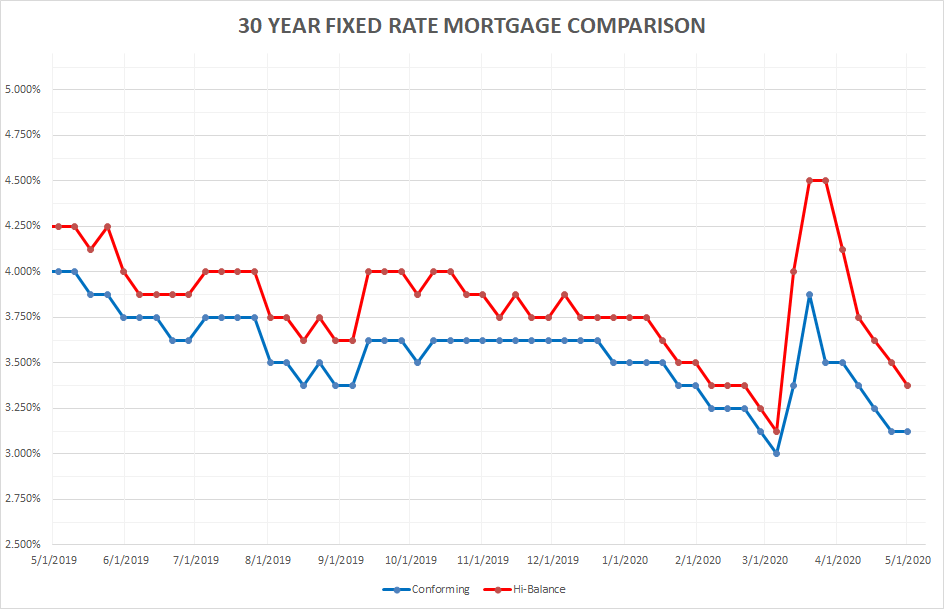
This stabilized the lower end of the mortgage market, conventional loans (i.e. Fannie/Freddie) at or below the loan limit of $510,400. We saw rates drift down for both conforming and high-balance rates.
Then Congress passed the CARE Act, President Trump signed into law and the mortgage markets faced another challenge. One of the provisions of the CARE ACT is that any borrower with a federally backed mortgage on a single-family property is eligible for a forbearance for up to 180 days if they request one from their lender. (Note, for the purposes of this update “lender” will mean loan servicer—the company that collects mortgage payments from borrowers. Not all lenders who fund loans retain servicing for the loans and sell them to other companies to collect the payments and pass them along to the GSE.)
Forbearance means a modification of the monthly mortgage payment, either no payment at all, interest only payment, less than interest only; a payment in which the full amount due is deferred in whole or part.
To recap, money flows from the borrower making mortgage payments to lenders who pass those payments, less servicing fees, to the GSE. On the other side the GSE purchase loans from lenders who then have capital to fund mortgages for borrowers.
Prior to last week one of the differences between Fannie and Freddie was that if a loan was in forbearance a lender servicing a Fannie Mae loan had to continue to advance payments for principal and interest until the loan was paid off or foreclosed on. Lenders who had a Freddie Mac loan had to only advance payments for four months. Last week the Federal Housing Finance Authority gave lenders a bit of a break by changing the rules for Fannie to match Freddie, lenders have to advance four months of payments for loans in forbearance.
Big break! Right? Wrong, as the lenders are forwarding four months of payments on mortgages for which they are collecting no payments.
Let’s look at some math. Let’s say the GSE have about $600 billion in outstanding single-family mortgages with an average interest rate of 4%. Let’s say 15% of those homeowners file for a forbearance. That means $300 million per month in interest is not being collected (plus principal on the mortgages) by lenders that is being forwarded to the GSE. Four months of payments is $1.2 billion being taken from lenders in cash.
That is $1.2 billion that cannot be used for other mortgages. That is $1.2 billion that cannot be used for salaries, leases for offices or toilet paper.
This is how forbearance is impacting the market today. Because the lenders have to enable a forbearance on any single-family mortgage that is back by the federal government, lenders do not want to make a loan today that will become a forbearance later in the month, or next month or the month after.
It takes a lender about a year to recoup the cost of originating and funding a mortgage. A year of collecting payments. Add the cost of acquiring the mortgage, then add in four months of no payments during that first year and you can understand the financial loss a lender can take if a new loan goes quickly into forbearance.
Because of this, lenders are looking to mitigate risk while still engaged in their primary business: funding home loans. Risk mitigation is accomplished in several manners, higher rates, lower loan amounts, fewer programs that present higher-risk in normal markets.
For conforming (GSE) products, what we have seen this week for single-family owner-occupied transactions are rates for purchases and rate and term refinances, for both conforming and high-balance loan amounts, have continued to drift down for purchases and remained fairly stable for rate refinances. These transactions are, at the moment, unaffected by the CARE Act forbearance regulations.
The high-balance market has been somewhat affected lender to lender as they manipulate their rates on a daily, sometimes hourly, basis to manage their pipelines and cash-flow, but across the breadth of the market we are seeing lenders with rates available on refinances similar to what we saw last week. For instance, one lender may have had a rate of 3.625% last Friday and this Friday for the same parameters are asking 4.00%, while another lender who was at 4.00% last week is at 3.625% today.
These are the loans that lenders feel most confident in people continuing to make payments and not ask for forbearances in the near future. Less confidence is given to loans for multi-family (2-4 units) borrowers, which results in slightly higher rates. Even less confidence is given to non-owner occupied (investor) mortgages. And even less to borrowers refinancing and taking cashout as part of the transaction.
Regarding the cashout refinances, several lenders have imposed such a high price premium on the transactions they are essentially telling the market, we are not going to fund any transaction that is not a purchase or rate and term refinance.
What is the solution? As I mentioned last week, either Congress needs to pass legislation enabling the Treasury to open a credit window for lenders to borrow at very low, to zero, rates funds to cover their payments to GSE for mortgages in forbearance because of the CARE Act. As well, the Federal Reserve can step forward and do the same thing, enabling lenders to borrow from the Fed at the same rate charged to member banks to cover their forbearance payment losses.
This would enable lenders to retain liquidity, will greatly stabilize the markets and enable the mortgage industry to provide lower rate mortgages to families to provide payment relief and homebuyers to purchase with lower rates as well.
Have a question? Ask me!
It came as no surprise that the economy shrank 4.8% in the first quarter as a result of the economic shutdown due to Covid-19. The big, huge, question to be answered is what will be the amount of contraction in the second quarter? I have seen some estimates as high as 25%–which would be beyond the Great Depression for a single quarter. There is no amount of federal stimulus money or programs that can provide relief if this were to be the case. The only cure for slowing the economic slide and prevent a major depression is to enable businesses to operate, enable paychecks, enable goods and services to be purchased by the American consumer.
Frequent readers of the WR&MU know that consumer spending is 65-70% of our economy. Preventing consumers from spending has only one result, economic calamity. At some point those able to enact and enforce economic transactions by picking winners and losers as to which businesses can operate and those that cannot need to make the decision as to what amount of medical risk for communities and are nation is acceptable compared to the risk of economic collapse. What will be the long-term toll of each? Being a student of economics going on forty years, I know that the primary basis of physical and mental health is economic stability. For the same amount of time I have been a student of politics (my degree is in Political Studies and Economics), and it has always been apparent that there exists not an insignificant amount of economic ignorance by most elected officials who do not fully grasp how business, small, medium or large, works and the intertwining of all sides of economic transactions. Our stability becomes exponentially more fragile the longer businesses are forced to remain inoperable.
Off my soapbox, for now.
Rates for Friday May 1, 2020: As mentioned above, rates for purchase transactions remain fairly stable this week. Refinances are case-by-case depending on your situation so call to go through your options.
FIXED RATE MORTGAGES AT COST OF 1.25 POINTS LOCKED FOR 45 DAYS:
30 year conforming 3.125% Flat
30 year high-balance conforming 3.375% Down 0.125%
Please note that these are base rates and adjustments may be added for condominiums, refinances, credit scores, loan to value, no impound account and period rate is locked. Rates are based on 20% down with 740 FICO score for purchase mortgages.
I was pleasantly surprised last week in the number of people who commented on my look at the tax implications of the Payroll Protection Program, especially for California businesses. Thank you for all those who provided feedback.
I began home isolation on March 2nd. As some may recall, my daughter had returned from France as her semester abroad was cancelled that Saturday (February 29th) and our company felt it best I stay home for two weeks to ensure she did not pick up C-19 while in France, or her journey through Italy just as they were closing cities. The following week is when the states, counties and cities started isolation orders.
I am now beginning my third month of missing my co-workers, and my wife wishing I was bugging them in their office everyday instead of her in the home office (she has always been a home-based company). I miss seeing my co-workers every day, but am so proud of how our in-office staff have been still providing the great support and service to all the originators in our company to continue processing and funding much needed mortgages enabling families to purchase their new homes or save money on their current mortgage payments.
I am very fortunate to be in an industry that is still active and providing services to those who need mortgages. Thank you to everyone who has enabled me and Stratis Financial to assist you with your mortgage needs before the C-19 pandemic, but especially during the crisis. We are a small independent company and our much of our staff has been together for almost twenty years. We are grateful for our clients who are enabling everyone at Stratis to work and do our jobs providing excellent service and mortgage products.
With tremendous thanks and gratitude to our clients, business partners who continue to refer their clients and especially our staff who make it all work,
Dennis
Past Weekly Rate & Market Updates can be found on my blog page at my website www.DennisCSmith.com/my-blog


