

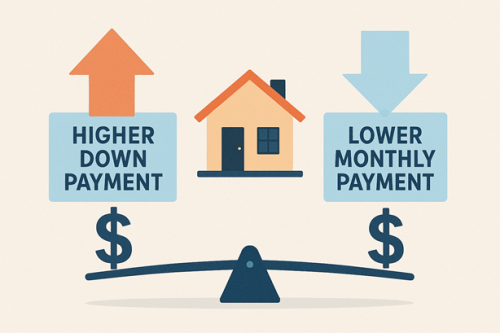
What is the benefit of putting less money down?
Question of the week: What is the benefit of putting less money down?
Answer: Having more money.
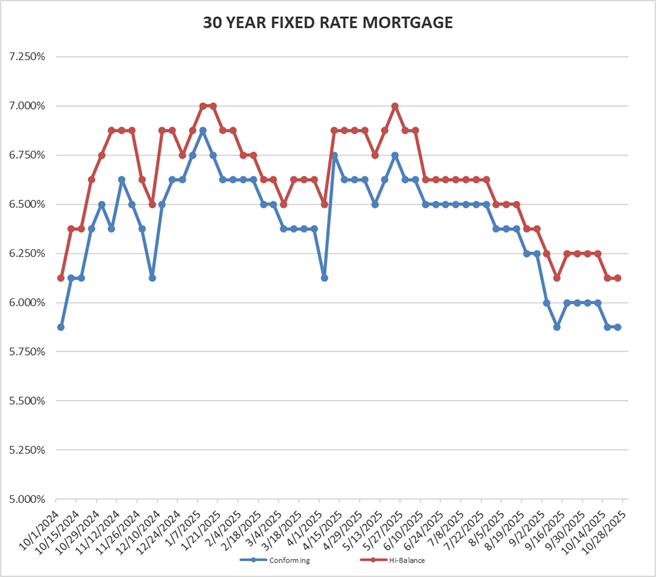
Since the beginning of the WR&MU we have used 20% for a purchase transaction (and a 740 FICO score) for the rates posted below. The 20% down payment is used as it is the one most commonly used by the industry when calculating rates.
That said, I have always been a fan of buyers putting less money down, if possible, to purchase a home. Primarily because I believe in “leverage,” or OPM, Other People’s Money for major purchases as I can do more with the cash savings than can be done with it in an illiquid asset.
Equity, or the amount of value in your home, is the difference between what the home is worth and the amount of the mortgage. For instance, if you have a $800,000 home and owe $640,000, your equity is $160,000.
Your equity, if you have a mortgage, grows in two ways.
First, very incrementally through monthly mortgage payments as a small percentage of the payment pays down the principal. Taking our example above, assuming a 5.875% mortgage, the monthly payment would be approximately $3785 per month. After 5-years of payments ($227,100) you will have paid down a little over $45,000 of the principal. That is about 5.5% of the purchase price of the home, or a little over 1% equity growth per year through mortgage payments.
Second, considerably more impactful on equity growth, is the value of the home (over time in most markets). Using our $800,000 purchase price, if the average market price increase is 4%, after five years the home is worth about $975,000; an increase in equity of almost 22%.
We have established that equity growth is dependent more on the housing market than paying down a mortgage. This shows that owning a home is more important than the amount of your mortgage to increase equity.
I term equity in a home, “dead money.” It does not increase the value of your home, nor does it generate any return on value—i.e. no interest or dividends. You cannot spend equity, you cannot eat equity, you cannot grow equity other than paying down your mortgage or having other similar homes in your area increase in value.
To obtain the equity in your home it will cost you money and time. Either you sell your home and pay fees for agents, escrow, title, taxes, etc. Or you obtain a mortgage, 2nd mortgage, or HELOC, all of which cost money and a process that will take time before the funds are available to you.
If you have money in a savings account it will grow due to compound interest. Or, if you have money in an investment or retirement account, over time it will likely increase through dividends, interest, and markets going up. Unlike accessing equity, accessing these funds, which are either fully or very liquid, can happen quickly, and, depending on where they are parked, very cheaply or at no cost.
If you can purchase a home with less money down, and yes with a higher monthly payment, after closing you will have less equity and more money left in your accounts.
Here is the math on a $800,000 purchase with 20, 10 and 5 percent down scenarios for borrowers with a 740-credit score. Note the rate on all options is the same, 5.875%*, and mortgage insurance is added to our calculation.
*It is surprising for most that a loan with a higher down payment has the same rate as a lower down payment. This is because the 10% and 5% loans have mortgage insurance which cover a significant amount of the losses in a foreclosure, while a 20% down loan has no mortgage insurance and the lender will lose more money in a foreclosure. At times the lower down payment loans have lower rates than 20% down.

The final column is important; MOs RECOUP is the number of months it will take the buyer putting 20% down to save back the extra money they put into the purchase divided by their monthly savings due to a lower loan amount and no mortgage insurance.
The math 20% down buyer puts down $80,000 more than the 10% down buyer. His monthly payment for the loan is $643 less per month than the 10% down buyer, which is his savings for the extra $80,000 down.
The 10% buyer, at the end of the transaction will have $80,000 more in the bank, and will pay $643 more per month.
Divide $80,000 by $643 and the result is 124. If the 20% buyer puts $643 per month into the bank, it will take him 124 months, over 10-years, before he has saved the $80,000 he put into the home ten years before.
In the meantime, the 10% buyer has the $80,000 he can use as he wishes, use to do any repairs or remodels without having to take out another loan, use to supplement his monthly payment difference of $643 per month, put into a savings or investment account, start a college fund for children, donate to the 3-legged dog society, whatever he desires.
Provided both homeowners keep their homes for an extended period of time, the 124 months will likely get extended even further.
Because the 10% loan has mortgage insurance, the chances are very like that the MI will be able to be removed from the loan in the future once conditions are met (24 consecutive payments made in a timely manner and equity of 25% or higher). When this occurs the difference between the two payments are $168 less per month.
Secondly, assume in 5-years, but perhaps sooner, rates drop to 5% and both homeowners decide to refinance. Remember, more equity does not mean higher value, so both homes, assuming 4% growth per year in value, are worth $975,000.
The 20% borrower has a balance of $594,000 on the mortgage, at 5% the monthly payment is $3190 per month, a savings of $595 per month.
The 10% borrower has a balance of $669,000, which puts their loan-to-value at 69% percent so they do not have mortgage insurance. Refinancing lowers their payment to $3590 per month, a savings of $892 per month.
The 20% borrower is paying $400 less per month than the 10% borrower, with $40,000 left on the months-to-recoup calculation, instead of 64 months left on the original savings, it is now 100 months—extending the total time to recoup the original extra $80,000 down from over ten years to almost fifteen years.
I always tell my clients, it is not my money being spent, I am not making the payment, I am not living in the home, and I will not be the one benefiting from more or less cash in the bank, nor a higher or lower mortgage payment. That said, my advice if you can afford it and qualify for the home you want, put less money down for larger benefits in the long run.
If you, or someone you know, wants to do the math on your home purchase, please contact me and I’ll pull out my calculator.
Have a question? Ask me!
We had some economic news this week. For the first time since the government shutdown, meaningful economic data released today. September’s Consumer Price index increased at a slower the expected rate, up 0.3% for the month as opposed to 0.4%, which would have matched August’s CPI growth. Year over year CPI is 3.0%, slightly higher than August’s 2.9%. The September CPI number is important as it is the final month used in the average to calculate the Cost of Living Adjustment (COLA) for next year’s social security payments. The average for July, August and September CPI data shows SSI payments next year should increase by 2.8%. The CPI data, being lower than expected makes if very likely the Federal Reserve will lower its benchmark interest rate for the second month in a row next week.
Rates for Friday October 24, 2025: Even though CPI was bit lower than expected, investors have pretty much priced in a drop in the Fed rate next week, as a result, rates are flat from last Friday.
FIXED RATE MORTGAGES AT COST OF 1.25 POINTS LOCKED FOR 45 DAYS:
30 year conforming 5.875% Flat
30 year high-balance conforming 6.125% Flat
Please note that these are base rates and adjustments may be added for condominiums, refinances, credit scores, loan to value, no impound account and period rate is locked. Rates are based on 20% down with 740 FICO score for purchase mortgages.
As we wrap up the baseball season with the World Series between the Dodger and Blue Jays, I start looking at the calendar for when pitchers and catchers report to spring training next year.
In the meantime, despite knocking my Phillies out, I am very much a Dodger fan—not just because I really do like them, just not as much as my Phils, but because I will never be able to root for the Blue Jays because of 1993.
No, I did not watch the clip.
Note that Phillies phans insert the same middle name for Joe Carter than Red Sox fans use for Bucky Dent.


