

How do inflation and employment affect mortgage rates?
Question of the week: How do inflation and employment impact interest rates?
Answer: Thorough readers of the WR&MU have received some education in macroeconomics (study of the whole economy) and the tie in between rates and economic data. However, after many years of feedback I know that readers of the WR&MU are like kids at a children’s birthday party.
When our oldest was about 7 years old I made the observation that there are four types of kids when it comes to cake and ice cream: Kids who eat only the ice cream, kids who eat only the cake, kids who eat only the icing, kids who eat all of it (I am the latter).
For the WR&MU we have readers who read only the Question of the Week, those who read only the economic update and rates, those who read only the personal section at the end (by far the largest group), and those who read the entire update (by far the smallest group!).
This week hopefully we will catch a broad readership for the top section.
First and foremost, mortgage rates are not controlled by the Federal Reserve or any specific entity. The vast majority of mortgages are bundled by lenders and sold to Fannie Mae or Freddie Mac. Fannie and Freddie then create bigger bundles, called Mortgage-Backed Securities (MBS), and sell those on the open market. The price investors will pay for MBS determines mortgage rates, the higher price they will pay the lower rates will be, the lower price they pay the higher rates will be. Fannie and Freddie determine their purchase price for mortgages from lenders based on the price they get when re-selling to investors.
For mortgages that are not sold to Fannie or Freddie, the pricing is based on the prices Fannie and Freddie are getting and then adjusted for risk and demand.
Investors make their decisions on what they will pay for 15- or 30-year fixed rate mortgages based on information they receive on economic activity, geopolitical news, and most importantly expectations as to what the economy will be like in the future.
A basic rule for interest rates is the relationship between interest rates and economic strength. Strong economic times have higher rates, slow or weak economic times have lower rates.
Above we wrote that the Federal Reserve does not control mortgage rates. This is true in the sense that they do not raise or lower the rates directly. However, they do control, to a large extent, the rates for investments that will compete with MBS for investors.
For instance, when the Fed increases its benchmark rate by 0.25%, banks will increase their prime rate by 0.25% because it costs them more to borrow from the Fed and other banks. There are many credit instruments, such as credit cards, auto loans, lines of credit, education loans, that use the prime rate as their primary determinant for rates. If the prime rate goes up 0.25%, we can expect rates for consumer, and commercial, credit to go up as well.
This is the current rate environment, the Fed has been, and will continue, to raise rates through the end of the year, and possibly into 2023.
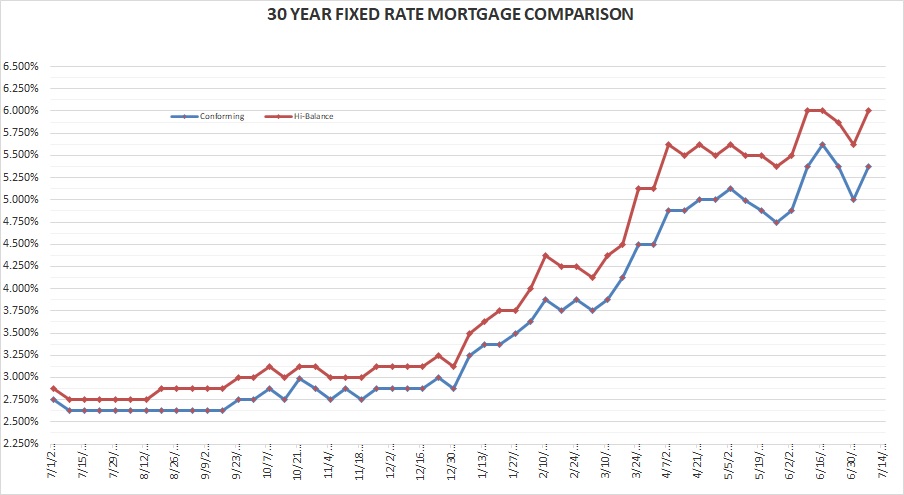
However, since January the Fed has increased its rate from near zero in January to 1.5% after its most recent rate increase. During this time, we have seen mortgage rates climb from 2.875% to 5.375% (down from recent high of 5.625%); significantly more of an increase than the Fed rate increase.
The primary reason for this is investors anticipating higher rates from the Fed and the need for a higher return on their investments because of inflation.
Back to our question on how inflation and employment impact mortgage rates.
Inflation is caused by too much money chasing too few goods and services, demand exceeds supply. This can be a result of lack of supply, or an abundance of money.
The pandemic created a reduction in supply of many goods used by consumers and manufacturers, the “supply chain” issue we have been reading and hearing about for almost a year. Manufacturing shutdowns, or slowdowns, due to lack of workers either due to government mandates, or employees out with the virus, or employees leaving work to receive government benefits, reduced supplies needed to produce consumer goods. As a result, prices began to climb. Automobiles were the most noticeable sector to see large increase in prices as supplies were low due to a lack of computer chips being manufactured. Another noticeable sector with sharp price increases was durable consumer goods, think appliances, consumer electronics, home furnishings.
The early increases were attributed to work-at-home investments as families created home offices, or spending so much time at home resulted in remodeling and repairs. As we came out of the pandemic and employment grew, more people getting paychecks entered the marketplace to purchase goods and services.
Fueling the purchasing power of the consumer was several trillion dollars being sent to Americans from federal and state governments to stimulate the economy and keep it from crashing.
As inflation began to grow, many investors saw the amount of money in the economy from the Federal Reserve and federal and state governments, increasing employment as workers returned to their jobs, most notably the very large leisure and hospitality sector, and continuing lack of necessary supply to keep prices in check.
While the Fed was calling the increase in prices in the early stages of our current inflationary era “transitional,” investors and many economic analysts were rebuking the label and calling for the Fed to change its stance from boosting economic activity to stifling it but increasing rates.
Not being able to control what the Fed does, investors voted with their dollars and went cold on U.S. Treasuries, MBS, and other fixed rate investments, causing rates to climb.
High inflation with a strong labor market creates a spiral that is hard to break. Employers must pay higher wages to attract workers, are paying more for the goods they sell to consumers, and must therefore charge consumers more for the goods they sell. Consumers, paying more for their goods and services, demand higher paying jobs to afford their standard of living.
Underlying all of the price increases for consumers and businesses, is the price of energy needed to run equipment, transportation, and to heat and cool buildings.
The spiral is broken when prices and/or employment slow their growth, or decline. It is rare that once prices increase that they drop, even more so drop to the levels before an inflation cycle. What is not so rare is that employment shrinks, unemployment rises, as an economy cools.
When investors buying rate based investments, such as mortgages, see economic data showing inflation is slowing, that employment growth is slowing, or that one and/or the other is shrinking, they will react by purchasing those investments to lock in higher rates of return before rates fall once again.
Nothing is in concrete in economics, except the relationship between supply and demand. Reading the data that represents supply and demand in our economy as seen by inflation and employment, investors will determine if rates should be going up, or going down. They will act on their determination, thereby causing rates to go up, or down.
The target for inflation that is acceptable to enable steady, but not too robust, economic growth and stable employment markets is around 2%; this is also the target for stable interest rates. In May the Consumer Price Index showed an annual rate of inflation of 8.6%. It will take quite a bit of work to slow price growth more than 75% of the current rate of inflation.
Have a question? Ask me!
Labor markets are still strong. That is the message in data released today by the Department of Labor with June’s employment report. The economy added 372,000 new jobs in the month, bringing total employment back to over 95% of pre-pandemic levels—total employment is about 500,000 short of February 2020. The increase was a surprise to most analysts who thought job growth would be slowing due to higher wages and prices. Wages increased 0.3% for the month, showing a slowing in wage increases from 5.6% in April, 5.3% in May, to 5.1% in June. The data supports large rate hikes from the Fed as a strong labor market makes a recession, a deep and long recession, less likely.
Rates for Friday July 8, 2022: After dropping the most from week to week since 2008 last week, rates this week spiked back up to where they were the week before. As mentioned above, the strong jobs data reduces recession concerns, increasing the likeliness of large rate hikes from the Fed who will feel they can spike rates to slow inflation without pushing the nation into a deep recession. Investors reacted to the news by pushing mortgage rates back to, or near, recent market highs.
FIXED RATE MORTGAGES AT COST OF 1.25 POINTS LOCKED FOR 45 DAYS FOR PURCHASE TRANSACTIONS:
30-year conforming 5.375% Up 0.375%
30-year high-balance conforming 6.00% Up 0.375%
Please note that these are base rates and adjustments may be added for condominiums, refinances, credit scores, loan to value, no impound account and period rate is locked. Rates are based on 20% down with 740 FICO score for purchase mortgages.
A milestone week for yours truly this week as I completed my 60th tour around the sun. The only time I don’t feel like I’m still in my early 30’s is when I look in the mirror. In a diva type move, I am considering removing all the mirrors in our home.
Reading about how Medicare is fully funded to 2028 (66 years old) and social security to 2037 (75), I’m conflicted as to whether I should be older to take advantage of these programs I have been funding for over 40-years, or should be much (much) younger to have been better about putting away funds for retirement when I was much (much) younger, or be this age and know I’ll be part of the employment force for much (much) longer.
Have a great weekend, I’ll be researching who has the best “senior” discounts!
Dennis
Past Weekly Rate & Market Updates can be found on my blog page at my website www.DennisCSmith.com/my-blog


