


How can we buy a home in 2024?
Question of the Week: How can we buy a home in 2024?
Answer: With planning and assistance from professionals, and perhaps family.
While there are families buying homes for over one-million dollars with cash, they are the far, far outliers for the home buying market. Chances are if you are reading the WR&MU, or someone you know because you were kind enough to forward it, need a mortgage to purchase your new home.
Income, funds for closing, credit payments and score are the factors that go into mortgage underwriting and approval. The income and credit payments are used in the debt-to-income (DTI) calculation, the primary factor in the amount of mortgage for which you will be able to qualify.
Debt-to-income Add up your monthly credit obligations, add in the new PITI (total housing payment that includes mortgage payment principle and interest, property taxes, homeowners insurance, and other fees such as homeowners association if applicable), and divide by your gross income. This calculation results in a percentage rate:
Income = $10,000 per month
PITI of proposed mortgage = $3500 per month
Car payment = 600 per month
Credit card minimum payments = $250 per month
Total debt payments divided by income: $4350 / $10,000 = 43.5%
This DTI will be eligible for most conforming mortgage programs. If you wish to purchase a home that needs a larger mortgage, your options are to increase your income, and/or reduce your monthly debt payments.
Income Perhaps the most difficult factor to control. Most people cannot quickly increase the amount of money they make—and if they can, depending on how they create that increase it may not be eligible for loan qualifying. Because of this, if you are not able to qualify for the size of the mortgage you need for the price range you require you may need to obtain a co-signer.
Qualifiable income has many facets depending on whether you are a W-2 employee or self-employed, are paid bonuses or overtime, have commission income, all have different guidelines to qualify what income will be used to determine the size of your mortgage amount.
Regarding increasing your income, guidelines look backwards as to your history of amount you are paid and how you are paid. If you add a side-gig, guidelines will want to see that you have a history of working more than one job, and will want to see at least one year of the income to show consistency in earnings.
Credit payments While it can still be challenging, it is often easier to reduce credit obligations to improve qualifying than to increase income.
During initial quick pre-qualification calls and meetings to get an idea of what our starting point is, many clients when asked about what their monthly debt payments are tell us how much they are paying per month on credit cards.
For mortgage qualifying the industry uses the minimum required payment, for most credit cards that amount is 2% of the outstanding balance. It is great that you are paying more per month on your credit obligations to pay them off sooner, but while your $1500 per month payments are very helpful, for our standpoint the $250 per month minimum increases the amount of mortgage you qualify for dramatically.
When it comes to auto loans, or other installment debt, if the balances on the obligation are 10-months or less, for most mortgage programs, the payment will not be included in the DTI calculation. For instance, in our above DTI calculation with the $600 per month car payment, if the balance of the loan is $5980, the $600 payment is not included—this frees up $600 that can be used to increase your purchasing power.
As for credit card debt, if we are able to show on a credit report that balances are lower, or paid off, then new payment, or no payment, can increase purchasing power.
Funds for closing One of the hardest struggles most people have is losing weight and keeping the lost weight lost. Equally challenging for many, most, is saving money and keeping money saved. Both require pretty much the same methods: plan, execution of plan, discipline to stick with execution of plan.
Funds for closing include down payment, closing costs, and funds for those who may need to lower debt obligations as described above.
Down payments can range from no down payment if you are a veteran with available benefits to as much as you can handle. Most first-time buyers are looking at down payments starting at 3% and increasing from there.
Closing costs are roughly estimated at 3% of the purchase price, perhaps more or less but that is the rough starting point before digging into details of price, loan amount, closing costs requirements (for instance if an impound account is required so your taxes and insurance are collected by the lender).
With home prices where they are, families who started a long-term savings plan several years ago to use for buying a home have been chasing the market and needing to save more and more.
Important note: many families we have worked with over the years have been waiting to buy until they have a 20% down payment, in the mean time they have missed out on buying and subsequent home value appreciation because they did not buy with 3%, 5% 10% down when they would have qualified.
It is never too soon to start planning, and saving, for your home purchase. Ideally, you consult with us to go through different ideas and options for your plan. If you have a financial advisor consult with him/her for savings plan and options with investments.
One avenue for funds for home purchases that is very often over-looked, or avoided due to poor information, is the use of retirement accounts as sources for funds.
The IRS allows first time homebuyers, defined as someone who has not owned a home for 3-years or longer, can withdraw up to $10,000 from a retirement account without penalty (there are some conditions, please check with your tax preparer). For a married couple that is $20,000 tax free for closing costs.
Most employer sponsored retirement accounts (i.e. 401(k)) allow employees to borrow from the 401(k) for the purchase of a home. Typically, plans will let you borrow up to 50% of your account balance to a maximum loan amount, also typical is $50,000 or less.
If you borrow from your 401(k), you likely will have an option of period to repay and the payments are made through your normal paycheck. You pay yourself back, not a 3rd party, and as with all loans there is an interest rate—you pay yourself interest. Note if you leave the company before the loan is paid off, you will have to payback the outstanding balance or the amount is deducted from your 401(k) and the amount is counted as income and subject to taxes and any penalties for early withdraw.
Consider, husband and wife, both long-term with their companies, each has $80,000 in their 401(k) accounts. Each obtain a loan for 50% of their balances, then take $10,000 each with no penalties. They have $100,000 for down payment and closing.
Yes, you have depleted your retirement accounts, however you will be paying the funds back, with the exception of the $10,000 each taken with no loan, and your funds will be invested in a home that will appreciate over time, which will at some point become part of your future retirement.
Finally, a very common source of funds are parents or other family members providing a gift, or in some instances loaning funds as a second mortgage on the home with a generously low interest rate and repayment terms that do not negatively impact qualifying.
Credit score For most borrowers credit history does not lead to inability to qualify, but instead impact the interest rate they will receive. Mortgage rates are determined by several factors, one of which is credit score, or FICO score. Pricing is determined in tiers; higher scores have lower prices and lower tiers have higher prices. Depending on your history and current accounts, you may be able to increase your credit score. For some clients this can happen somewhat quickly by adjusting account balances, for others it can take more time to cure some past issues.
Too often we have met with clients who made decisions thinking they were improving their qualifying and speeding up their home buying process that need more time do to actions that took that slowed their home buying process; usually from scouring the internet, watching YouTube and TikTok videos and getting poor information. If you are considering purchasing a home this year, next year, or at any time in the future, meet with a mortgage professional to learn about the process, what your options are given your specific situation, and put together a plan to homeownership.
To schedule an initial meeting by phone or Zoom, click here for my calendar, please feel free to forward to a friend or family member!
Have a question? Ask me!
Maybe not bad news? The Bureau of Labor Statistics released the Consumer Price Index for December yesterday, and the numbers went backwards. Prices rose 0.3% in December, the highest in three months. Year-over-year, prices rose 3.4% after increasing 3.1% annually in November. Making what would not be good news into good news is that the “core” rate of inflation (energy and food prices stripped out of data) decreased year-over-year to 3.9%, the first time the number has gone below 4% since mid-2021. What could have been negative for rates with the monthly increase in the broad data, became somewhat neutral as the data will have no impact on any Fed decision on rates.
Rates for Friday January 12, 2024: Rates dip from last Friday, starting 2024 with some nice downward momentum!
FIXED RATE MORTGAGES AT COST OF 1.25 POINTS LOCKED FOR 45 DAYS FOR PURCHASE TRANSACTIONS:
30-year conforming 6.50% Down 0.125%
30-year high-balance conforming 7.00% Down 0.125%
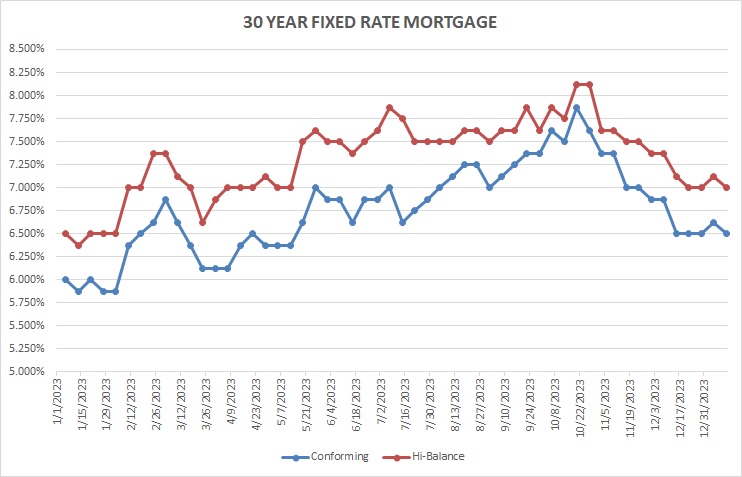
Please note that these are base rates and adjustments may be added for condominiums, refinances, credit scores, loan to value, no impound account and period rate is locked. Rates are based on 20% down with 740 FICO score for purchase mortgages.
Our first “normal” week of the year. Schools are open, everyone working normal work week, the “Resolutionistas” are filling gyms and the vegetable section of grocery stores…
Heading into my knee surgery I put into my head a mantra to prevent over doing it during rehab, which I have been apt to do in the past for other procedures and ailments. I kept telling myself my objective (resolution?) was for my knee to get incrementally better every day.
As I thought about it, and continue to through the rehab process, I learned that this is the mantra I should have had for life starting many years ago.
So, for 2024 and beyond, that is my daily objective, get incrementally better every day.
Have a great week,
Dennis
Past Weekly Rate & Market Updates can be found on my blog page at my website www.DennisCSmith.com/my-blog


