


Why is my agent telling me I have to put 20% down?
Question of the week: Why is my agent telling me I have to put 20% down?
Answer: Memory bias and industry assumption.
The neighborhood that wasn’t very good when you were growing up has changed with many families moving in and improving the homes and community—some still assume it is not a very good neighborhood due to some bad experiences or occurrences in the past.
The restaurant you went to for years for special occasions and celebrations has declined as the second and third generations have taken control and let standards for food and service decline—you think it is good due to nostalgic memories.
Many years ago, decades ago, buyers using conventional loans with less than 20% down that required mortgage insurance had a harder time getting their offers accepted because there tended to be a greater number of delays, or denials, in their loan approvals.
These loans would be underwritten by the lender and then the mortgage insurance company. Not infrequently, the mortgage insurance underwriter would request additional documentation or information beyond what the lender’s underwriter would require, which could delay closings. In some instances, the mortgage insurance underwriter would deny coverage. This would result in either killing the transaction, or in many of these instances, delaying the closing further as the loan was sent to a different mortgage insurer.
Many years ago, decades ago, buyers using FHA or VA financing for their purchase transactions would have a harder time getting their offers accepted because the underwriting, while looser on many credit guidelines than conventional mortgages, were stricter on the condition of the property. For these loan applications, underwriting conditions that would not be placed on conventional transactions such as painting peeling paint, replacing cracked electrical faceplates, or obtaining a roof certification. As well, because the down payments were either 3% (FHA) or zero (VA), the perception was that there was a greater chance that loans would be denied in underwriting.
These biases regarding these types of transactions continue today with many agents. I have had clients who lost out on offers with 10% down that were for more money than competing offers with 20% down. Why? Because the listing agents felt the 20% down offers was less risky than our clients’ offers.
Knowing this many agents encourage their clients to write offers with 20% to overcome this bias and increase the chance their offers will be accepted.
Like the old neighborhood that has gotten better, so too have mortgage underwriting and approvals. More importantly, what has improved tremendously over the years are pre-approvals that we provide to our clients to accompany their offers.
We have the ability to obtain credit approval from Fannie Mae and Freddie Mac which puts the biggest risk of not closing a loan on the value of the property per the appraisal, or other factors that do not concern the borrower—such as title issues, undisclosed property issues, or for some transaction faulty Homeowners’ Associations.
Due to delegated underwriting, the lenders’ underwriters also underwrite for the mortgage insurance companies, eliminating a second underwriter review than can delay, or negate, loan approvals.
In most cases, it makes more sense for buyers to put less down payment. The money they save in the bank with a lower down payment can take a years to recoup from the monthly mortgage payment savings from a higher down payment (read “Why mortgage insurance is a good thing” from WR&MU last August).
From a lender standpoint, if we have our Automated Underwriting approval, and all the evidence for income, assets, credit, support the approval, we know we will close a loan whether 25%, 20%, 10% or 5% down. One is not less or more risky than the other, except in the minds of those still making decisions based on decades old biases.
This holds true not only for conventional mortgages but FHA and VA as well.
Our industry has become excellent at being able to determine very quickly if a loan will be approved or not. For those agents who have been burned by pre-approval letters that resulted in loan denials and failed escrows, I feel safe in saying the issue was likely not the amount of down payment, or loan program, that was being used by the borrower, but likely the due diligence performed by the person producing the pre-approval.
Because of the 20% down bias, too many buyers are writing offers they should not have to write, spending more of their hard earned savings than they need to spend, or losing out on homes they should be buying, for no reason that has to do with whether their mortgage application is riskier or safer depending on the size of their down payment.
Finally, a personal experience with higher down payments having less risk than offer with lower down payments. We purchased our home because it fell out of escrow and we were a back up offer with 10% down. The buyer that fell out was purchasing the home with all cash and couldn’t, or wouldn’t, get their funds together within the stipulated time frame.
Whether a buyer is fully vetted and qualified for their offer price and terms is what matters most, not the size of their down payment.
To schedule an initial meeting by phone or Zoom, click here for my calendar, please feel free to forward to a friend or family member!
Have a question? Ask me!
Wheee! Put your hands in the air and ride the rollercoaster that is the mortgage and bond market. Quick reminder: prices up-rates down, prices down-rates up. When we discuss bonds and Mortgage Backed Securities (MBS, which determine mortgage rates), and say the “market dropped” it means prices dropped and rates went up.
Federal Reserve Chair Jerome Powell told Congress this week that based on economic data coming out this month, mainly employment and consumer prices, the Fed may return to larger rate increases—recapping the Fed was raising rates at 0.75% (three-quarters of one percent) in November, slowed increase to 0.50%, then last month increased its benchmark rate by 0.25%. Following last month’s data showing hot employment markets and higher inflation, markets responded accordingly and rates popped on Monday.
Mortgages and bonds gained ground yesterday as news came out the Silicon Valley Bank, the 16th largest bank in the country, was having difficulties and losing deposits. A major bank for tech companies, venture capitalists, and start-ups, SVB clients started pulling deposits above FDIC insurance coverages ($250,000 per account). Sensing big trouble, investors dumped stocks and bought bonds and MBS pushing rates down.
The roller coaster continued today as MBS opened higher than yesterday’s close based on the SVB situation, an oddity as today is the first Friday of the month—which means the jobs report for February, which the Fed will be watching to determine how much to raise its benchmark rate in a few weeks. The SVB issue came to a bit of a conclusion as the FDIC took control of the bank and closed it, transferring deposits to a new bank (Deposit Insurance National Bank of Santa Clara). On Monday insured depositors can access their funds, those with accounts above $250,000 will get certificates for their balances that are uninsured, that may or may not be fully redeemable in the future. This is by far the biggest bank failure since 2008, and is second all-time only to Washington Mutual’s collapse.
Continuing the ride, after the open MBS securities have bounced around, but mostly down (higher rates) as investors digested the run on bank stocks, and the Labor Department’s jobs data. Was the data positive or negative for rates? That is still being determined as the data was a bit of both. On the negative for rates was that 311,000 jobs were added in February, about one-third more than expected. While down significantly from the 517,000 jobs added in January, the number still signals strength in the jobs. Leading the way, again, are jobs in leisure and hospitality—a further negative as it indicates consumers are still paying for meals at home instead of saving money and making them at home. The positive in the report for rates was a bump in the unemployment rate to 3.6%, showing some weakness and perhaps a start of the climb to an expected rate of 4.50-5.00% later this year. With wage growth also declining to 0.2% from February’s 0.3%, indicating a slowing in wages impacting inflation, combining with the higher unemployment rate, investors need to consider if these two data points are enough to slow the Fed’s momentum for a higher rate increase.
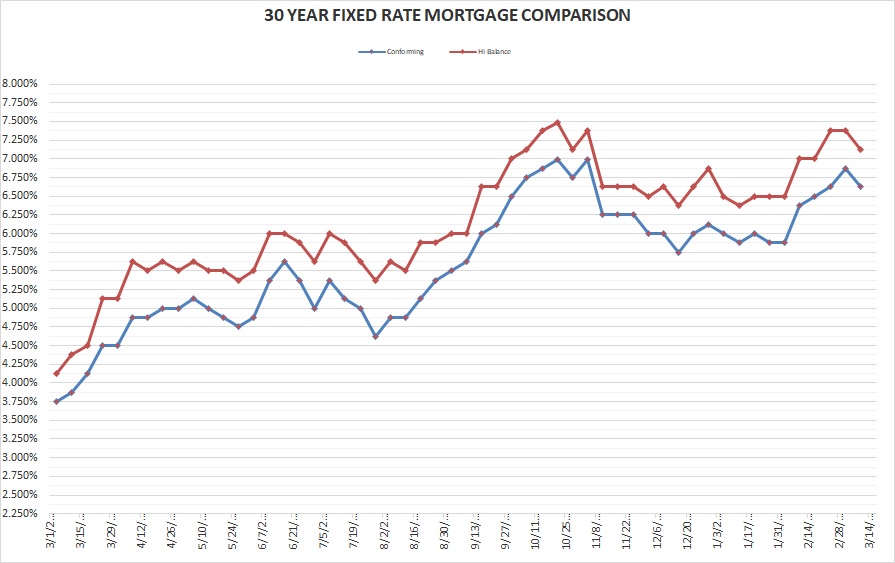
Rates for Friday March 10, 2023: As we pull up to the disembarking platform and get out of our rollercoaster cart this Friday rates are lower than last week, reversing the increases we experienced. Hang of to your hats, as the ride continues through the month with data being released for consumer prices and retail sales—both closely watched by the Fed, and investors.
FIXED RATE MORTGAGES AT COST OF 1.25 POINTS LOCKED FOR 45 DAYS FOR PURCHASE TRANSACTIONS:
30-year conforming 6.625% Down 0.250%
30-year high-balance conforming 7.125% Down 0.250%
Please note that these are base rates and adjustments may be added for condominiums, refinances, credit scores, loan to value, no impound account and period rate is locked. Rates are based on 20% down with 740 FICO score for purchase mortgages.
It used to be that Leslie and I would try to watch all the best picture nominees before the Oscar ceremonies. That was easier when there were only five pictures nominated. Now with ten that is harder to do. Factor in whether they are released in theaters, or what streaming platform the are on, it becomes more challenging.
Of this year’s nominees, I have seen Top Gun: Maverick, Everything Everywhere All at Once, The Banshees of Inisherin, All Quiet on the Western Front, and about half of Elvis. Five very different movies. My least favorite was Elvis, hence seeing only half. Of the others, I enjoyed them all. If I had a vote, it would be a close one between Banshees and All Quiet, with Banshees winning out.
Have a great week,
Dennis
Past Weekly Rate & Market Updates can be found on my blog page at my website www.DennisCSmith.com/my-blog


