


Why are more jobs bad for real estate markets?
Question of the week: Why are more jobs bad for real estate markets?
Answer: Wonky economics geek warning…While I always try to make simple explanations of economic activity and principles, our commentary today may get a little wonky and in the weeds. I hope, however, to provide information that will enable readers a better understanding or our economy and how different sectors relate to, and impact, each other. You’ve been warned!
Real estate markets are very dependent on the rates that buyers pay for their mortgages to purchase their new homes, other residential properties, and commercial properties. While there were a lot of all cash transactions during the pandemic when properties on the market were scarce and buyers in the market were plenty, in most real estate market periods buyers use a mortgage for their real estate transactions in an overwhelming majority of sales.
Higher rates increase the cost of the property to the buyer. Fifty-two weeks ago a family could purchase a $600,000 home with 20% down and have a monthly mortgage payment of about $1990 per month. After five years their total cash to own the property would be $239,400 (down payment plus 60-months of the mortgage payment).
Today a family can purchase a $600,000 home with 20% down and have a mortgage payment of about $2875 per month. After five years their total cash to own the property would be $292,500; about 22% more for the same home.
Higher interest rates not only increase the long-term cost of a new home, they also limit the sales price many buyers can afford to purchase. In the above examples, if a family needed the mortgage payment to be 33% of their income to qualify, last year an income of about $80,000 per year qualified them for their $600,000 purchase. This year the income needed would be about $115,000.
(Note these figures are examples and not intended to be accurate numbers to use to calculate what mortgage amount you may qualify for to purchase a new home.)
Today the Labor Department announced that the economy added 263,000 jobs in November, included in the announcement was data showing that wages increased the most in the past 13-months. Both data sets were well above Wall Street expectations.
More people are earning paychecks and paychecks are bigger than they were the month before. This is very good news for families that are seeing new income, and those seeing higher income, flow into their bank accounts each month.
As you are very aware, I hope, inflation spiked tremendously this year, reaching a 40-year high in the summer. To fight higher, and higher, and higher, prices, the Federal Reserve has engaged in a policy of increasing their benchmark interest rate to slow economic growth, slow consumer spending, slow companies expanding their payrolls and the hiring of new workers. The Fed’s objective is not just to slow these sectors of the economy, but to have them shrink. Slowing inflation from 8% to 6% per year is great, but their goal is to lower inflation to 2%.
Our economy is driven by consumer spending, accounting for approximately 70% of all economic activity. Consumer spending is driven by wages and salaries. Wages and salaries are driven by supply and demand in the labor markets. Consumer prices are mostly driven by the wages and salaries paid by businesses. Theoretically, higher prices slow consumer spending, which slows demand for workers, which slows wage and salary growth.
Stay with me, we’re getting to our question of the week answer.
Earlier this week Jerome Powell, the Chair of the Federal Reserve, stated that slowing inflation is encouraging and that after four increases of 0.75% (three-quarters of one percent) in its previous four meetings, and a total of 3.5% in rate increases since March, the Fed may raise its benchmark rate at a slower pace, starting with their meeting on December 14th.
Critical word in that run-on sentence? “May.” The Fed may slow the rate of its rate increases.
In comments from Powell and various other Federal Reserve members, as well as in minutes from their meetings, an area of focus and concern is the labor market. Intimately aware of the relationship between inflation and wages, the Fed is not only targeting inflation with its rate hikes, but wages and salaries. Not necessarily the amount workers are earning, but how many workers are earning wages and salaries. To reach their 2% inflation goal many Fed officials feel the unemployment rate will climb to as high as 5%; in November the rate was 3.7%.
November’s labor market data reflects a labor market that is growing, not slowing. More workers earning more money leads to more consumer spending, which makes it difficult to push down inflation rates. Portending higher wages, and more hiring, is that there are 1.7 job openings for every available worker; demand for workers is far outpacing supply in the economy.
With today’s news, the “may” in Powell’s statements regarding future rate increases may become a may not. Some experts are now changing their views from Wednesday, after Powell’s comments, and are feeling another 0.75% rate increase is in store in a few weeks.
Investors are reacting to today’s news with an expectation of higher rates for a longer period of time. The combination of other economic data this week (see section below) on GDP growth, combined with the jobs data push out concerns of a recession looming early in 2023. As well, the expectation that the Fed Funds rate, which was in the 0.00% – 0.25% range in early March, could be over 5.25% – 5.5% by Fall of 2023.
More jobs reflect a strong economy, strong economies generally have higher rates, higher rates dampen housing markets. In the current economic cycle, more jobs with already high rates can, and perhaps will, harm the real estate markets by reducing the number of qualified buyers and having more potential buyers stay on the sidelines.
Last December the question of the week was, “What does the Federal Reserve announcement mean for mortgage rates?” For those who enjoy wonky-economics, it is a good look back at one-year ago and what the concerns and expectations were for our economy and rates before inflation through everything off track a few months later.
Have a question? Ask me!
Loan limits for 2023 are significantly higher. The Federal Housing Finance Agency, which oversees Fannie Mae and Freddie Mac, announced that the maximum conforming loan limit would increase from $647,200 in 2022 to $726,200 in 2023; the “high-cost area” or “high-balance” maximum limit is increasing from $970,800 to $1,089,300. The 12% increase from the 2022 loan limit, follows an 18% increase from 2021 to 2022; the highest two consecutive year increases in the conforming limit since the 33% increase between 1985 ($115,300) and 1987 ($153,100) when I started my career in the mortgage industry. Interesting to note is that from 2006 to 2016 the maximum conforming limit was $417,000. The loan limit is established using the average increase in home values over the prior year using the House Price Index for the third quarter.
The first revision of 3rd quarter GDP was adjusted upward from 2.6% growth to 2.9%. The upward adjustment shows the economy growing at a steady rate despite the Fed’s efforts to slow it. Consumer spending still fairly strong, labor markets expanding, GDP growing, all against concerns of a pending recession in early 2023. The news is not positive for rates declining.
What is positive for rates, perhaps not necessarily declining but leveling off over the short term, was the Personal Consumption Expenditures (PCE), the primary inflation gauge used by the Federal Reserve. Declining 0.3% in October and down to 6.00% year over year, the PCE is moving in the right direction, supporting slower rate increases from the Fed and possible mortgage rates flattening, and/or declining.
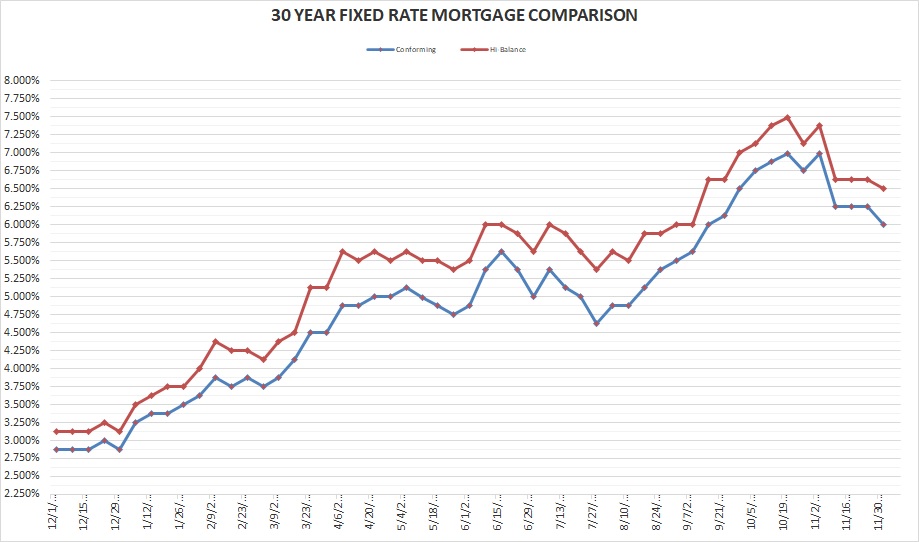
Rates for Friday December 2, 2022: Rates were flat last Friday, following Thanksgiving, from the prior week, and the drop in rates earlier in the week from Powell’s comments about slowing rate increases is holding through today’s trading. Rates at their lowest since mid-September.
FIXED RATE MORTGAGES AT COST OF 1.25 POINTS LOCKED FOR 45 DAYS FOR PURCHASE TRANSACTIONS:
30-year conforming 6.00% Down 0.25%
30-year high-balance conforming 6.50% Down 0.125%
Please note that these are base rates and adjustments may be added for condominiums, refinances, credit scores, loan to value, no impound account and period rate is locked. Rates are based on 20% down with 740 FICO score for purchase mortgages.
Many of the Dads, and Moms, know how hard it can be to get the family to go along with some simple rules, perhaps instead of rules “requests” might be more appropriate here. I tried to maintain in our home that no Christmas music be played until after Thanksgiving. As our girls got older, they pushed against this, not necessarily because they wanted the songs and carols but perhaps to tweak Dad. In their high school years, when they were home for Thanksgiving, almost as soon as the last dessert fork was put down at the table my phone would be grabbed and the playlist switched to the Christmas list.
This year I was kind enough to text them a calendar of November indicating Xmas music could be played. The response was as expected with the cheeky younger one making sure I knew that she and her roommates were playing Christmas music during Thanksgiving dinner.
Kids, what are you going to do?
I hope you had a wonderful Thanksgiving Day and weekend, filled with family, friends, and gratitude.
Have a great week,
Dennis
Past Weekly Rate & Market Updates can be found on my blog page at my website www.DennisCSmith.com/my-blog


