
Should we buy a fixer for our new home?
Question of the week: Should we buy a fixer for our new home?
Answer: I have always been a strong believer of buying the worst house in the best area that you can afford. There are some qualifications that I will get into, but in general the quickest way to create value in real estate is to improve a property.
Getting a loan on a “fixer” can be easy, or quite the challenge, depending on what makes the property a fixer. Before we discuss the mortgage aspect of a fixer, let’s take a look at some other factors to consider.
Every neighborhood has a price range, the lowest part of the range is the value of the dirt. What is a vacant lot worth in the neighborhood? There are some properties that may be worth less than the lot value, consider a home that was gutted by fire and the lot must be scraped before any new structure can be built, in this type of instance it will cost a buyer significantly to get the permits and pay for the demolition and removal of the old structure.
The highest part of the price range in a neighborhood is a bit harder to determine, but generally not too far above the highest price of the home that has sold in the recent past. There are some exceptions in very high price areas where cash is common for the purchase transactions and the lot values alone have two commas in them. However, in most neighborhoods there is a ceiling above which it will be hard to get an appraisal to support a sales price—and since we are talking about using a mortgage to purchase a property the appraisal is critical.
Consider a neighborhood where most of the homes are somewhat similar, with about six or seven different floor plans ranging from three to five bedrooms and square footages up to 4,000 square feet. The most recent sale of a five bedroom, 4,000 square foot home with a pool that has is in excellent condition and modernized in terms of fixtures and appliances was for $750,000. This is the top of the market, the only other sale near this one was a similar size home without a pool that sold for $725,000.
Can you breach the highest sale in the neighborhood? If you own the exact same model, with a pool, how much more than $750,000 can you sell your home for if you make improvements? If you remodel your kitchen to a smart-kitchen with talking appliances, put in the latest Japanese toilets in all four of your bathrooms, convert the family room into a home theater experience with remote screen, window coverings, dimming lights and of course ultimate sound, plus the highest quality carpets and flooring, if you did all this and spent $100,000 or more how much more will your home sell for than the home that sold for $750,000? Will you get the entire $100,000 you invested plus costs of sale? Will you get more?
You possibly can, but to do so your buyer will likely need to bring a lot of cash to the table as even with all the money you put into the home and the improvements you made, an appraiser will be limited on how much higher than $750,000 s/he will be able to support in value given the neighborhood and other sales. You will have a home that is very nice, but still in the same neighborhood with values within a certain range. If you want to recoup the costs of your improvements, plus costs and some profit so want $900,000 for your fantastic home, the reality is that an appraiser may cap the value at $800,000 to $850,000 leaving your buyer needing to come up with $50-100,000 cash if they are getting financing to purchase.
A property is worth what someone is willing and able to pay for it; if the “able” part requires a loan then the value becomes what an appraiser tells the lender the property is worth.
Back to buying a “fixer.”
When looking at properties there are generally two conditions available, turn-key and needs TLC, aka a “fixer”. Some sellers spend some money before putting their homes on the market to freshen landscaping, paint the interior and possibly exterior and update floor coverings to make the property look as clean and fresh as possible to capture the highest price possible for the size in the neighborhood. These homes are perfect for the family that wants to just have to unpack boxes, purchase some new wastepaper baskets and plug in their entertainment devices.
The second type of property condition, the fixer, has a very broad range of what “fixing” is needed. From a lending stand-point, this is where things can get interesting.
Homes in the non-turn-key condition range can go from needing interior paint and new floor coverings to replacing electrical and plumbing systems, roofs, foundation repairs or other major work. There is generally a direct correlation between the amount of work needed to bring a home to the average, or beyond, for the neighborhood and the price to purchase. Factored into the price is often the ability to obtain a loan based on the condition, the more loan friendly a home generally the higher a buyer will, and can, pay as leveraged markets enable higher prices than cash markets.
What difference does it really make to a lender if a property is not in the greatest of shape? This is a question that comes up with buyers looking at properties that need some work to get them into decent living condition. It is important to remember when getting a loan that two entities are being evaluated for approval, the borrower to ascertain payments will be able to be made on a time basis, and the property to ascertain that not only is the value sufficient to support the applied for mortgage without significant costs to bring the property to reasonable standards and condition. Some clients argue, “well it will be once we fix what needs to be fixed.” What if in doing your repairs and upgrading it is discovered there are deeper issues than you were able to account for and because of this you run out of money trying to bring the property up to snuff?
From a lender’s perspective, the primary concerns are health and safety. If when an appraiser is inspecting a property sees something that s/he feels is of concern that will either cost a tremendous amount of money to fix or is a health and safety factor it will be noted on the appraisal. When reviewing the appraisal the underwriter will make final loan approval conditional on the items listed being corrected.
What are some examples?
A property last sold in 1985 and nothing has been done to the home since. The electrical and plumbing work, the roof still looks good and there are not leaks but the place is dirty with walls showing where pictures hung for over thirty years, the carpets are stained and show a clear path through every room, window coverings are dated and need replacing. None of these are health and safety issues, nor take a considerable amount of money to fix. Depending on the size of the home and whether the buyers can do the work themselves or need to hire others, the house can be spruced up pretty quickly for less than $10-15,000. The buyers of this home putting in some sweat equity will be able to purchase a home at the bottom of the range of value because of the condition and quickly bring the value to the average or above average of the neighborhood.
If you are willing to spend your evenings and weekends peeling decades old wallpaper and painting walls and ceilings this is very good type of property to purchase. The challenge is finding a home with the potential on the market and then being able to outbid other buyers with the same objective in mind.
A property last sold in 1985 and has the same conditions as above but also several other issues:
- Several of the window panes are cracked or missing; these will need to be replaced as broken and missing glass are health and safety issues.
- The electrical system in obviously faulty, there are extension cords running from outlets in one room to lights, etc in another room; an obvious safety issue as patchwork electrical is a fire hazard.
- The roof is visually very worn and sagging, inside the house there are water stains on the ceiling; it appears the roof needs to be replaced as it is leaking.
- In one of the bathrooms there is a bucket under the sink that is full and the shower head is missing; another health issue as there are obvious plumbing issues.
- Under the window in the family room the wall is bubbly, evidence of prolonged water damage and the wood flooring below the window has rotted through so the subflooring support is visible; another obvious health issue with a leaky window and unstable flooring.
This home is very much a “fixer” and the type of property that can likely be purchased at the lower end of the price range in the neighborhood and after tens of thousands of dollars are spent to fix the many issues in the home can be brought up to well above the average condition and value.
This property would need the above items to be corrected before any traditional conventional, FHA or VA mortgage would receive final approval and be able to fund. This type of property typically would sell to a cash investor as the seller would not want to take the property off the market while a buyer tries to get loan approval, as well the seller will not be willing to spend the money to correct the items before the buyer gets loan approval—otherwise the work would have been done before putting the house on the market.
Homes in this type of condition can get mortgages from Fannie Mae or FHA using a home improvement loan. These loans are a bit more complicated than the standard loan but for the right amount of patience and effort can be effective in helping potential homeowners with the purchase and repairing of properties that otherwise would not be able to obtain loan approval.
Should you buy a fixer for your new home? If the right opportunity arises a fixer may be the perfect situation for you and your family. If you do find a property that is in disrepair before you commit to a contract give me a call so we can discuss the condition and the options that may be available to you based on your financial situation and ability to qualify.
Have a question? Ask me!
Inflation continues to not be a concern. Consumer and Producer Price Index data released this week shows that absent energy costs inflation both the CPI and PPI are favorable for consumers and the economy. Both indexes were high in March when the complete basket of goods and services were measured, primarily due to higher costs for gas and electricity—nationally gas prices were up 10% in March. Stripping out the volatile energy and food costs, what is known as the “core” rate of inflation, was up only 2% year over year for the PPI and only 1.9% for the CPI. Overall the news is friendly for rates as the higher inflation goes the higher rates go, tame prices lead to tame rates.
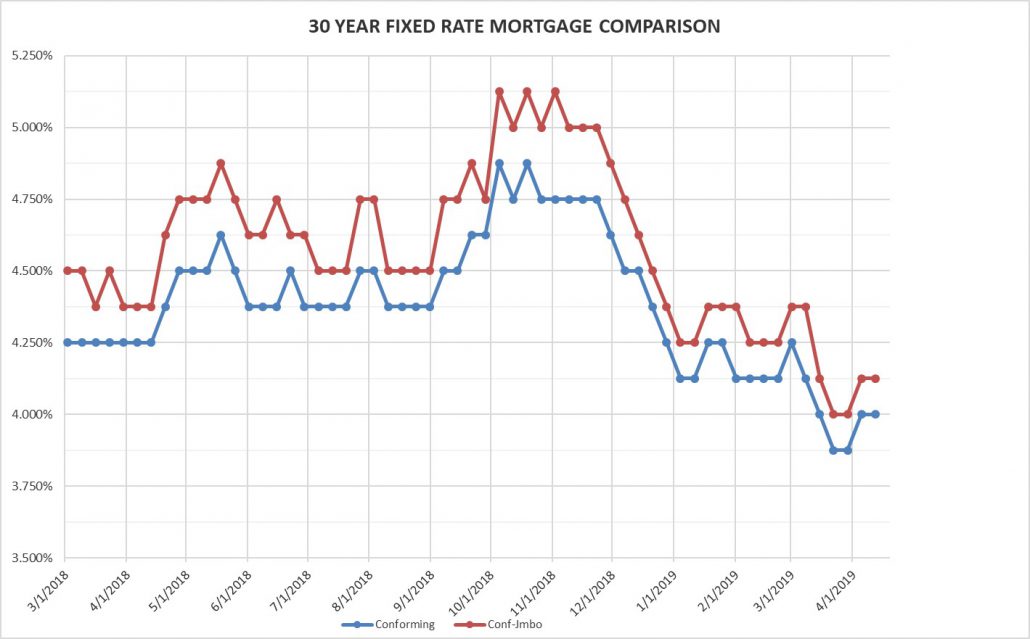
Rates for Friday April 12, 2019: A little upward pressure on rates this week, but we end the week flat from last Friday. Investors have been selling their fixed return assets, i.e. bonds and mortgages, for equities this week looking to profit from low inflation, strong labor markets and the Fed taking any rate increases for the rest of the year off the table. We have a very stable rate market and absent any major event rates should drift up and down from current levels no more than an eighth of a percent (0.125%) in the foreseeable future.
FIXED RATE MORTGAGES AT COST OF 1.25 POINTS LOCKED FOR 45 DAYS:
30 year conforming 4.00% Flat
30 year high-balance conforming 4.125 % Flat
Please note that these are base rates and adjustments may be added for condominiums, refinances, credit scores, loan to value, no impound account and period rate is locked. Rates are based on 20% down with 740 FICO score for purchase mortgages.
Sunday will wrap up one of my favorite weeks of the year. No, not the week before the April 15th tax deadline. The week of enjoying announcer Jim Nance as we move from the Final Four and Championship game in the NCAA basketball tournament to Augusta, Georgia for the Masters golf tournament. Mr. Nance is fortunate enough to be the lead announcer for both of these events, and we are fortunate to have him describing the action for us.
I love golf, my passion much better than my ability, and really enjoy watching the major golf tournaments. The impossible dream for me would be watching a tape of Jim Nance after the final round of the Masters saying, “And Dennis Smith drains the five footer for par on 18 to win the Masters!” I think I look good in green, especially a green jacket with a lovely logo on the breast. My rooting interest this weekend is for Ricky Fowler, one of the nicest men in golf, to win his first major. As it looks as I write this he has a long way to go as he is six strokes behind the leaders.
Have a great week,
Dennis
Past Weekly Rate & Market Updates can be found on my blog page at my website www.DennisCSmith.com/my-blog