


Follow up with more credit information
Question of the week: Following up on last week’s question of the week.
Answer: Thank you to everyone who followed up with more questions and comments regarding credit and credit scores.
Second generation, and long term now retired, mortgage professional Steve wrote to remind of a very important issue that sometimes derails a mortgage approval.
During the approval process most lenders run a “soft-pull” credit inquiry to see if any other inquiries have occurred since the credit report we have in file. This is to discover if the applicant has applied for and opened additional credit since the report in the file was run.
Not infrequently we will get a message from underwriter, “Please explain inquiry on XX/XX/2021 and indicate if new credit account has been opened.” Contacting our client about the inquiry, they may respond, “Oh, we purchased a new car. Since you already ran our credit we didn’t think it would matter.”
It matters. Now we have to re-work the file and debt-to-income ratios to determine if you still qualify with the new car payment.
Another action that might impact your credit is if you pay off all, or a lot of, your credit accounts before we run a credit report. This is natural instinct for many who want to eliminate debt and payments to enhance their ability to qualify for a mortgage. However, sometimes this may backfire and result in lowering your credit score.
Huh? Why would paying off credit lower my credit score, in prior WR&MU you stated that lower balances help my credit score. True, I have written that. However, in some instances having no balance can be harmful to your score as well. When running models to see what adjustments need to be made to improve a credit score, for some clients the report will say, “having a $850 balance on Generic Visa will improve score 10 points.”
When you are beginning the process of thinking about purchasing a new home, before paying down, or off, any credit accounts consult with a mortgage professional to determine your qualifying debt-to-income ratios with current balances, how your qualifying ratios improve is there is strategic paying down, or off, of credit accounts, and possibly running a credit report and then a “what-if” scoring model to determine how adjusting different accounts impact your score.
In the big picture, your credit score matters when it comes to pricing your loan, in the smaller picture a change of a ten to fifteen points may have no impact because of the pricing tiers (call LLPAs or Loan Level Pricing Adjustments) imposed on lenders by Fannie Mae and Freddie Mac for ranges of credit scores.
Starting at the minimum score of 620, the pricing improves with each 20 point tier until a credit score is 740 or higher, from 740 to 779 the pricing is the same, and pricing is the same from 780 to the maximum score of 850 (which I have never seen).
Depending on the type of loan, property, transaction, credit score and loan to value, the pricing difference from tier to tier can be as low as 0.125% and as high as 1.50%. For example, if your score is 674 and we discover you can increase your score to 680 and you are purchasing a home with 20% down, this could improve your rate by 0.25% (one-quarter of one-percent); on a $500,000 mortgage this could save you $67 per month, about $800 per year.
Depending on your score and where it falls in the pricing tiers, a small change up or down in your credit score will not impact your interest rate.
The conclusion is the same as last week’s WR&MU answer, before making any major adjustments to your credit accounts, consult with a mortgage professional who is knowledgeable about credit scoring, its impact on qualifying and interest rate, and has the access to tools to determine how certain actions may impact your score. Click the “Ask me” link below to contact such a qualified mortgage professional.
Have a question? Ask me!
It has been more than 30-years since inflation has been as high as it was in October. The Consumer Price Index rose 0.9% in October from September, and 6.2% from October 2020, the highest year to year increase since 1990. Analyzing the data from the last several months, the consensus is that high inflation will persist into 2022, the question is how long into the new year? The news is very mortgage rate unfriendly, not just the number but the persistence of climbing prices and outlook for it continuing longer than many previously thought.
Many Fed officials are looking for higher rates. Word has come out the Fed officials are about 50/50 on whether to raise the Fed’s benchmark interest rate in late 2022 or early 2023, some are hinting they would like a hike earlier in 2022. A few weeks ago the Fed announced it was slowing its purchases of Treasury debt and mortgages (aka Quantitative Easing) beginning this month with a schedule to stop completely in mid-2022; the news of rate hikes possibly coming shortly thereafter has pushed interest rates up this week.
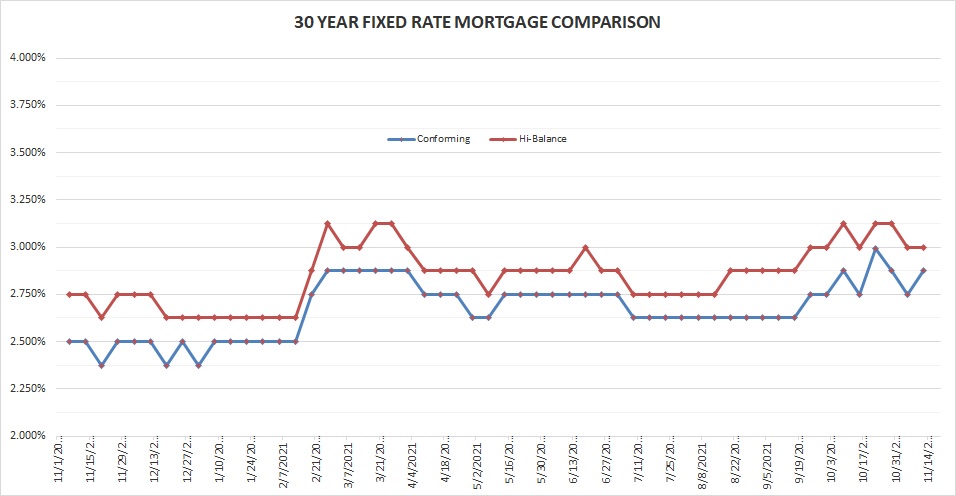
Rates for Friday November 12, 2021: A spike in rates on Wednesday before the Veterans’ Day holiday caused the conforming rate to pop back up this Friday after last week’s dip; high-balance conforming rates have held onto their rate from last Friday. Rates are very volatile as investors react to economic news pointing to higher rates at some point in the future.
FIXED RATE MORTGAGES AT COST OF 1.25 POINTS LOCKED FOR 45 DAYS FOR PURCHASE TRANSACTIONS:
30 year conforming 2.875% Up 0.125%
30 year high-balance conforming 3.00% Flat
Please note that these are base rates and adjustments may be added for condominiums, refinances, credit scores, loan to value, no impound account and period rate is locked. Rates are based on 20% down with 740 FICO score for purchase mortgages.
Is this it? Are the high temperatures in Southern California the last we will see until, May, June? Several weeks ago, I wrote about Indian Summer on the East Coast, and other parts of the country. When we were growing up we loved the break in the first weeks of cold weather to have some more days with warmer weather. “Warmer weather” usually categorized as low to mid-60’s. In Southern California the comparable is a break from mid-60’s weather and several days of high ‘80’s or higher.
Nothing like putting up Christmas decorations in shorts and t-shirts!
(Note our Christmas decorations and lights do not go up until after Thanksgiving!)
Have a great week,
Dennis
Past Weekly Rate & Market Updates can be found on my blog page at my website www.DennisCSmith.com/my-blog


