

How should we finance our solar panel installation?
Question of the week: How should we finance our solar panel installation?
Answer: This is a follow up to last week’s Question of the Week, “Should get a HELOC?”
This is fairly common question over the past few years as more and more families are installing solar panels to reduce, or possibly eliminate, electricity payments to the utility companies. Something the Smith Homestead is doing as well (when we are finished with the process it will be the subject of a WR&MU).
The general idea of financing the installation of solar power on your residence, or commercial property, is that the average power bill payments for the past year or so will be equal to monthly payments on financing the installation and have the loan paid off in five to seven years.
The several options most touted by solar installers to finance your new solar power system are either a loan from a finance company, credit union or bank, or some in California tout the Home Energy Renovation Opportunity (HERO) program. The third option we covered last week, using a Home Equity Line of Credit. The fourth option is to lease the solar panels.
Currently the federal government is offering tax credits for homeowners who install solar panels on their properties. In 2021 the credit is 22% of the cost of the system. If your system costs $20,000, you will receive a credit for $4400. Note this is a credit, not a deduction. The difference is that a credit is applied directly to the amount of taxes you owe, a deduction is used to lower your taxable income. A credit is much (much, much) better than a deduction.
Example: In 2021 you install a $20,000 solar energy system. Your taxable income for the year is $100,000 and our total tax liability is $18,000 (note these are made up numbers for purpose of illustration). You receive a tax credit for $4400 for your solar installation. Instead of a $18,000 tax liability, your tax liability will be $18,000 – $4400 = $13,600.
In 2021 you earn $100,000 and your tax liability is $18,000. You receive a $4400 deduction. Your taxable income is lowered to $95,600; your tax liability is $17,200.
The tax deduction saved you $800 in taxes; the tax credit saved you $4400.
Solar Finance Loan
Many solar financing programs will finance up to 100% of the cost of the system. The financing structure is worked up in such a way that when you receive your tax credit you forward the amount to the finance company—that way it is no longer 100% financing but 78% financing. If you do not forward the payment your rate will be higher due to the higher percentage of the value of the system covered by the loan.
These types of solar energy loans are fixed rate programs and you can usually pick a loan period from 3, 5, 7 or sometimes 10 years periods (the longer the period the lower your payment). As well, there is a lien against your solar panels that is recorded and therefore part of the title to your home—similar to a mortgage or HELOC but slightly different. It is similar to a mechanic’s lien.
If you refinance your home and do not wish to pay the solar loan off the financing lender will have to file paperwork to remove the lien and then it is refiled after the refinance is closed.
If you sell the property the loan can either be paid off, or some lenders allow the new buyer to assume the payments, provided they qualify based on income and credit.
HERO Program
Thankfully we are seeing fewer and fewer homeowners who have used the Home Energy Renovation Opportunity to finance their solar systems. I covered the program in the WR&MU in 2016. I did not like the program in 2016 and I do not like the program in 2021.
Under the HERO program you do not pay a lender for financing your solar system, you make the payments as part of your property tax bill. If you pay your taxes yourself by December 10th and April 10th every year, your payment will include six months of payments for your solar financing. If you have your taxes paid by your lender you will pay monthly to your lender, who will then pay the financing payment as part of your tax bill.
One reason I do not like the HERO program is the costs. While the rates may be somewhat competitive with those offered by a lender offering a solar finance contract, there is a hefty administrative cost, approximately 5%, added to your loan.
A second reason is the nature of the lien. Because the loan becomes part of your property tax bill it takes first position on your property. In other words, if payments are not made any lien on the property, such as your mortgage, gets paid after the taxes, and solar loan, are paid. This creates issues when refinancing or selling your property if the loan is not paid off as part of the transaction.
Leasing
Solar leases are similar to car leases, except almost all of them have a $1 buyout at the end of the lease. The issues I have with leases is you are usually not in control. You pay the lease every month, if you produce excess electrical capacity that is “sold” back to the local utility, the proceeds go to the leasing company. Generally, the terms are longer than financing options, are rates higher.
What is a larger problem for our point of view is most leases in the past had language in the contract regarding removing the panels, cost to remove, who pays any damage, etc that were against mortgage underwriting guidelines. As such, these types of leases prevent conventional financing for a home owner refinancing or a new buyer purchasing and wanting to retain the panels and the lease.
To sum up, if you are considering a solar system for your home, I recommend either using a HELOC or go through a lender that finances solar systems for your project. Many credit unions and lenders have solar financing products, as well almost every solar contractor has financing options they can provide you to call and investigate.
Have a question? Ask me!
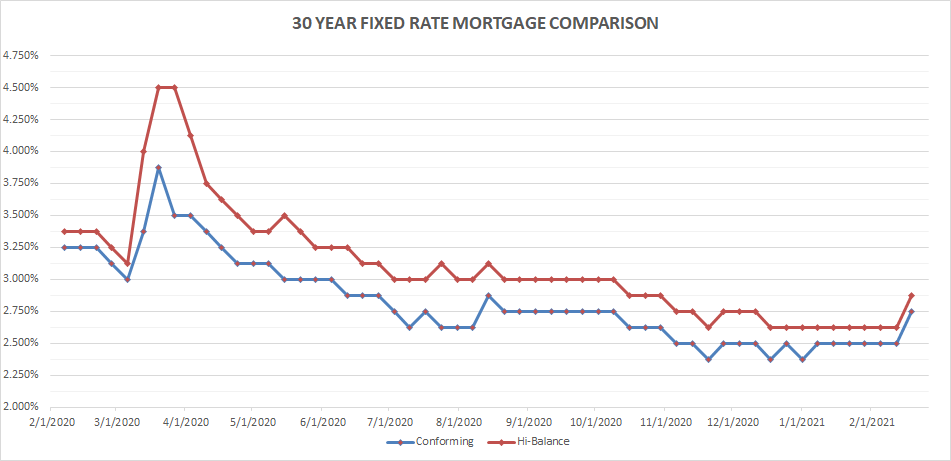
Rates for Friday February 19, 2021: After being flat for the past five to six Fridays, rates jump this week. They started to climb Friday, after the WR&MU was released and spiked on Monday. Through the week upward pressure has continued. Several factors contribute to the increase, more spending from Washington, improving economic data, decline in Covid positive tests and deaths from the virus, and exponentially growing number of people getting vaccinated. It very much seems like we have bounced off the bottom. We won’t know for several weeks, or more, if this is true.
FIXED RATE MORTGAGES AT COST OF 1.25 POINTS LOCKED FOR 45 DAYS FOR PURCHASE TRANSACTIONS:
30 year conforming 2.75% Up 0.25%
30 year high-balance conforming 2.875% Up 0.25%
Please note that these are base rates and adjustments may be added for condominiums, refinances, credit scores, loan to value, no impound account and period rate is locked. Rates are based on 20% down with 740 FICO score for purchase mortgages.
A milestone day in the Smith home this Friday. For the first time in her 19 years Leslie and I will not be celebrating her birthday with her. She will be celebrating with a nice dinner with some classmates in Manhattan tonight. We are thrilled to be missing her birthday celebration as it means she is doing what she wants to do, attend college in New York City, after being home in the fall when she thought she would be in college.
Born in the shadow of 9/11, being in elementary school through the Great Recession and recovery, attending high school through the turbulent Trump Era, finishing high school and starting college in the midst of the coronavirus pandemic. Quite a set of historical events in her young life, and those of her cohorts. Through this they are amazing in their insight, maintaining sense of humor, and desires to succeed. As parents, we are hoping they have fewer negative historic events in their future and many more positive ones.
Have a great week,
Dennis
Past Weekly Rate & Market Updates can be found on my blog page at my website www.DennisCSmith.com/my-blog


