


Can I buy our family home from my siblings?
Question of the week: Can I buy our family home from my siblings?
Answer: Last week we covered transferring equity in a home to a spouse in return for sole ownership as part of a divorce settlement.
This week’s question is a frequent one from clients whose surviving parent has passed away and their home was in a trust, or worse not in a trust and possibly going through probate.
It is a common scenario, Mom and Dad have owned a home for many years, first one passes away and then the other. The parents have multiple children, and one would like to retain the home instead of seeing the home sold and the proceeds divided amongst the kids along with other assets.
Similar to our scenario last week, when a property is in a trust it can be transferred to a beneficiary using a refinance to pull equity out of the property to transfer to other beneficiaries.
Our scenario, Beverly and Murray purchased their home in late 1990’s when their three children, Adam, Barry and Erica, were young. Murray died several years ago, at that time Beverly updated their trust and retained the children as equal beneficiaries of the trust’s assets upon her passing.
Beverly passed away in March. The home she shared with Murray had a value of $850,000 with a mortgage balance of $250,000. Other financial assets included $90,000 in bank accounts and $300,000 remaining in Murray’s IRA.
Adam wants to keep the home and move in with his wife Sara and their children. Barry and Erica have no desire to live in the home, but naturally would like their fair share of the home’s value.
Our math on the transaction is that with a value of $850,000 and mortgage of $250,000, leaves net equity of $600,000. Each child’s share is $200,000. To pay-out his brother and sister, Adam needs a mortgage of $650,000. From the proceeds, $250,000 pays off the mortgage, and $400,000 is split between Barry and Erica.
We ensure that Adam and Sara qualify for a $650,000 mortgage, then proceed with a refinance transaction.
At closing we instruct escrow to send funds directly to Barry and Erica in the amount of $200,000 each. We require this transfer of funds to Adam’s siblings instead of to him and then to his siblings to reduce his interest rate. As in our divorce scenario, because the proceeds from the transaction are not going to Adam’s benefit and are being transferred to others due to a legal settlement, our refinance is considered a “rate and term” refinance instead of a “cash out refinance;” the latter are typically about 0.50% (one half of one percent) lower in rate than a rate and term refinance.
This transaction can have more complexity with Adam trading his share of the cash in his Mom’s bank account and his share of his father’s IRA, to Barry and Erica in exchange for a reduction in the amount of equity they would receive from the home. Taking one-third of the cash and the IRA, Adam’s share would be $130,000. Reducing the amount of equity to be paid to Barry and Erica in exchange for these funds would lower Adam’s refinance total to $520,000.
Or, as I have seen, the children reduce the amount of equity Adam would transfer to his brother and sister by the estimated costs should they sell the property on the open market. For example, if the cost to sell in their market is 7% of the sales price, including real estate commission, escrow, title, transfer taxes, etc, the value of the home is reduced by about $60,000. Divided by three that reduces each’s child’s share of the equity by $20,000 for a total of $180,000 to each child. Adam’s refinance is now $610,000 ($650,000 original refinance less the $40,000 in costs pro-rated for Barry and Erica).
Should both complicating factors above become part of the agreement between the children, Adam’s refinance would total $650,000 less $130,000 (Adam’s share of cash and IRA) and less $40,000 (costs should property be sold on market) for a refinance of $480,000.
If the rate of the refinance is 6.5%, by making these changes Adam’s monthly payments drops from about $4100 for a $650,000 mortgage to about $3035 for a $480,000 mortgage.
This all depends of course on the three siblings all agreeing to a) Adam paying out Barry and Erica and keeping the home, and/or b) Adam’s portion of cash and IRA going to Barry and Erica in exchange for lowering their pay-out from house, and/or c) Barry and Erica agreeing that if home put on the open market their proceeds from the sale would be reduced by the costs to market and sell the home.
While the math is simple on these transactions, like often happens in divorce cases where we are separating equity to pay-out a spouse, there can be a lot of emotion involved. Grief from the parent’s passing, emotional attachment to the family home, sibling rivalry or grudges from past transgressions (he went out on a date instead of seeing me in the lead in the high school musical), can make negotiations and compromise challenging.
Our experience is that in transactions that transfer a home from one party or parties to another through legal action the ones where all parties see the transaction as business and look at numbers go smoothly and can close quickly.
In cases where emotions, bitterness, and, because of the amount of money involved in California real estate, greed, we have seen these transactions take months, in some cases over a year, and a lot of legal expenses, before closing.
A final note, an increasing amount of our transactions involving a home being retained by a child after a parent’s passing have a reverse mortgage on the property that needs to be paid off. This does not complicate our process, it only changes the math as to what the payoff balance is on the mortgage and requires us to be in contact with the reverse mortgage lender to let them know what our transaction is and updates on timing until we close and they are paid off.
If you, or anyone you know, are in a situation where one party needs to extract equity to payoff another party, be it spouse, significant other, siblings, partners, please give me a call to help structure and close your transaction to everyone’s satisfaction.
To schedule an initial meeting by phone or Zoom, click here for my calendar, please feel free to forward to a friend or family member!
Have a question? Ask me!
Rate mover? That was the question when retail sales data came out on Tuesday as sales increased 0.4% for the month, 0.6% if auto and gas sales stripped from the data. After falling four of the prior five months, the size of the bounce caused our question above. Also adding to the concern that rates would increase on the report was an increase of 0.6% in bars and restaurants. As I’ve written before, economists look at spending in bars and restaurants as an indication of how consumers feel about their personal economic future since this spending is entirely discretional, choosing to spend a lot more to go out than to have a beer and dinner at home. If consumers feel positive they will maintain, or increase spending, driving the economy towards growth. This hampers the Fed’s ability, and desire, to lower inflation. This leads to more austere measure to raise rates and slow the economy.
The answer, to the question was not much. In part because the total number of retail sales was lower than many expected, bonds and mortgages (fixed rate investments) have been trading in a narrow range* and not enough momentum was generated by the news to break the range and push rates higher.
*Am I a jinx? Last week in the rate summary section of the WR&MU I stated, “Looking back over the past two months, rates have floated in a tight range.” If you look at charts for stocks, bonds, many different marketable commodities, you will see periods where the ups and downs are within a small range. The top of a range acts as a sort of ceiling on prices, the bottom as a floor. In a stable market, prices will float up towards the ceiling then skip back down, float down to the floor and skip off and head up.
When there is enough momentum to break through a floor or ceiling this break is followed by prices going in the same direction for a while before settling into another range, or bounce up and down in large amounts before settling into a new range. Yesterday we saw a break out in the range as bond and mortgage prices dropped significantly (lower prices mean higher rates). Today prices continued to drop, having a brief rally earlier in the day but then falling again. Did I jinx the rate markets last week? I am skeptical that I have that much power in the universe.
Why? Why did bond sellers jam the markets with Treasuries and mortgages? No specific data or comments seemed to push the market. Looking ahead to what the Fed may do, investors anticipate a few more rate hikes, but those have mostly been priced into mortgage rates. Yesterday saw some employment data that could foretell a strong employment report for May, which would support higher rates from the Fed. It appears that once the bottom of the range was broken investors sold off fixed rate investments to not be caught out of the market. Once the momentum started more sellers pushed into the markets.
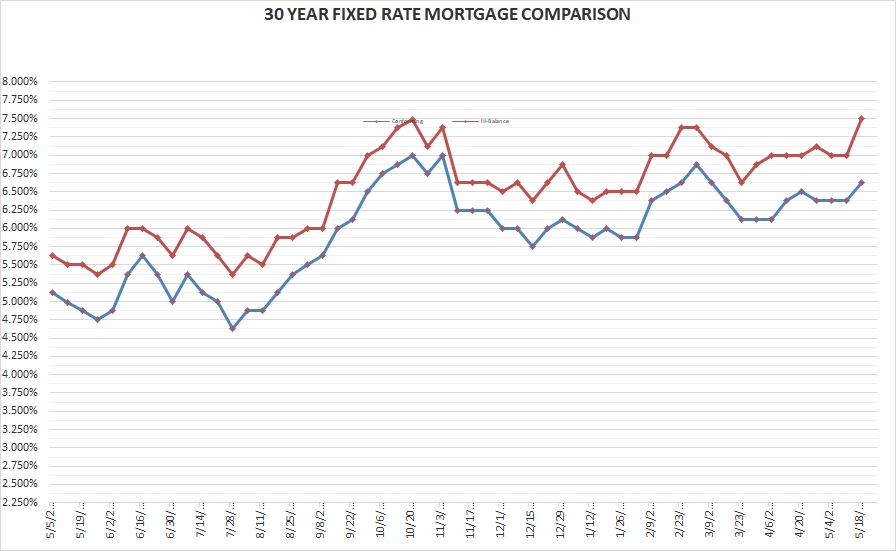
Rates for Friday May 19, 2023 As we near the close of markets this Friday we see the 30-year fixed rate at its highest in ten weeks, and the high-balance conforming rate at its highest since it peaked in October. Is this rate break out going to push rates even higher, or is it a brief market correction that will settle down and possible dampen rates in the near future? No one knows for certain.
FIXED RATE MORTGAGES AT COST OF 1.25 POINTS LOCKED FOR 45 DAYS FOR PURCHASE TRANSACTIONS:
30-year conforming 6.625% Up 0.25%
30-year high-balance conforming 7.50% Up 0.50%
Please note that these are base rates and adjustments may be added for condominiums, refinances, credit scores, loan to value, no impound account and period rate is locked. Rates are based on 20% down with 740 FICO score for purchase mortgages.
Artificial Intelligence (AI) has been very prominent in news reports, social media feeds, and conversations. Are reporters writing news or AI programs? Who is calling you, someone from your bank or AI program simulating your bank?
The ability of AI to perform different tasks, functions and jobs appears to be expanding exponentially, and it is concerning many experts and policy makers.
It may also be concerning some, many, readers of the WR&MU. Let me put to rest one concern, AI is not writing the WR&MU. This is self-evident due to the spelling, grammar, and style mistakes that are present in some (many) of the weekly updates.
You will know if AI has taken over the WR&MU if you see any positive comments about creamed spinach, Dallas Cowboys, New York Mets, or other teams that are rivals of Philadelphia teams, Texas Longhorns football, or the Bullet Train.
Have a grate weak,
Dennis
Past Weekly Rate & Market Updates can be found on my blog page at my website www.DennisCSmith.com/my-blog


