


What is going on with rates?
Question of the week: What is going on with rates?
Answer: They are going up.
As I have been writing for the past several months, rates have been lower than anticipated, by me anyway, due to the amount of money flowing into our economy from Washington and economic activity rapidly expanding.
Last week we saw the employment data saw significantly fewer new hires in April than expected, about three-quarters of a million fewer. The result has been employers increase starting pay rates, offering incentives, and paying a lot of overtime to current workers.
For restaurant and bar owners they are facing a double-whammy to their bottom line as not only are they facing wage pressure, but also cost pressure on the products they purchase.
Supply chain issues are present throughout the economy. Many of the shortages are from the start of supply chains. You have been reading about the costs of lumber spiking, part of this is demand but a very big part of the spike is the lack of supply. Like many industries, wood producers shut down, or decreased, production last spring when cities and states around the country started shutting down businesses and commerce. Prepared lumber is not a product that can be easily stored and left to sit for prolonged periods of time. Anticipating a large drop in demand that would leave them with large inventories and having to cut prices to move the stacks of lumber they felt would have little demand, sawmills slowed production. What happens when a company slows or stops productions? They furlough or lay-off workers.
Not too far into the pandemic demand for lumber picked up and suppliers faced other challenges. They needed to restart production, but to do so needed to increase the amount of raw lumber they purchased. Knowing mills were decreasing production, the logging companies reduced their production. Low supply for raw product, higher demand for their finished lumber pushes prices up.
During the pandemic shipping and transportation lines saw tremendous increase in demand as consumers staying at home ordered goods delivered directly to their front doors. The trucking industry saw a demand for more licensed truckers than were available, creating a labor shortage and wage pressure on transportation companies, and there for transportation cost increases to wholesalers and retailers.
Those who live near the ports of Long Beach and Los Angeles have seen the harbor packed with container ships waiting to find a berth to unload their goods. A friend of mine runs and import-export company. In a phone call yesterday, he said the cost to ship a container from Hong Kong to Long Beach has increased almost four-fold. Some shipping companies do not want their containers put on a truck in Long Beach and then driven to Cleveland because they need the empty container as quickly as possible to ship back to the Far East to fill with goods to bring back to the United States. So unbalanced is the current trade market he said he has trouble getting trailers exporting goods on ships as there is more of a premium for the empty containers.
A huge factor that is now impacting the transportation industry is the spike in fuel prices. The average monthly retail price for diesel fuel, which propels our trucking industry, is up almost 30% from Thanksgiving. With production decreasing in the United States, requiring more imports, prices can be expected to continue to increase.
All of the issues in these industries are repeated for goods throughout our economy where we see shortages due to decisions made last March, April, and May by wholesalers and suppliers as they anticipated where their products would be needed, or what retooling they needed to do to remain open. Other goods are feeling the impact of the shipping and transportation imbalances.
Chip makers shifted some productions for automobiles to consumer electronics, creates supply issues for automakers. Pulp used for paper goods, like toilet paper and paper towels, is facing supply issues due to lack of shipping containers. Pork, chicken, produce, are all seeing costs rise due to transportation costs increasing.
This week inflation data was released that seems to be the final push needed for investors who have been anxiously watching data to determine when rates would, should, start to climb off their lows. Somewhat placated by the Federal Reserve purchasing hundreds of billions of mortgage and U.S. Treasury debt every month, and repeated announcements by the Fed that it had some, but not a lot, of concern for inflation in the economy. Investors have been content to maintain the low-rate status quo.
When data was released, showing prices rose at the highest rate in thirteen years in April, up 0.8% for the month, economic principles that have not applied in the last year hit home. Supply issues, transportation issues, increased demand as people leave their bubbles and go out to eat, travel, trade-in cars, and continue to need to feed their families, with more people being employed, others receiving federal and state stimulus checks, with benefits continuing for another four months, create a perfect storm for higher prices.
Returning to our nation’s capital, the flood of funds into the economy with prior and proposed spending has two impacts on interest rates. First, is the money itself that creates environment where demand for goods and services is greater than the supply of same. Second, where does the government get this money? It borrows it. Increasing the supply for fixed rate investments. When supply exceeds demand, prices drop; long time readers of the WR&MU know that in bonds and mortgages, when prices drop rates rise.
The Federal Reserve has deemed our current spike in prices, “transitory inflation;” aka, temporary. Its position being that once supply chain, transportation, and initial pent-up demand by consumers are resolved we will see inflation return to the target rate of 2%.
But once employers raise wages they cannot, or not easily, lower them. Rarely do we see prices for most goods and services drop after being raised, with the exception of fuel costs which is perhaps the most elastic in price. Which means for the most part we will see a shift upwards in wages and prices that will remain.
What needs to be answered, is how long will this stabilization take to come about and how high will inflation rise during this “transitory” period? The Fed feels in a short period of time, short enough that there will be minimal impact on rates. Others feel long enough and high enough that rates will increase, dampening economic expansion and inflation.
We are most certainly in a transitory phase in the economy. In my opinion it is transitory from very low inflation to moderate, perhaps high, inflation that will see rates move upward in the near and medium future.
For those in the housing markets, as buyers, sellers, agents, lenders, how high will rates need to go to dampen demand for homes and mortgages?
The answers to these questions will likely be known only after the fact.
Have a question? Ask me!
What do they know? Last week we saw how analysts whiffed on their estimate of job growth in April. This week we see them swing and miss again on retail sales estimates. After an almost historic 10.7% increase in retail sales in March, estimates were for an almost 1% increase in April from March. Earlier today it was announced that retail sales were flat from March; stripping out auto sales dropped almost 1% from March. Auto sales were up 3% despite shortages in popular models and little price flex from dealers due to demand. Bars and restaurants saw a similar 3% increase in sales as more indoor dining had registers ringing.
Is this a sign everything you wrote above is wrong? Possibly, but I don’t think so. After a huge surge in buying a slow down is always expected. Auto sales and dining out are very good indicators of consumer confidence, as if they are worried about their economic future, they are not going to enter into long-term payment contracts or splurge on night’s out. More importantly, Americans are sitting on around $2 trillion in personal savings—a huge amount of money. A significant portion of this amount will likely be spent through the summer and fall. As well, there are still around eight million fewer workers today than in February 2020; and around eleven fewer than would be expected had job growth not been interrupted by the pandemic. Future spending should continue to increase as the accumulated savings and new employment hires wages enter the retail markets.
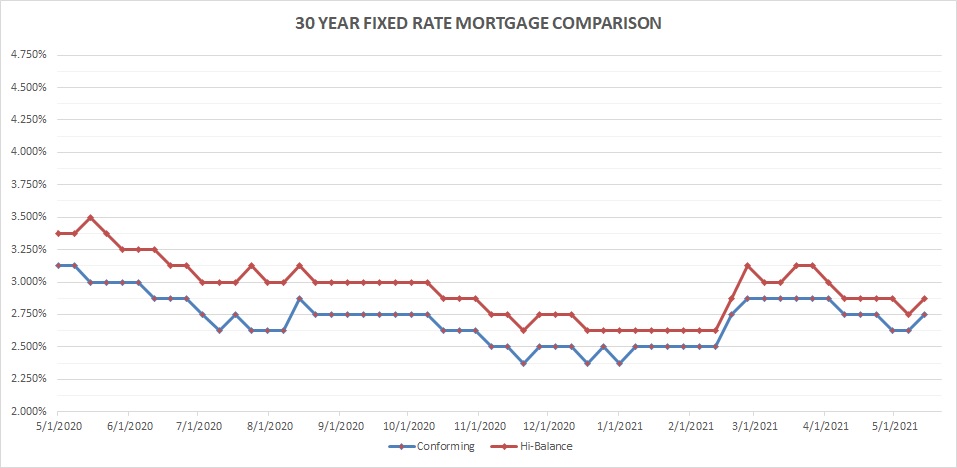
Rates for Friday May 14, 2021: Rates are up from last Friday, and down a touch from earlier in the week as investors bought up fixed rate products as concerns about growing conflict in the Middle East threatens to expand into all out war. There are any pressures on markets economically and politically, domestic and global.
Correction to last week’s rates, I indicated the high-balance rate had declined 0.125%, but did not change the rate to 2.75% from the prior Friday’s 2.875%
FIXED RATE MORTGAGES AT COST OF 1.25 POINTS LOCKED FOR 45 DAYS FOR PURCHASE TRANSACTIONS:
30 year conforming 2.75% Down 0.125%
30 year high-balance conforming 2.875% Down 0.125%
Please note that these are base rates and adjustments may be added for condominiums, refinances, credit scores, loan to value, no impound account and period rate is locked. Rates are based on 20% down with 740 FICO score for purchase mortgages.
Greetings from the Central Coast as Leslie and I are taking a long weekend away to enjoy a few of our favorite activities which will include tri-tip sandwiches and beer on the patio of the Firestone Grill, a winery or two, and relaxing in one of the wonderful rooms at the Apple Farm.
Have a great week,
Dennis
Past Weekly Rate & Market Updates can be found on my blog page at my website www.DennisCSmith.com/my-blog


