


Are you licensed?
Question of the week: Are you licensed?
Answer: Yes, I am licensed and so is Stratis Financial.
Residential lenders and loan originators in California have to be licensed by either the California Department of Real Estate or California Department of Business Oversight. As well, both companies and individuals must also be licensed by the Nationwide Mortgage Licensing System.
Stratis Financial, and all originators working at Stratis Financial is licensed in California by the Department of Real Estate (DRE). Under DRE regulations there are two types of licenses, a broker license or a salesperson license.
Every real estate company, and other entities like mortgage companies, in the State of California must have an individual with a broker license who is the “Designated Officer.” This individual is responsible for ensuring the company and the licensees working for the company adhere to policies and regulations. The DRE uses this method of supervision under the theory that an individual with their own license at risk and the possibility of penalties and fines will be more diligent in ensuring the company is operating within the rules and regulations than a non-person corporate entity.
Individuals with a salesperson license cannot work independently and must register their license under a broker license, the Designated Officer. An individual with a broker license can work independently, work for a company for which another individual with a broker license is the DE, or be a DE themselves.
In 2008 the Secure and Fair Enforcement for Mortgage Licensing Act (the S.A.F.E. Act) was passed. This Act required mortgage loan originators (MLOs) and the companies they worked for to be registered nationally. As well, it required states to pass legislation requiring MLOs to be licensed according to national standards. All state agencies that licensed MLOs had to participate in the Nationwide Mortgage Licensing System (NMLS).
By 2011 all individuals participating in originating mortgages with consumers had to be registered with the NMLS. Most MLOs were required to pass an exam to be registered (exempt from the exam were those working for insured depository institutions regulated by one of the alphabet banking regulators (OCC, OTS, FDIC, NCUA for example).
As part of the NMLS regulations, all MLOs who are non-exempt must complete eight hours of continuing education every year to remain registered in the system.
When the S.A.F.E. Act passed requiring an exam for entry into the mortgage business I was mostly happy—only mostly because of the carve out from the exam for those working for major banks and other institutions. I was happy because the NMLS exam was significantly harder than the exam required by the Department of Real Estate to obtain a salesperson or broker license. I was happy because a lot of individuals who should not have been in the mortgage industry opted out of the exam and registration. I was happy because no longer could a bad actor in the mortgage industry move from jurisdiction to jurisdiction when they had a license suspended or revoked.
It is my desire to see something similar be put in place for real estate agents and brokers so those responsible for the listing and selling of families’ primary assets also have a more rigorous process for obtaining licensing, are nationally registered and have stricter consequences for malfeasant behavior and actions.
If you are interested in seeing if someone is appropriately licensed, have any disciplinary actions on their records or other information, the NMLS has a consumer access website where licensees can be looked up by name or license.
Have a question? Ask me!
Prices rebounding, that is the take away from data released this week on wholesale and consumer price reports. The Consumer Price Index was up 0.4% in August, the third month in a row showing increases for consumer good and services. Leading the way was a surge in prices for used cars and trucks—the largest increase in fifty years.
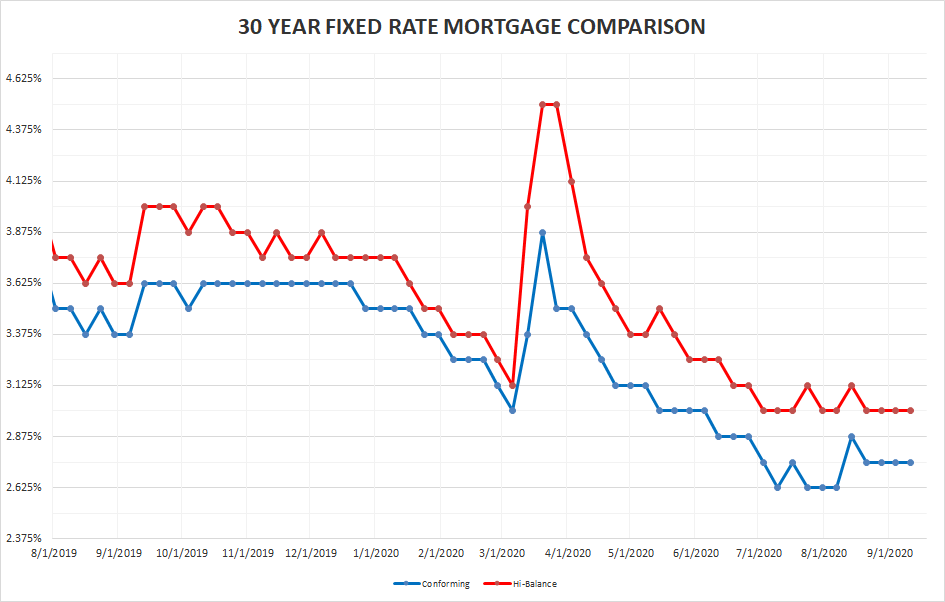
Rates for Friday September 11, 2020: We are seeing some reaction in the fixed-income markets, i.e. bonds and mortgages, to economic data. After a dip early in the week when tech stocks sold off, mortgage rates bounced back up after data on jobs and prices. Could we see rates start to move up? Possibly. Note that it appears lenders are slowly starting to price in the refinance fee that starts on loans funding on or after December 1st for conforming and high-balance conforming (Fannie Mae and Freddie Mac) mortgages.
FIXED RATE MORTGAGES AT COST OF 1.25 POINTS LOCKED FOR 45 DAYS:
30 year conforming 2.75% Flat
30 year high-balance conforming 3.00% Flat
Please note that these are base rates and adjustments may be added for condominiums, refinances, credit scores, loan to value, no impound account and period rate is locked. Rates are based on 20% down with 740 FICO score for purchase mortgages.
The topic of licensing came up in a conversation with a client who wanted to meet (virtually) today. I told her I could not because I will be in a webinar all day to complete my required continuing education. So as you read this I will be staring at me screen and having great empathy for students across the country who have to do what I am doing every day…
I am hoping, as I am sure you are as well, that by next Friday’s Weekly Rate & Market Update the fires are out, the smoke is cleared and the men and women fighting the wildfires are home safe.
Here again is a link if you wish to donate to the Red Cross Disaster Relief Fund, if you are able please click and donate—every little bit matters as the Red Cross is facing incredible challenges with finding shelter for displaced families amidst the Covid-19 pandemic.
Have a great week,
Dennis
Past Weekly Rate & Market Updates can be found on my blog page at my website www.DennisCSmith.com/my-blog


