

Is it true President Trump may change the mortgage market?
Question of the week: Is it true President Trump may change the mortgage market?
Answer: Yes.
In December the WR&MU covered some changes in the industry for 2025, not mentioned was a major change that will impact the mortgage, and therefore the real estate market, if enacted.
Some background.
As part of the legislative responses to the Great Recession that started with the meltdown of the mortgage and real estate markets starting in 2007, President George W. Bush signed The Housing and Economic Recovery Act of 2008. The Act established the Federal Housing Finance Agency (FHFA), which in turn announced it was taking over the Federal Nation Mortgage Association (FNMA—Fannie Mae) and the Federal Home Loan Mortgage Corporation (FHLMC—Freddie Mac), combined known as Government Sponsored Entities (GSEs).
This move was made as both GSEs had become illiquid as investors stopped purchasing their mortgage-backed securities (MBS) in the secondary market, thus freezing the industry. By establishing conservatorships by which the FHFA would direct the running of the two GSEs to regain solvency, re-establish trust in the MBS market, and enable the mortgage, and therefore real estate, market to recover.
As part of the agreement, the U.S. Treasury invested over $200 billion in the GSEs and extended credit to them so they would be solvent and operating. At the time they had over $5.1 trillion in debt and MBS. Essentially the United States government was backing the MBS issued by Fannie and Freddie; in other words, creating a guarantee for investors in their mortgage securities that they would be repaid if borrowers defaulted.
In short, the MBS issued by Fannie and Freddie had the backing of the U.S. government, just like the debt issued by the Treasury Department. Historically, because they are backed by the U.S. government, Treasury bills and bonds are considered the safest investment in the world. Ergo, with the same backing, MBS from Fannie and Freddie became equally, or very close to equally, as safe.
The original intention was that eventually the GSEs would exit their conservatorships and become independent entities traded as public companies, rolling back to their status pre-2008 and the establishment of the FHFA.
Sixteen years later, the GSEs have more than repaid the loans and bailouts from the Treasury, they are still operating under the FHFA. For several years, into the end of the Obama Administration, many have been calling for the conservatorships to end.
With Trump coming into office, it appears that a primary issue for his administration is to separate the GSEs from the government. While it may not happen this year, the consensus is that the separation will occur during this administration.
When, not if, separation occurs, it will have an impact on the mortgage industry. First, with MBS issued by Fannie and Freddie no longer backed by the federal government, how more return will investors require than if they invest in Treasury bills and bonds? The higher the risk the higher the return, how much higher is the risk for mortgages made to homeowners and investors in domestic real estate?
Accordingly, the expectation is that mortgage rates will increase due to the termination of the FHFA conservatorships. Note that investors anticipate events, so when it becomes very certain that the termination will occur investors will start behaving accordingly putting upward pressure on rates before the actual split.
As part of its conservatorship, the FHFA has imposed guarantee fees (g-fees) on the GSEs. Since Fannie and Freddie guarantee the payment of principal and interest for those purchasing their MBS, there is a fee that is charged per loan to cover the guarantees. These fees cover losses and administrative fees, as well as a return on capital, i.e. profit.
Over the years, the FHFA has increased g-fees, and added more g-fees that lenders must pay to Fannie and Freddie, which of course are added to costs for borrowers. While borrowers generally do not pay the g-fees directly, they are paid in terms of higher rates to absorb the fees.
One benefit to borrowers, and the mortgage markets, should be the elimination of g-fees when the GSEs separate from FHFA. The average base g-fees mandated by FHFA for single-family mortgages is currently 61 basis points (0.61%) which amounts to approximately three-eights (0.375%) to one-half (0.50%) of one percent to the mortgage rate.
Absent any reaction to investors with the elimination of guaranteed payments, the elimination of g-fees would result in a reduction in interest rates.
Several years ago the FHFA mandated that lenders increase the fees charged for second home and investment property loans, what is not known is if the GSEs will lower, or eliminate, these higher fees when they become independent entities; my guess is they will not.
Because they no longer have a backstop against losses, another unknown for post-breakup is underwriting criteria. Will the GSEs tighten their criteria or approval? Loosen some criteria that was required by FHFA? Or leave their guidelines essentially the same? One factor in this decision could be the feedback they get from major buyers of their MBS and their expectations for return vis-à-vis risk due to any changes.
One more impact that an end to FHFA’s conservatorships may have is the cost of mortgage insurance. For the past decade plus the cost of private mortgage insurance (PMI) has been historically cheap, due in part to the federal backing of MBS. While foreclosures have been historically low. Since peaking in 2010 they have been declining almost every quarter since. This certainly has had an impact on the cost of PMI, as has tighter underwriting guidelines as a result of the GSE conservatorships, with FHFA mandating the tightening, and rising property values.
Depending on changes that the GSEs make once they are independent of their fees to lenders, and underwriting guidelines, mortgage insurance costs may (should in my opinion) increase for borrowers.
While it is fairly certain that the Trump Administration will extricate Fannie Mae and Freddie Mac from their conservatorships and being subject to FHFA directives, less certain is the total impact this will have on home loan borrowers and the mortgage and real estate markets. My presumption is that rates will be higher, and guidelines a bit tighter for conventional mortgages.
Schedule an appointment to discuss your options if you are considering purchasing a new home or property or refinancing an existing one and want to know the mortgage options available to you.
Have a question? Ask me!
As expected, the Federal Reserve’s Federal Open Market Committee (FOMC), which determines policy for the Fed’s interest rate moves, did not lower its benchmark interest rate at its meeting this week. Furthermore, Fed Chair Jerome Powell stated that the Fed is not in a hurry to cut the rate in the near future—meaning a cut in March is off the table. As this was expected, the non-move had no impact on rates.
Hot December despite cold fronts. A big jump in personal spending in December helped push 4th quarter economic growth to a 2.3% rise in GDP, following a 3.1% increase in the 3rd quarter. For the year GDP grew at 2.8%, the third year in a row the economy grew at 2.5% or higher. A 4.2% increase in personal spending in the quarter, the highest since the first quarter of 2023, was the primary factor for the GDP increase as consumer spending is 65-70% of our economy. Personal spending was up 0.7% in December, following a strong 0.6% increase in November, as consumers outspent their incomes which showed a 0.4% increase for the month.
Incomes did outpace inflation in December, as the Personal Consumption Expenditure index rose 0.3% in December, the most since April, a 2.6% pace year after year. The PCE is the Fed’s preferred inflation index for determining rate moves, and the core index (energy and food stripped for data) is its preferred part of the PCE; the core index had a rather benign 0.2% increase for the month and a 2.8% for the year. Inflation continues to be resistant to the Fed’s 2% target, the 2.1% rate in September is the closest the economy has come to the target. The one-half percent increase since September is not positive for interest rates. Looking ahead, the Fed is forecasting inflation to be 2.5% in 2025.
Looking ahead, it is my belief that the Fed lowering rates this year is becoming less likely given the economic data over the past several months. Instead, we may need to consider the Fed increasing rates as continued consumer spending, strong economic growth, a firm labor market, are not conducive to lower inflation.
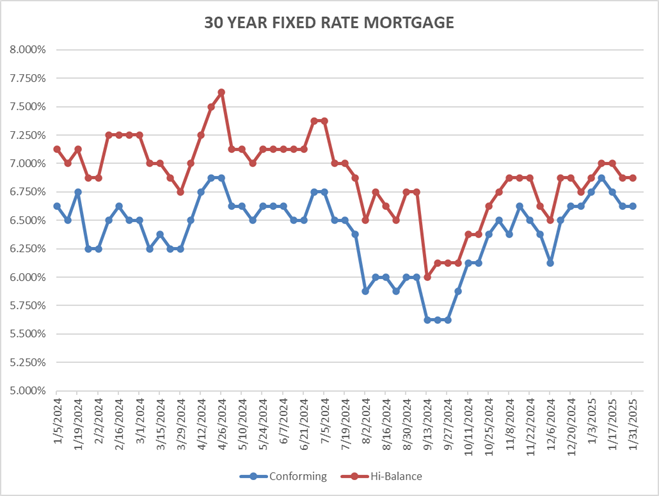
Rates for Friday January 31, 2025: I was in New York on personal family business last Friday and unable to get out the WR&MU, but rates had dropped from the prior Friday. Despite the economic news this week, rates are flat from last Friday.
FIXED RATE MORTGAGES AT COST OF 1.25 POINTS LOCKED FOR 45 DAYS FOR PURCHASE TRANSACTIONS:
30-year conforming 6.6275% Flat
30-year high-balance conforming 6.875% Flat
Please note that these are base rates and adjustments may be added for condominiums, refinances, credit scores, loan to value, no impound account and period rate is locked. Rates are based on 20% down with 740 FICO score for purchase mortgages.
Leslie and I are back to being empty nesters. Our oldest and her boyfriend went back to Boston after spending Christmas week with us. The youngest, who flew in the week before Christmas, left today to go back to Brooklyn. Her prolonged stay was a result of her having finished her classes, and her senior year, in December.
It will take a bit to get used to the change in energy, meal schedules, and pop culture education.
If you per chance know of any openings for a bright, witty, smart, young woman looking for a job in New York City referrals are very appreciated!


