

Is now a good time to buy a home?
Question of the week: Is now a good time to buy a home?
Answer: Over the years (decades) this question pops up in the WR&MU, most recently in May 2020, when the pandemic was a few months old and rates had dropped 1% in eight weeks after spiking 1% in two weeks.
There was great uncertainty in the markets and economy with the shut downs, transition away from offices, and millions of homeowners requesting and being granted deferments for their mortgage payments. Unknown at the time was it those deferments would lead to foreclosures, which would lead to a 2008ish collapse of housing markets.
The question of the week was pertinent, and the answer was that it was a good time to buy with rates so low and, at the time, the housing markets being soft. By August, the median home price in California would jump from $588,070 in May to $706,900 as the 30-year conventional mortgage rate dropped from 3.875% to 3.375%.
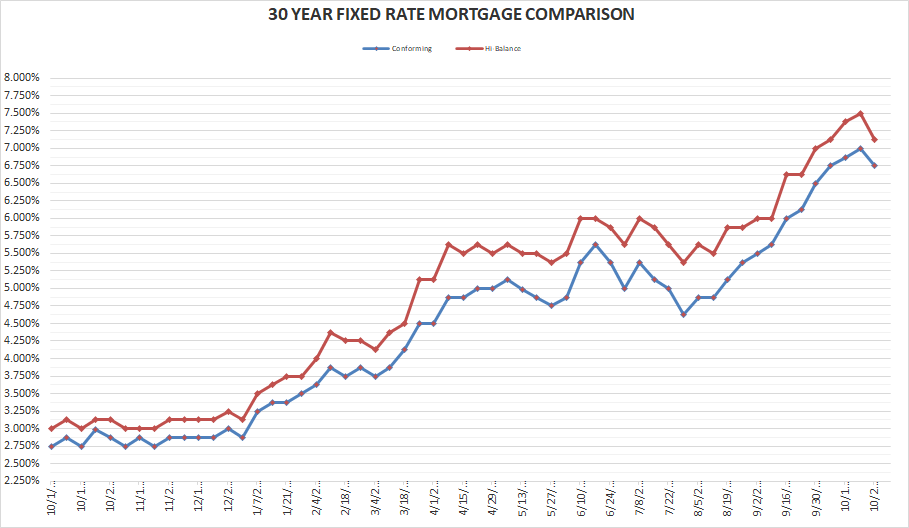
Today, the median home price was $821,680 in September, down from all time high of $900,170 in May. Down 9.6% from the high in May, the median price is up 1.6% from last September—essentially flat. In the past year however, rates are up almost 4% from 52-weeks ago.
Some comparative math from last year to this:
September 2021
- Median price $808,890
- 20% down payment $161,890
- 30-yr fixed rate mortgage $647,000
- 30-yr high balance fixed rate* 3.125% *this is high-balance rate as conforming loan limit was $548,250
- Monthly mortgage payment $2772
October 2022
- Median price $821,680
- 20% down payment $164,340**
- 30-yr fixed rate mortgage $657,340**
- 30-yr high balance fixed rate 7.125%**
- Monthly mortgage payment $4429**
**The current conforming loan limit is $647,000, it is anticipated the limit for 2023 will be $715,000 and many lenders accepting loans using the 2023 limits. If this is the case:
- 30-yr fixed rate 6.75%
- Monthly mortgage payment $4263
Reframing our question of the week, is it a good time to buy a home that costs about the same as a year ago but with a payment that is $1657 higher than last year, an increase of 60% (sixty percent!)?
Perhaps.
A few questions to answer to determine if the answer for you is “perhaps not” or “perhaps so.”
- Can you qualify for the home you would like to buy? Using the median home price for our example, are there homes on the market in this price range that are in area(s) you would like to live in and of the size you want/need?
- How long do you foresee living in this property? If the home you can afford is smaller than you would like, will you likely be looking for a larger home in 2-3 years, 3-5 years? Or can you afford to purchase a home that you will live in for more than five years?
- Is your income likely to increase for the next several years, stay the same, or possibly decline?
There are likely many more questions you will ask yourselves, what will happen to prices in the future, what will happen to rates, will we regret buying now, will we regret waiting to buy, and many more. Let’s take a look at two scenarios, rates stay high and prices decline, rates drop and prices increase.
Prices drop in the next twelve months by 5%, rates remain near 7%.
- Price $780,500
- Down payment $156,100
- Loan amount $624,400
- Rate 7%
- Monthly payment $4154
Prices go up 5% in the next twelve months by 5% rates drop to 5%.
- Price $862,750
- Down payment $172,550
- Loan Amount $690,200
- Rate 5%
- Monthly payment $3705
As you can see, the mortgage interest drives affordability considerably more than price. An difference in price of over $82,000 with a decline in rate of 2%, results in a difference of almost $450 per month lower for the higher priced home.
Back to your questions, the most important question is what can you afford to own today and does it fit your family’s needs? If so the other questions, while relevant, are less so because you have procured a home for your family that will provide housing and payment stability, unless the instability is a lower payment.
Over time the chances are that rates will drop below their current levels. While likely not approaching the historic lows during the pandemic, it is not unreasonable to think they will drop to the 5% range in the future when inflation abates. This provides you the opportunity in the future to refinance your mortgage to a lower rate and payment in the future from current rates.
There is softness in the housing markets as more inventory comes to market. With rates where they are the demand is down as many buyers are sitting on the sidelines waiting for prices and/or rates to fall. Those active in buying are not facing very much, if any, competition for the homes they desire, and in many cases sellers who are open to negotiating prices and terms.
How long will this softness continue? Likely as long as rates are high pricing some, many, buyers out of the market. What happens when rates soften and begin to decline? More buyers entering the market tipping the supply and demand balance, and prices, slowly back to the sellers.
In our region, Southern California, home owners have a built-in market advantage: almost all the dirt that can support homes is already developed. This means no new supply of housing, which means there is a set number of homes that can come on the market. Over time values in the region will go up through inflation and demand. Yes, in short periods prices have, and likely will in the future, decline for a period, but always from record high prices.
I have been in the industry for 35 years, and my advice has always been the same for families considering to purchase a home: you are purchasing a home for the long-term and not as an investment, because of this over time your home’s value, even through dips in the market, will more than likely go higher during your period of ownership. Over time you income will likely increase, reducing the percentage of your income going to your housing costs. Rates go up and down, and hitting the downs you will likely have the opportunity to lower your rate and payment further.
Finally, what is rates and prices remain close to where they are for the next several years? You are still better off owning for many reasons, some of which are, you control your housing situation, you will build equity through your loan balance declining, your housing costs are pretty much fixed thanks to a 30-year fixed rate mortgage and Prop 13. None of this is true if you are renting. Over time your landlord can sell your home, rents will increase over time, none of your rent is building any equity or wealth.
Be curious, call me to see if you were to purchase a new home today what would the numbers look like, how much can you afford, what can you buy. It doesn’t cost you anything to find out and the result may be you are on a path to housing and financial stability.
Have a question? Ask me!
Is the data good or bad? Yesterday the Commerce Department announced that in the 3rd quarter the economy grew at a 2.6% annual pace, following declines in the first two quarters of the year. That should be good news, no recession, however…Somewhat robust growth puts upward pressure on wages and prices, which portends higher interest rates. However,…the economic growth was primarily due to shrinkage in the trade gap. Due to a stronger dollar and slowing consumer spending imports declined in the quarter, combined with an increase in exports the jump in GDP can be attributed to containers of goods entering and leaving our ports.
Further dissecting the data, almost zero growth (plus 0.1%) in the quarter for private domestic purchases (spending not including inventories or trade) following 0.5% growth in the 2nd quarter and 2.1% in the first, shows a larger reduction consumer spending due to inflation. The good news here is slower consumer spending should slow inflation.
Overall, the GDP data is seen by many economists as signs that the economy will fall into a recession, longer and deeper than the one earlier in the year, perhaps starting in the 4th quarter of 2022 and lasting into 2023. If this comes to pass it is good news for mortgage rates, as rates tend to drop when the economy slows. The primary driver for rates will remain the Federal Reserve’s aggressive policy to fight inflation with higher rates. At what point will they halt the increases if/when we enter a recession lasting more than two quarters.
Rates for Friday October 28, 2022: Against this backdrop of economic data, mortgages rates decline from Friday to Friday for the first time since the week ending July 29th, which was the last week-to-week decline over a 6-week period. The Fed will raise its benchmark rate next week, likely by another 0.75%, this increase is already priced into the mortgage markets.
FIXED RATE MORTGAGES AT COST OF 1.25 POINTS LOCKED FOR 45 DAYS FOR PURCHASE TRANSACTIONS:
30-year conforming 6.75% Down 0.24%
30-year high-balance conforming 7.49% Down 0.365%
Please note that these are base rates and adjustments may be added for condominiums, refinances, credit scores, loan to value, no impound account and period rate is locked. Rates are based on 20% down with 740 FICO score for purchase mortgages.
I got my hope from last Friday! The Phillies are in the Series. Getting greedy, my hope this Friday is they have the trophy next Friday, or shortly thereafter.
When we moved to the Philadelphia area from Oklahoma we lived near Valley Forge, we would ride our bikes to and through the park. We took many visits to Independence Mall to see the Liberty Bell (we could touch it) and the tour on the Continental Congress. A passion for history grew, and I spent free time reading biographies and books on the Revolution and Civil War.
One reason I love baseball is its history, and how it reflects our nation’s history. For those who like history, or baseball, or both, here are a few very good books about baseball you may enjoy.
My most recent read, The Grandest Stage: A History of the World Series by Tyler Kepner, takes a unique approach to a history book, it is not in chronological order. Rather, the book is presented in seven chapters with each chapter focusing on an aspect of the game as seen in several series over the years. Muffs, heroics, managerial decisions, unheralded series changing plays, as they occurred from the first Series in 1903 to 2020.
Michael Lewis is one of my favorite authors. His books, at the core, are about economics, but they are written as if they are novels and easily tell the stories that present the economics. One of his most famous books is Moneyball: The Art of Winning an Unfair Game, perhaps made more famous by the movie starring Brad Pitt. The game of baseball has changed in recent history with more of an emphasis on analytics to make decisions on players and tactics during the game. Moneyball chronicles the first team to depend on analytics for building a team, for a team with a small budget.
Summer of ‘49 by David Halberstam is a baseball classic. Focused on the 1949 season, it takes the reader into one of the greatest rivalries in sports, certainly baseball, in a season when they fought for the pennant. The Yankees with the great Joe DiMaggio and the Red Sox with the even greater (in my opinion) Ted Williams lead us through the season with stories on the impact of the teams and race for first on the cities, fans, papers and others involved with the teams.
Roger Kahn’s The Boys of Summer is almost a sequel to Halberstam’s ’49 as the book centers on the Brooklyn Dodgers and the 1950’s. Kahn grew up in Brooklyn and gives a first hand look at some of the games greatest players who walked to the ballpark every day in the summer to play the games.
There are many more, but if you put any of these in stockings for Christmas the recipient will be in for a great read about the great game.
Have a great week,
Dennis
Past Weekly Rate & Market Updates can be found on my blog page at my website www.DennisCSmith.com/my-blog


