


Why shouldn’t I get 20% off?
Question of the week: Why shouldn’t I get 20% off?
Answer: We continue the series we have had on credit with today’s Black Friday edition of the WR&MU, which is dedicated to those who are always bargain hunting, and sometimes ignoring long-term consequences of their hunt.
Everyone loves a bargain, or the perception of getting a bargain. Retailers know this, which is why most the merchandise in stores are “on sale.” Department stores and large retail chains have created a method of making every item in their stores a “bargain,” offering a discount on everything you purchase that day if you obtain a credit card from them.
Over the years retailers have discovered their bottom line improved if they were able to partner with major banks to issue credit cards to their customers, as a result the “department store” card is becoming a dying financial instrument.
Back to your question, why shouldn’t you get 20% of your purchases? This a typical discount retailers provide shoppers if they obtain a credit card, their credit card, that day.
The purpose of the credit card offer is not to get you to buy more items in the store at a discount, but to get you to finance those purchases, that day and in the future, with interest rates that can be as high as 23%, or more.
Whether a department store card, which can only be used at that retailer’s stores, or a credit card issued by a major bank that can be used anywhere credit cards are accepted, both typically will give discounts if the card is used at the retailer.
This is the hook. Offering discounts and bargains if you use the credit card with the retailer’s logo on it.
These discounts are great, provided you do not carry balances on the cards, especially for a prolonged period of time.
Rare is the credit report I see that does not have credit cards with balances. Two weeks ago, we covered how your credit card balance in relation to the credit limit (credit usage) impacts your credit score. In reviewing reports, I often see the revolving credit accounts with the highest usage percentage are cards tied to retailers, airlines, or hotels. These balances are being carried at very high interest rates, but you are getting points.
So, the $500 charge you made at Macy’s, Home Depot, Banana Republic, to get 20% off, leads to other charges for movie tickets, restaurant meals, gas, car repairs and of course clothing, shoes and other apparel. These charges then sit on your credit card, and each month you pay down the balance, but not off, and part of your monthly payments go to interest, at a high rate.
But of course, you are getting points which you can use to get further “discounts” on merchandise or travel.
Credit cards that have benefits of points towards discounts can be very useful, provided the purchases and balances are properly managed—which means paying off the balances as soon as possible to ensure the benefits are greater than the costs of high interest rates.
As in our other WR&Mus in this series on credit, by budgeting your spending and credit use, credit can be a useful financial tool; with poor budgeting, planning and spending, it can be a detrimental financial tool. In our industry, mortgages, the rewards are greater for those who have properly managed their spending and use of credit; which has long term rewards of lower rates on a 30- or 15-year mortgage.
Here are the other WR&Mus in our series on credit:
November 5th: Getting new credit before a home loan
November 12th: New credit during escrow, items impacting credit scores
November 19th: Incorrect balances on your credit report
Have a question? Ask me!
Minutes from the latest meeting of the Federal Reserve meeting showed a higher concern for inflation that any prior meeting. Their concern with the sharp increase in prices has most members considering accelerate their tapering off of purchasing U.S. Treasury debt and mortgages, as well increasing their benchmark interest rate sooner than later. Prior discussions had the Fed ending their debt purchases by early to mid-summer, the latest minutes show this end date may be early spring 2022. The news is interest rate unfriendly.
Data on income, spending and costs in October were released on Wednesday, and it was consistent with prior data showing increases in all three categories. Personal income was up 0.5% from the prior month, however the increase in earnings was deeply discounted by the 0.6% increase in prices, which were up 5.00% from October 2020. The year-over-year inflation rate was the highest since 1990. Personal spending was up 1.3% from September, however taking out inflation the increase was 0.7%. Overall, the news is not positive for rates as the data adds more support to the Fed maneuvering to push borrowing rates higher.
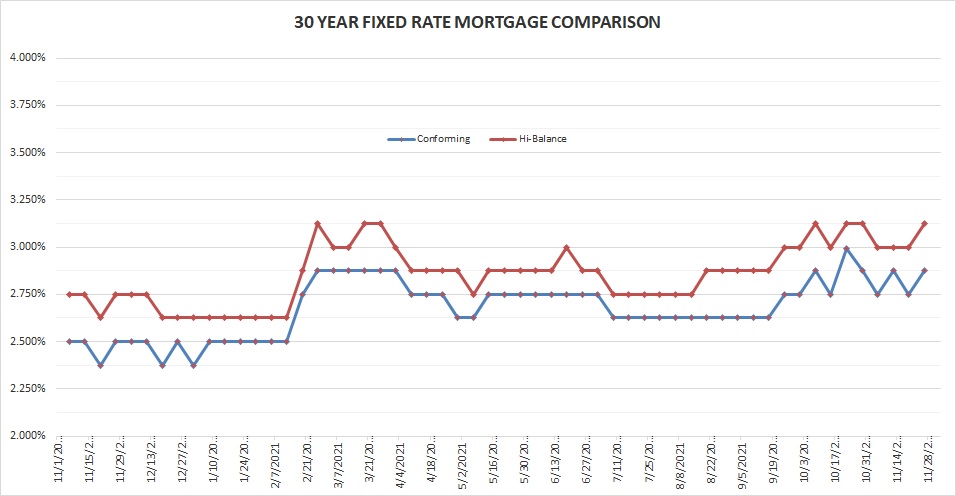
Rates for Friday November 26, 2021: With the Fed accelerating the time frame for higher rates, and data supporting higher rates, it is not a surprise that we see rates higher from last Friday, as you can see by the chart we have choppy lines—which indicate transition and upward pressure after lower, and stable rates for a prolonged period. Markets are open today and while not reflective on rate sheets, Mortgage Backed Security (MBS) prices are up today (lower rates) due to investors dumping stocks and purchasing fixed rate assets (like mortgages) on news of a new variant in the Covid-19 virus that could lead to a surge in cases, and possible return to shutting down commerce and economies.
FIXED RATE MORTGAGES AT COST OF 1.25 POINTS LOCKED FOR 45 DAYS FOR PURCHASE TRANSACTIONS:
30 year conforming 2.875% Up 0.125%
30 year high-balance conforming 3.125% Up 0.125%
Please note that these are base rates and adjustments may be added for condominiums, refinances, credit scores, loan to value, no impound account and period rate is locked. Rates are based on 20% down with 740 FICO score for purchase mortgages.
I hope you had a wonderful Thanksgiving; we did and I write this still in somewhat of a tryptophan coma—likely adding to my grammatical, punctuation and other usual errors.
Have a great week,
Dennis
Past Weekly Rate & Market Updates can be found on my blog page at my website www.DennisCSmith.com/my-blog


