

How much purchasing power has been lost to rates?
Question of the week: How much purchasing power has been lost?
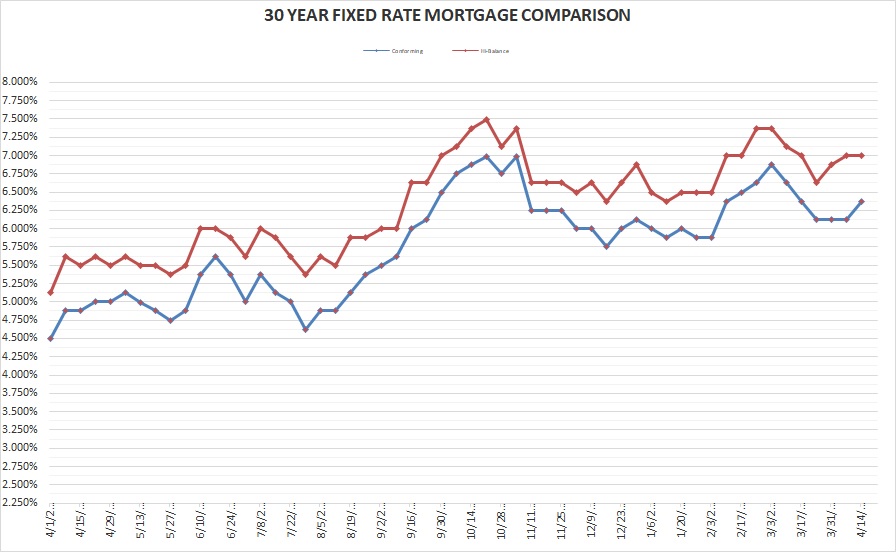
Answer: This is a follow up to WR&MU from February and March of last year when rates jumped from 2.875% on December 31, 2021 to 3.875% in mid-February and then to 4.5% in late March.
For my examples I used a couple making $100,000 per year, using a debt-to-income qualifying ratio of 40% for housing payment only resulting in a $2500 mortgage payment (estimating about $850 for monthly tax and insurance expense).
In December 2021 at a rate of 2.875% with 20% down the couple could qualify for a $750,000 home with a $600,000 mortgage.
In February 2022 at a rate of $3.875% the purchase price had declined to $660,000 with a mortgage of $530,000, a decline of about 12% in purchasing power from December.
In March 2022 at a rate of 4.5% the sales price dropped to $620,000 with a $496,000 mortgage. This is a 6% decline in purchase power from February 2022 and a 17% decline from December.
Using today’s 6.375% conforming rate, the $100,000 income earners, qualifying with a $2500 per month mortgage payment can obtain a $400,000 mortgage and a $500,000 home. This is a decline of almost 20% from last March, and 33% from December 2023.
Looking at February’s home sale statistics, the median home value dropped 4.8% for the year. Contrasting this with the 20% decline in purchasing power it is evident that while increasing rates have impacted the real estate sales in California, they have not resulting in a crashing housing market. This is largely due to scarcity of inventory on the market.
While fewer buyers may be out looking to purchase homes, there are enough relative to homes on the market to support prices at higher than pre-pandemic levels.
Looking forward, as rates begin to stabilize and eventually decline, purchasing power will increase, and so will the number of buyers going to market. Consider the decline in the total number of sales (down 33% statewide) that is not transferring to corresponding declines in prices, how quickly will inventory increase as more buyers come to market?
There is about a one-and-a-half years’ worth of pent up demand of buyers that have been wanting to buy but are holding off due to rates, qualifying, prices. This includes first-time buyers, and move-up buyers. Until the inventory on the market expands from those who have to sell, most commonly due to death, divorce or relocation out of the area, to those who want to sell to upsize, downsize, or a different neighborhood, inventory will lag demand as new buyers come to market.
What happens when demand exceeds supply? Prices rise.
Last year when I printed the numbers on declining purchasing power, many who could qualify for the homes they wanted decided to wait for rates to decline. For those who did not wait they may have seen the value of their homes drop in the past year, but when calculating the current home value and the mortgage payment with today’s rate to their purchase price and mortgage payment with the lower rate, they made good decisions as prices will likely increase next year from this as demand picks up with lower rates.
Is it worth it to wait? For what, lower prices, lower rates, both? In my opinion it is not. If you can afford the home you want today, and are able to outbid competitors for the home, my advice is to buy the home. When rates decline you will be able to lower your payment with a refinance, and if my calculations are correct regarding lagging supply to demand as rates do decline, you will most likely see growth in value.
To schedule an initial meeting by phone or Zoom, click here for my calendar, please feel free to forward to a friend or family member!
Have a question? Ask me!
Rates jumpy this week on inflation and consumer spending data. On Wednesday the Consumer Price Index for March showed prices rose only 0.1% for the month and the annual rate of inflation slowing from 6% in February to 5% in March, the lowest level since May 2021. One large reason for the decline was the spiking inflation from January and February 2022 dropping out of the calculations. While the dropping overall number was good news, especially for rates, the “core” rate (food and energy prices omitted from data) rose 0.4%. With grocery prices up 8.4% from last year, families may be seeing slowing prices on incidental purchases but the cost of feeding the family are still stretching budgets. Due to the slowing overall number rates responded positively to the CPI data, but no numbers in the report cause the Fed to back off its tightening and pushing rates higher to slow inflation through slowing economic growth.
Today’s retail sales data had the opposite effect on rates than should be expected. Retail sales dropped by 1% in March, the fourth time in the last five months sales have declined. The primary reason for the drop was reduced sales for auto dealers and gas stations, exclude the two categories and sales were down only 0.3%. Gas sales dropped 5.5% due to declining price of oil more than reduced volume purchased, expect this to switch for April (and CPI to increase) as OPEC has cut production in April seeing prices surge. While the reduction in retail sales usually is a cue for lower rates, consumer spending is approximately 65-70% of our economy, rates spike today as while brick and mortar sales were down, on-line sales have been brisk. Overall the news, like the CPI data earlier in the week, was not sufficient to support the Fed changing course on rate increases.
Rates for Friday April 14, 2023: Following a dip mid-week, bonds and mortgage markets have seen a big drop today (prices drop rates rise) and the 30-year conforming up to levels from last month.
FIXED RATE MORTGAGES AT COST OF 1.25 POINTS LOCKED FOR 45 DAYS FOR PURCHASE TRANSACTIONS:
30-year conforming 6.375% Up 0.25%
30-year high-balance conforming 7.00% Flat
Please note that these are base rates and adjustments may be added for condominiums, refinances, credit scores, loan to value, no impound account and period rate is locked. Rates are based on 20% down with 740 FICO score for purchase mortgages.
Long time readers know this is the “personal section” of the WR&MU. Today a bit more personal and it comes with a strong recommendation. Since November I have had on my “to-do” list an item that is easily ignored, an “I-can-do-it-later…” My mistake. Three weeks ago I had a small rash on my stomach, showed it to Leslie who immediately said, “you have shingles.” A video-doctor-visit confirmed her diagnosis. The to-do I put off? Getting a shingles vaccine.
For those eligible who have not yet received the shingles vaccination, I strongly suggest you put on the must-do-now list. The discomfort, pain, loss of sleep, etc I have been experiencing is maddening due to my being able to have prevented it with a quick visit to CVS.
Evidently I am fortunate, per the doctor, as we caught it right away and he was able to prescribe some medicine to mitigate the spread early on. If what I have is fortunate, I have great empathy for those who have experienced the disease who were not “fortunate.”
Consult with your doctor, get the shot, avoid the experience.
Have a great week,
Dennis
Past Weekly Rate & Market Updates can be found on my blog page at my website www.DennisCSmith.com/my-blog


