
Should I be concerned if my loan servicer changes?
Before we get to the question of the week, a small addition to last week’s piece on the impact of tariffs on mortgage rates, see below after the answer to question of the week for the update.
Question of the week: Should I be concerned if my loan servicer changes?
Answer: Yes. Concerned by not panicked.
A quick recap on the path of most mortgages for newer readers of the Weekly Rate & Market Update, and a refresher for loyal readers. The vast majority of mortgages, after they are funded, are packaged into bundles by lenders and then sold on the secondary market to either Fannie Mae or Freddie Mac if they are conventional mortgages, or Ginnie Mae if they are government mortgages. The loans are then re-bundled into larger packages and sold to investors.
The actual loans are sold, but the servicing is maintained by the lenders. “Servicing” is the collection of the monthly mortgage payments, the principle and interest on the loan, and if set-up with an escrow (aka impound) account for taxes and insurance those payments as well. The servicer the retains a portion of the interest, generally 0.25-0.50%, and forwards the rest of the interest and the principal to Fannie, Freddie or Ginnie, who then retain a small portion of the interest and forwards the remainder to the investors.
Mortgage servicing is a big business, a very big business. Consider that total mortgage debt in the United States is over $10 trillion dollars, of that amount Fannie and Freddie have about 60%, or $6 trillion, of the market. Assume an average interest rate of 4% and that amounts to $240 billion annually in interest payments, if servicers retain 0.25% of the payments that creates a $600 million industry.
Because of this steady volume of revenue mortgage servicing becomes a nice source of income, as well as a very nice asset that can be sold. Why would a bank or mortgage lender sell its servicing portfolio if it provides so much cash flow? If a bank needs cash to purchase another bank, pay off liabilities, build reserves, it may sell its servicing portfolio to another servicing entity. If a bank’s servicing portfolio becomes so large it will require more expenses to handle the volume, it may sell its servicing portfolio to another servicing entity. If a bank or mortgage lender is just not interested in setting up a division to service the mortgages it funds, it will sell it servicing portfolio.
It is not uncommon for property owners with conventional or government mortgages, or even jumbo mortgages, to receive a notice that their servicing is being transferred to another company and they will need to make payments to the servicing company at a certain date in the future.
Should this concern you if you get this notice. Concern may be too strong of a word, but you should definitely be aware of the possible issues that may occur due to the transfer of your mortgage servicing. Steps you should take if your servicing is being transferred:
- If you have auto-pay setup with your bank to send out your mortgage payment, or setup with your lender to pull your payment from your account, make sure you cancel the payment to your soon to be old servicer.
- Save your recent statements, this is especially
important if you have an escrow/impound account for taxes and insurance. If you
do not receive paper statements log into your account with your current
mortgage servicer before the transfer is complete and print your most recent
statements. Why?
- Your current servicer may restrict access to their website in the future for non-clients
- To have verification of outstanding mortgage balance.
- To have verification of balance in your impound account for taxes and insurance.
- To have verification of total interest paid to that servicer for your records for filing your tax returns you can match to the IRS form 1098 (mortgage interest paid).
- After you have made your initial payment to the new servicer, verify the payment has cleared your bank account, once that has been verified contact the new servicer to confirm payment has been applied to your account.
- If you have an impound account, when you call to verify your payment has been applied properly, ask what the balance is in your impound account before and after the payment.
- Do not set up auto-pay until you have made one, and preferably two, payments to your new servicer and received statements confirming the payments have been properly applied.
- If you have an impound account, when property taxes are due verify the new servicer has made the payment, and it was applied to your property. You can do this by logging onto the website for the tax collector for the county in which your property is located.
- If you have an impound account, confirm with your insurance company that you have a new servicer and that you are to be notified when the payment has been made, and especially if it has not been received when due.
- If you have issues requiring any phone communication keep a log of date and time of call, get identification of the individual you are communicating with regarding the problem, take good notes and confirm before the call is completed what was said and action to be taken. If you feel it necessary do not hesitate to thank the person for their assistance but that you would like to communicate with a supervisor as your issue has not been resolved, make sure you get the supervisor’s name and direct contact information if possible.
Not all borrowers have issues when their mortgage servicer is changed, in fact the over-whelming majority experience no issues at all. There are, however, issues with some accounts and to be aware of potential issues might make it easier for you to resolve should it happen to you.
The Smith Family Estate’s mortgage servicer is in the process of being transferred to a new company, one I have never heard of. Am I concerned? A bit, mainly because I know the issues that can occur; concerned but not overly worried as I know that the chances are all with go smoothly. But in case they do not, I am prepared. If you are notified your servicing is being transferred you should be prepared as well.
Have a question? Ask me!
Updating: In response to last week’s question of the week and answer, friend Conor asked, “I’m interested in the example of $5 on a $1,000 iPhone. If there is, say, a 20% tariff placed on such electronic goods, wouldn’t there be a much larger impact?” Conor points out my need for an editor, especially when I write the WR&MU over several hours between more urgent client matters. He also asks a great question. In the WR&MU last week I averaged the cost of the tariffs imposed on Chinese goods across all goods and services consumers purchase, and failed to address the impact on specific goods on Chinese imports impacted. Conor is correct, the $1000 iPhone with a 20% tariff becomes a $1200 iPhone.
The impact of the tariff is for the consumer to either retain brand loyalty and purchase the more expensive iPhone, wait out the tariff and trade conflict for the tariff to be lower or go away, or purchase another brand of smartphone not manufactured in China.
There is another option however that will enable the consumer in the United States to purchase the new iPhone with no additional tariff cost. If Apple changes its supply lines and contracts with companies in Taiwan, India, South Korea, or any other country currently with the ability not subject to the Chinese tariffs to assemble iPhones for the American market and use the assembly plants in China to ship to other nations where there are no tariffs on the imports.
Starting before President Trump imposed tariffs on Chinese imports many companies with facilities in China have been shifting production to other countries so their products are not impacted. This transition has the effect of exacerbating the costs of the tariffs to China with the loss of jobs and revenue.
There are many products that will still be manufactured in China that American consumers purchase, and the consumer will need to make the choice to pay the tariff on the individual item or either not purchase or purchase a competing brand from another nation—perhaps the United States if such an option is available.
Thanks for the question Conor!
Bounce. What is one word to describe Southern California home sales in April, Alex? The California Association of Realtors April housing sales data showed a big bounce in sales for the month. Statewide the median price went from $565,880 in March to $602,920 in April, an increase of 6.5% for the month and 3.2% from April 2018. Prices may have increased statewide but units sold declined 0.1% for the month and 4.8% for the year. More locally Los Angeles and Orange Counties saw large spikes in sales volume, up 18.2% and 17.1% respectfully from March (with LA down 0.1% in units sold from last year and the OC up 0.5%). Prices for both counties also rose. The median price in LA increased 3.5% for the month to $544,170, which is 3.0% from March 2018. Further South, the $825,000 median price in Orange County was a 1.9% month over month increase and 0.9% bump from last April. One month does not make a trend, however it is a positive sign heading into the summer housing market to show some strength in the spring.
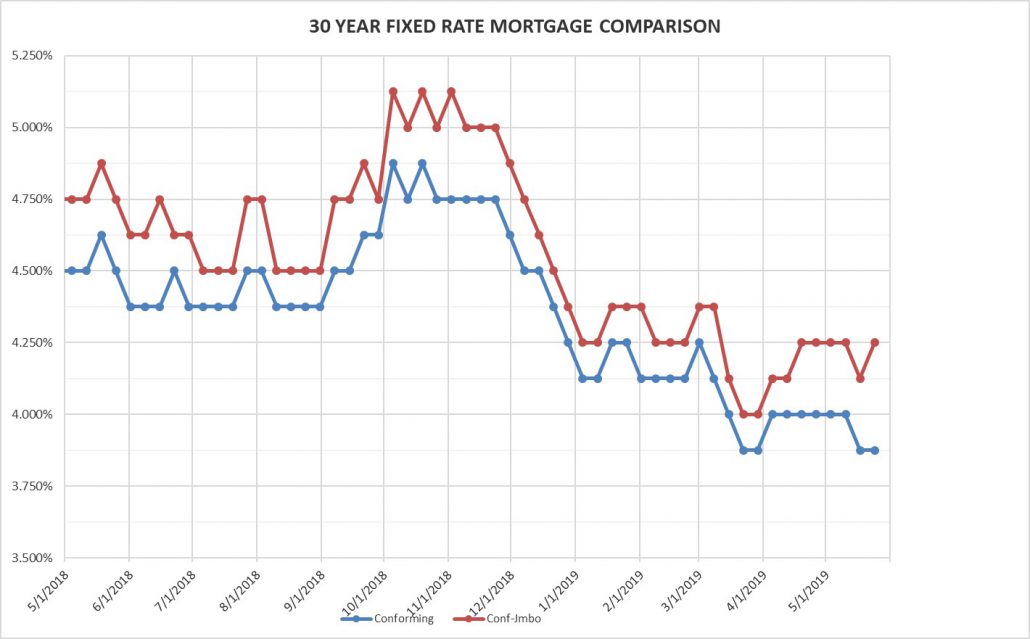
Rates for Friday May 24, 2019: China continues to be front of mind for investors this past week, but there has been little impact on the conforming rate, which is flat from last Friday. The high-balance rate skipped off last week’s dip and is up for the week. It is the Friday before a three-day weekend so the junior traders have been left in charge of the desks on Wall Street with the directive, “don’t lose,” which means a lot of equities and bonds being sold to hold cash and be protective of assets.
FIXED RATE MORTGAGES AT COST OF 1.25 POINTS LOCKED FOR 45 DAYS:
30 year conforming 3.875% Flat
30 year high-balance conforming 4.25% Up 0.125%
Please note that these are base rates and adjustments may be added for condominiums, refinances, credit scores, loan to value, no impound account and period rate is locked. Rates are based on 20% down with 740 FICO score for purchase mortgages.
Monday, we remember those who have lost their lives in service to our nation. This can be very difficult day for many active duty members of the military, veterans and families as they remember their comrades in arms, friends and family members who died in service. While we enjoy a day off we must also pause to acknowledge the sacrifices made by so many and give condolences to those who have lost their loved ones. From the beginning our nation has been one with many differences in opinions for almost every issue, but we come together to thank and acknowledge those who have stepped up to protect our right and ability to have those differences.
Our Lucky Charm for Boston sports (as explained last week), came home on Monday—the first time since January I have been able to hug her. Very wonderful to have her home for a bit before she takes off on Monday for Camp Birchwood in Minnesota where she was a camper for eight years and this summer will be a counselor for the next two months. She’s doing her job, growing up!
Have a great week,
Dennis
Past Weekly Rate & Market Updates can be found on my blog page at my website www.DennisCSmith.com/my-blog