What impact will the tariffs and trade with China have on mortgage rates?
Question of the week: What impact will the tariffs and trade war with China have on mortgage rates?
Answer: Great question, with a variety of possible answers, only three of which concern us: will the tariff tiff lead to higher rates, lower rates, or have no impact.
To recap for newer readers of the WR&MU, I have a degree in economics and political studies and have studied both since I walked on campus in August of 1980. There are plenty of jokes about economists not being able to give a complete answer to any question without a “but…” or “on the other hand…” which his some of what I will provide today, but also my personal opinion.
To recap the issue, in July 2018 President Trump imposed tariffs on China for what many consider unfair trade practices. There had been negotiations between China and the United States on trade issues since Trump and China’s President Xi Jinping visited the U.S. in April 2017 to meet with Trump, this was followed by Trump’s visit to China in November 2017. Following the visit negotiations on a broad range of trade issues were more circular than linear and the Trump Administration began implementing actions to pressure China into working to resolution of issues in the trade talks, and starting in March 2018 tariffs began to be imposed on certain goods entering the United States from China and other nations. China, in response, began imposing tariffs on certain goods imported from the United States.
Primary to the United States negotiations for a trade deal with China is the Chinese government doing nothing to stem, or preferably stop, the theft of intellectual property and the manufacturing of forged goods for sale into American and other international markets. The estimated costs of these actions by Chinese businesses, many of which are government controlled is from $250 to over $600 billion per year.
For more context, the trade imbalance with China in 2018 was $419.2 billion in China’s favor, in other words the United States imported $419.2 billion more from China than exported to China. From the numbers, the Chinese business and labor markets benefit more from trade between the nations than do American businesses and labor markets; on the other side American consumers benefit more from the imported goods from China than Chinese consumers from American imports.
Back to our question, what impact can this issue have on mortgage rates?
The issue can have the impact on increasing interest rates if the trade war is resolved in such a manner that results in loss of income to American businesses due to piracy and forgery of American intellectual property and products and a much wider opening to Chinese markets for United States goods. The result would be economic growth and expansion for the United States economy, which results in higher rates as strong economic expansion and growth tend to lead to inflation and higher rates. Rates or usually tied to stocks, if stock prices rise so do rates, besides higher prices and wages putting upward pressure, so will corporate earnings and profits sending stock prices higher pulling money out of fixed rate investments, like mortgages, creating more upward rate movement.
The issue can have the impact of lower interest rates if the trade wars continue beyond the United States and China to include other nations resulting in economic slowing in both nations and around the globe. This could create a recession, which is economic contraction instead of growth, which results in lower interest rates. Corporate earnings would drop, as would stock prices, which would have investors purchasing more fixed rate assets, leading to more downward rate movement.
The issue can have no impact on rates if either no new trade deal is put into place and the tariffs remain where they currently are or even increase some more.
Looking at the data, the last option is what I think will happen. It is important to separate the politics from the data of the trade between the United States and China. This is challenging since almost all of the information we receive is political in nature—just read all the adjectives, and the “could happen if…” “might happen if…” “may happen if…” in stories on any subject and in particular the trade issue, these statements color a story and ultimately inject politics. The impact of the issue so far has seen the stock market drop and climb and drop and climb, much of which I, and others, feel is unfounded as the impact of the tariffs on the overall economy and the amount of trade with China are both overstated.
Tariffs are taxes on imported goods that go to the federal government. From the beginning of our country until into the 20th Century, tariffs were the primary source of funding for our federal government. In 2018 Americans paid a total of $5.51 trillion in taxes (with a t-) to federal, state and local governments, of which $3.6 trillion when to Washington D.C. The most recent tariff hike on $200 billion in imports from China raised $30 billion a year in taxes for the United States, or about 0.8% (zero-point eight percent, or less than one percent) of total tax revenue last year. Certainly, a lot of money, but an additional $30 billion in tax revenue has zero impact on the government.
This also means that American consumers will pay $30 billion more for Chinese goods, absent inflation, due to the tariffs. In the first quarter of 2019 consumers in the United States spent $14.25 trillion, about 68% of our total Gross Domestic Product (GDP). If consumer spending drops 2% per quarter for the remainder of the year, a big if, total spending in the United States for the year would be over $55 trillion. The higher costs to consumers for the tariff costs are about one-half of one percent of their total spending (0.5%). Because iPhones and chargers are made in China, if we add 0.5% to the current cost of a high-end iPhone that is $1000, the price with tariff would be $1005.
Consumers are benefiting from the current situation in the grocery stores as food prices are down since China is importing less wheat, soybeans and other farm products. American farmers have crops ready to ship and while looking for other markets to take up the slack from the drop in exports to China an over-supply has led to lower prices at home. China importing less from the United States does not mean that China has stopped consuming wheat and soybeans, it means they are importing from other nations, which leads to higher prices in those countries, and also a vacancy in markets where they were exporting before selling to China.
In summation, the amount of trade between the United States and China is a very small percentage of our national economy, all exports to China amount to about 0.6% of our GDP so if all exports to China were to cease, while it would have a negative impact on some industries it would have a negligible impact across the whole economy. As well, the negative impact can, over time, be reversed with exports previously sent to China sent to other nations due to supply and demand in international markets.
Of greater impact to our domestic economy then the potential loss of trade is the historically higher tariffs on U.S. imports to China than Chinese imports to the United States, which has limited the Chinese markets to American companies while providing almost unlimited access to American markets by the Chinese. Combined with the loss of revenues due to theft of intellectual property and manufacture of forged goods, the trade situation with China is more costly to our GDP than the costs of the tariffs being imposed and loss of exports to China and higher prices for Chinese goods in the United States. Should an agreement be reached in which the Chinese government agrees to lower tariffs so they are somewhat in balance between the two nations and to crack down on forgeries and piracy the U.S. economy would see a very positive benefit due to an expanded marketplace for U.S. goods and retention of lost revenue.
Tariffs can be extremely harmful to both importers and exporters resulting in higher costs and/or lack of production. This is the case if the amount of trade and GDP impacted by the tariffs is a significant portion of either, or both, nation’s total trade and economy. While there is a lot of trade between the United States and China, the amount is not a significant portion of the American economy. Because of this the overall impact of the current tariffs, and potentially higher tariffs in the future, should not have a large impact on our economy nor interest rates.
Have a question? Ask me!
Speaking of American consumers, retail sales in April dropped 0.2% from March. Ordinarily this would be of some concern since consumer spending is 65-70% of our GDP, however since retail sales jumped 1.7% from February to March a slow down in April was expected following the torrid buying in March. Investors reacted to the news with a yawn and rates were not impacted.
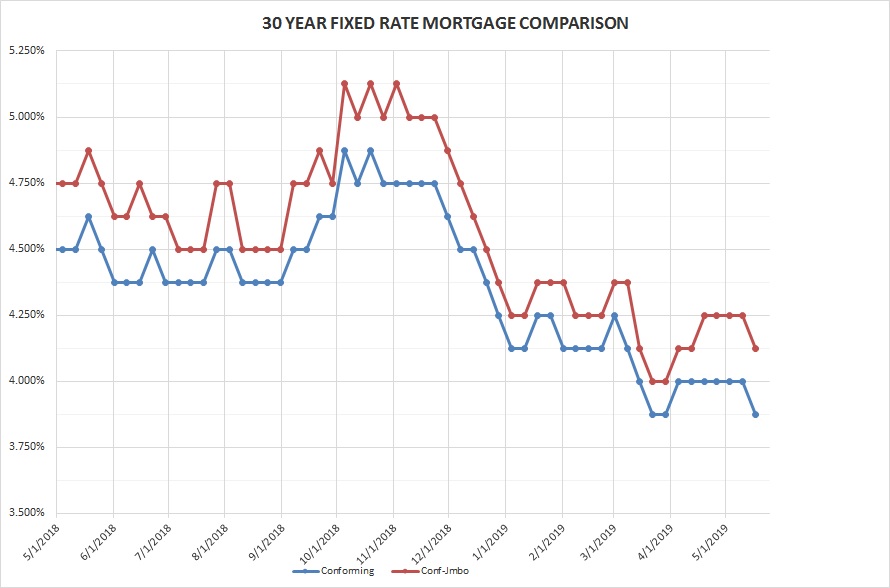
Rates for Friday May 17, 2019: As stated, rather lengthily, above the perception of the impact of the trade dispute with China is worse than the actual economic impact. Perception however, is what moves markets and the markets will continue to be somewhat unstable until some sort of resolution occurs. After several weeks of rates being flat Friday-to-Friday we see a dip this week due to the instability in the markets and investors moving from stocks to bonds and mortgages.
FIXED RATE MORTGAGES AT COST OF 1.25 POINTS LOCKED FOR 45 DAYS:
30 year conforming 3.875% Down 0.125%
30 year high-balance conforming 4.125% Down 0.125%
Please note that these are base rates and adjustments may be added for condominiums, refinances, credit scores, loan to value, no impound account and period rate is locked. Rates are based on 20% down with 740 FICO score for purchase mortgages.
If there are any fans of Boston teams reading this you may want to give me a call. The purpose of the call will be to ascertain your devotion to those teams and if it is enough to enable your Lucky Charm to remain in Boston for three more years. What Lucky Charm?
Last night the Boston Bruins advanced to the Stanley Cup Finals, where they will be the overwhelming favorite to beat either St. Louis or San Jose. If/when they do win the Stanley Cup, the Bruins will be the third team to win a championship for Boston since August 2018.
In August of last year our daughter showed up in Boston to begin her freshman year at Boston University. Her arrival was followed a few months later by the Red Sox winning the World Series and a few months after that the Patriots won the Super Bowl, and now the Bruins are four wins away from the Stanley Cup. Coincidence? Maybe. But if you are a Boston fan why take the chance? Why not make a donation to keep her in Boston as your Lucky Charm and bring more championships to your city?
For those who do not like Boston teams we may be able to negotiate what it would cost to get her to leave Boston and attend university where your favorite teams play. For your information, this Phillies, Eagles, Flyers, Sixers fan has struck out on her moving south….
Have a great week,
Dennis
Past Weekly Rate & Market Updates can be found on my blog page at my website www.DennisCSmith.com/my-blog