
How can we help our children purchase their first home?
Question of the week: How can we help our children purchase their first home?
Answer: This question came up yesterday when I was having breakfast with Martin and Marc, two attorneys who between them have children between early to late 20’s. Concerned about the cost of residential real estate in California, they wondered how they could assist them get their foot in the door (haha, nice pun) of home ownership.
The concern Martin and Marc have is not unique, many parents with children entering the age they were when they were purchasing their first homes are concerned their children will either have to rent for a very long time, or move to another part of the country to purchase a home and raise their families—and grandma does not want to travel to Frisco, Texas or Nashville, Tennessee to visit her grandbabies!
There are three primary factors to loan qualifying: income, credit and cash to close. How a parent help a son or daughter with each of this areas of qualification, or can they?
Before we get into the different areas I will be addressing the two most common types of mortgages used by all home buyers and especially those purchasing their first homes, conventional mortgages, aka Fannie and/or Freddie, and FHA mortgages. Unless noted otherwise the guidelines will be pretty much the same.
INCOME
Conventional guidelines have loosened up on income assistance and now pretty much mirror the FHA guidelines. It is really hard to get your kid a raise, even if s/he works for you a sudden spike in income will have the underwriter arching eyebrows thinking, “this kid got a raise just to qualify,” which is why working for a family owned business typically requires a bit more history of earnings for qualifying.
A parent can assist with income qualifying by co-signing on the mortgage. When we have a co-signer combine all the borrowers’ income and all the borrowers’ debt obligations in the debt-to-income (DTI) calculation. When parents co-sign we must include their full housing payment, principal and interest on mortgage, property taxes, homeowner’s insurance and HOA dues if any. This inclusion of housing payment can sometimes be the barrier for a co-signer assisting as it throws off our DTI requirements.
It is important for anyone co-signing to know and acknowledge that they are 100% responsible for 100% of the payment. If the kids miss a payment it will reflect on your credit report. If the kids miss several payments and go into default, you are also in default. If the mortgage is foreclosed, you have a foreclosure on your record. Therefore, if you co-sign it is highly recommended you obtain on-line access to the lenders website so you can check in every month to make sure the payment has been made and all is well.
One concern many parents have when co-signing is how it will impact their ability to obtain credit in the future with another mortgage on their record. The current guidelines for mortgage qualification if an applicant has co-signed for another mortgage is if the applicant can show the primary borrower (a term I dislike using since all borrowers are equal) has made all the mortgage, tax, insurance and if applicable HOA payments over the past twelve months the housing payment will not be calculated in the qualifyinig for a new mortgage. For instance, you have co-signed for your kids and the total housing payment (PITI) is $3000 per month. You decide to purchase a vacation home in Palm Desert and are getting a mortgage, but with your current housing payment and your kid’s housing payment you do not qualify. You show proof that you kid has made all the payments for the house, mortgage, taxes, etc, for the past twelve months. Now the payment will not count in your qualifying and now you qualify for that 2500 square foot single-level in back of the golf course. “Proof” will entail obtaining bank statements from your children showing they have made all the payments required for the property, i.e. cancelled checks or direct payments to mortgage company, county tax collector, insurance agency. Note if there are systematic deposits into their account from you, this will be construed as assistance and therefore the payment will count. If there are even occasional deposits tracked to you for large sums there is a good chance this may disqualify the guideline as well.
CREDIT
The cliché in our business is, “you can’t co-sign bad credit.” This means if your credit scores are hovering around 800, and your kid’s credit score is mid-500’s, your 800 score is not relevant. For credit scores lenders use the lowest-middle score of all borrowers. Similarly if the situation is reversed and you have the low score and your kid has the high score, your score is the one that impacts the ability to qualify or the interest rate being higher.
The best way a parent can assist a child with the credit aspect of qualifying for a mortgage is to pay down or off some of the items on the credit report. In the short term paying an auto loan down to below 10 months of payments will have that payment not count in qualifying. If you son or daughter has an auto loan and the payment is preventing us from qualifying, if you are able to pay the account down to less than nine months that payment is not used in our DTI calculations and now they qualify.
The same can be done with other credit payments to lower total debt payments, such as credit cards. As well, if your kid’s credit score is low, we can run an analysis to determine if there are any remedies to boost the score. Often times this can be done by paying off credit cards, or in many instances just paying them down below certain levels. Raising a score fifteen or twenty points can sometimes result in a lower interest rate and easier qualifying.
Before doing this make sure you consult with your mortgage professional (me!) to ensure it is done properly and does not create a situation that does not help in qualifying. Whenever there is “outside money” we have guidelines that must be followed. That leads us to….
CASH
This is the most common form of assistance that parents provide children looking to purchase their first home, a gift of cash for down payment, closing costs, credit relief, wherever needed.
Depending on when you make your cash gift to your children, there are specific guidelines that must be followed if there is a cash contribution to the borrowers to ensure the legitimacy of the funds are from a “acceptable donor,” essentially a relative or significant other (fiancé(e), domestic partner), and that the funds are not borrowed.
This entails a proof the donor had the funds to gift, proof the funds transferred from the verified donor account to the borrower’s account, a gift letter indicating there is no expectation of repayment.
Before making any cash contribution, or pay-off debt, or consider co-signing, please contact me so we can run through the specifics of the potential transaction and how you might help your children purchase their first home.
Have a question? Ask me!
Still strong. Early in the week the first revision to the 1st quarter Gross Domestic Product data lowered the estimate for growth in the quarter from 3.2% to 3.1%, not as strong as initially estimated but still a strong growth number for the nation’s economy. The news had no impact on mortgage rates.
Financially healthier households. That is the take-away from data released this morning by the government on personal income, consumer spending and inflation in April. Personal income grew at a very good rate of 0.5% for the month. While household revenue increased in the month, the additional funds were not being used for consumption, which grew at a rate of 0.3% from March—not a surprising number following March’s staggering 1.1% increase in consumer spending from the prior month. The Personal Consumption Expenditures index, a key gauge for inflation, increased only 0.3% for the month and is up 1.5% from last April, well below the Fed’s target inflation rate of 2.0%. With incomes up higher than spending it follows that the savings rate increased, from 6.1% in March to 6.2% in April. This is a bit of a mixed news data point, since consumer spending is 65-70% of our national economy, slowing growth in spending and higher rates of savings are great for long-term household finances but a bit of a damper on economic growth. Personally, I am fine with a bit of a slowdown in economic growth as a result of increased personal savings rates. Over all the news is neutral to rates.
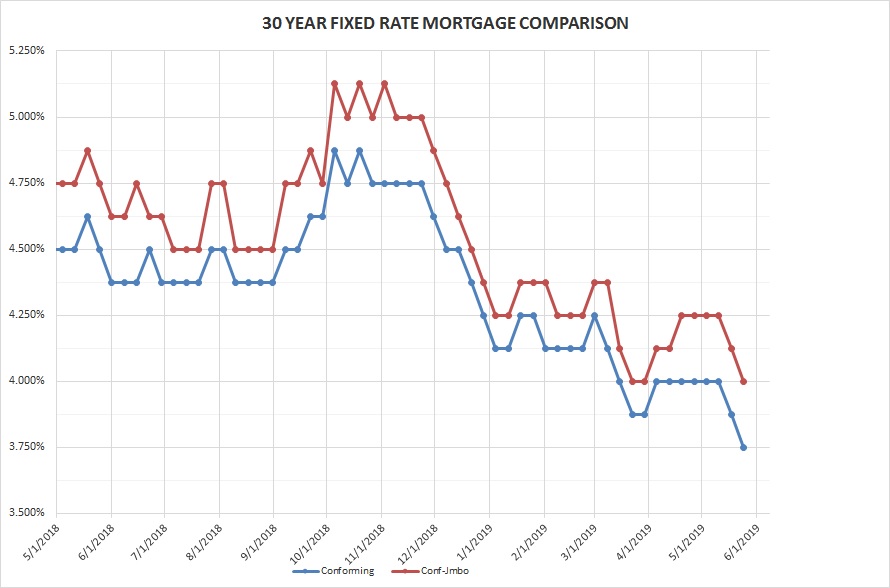
Rates for Friday May 31, 2019: A great line this morning form an article on the MarketWatch.com (a Wall Street Journal subsidiary) website regarding the economy, “The U.S. economy is basically sitting in the middle lane of a highway. It’s unlikely to generate enough speed to justify a shift into the fast lane or slow down so much that it will be shunted to an off-ramp.” This middle-lane economy is a bit swervy as investors concerns over the Trump Administration combining trade strategy with foreign policy has them nervous for potential long-term impact on not only the domestic, but also the global, economy. While the domestic economic news keeps rates in the middle lane, domestic politics and international economics has investors in a “flight to quality” today, leaving stocks and buying bonds and mortgages—which puts downward pressure on rates. All the movement of funds has resulted in our 30 year conforming rate being the lowest it has been on a Friday since January 5, 2018.
FIXED RATE MORTGAGES AT COST OF 1.25 POINTS LOCKED FOR 45 DAYS:
30 year conforming 3.75% Down 0.125%
30 year high-balance conforming 4.00% Down 0.125%
Please note that these are base rates and adjustments may be added for condominiums, refinances, credit scores, loan to value, no impound account and period rate is locked. Rates are based on 20% down with 740 FICO score for purchase mortgages.
It’s that time of year…near the end of school year but still not near enough for many kids. And parents. This morning as Leslie and I were walking the dog we crossed path with our neighbor who was returning to her home after loading a bunch of stuff into the minivan. “Almost there!” I greeted her. She turned to us with a smile, “I can’t wait. Lauryn (middle school) has a speech to give since she won a contest, a musical recital and then she’s in a play. All today!”
We wished her well and I told Leslie, “She embodies the Maycember song.”
What is Maycember? Click the link to the Holderness Family YouTube page for one of the most spot on, and funny, songs about the end of the school year that almost every parent—especially those with elementary and middle school kids–goes through.
For a great laugh for your Friday click here for “Maycember.” I’m thinking many of you will share this mom’s and dad’s you know can relate.
Have a great week,
Dennis
Past Weekly Rate & Market Updates can be found on my blog page at my website www.DennisCSmith.com/my-blog