Posts

Can we remove our loan contingency?

Question of the week:  Can we release our loan contingency?

Answer: This is a question ever lender is asked on every purchase transaction mortgage package they are working on.

Section 3, Item J of the California Association of Realtors’ California Residential Purchase Agreement and Joint Escrow Instructions, aka “RPA” or “the offer,” has five clauses that deal with the loan terms of the offer to purchase a property.

  • Clause one deals with loan applications and requires that within three days, or other stipulated time frame, after acceptance of offer, the buyer needs to deliver to seller a letter from buyer’s lender stating that after receiving application and credit report buyer is prequalified.
  • Clause two is titled loan contingency and states that buyer shall act “diligently and in good faith” to obtain financing and that buyer’s qualification stipulated in clause 1 is a contingency.
  • Clause three are the terms regarding loan contingency removal and states that within twenty-one days, or other stipulated time frame, of acceptance of offer the buyer must remove the loan contingency or cancel the agreement.
  • Clause four gives the buyer the opportunity to declare that the offer is not contingent on the buyer’s ability to obtain financing.
  • Clause five deals with credits to the buyer and what happens if credits exceed limits imposed by buyers’ lender.

Our question of the week deals with clause number three, removal of loan contingency, and tangentially clause four, there is no loan contingency.

What is a contingency and why do is matter?

When you make an offer to purchase property you will almost always need to put up an initial deposit when you and the seller reach an agreement on price and terms. In the RPA where you indicate the price you are offering for the property, you also indicate how much of a deposit you will be sending to escrow should your offer be accepted. The amount of your deposit can vary, but generally the higher the deposit the stronger your offer is considered to be. Most offers are generally around 2% rounded to the nearest $5000 level. For instance, on a $300,000 offer you may have a $5000 deposit, on a $400,000 offer you may have a $10,000 deposit. If you have a $400,000 and your deposit is $25,000 then  you are telling the seller, “we feel really confident we will be able to close this transaction and are putting up $25,000 to show our confidence.”

The deposit really matters because if you cannot close your transaction after you have removed contingencies the seller has a claim on the deposit.

Notice “contingencies,” the loan contingency is mentioned above, other contingencies are for appraisal, physical inspection, documents pertaining to a homeowners’ association if applicable, sale of buyer’s current property, termite report and clearance are the most common and included in the purchase agreement’s boilerplate language.

The impact of removing contingencies is covered in Section 14, Item F, effect of buyer’s removal of contingencies, which basically says you are satisfied with all inspections and ability to obtain funds to close and are moving forward to close the transaction and accept liability if you cannot perform actions needed to close; i.e lose your initial deposit.

Item H of Section 14 contains the language regarding the effect of cancellation of the contract on deposits. Essentially, both parties must agree in writing to the cancellation and the disposition of the deposit. If one party refuses to agree to the cancelation and disposition of funds, then the clause addresses the steps to be taken due to the adversarial nature of the issue.

The bottom line is that removal of contingencies are a big deal if later in the transaction something happens that inhibits either party’s ability to close, but especially the buyer’s inability to close.

Circling back to our question regarding the loan contingency clauses stipulated in section J, within twenty-one days you have to inform the seller you are removing the loan contingency or are canceling the agreement.

If you choose to cancel the contract rather than removing the loan contingency then you are entitle to your deposit being returned, less any costs incurred on your behalf.

If you do not remove the contingency then the seller has the right to terminate the contract which generates a return of your deposit.

If you do remove the contingency and cannot obtain financing to close the transaction by the agreed upon close of escrow date, the seller can cancel the transaction and demand your deposit be transfer to them from escrow.

Can we release our loan contingency?

For many years our company has replied to this question based on advice from our legal counsel. Because California is a litigious state, we have been advised and follow the advice, that we will not tell clients, “Yes, remove your financing contingency.” If we say that we are telling our client that their loan will be funded and their deposit is secure based on the ability to fund that loan.

There have been many instances over the years where after a loan contingency has been removed a buyer has lost their job, has suffered some calamity that exhausted funds needed for closing, had an IRS or other tax lien appear that was not on a credit report, that precluded the ability for the buyer to obtain final loan approval and funding of their mortgage. In these instances, should we have told a client they were okay to remove their loan contingency and they lose their deposit we are open to action by the buyer to reimburse them for their lost deposit and possibly other expenses.

In our current environment, where many people are being laid off, furloughed, having salaries and wages reduced, due to the Covid-19 pandemic, increases the chances of something occurring that may prevent final loan approval and/or funding. This is one reason why the mortgage industry has dramatically increased employment and income verification after loan approval and before drawing loan documents and the day of funding.

What we can tell a client when asked if they can lift their loan contingency is that they were qualified when we took the application and are still qualified. However, funding of the loan will be contingent on no changes to their income, employment or other qualifying factors until the funding of the loan.

When the time comes for you to remove your loan contingency, consider all the factors in your employment, income, funds for closing, and objectively consider if there is a chance any of those may change enough to change your ability to qualify. If you feel there may be some change to your income then run it by your lender to see how that changes your qualifications and chances to close.

More importantly, before writing an offer, consider your employment, income and funds for closing and determine if there could be an impact on any of them before you close escrow that may change your ability to qualify. If so then you may wish to delay your home purchase until you are certain your ability to close has stabilized so as not to be put in a position to potentially risk several thousand dollars put on deposit.

In the end, your decision to remove your loan contingency or cancel the purchase contract is a risk assessment you need to make based on what you feel may happen after you make that decision.

Have a question? Ask me!

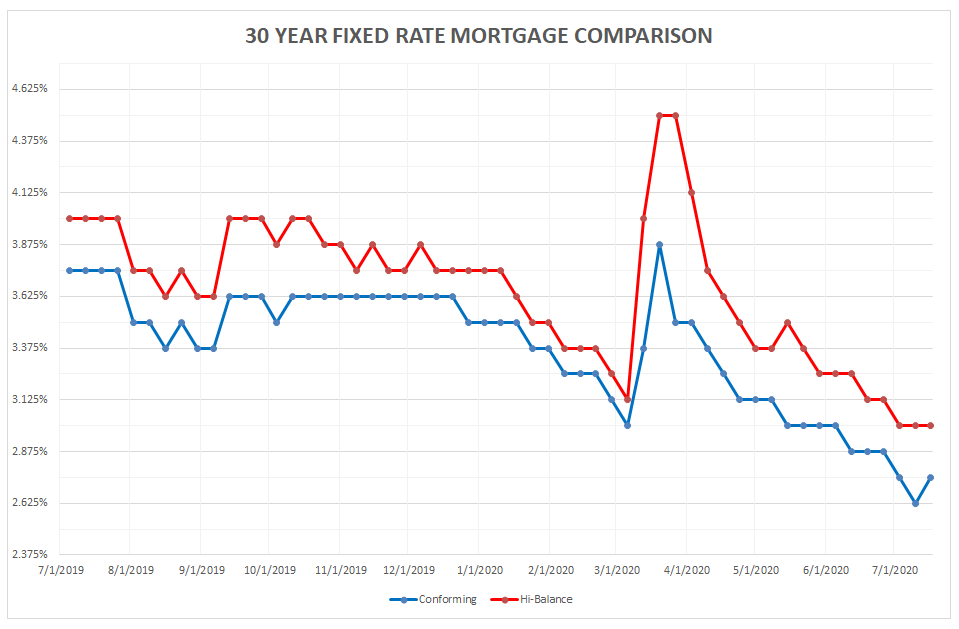
Rates for Friday July 17, 2020: Economic data a bit mixed this week as reports for June retail sales continued the gains seen in May, consumer prices increased on higher demand, both of which are good news for the general economy….but….initial jobless claims for the week ending July 11th were still over the 1 million mark and continuing jobless claims are over 17 million, which reflects a reset in many states as they close some parts of their economies that had opened in May and June.

For the week the high-balance rate remains flat from last Friday and we see a bit of a bump on the conforming rate from last Friday.

We are still seeing large disconnect in the high-balance market from purchases and refinances, as well the spread remains larger than it has historically between “no-point” transactions and those with one or fewer points. Call for details and quotes.

FIXED RATE MORTGAGES AT COST OF 1.25 POINTS LOCKED FOR 45 DAYS:

30 year conforming                                            2.75%   Up 0.125%

30 year high-balance conforming                   3.00%    Flat

Please note that these are base rates and adjustments may be added for condominiums, refinances, credit scores, loan to value, no impound account and period rate is locked. Rates are based on 20% down with 740 FICO score for purchase mortgages.
This is usually the time of the summer that Leslie and I are off on our annual summer road trip. We usually start talking about our possible trips in January or February. Even before Covid-19 was on the radar we still had not had any discussions about where we wanted to go. Probably because we still did not know the girls’ plans for the summer.

Our drive trips have been up to Northridge a few weeks ago to visit my brother’s family, and again tomorrow to see them and also my sister who is on her own drive trip from her home in Boise.

I miss the small roads and towns we won’t be seeing this summer.

Have a great week,

Dennis

Past Weekly Rate & Market Updates can be found on my blog page at my website www.DennisCSmith.com/my-blog

Should we buy a property with a friend or family member?

Question of the week:  Should we buy a property with a friend or family member?

Answer:  Most questions of the week are the result of a topic coming up in conversations over the course of several weeks. This week’s question came up several times this week; which is not that unusual, especially if there is a big mortgage, real estate or interest event or news that week. This topic, owning property with someone other than your spouse, is a bit off-beat so it was surprising to me that I received several calls this week on the topic.

Back to our question, should you buy, or own, property with someone other than your spouse?

My short answer is “No.”

When consider most issues concerning real estate and mortgages, I look long-term as owning real estate is very rarely a short-term proposition. When looking at anything long-term a factor to consider is that no one lives forever, not you nor the individual(s) with whom you may own property.

Another long-term factor is that people’s lives undergo changes, some good and some bad. This is true for you and for your potential real estate partners.

Let’s dig into why I am not in favor of co-owning real estate.

The three most prevalent scenarios for co-ownership are purchasing a vacation home to share with a sibling’s family or close friends, purchasing investment property to share the acquisition and carrying costs, and inheriting property as a co-owner with your siblings or other relatives.

Each of these has some positive characteristics. Enjoying a mountain, beach or desert retreat with your family can create wonderful memories for siblings and cousins. The ability to purchase an investment in real estate with less cash out of your savings and less downside on months where expenses exceed revenue. Sharing legacy real estate owned by your parents, grandparents or other deceased relative can benefit you and other descendants.

One purpose of how title to real estate is held is what happens to ownership of the property when one of the title holders dies. Because of this there are several ways title to property can be held.

Self-explanatory is taking title as an individual. When the individual title holder passes away disposition of the property will depend on if s/he has a will, if not the property will go through probate and a judge will decide who receives the property.

If the property is held in trust and the trustee(s) pass away the disposition of the property is completed according to the instructions in the trust.

If the property is held by one or more individuals it gets a bit trickier. If title is held as joint with right of survivorship, when on owner dies the other owner gets full title to the property and will own as an individual. This is most common with married couples. With joint title ownership neither party can sell or encumber without the other party’s consent.

Title can also be held as tenants in common. Under this form of ownership does not have to be equal. For instance, Bill and George can own a condo in Mammoth as tenants in common each with a fifty percent interest, or as tenants in common with Bill having a seventy percent interest and George having a thirty percent interest. (Sidebar, I had a married couple purchasing their first home several years ago and the wife wanted title to be tenants in common with her having a 95% interest and her husband a 5% interest since her parents were gifting some of the down payment. As I recall they ended up owning as joint tenants…I am not sure if they are still married.)

Another aspect of tenants in common is that each owner can sell their interest without the consent of other owners, as well each owner can encumber their portion of the property.

Most partnerships to purchase property take title as either tenants in common with percentages of ownership, or form an LLC or S Corporation to own the property and the partners each have a certain number of shares in the corporation.

Back to our condo in Mammoth. Because they are pooling money Bill and George do the math and see they can buy a $450,000 three bedroom condo together, a bigger and better condo than either could buy individually. Bill and George buy the property as tenants in common each with a fifty percent share. They agree to a schedule to use the property themselves. Because of the desirability of condos in the area for short-term rentals (i.e. AirBnB), and the higher rental rate for a three-bedroom unit, they agree to have a schedule segmented into three weeks divided between Bill, George and renting the property. If either Bill or George decide to not use the condo on their week and rent the unit, they get credit for the rental revenue. They set up a checking account to handle the income and expenses and each agree to put in $10,000, if account runs below $5000 if rental revenue does not cover expenses they agree to each put in another $2500.

Bill is married with two children, one almost out of college and the other out of school and working. George, his best friend since grade school, has been divorced twice and has two kids from each marriage.

Being responsible, Bill puts his portion of the property in the living trust he has with his wife.

Possible scenarios, actually realistic as I have seen many of these occur:

  • George is killed in an accident driving home from Mammoth. He had no will or trust so his estate, which includes a fifty percent ownership of a condo in Mammoth, goes to probate. During the time it is in probate Bill has to maintain the property and has to stay in constant communication with the probate attorney for accounting for expenses and income. Eventually the probate is completed and George’s four children, who do not get along, are all given a share of the property, 12.5% each. Bill is now partners with four adults he barely knows, who do not all get along. Does/can Bill buy them out? What about being able to use unit, who gets to use it when? When will it be rented? Will all four new partners agree to share in expenses? What if Bill sees the light and wants to sell, but two of the children do not?
  • Bill passes away from a heart attack. His wife, Sally, is surviving trustee and is now partners with George. They have been cordial through the years but not real close. She does not want to be partners with George, but he does not want to sell the unit because he likes being able to spend time up there with his kids or his latest girlfriend. Because of some financial issues after his and Bill’s purchase of the property he cannot qualify for a refinance to buy Sally’s share. Sally makes inquiries to see if she can sell her portion of the property but any potential buyers want to pay a lot less than half market value. Sally is partners with George and then the above scenario occurs, George dies and Sally is partners with four others.
  • George has some financial challenges with his company. He has committed underhanded accounting and ends up in court on criminal charges, including unpaid taxes to the county, state and federal governments. George’s assets are seized by the IRS. The IRS investigates to see if Bill is somehow involved, if the 50-50 ownership was part of George’s financial scheming and Bill spends a lot of money, tens of thousands to pay for accountants and attorneys to prove his innocence.  Bill is now partners with the IRS on a condominium in Mammoth.
  • Bill and Sally get divorced. It is ugly and the division of assets results in Sally getting half of Bill’s share of the condo. George now has two ex-spouses who cannot speak to each other as partners. He proposes the sell the condo. Sally, to be spiteful, says she does not want to sell. Bill goes back to his attorney to open up the divorce to see if judge will force Sally to sell. Result is Sally gets a larger portion of Bill’s retirement accounts in exchange for her portion of the condo.

What about inherited property where siblings inherit one or more properties from their parents? The same issue above can occur, and do. Exacerbating the potential issues are the spouses of the brothers and sisters. While the inherited property is exempt from community property, that does not prevent any person from deeding their share into community property or a living trust—the result of which is that the other siblings can/will become partners with their brother/sister in-law or nieces and nephews.

Inherited property typically comes with some emotion. Attachment to the family home, a vacation home with happy memories from summers and holidays. In many instances even investment properties can carry positive emotions wanting some family members to retain them.

Other factors that cause some family members wanting to retain inherited property are financial. The step up in basis for tax purposes that can minimize future capital gains taxes. In California the retention of very low property taxes. And of course, the possibility of monthly income from rental properties.

Before deciding to enter into a co-ownership relationship you need to consider the what-ifs regarding title should one of the co-owners passes away, or gets divorced, or other major life event, but also some financial considerations.

One such consideration is that real estate has very expensive exit costs. Depending on real estate commissions, transfer taxes and other potential costs in your area, the cost can be as high as 8-10%. Add in acquisition costs, which depending on the price and loan amount can add another two, three or four percent, and you will need your property to increase in value ten to fifteen percent just to break even if the partnership is not working out and all parties agree to sell.

As for buying another party out, you will need to agree to the amount of the buyout. Is it based on market value for closed properties, which include commissions? Once an amount is agreed upon you need to qualify for a cash-out refinance transaction, which has higher rates and costs than a rate and term refinance.

One suggestion I have for those who do enter into a co-ownership relationship is both parties pay for an attorney to draw up a partnership agreement that spells out what happens if one party wants to sell, a time frame which the agreement is revisited and if one party does not agree to continue the relationship the property is put up for sale or one party can buy out another with the formula for calculating the price entered in the agreement.

I have not painted a real rosy picture for those interest in co-owning property, which was my intention. Before entering any co-ownership relationship, or continuing one if property was bequeathed to you and others, consider the possible negative consequences. There are many variables that can go wrong that can be very costly in time, money, energy and relationships.

All that said, if you are interested in entering a co-ownership transaction please give me a call to run through numbers and what-ifs for the costs, payments and prices.

Have a question? Ask me!

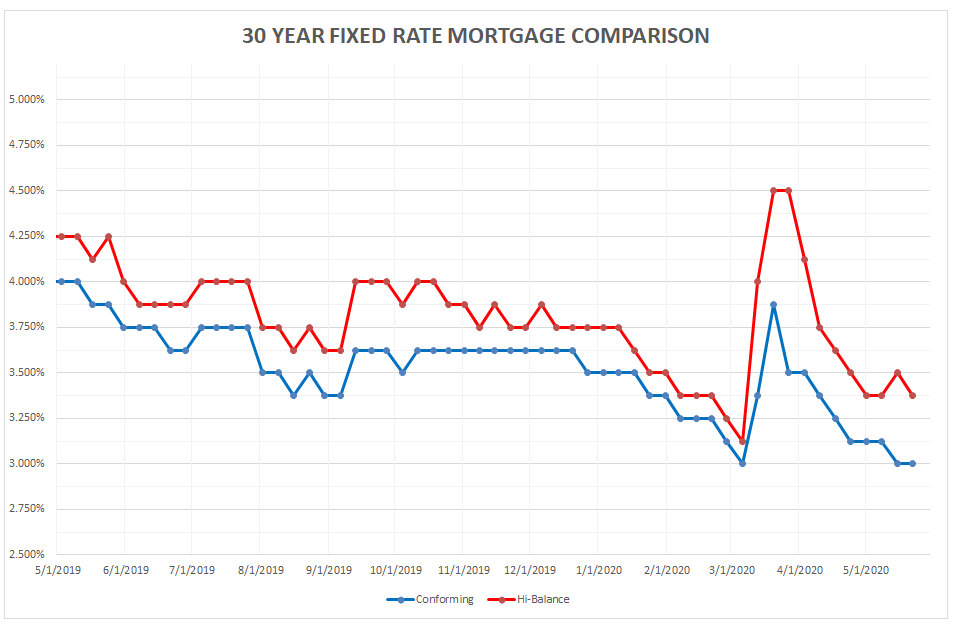
Rates for Friday May 22, 2020:  Rates are barely impacted by any economic news, everyone anticipates bad news so bad news is already priced into the markets. With tensions heating up between China and the United States we have seen some instability in equity markets, enough that I anticipated rates to drop today ahead of the three-day weekend. This did not happen and rates were flat for the day. For the week the conforming rate for purchases is flat from last Friday and the high-balance rate is down a tick. Note, these rates are for purchase transactions and refinance rates vary greatly depending on many variables for loan amount, loan to value, FICO scores, purpose of loan, etc., call for quotes.

FIXED RATE MORTGAGES AT COST OF 1.25 POINTS LOCKED FOR 45 DAYS:

30 year conforming                                            3.00%   Flat

30 year high-balance conforming                    3.375%  Down 0.125%

Please note that these are base rates and adjustments may be added for condominiums, refinances, credit scores, loan to value, no impound account and period rate is locked. Rates are based on 20% down with 740 FICO score for purchase mortgages.

Just because we cannot have parades or ceremonies does not mean we honor and respect those who have lost their lives wearing the uniforms of our nation’s military. For those who have lost a parent, child, sibling or close friends, I have greater sympathy for you this year as you may be impeded from visiting a grave site or attend a special memorial.

Having many of our freedoms restricted these past several months has given a greater appreciation for the freedoms we are so used to enjoying. Monday let’s all take a moment to honor those whose lives have been lost to protect those freedoms and the rights we enjoy that have always been, and will continue to be, a beacon for others who desire the same freedoms and rights.

Have a great week,

Dennis

Past Weekly Rate & Market Updates can be found on my blog page at my website www.DennisCSmith.com/my-blog

What are loan limits?

Question of the week:  What are loan limits?

Answer: Every mortgage program has limits as to how much of a loan the program is eligible to fund. The limits are dependent on several factors, depending on what type of mortgage is being approved. For example is it what is termed a “conventional” loan, is it a “government” loan, is it “non-conforming” or “jumbo?” Another factor is geographic location of the subject property, some programs will have higher loan limits in Long Beach, California than Long Beach, Mississippi. One more factor is what is the loan-to-value, i.e. what percentage of the value of the property is covered by the loan.

Conventional mortgages “Conventional,” or “conforming” loans refer to mortgages that are funded using guidelines established by Fannie Mae or Freddie Mac. These loans are funding by lenders who then sell the loans to Fannie or Freddie, who then package the loans into bundles and sell them as investments called Mortgage Backed Securities (MBS).

The conforming loan limits are set by Federal Housing Finance Agency (FHFA) based on the percentage increase, or decrease, in the average housing price. Mortgages that meet either Fannie or Freddie underwriting guidelines and fall within the established loan limits are eligible to be purchased by either entity depending which guidelines were used for approving and funding the mortgages.

Following the housing and mortgage markets melt-down starting in 2008 a “high-balance” loan limit was established for high cost areas across the United States. This enabled home buyers and owners in areas such as Los Angeles or Boston, where the median home price is higher than the conforming loan limit, to have easier access to low rate mortgages supported by Fannie and Freddie’s funding guidelines.

The high-balance loans have higher rates and pricing than standard conforming loans, as well as stricter underwriting guidelines.

For 2020 the conforming loan limit nationwide is $510,400. The high balance loan limits vary by county with the maximum being $765,600, which is the maximum limit for Los Angeles, Orange and several counties in Northern California. Here is a map that shows loan limits by county across the country.

Note that these are the limits for single family residences, there are different loan limits for two-, three-, and four- unit properties.

When I started in the mortgage industry in 1987 the maximum conforming loan amount was $153,100.

Government Loans that are insured by either the Veteran’s Administration (VA) or Federal Housing Authority (FHA) have separate underwriting guidelines. It should be noted that while conforming loans are sold to either Fannie or Freddie, government loans are insured by government entities.

VA loans are unique in that there is no limit on loan amounts based on location or imposed by the VA. The primary limit is the amount of the entitlement the veteran has from the VA, his/her ability to qualify, and what, if any, down payment or equity is in the property.

FHA has loan limits by county, the maximum loan in Tulare County is lower ($331,760) than the loan limit in Orange County ($765,600).

You probably noticed that the maximum loan limit in Orange County for FHA mortgages is the same as it is for conforming mortgages. Like the conforming high-balance mortgages, the FHA Jumbo mortgage is for those loans over $510,400 and have higher rates and prices with slightly different underwriting guidelines.

Non-conforming Generally labelled as “jumbo” mortgages, those loans that are funded outside of conventional or government channels have many different programs, and therefore limits and underwriting guidelines.

The most common non-conforming mortgages are traditional jumbo loans, which means they are used for applicants using underwriting standards that are close to those used by Fannie or Freddie; i.e. decent credit, verified income and funds to close, and properties that are “traditional.”

Non-conforming mortgage programs are funded by lenders and then sold to specific investors who establish the guidelines for underwriting and funding the mortgages. There are hundreds of different such investors who purchase mortgages from lenders, from major brokerage houses, to equity firms, to insurance companies, to regional banks. They establish mortgage products that run the gamut from traditional 30 year fixed mortgages to what are termed “hard money,” or “alternative” mortgages for those with credit or other challenges.

Most jumbo programs will fund mortgages under their guidelines down to the conforming loan limit plus one dollar. For example, if you are purchasing or refinancing a home with a loan amount of $525,000, because it is higher than the conforming $510,000 limit, you have the option of using either a high-balance conforming mortgage or a jumbo mortgage. Why would a borrower choose a jumbo loan instead of high-balance conforming? Some days the rates are lower on the jumbo option, or there may be something in the qualifying guidelines with a jumbo program that is more lenient and enables the borrower to qualify.

Most non-conforming loan limits are based on loan to value limits. For instance, a lender may go to 90% LTV to $1,000,000; 80% to $1.5 million, 75% to $2 million and 70% LTV to $2.5 million. Another lender may not lend above 80% LTV but at that limit lend to $2 million.

Loan limits come into play when we are working with clients as the loan amount, loan to value, and very importantly their ability to qualify, are factors as we determine loan product options and what rates and costs are associated with those options.

Want to know your loan limit? Give me a call!

Have a question? Ask me!

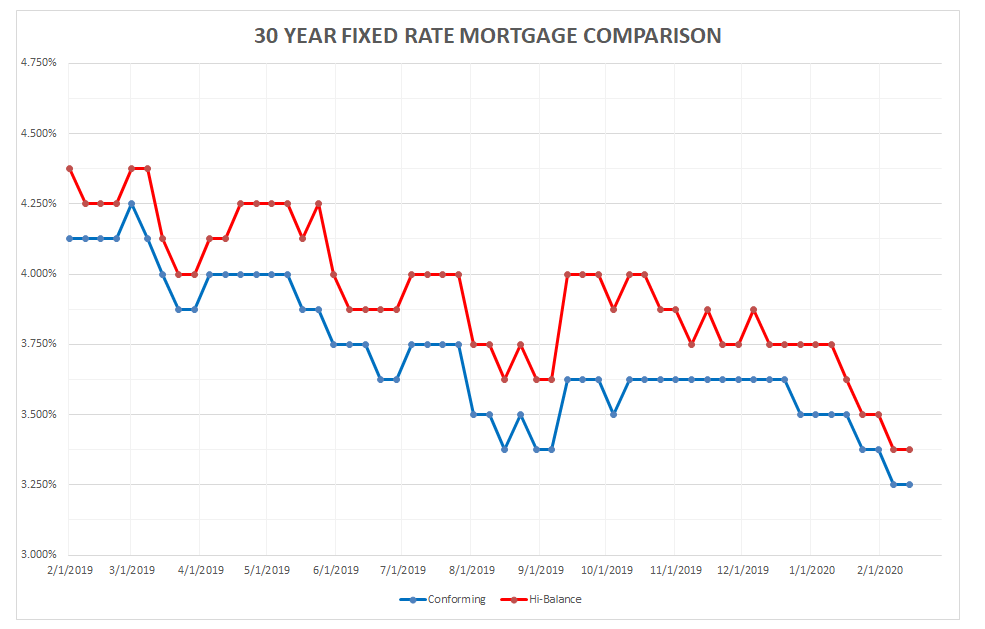
Rates for Friday February 21, 2020:  Rates are a little softer from last Friday, while the conforming rate is flat for the week the price is a bit lower, with either some closing credits or lower origination fee. The coronavirus still looms over markets as the length and breadth of its impact on commerce and populations is still not known.

FIXED RATE MORTGAGES AT COST OF 1.25 POINTS LOCKED FOR 45 DAYS:

30 year conforming                                            3.25%    Flat

30 year high-balance conforming                   3.375%  Flat

Please note that these are base rates and adjustments may be added for condominiums, refinances, credit scores, loan to value, no impound account and period rate is locked. Rates are based on 20% down with 740 FICO score for purchase mortgages.

We became childless this week. Our youngest had her eighteenth birthday and is now a legal adult. So, while we have adult children, we no longer have children that are childs!

Looking through the pictures of she and her sister through the years I get, as most parents likely do, a sense of how long ago it was she had her Dottie stuffed elephant and princess gown on, and also how it seems like just a year or so ago the picture was taken.

The passage of time is our blessing and curse. Blessed to be experiencing new adventures, relationships and, hopefully, more wisdom. Cursed as the experiences increase the time left to create more is lessening. We do not know how long we have for our new experiences, enjoy them and those you share them with every moment of every day!

Have a great week,

Dennis

Past Weekly Rate & Market Updates can be found on my blog page at my website www.DennisCSmith.com/my-blog
What happened this year?

Question of the week:  What happened this year?

 Answer: It has been an interesting year, and a boring one depending on what issues and factors we are observing over 2019.

Since I am in the mortgage business let’s start our 2019 look back with interest rates.

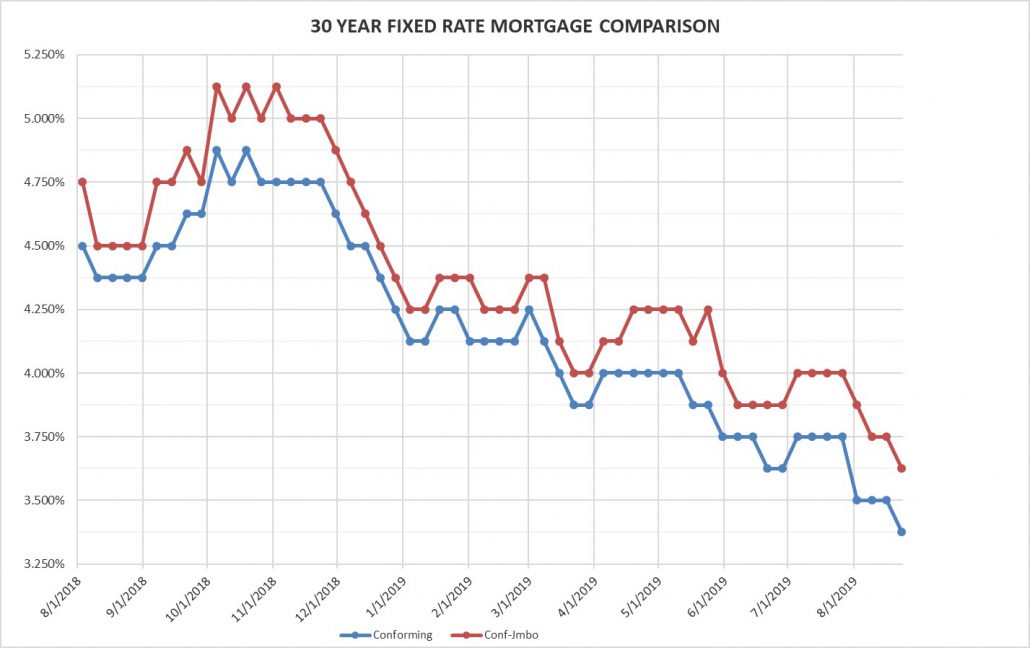
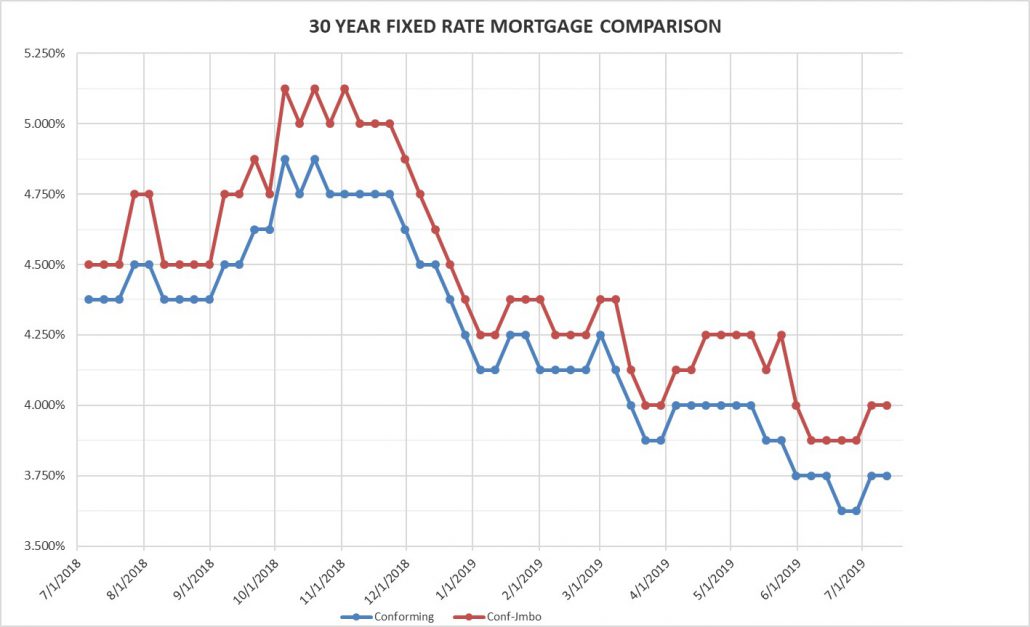
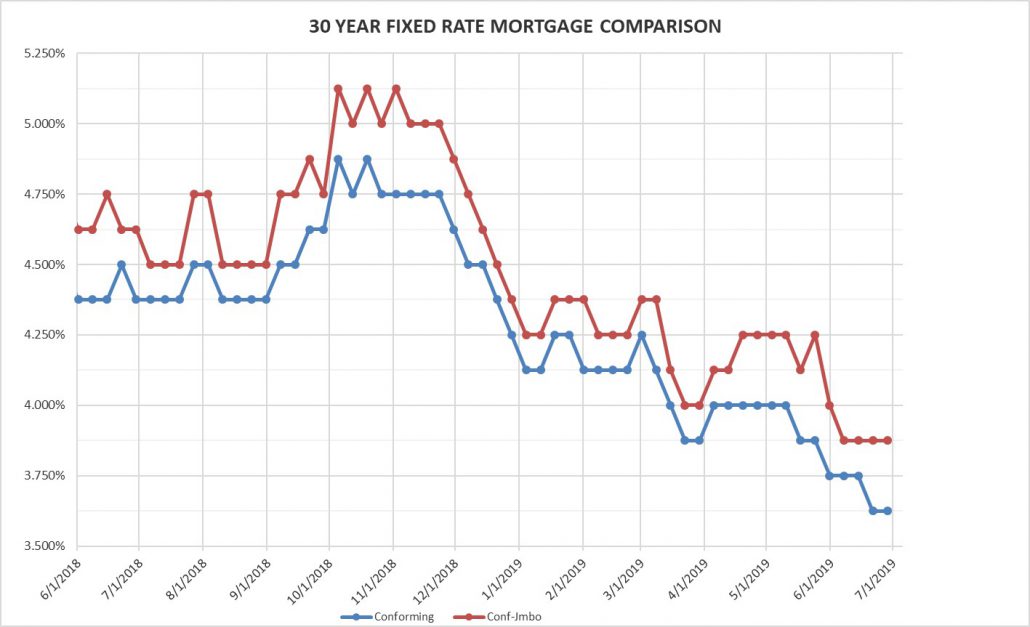
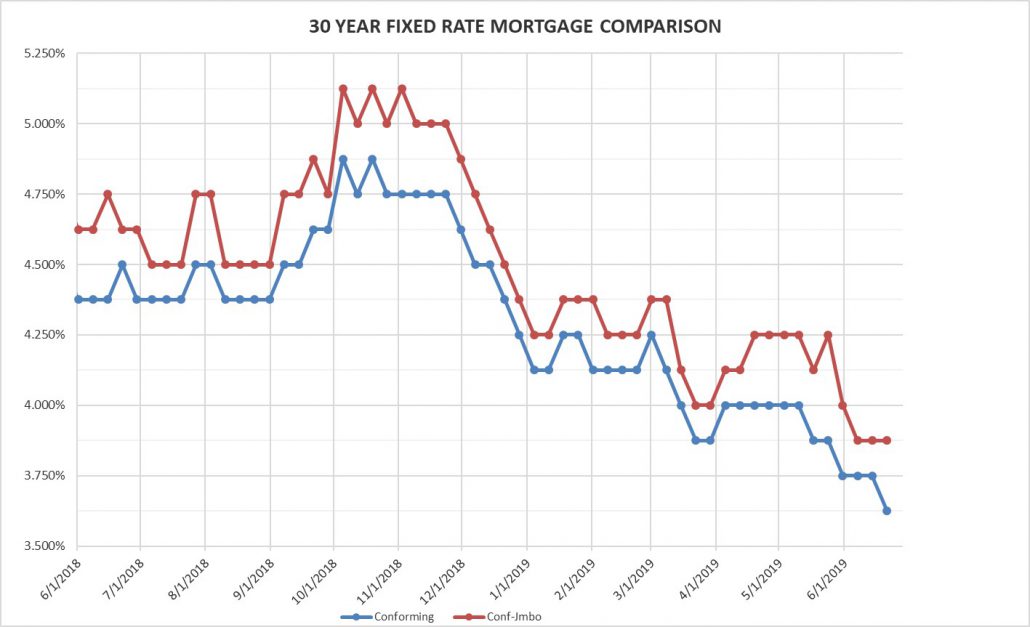
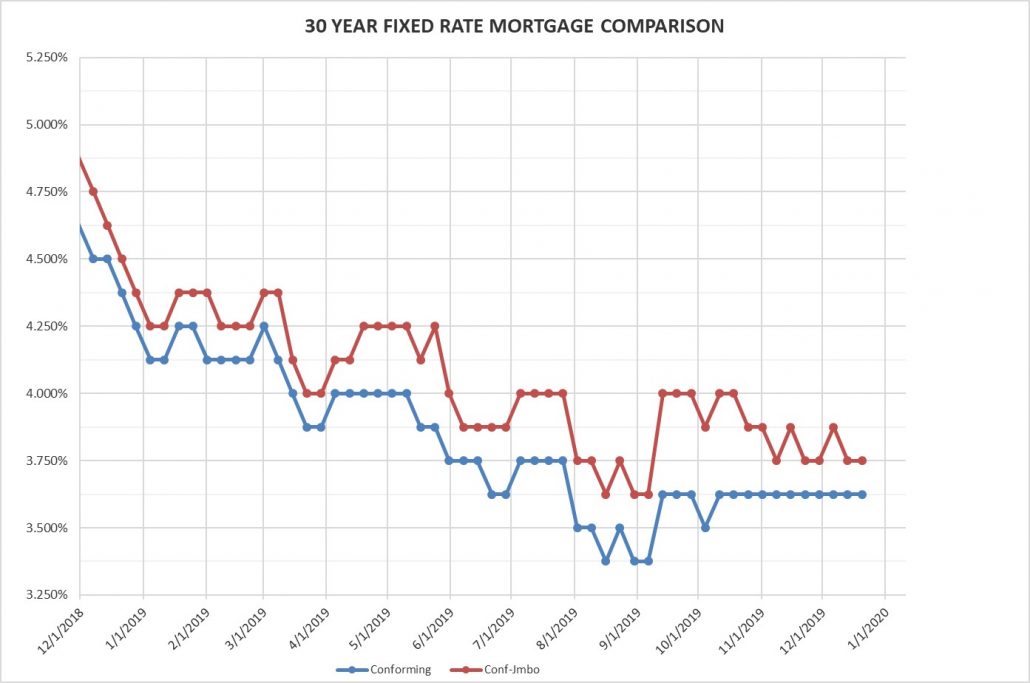
After a run up of one-half of one percent (0.50%) in the conforming 30 year fixed rate from the beginning of September to early October in 2018 rates began to fall as 2018 came to a close. The downward trend caused 2019 to open the year with the conforming rate used for the Friday rate in the WR&MU (30 year fixed conforming with 20% down purchase of a single family residence with a cost 1.25 points and a borrower FICO of 740) at 4.125%.  

Rates bounced around between 4.125-4.25% through February, then in March rates declined to reach 3.875% for a few weeks before spending most of April and into May at 4.00%. In mid-May rates started to drop again until reaching 3.625% briefly to end June before spending July at 3.75%.

July ended with the largest Friday-to-Friday drop in conforming rates, one-quarter of one percent (0.25%) since October 3rd to October 10th 2014. Weekly Rate & Market Update readers will eidetic memory will recall that on the first Friday in August I was sending the WR&MU from Milwaukee, letting readers know that earlier in that week the Federal Reserve announced a reversal of its rate policy. In previous announcements the Fed had stated it would lower its Fed Funds rate by three-quarters of one percent (0.75%) in 2019, after four rate increases in 2018. Following its meeting in the final week of July, Fed Chair Powell announced that the rate drop that day would likely be the final rate change the Fed would make in 2019. Markets reacted by snapping up bonds and mortgages causing the extraordinary move down in mortgage rates that week.

Entering August, following the Fed rate move and announcement on July 31st, the conforming fixed stood at 3.375%, the lowest since November 2016.  The historic lows lasted about three weeks, until the Fed went against Powell’s announcement in July and lowered rates again in mid-September and rates rose to 3.625%, where they have stayed every Friday but one (October 4th when we dipped to 3.5% for a few days) since. This is our tenth week in a row, and thirteenth of the last fourteen, that our conforming fixed rate has remained at 3.625% from Friday to Friday.

Summing up rates in 2019, they have dropped one percent (1.00%) since the start of the year and have been virtually unchanged for the last quarter of the year.

With rates being so positive for borrowers it is no surprise that housing markets in most of California and especially Southern California saw positive gains in values and transactions.

Using data from the California Association of Realtors from sales in November, the most recent month available, sales of single family residences across the state were up 5.6% from November 2018 and the median price went up 6.4% from $554,240 in November 2018 to 589,770 in 2019. Condos statewide also faired very well, up 7.3% in sales from a year ago and an increase in median price from $458,00 to $485,110.

More locally, Los Angeles County, despite seeing a drop in prices and number of units sold from October to November, had an increase of 5.1% in sales and a 7.4% jump in prices from $553,940 last November to $594,840 last month. Neighboring Orange County saw a decline sales from October and an increase in the median sales price, but also saw gains from last November in sales and prices. The median price in Orange County for a home in November 2018 was $795,000, after a 3.4% increase in prices the November 2019 median price was $822,000, the increase in prices was driven by a 6.9% increase in the number of sales.

Investors in the equity markets had a very good year in 2019. Whether an institutional investor managing pension funds or mutual funds, or workers with retirement accounts, or retirees receiving income from their accounts, everyone benefited.

As is frequently mentioned in the WR&MU, there is a strong relationship between equtity (stocks) markets and fixed-rate investment (bonds and mortgages) markets. Historically as the price of one goes up the price of others goes down. This year saw both fixed rate and equity markets see higher prices. (Refresher, when the price of bonds, and similar investments, go up their yields go down. So, when the price of Mortgage Backed Securities rise then interests go down.) As mentioned above, 30 year mortgage rates have dropped one-percent (1.00%) since January, which means the prices investors have paid for a 30 year fixed rate investment has gone up. The result was whether an investor had all their funds in equities or bonds, or a mix, they almost certainly saw a positive return through the year.

Investors were reacting with their consistent investing in all markets to an economy that has had incredibly consistent growth since the Great Recession ended in June 2009. Pushing the economy has been consumer spending, which has grown each month of the year with the exception of a dip in October from September. Consumer spending is 65-70% of our economy, if consumers continue to spend on goods and services our economy will continue to expand.

The expanding economy is directly related to the strongest labor market in decades. The year started with the unemployment rate at 4% in January, and for the rest of the year has declined to November’s rate of 3.5%. With the low unemployment rate has been a steady increase in wages, which outpaced consumer spending almost every month of the year through November. With wages increasing 0.54% in November from October, the annualized rate of increase in paychecks has been about 4% the first eleven months of 2019.

Workers have kept more of their paychecks as well as inflation has been at or below 2% month after month. With paychecks growing faster than spending and inflation the result has been that American families rate of savings has also been increasing.

None of the numbers showing growth in any sector in 2019 have been outstanding. Everything has grown in moderation, and has been for several years. Towards the end of 2018 and early in 2019 the “experts” were predicting that our economy would be in recession by now. Obviously they were wrong, in part because economists are very slow to change and most are still using old models and economic theories to try to predict future events.

Historically very low unemployment, raising wages, increase spending, leads to higher inflation which would lead to higher and higher interest rates. Our economy the past several years has bucked historical data. The constant economic growth has not resulted in high inflation and high rates. In large part because the growth has been so moderate.

As an analogy, think of a track meet. The fast race is the 100 yard dash. The runners go as fast as they can from the start and when they finish, they are completely spent, bent over gasping for breath and it takes a while for them to catch their breath and stumble around gasping. The middle distance runners start at a medium pace and then sprint to the finish line, they can run longer because they don’t push hard until the end. After their race the runners are tired and it takes a while for them to catch their breath. Marathoners run a very long distance at a measured pace, trying to keep their times per mile consistent to ensure they finish the race. When they are finished they are certainly very tired, all their muscles have been used and they are certainly in need of a rest, but do not appear to be gasping for breath as you see with the sprinters. Finally, we have the long distance walkers. Their strides look funny but their pace is quick and measured. When they finish their race they are also tired from their exertion, but their recovery is fairly quick compared to contestants in other events.

When an economy grows at a very fast pace over a short, or medium, period of time is it prone to falling quickly into recession and have that recession last for a long period time. When an economy grows strongly over a longer period of time it will generally shrink into recession slowly and the recession will not be as deep or long as the recession that comes quickly. When an economy grows very moderately over a very long period of time it does not have a lot of shrinking that needs to occur to enter recession, and when it does enter recession it will likely be shallow and short lived before recovery back to growing again.

I think the last statement is true because we have never had an economy grow for so long at such a measured pace benefiting so many sectors of the economy. Theoretically, the less an economy needs to lose to enter recession the less the damage to the economy as it shrinks and is in recession, therefore the less repair needed to pull out of the recession.

Because of the pace and breadth of growth in our economy, I feel 2020 will see more of the same, with moderate growth in GDP, wages, spending and inflation. The greatest risk to our economy entering a recession, in my opinion, is outside influences, such as a major recession in China or Europe.

Home prices in California should continue to grow at a modest pace and rates should continue to be below, or near, 4% for the coming year.

Next week: What happened this decade? A look back at the 2010’s in mortgages, real estate and other areas that impact housing.

Have a question? Ask me!

Rates for Friday December 20, 2019: The positive economic news this week would normally put upward pressure on rates, but investors are perhaps reflecting on the Fed stating no intention to raise rates in not reacting as expected. This time of year is weird with holidays in the middle of the week, senior traders and fund managers taking time away from the office leaving their juniors at the desks with the instructions, “don’t mess up,” which leads to conservative actions—like moving money into cash. As well, many may be selling some holdings to take some capital gains which could lead to drops in market prices over the next five or six trading days in 2019. Rates are flat from last week.

FIXED RATE MORTGAGES AT COST OF 1.25 POINTS LOCKED FOR 45 DAYS:

30 year conforming                                            3.625%     Flat

30 year high-balance conforming                    3.75%      Flat

Please note that these are base rates and adjustments may be added for condominiums, refinances, credit scores, loan to value, no impound account and period rate is locked. Rates are based on 20% down with 740 FICO score for purchase mortgages.

A very exciting few days for the Smith home as our oldest comes home this afternoon from Boston. We haven’t seen her since August and looking forward to a few weeks with her before she’s off to Grenoble, France for her next semester. Her arrival is the best birthday present Leslie will receive for her big day tomorrow—which will be a “Leslie Day” as we do her favorite things, see the new Star Wars movie, having Mexican food for dinner and then going to Color Me Mine to chat and do a crafty project. She loves all three, Star Wars, Mexican food and crafts.

I hope Santa is nice to you all, filing your stockings with joy, love and friendship.

Have a great week,

Dennis

Past Weekly Rate & Market Updates can be found on my blog page at my website www.DennisCSmith.com/my-blog

What should we offer?

Question of the week:  What price should we offer?

 Answer: This is a question we cover every couple of years and my answer has been pretty consistent. Offer what you can afford and what the seller will accept.

It is in our nature to want to negotiate and get a “bargain.” Why buy a pair of Nike Air shoes at one store for $100 when you can get the same shoe online or at another store for $95? Convenience?

The auto industry is set up to haggle, negotiate and make car buyers feel good when they can brag that they knocked several thousand dollars of the sticker price. Nobody brags around the office water cooler, “hey the guy would have taken $400 but I paid $500!”

Amazon, eBay and other internet vendors have reinforced, actually strengthened our primal instincts at getting a deal. Everything is more commoditized today than in the past.

But should this urge to buy as low as possible be followed when you are purchasing your new home?

Let’s look at the cost-benefit of haggling with a seller.

You have been prepping to purchase a home for several months. We have met and gone through your financial information and I am ready to provide a pre-approval package to your real estate agent when you find the right home and decide to write an offer.

You look at several properties in different areas of different sized and amenities, all within a defined price range. You finally find the property you want. It checks all your boxes and as you walk through you can imaging your family living in the home. The price is right in your qualifying range.  You know you can make the payments and you have more than enough in your accounts for down payment and closing.

So, what do you offer when you find the house you want to buy? My advice is always, offer what it takes to buy the home you want.

“But what if the seller would take less?”

What if they won’t and accept someone else’s offer?

Let’s take a look at the math of a sale for the buyer and seller on a property listed for $625,000.

For the seller, the costs of the transaction are about 7-8% depending on the commission he agreed to pay the real estate agents when he listed his home for sale, let’s use the higher amount. If he sells for $625,000 his costs are $50,000, his proceeds therefore are $575,000. If he sells his home for $600,000 his costs are $48,000 and his proceeds are $552,000. He sells his home for $25,000 less than his asking price and his proceeds are $23,000 less than had he sold the home for $625,000.

For a buyer on a $625,000 sales price, if he were to put 20% down that would be $125,000, and the loan amount would be $500,000. If the interest rate is 3.75% on a 30 year fixed rate his monthly payment would be $2316 per month.

The buyer however wants to see if he can get the property for a bit less and offers the seller $600,000. The buyer’s down payment would be $120,000, just $5000 less than if the offer was $625,000. His monthly mortgage payment would be $2326 on his $480,000 mortgage, $93 less per month than the $625,000 transaction.

The seller is out $23,000 with the lower price, while the buyer is saving only $5000 in cash. The buyer is also paying $93 less per month, a little over $1100 per month. The question for the buyer, is it worth losing the home you want for $5000 out of pocket and an additional $93 per month?

What do you spend $90 per month on? If you stop by an internationally known coffee purveyor you every morning on your way to work you are spending about $90 per month. If you don’t brown bag your lunch every day you are spending more than $90 per month.

There is another aspect beyond the cash in or out of pocket in the above scenario. There is good will. What is good will worth?

It is not uncommon in a real estate transaction on a previously owned home for the home inspector to present a report to the buyer with a list of issues with the property, many minor and a few less than minor. It is also not uncommon for the buyer to ask the seller for a credit to cover the costs to correct some of the issues with the property that they buyer will fix after he owns the home.

If the seller gives a credit to the buyer in escrow it is usually applied to offset closing costs, and not to lower the price. This is to the advantage of the buyer. For the seller it does not matter that much if the credit applies to buyer costs or sales price; as we saw above a reduction in sales price takes a lot of money out of the seller’s proceeds, about the same as a straight credit will.

For the buyer, as we saw above, any change in sales price has a small impact on the amount of cash needed to close, but a credit for costs is a direct dollar for dollar savings. For example, the buyer is putting 20% down, and the seller has agreed to a $5000 credit in lieu of making repairs requested by the buyer, the buyer is saving $1000 in cash—to make repairs that are estimate at $5000. If the $5000 is credited to offset closing costs the buyer saves $5000 in cash.

Back to goodwill. If the buyer was able to negotiate the seller down several thousand dollars from the price the seller really wanted, and then comes to the seller for several more thousand dollars, what is the mindset of the seller?

Yes, you may be able to purchase the home you want for less than the seller is asking. But before making that lower offer, consider the risk of not getting the home you want and the difference in how the math impacts you on a cash and payment basis. More often than not you will likely find the risk of losing the home you want is more than the cost of obtaining it.

Have a question? Ask me!

It was an interesting week. It was interesting in many respects, but I am referring to the news and information that impacts mortgage rates. In regards to economic data the Consumer Price Index for November showed strong growth at 0.3% for the month and pushed the annual inflation rate from 1.8% to 2.1%, the highest in twelve months. While rising prices are typically a push for higher rates, this weeks announcement did not have a large impact because the annual rate is in the Fed’s desired inflation rate. The other major piece of economic data was that retail sales in November were well below expectations at 0.2% growth from October (which was revised up to a very good 0.4% growth). A major reason for the somewhat disappointing showing was the late Thanksgiving this year, likely pushing a lot of holiday shopping into December. Since the consumer is 65-70% of our economy lackluster retail sales can be a concern, most investors held off on reacting to the news until they see how December sales go.

While the economic data is interesting to data geeks like me, political news has had more of an impact this week. As one commentator put it, “the news this week has been swirling like a dust storm making it hard to see where investors are going.” Early in the week Congress and the White House agreed on a new economic treaty with Mexico and Canada that will replace NAFTA, which is positive news for the economy. Yesterday the White House announced that the U.S. has signed a trade agreement with China resolving some of the disputed trade policies and not too long ago China followed with its own announcement that an agreement has been reached. Behind this backdrop of cooperation between Capitol Hill and Pennsylvania Avenue is the ultimate in non-cooperation as the House Judiciary Committee has sent articles of impeachment to the House for a vote, where it almost certainly pass on straight party lines initiating a trial in the Senate.

As mentioned often in the WR&MU, investors do not like uncertainty and when this happens they tend to flee to safety—which means fixed rate returns of bonds and investments like mortgages. The trade agreement announcements, being good for the economy pushed on rates to climb. Even though expected the breaking news of the impeachment proceeding has caused investors to pull back and they are pushing rates back down a bit.

Ignored in all the data, news and commentary is that earlier this week Fed Chairman Jerome Powell announcing that the Fed is looking to do nothing with rates in 2020. This takes pressure of rates for each economic announcement and creates stability, which is good news for those planning on purchasing a new home in 2020.

Rates for Friday December 13, 2019: After a spike yesterday and a gentle decent so far today rates are the same for conforming as there were last Friday, and the conforming rate is the same for the ninth consecutive Friday; I cannot recall this ever happening. The high balance rate slipped back down this week, continuing its see-saw course of the last few weeks.

FIXED RATE MORTGAGES AT COST OF 1.25 POINTS LOCKED FOR 45 DAYS:

30 year conforming                                            3.625%     Flat

30 year high-balance conforming                    3.875%    Up 0.125%

Please note that these are base rates and adjustments may be added for condominiums, refinances, credit scores, loan to value, no impound account and period rate is locked. Rates are based on 20% down with 740 FICO score for purchase mortgages.

I think one of my favorite parts of Christmas is walking in the house at the end of the day, or coming downstairs in the morning, and smelling the freshness of pine from the tree in our front room. That may be a major subconscious allure to the mountains as the olfactory memory we have smelling the pine trees and creating the memory of Christmas time with family and home.

Have a great week,

Dennis

Past Weekly Rate & Market Updates can be found on my blog page at my website www.DennisCSmith.com/my-blog
What are your tips for making our home search easier?

Question of the week:  What are your tips for making our search for a new home easier?

Answer: This was a question asked last week by a young couple purchasing their first home. They were referred to me by her older brother and were just beginning their home buying process. Here is the plan I laid out for them.

The first thing I tell new clients is to remember a few things. First, when meeting with mortgage professional(s), real estate agent(s) or other service providers, you are conducting job interviews. You will be working with these people for quite a while, if you’re very lucky in finding the right home right away, are fully qualified, you are looking at a month minimum. The home buying process is somewhat emotional and you want to work with people you have confidence in their ability, are experienced and that you trust.

Either the first or second step was being taken care of, they were meeting with a mortgage professional. Being that they are first time buyers, our initial meeting was about an hour. We covered how mortgages work, the process once they have an accepted offer and the relationship between price, down payment, mortgage amount, rates and costs for closing. Then we got into their financial details to determine a purchase price range and subsequent funds needed for closing and their monthly housing payment.

With this information exchange, they were comfortable with the financial aspects of their purchase and we are able to generate a pre-approval package to accompany their offer when they find the right home. My objective is that when you are looking at homes in the price range we discussed you are focused on the properties and their plusses and minuses and not wondering if you can afford the homes you are considering.

If meeting with a mortgage professional is not the first step, the first step should be to meet with a licensed real estate professional. If you have not been pre-approved, or spoken to a mortgage professional to determine a price for which you can qualify, I advise that the initial meeting is to get to know one another. As mentioned, this is a job interview. Ask how they like to work with buyers, what is their process, when are they available to show you properties. If you have already met with a mortgage professional, let them know and provide contact information. If you have not met with me yet, please tell them that you have a mortgage guy with over thirty years in the industry and you will be meeting before you start looking at homes—unless you are out of state in which case I, unfortunately, cannot assist you.

Until you know how much of a home you can afford, an amount verified by a mortgage professional, do not start looking at homes. Most experienced agents will not start showing new potential clients homes until they hear from a lender letting the agent know they are qualified, any potential issues being addressed and how much the buyers can afford.

The obvious concern is you do not want to look at homes for $750,000 and find out you can qualify for a $650,000 home. However, we also have worked with many clients who were looking at homes with prices significantly lower than what they can afford. They made assumptions of what they can afford, or used simple on-line calculators, and after our discussions with them and educating them on the process and how we determine affordability adjust their sights a bit higher.

The next step I strongly suggest for home buyers before starting to look for property is a Must Have/Can’t Have list. If you are buying with your spouse or significant other I advise that you each be very selfish. Go into separate rooms and make a list of the three things, or less, that your home must have. Then make a list of three things, or less, that if a home has this feature you absolutely will not buy it. Then compare lists.

If there is something on your “can’t have” that is on your spouse’s “must have” list then you need to have a conversation because one of you might not be happy living in a home that either has that feature or does not.

Ideally, your lists are compatible and reasonable. When my wife and I were looking to purchase our current home 20 years ago her only “must have” was a formal dining room. I didn’t have a “must have” and my only “can’t have” was a rock roof.

Regarding the Can’t Have, I have had agents express to me, “I’ve shown them fifteen houses that are exactly what they say they want and they won’t write and offer.” I ask, “have you asked them what the home can’t have?” No infrequently that solves the problem, as the Can’t Have for some can be more important than the Must Have. Make sure you let your agent know any features that will stop you from buying a home, it will make your search easier. As well, if an agent continues to show you homes with features that you have expressed are deal killers you may want to look for another agent.

Once you have your list give it to your real estate agent. With your list, knowing the price range for which you qualify and the area where you would like to live, your agent should be able to show you homes that are on the market the meet your criteria, or most of it.

This is important—listen to your agent. If your needs list, amount for which you qualify and area where you wish to purchase do not match, then you need to make some changes in your expectations. Every agent has the story of clients who wanted what was impossible, essentially a $800,000 home with a $500,000 budget. The clients go from agent to agent to agent being told, “that is not possible,” but refuse to listen. These types of clients are still looking, only the house they could have bought for $500,000 a few years ago now costs $575,000.

Finally, on the home search, there is no perfect home. I have had clients have custom homes built and after they moved in there were features they wish they had added, not put in or built differently. Your objective is to get as close to your list as you can, but you may need to make a few concessions.

Once you are all on the same page be ready to buy. Your agent knows what you want, s/he knows what you can afford and has been monitoring the market, and making calls to past clients, for the home you want to buy. If s/he calls you on Tuesday and says, “I found it and it went on the market today..” go see it that day or evening and do not be afraid to write your offer!

One final point, this process is about you. You will be getting advice from a lot of people, some involved in the transaction, such are your agent and me (ideally); some not involved, such are you co-worker or cousin Linda. I tell clients to always remember they are in control, they make the decisions and everyone else reacts to those decisions, and that three things are true, at least when it comes to me and likely everyone else: 1) I am not spending any of my savings to buy your home 2) I am not going to dedicate any of my income to make your monthly payment 3) I am not going to live in your home. All advice you get goes through that filter—you are buying the home, paying for the home and living in the home, your opinion is the one that matters most.

Working with homebuyers to set up their purchase transaction and work with them through our closing of escrow to become homeowners is something myself, and our company, excel at, as thousands of homeowners in California can attest. We do not just punch numbers and say, “this is how much you can buy.” We work closely with our clients to ensure they understand the transaction, are comfortable with the financial aspect of the purchase and have all their questions and concerns addressed.

If you know someone considering a home purchase in the near, or even distant, future please have them call me.

Happy home hunting!

Have a question? Ask me!

California home sales a bit mixed. The California Association of Realtors released sales data for September home sales. Total units sold statewide were down 0.5% from August, but up 5.8% from last September, while the median price dropped 1.9% for the month to $605,680, which 4.7% higher than the median price in September 2018. More locally, while total units sold in LA County was down 9.4% from August, sales volume was up 9.2% from last year and the median priced home in the county was up over $35,000 (5.6%) from August to $663,110, a 4.5% year over year gain. Orange County has been up and down all year, due to smaller number of sales and a wide spread in home values. In September the median home price was $830,000, up 0.6% from August and a whopping 16.4% from 2018; the number of units sold was down 9.1% from last year but up 2.5% from August. Low rates are supporting the housing markets, which are tempered by high prices and reducing inventory—active listings statewide are down almost twelve percent from last September and the number of active listings has been falling for three straight months.

Rates for Friday October 25, 2019: We saw fractional improvement in the mortgage market from last Friday, not enough to move the rate on the 30 year conforming rate, but enough to drop the high-balance rate back to the more traditional 0.125% (one-eighth of one percent) spread above the conforming rate. The market has priced in a rate drop by the Fed next week. If the Fed does not change the rate we can expect rates to pop up, if they drop the rate and release a statement that somehow forebodes another rate decrease in the near future rates may/should soften and perhaps dip a bit more.

FIXED RATE MORTGAGES AT COST OF 1.25 POINTS LOCKED FOR 45 DAYS:

30 year conforming                                            3.625%     Flat

30 year high-balance conforming                     4.00%      Flat

Please note that these are base rates and adjustments may be added for condominiums, refinances, credit scores, loan to value, no impound account and period rate is locked. Rates are based on 20% down with 740 FICO score for purchase mortgages.

This Indian Summer in California, temperatures in the mid-90’s to 100’s depending on where you live. In many parts of the country Indian Summer is when the thermometer reaches mid-60’s to 70’s. We can complain about hot weather in October, but….when our “cold days” are in the low 50’s during the winter how empty are those complaints about our October temperature spikes?

The World Series thus far has not gone as many expected, myself included. Being a Phillies Phan I do not hold much love for the Nationals, but very much appreciate the season they had after a horrible start and the way they play the game. Speaking of which, no matter who your team is, if you are a baseball fan you have to love to watch Jose Altuve of the Houston Astros play the game. I’m still hoping for an Astros comeback, but I think I will be disappointed and Washington will be hoisting a trophy and hosting a parade before the next Weekly Rate & Market Update.

Have a great week,

Dennis

Past Weekly Rate & Market Updates can be found on my blog page at my website www.DennisCSmith.com/my-blog

What is Escrow?

Question of the week:  What is escrow?

Answer:  We have a lot of first time buyers entering the real estate market, which means a lot of people unfamiliar with the terminology and different services in the industry. This question was asked to me this week by a young couple purchasing their first home. They have heard, “when you open escrow, when you close escrow,” but what is this “escrow” they will be opening and closing? 

Dictionary.com defines escrow as “a contract, deed, bond, or other written agreement deposited with a third person, by whom it is to be delivered to the grantee or promisee on the fulfillment of some condition.” 

By this definition escrow is a third person with whom a contract is deposited.  For a contract to be valid it needs two parties, so part of the contract must be that both parties agree who will be the escrow, the holder of their contract.

In real estate, escrow is a third party that buyer and seller, or in the case of a refinance the borrower and the lender, use to transact funds from one party to the next; escrow is also referred to as the settlement agent.  Given instructions agreed to by both parties, the escrow holder agrees to accept funds from the buyer, and the buyer’s lender if necessary, and then after paying costs for other services involved in the transaction, deliver the funds to the seller once all promises are fulfilled in exchange for a grant deed from the seller that is delivered to the buyer.

Escrow is neutral and has no agency contract with the buyer or seller, its agency is with the transaction.  A simpler way to look at this is that the Smiths are selling their home to the Joneses.  The Smiths are represented by Mary as their real estate agent and the Joneses are represented by Joe as their real estate agent.  Once an agreement to price and terms is made an escrow account is opened with Sally at the escrow company, at that point Sally is the agent of the transaction representing the agreement the Smiths and the Joneses made.

If the Joneses wish to make a change to the agreement, say have $3000 credited to them to off-set some repair costs discovered during their home inspection, they notify Sally at the escrow company.  Sally cannot just change the terms of the transaction, she first must get consent from the Smiths for the credit.  Once both parties agree to any changes then Sally can amend the transaction.

Escrow plays a vital role in real estate transactions.  Large sums of money flow through escrow companies on a daily basis for purchase and refinance transactions.  Escrow is not only charged with making sure the initial instructions are followed but also that neither party is able to change the transaction without the consent of the other.  At closing, escrow is responsible for disbursing funds to all the parties and services involved in the transaction, refunding overages to buyers or borrowers, pay fees to termite, title, home warranty, lender and themselves, payoff any liens currently on the property such as the seller’s mortgage or tax obligation and transmit the net proceeds to the seller.  After the closing escrow provides a very detailed accounting of all funds received and disbursed to all parties.

Escrow companies and officers in California can be independent of any other affiliation or may be part of a title company or owned and operated by a real estate brokerage.  If the escrow company for a purchase transaction is owned by the real estate broker representing the buyer or seller this must be disclosed to all parties.

Agents and lenders cannot require that a particular escrow company be used on any transaction; buyers and sellers have the opportunity to request a specific company if they choose, though it is customary in our marketplace the seller, or the seller’s agent, is given the choice of this service.

A good escrow officer and company is like a good umpire in a baseball game, you don’t always know how good they are until you get a bad one; thankfully the latter are very few and far between these days.

For the first-time buyers, all buyers, opening escrow is great news as it means your offer to purchase your new home was accepted. Closing escrow is even greater news as it means you now own your new home!

Have a question? Ask me!

No worries here. The Consumer Price Index for July showed that prices for consumers rose 0.3% for all goods and services and also for the “core” rate (gas and food are stripped out). For the past twelve months, the CPI is up 1.8%, which could be labelled a very benign inflation number. If price growth continues to decline there will be more support for the Fed to lower rates, however the last several CPI releases have shown a pretty steady rate of price growth just below 2%. The news is mortgage rate neutral.

What me worry? Says the American economy after the Commerce Department released retail sales data for July. July saw the largest one month increase in retail sales in four months at 0.7% above June’s sales. Taking out car and gasoline sales for the month and sales increased 0.9% for the month, with on-line sales jumping a staggering 2.8% from June—likely boosted (shoved up?) by Amazon’s Prime Day and its competitors also pushing their own deals available. Evidently the trade dispute with China is not preventing consumers from buying products, nor is it increasing the prices paid for those products. Overall the news should be negative for lower interest rates as consumer spending is 65-70% of our economy and strong retail sales should portend economic growth and higher rates.

Rates for Friday August 16, 2019: Look at the pretty charts! Chart makers who track stocks and bonds had a fun week as they created what looked like silhouettes of mountain ranges with peaks and valleys. As I write this the Dow is down about 0.875% for the week and the S&P is down 3.67% since Monday’s open. In between we say a large peak on Tuesday and a deep valley on Thursday. All the while the rate on the 10-year Treasury dropped into mid-week before bouncing a bit today. Why all the activity? Concerns about a recession and European economies caused investors to sell of their equity holdings and purchase bonds and fixed rate investments—engaging in flight to safety (as discussed in the July 26th WR&MU). As discussed above, the concerns appear to be unfounded, however the result of the recession concerns is a dip in rates this week from last Friday, and the conforming rate at its lowest since the week ending December 9, 2016. Can they go lower?

FIXED RATE MORTGAGES AT COST OF 1.25 POINTS LOCKED FOR 45 DAYS:

30 year conforming                                            3.375%     Down 0.125%

30 year high-balance conforming                   3.625%     Down 0.125%       

Please note that these are base rates and adjustments may be added for condominiums, refinances, credit scores, loan to value, no impound account and period rate is locked. Rates are based on 20% down with 740 FICO score for purchase mortgages.

Long time readers of the WR&MU know that this is the space I use to comment on personal events in me and my family’s life—for some I know this is the only part you read! (As an aside, my dad was very old school and could not understand why I always wrote this final segment—when I informed him it was probably the most read section, “Oh, then you should probably keep it.” Good advice.) This week these section is for parents of new adults.

Do you have a son or daughter who recently turned 18, or any children you still provide for over 18? Then please read on. Last year when our oldest daughter, then 18, flew off to Boston for college, before she left I had her sign two copies of a HIPAA Release Form (link below). Because she is an adult, no medical provider can provide either my wife or I any medical information about her. Should she have an accident or emergency and we are contacted that an event has occurred, federal law prohibits the medical provider from releasing any details.

With she and us each having signed copies of the HIPAA release form that we can provide the medical provider authorizing them to communicate with Leslie and I, they will be able to provide us with details of her condition, etc. We also have an electronic copy that we can quickly send to a healthcare facility across the country to expedite the information collection.

If you have any children 18 or older I encourage you to have them complete the form linked below and provide you with an original or copy. As well, if they are in college and/or living with roommates, encourage them to inform their roommate(s) of the form and where it is located (and to have them complete one for their parents). Privacy laws are very important to protect us, the HIPAA laws however can be detrimental for parents who need information and be able to be pro-active in their adult children’s healthcare.

Here is a link to the HIPPA Release Form we use. I hope none of us ever need to use it.

Have a great week,

Dennis

Past Weekly Rate & Market Updates can be found on my blog page at my website www.DennisCSmith.com/my-blog
Do you have a will and a trust?

Question of the week:  Do you have a will and a trust?

Answer:  This is one of the recurring topics in the Weekly Rate & Market Update, and it is time to revisit it again.

It is coming up this week because in the last few weeks I have run across quite a few professionals in various industries, banking, insurance, financial services and even an attorney, who have not prepared a will and trust. All have property, some have children, and all have referred clients and friends to attorneys with the advice they need to have a plan for their estates.

Physician, heal thyself—patients take heed to what the doctor advises but not how the physician behaves….

For those of you who have a proper estate plan you may wish to skip the rest of this section of the WR&MU, for those who do not I encourage you to read on.

Many people feel that preparing a will and trust is not something they need to do at this time in their lives, they are “too young,” or “do not own enough to bother,” or one of my favorites, “my family will take care of it,” which is a nice burden to put on one’s family.

If you were hit by a bus today what happens? What happens will depend on many things, are you married, do you have joint assets with a non-spouse, do you have children, and very importantly do you have a legal document that spells out what you want to happen? The last phrase would be a will and trust.

One question I asked married couples with children who do not have an estate plan is, “if you were both to die at the same time, what happens to your children? Whose parents, sister or brother would raise them, care for them, ensure their continued education and well-being?”

I then add that without a plan in place, that all family members know about, there is a decent chance that the in-laws may stage a battle of custody of their grandchildren/nieces/nephews. Consider the children have had their parents die and now are in the middle of legal battle between their two sets of grandparents, or uncles and aunts, over where they get to live.

If you have children you are likely having a pretty grim vision of your own children and relatives. Unless you have a plan in place spelling out who will have custody of your children, who will be the executor of your estate and ensure that your assets are properly protected and used for the continued well-being of your children until they reach a certain age at which they will have access to what assets may be left in the estate.

If you have children, whether you own property or not, having a written legal directive spelling out your desires should you and your spouse become incapacitated for your children and assets is a must. If you do not have a plan in place the decision will be made by the state, which means family court, which will take a lot of time, cost a fair amount of money, and not be beneficial to your children and perhaps detrimental to the family members who may be contesting custody.

One of the primary benefits of having a trust is the avoidance of probate. If someone dies without a will outlining how an estate is to be settled then a judge in probate court will make the decisions. Usually a family will hire an attorney to act as their agent for the proceedings and process. The costs can be very high for probate, a lot higher than the cost of having a will and trust prepared, unless of course one of the surviving family members has the time and ability to go through the filing process, court time, etc. Speaking of court time, per friend and attorney Greg Burnight when I asked how long probate is taking in Los Angeles County, “It is almost impossible to close an estate through probate in less than nine to ten months. More often it is a year or so without any real hiccups.” That is a long time for your children to be waiting to find out which relative they will permanently be living with if there is a contest.

The probate process exists whether you are married, single, co-habitating, have children, own real estate, are young or old. If you die and do not have a will chances are your estate will go through probate. The “I am not old enough,” “We don’t have kids,” reasons people give not to prepare a will and trust are not valid—it is something adults need to do and is essential for parents with minor children.

One more point, as I have mentioned before, proper estate planning comes at a cost. There are some areas of our lives where we can look for “deals” or “savings” or cut back. Estate planning is not one of these areas. Look for savings on airline tickets and hotels, new workout shoes or a vehicle purchase, do not look to save money and get a bargain on securing your estate. As I have told many clients over the years when discussing the topic, you will never know if your will and estate plan was properly prepared, fulfilled your intentions and spared your family time and resources while grieving your passing. But they will know, and the frustration, challenges and cost to them may tarnish their memory of you and the legacy you wish to leave behind.

If you have an estate plan make sure you review and have it revised from time to time. Our oldest daughter is now an adult, our estate plan was therefore not current resulting in our consulting with an attorney who specializes in the field to make the necessary revisions so we can be at ease knowing if the tragic were to occur our children will be looked after.

Open your calendar and schedule a for some time next week to call a will and estate planning attorney. If you do not know one and would like recommendations please call or email me.

Have a question? Ask me!

Is inflation tame or not? I often say, “math doesn’t lie.” Two plus two is always four, the square root of 169 is always 13 and 4% of $500,000 is always $20,000 (I use a calculator for the hard ones). But absent math, numbers can be subject to interpretation. Take the June Consumer Price Index, which showed prices increasing 0.1% for the month and 1.6% year over year. These numbers show that inflation is pretty tame, and below the desired 2% inflation target set by the Federal Reserve. Change the calculation for prices pay for goods and services by eliminating food and energy costs (call the “core” rate) and the scaled down basket of items increases 0.3% for the month and is up 2.15% for the year—above the Fed target. The discrepancy is due to falling energy prices in June and rising costs for rents, clothing and automobiles (especially used). Traditionally the Fed uses the core rate of inflation when making monetary decisions, such as whether to raise its benchmark interest rate. If tradition were followed the CPI data for June would be a negative for rates and possible higher rates.

Tradition! Tradition!*** A lot of market activity this week because of the release of the minutes from the most recent meeting of the Federal Reserve Open Market Committee (FOMC). The minutes show that the majority of voting members favor lowering interest rates due to “risks and uncertainties” that weigh on economic outlook for future growth. In testimony before Congress this week Fed Chair Jerome Powell indicated that the business confidence survey in May appears to be a reason the Fed will likely cut rates before the end of the month. Lost in the reasoning for cutting rates is reference to data. In terms of data, there is little that indicates a cut in rates is necessary. Historically, traditionally, when the core inflation rate is at or above 2%, when labor markets are tight and rates are increasing, and when GDP continues growing, the expectation is more towards higher rates to dampen possible future inflation. As the holder of a degree in economics and having studied the field for several decades, I find the potential action by the Fed based on surveys and perceived uncertainties to be untenable. The Fed news is generally good for rates in the long-term, and has already been priced into our rates. The result of the rate decrease, likely a boost to equity markets and a weakening dollar, can lead to higher rates. ***see bottom of update

Rates for Friday July 12, 2019: With the contradiction between data and public comments from the Fed rates have jumped around this week, and there are some large variances amongst the lenders we use. As we close out this Friday, rates are flat from last Friday.  The market is choppy, my advice is to lock when you can and not risk rates jumping while you are waiting to see if they go lower.

FIXED RATE MORTGAGES AT COST OF 1.25 POINTS LOCKED FOR 45 DAYS:

30 year conforming                                            3.75%     Flat

30 year high-balance conforming                    4.00%     Flat      

Please note that these are base rates and adjustments may be added for condominiums, refinances, credit scores, loan to value, no impound account and period rate is locked. Rates are based on 20% down with 740 FICO score for purchase mortgages.

***One of my favorite musicals (I love musicals) is “Fiddler on the Roof.” In 7th grade I was part of the chorus and dance cast for the musical at school, I was not that great but I’m not sure any other kid like the music and story as much as I did. Fast forward, I was fortunate to see Zero Mostel play Tevye at the Winter Garden Theater in 1977 when my mom took me out of school for a Wednesday matinee. For many, many years, when I hear, see or write “tradition” I sing to myself the song from Fiddler on the Roof.

Have a great week,

Dennis

Past Weekly Rate & Market Updates can be found on my blog page at my website www.DennisCSmith.com/my-blog

Why did you advise us to retain our home in California when we are moving out of state?

Question of the week:  Why did you advise us to retain our home in California when we are moving out of state?

Answer:  Last week we looked at options if you are purchasing a new home and wish to retain your current residence as a rental (link here). This week we take the question a bit further, what if the new residence is out-of-state?

It is no longer news that hundreds of thousands of Californians annually have been moving out of the state. Whether they are retirees or wage earners who have re-located when their employer moved out of state or have sought new employment outside of California, the primary factors for most of those relocating are cost of living and taxes.

When I am speaking with clients who own their homes in California who are relocating out of state a common refrain is, “you should see how much house we get for so much less…” Or, “we can sell our home here and buy one in fill in a state with no mortgage.” That is an attractive lure, especially since the greatest expense most families has is housing. What if your housing costs were eliminated, and your taxes were lower, and the costs of other goods and services were lower than what you are used to paying in California? How much more financial freedom and less stress would you have?

But should you sell your home in California to finance your new life in your new state?

Maybe, maybe not.

California is surrounded by states that have lower tax rates and lower property values. One popular destination is Nevada. There is no personal income tax in Nevada, its property tax is among the lowest in the nation, and while the sales tax is near or over 8% in most cities, that is offset by the other low tax rates.

There are many other states around the country with lower taxes, lower cost of living and much lower costs for homes. For those who are retired the ability to stretch retirement income and savings to live more comfortably financially, and use their equity from the sale of their home in California to purchase a comparable home in another state with a very small, or no, mortgage significantly helps stretch their retirement dollars.

For those still in their working years, with or without children, the lower cost of living and often lower congestion and density is enticing. Yes, their wages may be lower, but comparable when all other costs of living are factored into their home economics. If they are not homeowners, they see the opportunity to purchase a home that is out of reach in California. If they are homeowners they see that they too can sell their home in California and have a significant down payment for their home in their new state.

But what happens if you sell your home in California, move to Nevada, Washington, Texas or some other state, and you feel you made a mistake, you miss California and want to return?

We have had many clients of the years where this has happened. They sell their home in California, net a nice amount of cash from their home and purchase their new home with 30-40-50% down, or more. Be it the culture, the climate, their employment not being satisfying, or missing friends and family, after a few years they decide they want to return to California.

Then they do the math. Their home in Nevazonaexas has not appreciated much. It will cost them 7-8% to sell their home and are looking at netting about what they put into the home for down payment and closing costs—maybe.

Meanwhile, back in California, they find out they are having a hard time qualifying to purchase a home comparable to what they sold, or if they do they are paying a higher price and have a higher mortgage than they had when they sold their prior home.

It is a difficult conversation we have going through the math and telling past clients looking to move back to the state that what they qualify to purchase is smaller than the home they sold not too many years ago, or the same size home in a different neighborhood.

We have had clients who have moved out of state and retained their homes in California and converted them to rentals. Perhaps refinancing before they left the state to obtain some funds to purchase a home in their new state, or waiting to purchase until they know they are in Nevazonaexas to stay. If they do make the decision to stay they can either continue to rent their former home and retain as an investment, or they can sell the home and take the proceeds to either purchase a new home in their new state, or payoff their mortgage, or invest the money and perhaps shorten their time until they retire.

If they decide they do not wish to live in Nevazonaexas any longer, they simply need to give their tenants notice they are returning to California and need them to vacate their home. They gave relocation a shot, it did not work out for them and they are able to return to their former home without having to worry about if they can afford to purchase a home in California.

If you own your home in California and are moving out of state my advice is that you seriously consider the option of retaining your current home for a period of time after you move just in case it does not work out and you want to return to California in the future.

If you want me to help you with the math of relocation please do not hesitate to contact me.

Have a question? Ask me!

Is it needed? It appears to be a foregone conclusion that the Fed will lower its benchmark interest rate in July. The reasoning is to get ahead of a potential slow-down in the economy, as primarily shown in inflation numbers—data for May shows the annual rate of inflation dipped to 1.5% on a year over year basis, which is well below the Fed’s inflation target of 2.0%. But is the economy in need of any boost? Personal incomes in May grew 0.5% from the prior month, continuing a steady upward trend, consumer spending grew at a good rate for the third month in a row, up 0.4%. Since consumer spending is 65-70% of our economy, consumers are maintaining a foundation for continued, steady growth. Helping future economic growth, is personal savings growth, no surprise since income growth outpaces spending growth, which is at 6.1%. In a normal environment the data would support upward pressure on rates, but the Fed’s desire to lower rates based on their assumption the American consumer will slow consumption in the future takes that pressure off.

Rates for Friday June 28, 2019: As mentioned above, data supports rates not being at multi-year lows but the sentiment and actions of quasi-government organizations are keeping rates low. Looking forward, there is little room to the down side and markets have priced in a rate cut in July from the Fed. Now is a great time to get a mortgage!   

FIXED RATE MORTGAGES AT COST OF 1.25 POINTS LOCKED FOR 45 DAYS:

30 year conforming                                            3.625%     Flat

30 year high-balance conforming                      3.875%      Flat    

Please note that these are base rates and adjustments may be added for condominiums, refinances, credit scores, loan to value, no impound account and period rate is locked. Rates are based on 20% down with 740 FICO score for purchase mortgages.

When is Independence Day? July 4th is when we celebrate. John Adams, in a letter to his wife Abigail** dated July 3, 1776 described the events of the prior day in the Continental Congress during which the delegates from twelve of the thirteen colonies approved a motion for independence from England presented by Richard Henry Lee. In the letter he writes,

“The Second Day of July 1776, will be the most memorable Epocha, in the History of America…I am apt to believe that it will be celebrated, by succeeding Generations, as the great anniversary Festival. It ought to be commemorated, as the Day of Deliverance by solemn Acts of Devotion to God Almighty. It ought to be solemnized with Pomp and Parade, with Shews, Games, Sports, Guns, Bells, Bonfires and Illuminations from one End of this Continent to the other from this Time forward forever more.”

We celebrate July 4th as Independence Day, as that is the day the Declaration as we know it was adopted by the Continental Congress after two days of debate and revisions to Thomas Jefferson’s historic document. The next day, July 5th a printer made hundreds of copies that were then given to messengers to deliver throughout the colonies.

We all know the image of the Declaration of Independence, with the large header “In Congress, July 4, 1776” and adorned with signatures on the bottom, the most prominent being that of John Hancock, the President of the Congress. There is some dispute as to when the signatures were affixed to the document. July 4th is the commonly learned and believed date members of Congress signed, but later statements from those present brought up that not all the signatories were in Congress on that date, either as officials or physically. There is a strong argument that the document was signed by most members of Congress on August 2, 1776. One part of this argument being that it took some time for the adopted declaration to be clearly written in a steady hand on parchment.

Regardless of the dates, in 1870 Congress declared July 4th to be a national holiday as part of a bill that included other national holidays, including Christmas. And so it is, a wonderful national day to celebrate the humble beginnings of our great nation.

Two final thoughts, first I encourage everyone to read the actual text of the Declaration of Independence, it is a wonderful read, especially if you are able to consider that many of the sentiments have never been expressed before as a basis for creating a purpose of not only independence but governance. Here is a link to the Declaration of Independence.

**Second, the John Adams biography by David McCullough is a wonderful book on a fascinating man. One of my favorite parts of the book are the letters between John and Abigail Adams. Separated for much of their marriage, the letters show us not only the history of the era, but the love they had for each other and their family. I strongly recommend the book.

Have a great week and Happy Independence Day!

Dennis

Past Weekly Rate & Market Updates can be found on my blog page at my website www.DennisCSmith.com/my-blog
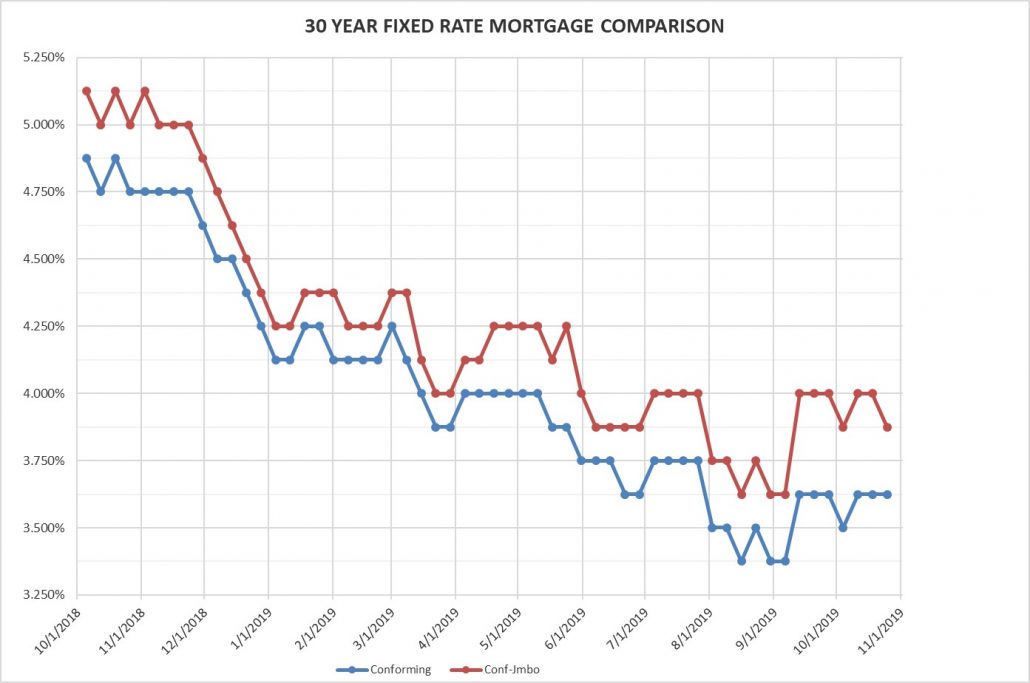
Can we keep our current home as a rental and buy a new home?

Question of the week:  Can we keep our current home as a rental and buy a new home?

Answer:  Perhaps, let’s look at the factors involved.

First and foremost, you need to be absolutely certain you are ready to be a landlord. Like any investment there are risks involved and since rental property is an active, not a passive, investment, there are more risks than loss of value.

The upside to being a landlord is having great tenants who always pay their rent on time, absorb occasional increases in rent, take great care of the property and rarely contact you with any issues. The downside is the opposite of each of these.

If you are going to convert your current residence into a rental you need to also shift your mindset that the property is no longer your home but an investment, which means you need to release emotion and accept your former home is now a business. I had a couple who had spent a lot of time and money over the years creating a beautiful home. When we had the conversation about converting it to a rental when they purchased a new home I looked at the wife, who was rightfully very proud of their home and the work they did, and said, “are you okay knowing strangers will live in your home, they will damage some of it, may paint rooms different colors and not maintain and care for as you have?” She looked at me with a pained expression and after a few moments said, “I don’t think I can do that.”

 She may have been ready to be a landlord, but not for the home she created. They ended up selling the home to buyers who loved it, and over the years cared for it as I notice when I drive by from time to time. The couple ended up purchasing a different property after they purchased their new home and still retain that property as a rental.

Are you ready, as a landlord, for the expenses that may not be covered by the rental income? One big benefit of converting your property to a rental is the tenant will be paying off your mortgage. When considering the possibility of conversion, the first math that is performed is how much rent can we charge and what is our monthly payment for mortgage, taxes and insurance. What also needs to be factored into the equation is maintenance, loss of rent and time. Will you retain a gardener, or if appropriate the pool service? Who will trim trees and bushes? How much longer before you need to replace the roof, the water heater or the garage door opener? Are the kitchen appliances warranties running out soon?

What happens when your tenant leaves the property? Will their one month deposit cover painting, re-carpeting, major cleaning and damage repair if they were particularly harsh on the home? What about the lack of rent income between their departure and the next tenant moving in, do you have funds for that?

Most importantly, can you absorb the expenses if you have a tenant who stops paying rent that  you need to evict which can take up to a year and cost you a lot of money?

Now that I have painted a wonderful picture of being a landlord…there are many advantages. As mentioned above, you have someone else paying for your investment—sort of like an employer contribution to your retirement plan. Depending on your situation you may have some tax advantages due such as depreciating the asset and expenses through the year that exceed income that can be deducted. As well, depending on your timing and how long you have had the property, you might be able to mitigate or eliminate capital gains with the two-in-five rule, if you live in the property two of the previous five years you can sell and not pay capital gains. (I am not a tax expert or CPA, before making any decisions regarding tax advantages or costs please consult your tax professional.)

Perhaps the biggest advantage of the conversion is you have an asset that can, probably will in Southern California and other areas, increase in value over time. For which someone else is paying the holding costs.  

Our question of the week was not “should we….” but, “can we…” I have covered some of the questions regarding should you consider converting your current home to a rental, now let’s look at the can you.

If you are not purchasing your new home with all cash then your ability to qualify for a mortgage to purchase your new home with the expenses of your existing home remaining.

Here are the basic guidelines used by most mortgage programs for qualifying when converting your home to a rental:

  • Borrower must supply a rental agreement and proof of deposit from tenant into borrower’s bank account
  • 75% of the rent will be considered for qualification purposes (i.e. if rent is $2000 per month, qualification rent will be $1500 per month)
  • Borrower must have up to six months PITI in reserves for each property owned, this includes property that is being retained and the new home being purchased (i.e. if your current mortgage, taxes and insurance are $2500 per month and your these payments on your new home are $3500 per month, you will need $2500 x 6 months, plus $3500 x 6 months, you will need $36,000 in reserves after the close on your new home). Depending on the program retirement accounts may be considered in this calculation.

Some loan programs, especially “jumbo,” or non-conforming have additional guidelines:

  • Borrower must have at least 25% equity in conversion property as determined by an appraisal
  • In addition to the rental agreement and deposit, borrower must provide a rent survey for the area that supports the rent on the rental agreement
  • Reserves could be as much as twelve months PITI for all properties owned and retirement accounts may not be considered

A big factor for many families considering the conversion of their current home to a rental is if they have the funds to purchase their new home without selling their current home. If your intention is to access funds from you current home through a refinance or obtaining an equity line your loan rate and amount of funds available can be impacted by the occupancy guidelines by lenders.

I am a big supporter of those who wish to retain their current home and convert it to a rental property when they purchase their new home. There are challenges in qualifying for the new home, from funds available for down payment, closing and reserves and debt-to-income ratios. However, going through all the options will determine the purchase price and payments on your new home for which you will qualify and from there you can decide how to move forward.

If you, or someone you know, is considering purchasing a new home and would like to retain your current home please give me a call so we can go through your situation and all the options available.

Have a question? Ask me!

Maybe, if, but…The Federal Reserve Open Market Committee (cleverly known as the FOMC) met this week. This is the group that determines if the Fed is going to change their fed funds rate or not. Going into the meeting the consensus was that the Fed would leave rates alone at this meeting in June and increase the rates at their meeting in July. The first part was correct, the Fed left rates alone. The second part is no longer a consensus based on the comments following the meeting.

Quick primer on the Fed and rates: if inflation is growing and the economy is running really hot the Fed will increase rates to slow things down and put a damper on inflation—the Fed likes inflation to be very close to 2% on an annual basis. If the economy is slowing and inflation is too low the Fed will lower rates to stimulate investment and growth. Last year the speculation was that the Fed would increase rates three times in 2019. As the year progressed and economic data showed inflation lowering, labor market growth being very tight but slowing, and concern about impacts from the trade and tariff dispute with China, statements from the FOMC meetings made it pretty clear that there would be no rate increases in 2019. After a few months the mummers from the FOMC were that a rate cut or two might occur.

Yesterday the information from the meeting was mixed. Yes, labor markets are tight with wages increasing which could result in higher inflation, and the economy is still strong—both of which support raising rates. Yes, inflation has declined and the Fed predicts it to drop to 1.5% for the year and the trade issues that could impact the economy still exist—both of which support lowering rates. With the FOMC members somewhat split on what’s next, with nine predicting no rate cut this year and eight predicting one or two rate cuts.

Rates for Friday June 21, 2019: Despite the Fed not lowering rates and a split within the Fed as to whether they will drop rates lower in the month, conforming rates have dropped from last Friday to the lowest they have been since October 2017. It feels like we are within sight, if not at or very near the bottom for this cycle—but I felt that way in April when we were at 4% for several weeks.   

FIXED RATE MORTGAGES AT COST OF 1.25 POINTS LOCKED FOR 45 DAYS:

30 year conforming                                            3.625%     Down 0.125%

30 year high-balance conforming                     3.875%      Flat    

Please note that these are base rates and adjustments may be added for condominiums, refinances, credit scores, loan to value, no impound account and period rate is locked. Rates are based on 20% down with 740 FICO score for purchase mortgages.

Historically the summer blockbuster has been “must see.” Certainly, “Jaws,” “Top Gun,” “Raiders of the Lost Ark” captured huge audiences across many demographics. So far this summer it looks like a cartoon, “Toy Story 4” is out today, it may be this summer’s blockbuster—we are seeing it Sunday.

One movie that will not be considered a blockbuster that I saw with my daughter last week is “Late Night.” She is a big fan of actress Mindy Kaling, who is one of the movie’s stars, and also wrote and produced the film; and could not wait to see it. We went up to Hollywood last week for an early screening before the film is widely released. I went thinking it would be okay and was more interested in spending time with her than watching the movie. About halfway through the show I leaned over and whispered, “This is really, really good.” And it is, in fact it is much better than really, really good in my opinion. Wonderful script, casting, acting and story. It is not on many people’s radar for “must see” summer movies, but I put it on mine.

Have a great week,

Dennis

Past Weekly Rate & Market Updates can be found on my blog page at my website www.DennisCSmith.com/my-blog