
Posts

Why is mortgage insurance a good thing?

Question of the week:  Why is mortgage insurance a good thing?

Answer:  Last week in the Weekly Rate & Mortgage Update we discussed if home buyers should wait until they have 20% for down payment before purchasing (you can read the WR&MU, and I encourage you to, but the short answer is “No.”).  The primary reason many clients give us for wanting to wait until they have 20% down is to avoid paying mortgage insurance.

To which I always counter, mortgage insurance is a good a thing and not something you may want to avoid.

Which leads to the question of the week, why is mortgage insurance a good thing?

The quick and simple answer is because it can enable you to purchase your home a lot faster.

As discussed last week, the number one cause of delay for families purchasing homes, according to a California Association of Realtors survey, is waiting to save for down payment and closing costs. A significant number of these delayed purchases are due to wanting to have 20% down to avoid mortgage insurance. But is the delay worth it? We covered the potential cost and missed opportunity last week of waiting, what is the cost of not waiting and buying when you can?

Before we begin the conversation of why mortgage insurance is good, let’s examine what mortgage insurance is. For those new to the conversation, mortgage insurance is not insurance that pays off the loan if you pass away or become disabled—there are life insurance and/or disability insurance policies you can get to cover the mortgage to protect your home and family should something happen.

The purpose of mortgage insurance is not to insure you, but to insure your lender should you default and go into foreclosure. Between the missed payments, legal fees, professional fees, loss of value due to foreclosure sale and other costs, a lender will average about 35% of the value of the property. Because of this if you have less than 20% down the lender will require mortgage insurance that covers the difference between your initial down payment and 35% of the purchase price.

For example, if you are purchasing a home with 5% down the lender will require 30% coverage from a mortgage insurance company, if you put 10% down coverage of 25% will be required, and if you put 15% down coverage will be 20%.

Even with this protection, should a home go into foreclosure there will likely be losses to the lender. Consider the process and losses. It typically takes about eight to nine months for a home in California to be foreclosed on after the first missed payment. Once you miss a payment by more than 30 days, i.e. you do not make your March 1st payment by April 1st, you are in default of the note. To cure the default, you need to make all payments due plus late payments. So, if you miss the March payment you have until April 30th to make the March payment plus the late fee and the April payment plus the late fee, if applicable.

If you are unable to cure the default at some point the lender must make a foreclosure avoidance assessment to discuss with you the circumstances that led to your default and if there is any way to avoid foreclosure. If there is no agreement between you and the lender to continue with the mortgage, i.e. a modification, the lender can then record a Notice of Default (NOD) with the county recorder in which the property is located no sooner than 30 days after the initial contact for the assessment. After 90 days or more have passed since the filing of the NOD the lender can then record a Notice of Sale informing you that the lender intends to sell the property at auction in 21 days or more. At auction, the lender will sell to the highest bidder who must have cash or a cashier’s check, it is very likely that the first bid will be placed by the lender for the outstanding balance due plus foreclosure costs. At the fastest a foreclosure can occur within about 200 days of the first missed payment, however they generally take about 60 to 90 days longer—or depending on circumstances can take much, much longer.

If you purchased a home for 5% down and a $400,000 mortgage with mortgage insurance and are foreclosed on the lender will be reimbursed for losses up to 30% of the loan amount, $120,000, by the mortgage insurance company.

There are different methods of paying for mortgage insurance. You can pay monthly, a full premium upfront, or fund a “no PMI” mortgage that is a loan that is self-insured by the lender due to a higher interest rate on the mortgage. Of the different types of payments, the most popular is the monthly payment, primarily for two reasons. First and foremost, it is able to be removed from the mortgage for most transactions after you have made 24 consecutive on-time payments and can show evidence (lender approved appraiser’s valuation) that you have at least 20% equity in the property you can request the PMI and its payments be removed from you loan—caution, do not just engage an appraiser, contact your lender with your request and get a list of approved appraisal management companies to contact for an appraisal. When your loan balance become 78% of the original purchase price, or appraised value, of the property when the loan funded the lender must drop the mortgage insurance without a new appraisal. The second reason payments are popular is that for the past several years mortgage insurance has been deductible for federal income taxes depending on your income.

That is the purpose of the mortgage insurance, what is your benefit.

That you can purchase a home with as little as 3% down, or 5%, 10%… In California, and most real estate markets, being able to purchase a home without having to save 20% of the payment is tremendous benefit. Doing the math, for a $500,000 home you can purchase a home with only 3% down payment (higher sales prices qualify for 3.5% down payments using FHA, or no down payment if you are an eligible Veteran).

What is the advantage to purchasing a home with less than 20% down? Not having to wait to save the 20% down payment and missing the opportunity of home ownership for perhaps several years—or ever. Consider how long it will take you to save a 20% down payment on your current income, even if you are able to eliminate all your debts—which delays your ability to save. Two years? Three? Five? Ten? During this period will housing prices be stagnant, or increasing faster than your income increases? As you try to save the amount you need to save will continue to increase creating a longer delay in your ability to purchase.

If you know you are going to receive a large financial windfall in the very near term, which I define as less than six months, from a lawsuit settlement, sale of a major asset such as a company, boat or other property, or an inheritance, you may be able to shorten your ability to gather the 20% down. But for most families this is not the case and they should be open and favorable to purchasing a home using a lower down payment and mortgage insurance.

The monthly cost of mortgage insurance is a lot less than most potential homebuyers think it will be, and MI is cheaper today than for non-government loans than in the past (MI for government loans is higher today than it was several years ago).

For a $400,000 here are the monthly costs for a borrower with 740 credit score in California purchasing a home with a 30 year fixed rate mortgage for different down payment amounts:

  • 5% down has a monthly PMI payment of $177
  • 10% down has a monthly PMI payment of $127
  • 15% down has a monthly PMI payment of $67

If this loan has a 4.125% interest rate having a monthly payment of $1939, the 10% PMI payments effectively add one-half of one percent (0.50%) to the payment rate, lifting it effectively to 4.625%.

Consider purchasing a $445,000 house. To purchase with 20% down you will need a down payment of $89,000 and will have a payment, at 4.125%, of $1725 per month.

Purchase the same home with 10% down and you need $44,500 for down payment, easy math tells us you need $44,500 less. The monthly payment including mortgage insurance will be $2068, or $343 more per month. You are spending $343 more per month as long as you have the mortgage insurance, but saving $44,500 in funds needed to close.

Let’s assume the scenario above is a brand-new home and there are two that are identical at the same price next door to each other. James and Monica purchase one of the homes with the 20% down scenario and Jeffrey and Maria purchase next door with the 10% down scenario and they close on the same day. Every month on the they meet for cocktails on one of their porches, and before the mixing begins James and Monica put the $343 savings they have from not purchasing with 10% into a safe. The couples will have to have 129 evening cocktail gatherings before James and Monica have save the $44,500 in cash that Jeffrey and Maria did not put into the down payment for their home. That’s over ten years, but which time statistics show one of the homes will likely be sold due to job transfer, purchasing a bigger home or divorce.

The obvious drawback to the additional payment is the ability to qualify, with a higher monthly payment you will qualify for a lower loan amount and purchase price. Taking a look at this using the above scenario of an additional $343 added to your payment putting 10% down instead of 20% down and assuming that based on other debt obligations our borrower can qualify with 32% of their gross income can support the monthly loan, or monthly loan and PMI payment.

For the 20% down scenario with a cost for the loan payment of $1725 income of about $5400 per month will be needed to qualify.

For the 10% down scenario with the cost of the loan payment plus the PMI payment of $2068 income of about $6460 will be needed to qualify, about 20% more income for the same property.

That said, what is more likely for the average family, that a family making $5400 per month can save $89,000 at the same rate that a family making $6460 can save $44,500 or vice-versa?

Not waiting to save 20% down and using PMI to purchase a home may reduce the amount of home and mortgage you may qualify for, but it can greatly reduce the amount of time it will take for you to purchase your new home.

The best time to contact me about your ability to qualify for purchasing a new home is as soon as you decide you would like to purchase a new home. The sooner we discuss your financial situation the sooner we can work on a plan to homeownership that encompasses your available funds, if any, your income, debts, credit rating and what will need to happen, if anything, so you are able to purchase your new home. Perhaps it is a savings plan, or a debt reduction plan, or a credit rehabilitation plan, whatever may be holding you back from purchasing a new home the sooner we discuss your options the sooner you will be able to purchase your new home. Call me and let’s set up an appointment!

Have a question? Ask me!

 An interesting report today from the Labor Department. The February employment report was released today and it overwhelmingly missed expectations, with 20,000 new jobs created in the month versus the expectation of 175,000 new jobs. While interesting, the very interesting parts of the data was despite only 20,000 jobs being created the headline unemployment rate dropped from 4.0% to 3.8%, indicating a saturated job market higher creating fewer jobs, but fewer people looking for jobs. This rate of unemployment counts only those who indicate they have been looking for a job, the data geeks like myself like what is labelled the U-4 rate which includes those too discouraged to look for work, plus part time workers who would like to work full time. The U4 rate fell from 8.1% to 7.3%, a solid indicator of a very strong labor market. Adding more interestingness (sidebar: this is weird, I thought I made that word up but spell-check didn’t flag it) to the report, total hiring for December and January were both revised substantially higher. At first blush, the sharp decline in new hires should be good for mortgage rates as the data may signal a slowing of the labor market, however the other data in the report shows a very strong labor market that should put upward pressure on mortgage rates.

The report had good news for existing workers as wages climbed again month over month and are up 3.4% from last February, the biggest annual gain since the end of the recession in 2009. The concern with higher wages is that the costs trickle into the economy as employers raise prices to pay the wages, as we have seen in recent inflation data this has not been the case. Labor is a key factor for the Fed when considering increases to interest rates, it appears more of a factor than inflation, and rising wages should put upward pressure on rates, but with an absence of inflation investors reactions today to the Labor Department report were to maintain the status quo and rates did not pop today as might be expected.

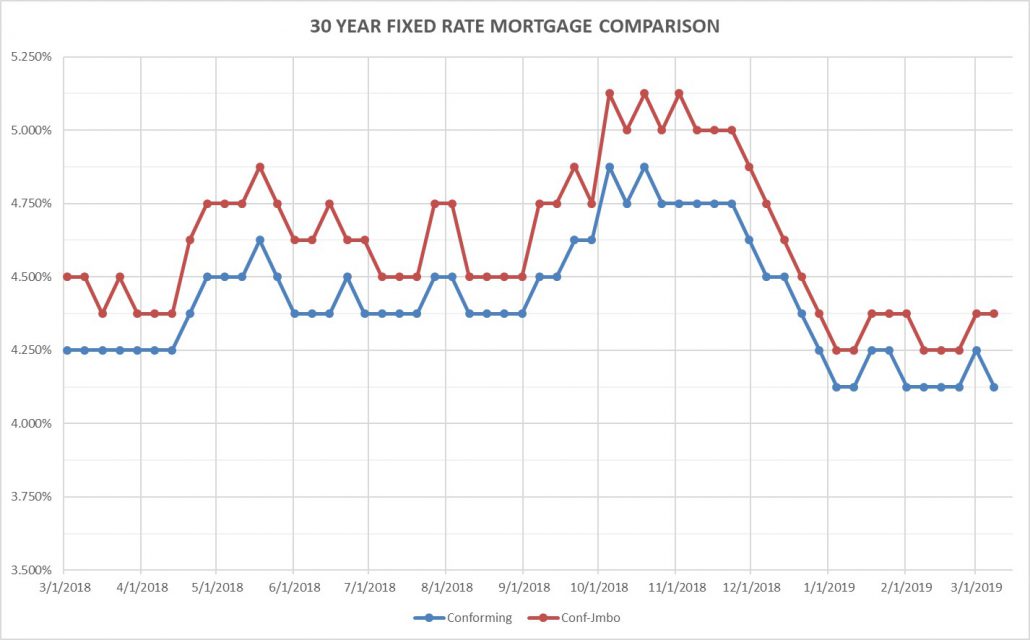
Rates for Friday March 8, 2019: For the week investors looked to move money into fixed rate markets such as Treasury bills and mortgages, as a result the conforming rate ticks back down after its bump last week and high-balance rates remain flat.

FIXED RATE MORTGAGES AT COST OF 1.25 POINTS LOCKED FOR 45 DAYS:

30 year conforming                                            4.125       Down 0.125%

30 year high-balance conforming                     4.375%    Flat     

Please note that these are base rates and adjustments may be added for condominiums, refinances, credit scores, loan to value, no impound account and period rate is locked. Rates are based on 20% down with 740 FICO score for purchase mortgages.
Ten years ago, I started working out of the house on most Fridays. My routine at home is to write some, most, or all of the Weekly Rate & Market Update and try to schedule some meetings for prospecting and networking, and of course communicate with the office and clients. Today as I sat working I heard and saw a large SCE truck in our alley and a few guys went up in a cherry picker to do whatever they do on the pole across from our home. As I was typing “The quick and simple answer…” I heard of loud noise and the house shook. “Oh, ‘goodness’,” I thought, did they hit the house? I looked up and saw the cherry picker halfway down and still in the alley. Which led to my going outside to see what the heck happened.

In lowering their bucket, they came down on a communication line and pulled the facia board the line was attached to off the house. Yippee! One of the workers went up on the roof and nailed it somewhat back into place and we completed a report and I received information about making a claim.

You can imagine my excitement in knowing my future will get to include interacting with a major utility company and tradesmen to get the repair completed and paid for by SCE. I hope you are not too jealous of this wonderful opportunity I have and you, likely do not.

Have a great week,

Dennis

Past Weekly Rate & Market Updates can be found on my blog page at my website www.DennisCSmith.com/my-blog

Should we wait until we have a 20% down payment to purchase our new home?

Question of the week:  Should we wait until we have 20% down payment to purchase our new home?

Answer:  No. 

I have covered this topic throughout the years answering various questions that invariably lead to down payment, be it my thoughts on mortgage insurance (I like it, I will reprise reasons in coming WR&MU), cost of waiting to buy (covered last November), or borrowing from your 401(k) to help with your purchase, and many other questions of the week. We will cover it again today.

In a survey conducted by the California Association of Realtors the number answer to the question “Why didn’t you purchase a home sooner?” was “Needed to save for a down payment.”

Anecdotally, within my own and my co-workers’ experience the past several years, this is also a prime barrier we see with many of our clients who wish to purchase homes. The want to save more money for a down payment.

A bigger down payment.

It takes a lot of money to purchase a home in California, especially Southern California. Combine that with the prevailing sentiment of avoiding mortgage insurance and we have many families who could purchase a home today but are delaying doing so in order to save more money for a larger down payment.

It has always been my opinion that if you are able to purchase a home with the funds you currently have available you should do so. As I covered last November  with a very detailed comparison of two families purchasing homes in September 2017 versus 2018 the cost of waiting for accumulating a higher down payment to avoid mortgage insurance can, and usually does, costs you more in the long run.

The counter-argument is that he housing market is slowing. Last week the WR&MU had the home sales statistics for California showing the number of sales declining and prices, while flat year to year, were down from the prior month. If the market is slowing and prices may come down, does it not make sense to wait to purchase and let prices fall further and while waiting save more money for a down payment?

Only if your crystal ball is correct, if interest rates stay near their current levels and do not increase, if you are able to correctly predict the market, if you are certain the home in the neighborhood you want will still be available when you determine the timing is right.

Perhaps the biggest shift in homebuyers’ attitudes from the pre-2008 real estate bubble burst to the post-20008 real estate bubble burst has been their reason for purchasing a house. Many in the period of the real estate price balloon expansion prior to 2008 were purchasing houses, they were looking to make money on a real estate investment, they were using the value increase to obtain equity to finance consumer consumption. They were not buying homes so much as investments, as such price was what mattered most.

I have found that the homebuyers we have been speaking to and working with the past decade have been more interested in purchasing a home. They are looking for a place to raise their families, spend their retirement and hold for a long term rather than hoping for prices to climb so they can cash in.

This shift in mentality negates, somewhat, market conditions. If you are in a home for a long period of time, ten, fifteen, twenty years, minor market corrections are not of as much importance as if you were looking to purchase and then sell in the next three or five years.

If you have three, five, ten percent of the purchase price of the home you want to purchase available, and you can afford the mortgage payment buy the home. Buy the home today with the funds you have available and begin creating the home for your family. Yes, there may be a dip in the future of your home’s value, but does it matter if you will not be selling?

Our nature is to get what we want for the lowest price possible, but often while looking for the lowest price we are missing out on the best quality, best service or best product for ourselves and our family. Have you ever been shopping different airlines for ticket prices for your family vacation and see a good price but then take five or ten minutes more to see if there is a better price, then gone back to the site with the lower price and find there are no more seats available? You lost out on a potential bargain by looking for a better one. This happens to homebuyers as well, even in a soft market.

If you have funds available for a down payment, but are wanting to save more, please call me so we can discuss all your options for today and tomorrow when you have the funds saved you feel you will need. Those who know me know that I am not a “hard-sell,” I merely present options for you to make the decision you feel is best for you and your family, I cannot make you purchase a home, but I would like to show you the options of how you can—or if you are not able to show you what you need to do so you will be able to purchase your new home.

Find out your home buying options today, even if you want to wait until tomorrow.

Next week I will again answer the why I like mortgage insurance question, the week after I will cover the second reason families give for delay their home purchase as it coincides with work we do with our clients.

Have a question? Ask me!

Due to the partial government shutdown several economic reports for December are being released along with January data. One of these is personal income and consumer spending for December. December was an interesting month, personal incomes rose a very strong 1% for the month, but consumer spending dropped 0.5%, the largest drop since 2009. As a result of the increase in income and decline in spending personal savings jumped to 7.6%. Overall the news is mixed for its impact on mortgage rates, higher incomes should lead to higher spending and inflation, but the decline in spending and increase in savings should lead to a slowing in the economy.

Despite the drop-off in spending in December the 4th quarter Gross Domestic Product still grew by 2.6%. The rate of increase was slower than the 2nd (4.2%) and 3rd (3.4%) quarters but not enough to prevent 2018 to be the fastest growing economy since 2005. Holding back 4th quarter growth were a myriad of factors including housing and the trade deficit—and late in the quarter spending by consumers. Inflation for the quarter was 1.7% and year over year right at the Fed’s target inflation rate of 2.0%. Overall the news is negative for mortgage rates, a strong economy usually portends higher interest rates. However despite the strong growth in the year we have seen rates from recent highs in the fall of 2018.

Looking ahead, consumer confidence surveys released this week saw a surge, increasing for the first time in four months as most surveyed see better conditions ahead for themselves and their families. Will this confidence lead to increased spending and continued GDP growth above 2% and possible 3%?

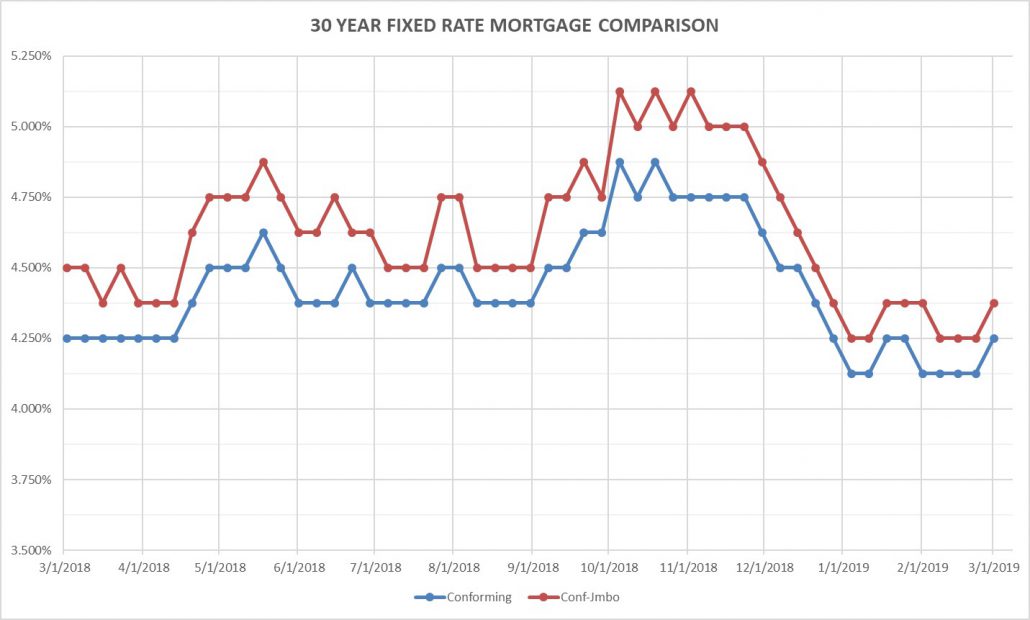
Rates for Friday March 1, 2019: After three weeks of steady rates we see a slight bump in interest rates from last Friday. There are many small reasons why this has occurred, mostly investors chasing higher yields elsewhere which puts a damper on prices and therefore higher returns, i.e. rates, in the market. I do not see this as a trend.

FIXED RATE MORTGAGES AT COST OF 1.25 POINTS LOCKED FOR 45 DAYS:

30 year conforming                                            4.25        Up 0.125%

30 year high-balance conforming                   4.375%   Up 0.125%       

Please note that these are base rates and adjustments may be added for condominiums, refinances, credit scores, loan to value, no impound account and period rate is locked. Rates are based on 20% down with 740 FICO score for purchase mortgages.

Sometime during our first year of marriage I got a bad head cold and Leslie said, “My dad has always said it takes three days to get a cold, three days to have it and three days to get rid of it.” Over the years I have noticed Don is right about this. Today is day one of the three part series for me, which means the last three days have been the wonderful, sneezy, snuffling, achy, sleepy portion of the cycle. Blech. Despite Don’s wisdom that this too shall pass, I am one of those who takes everything available, DayQuil, Mucinex, Emergen-C, Afrin, NyQuil, Ibuprofen, water, soup, whiskey…some day I’ll learn that I should just stick to one and ride it out.

I hope your week was spent in better health and that you are able to have the three-three day cycle avoid you and your household this year!

Have a great week,

Dennis

Past Weekly Rate & Market Updates can be found on my blog page at my website www.DennisCSmith.com/my-blog

Why should we shop for our new home in the rain?

Question of the week:  Why should we shop for our new home in the rain?

Answer:  Unlike most of the country, Southern California—most of California, has rain only a few months of the year, usually between late October and early to mid-March. Rain can be extremely destructive to property over the long-term and the opportunity to see how a property is impacted by rain should be a major factor in your home buying decision.

Consider the home owner who looks at homes in early April and finds one they really like. The last substantial rain in the area was in late January and early February. The property had some issues in the prior rainy season. Some small leaks from the roof and a skylight resulted in water spots on the ceilings. Windows on the south side of the family room leaked and resulted in some damage to part of the molding. In the rear of the house the run-off from the gutters pools around the exterior walls as high as three to four inches and drains by seeping below the foundation.

The seller of the property painted the interior of the home, including the ceilings with the water spots. Took some putty and paint and patched the moldings on the windows. Washed the exterior walls and planted some flowers and large plants where the water pooled and showed evidence of water creep.

The couple purchases the home and after a very hot spring, summer and early fall an El Nino arrives and there is significant rain and wind from early January through February—not dissimilar to our weather this year. Early on they discover water dripping through the ceiling in the kitchen and dining room, water was coming in through the south side of the family room and the water was getting very high where the gutters drained so that they had to carve a trench into their back yard to release the pond that was developing.

In this case the seller knew about the issues and did not disclose them to their real estate agent nor the buyers. Their defense could be that it had not rained for some time as the prior winter was fairly dry so they are not liable for the problems with the rain and water damage.

Since the trouble spots were covered up the physical inspector hired by the buyers could not detect the issues as everything appeared normal and there is no way to adequately test for how a property will react when several inches of rain falls over a short period of time.

The buyers incur expenses to replace their roof, replace windows and install hardscape and drainage systems to ensure water is kept away from their home and drains properly. The good news is their home is in tip-top shape and ready for foul weather; the bad news of course is thousands, tens of thousands, of dollars needed to be spent right after they used their savings to purchase their new home.

Imagine if the buyers had been able to inspect that same home this weekend after the storms we have had come through in the past several weeks? Any water issues a home may have would be evident and potential buyers would have a very good idea of what corrective measures would need to be taken and have professionals estimate costs to cure the issues. Buyers could then have these costs in mind as they determine whether to make an offer or not and if they do so how the price may be impacted in consideration of future costs.

It is important for me to note that the scenario where a seller purposefully hides known defects is not the normal case of real estate transactions. The same couple could have purchased the same home and the home had no noticeable issues with rain water and weather, however after a long summer and possibly eight or nine months before the next rain the same issues could present themselves. Southern California weather takes its toll on buildings with the constant sun and dry weather.

While summer is the hot season for temperatures and also housing markets, looking at homes to purchase during the summer can be a detriment in the long term. I have always felt that in Southern California it is the wet and windy winters that are the best time to house hunt in order to see how your potential new home handles our worst weather.

If you are considering purchasing a new home please contact me so we can develop a strategy for your purchase and the best mortgage options and purchase price to acquire your new home.

Have a question? Ask me!

The economic data presented this week suggests rates should go lower. Long time readers of the WR&MU know that good economic news pushes rates up and not good news pushes rates down. News that puts upward pressure on rates are inflation over about 2%, strong retail sales, strong GDP growth and strong job market; the opposite of those actions on those factors generally leads to lower rates.

Prices were flat for consumers in January, literally with 0.0% increase in the Consumer Price Index. Held down by a drop in gasoline prices. Stripping out energy and food prices, called the core price index, prices increases 0.2% for the month and was up 2.2% year-over-year. The Producer Price Index did not fare as well, dropping 0.1% in January after a 0.2% drop in December. The news is positive for lower rates as higher inflation is healthier for the economy and growth.

Wages bucked the price trend, with “real” wages (adjusted for inflation) rose 0.2% in January and year over year are up 1.7%. Good news for the rank and file (excludes executives) whose wages are up over the past year by 2.1% . The stronger wage gains are not positive for rates as higher labor costs theoretically are passed on to consumers creating higher prices, known as wage inflation. Strong wage inflation puts upward pressure on rates.

With the government shutdown concluded we finally get retail sales data for December, and it is not positive. In fact, sales in December dropped 1.2%, the biggest decline since September 2009. There were numerous factors that could have contributed to the large decline, poor weather, the start of the shutdown, mummers of recession and a huge drop in gas station receipts (down 5.1%) due to lower prices. It appears, however, that the drop was attributed to other factors as well and it puts into question the strength of the economy in the 4th quarter. The biggest surprise in the report was a 3.9% drop in internet sales, but also dropping were sales across the board at restaurants, bars, apparel, home furnishings, virtually every consumer category. The news is very friendly for lower rates as consumer spending is 65-70% of our economy, a slow down in consumer spending opens the door for those mummers about recession.

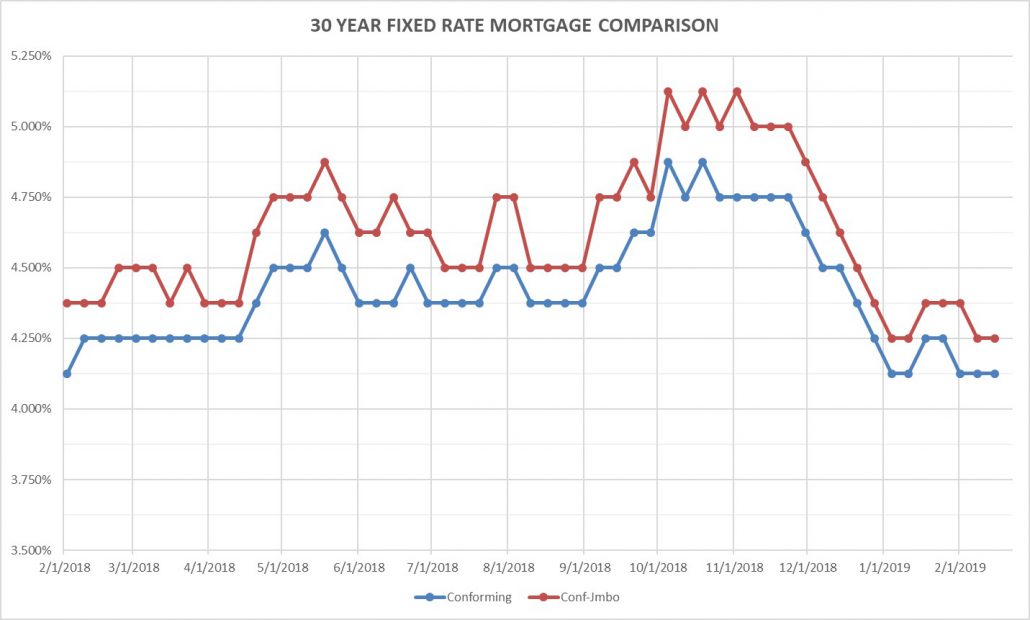
Rates for Friday February 15, 2019: There is a lot of information influencing markets, and while rates have been stable week to week they are ready to break out higher or lower. The ongoing trade negotiations with China, political fighting continuing in Washington over budgets and expenditures and the not great economic news all are influencing investors. Looking ahead rates should go lower based on data, but as we have seen over the past six to twelve months, data is not the primary driver in investor decisions that influence rates and markets.

FIXED RATE MORTGAGES AT COST OF 1.25 POINTS LOCKED FOR 45 DAYS:

30 year conforming                                            4.125    Flat

30 year high-balance conforming                     4.25%      Flat     

Please note that these are base rates and adjustments may be added for condominiums, refinances, credit scores, loan to value, no impound account and period rate is locked. Rates are based on 20% down with 740 FICO score for purchase mortgages.

Continuing weather talk from above, I like the stormy winter (for California) weather. I can say that because I do not live in an area negatively impacted by mud-slides or blocked highways. It can interfere with weekend activities, but spending a Saturday or Sunday inside cozied up with sweatshirts, hot beverages and a good movie or book definitely has appeal.

Unfortunately, the rains are part of the California Trilogy of Tragedy which occurs when we have years of deluge and not drought. The rains cause tremendous abundance of undergrowth and grasses that die off in the summer dry weather and become tinder for the fall to start and spread wildfires which burn off all the ground cover and create barren landscapes that become mudslides the next rainy season. Rain, fire, mud, repeat.

Fires and mudslides in the middle of the wilderness are not tragedies, they are part of nature over the eons and millennia; when homes and developments are permitted in and immediately adjacent to wilderness areas the trilogy results in tragedy for towns and families. We will continue to see the cycles occur with loss of homes to fires or slides as long as local and state government issue permits for development collecting tax dollars in return.

Off my soap box.

Have a great week,

Dennis

Past Weekly Rate & Market Updates can be found on my blog page at my website www.DennisCSmith.com/my-blog
1-25-19: What are the different types of mortgages available?

Question of the week:  What are the different types of mortgages available?

Answer:  In the years immediately following the real estate and mortgage market meltdowns many mortgage products left the market. In the last few years many of the products that were available for home buyers and owners prior to 2008 have returned presenting more options for financing residential real estate, and enabling those who are unable to qualify for traditional mortgages.

In response to the collapse of the real estate markets the Dodd-Frank Act was put into law. Dodd-Frank has a regulation for mortgage lenders that created “qualified mortgages,” or QM loans. There are several factors that go into a mortgage being eligible for the QM designation, the primary being that borrowers must show income and the ability to make the monthly mortgage payments. Having funds available to pay off the mortgage is not evidence of ability to repay the mortgage, unless using a certain formula income from the asset account(s) generate income that would enable qualification.

If a lender funds non-QM mortgages they must have “skin in the game,” this is had by the mandate that lenders must retain at least 5% of such mortgages. All conventional mortgages are sold in secondary markets, which is what Fannie Mae and Freddie Mac, where they become security for Mortgage Backed Securities (MBS). Most jumbo loans are sold by lenders to investors who create their own investment vehicles backed by the mortgages. Government loans, VA and FHA, are sold by lenders to Ginnie Mae, who like Fannie and Freddie, bundle the mortgages and sell them to investors.

Conventional mortgages and most “jumbo” mortgages meet the QM criteria as they are underwritten to the guidelines established by Fannie Mae and Freddie Mac. Also meeting the QM standards are VA and FHA mortgages using underwriting guidelines established by the VA and HUD respectively. One of the reasoning behind the QM policy is that investors in mortgage backed securities of conventional or government mortgages investors know the quality of the investment. The primary reason for the mortgage market collapse was the tremendous percentage of mortgages in the Fannie and Freddie MBS pools were funded without income verification, nor asset verification and for many no appraisal of the property used as collateral. With the QM rule investors have reasonable certainty that all the borrowers of the mortgages in their MBS investments have shown ability to repay their mortgages.

Here is a quick comparison of the mortgage options available in today’s markets:

Conventional mortgages can have relatively high loan to values, depending on loan amount and ability to qualify as high as 97% of the property value with several options for mortgage insurance.

FHA mortgages have a minimum down payment of 3.5% and have mandatory mortgage insurance regardless of the loan-to-value. The underwriting guidelines for FHA mortgages are a bit more lenient for qualifying than conventional mortgages.

VA mortgages are for eligible veterans, either active duty or discharged from the service (unless discharge was dishonorable). Veterans who qualify can purchase their home with no money down and the loan limit for purchases can far exceed the limits for conventional or FHA mortgages. The mortgages have a “funding fee” added to the loan amount, which is VA’s version of mortgage insurance.

Non-conforming, or jumbo, mortgages mirror conventional mortgages in many respects, however most will not fund mortgages above 90% of the value of the property and have tighter underwriting guidelines for qualifying.

Non-QM, or Alternative, mortgages have many variations to provide mortgages for borrowers with poor credit scores, borrowers with high debt-to-income ratios, self-employed borrowers with low income on their tax returns are some of the most common applicants for Alternative mortgages. Lenders in this section of the market have products that use deposits into business or personal accounts to calculate income, statements from accountants to accompany tax returns to explain losses or other criteria. Because of the more relaxed underwriting standards, and the retention rules for non-QM products, rates on these mortgages are higher than those on QM mortgages.

It is estimated that $5-6 billion of non-QM mortgages were funded in 2018 for residential borrowers and predicted that the total volume will increase considerably in 2019.

Too often we meet with clients who are able to purchase, or refinance, their home using alternative mortgage products but the bank or mortgage professional they were working with did not have such products available, encouraging them to obtain a co-signer, obtain more funds or otherwise try to fit into the products they have available. Because we work with many lenders, in the QM and non-QM spaces, we often have the ability to help them with their purchase or refinance.

If you, or someone you know, is in need of a mortgage to purchase or refinance their home please contact me to go through all their mortgage options to help them find the best financing for their ability to qualify.

Have a question? Ask me!

Home sales are cooling off. The California Association of Realtors have released sales data for December and every major market in the state except San Francisco had a drop in sales from December 2017. Locally, Los Angeles County saw a drop in sales from November of 3% and from last December of 16.3%; the median sales price in December was $588,140 in the county up 6.2% from the prior month and 1.8% for the year. In Orange County sales tumbled 15.5% for the month and 18.3% for the year with the median price in December of $785,000, off 1.3% from November and 0.1% from the prior year. Nationwide real estate sales are at a three year low. Historically December is a slower month for home sales so a dip from November is not surprising. Are these numbers a “dip” or are they foreshadowing a decline in the market that will last for….how long? Next week I will compare the current real estate market to that leading up to the 2007-8 start to the collapse that led to the Great Recession.

Rates for Friday January 25, 2019: Rates are steady from last Friday, though some movement up and down during the short week. So far, the federal government shutdown has not impacted the economy. Unlike if 800,000 workers in the private sector were laid off, the furloughed federal employees will go back to work and cash flow shortages for federal workers and vendors will be back filled; because of this any negative impact on the overall economy is short termed. It appears that there is some movement in Washington to settle differences and re-open the government and I am optimistic the normal dysfunction in our nation’s capital will return.

FIXED RATE MORTGAGES AT COST OF 1.25 POINTS LOCKED FOR 45 DAYS:

30 year high-balance conforming                    4.375%     Flat     

30 year conforming                                            4.25%       Flat

Please note that these are base rates and adjustments may be added for condominiums, refinances, credit scores, loan to value, no impound account and period rate is locked. Rates are based on 20% down with 740 FICO score for purchase mortgages.

Those who know me will not be surprised by this statement: I love pie. And cookies, but pie holds a bit of a higher place because it is usually not as readily available as a cache of thin mints in the freezer. Thankfully my oldest also loves pie and over the years she and I have made many runs to the best pie purveyor in Long Beach, Jongewaard’s Bake-N-Broil. For the past several years we have gone to Bake-N-Broil on January 23rd to celebrate National Pie Day.

With her attending university in Boston I knew I would be spending National Pie Day alone. Thankfully for this first year I was likely to be without my pie-buddy on 1/23 Winter Storm Harper hit the Northeast. Why thankful? Late Friday night JetBlue sent her an email that her flight to Boston on Sunday morning was cancelled. By the time we go through to get her a seat back to school the only available flight was a red-eye leaving Tuesday, January 22nd. So though it was a day early we were able to celebrate National Pie Day together—she had lemon lush and I had French apple. Thank you Harper for letting me continue a tradition. (She plays in the pep band for BU and let me know that at the basketball game on Pie Day they had free pie available—she got a slice of Boston Cream Pie. I’m so proud.)

Have a great week,

Dennis

Past Weekly Rate & Market Updates can be found on my blog page at my website www.DennisCSmith.com/my-blog

1-18-19: Will the federal government shutdown impact the timing of my loan approval?

Question of the week:  Will the federal government shutdown impact the timing of my loan approval?

Answer:  No, well very, extremely likely no.

Unless you are in a rural area and obtaining a USDA or perhaps waiting for FHA to approve a condominium complex in which you are purchasing or refinancing one of the units.

At the start of the shutdown there was some delay for borrowers with properties in areas that required flood insurance, which is available only through the National Flood Insurance Program, however Congress passed legislation and the President signed into law a bill authorizing the program to May 2019 so the policies could be written.

For the vast majority of mortgages for residential mortgages there is minimal interaction with the federal government during the loan process.

One requirement for many mortgages is verification of your income by a review of your tax transcripts as filed with the IRS (to see why we need this form here is the WR&MU from April 2018 on the subject. For this process, we use IRS Form 4506-T, during a government shutdown the requests for a copy of your returns are not processed. Having experienced such delays in the past, in recent years lenders have eased the burden by allowing some work arounds to the Form 4506-T requirement, typically a copy of the cancelled check or other proof you paid taxes owed on the tax returns provided, or a copy of a bank statement showing the deposit of your refund that matches the refund on your tax returns provided.

Government insured loans, such as VA or FHA, are not impacted by the shutdown as the processing and underwriting is performed by private companies and not government agencies. While Fannie Mae and Freddie Mac are quasi-government agencies they are operated as private companies and are unaffected by the shutdown.

The primary area of impact during government shutdowns, once flood insurance is authorized, are inquiries for loan issues in which a response is required from either VA or FHA. It is very rare that a situation arises in which a lender will require a response from either of the agencies in order to approve a loan, but they do arise from time to time and any such cases arising during the shutdown will likely face delays until someone is available to reply.

In a broader view, the impact of the shutdown on mortgages is the impact it may have on the economy and subsequent impact on interest rates. Fundamentally, if there is an impact on rates it would be for rates to decline. A very prolonged shutdown could result in negative economic impact and regular readers of the WR&MU know that poor economic performance usually leads to lower interest rates.

If you are concerned that the government shutdown will impact your current loan in process, or a home mortgage you are contemplate, do not be concerned.

Have a question? Ask me!

With the government shutdown some key economic data that could impact mortgage rates is not being release. This week we would have had retail sales data for December, a key piece of information for gauging economic activity since consumer spending comprises 65-70% of the nation’s economy. With no data on how the Christmas shopping season went for retailers investors are left to speculate whether the 4th quarter GDP data will show 2018 ended strong and total growth over 3% or slowed down with growth being under 3%. The lack of information had no impact on rates as investors looked to other bits of news to guide their decisions.

Rates for Friday January 18, 2019: Stocks and bonds are in their traditional relationship, if stocks go up so do rates, if stocks go down so do rates. Stocks climbed this week, much of the increase on speculation that the trade dispute with China is cooling down and on rumors the United States may lower some tariffs. Investors fled their prior “flight to safety” of bonds and invested their sales proceeds in stocks. After thirteen weeks of rates being flat or down from the previous Friday we see mortgage rates tick up this week—the first Friday to Friday increase in rates since October 19th.

FIXED RATE MORTGAGES AT COST OF 1.25 POINTS LOCKED FOR 45 DAYS:

30 year conforming                                            4.25%      Up 0.125%

30 year high-balance conforming                    4.375%     Up 0.125%      

Please note that these are base rates and adjustments may be added for condominiums, refinances, credit scores, loan to value, no impound account and period rate is locked. Rates are based on 20% down with 740 FICO score for purchase mortgages.

After four weeks it is time for our daughter to return to Boston to finish her freshman year. Always a bit of a weather nut, looking at the national weather maps in the paper every day, something I got from my dad, I am much more so concerning weather in the Northeast these past five months. My weather-nerdness has us on somewhat of a concerned profile as a very big winter storm is on track to hit the Boston area late Saturday and into Sunday—include her 2:30 landing time at Logan Airport. Part of going to school back east, or anywhere that winter weather is not 50 degrees and some rain, is dealing with weather delays at the airport.

Not all lessons are learned in the classroom. Our plan tomorrow is to spend a bit of time at the bookstore to get some “old fashioned” books in case her Kindle runs out of juice.

Have a great week,

Dennis

Past Weekly Rate & Market Updates can be found on my blog page at my website www.DennisCSmith.com/my-blog

1-11-19: What are our mortgage options for remodeling our home?

Question of the week:  What are our mortgage options for remodeling our home?

Answer:  There are several options for paying for major home improvements or remodeling. Most commonly used for paying for major home projects are cash, a home equity line of credit or fixed rate second trust deed, new primary loan with cash out, new renovation loan, or possibly tap other resources. Here are some basic guidelines for the various financing options.

Cash: Depending on the scope of your project you may have enough money saved to pay for your construction project. The obvious advantage is lack of any interest costs and monthly payments. Keep in mind that many remodel/renovation projects can end up costing more in time and money so make sure you have enough to cover cost over-runs as well as whatever post-project expenses you may have—such as new furniture, floor coverings, etc. If you are using cash for your remodel you may want to obtain a home equity line of credit for a small amount to cover over runs to ensure you do not run out of funds during the project and then may be unable to obtain financing because part of your house is torn apart and not yet put back together. If you do not need to access the available funds that is great, but if you do you will be prepared and seamlessly be able to continue and finish your project.

Home Equity Line of Credit (HELOC): A HELOC is like a credit card, you are approved for a maximum amount of credit and then you can access as much of the funds as you need up to the credit limit, you make payments based on the amount of the outstanding balance. A big advantage of HELOCs and remodeling is you only pay for the amount of money you need when you need it. For instance, your project is estimated to be $50,000 with 20% paid upfront to get started and then other funds paid to the contractor at certain points of completion with the final amount due when all is complete. You sign the contract and access $10,000 and pay the contractor, you bill comes the next month and you owe the payment due based on $10,000. The next month you pay another $15,000 to the contractor and not having paid any principal on the first payment, you made an interest only payment, your next bill will be based on the $25,000 balance. This gives you flexibility based on how you use the funds available.

Another advantage of HELOCs is many lenders will provide lines of credit at a higher loan-to-value (LTV) than you may be able to obtain with a fixed rate loan or traditional mortgage. This enables you access to more funds than you would otherwise be able to obtain.

The disadvantages to HELOCs are the rates are variable, tied to the prime rate so over time it is hard to budget total costs; for example, since December 2016 the rate has increased 2%, while during this period the 30 year fixed conventional rate is only up 0.25% (after being higher by 0.75% a few months ago). The other disadvantage is self-imposed by the borrower—interest only. The minimum payment due on most HELOCs is an interest only payment, many borrowers fall into the habit of paying interest only which results in a large balance remaining on the loan which has to be paid at some point in the future either through a refinance or sale of the home.

Fixed rate Second Trust Deed: This financing instrument operates like a traditional fixed rate mortgage, however because it is in second position the rate is higher than available primary mortgages at the time of the transaction. The advantages of the fixed rate second are the ability to budget exactly what the payment will be for the period of the loan (generally available in fifteen or twenty year options) and if your current mortgage has a rate that is significantly lower than your current rate you can retain that rate and payment.

The disadvantages of the fixed rate second are many lenders restrict the LTV to 80% (same as most primary mortgages) and the higher interest rate.

Cash-out Refinance: This option is pretty straightforward, you refinance your existing mortgage and increase the amount borrowed to cover the funds you need up to the LTV allowed by the loan program. Most cash-out programs limit the loan balance to 80% of the appraised value of the home so if you are going with this option it is a good idea to have a good estimate of the value of the property.

The advantages of the cash-out refinance option are that you have a 30 year fixed rate mortgage. This provides you the lowest possible payment due to the long amortization, a fixed rate throughout the term of the mortgage which enables you to budget your monthly housing payment with certainty. Another benefit for many homeowners is depending on how long you have had your current mortgage and the increase in monthly payment may not be as high as you would expect; for instance we are closing a loan with a borrower accessing $75,000 and their payment is going up only about $275 per month, whereas their option on a fixed second increased their payment by almost $700.

Disadvantages of the fixed rate option are you are provided all the funds at closing and begin making payments on funds that may be sitting in the bank waiting for your project to begin and through the finish. Another is your interest rate may increase from your current mortgage rate.

It needs to be noted that when pricing mortgages a cash-out refinance are costlier than a rate and term refinance and a purchase transaction. The higher the LTV the more expensive the loan, conversely if you have a lot of equity in the property your costs would be lower if you LTV falls below certain price points based on the appraised value and how much your are borrowing.

Renovation Loan: This option is a combination of a traditional fixed rate mortgage and a HELOC and can be used to purchase a home you wish to remodel or as a refinance of your existing home for major renovations. We will use as an example a refinance.

Your current home is worth $550,000 and you owe $325,000. You wish to add a bedroom, a full bathroom and remodel the kitchen. The total costs are $125,000 and after the work is completed the value of the property will be $645,000. We complete the loan application for a mortgage of $450,000, $325,000 to pay-off your existing mortgage and $125,000 for costs to remodel. With our loan package besides the standard information we would need to show you qualify we will also need plans and estimates of costs from your contractor. During the loan processing we will make sure your contractor is approved by the lender and have an appraisal completed that includes the current value and the value of the home after the project is complete.

All goes well and the loan is approved and we fund the mortgage, your existing mortgage is paid off and the excess funds are placed in an escrow account controlled by the lender. After certain parts of the project are completed you request a draw from the account, the completion of that part of the project is verified and funds are transferred and you can pay the contractor. At the end of the project you have used all the money on the mortgage and your contractor is paid.

Advantages of this option are that you have a 30-year fixed rate mortgage upon completion of the project and the rate is competitive with a traditional mortgage or cash-out transaction. Another advantage is your contractor is vetted by the lender—which in our experience has resulted in some borrowers needing to change contractors after issues arose regarding insurance, licensing or past issues with the contractor that the lender discovered the borrowers were unaware of when they selected the contractor. This may sound like a negative, however should something occur with the contractor during the project it is a nightmare; knowing a contractor had issues in the past decreases the opportunity for such nightmares to occur.

 A disadvantage for many borrowers is the process to get to loan approval, which is longer and significantly more thorough than the traditional approval process—it is a bit more time and effort but understandable due to the nature of the project. Another disadvantage for some is the draw process where the contractor is not paid until certain completion points in the construction. Many contractors want funds before they start the process, using the renovation process they may not get the funds until after the process; some borrowers mitigate this issue by fronting the funds to the contractor and then getting reimbursed through the draw process.

Piggy-back: Some homeowners do their own version of the renovation loan by maximizing their funds available with a traditional 30 year fixed rate mortgage and then add a HELOC onto the property for additional funds. For instance you need $80,000 for your project and a cash-out refinance will enable you to obtain $65,000, you obtain the additional $15,000 needed on a HELOC—what we call a piggy-back transaction as your HELOC piggy-backs on your first mortgage. The advantage of the fixed rate 30 year loan for the bulk of the funds needed combined with the higher LTV of the HELOC lets you complete your project with the best of both options.

Reverse mortgage: Yes, reverse mortgages can be used for home improvements if the borrower qualifies and enough equity is in the property.

Other options can include borrowing from the bank of mom and dad, possibly borrowing against your 401(k) or a margin account on an investment account.

One of my favorite books we used to read to the kids was If You Give A Pig A Pancake. I usually encourage any family looking to do an extensive remodel to read the book as it is a good metaphor for many such projects. A major pitfall for most homeowners is underestimating the amount of work and costs that will need to be done to accomplish their goal of another bedroom and bath and a remodeled kitchen. Once walls are open what will the contractor find? Out of date and code electrical? Inadequate framing? Foundation issues? A rotted out floor under the shower? The original choices for cabinets or fixtures are not available adding time, and/or costs, to the process? You forgot that with the newly remodeled home that you now need furnishing?

A high percentage of the time when I have clients undergoing a remodel they let me know that even though they thought they were being somewhat liberal in the costs they still were short of what was needed. Read the book and imaging instead of a pig going through your home in search of a pancake it is your remodeling project needing more and more done to ensure completion.

Be very thorough in your plans, go deep into your interviews with contractors as to typical issues that come up, and possible issues given the age of your home, location (for instance we are on expansive clay soil which causes foundation issues—not all contractors are aware of this) and scope of your project.

All that said, I usually counsel clients that are considering extensive home improvements that before they commit to explore the options of what homes are on the market that would achieve the same objective. If you are looking to add a bedroom, bathroom, modernize your kitchen or other work that entails a lot of time and money, evaluate the current value of your home, what your net proceeds would be if you were to sell, what loan amount and sales price you will be able to qualify for and feel comfortable paying and then look at the local market to see if it makes sense for you to purchase what you want.

You may find that you prefer to remain in your current home and endure the remodel process, or you may find that you would benefit by purchasing a home that meets your needs.

Whichever route you choose to take please contact me to go through all your options and the advantages and disadvantages of each.

Have a question? Ask me!

Words matter, especially when they are the words of the Federal Reserve Open Market Committee (FOMC)—the group that sets the Federal Reserve borrowing rates which impact other rates such as the prime rate. The minutes from the last FOMC meeting were released this week and they showed that while all the voting members say “yes” to increasing rates at the last meeting there was some discussion by some to not raise rates. As well the minutes showed that future rate increases are not guaranteed. This is positive news for mortgage rates.

More positive rate news today as the Consumer Price Index dropped in December for the first time in nine months, primarily due to lower gasoline prices. Also declining was the year over year cost of living, dropping to 1.9% growth from the annualized growth of 2.2% in November. The 1.9% price increase was the first time since August 2017 the important data point was below 2%. The news is very mortgage rate friendly as the Fed uses the data for their gauge of inflation and the desired price increase for the Fed is 2% per year. If the price decrease remains below 2% moving forward it puts pressure on the Fed to not increase rates.

Rates for Friday January 11, 2019: For the first time in six weeks rates have not declined, and prior to today’s CPI data we might have seen them bump up a little bit. Upward pressure on rates this week was caused by gains in stock markets as investors felt confident about the on-going trade talks with China. At this point the government shutdown is not have much, if any, impact on financial markets.

FIXED RATE MORTGAGES AT COST OF 1.25 POINTS LOCKED FOR 45 DAYS:

30 year conforming                                            4.125%      Flat

30 year high-balance conforming                    4.25%        Flat    

Please note that these are base rates and adjustments may be added for condominiums, refinances, credit scores, loan to value, no impound account and period rate is locked. Rates are based on 20% down with 740 FICO score for purchase mortgages.

Since the end of the last football season my ring tone has been the Philadelphia Eagles fight song, “Fly Eagles Fly.” Starting in March of last year our youngest has asked me, “how long are you going to have that as your ring tone?”

“As long as they are the reigning champions.”

On Sunday I thought I would have to change my ringtone, thankfully the left-hand of the Eagles defensive tackle deflected the Bears’ kicker’s field goal attempt just enough to cause it to hit the upright and the cross bar so I retain the ringtone at least for one more week.

Not overly positive with this week’s game against Drew Brees and the Saints, but hopeful that next week at this time when you call I will still hear, “Fly Eagles fly, on the road to victory….”

Have a great week,

Dennis

Past Weekly Rate & Market Updates can be found on my blog page at my website www.DennisCSmith.com/my-blog

1-4-19: What is 2019 looking like for Stratis Financial?

Question of the week:  What is 2019 looking like for Stratis Financial?


Answer:  Exciting! We spent the last quarter of 2018 adding some new lender partners to expand our portfolio of mortgage products well beyond our foundational products of conventional and jumbo 30-year fixed rate mortgages. Our new lenders bring alternative products that can benefit self-employed borrowers, borrowers with extremely high-net worth and borrowers looking to secure housing through retirement. With our growth in lending options we can cover pretty much any mortgage need for residential homeowners or home buyers in the state of California.


Personally, I am excited to add a new relationship referral source that will enable me to be assist more families with their mortgage needs as well as strengthen my connections with past clients and referral sources.


From you I am looking for inquiries for your mortgage needs and plenty of questions to answer for you in 2019, please ask and I will answer and help you with solutions and options!


Have a question? Ask me!


Job growth and economic growth seem to be going in different directions. In the last revision for 3rd quarter 2018 Gross Domestic Product output the rate of growth was 3.4%, down from the prior quarter’s growth of 4.2%, current forecasts for the 1st quarter of 2019 are economic growth in the U.S. economy growing less than 3%. The data shows economic growth is slowing. In a seeming anomaly, during this slowing growth period employers have not been slowing their hiring practices, as evidence by today’s report on December employment from the Department of Labor. Blowing away forecasts, employers added 312,000 new jobs in December, the consensus forecast of economists surveyed by MarketWatch was an addition of 182,000 jobs. Also included in the report were upward revisions to the job growth data for October and November. The most reported employment number is always the unemployment rate, in December it rose from 3.7% to 3.9%, not due to layoffs but due to more people entering the job market seeking work.


This is very positive data, but the most important data in the report was that average hourly earnings for workers increased 0.4% for the month and year over year the increase was 3.2% in wages, matching the post-recession high of earlier this year. With wages growing over 3% and inflation growing right around 2% workers have more residual income to either spend on goods and services or put into savings, or both.


Today’s data has created confusion amongst the “experts” as to the short and long-term future for rates and the economy. Will the increase in hiring and wages spur economic growth? Will it push back, or push off, an expected recession in late 2019 to early 2020 or not at all? Will the job markets create inflation that will cause the Fed to react with more rate increases? Or is the labor market surge, a final movement before international markets seep into domestic markets causing economic slowing to accelerate to the point that the economy shrinks into recession? The economic data the past several months has been inconsistent with the employment showing growing strength while growth has been losing strength.


What does it all mean for interest rates? The hundred-billion-dollar question, literally. Quick recap: good economic news means higher interest rates; bad economic news means lower interest rates. What we see from our economic data is a combination. Good news: more workers working earning more income allowing them to spend more and sustain economic growth. Bad, or less than good, news: Economic growth has been slowing, international markets are slowing and in turmoil due to the ongoing tensions due to tariffs and negotiations between major trade partners, home sales slowing down nationwide. Rates have been dropping consistently for six weeks and are well down from their seven-year high in October. Last month the Fed indicated instead of three rate hikes in 2019 it would probably initiate two rates hikes, and the common wisdom has become that the Fed may not raise rates at all in 2019. What it means for rates in the short-term is likely continued volatility in equity markets, i.e. stock markets, which typically results in investors putting their money in the “safe havens” of fixed rate assets, such as bonds and mortgages. More money invested in fixed rate assets leads to lower returns on those assets, in other words lower rates, or lack of rising rates.


Rates for Friday January 4, 2019: Interest rates and stock markets continue their intra- and inter-day surges and falls, with the trend being lower rates through the volatility. Should there be resolution to the tariff/trade disputes, an agreement to open the closed portions of the federal government and positive news for the 4th quarter GDP the turmoil will subside and rates will rebound higher. If the confusion continues and the GDP news shows continued decline in growth rates will stabilize at current or lower levels. Take advantage of the current rate market while you are able to do so. Rates are down again this Friday from last.


FIXED RATE MORTGAGES AT COST OF 1.25 POINTS LOCKED FOR 45 DAYS:

30 year conforming                                            4.125%      Down 0.125%

30 year high-balance conforming                     4.25%        Down 0.125%


Please note that these are base rates and adjustments may be added for condominiums, refinances, credit scores, loan to value, no impound account and period rate is locked. Rates are based on 20% down with 740 FICO score for purchase mortgages.


The Smith family is on its annual post-Christmas/pre-back-to-school trip to a desert, this year returning to our favorite p-C/p-b-t-s location of Scottsdale, Arizona where the temperatures have been very cool, the skies clear and the relaxing fantastic.


We return to our familial abode tomorrow and back to mostly normal schedules on Monday (exception being our college freshman who is wondering what to do for the two more weeks before she returns).


Looking forward to a wonderful 2019 and helping you, your family, friends, neighbors and co-workers with your mortgage needs!


Have a great week,


Dennis


Past Weekly Rate & Market Updates can be found on my blog page at my website www.DennisCSmith.com/my-blog

12-28-18: Happy New Year! Rates Drop Continues

Question of the week:  Are you having a nice holiday?


Answer:  We are, and I hope your family is as well. It is nice having our oldest home and the family all together for a while.


A break this week from the Weekly Rate & Market Update, should have a regular missive next week.


Have a wonderful New Year!


Have a question? Ask me!


Rates for Friday December 28, 2018: You may have noticed the markets have been a bit schizophrenic this week, continuing the ups and downs from last week but with much bigger swings. The volatility in the equity markets (stock markets) has created a flight to safety for investors, which means they are leaving the uncertainty of equities and purchasing fixed rate investments to lock in returns—i.e. bonds and mortgages. As a result rates continue to drop, the fourth Friday to Friday drop out of the past five weeks for conforming and the fifth Friday in a row for high-balance rates. The 30 year conforming rate is the same as it was on April 13th and down five-eighths of a percent (0.625%) from its high of the year in October. If you have an equity line with a large balance now may be a good time to start doing the math and looking to lock in that variable rate.


FIXED RATE MORTGAGES AT COST OF 1.25 POINTS LOCKED FOR 45 DAYS:

30 year conforming                                            4.25%      Down 0.125%

30 year high-balance conforming                   4.375%     Down 0.125%


Please note that these are base rates and adjustments may be added for condominiums, refinances, credit scores, loan to value, no impound account and period rate is locked. Rates are based on 20% down with 740 FICO score for purchase mortgages.


A year and a half in age and one grade apart, we spent a lot of time together as we moved five times growing up through three states and a foreign country. A handful for our mom, and many neighbors as we were prone to create a bit of havoc, we stood by and behind each other and took what we deserved in terms of discipline. Happy birthday to my big brother Michael as he spends it on another road trip through the state—though this time in a car with his lovely (and tolerant) wife instead of on his beloved motorcycle. Safe travels on your trip and through 2019. Cheers!


Have a wonderful New Year’s celebration, and if you have a lot of fun please use Lyft or Uber (a tip I received a few years ago from my friend and millennial Jerry, rates jump very high for ride-shares on New Years. Before ordering a car go to a nearby hotel and see if you can work out a cash deal with a driver dropping someone off to take you to your destination; you save money and the driver makes more than if they were getting the ride through their car service. And you can probably get a car faster.)


Happy New Year and thank you for your support in 2018!


Dennis


Past Weekly Rate & Market Updates can be found on my blog page at my website www.DennisCSmith.com/my-blog

12-7-18: I have tax liens; will that prevent me from purchasing a new home?

Question of the week:  I have tax liens; will that prevent me from purchasing a new home?


Answer:  Liz is an attorney and specializes in negotiating settlements with federal and state tax authorities, and a friend of mine. We were having a few weeks ago and this question came up as we often have clients that have state and/or federal tax liens and it was great to get some input on some options for tax liens.


Before we answer the question of whether tax liens will prevent you from obtaining a mortgage to purchase a new home, let’s answer the question: What is a tax lien?


A lien is the right to keep possession of someone’s property until a debt or obligation is paid. In the case of the government it is the right to take possession of someone’s property until a tax debt is paid—i.e. a tax lien.


If you have unpaid taxes and a lien has been filed against you the guidelines for all loans are that until the obligation is paid a loan will not be funded and closed.


Example: You are purchasing a new home for $575,000 and applying for a mortgage of $517,500 and are qualified to obtain loan approval. You have a lien for unpaid state taxes of $5000 from 2014 that is recorded in the county where you lived when the lien was filed. We submit your loan and the underwriter approves the application with a condition that we must show proof that the state tax lien from 2014 is satisfied and show evidence of where the funds for satisfying lien came from before the loan will be able to close. In many instances we coordinate satisfying the lien with the title company so you can pay the amount owed, initial amount plus penalties and interest, as part of the total funds needed for closing. Title will then guarantee to the lender, and you, the lien is paid and record the deeds needed for closing.


There are some instances with FHA mortgages where if you have established a payment plan to satisfy a lien recorded against you and are making payments on a constant and consistent basis. These situations are approved on a case-by-case basis, so if you are in such a situation do not assume you are automatically able to be approved. Before you write an offer and open escrow we would want to run your situation and any evidence through an underwriter for an opinion as to whether the lender would approve the loan with your payment agreement.


For unpaid taxes, or other debts, to become liens or judgments the obligation has to be outstanding for a fairly significant period of time. If you are aware of an unpaid obligation, especially taxes, it is strongly recommended you contact the public agency to which the obligation is owed and establish the amount owed and if necessary a payment plan. Many tax debtors are fearful of contacting the public tax authority thinking they may attach bank accounts or employment income to repay the back taxes due. This is not the case, these measures happen if a lien is filed and there has been no communication from you for a long period of time. Generally, for most private citizens for what the tax authorities would consider small amounts owed, the agency is willing to wait until you are forced to pay the tax obligation because you are purchasing a home or some other event.


Should you have an outstanding tax obligation it is strongly recommended you contact the agency to which the taxes are owed and negotiate a settlement amount and if you are unable to pay the full amount do at that time to set up a payment plan to pay off the taxes and retire the debt. In almost all cases, if you set up a payment plan and make the payments on time for the amount owed the agency will not file a lien against you. Depending on the loan type for which you are applying some lenders will approve and fund a loan if you show you are making consistent and timely payments on your obligation—counting the monthly payment amount as part of qualifying.


If you are having your pay garnished to collect a judgment or other obligation the garnishment is not considered a payment plan since it was not voluntary. Before a mortgage can be approved and funded the total obligation must be paid and the garnishment removed.


Prior to this year when running credit reports public records would show on the report that would impact whether we would be able to obtain loan approval, or what steps we would need to take to obtain loan approval: Federal and state income tax liens, county property tax liens, judgments from lawsuits or court cases, unpaid child or spousal support and bankruptcy being the most common. Beginning earlier this year these types of public records were no longer reported on credit reports, with some exceptions if a case somehow fell through the cracks.


Because a lien or judgment is not on your credit report does not mean we will not find out about it. As part of the mortgage process we obtain title insurance, part of the title insurance process is your completing a Statement of Information that includes name, addresses and employment for the past ten years, spouse(s), etc. The title companies runs this information through their data bases to determine if there are any public records filed in your name and notify us if that are any.


When there is a public record filed it needs to be addressed before we can obtain final loan approval and fund your mortgage. Because this is now the only way any public records will be discovered it is highly recommend you inform us at the beginning of the transaction if you have any public records for taxes, support payments, bankruptcy etc so we can begin working on the issue at the beginning of the transaction instead of waiting to find out from title closer to our scheduled closing date.


We have had transactions that have fell apart because borrowers delayed in completing their Statement of Information until close to closing, a lien popped up with title and we were unable to solve the issue in a timely fashion to satisfy the seller.


If you know, or suspect, there may be a lien let us know up front, complete a Statement of Information right away for title to run it through databases and if there is something filed we will have to ability to determine our best options and proceed accordingly.


Ignoring tax or other public record obligations thinking they will go away is not a long term success strategy. We have helped many families over the years with serious debt delinquency get their debt paid and in a position to purchase a home. The longer you wait to begin the process of satisfying the debt and clearing your public record the longer before you are free and clear. Start the process today, you will have a tremendous mental weight lifted just by beginning the process.


As always, if you or someone you know has public records and feel they will prevent obtaining a mortgage please contact me to discuss your situation and potential solutions we can begin to work on so you can become a homeowner.


Have a question? Ask me!


Higher loan limits for 2019 were announced by the Federal Housing Finance Agency. Starting for loans funded after January 1st, 2019 the conforming loan limit for single family residences (including condos) will increase from $453,100 to $484,250; for “high-balance” areas (LA and Orange Counties for example) the limits for Fannie and Freddie mortgages increase from $679,650 to $726,525. Will the loan limit increases have a dramatic impact on the housing markets? Not so much, at any given time the rate difference between the conforming loan amount and the high-balance amount is from one-eighth to one-quarter of one percent (0.125% or 0.25%). There will be some advantage to those borrowing more than the prior limit and at or below the new limit for high-balance as qualifying for the high-balance mortgage is generally easier than for “jumbo” or non-conforming mortgages.


November employment report contains no news that impacts rates. First Fridays are a big event for economic data geeks such as myself and investors as the Department of Labor releases job reports for the prior month. Today’s reports are nothing too exciting. The economy created 155,000 new jobs last month, significantly less than the 237,000 in October and below the expectations of most investors; however the total jobs added is not insignificant and still reflect a healthy employment market. Enough jobs were added to keep the unemployment rate at a near 50 year low at 3.7%. Wages continue to grow, up 3.1% over the past year—a factor in whether the Fed will increase rates later this month.


Rates for Friday December 7, 2018: Last week’s WR&MU mentioned that Presidents Trump and Xi were meeting at the G20 summit to discuss the tariff disputes. Following the meeting they announced a 90 day moratorium on new tariffs and agreed to negotiate the recent tariffs enacted by both countries. The news was well met by investors and stocks and bonds improved. As the week has progressed many have noticed the decline in stock markets, due in large part to continued uncertainty as to the trade war truce. Rates have benefited from this  uncertainty as the funds pulled out of stocks have flowed into long-term fixed assets, i.e. mortgages. As a result rates drop for the second Friday in a row and are at their lowest in three months.


FIXED RATE MORTGAGES AT COST OF 1.25 POINTS LOCKED FOR 45 DAYS:

30 year conforming                                            4.50%      Down 0.125%

30 year high-balance conforming                   4.75%     Down 0.125%


Please note that these are base rates and adjustments may be added for condominiums, refinances, credit scores, loan to value, no impound account and period rate is locked. Rates are based on 20% down with 740 FICO score for purchase mortgages.


For the past year I have been listening to an incredibly detailed podcast about World War II. To give you an idea how detailed, the podcaster began the podcast in December 2011, this past week he finally got to Pearl Harbor—seven years to cover three to four years. As a history buff I love the detail, he spends about ten episodes just on Churchill, but now that I am caught up I will have to wait a week or more (he is great at putting together information and his commentary, not so great at sticking to a schedule) before his next podcast. I anticipate his completing the war in around 2026.


I bring this up because today is the anniversary of Pearl Harbor and I feel its importance in our nation has declined over the years—not surprisingly. When the Japanese planes approached Oahu and began their bombing and strafing many on the island, civilian and military, thought the planes were part of a drill—even as bombs exploded many thought there must have been some mistake made. Once reality hit the general attitude went from disbelief to anger very quickly. Sentiments quickly echoed across the country as the news was broadcast that Sunday.


In Gilmore, Iowa seventy-seven years ago a boy named Don had turned twelve that morning, and the radio told his parents and the community what had occurred in far off Hawaii earlier that day. I asked Don several years ago what was his memory of that birthday and Pearl Harbor. His response was, “I didn’t get a chance to ride the pony.” They lived on the farm and he had eleven brothers and sisters and before it was his turn to ride the family pony they were all called into the house.


Happy 89th birthday to Don McCormick, my father in-law.


On a final note, thank you to everyone who bore with my very long WR&MU last week and those who replied with positive comments!


Have a great week,


Dennis


Past Weekly Rate & Market Updates can be found on my blog page at my website www.DennisCSmith.com/My-Blog

11-30-18: What will be the cost of waiting, or is there one, to purchase your new home in mid to late 2019, or 2020, instead of now or the near future?

Question of the week:  What will be the cost of waiting, or is there one, to purchase your new home in mid to late 2019, or 2020, instead of now or the near future?


 Answer:  This installment of the Weekly Rate & Market update is a follow up to the WR&MU of November 16th when the question of the week was “What was the cost of waiting?”


I got very carried away writing the update this week and to follow is a lot of detailed economic information. My conclusion shown at the end is that there is little cost to waiting, but likely not a lot of benefit, if you can afford to purchase where you want to purchase today. If you are waiting for prices to drop significantly so you can afford to purchase in area you could afford a few years ago but cannot today, then your cost of waiting is the cost of homes in areas you can afford likely going up as will the home you currently cannot afford—essentially to see a decline in values of 15-20% is not very likely so you should change your expectations and neighborhoods to where you can buy. For those interested in my more detailed observations, bless you and read on!


The answer to this week’s question is speculation on my part based on several economic factors, trends and some educated guessing. Regarding the educated guessing part, I have degree in economics and political studies and have been a student of both for over 35 years. (Two famous jokes about economics at the end of the update for those interested. They were funny when I was in college, not sure they still are…)


To answer the question of the week, I am going to flip the standard format of the WR&MU by presenting economic news this week and how it relates to interest rates, then extrapolate out to what I see for 2019.


As you read the following keep in mind that there is upward pressure on rates when economies are doing well and there is inflation, there is downward pressure when economies are sluggish, slow growth or recession, and if there are extremely negative events such as threats of war, war, or economic collapse in other nations.


While economic data is usually the primary driver for interest rates, politics also has an influence. This weekend a political event will occur that could/should impact not only rates but our economy for the near and possibly long-term future. President Trump will be in Buenos Aires for the G20 summit and has a meeting scheduled with Chinese President Xi Jinping for the purpose of discussing the tariff war between the two largest economies in the world—by three to four-fold over the next nearest.


If the meeting goes poorly and there no movement to lower tariffs, or either or both sides are so upset they raise more tariffs, we will see higher rates due to higher inflation. With tariffs increasing prices of Chinese goods imported into the United States those goods will need to either be manufactured in the United States or imported from other nations. Either scenario will increase the prices of the goods, for those manufactured in the U.S. companies will need to hire workers in an economy that is at or near full employment, which will require higher wages, as well as purchase materials required to manufacture the increased supply of goods they will need to sell. Higher prices lead to higher rates.


The meeting will be considered “good” if there are mutual statements of starting talks to find common ground on the issues that led to the tariffs, mainly market dumping, counterfeiting of American brands and piracy of intellectual property. Any indication that both sides are looking to de-escalate will likely lead to lower rates as the expectation will be a relief on inflationary pressures and avoidance of further conflict.


This critical meeting between Trump and Xi can have a significant impact on our housing markets due to their potential impact on mortgage rates.


Another non-data event this week has had an impact on mortgage rates. Federal Reserve Chair Jerome Powell gave a speech to the Economic Club of New York. In the speech, he said that he believes rates are “near neutral,” and that prior business cycles have ended not due to inflation but rather because of asset prices. Regarding “near neutral,” this comment had investors buying bonds, and mortgages, putting downward pressure on rates as they read the comment to mean that the Fed may not increase rates four times between now and the end of 2019. Instead of the Fed rate increasing one percent over the next thirteen months, perhaps only three-quarters of a percent, or one-half of a percent. The comment about asset prices ending cycles instead of inflation brings forth another interpretation is that the Fed may shift from using inflation as their primary basis for rate increases and somehow may be looking at over all prices in different markets such as stocks and housing. If these interpretations are correct, and the Fed does strongly signal fewer rate increases in the near future the impact can be a sparking sales in the housing markets as rates remain near current levels or perhaps dip in the coming months/year.


Real and potential statements are not the only news impacting rates, and therefore housing markets, this week. We also had some real data, starting with consumer confidence for November. Consumer confidence impacts rates as consumer spending is 65-70% of our economy, happy and confident consumers are expected to spend more, leading to economic growth, leading to inflationary pressures, which lead to higher rates. The consumer confidence index dropped in November for the first time in five months, however the decline is not overly surprising since the October index was the highest in 18 years. The primary factor in the November decline was primarily due to feelings by respondents that they would see little to no income growth in 2019.


Speaking of consumers, this week we receive data on their spending and income in October. Consumer spending in October saw a big increase, 0.6%, from September, a good sign for retailers heading into the Christmas shopping season and a good sign for the Gross Domestic Product growth number for the 4th quarter, and for the year. Strong GDP growth is a strong indicator of inflation, which, as we have said repeatedly, leads to higher rates. Consumers increased spending in October, and earned more as incomes rose 0.5% from September, the highest monthly increase since January. Stronger earnings are also inflationary as they a) provide more money in households for spending and b) increase costs for employers who must raise their prices to accommodate the higher costs.


Released the same day as the reports on income and spending was the rate of inflation as calculated using the “PCE gauge,” which is the Federal Reserve’s preferred inflation index (it excludes food and energy and thus is labelled the “core inflation rate”). Despite higher spending and incomes, the annualized rate of inflation for October was 2%, right around the Fed’s target rate of inflation. The news is interest rate friendly and supports the Fed Chair’s statement about rates being “near neutral.”


Before we answer the question about if there will be a continued cost to waiting to purchase a new home we must look at the most recent housing data for our Southern California markets. The quick synopsis is that local markets are in a period of transition according to data from the California Association of Realtors.  State wide the median price in October for single family homes was down 1.2% from September, but up 4.7% from last October at $572,000. More locally, in LA and Orange Counties the median movement month to month and year to year somewhat mirror the activity statewide. The median price in LA County in October was $614,500, 3.2% lower than September and 5.9% higher than 2017; Orange County saw the median price from September drop 1.8% to $810,000 but was still 3.1% higher than in 2017.


Total sales volume, i.e. units sold, were up statewide month over month, 3.8%, and down 7.9% year over year. Like with prices, units sold locally were also up monthly and down annually. In LA County, there was surge in sales in October, climbing 29% from September, however the total sales volume for the month was down 5.9% from last year. In Orange County, sales also increased from September but a much more modest 3.9%, and also decreased from 2017 with a drop of 11.3%.


Month to month the trend is more sales at lower prices, plus increasing inventory on the market and longer periods of homes on the market before being sold. One other pattern is a growth in the number of cancelled or expired listings that are not renewed.


Back to our question, what does all this mean about housing markets and if there will be a cost to waiting to purchase a new home.


The data is somewhat murky for both the economy and the housing markets—murky usually means transition. Is the transition in the benefit of those looking to purchase homes? If there is a buyer’s market, how much of benefit will there be and for long?


The economic transition seems to point to a recession late in 2019, which means the slow down starts in early to mid-2019. This is not an uncommon thesis, as others reading the economic data are also indicating a stronger probability for a recession in the next twelve months. If this occurs the biggest question will be the depth and length. In my opinion, the depth will be fairly shallow and the length fairly short. Keep in mind a recession is defined as two consecutive quarters of negative economic growth, that would cover six months or more.


If there is a recession the impact on housing markets would depend on the cause of the recession, is it a decline in asset values as Fed Chair Powell stated? Is it inflation? The cause will be a primary factor in impact on housing markets.


If the cause is primarily driven by asset prices being too high, then as prices decline, or remain somewhat stable with incomes and other prices increasing, then rates will be dropping into and during any price corrections or stabilization making homes more affordable than they are today.


If the cause is primarily driven by inflation then even if housing prices drop the affordability will not necessarily increase as rates will be increasing to slow inflation. We can see an economy with rising energy, food, clothing, houseware costs but dropping, or stable, costs for large ticket items such as housing and automobiles. If this is the case rates will be climbing resulting in the month costs of housing, i.e. mortgage rates, climbing. If this is the case then the length and depth of a housing correction will likely be longer and perhaps a bit deeper than if there is an asset based cause for a correction.


When looking at housing markets we must acknowledge the uniqueness of California as a whole and Southern California in particular. Besides the weather, which will always be a draw, the lack of available land to build more homes in the any county that touches the ocean is a huge factor. Yes, there are some areas still in the region for new homes to be built, however overall the vast majority is fully developed. In many areas, new housing is going vertical with high rises and not horizontal with single family residences with yards. This inability to add significant supply will sustain a certain level for housing markets locally.


What about the housing crash ten years ago, space availability was not much different, so why did home prices drop so much? Great question to look at. The foundation for the market was built largely on panic buying and people more concerned with making money on a property purchase instead of a buying a family home. Homes were purchased with no verification of income, funds to purchase and in many cases no hard appraisals. Mortgage products were available that enable buyers to purchase way beyond their capabilities, and as prices rose many were looking to sell their homes quickly for a profit and buy their next home. When prices started to drop many found themselves in homes with loan balances higher than property values due to no down payment purchases, rather than pay it many walked away and foreclosures rose putting more downward pressure on the market. Eventually prices did stabilize as buyers who had been priced out of the market were able to purchase due to lower prices and rates.


Finally, the market collapse a decade ago was not a result of a recession caused by inflation, or high interest rates, but rather because of poor lending standards and mortgage products that created an unnatural inflation in housing prices. When investors started looking into the mortgages being sold on the market that were based on little to no verification of ability to repay on homes that had climbed in value at unheard of rates, they stopped buying those mortgages. The result was a domino effect that pulled the nation, and the globe, into recession.


One very large impact that compounded the decline in values was the lack of qualified buyers to purchase homes as they hit the market—lower demand with higher supply continued the price declines. Many families that might have qualified to purchase a new home were prevented from doing so for several years because of the foreclosure or short-sale on their credit records. This group was a significant number that otherwise would have absorbed inventory on the market.


Since 2010 buyers of homes have overwhelmingly been purchasing homes in which to raise families and not to make money. They have been qualified for their mortgages by proving income and funds for purchasing. Most buyers have been putting more than the minimum required down payment, so they have “skin in the game” and will be less likely to walk away or panic sell if/when market prices dip.


The run up in real estate values over the past several years was created by qualified buyers competing with other qualified buyers to purchase homes. The mixed market we now see, with housing values starting to decline, sales down one month and up the next, is based on affordability due to the price increases exacerbated by the increase in rates since the start of the year. The pool of buyers has not shrunk, and will not shrink because of any market transition, what has changed is the price for which they can qualify and/or their desire to purchase in a market they see as transitioning so they are waiting for prices and rates to drop.


All of this said, and I apologize for my long-winded path to this point but I wanted to be somewhat thorough, I do not feel there is a large cost to waiting, but I also do not feel there is a large benefit to be gained by waiting to purchase a new home.


Many sellers, or would be sellers, are holding properties off the market as they desire a higher price for their home than the market will support. For the past few years new listings have come on the market at the highest price in the neighborhood, or just beyond, and buyers have been over-bidding the list price to obtain the home. More recently homes are selling at or just below list prices, causing potential seller to hold off until prices increase again.


Note, “again.” Because of the lack of ability to build more housing near the coasts (let’s define “near” 25 to 30 miles from the ocean from San Diego to Santa Monica) there is limited ability to expand supply, any increase in demand will push up housing prices. Natural attrition is due to death, divorce, and relocation will dictate supply, population growth and aging as more people enter the age of homeownership will dictate demand. Demand will not be able to be sated with new housing, hence existing housing will be what is available for buyers to bid on. Over time Southern California coastal residential housing goes up. How soon and how much changes depending on what time frame, over longer periods of time  however prices climb.


Looking into 2019 housing prices will dip in some areas, drop in others and stay somewhat constant in other areas. Rates should remain near current levels, possibly declining towards the middle to end of year if/when economy slows down, but since they are already so low (historically discounting the false rates created by the government and Fed starting in 2008) there will not be a significant drop as we saw following the last recession. What I do see happening is families slowly moving their geographical areas of desirability to neighborhoods they can afford. The home they can purchase to purchase for $500,000 is no longer available in the neighborhood they were hoping to purchase in one, two or three years ago; that $500,000 home is now selling for $550,000 to $600,000. Where homes were selling for perhaps $425,000 – $450,000 two or three years ago are likely the $500,000 homes today. The decision will be, do we buy a home in an area we did not want to purchase in before or do we wait and hope real estate prices drop 15-20% to $500,000 to buy where we initially wanted to, or do we continue to rent with rents still increasing?


I believe the cost of waiting will be that if you stick to your desired area to purchase and hope for prices to decline significantly you will continue to rent until some major change in your financial situation to purchase a home in that area. The cost of waiting into the future will be lost opportunity in neighborhoods of lesser value that you can afford as families start to purchase in those areas, slowly increase their values and changing the neighborhoods with higher ownership density.


If you are able to purchase a home in your desired area, I do not see any significant cost in waiting, but not a lot of benefit to waiting either. Yes, prices may dip some more into the new year, yes rates may dip some more into the new year; however when will you know that the dips have stopped? When will you know that the time is perfect to purchase with rates and prices, and what will be on the market at that time?


My advice has always been, when buying a home, if you like and can afford it buy it. You will be there for a long time, any changes in price over the early years of ownership will be more than made up for in the long run due to where you are buying—California. Your ultimate cost of waiting may be hoping the house you really like still being on the market when you feel the price is right.


Sellers on the market now want to sell, make an offer!


Disclaimer on this very long-winded update:


The WR&MU on October 21, 2016 had a total miss on my part for predicting economic recession, in fact the exact opposite happened as I did not put a lot of thought into Trump winning the election and the resulting economic growth. That will provide a filter for any predictions I make, as well as others—it is all an educated guess and different guesses result on how each guesser is trained to read the tea leaves.


Have a question? Ask me!


Rates for Friday November 30, 2018: The comments by Fed Chairman Powell resulted in a nice rally for bonds and as a result the 30 year conforming rate is lower than the previous Friday for the first time in five weeks. Will it hold? Per comments above a lot depends on the meeting between Presidents Trump and Xi this weekend.


FIXED RATE MORTGAGES AT COST OF 1.25 POINTS LOCKED FOR 45 DAYS:

30 year conforming                                               4.625%       Down 0.125%

30 year high-balance conforming                       4.875%      Down 0.125%


Please note that these are base rates and adjustments may be added for condominiums, refinances, credit scores, loan to value, no impound account and period rate is locked. Rates are based on 20% down with 740 FICO score for purchase mortgages.


We have three seasons in Southern California that cycle annually: Dry, Fire, Mud. When it is dry we have more fires, when it rains we get mud in many areas but especially the fire zones and the rain creates more undergrowth that gets very dry leading into the next fire season causing more and bigger fires that are then turned to mud slides….yet our state and local governments continue to allow more and more housing to be rebuilt where there are histories of fires, floods and mudslides. See Einstein’s definition of insanity.


Since it has been quite a while since we have had a drenching like yesterday, I hope your roofs, windows and other parts of your homes held tight. While we have had no water penetration the same cannot be said of the other scourge for most of the region: ants finding ways into our homes as their colonies get flooded out. The battle is on! We seem to have won the first one but know there are more to come. All that said, I don’t mind the ants a few times a year as opposed to snakes or very large arachnoids!


Enjoy the official start of the holiday season as parades and other activities begin!


Have a great week,


Dennis


Economic Jokes:


Every question asked of any economist has the same answer, resulting in no definitive answer: “On the one hand blah blah blah; one the other hand blaw, blaw, blaw.”


A company is looking to hire an analyst. There are three finalists, a physicist, a mathematician and an economist.


The physicist walks into the interview and on the white board is a question; What is the answer and why: (12-4)3 + (4(13/4)+7) – 21 = ?


After explaining his process as he is writing down several equations using vectors, calculus, etc he writes down 23, circles it and puts down the marker and stares at the interviewer. The interviewer says, “Thank you, please erase your work and send in the mathematician.”


The mathematician enters, sees the equations and mumbles to herself as she solves the problem using basic math, circles the answer of 23. She caps the marker, looks at the interviewer and says, “It is basic math and the answer is 23.”


The interviewer says, “Thank you, please erase your work and send in the economist.”


The economist walks into the room and sees the question and reads aloud, “What is the answer and why.  This is a job for an analyst position correct?”


“Yes.”


“Are you the one I will be reporting to?”


“Yes.”


“Are you the one giving me the information to analyze and I presume it will then be passed along to your superiors?”


“Yes.”


The economist looks around the room. Walks to the door and locks it. Pulls a chair up very close to the interviewer, leans in and whispers, “What is the answer and why….what do you want the answer to be?”


The economist got the job.


Past Weekly Rate & Market Updates can be found on my blog page at my website www.DennisCSmith.com