
Posts

11-16-18 What was the cost of waiting?

Question of the week:  What was the cost of waiting?


 Answer:  Over the past few years we had a lot of clients who were waiting to buy a new home because they felt the market would correct at some point and they could purchase the home they wanted for less money. About once a year for the past few years our question of the week has been, “what is the cost of waiting.”


On March 2, 2018, this was the question of the week and in my answer the worst case scenario I presented, with highest cost increase and highest interest rate, has come to pass.


Instead of creating my own sales prices for the answer to this week’s question, I will use the median home price for Los Angeles County as published by the California Association of Realtors.


What was the cost of waiting to purchase a home from September 2017 to September 2018?


In September 2017, the median priced home in the county was $606,110, in September 2018 the median price rose to $634,680, and increase of 4.7%. During this same time the interest rate for a 30 year fixed rate loan for borrower with a 740 FICO score rose from 3.75% to 4.75% for the loan amounts needed to purchase the median priced home with 20% down.


With the prices and rates climbing it follows that the mortgage payment also increases. With the 20% down payment on the median price the loan amount in September 2017 was $484,890, in 2018 the loan amount rose to $507,940. As a result, the monthly payment for the median home in 2017 was $2245, this year that payment is $2650 per month, an increase of $405 per month, or about 18%.


Long-time readers of the WR&MU know the mortgage industry used debt-to-income (DTI) ratios to qualify income for mortgage applicants. The DTI is calculated by adding up the applied for housing payment (mortgage principal and interest, property taxes, homeowner’s insurance, homeowners’ association if applicable, aka PITI) plus credit obligations (credit cards, auto and student loans, alimony and parental support payments, etc). Once the obligations are added together that number is divided by your gross income and the result is your debt-to-income ratio. Example: your new house payment is $3000 per month, you have $1000 per month in revolving debt and car loans for a total of $4000 per month. Your salary is $10,000 per month. Divide the $4000 in obligations and house payment by your $10,000 per month salary and your DTI is 40%.


The catchall rule of thumb for most homebuyers is that the house payment, PITI, should be around 35% of your gross income. Why 35%? Because when we add in your other credit obligations we do not want to exceed 45% of your gross income for most loan programs and many households have about 10% of their income going to other debt obligations.


Using the 35% rule of thumb, how much more income did you need to qualify for the median home in September 2018 from September 2017?


Including estimates for taxes and insurance the PITI for the median home in 2017 with 20%, a 30-year fixed rate of 3.75% was $2998 per month. Divide the PITI by 35% and we see that you needed income of about $8550 per month ($102,600 per year) to qualify for the median September 2017 home.


The September 2018 median priced home in LA County, also with 20% down but with a rate of 4.75% for a 30-year fixed rate, had PITI of $3438 per month. Still using 35% as the factor for calculating qualifying income you needed income of about $9825 per month ($117,900) in September 2018 to purchase the median price home.


Summing up, the cost of waiting that past year resulting in needing about 5% more funds for down payment, a 18% increase in your mortgage payment and you would need to earn 15% more to qualify.


The last number is the most critical, in general you need to earn 15% more in 2018 than you did in 2017 to purchase the same home.


Most people are not getting 15% raises from year to year. So how do the numbers look based not on a hypothetical but a reality?


Bill is single and approaching retirement—he plans on retiring between 2023 and 2025. He pays almost $2000 per month in rent and recently came into a financial windfall of about $200,000. We first met in March of 2017 and proceeded to have several conversations regarding his ability to qualify, and more importantly what he felt comfortable paying, for a new home. Involved in the decision process were his tax preparer, financial advisor and real estate agent. The parameters were to keep Bill’s total housing payment, PITI, at $3000 per month or lower and including closing costs not to spend more than about $120,000 to purchase his new home. This put us in a price range of about $550,000 for a new home, with a 4% interest rate our limitation was on the amount of cash to close the transaction not the monthly payment.


Bill actively entered the market looking at homes and condos that fell within his cash to spend and monthly payment parameters. You may recall that rates fell from the Spring of 2017 into the Summer and Fall, which was good news for Bill as he by using his cash to close as his limiting factor the same price homes became cheaper as the monthly payments went lower with interest rates.


Unfortunately, Bill could not find the right home for him, or by the time he made the decision to write an offer on a home another buyer had already entered escrow.


Because of the market as time went on the neighborhoods in which he was looking had rising prices, so to purchase the same house he needed more and more down payment to meet the 20% down we had budgeted.


Today, even with higher rates his ceiling of $120,000 to spend still is a sales price of around $550,000, however because of the rising prices in the market the 3-bedroom homes in that price range are now 2-bedroom homes in the same neighborhood, or perhaps even a neighborhood that is the next level lower in terms of price, location, etc.


Because of his hesitation throughout 2017 and into 2018, Bill has to either change his parameters to purchase the home he wants, or change locations where the average prices are lower, which creates a challenge for his commute to work, visiting family and where he would like to live in retirement.


We are now looking at condominiums for Bill as the prices are usually lower in the same market and we can purchase something within his cash spending restrictions as well as stay within his monthly payment restriction even with the HOA dues. In the meantime his rent has increased 5% and the landlord is considering selling the property to take advantage of current real estate prices.


Waiting has cost Bill not in cash to close or monthly payment but in size of home, location of home and/or type of home he can purchase today as opposed to one year ago.


All of which leads to a follow up question: What will be the cost of waiting, or is there one, to purchase your new home in 2019, or 2020, instead of now or the near future? A question I will explore in next week’s WR&MU.


Have a question? Ask me!


Consumer prices jumped last month. The prices consumers pay for goods and services rose 0.3% in October and year over year the general inflation index climbed 2.5%, the highest it has been in the past year, according to Consume Price Index data released this week. Leading the charge upwards in prices were gas, rent and used vehicles. This data would put upward pressure on rates, however the data used to calculate inflation by the Federal Reserve is the “core” rate of inflation—which strips out volatile gas and food prices. The core rate for October came in with a 0.2% monthly increase and the annual rate dipped to 2.1% from the prior month’s rate of 2.2%. This is a bit confusing with the two different calculations, consumers are seeing a cost of living increase of 2.5% from last year, but if they didn’t buy and gas or clothes they only saw an increase of 2.1%. Because the core rate was within expectations and the Fed’s target inflation rate mortgage rates were not impacted by the news.


Consumers are the most important part of our economy. Personal spending and consumption accounts for 65-70% or our economy, because of this retail sales data is an important indicator of the economy’s strength. The retail sales data for October were released this week and included revisions to the prior two month’s data. In the revisions retail sales in August and September went from slightly positive to slightly negative, the first back-to-back negative months since 2015. For October, the data showed the biggest increase since last fall with an increase of 0.8% for the month. As with the CPI data, the spending increase was led by gasoline prices, and helped with a surge in new auto purchases. Taking out gas and car sales and the increase in retail sales drops to a much more modest 0.3%, so good news for auto dealers who saw an increase in sales, not as good news for retailers who saw their customers spend on gas and cars instead of sweaters and meals out. Overall the news is neutral for mortgage rates, the revisions downward for August and September will likely result in a revision downward for 3rd quarter GDP growth from the initial estimate of 3.5%, which is good for rates, and the increase in total sales being led by volatile gas prices and one-off new car purchases is discounted by investors.


Rates for Friday November 16, 2018:  Rates should be a bit lower today than they are, but it appears lenders are hanging on a bit to increases in the markets (higher prices equal lower rates) due to the weekend before Thanksgiving and potential volatility in the short week. Overall rates see some upward pressure easing this week due to stocks selling off and a comment from a member of the Fed board that decides rates indicating that moving forward the Fed will be very cautious—putting some question into whether there will be three rate increases as scheduled in 2019.


FIXED RATE MORTGAGES AT COST OF 1.25 POINTS LOCKED FOR 45 DAYS:

30 year conforming                                            4.75%       Flat

30 year high-balance conforming                    5.00%      Flat


Please note that these are base rates and adjustments may be added for condominiums, refinances, credit scores, loan to value, no impound account and period rate is locked. Rates are based on 20% down with 740 FICO score for purchase mortgages.


Unfortunately, it often takes the misfortunes of others to appreciate the fortunes we have. Such is the case for most of us this week as we gather with family and friends for Thanksgiving. Coming together in gratitude for what we have in our lives as we observe the incredible upheaval thousands, tens of thousands, of families have had in our Southern California region via the media, both traditional and social.


Those impacted by the wildfires in Southern and Northern California are extremely grateful for one of America’s most important organizations, the Red Cross, who show up at every disaster with all sorts of assistance from arranging shelter, food, water, clothing, even dolls and toys for children. This comes at a cost, which is almost all from charitable donations.


Here is where the readers of the Weekly Rate & Market Update can help those who no longer have a home this Thanksgiving, or are displaced, due to the fires, by clicking this link and making a donation of any size: Red Cross Donations


We will have guests at our table from near, my father in-law, and far as two families from Chicago, Leslie’s cousins as well as a family spending their vacation week in Southern California whose daughter has gone to camp for several years with our daughters. I am anticipating some talk about the Cubs and Bears.


My family and I are very thankful for the support we have had over the decades from our clients, business and referral partners. As well the incredible family at Stratis Financial who work diligently to ensure our clients’ files processed, approved and funded with the utmost on professionalism and efficiency.


Have a wonderful Thanksgiving with family and friends wherever the holiday may take you.


With gratitude,


Dennis


Past Weekly Rate & Market Updates can be found on my blog page at my website www.DennisCSmith.com

11-9-18 What kinds of loans do you and your company handle?

Question of the week:  What kinds of loans do you and your company handle?


 Answer:  This is a common question I am asked when meeting people, be it in a casual social setting or with professionals in other industries.


The broad answer is: almost any mortgage on residential property for one to four units in the State of California.


More specifically Stratis Financial excels at working with our clients to fund the following types of mortgages:


Conventional:  By far the most mortgages funded every year for residential mortgages in the United States. Broadly referred to as “conventional,” these are mortgages that are underwritten and approved to the guidelines as set forth by Fannie Mae and/or Freddie Mac. Once mortgages approved under these guidelines are funded they are sold by the lender in bundles of tens of millions of dollars to either Fannie or Freddie. While very similar with their guidelines, each of these agencies have some slight differentiation that dictates a loan can only be approved under one of their guidelines or the other. For instance in many instances Freddie Mac may only require the most recent year of Federal income tax returns for income verification for a self-employed borrower, whereas the guideline for Fannie Mae is two years of tax returns.


Conventional mortgages have two different loan tiers, labeled conventional and high-balance, which have different loan amounts, pricing and some different guidelines for qualifying and approval. These are the loans I put in the WR&MU rate quotes below. The maximum loan for single family residences for 2018 is $453,100, the maximum loan limit for “high-cost areas,” aka high-balance loans, for 2018 is $679,650. It is important to note that while Los Angeles and Orange County are considered high-cost areas, other counties in Southern California are not and have varying maximum loan amounts; for instance the maximum loan amount for Fannie or Freddie in Riverside County is $453,100 and in San Diego $649,850 in 2018.


The loan limits are established by the Federal Housing Finance Agency (FHFA) and can be adjusted annually. New loan limits for 2019 have not yet been announced, usually the loan limits for the following year are published in late November—you can be sure I will have the new limit announcement in the WR&MU the Friday we are made aware if the limits are changed.


Conforming mortgages can be used for one to four unit properties for primary residence, second homes and investment properties, different guidelines will apply depending on property use. As well fixed and adjustable rate programs are available.


Jumbo: Also referred to as non-conforming. These loans vary greatly from lender to lender as far as underwriting guidelines, loan amounts and pricing. Many lenders will start their jumbo loan programs at $453,101—just over the conforming limit—and go to several million dollars. The higher your loan amount the lower the loan to value you will have to have. For instance a lender may fund a loan up to one million dollars with a maximum loan to value (LTV) of 80%, another lender may fund up to $1.5 million with a maximum LTV of 80%. With a low LTV, say 60%, some lenders may have maximum loans of two million dollars, others may go up to ten million, or higher.


Most lenders in our market do not retain their jumbo mortgages but sell them to investors after funding, it is the investors who create the guidelines and determine the loan limits. Because different lenders use different jumbo investors we are able to fit specific criteria for clients to the jumbo programs available through different lenders.


A rule of thumb for jumbo loans is that the underwriting guidelines are stricter, how much stricter depends on the investors. As an example, one program may require any income to show it has been paid on a monthly basis for six months or more, say for payments from a retirement account, whereas another lender may use the annual distribution from the account, or show that an automatic payment has been set up. Reserve requirements, property features, income calculations, and other quirky guidelines differ from lender to lender and from Fannie and Freddie that may help one borrower or hurt another.


Another rule of thumb is that jumbo loans are higher priced than conforming; however this is not always the case. Not infrequently we will find a jumbo program that has a lower rate than other lenders high-balance conforming rates, when this is the case we ensure that the clients meet the more restrictive guidelines of the jumbo program and if so we lock them in at the lower rate and fund the jumbo mortgage. It makes no difference to the borrower that they do not have a Fannie Mae or Freddie Mac loan, especially if they are able to save money on a lower interest rate or cost of the mortgage.


Jumbo mortgages can be used for one to four unit properties for primary residence, second homes and investment properties, depending on investor, different guidelines will apply depending on property use. As well fixed and adjustable rate programs are available.


FHA: The original 30 year fixed rate mortgage for homeowners in the United States. The Federal Housing Administration was created in 1934 as part of the National  Housing Act that established the Department of Housing and Urban Development (HUD) as part of President Franklin D. Roosevelt’s New Deal agencies, also referred to as his Alphabet Soup. The New Deal Agencies were created by Roosevelt as part of his plan to pull the nation out of the Great Depression and besides HUD and FHA included the Securities and Exchange Commission (SEC), National Labor Relations Board (NLRB) and many other more specific purpose agencies such as the Tennessee Valley Authority (TVA) and national agencies like the Public Works Administration (PWA).


Homeownership prior to the Depression was very low and most homeowners had short term mortgages held by banks. The terms of the mortgages were very much in favor of the lenders and as a result foreclosure was relatively easy and could occur quickly, often with only one missed payment. The Depression caused a significant percentage of homeowners to lose their homes and farms to foreclosure.


The purpose of FHA was to insure mortgages funded by banks and lenders to encourage and enable lending to potential homeowners. It created 30 year mortgages, which resulted in lower monthly mortgage payments and established guidelines that made foreclosure a more difficult process for lenders to enable homeowners to recover from a brief set-back and retain their homes.


FHA still does not fund or purchase mortgages, instead the agency insures mortgages against default provided the mortgages follow the underwriting guidelines established by the agency.


Guidelines for FHA mortgages are generally more lenient than for conforming or jumbo mortgage products, especially for down payment requirements, income to debt ratios for qualifying and use of co-borrowers and gifts for assisting in qualifying. Looser guidelines mean riskier loans, but because the mortgages are fully backed by the United States government lenders are willing to make these loans at rates very near, often below, conforming lending rates.


The insurance the mortgages are paid by the borrower in two manners. There is the upfront mortgage insurance premium that is added to the loan amount at closing, plus a monthly mortgage insurance payment that is paid for the life of the loan. This adds to the cost of the loan, which depending on the rate markets could cause it to be more expensive than a conforming mortgage, however due to the looser guidelines it is often the best opportunity for many families to purchase or refinance their home.


It is important to note that the loan limits for FHA mirror those of Fannie Mae and Freddie Mac.


FHA mortgages can be used for one to four unit properties for primary residence, second homes and investment properties, depending on investor, different guidelines will apply depending on property use. As well fixed and adjustable rate programs are available.


VA: Congress passed the Servicemen’s Readjustment Act of 1944 and signed into law by Roosevelt. The law is more commonly known as the G.I. Bill and among the many benefits included in the Act was the establishment of the VA loan to enable active duty members of the military and qualified veterans to purchase homes with no down payment.


Like the FHA, the Veterans’ Administration does not fund mortgages but does insure them, which is why lenders will provide mortgages to those eligible with no down payment. The insurance, known as the funding fee, is added to the loan amount which would result in a loan above the value of the property, or if agreed upon the seller may pay the funding fee for the borrower. Due to the ability to finance the funding fee over the period of the loan a VA mortgage of the same amount and interest rate will have a lower monthly payment than a FHA mortgage.


There are similarities to FHA in guidelines for VA loans; however the biggest difference in the qualifying guidelines is that VA is not dependent on the debt-to-income ratio for loan approval. Residual income is the underlying guideline for VA loan qualifying. Instead of having a hard debt-to-income ratio of 50% of your gross income for total housing payment and debt obligations, the VA uses a minimum residual income amount for qualifying if necessary.


For instance in qualifying for a mortgage the applicant may have a debt-to-income of 55%, above most loans qualifying limit. However using residual income calculations the new housing payment including taxes and insurance, federal and state withholdings and payment for debt obligations, including but not limited to car and student loans, credit cards, alimony and/or child support are added up and subtracted from the applicant’s gross income. Depending on the amount of residual income the veteran can be approved. The amount of residual income required depends on the where the property is located and the number of family members; a single veteran purchasing in eastern Georgia will have a $441 residual income requirement whereas family of four in Southern California will have a $1003 requirement.


There are some criteria to be eligible for a VA loan, primarily the veteran must be honorably discharged from the service. There is a calculation for the maximum eligible loan amount based upon the entitlement available to the applicant from the VA. If a veteran has not used any of his or her entitlements the maximum loan amount, if qualified, could exceed one million dollars—there would be a down payment required, but significantly less than what would be required for FHA, conventional or jumbo loans for the same property.


VA loans are only available for the purchase or refinance of the veteran’s primary residence. In some instances a second property can be purchased using a VA mortgage, but it is a rare set of circumstances that would allow this.


VA loans can be used to purchase 2-4 unit properties as well as single family residences as long as the veteran will be occupying one of the units. Different guidelines may apply regarding loan amount calculations. As well fixed and adjustable rate programs are available.


Non-Qualified Mortgage: Also known as Non-QM, non-traditional, asset-based, or hard money, these loans practically disappeared following the passage of Dodd-Frank in 2010. The Wall Street Reform and Consumer Protection Act, commonly known as it Dodd-Frank after its sponsors Senator Christopher Dodd and Representative Barney Frank, was enacted following the 2008 housing and mortgage market melt downs.


One of the provisions of the law is that residential mortgages must meet certain guidelines to be considered a “qualified residential mortgage”. Among the qualifications are that the borrower must show evidence of income to support repaying of the mortgage; note not cash or assets, but evidence of income, the loans not be amortized for more than 30 years, do not have total points and fees in excess of 3% of the loan amount and cannot have interest only or negative amortization features.


These guidelines was in response primarily to the proliferation of no-income-verification mortgages that were funded by banks and lenders and either held in private portfolios or for the bulk of such mortgages purchased by Fannie or Freddie. The other factors such as negative amortization and interest only features in loans certainly contributed to the ease of credit that created the market collapses, but were secondary to the stated income mortgages as the primary cause.


If a lender funds mortgages that do not meet the guidelines of the qualified mortgage (QM) rule then the lender must retain at least 5% of the loans they sell into the secondary markets. This 5% rule creates a risk-retention factor for lenders in the Non-QM sector, or mandating they have some skin in the game.


Over the past few years we have seen an exponential growth in the number of Non-QM programs and lenders in the market offering loans using bank statements or other methods to determine ability to qualify for mortgages. Qualifying income is not the only reason these products are utilized for residential borrowers, others include issues with credit, subject property or chain of title and ownership history that do not meet the guidelines for conforming or jumbo products available. These loans are often part of a long term plan of obtaining funds for the purchase or refinance of a property with the intention to replace with a conventional or jumbo mortgage with more favorable rates or terms in the future.


Due to the considerably looser underwriting guidelines and the retention requirements for the loans these mortgage products have higher interest rates than conforming and jumbo mortgages.


Non-QM mortgages can be used for one to four unit properties for primary residence, second homes and investment properties, depending on investor, different guidelines will apply depending on property use. As well fixed and adjustable rate programs are available.


Stratis Financial has many other mortgage and home loan products available depending on the needs of property owners. If we do not offer a product, or I feel we are not competitive with a product, I routinely refer out to other lenders who have those products and meet the service levels we require for our clients.


What is your mortgage need? If you are uncertain please give me a call to discuss your needs and we can determine the options available for you.


Have a question? Ask me!


A few economic bits of news this week that investors key off of when making decisions which could impact mortgage rates. Consumers charged less in September than in August but borrowed more. For the fifth month out of the last eight, credit card use declined, which can be of some concern if the reduced credit card purchases result in lower consumer spending—which accounts for 65-70% of our nation’s economic activity. Total consumer debt continues to grow, at a slower rate than prior months but still growing, however much of the borrowing is for long term purchases such as vehicles and homes. The other somewhat significant piece of news was the release of the Producer Price Index for October.  If investors digested their news like many individuals do, i.e. just read the headlines without reading the details, they would have sold, sold and sold mortgages and bonds today causing interest rates to spike. The headline was that wholesale prices jumped in October for the highest increase in the PPI since 2012, climbing 0.6% for the month. Reading into the data we see that the increase was primarily due to higher gas prices. When the “core” rate of wholesale inflation is examined, with gas and food stripped out of the index, the rate of increase drops to 0.2% for the month, which is what investors expected.  Year over year the wholesale inflation rate is 2.9%, up 2.6% from September.


The Federal Reserve met this week. As expected there was no change in interest rates, what most followers of the Fed were interest in was the statement following the meeting regarding policy and future expectations. The statement on the economy was pretty much the same as it has been, mentioning the positive job growth and economic growth and that the Fed expects to gradually increase the federal funds rate in the future. Absent some major change in the economy from its current path, or a major non-economic event, we can expect the Fed to increase rates by one-quarter of one percent (0.25%) in December and then three times in 2019.


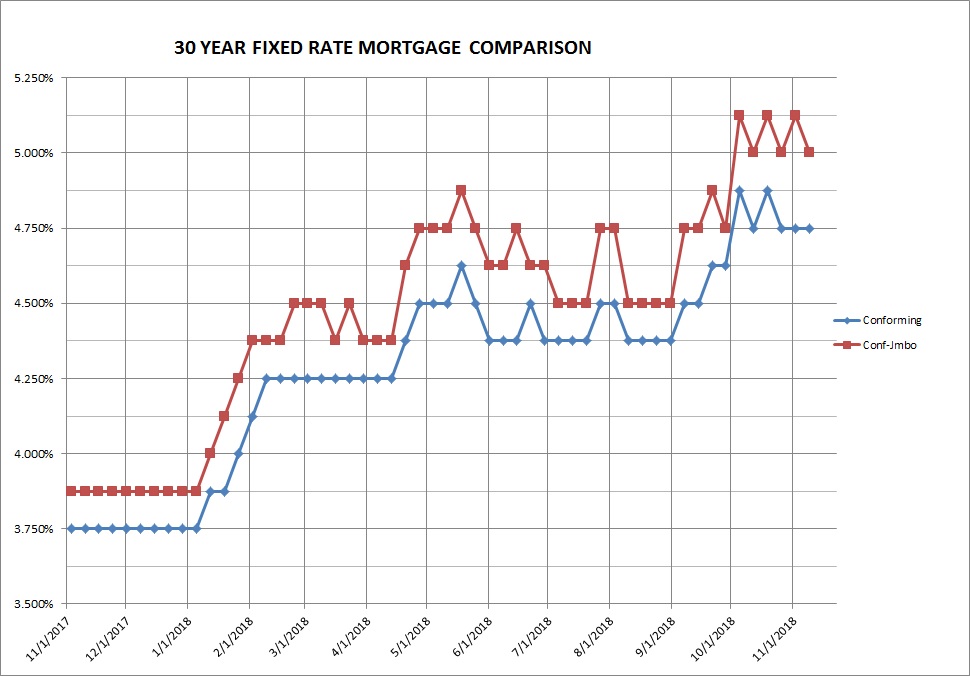
Rates for Friday November 9, 2018: Mortgage rates bounced around a bit this week but we finish with the conforming rate being flat from last Friday and the high-balance rate declining one-eighth (0.125%). Rates have been within a tight range of one-eighth of a percent for the past six weeks, any news positive or negative could prompt a break out of to higher or lower rates. In other words we continue to have a volatile somewhat unstable rate market.


FIXED RATE MORTGAGES AT COST OF 1.25 POINTS LOCKED FOR 45 DAYS:

30 year conforming                                            4.75%       Flat

30 year high-balance conforming                   5.00%      Up 0.125%


Please note that these are base rates and adjustments may be added for condominiums, refinances, credit scores, loan to value, no impound account and period rate is locked. Rates are based on 20% down with 740 FICO score for purchase mortgages.


Another milestone in the Smith household as our youngest passed her driver’s test and drove herself to school on Tuesday instead of taking the bus. It also has resulted in the big car shuffle as she took my 2006 Pilot, I am now in the 2010 Odyssey and Leslie moves into what was our oldest daughter’s 2001 Infinity until we decide it is time to get her a more recently manufactured set of wheels. We’re not real big on buying new cars in our family on a very frequent basis.


Have a great week, and drive carefully—especially around Bixby Knolls!


Dennis


Past Weekly Rate & Market Updates can be found on my blog page at my website www.DennisCSmith.com

10-26-18 Why can’t you use my bonus income to qualify me for my new home?

Question of the week:  Why can’t you use my bonus income to qualify me for my new home?


 Answer:  Income must be of a constant and continuing nature.


What constitutes “constant and continuing?” Generally, at least a two year history of receiving the income fulfills the requirement. There are some exceptions which I will cover below, but the question of the week specifically addresses bonus income, and much of this will apply to overtime and commission income as well.


Bonus income typically fluctuates from year to year depending on the matrix upon which the bonus is based. Because of the fluctuation there must be a guideline for the lender to consider the income for qualification purposes for your mortgage application. The industry standard is that if you have received a certain type of income for two years are more then we have reached the threshold of constancy. To reach the continuing nature policy we generally need a statement from your employer that the bonus will in all probability continue; this guideline is usually met with a letter from the employer or with a Verification of Employment (VOE) that we send your employer to complete. The VOE has sections for your employer to complete stating the length of employment, income for each of the past two years plus year to date broken down into base, bonus, overtime and commission. As well there is a place to indicate whether the continued payment of bonus, overtime and commission is likely to continue in the future.


Whether your bonus is paid annually, quarterly, monthly or per pay period does not matter for qualifying, we will convert the amount received into a monthly amount based on the amount received for the past two years, and if applicable year to date. The rule of thumb for bonus income, as well as overtime and commissions, is to use at least a two year average, unless the most recent year is lower than the prior year in which case the lower amount is taken.


Example: You have been with your company for five years and have received bonuses every quarter for the past three years and the bonus is paid on the first paycheck after the end of the quarter. In 2016 your bonuses totaled $12,000, in 2017 $12,600 and on your October 15th pay period your total bonuses year to date including September totaled $9700. The total amount received in bonuses is $34,300 over the past 33 months (two full years plus nine months in 2018), so we divide the total amount received by the time period over which it was received and get $1039.39, this is the amount of bonus income we will use for your qualifying for your mortgage—provided your employer verifies that you are likely to continue to receive bonuses in the future.


Example 2: Same employment scenario as above, however in 2016 you received $12,000 bonus, in 2017 you received $10,000 bonus and through September you have received $9000 in bonus income as reflected on your recent paycheck. It is evident you received $1000 per month in 2016 and so far in 2018. However, in 2017 your bonus was $833.33 per month—this is the bonus income that most lenders will use for income qualifying as it follows the standard guidelines from Fannie Mae and Freddie Mac. Even with a letter from your employer regarding 4th quarter bonus the lender will take the worst case scenario when calculating income.


All this covers how we do calculate and count your bonus income, back to our question, why is your bonus income not allowed? Reading through the above it is likely because of any or all of the following:


  • You have not received your bonus for at least two years
  • Your bonus has been inconsistent, i.e. you received bonus income in 2016 but not 2017
  • Your employer will acknowledge that your bonus is likely to continue, which we saw not infrequently during the recession with employers very hesitant to put in writing bonuses are guaranteed or likely to continue creating a legal document an employee may use against the employer should bonuses be canceled.


Any non-wage employment income is generally treated in a similar manner, most prevalent being overtime, commission and self-employment income.


As mentioned above there are some exceptions to the two year income rule:


New job—If you are starting a new job, depending on the circumstances, we can generally count your income with a short, or perhaps no, history of employment at the new job. Typically, showing at least thirty days of income is needed. If you are transferring from working for Dennis Sprockets to Smith Widgets and in somewhat the same type of work, we can use your new income—but not overtime or bonus unless expressly addressed and quantified in an employment contract and if you received similar amounts in your prior job. New professionals can also have “young” income used for qualifying with proof of education in the field and an employment contract. If transferring geographically and a new job with a new company we can usually use your new employment income before you start on your job with an employment contract and separate letter from a senior executive at the company.


Spousal support—If you have a divorce decree or separation agreement that is recorded that includes your receiving alimony or child support we can use that income once you can prove you have received six monthly payments in a timely fashion. Note the income must be received as one payment every six months and not six months’ worth of payments upfront. As well the agreement must indicate the income will be received for at least three years after the date of your mortgage application; for instance, if you are receiving $800 per month for each of your two children until they are 18 and your son is 16 then we will only accept $800 for qualifying for your youngest child.


Retirement income—If you receive a pension or social security income you do not need to show a two-year history. Provide your award letter stating the amount of income you are to receive and we will use the current income for social security; for a pension, we must show that the pension income will continue for at least three years.


Asset accounts—Most individuals and couples have their financial assets in a retirement account and/or taxable investment and bank accounts. Depending on several factors these accounts could be used for qualifying income. Retirement accounts can be used for income if you are taking regular withdrawals from the account. Depending on your age and the type of retirement account you may be having to take mandatory distributions on an annual basis, this can be used for income. Or if you are taking regular distributions we can use those amounts as income as well. If you have funds in non-retirement accounts there are some cases where we can perform a calculation called “asset depletion” so we can achieve qualifying income.


Rent—If you are purchasing a new home and renting out your existing home there are guidelines we can follow to use the rental income from your current residence as qualifying income to offset the mortgage, tax and insurance payments.


Bonuses, commissions, retirement, wages, there are many different sources of income; whether yours is eligible for use as qualifying income can depend on different factors. If you, or someone you know, if looking to purchase or refinance property please contact me to ensure you are fully qualified for the transaction you want to make.


Have a question? Ask me!


Don’t bury the lead. A couple of big pieces of economic news, since weekly update is primarily about mortgages and real estate we will start with the major news on home sales. This week the California Association of Realtors released its housing report for September. Based on the data I am of the opinion the real estate markets have become a buyer’s market. Los Angeles County saw the median home price increase 4.5% from August and 4.7% from 2017 to a value of $634,680. While the median price increased there was a dramatic drop in total sales. Sales volume for the month was down 18.3% from the prior month and 22% from last year. Neighboring Orange County saw both the median price and total sales volume drop in September. The county median price of $825,000 was down 1.6% for the month and 3.3% for the year, total volume was down 20.3% from August and 21.8% from September 2017. The data that supports my contention of our regional market being a buyer’s market is the increase in the number of active listings on the market and the time a home is on the market before it is sold and enters escrow. Basic premise, more supply leads to lower prices. Supply is growing and demand is not due to several factors, primarily higher interest rates.


Impacts sales and refinances. The softening market not only impacts sellers as they see values slowly erode, but also can have an impact on homeowners looking to refinance to lower payments, consolidate equity lines or obtain equity for various reasons. How? With a softer market there is more downward pressure on appraisals and therefore values needed for refinancing, or the rate and cost of the refinance due to potentially higher loan to value based on potentially lower appraised values.


The national economy is not following housing. This morning the initial estimate for the Gross Domestic Product was released and it showed growth in the quarter of 3.5%, slower than the 4.2% GDP growth in the second quarter. The expectation is that 2018 will end with total economic growth of 3% or greater, the first year with such growth since 2005. The report was, as you can expect, sprinkled with good news most notably the decline in inflation from 2% in the second quarter to 1.6% in the third quarter. That is good for consumers, but is it good for the economy? With some weakness in business spending and investment, slowing inflation and the equity markets dropping in recent weeks the signals are there for economic growth slowing, or reversing in 2019. It is quite possible, probable?, that a mild recession will begin in the third or fourth quarter of 2019. Overall the GDP news was market neutral as the growth figures met expectations.


Rates for Friday October 26, 2018: With stocks falling this week investors have been moving their funds to bonds and mortgages resulting in rates falling from last Friday. We remain in a volatile market and caution is strongly advised when thinking about floating your rate.


FIXED RATE MORTGAGES AT COST OF 1.25 POINTS LOCKED FOR 45 DAYS:

30 year conforming                                            4.75%     Down 0.125%

30 year high-balance conforming                       5.00%     Down 0.125%


Please note that these are base rates and adjustments may be added for condominiums, refinances, credit scores, loan to value, no impound account and period rate is locked. Rates are based on 20% down with 740 FICO score for purchase mortgages.


Few things are better than a short trip that feels like a very long trip. That was the experience Leslie, our daughter and I had last week when we flew out to Boston to see our college freshman. Leslie and I walked about 13 miles on Saturday, mostly up the Charles River while the internationally famous Head of the Charles rowing regatta was going on, watched a performance by the marching band, where ironically our daughter is the tallest in the flute section as she was in high school, then we all enjoyed a fantastic and leisurely lunch/dinner at an Italian restaurant, topped off with the ubiquitous visit to Mike’s for some pastries. Another long walk to LL Bean to get our girl squared away with duck boots for the coming winter and it was back to our hotel for a few hours of catching up and just being together. A packed day, with plenty of needed hugs, mostly for me, and just seeing how happy she is with her friends, college and new city and mom and dad have come home at ease.


Now we are looking forward to our next time seeing her when she is home for four weeks at Christmas!


Have a Happy Halloween and don’t get too spooked by the gremlins and goblins showing up on your doorstep…I’ve noticed they leave you alone if you bribe them with some sugary treats!


Have a great week,


Dennis


Past Weekly Rate & Market Updates can be found on my blog page at my website www.DennisCSmith.com

10-12-18: We just received our property tax bill…

Question of the week:  We just received our property tax bill…


 Answer:  Okay, okay this is not a question; it is the start of a question. There are several phrases to make it a question I will quickly go through this week:


…why is it lower than you estimated when we purchased our home earlier this year?


…why is it higher than last year since we are under Proposition 13?


…how much should we pay?


…why is it lower than you estimated when we purchased our home earlier this year?


If your property tax bill is significantly less than my estimates when we funded the loan to purchase your home then you will very likely receive a supplemental tax bill, if you have not received one already and the two bills added together, the tax bill you have just received from the County where your property is located and the supplemental tax bill, should be close to the estimate we used when you purchased your home.


In California the fiscal year is from July 1st to June 30th. The tax bill property owners have received in the past week from their County Assessor has an option of paying half the bill by December 10th covering first half taxes from July 1st to December 31st and the other half by April 10th covering the second half taxes from January 1st to June 30th. The tax bill mailed in September or October is based on the prior tax bill as adjusted for Prop 13, or if there was a transfer the value on January 1st.


When you purchase a property the tax base for the property is adjusted based on your purchase price. Depending on when you purchased the property the new value may not be adjusted by the County Assessor before the tax rolls are set for the coming fiscal year. If this is the case the tax bill you have received reflects the prior assessed value plus and adjustments for Prop 13 (see below) or additional payments for taxes or bonds put in place by voters or local government. This is the primary reason your tax bill is probably lower than you anticipated, and why you will receive, or have received, a supplemental tax bill.


The supplemental tax bill covers the difference between the taxes on the tax bill and the taxes you should be paying from the date of the close of escrow on  your property purchase to the end of the fiscal year, June 30th. Depending on the seller’s assessed value and your purchase price the supplemental bill can be very large, very small, or even “negative,” in which case you will receive a refund from the County.


Supplemental tax bills are only mailed a few times a year, so it may be some time after you closed your purchase before you receive your supplemental bill. Please note, if you have an impound account and your lender is collecting and paying your property taxes that your supplemental bill is not sent the supplemental tax bill, the payment is entirely your responsibility.


Confused? Let’s say you purchased a home for $650,000 and closed escrow on February 7th. Using our rule of thumb of your property taxes being 1.25% of the purchase price your annual taxes the first year of ownership should be $8,125 per year ($4062.50 for the first and second half tax bills). Your seller purchased the property in 2000 for $375,000 and their assessed value has risen through the years and their tax bill the year they sold the property was $5500. You just received your first property tax bill from your County Assessor and it shows you owe $5610 conveniently payable in two payments of $2805 each.


There is a difference in annual taxes between what you should be paying and what you are being billed of $2625. However this will not be the amount of your supplemental tax bill as that is the annual property tax differential and you only owned the property since February 7th, not July 1st of the prior year. There are 143 days between February 7th and June 30th, and that is the period which the higher assessed value should be applied for property taxes. Therefore your supplemental tax bill will be the annual property tax differential divided by 360 days multiplied by the number of days you owned the property between the sale date and end of the tax year:


$2625/360 = $7.29 per day x 143 days = $1042.71 as your supplemental bill.


Note that depending on your closing date you may receive more than one supplemental bill.


It can get pretty confusing, however most County Assessor websites have links where you can input your address, sales price and closing date and it will calculate your estimated supplemental tax bill.


…why is it higher than last year since we are under Proposition 13? Prop 13 was passed at the ballot box by California voters on June 6, 1978. There were three major items in the measure that immediately impacted property owners in 1978. First, it decreased assessed values by having all properties in California re-assessed to their assessed values in 1976. Second, it capped the assessed value of real property taxes by to the state at 1% of the ad valorem value of the property, i.e. the transaction value. Third, it limited increases to assessed values to an inflation index but not to exceed two percent (2.00%) per year.


It is the third factor that confuses many new or experienced property owners when they receive their property tax bill that the total is higher than what they paid the year before. Since property values are increasing your assessed value is increasing as well, but not more than two percent above the assessed value from the prior year.


Also surprised are those property owners who do not follow the news or politics. Their surprises come in the form of special assessments put on tax bills by either voters or elected officials in the form of bonds or taxes. For instance for our home in Long Beach we have nine such assessments that add 29% to our base tax rate of one-percent. Three of the assessments are local bonds for the Metro Water District, Long Beach Community College District and the Long Beach Unified School District; the other six are county measures and bonds for parks, flood control, sanitation, etcetera. Every city and county has different special assessments on their property tax bills that are added to the one-percent maximum taxable assessment from the state.


…how much should we pay?  The first question, “how much should we pay?” is a follow up to my Weekly Rate & Market Update from December 22, 2017 after the new tax law was passed that limited SALT (State And Local Tax) deductions to $10,000 per year. In the WR&MU the question was given the reduction in ability to deduct California state income tax and property taxes to a cap of $10,000, did it make sense for California property owners to pay both the first (due by December 10th) and second (due by April 10th) half taxes in 2017, which would result in most property owners who did this paying three half year tax year bills in 2017 (2nd half of 2016-17 in April 2017, 1st half of 2017-18 in December 2017 and 2nd half of 2017-18 in December 2017) thereby maximizing their property tax deductions. The advice from my CPA tax preparer friends Lew Finkelstein and Paul Scholz was, “depends” as some clients would not benefit from the additional half-year of taxes deduction if they were under the Alternative Minimum Tax (AMT) zone for 2017. For most people however it did make sense to pre-pay the April 10th payment and get the deduction.


What about this year? Before I answer here is the disclaimer: I am not a tax professional or accountant, before you make any decision as to how much you should pay in property taxes this year consult your tax preparer.


If you did pay the second half of your property taxes in 2017 instead of in April of this year, your property tax payment due by December 10th will be your first property tax payment of the year. Should you also pay the second half bill due by April 10, 2019? Again, it depends. If you pay just the first half payment, will your total of property taxes paid plus state income taxes be less than or more than $10,000? If your total is less than $10,000 you may want to go ahead and pay both first and second half property taxes in December to maximize your deduction; if your total is more than $10,000 you may want to pay the second half taxes next year in April when due—which means in 2019 you will again be over the $10,000 limit but at least you will not have a double tax payment in December when you may need the extra cash for the holidays.


Confused? Let’s say your annual tax bill is $6,000, you owe $3000 by December 10th and another $3000 by April 10th. You paid the full property tax bill in December of last year, so this year you have paid no property taxes. As a household your state income taxes for 2018 are approximately $8000 for the year. You have to pay your first half tax bill of $3000, so you will have paid a total of $11,000 in SALT (State And Local Taxes, i.e. income and property taxes) and can only deduct $10,000 on your federal taxes, so you have lost $1000 in deductions you used to get. If you pay the full $6000 then you will pay a total of $14,000 in SALT, can only deduct $10,000 so lose $4000 in deductions you used to get.


If you just pay the first half, in April you will have to pay $3000 for the second half taxes, in December you will have to pay the first half taxes for 2019-20, assuming it increases the maximum amount (2%, see above) that payment will be $3060 for a total of $6060 paid in property taxes in 2019. If your state income tax bill is the same, $8000, then you will have paid $14,060 in SALT and be able to deduct only $10,000 so you have $4060 you miss in deductions.  Provided there are no changes to the tax bill that increases SALT deductions.


The question you want to answer is do you want to have deductions left on the table this year or next year if the laws do not change? Personally, I will only pay the first half taxes this year and see if there is some political deal to revise the SALT deductions for 2019—I doubt there will be but we never know since there will be a new Congress starting in January.


Repeating my disclosure: I am not a tax professional. Before making any decisions regarding our taxes please consult with your tax preparer.


If you own property I strongly recommend you have two professionals assist you: a family law attorney to help you establish an estate plan with a trust and a professional tax preparer to ensure you are maximizing your tax opportunities as well as able to provide advice when needed.


If you have any questions on property taxes please do not hesitate to contact me and I will assist you the best I can.


If you, or someone you know, do not currently pay property taxes I am very willing and able to speak with you about how you can purchase property and become a homeowner!


Have a question? Ask me!


Prices are still under control. Strong increases in prices are still anticipated by many economists and analysts, as they have been for the bulk of the year, but have yet to manifest in the market place as inflation still remains under 3%. After dropping 0.1% in August, the Producer Price Index rose 0.2% in September and year over year wholesale prices are up 2.6%, the increase was in goods and services as food and gasoline prices both dropped nationally in September. On the consumer side the Consumer Price Index increased 0.1% in September, less than anticipated and slower than August’s increase of 0.2%. Year over year consumer prices are up 2.3%, a drop from August’s 2.7% annualized increase in prices. The most significant push on higher prices in September were higher costs for renters and home owners. Good news in the report was the after inflation wages for workers rose 0.3% in September and year over year are up 0.5%. The report is the basis for 2019 CPI adjustments for the government and it has been reported that social security benefits will increase 2.8% next year. Over all the price news is neutral for mortgage rates.


Rates for Friday October 12, 2018: A see-saw week for mortgage rates this week as investors ran to and fro with their money reacting to Fed-speak and speculation the Fed will increase rate by one-half of one percent (0.5%) in December instead of the anticipated one-quarter of one percent (0.25%) and have four rate increases next year instead of three. As well the drop in stock prices this week caused many investors to put some of their proceeds from selling their equity holdings into bonds—though it appears most of the money went into cash. We have a volatile rate environment, now is not the time to float your rate or try to time a dip, lock your rate when you can. All that said, rates are down slightly after last week’s spike late in the week.


FIXED RATE MORTGAGES AT COST OF 1.25 POINTS LOCKED FOR 45 DAYS:

30 year conforming                                            4.75%    Down 0.125%

30 year high-balance conforming                    5.00%     Down 0.125%


Please note that these are base rates and adjustments may be added for condominiums, refinances, credit scores, loan to value, no impound account and period rate is locked. Rates are based on 20% down with 740 FICO score for purchase mortgages.


Is it me or does it seem like Hurricane Michael had little of the pre- and post-landfall coverage that Florence received last month? Michael was the strongest hurricane to hit the United States mainland in over fifty years and the power of the storm is very evident in the pictures we are now seeing. Whole groves of trees snapped in half, houses not only flattened but blown completely away. The devastation looks more like a tornado than a hurricane, but with a significantly larger impact area. Several times a year it seems I post this link in the WR&MU, here it is again, if you are able please make a donation of any size to the American Red Cross who does incredible work assisting those impacted by disasters.


Have a great week,


Dennis

9-14-18: Can we afford this payment?

Question of the week:  Can we afford this payment?


 Answer:  Statistically, yes you can.


Statistics dictate the underwriting guidelines when determining how much of a mortgage and housing payment a family can afford to get loan approval to purchase a new home, or refinance an existing home. The key number is the debt-to-income (DTI) ratio which is your new housing payment (mortgage, property taxes, insurance and homeowners association dues if applicable, collectively referred to as PITI) divided by your adjusted gross income (income before taxes). Depending on the loan program this percentage of your total income for your total new debt obligations inclusive of housing payment cannot exceed between 43 and 50% of your gross income. (Note, VA mortgages do not adhere strictly to DTI guidelines for qualifying.)


For instance, if you are purchasing a new home and the total housing payment is $3,000 and you have car payment, student loan payment and credit cards with monthly payments reported on your credit report totaling $1275 per month, your total obligations are $4275 per month. If your gross monthly income is $10,000 per month you have a DTI of 42.75%, generally good enough to qualify for most programs.


Statistically. The debt-to-income guidelines were created based upon data from millions of property owner’s history of making payments in a timely fashion, and more important those that have not. Mortgage data is analyzed to see the percentage of defaults for debt-to-income ratios and there is a breaking point at which the percentage of defaults become untenable risk for lenders and that is where the DTI guidelines are set. It is important to note that the default data is also analyzed for occupancy, type of property and credit scores among other criteria and this is how rates are priced (sounds like a good question for next week).


Back to if you can afford the payment that we have given you which would be approved by underwriting.


I tell almost all clients purchasing a new home when we are going through the qualification process, “there are three things that are very true regarding your new home purchase. One, I will not use my savings to purchase the home. Two, I will use my income to help you make the monthly payment. Three, I will not spend any time sleeping or living in your home.” This is to say, while I may feel comfortable with the payment I am giving you for your potential new mortgage, property taxes and insurance, I am not making the payment so it is important that you are comfortable with what you feel you can afford.


That said it is also important to stretch a little of your comfort if your comfort level is well below your income ability, unless there are some exceptions. One gauge many first-time buyers, and some move up buyers, use for their new housing payment is what they are currently paying in rent. If you make $10,000 per month and are paying $2200 per month, using the $2200 per month to be what you would like your new housing payment to be you will be looking at homes that are significantly below your ability to qualify, and from my experience frustrated in the homes you will be looking to purchase as few, if any, will feel “right” for you and your family.


If the payment I am quoting feels too high for a client I ask that they take a look at where they spend their money, and is this likely to continue once they become homeowners. Purchasing a home is not just purchasing a place to live, it is also entering a new lifestyle, that of homeowner. For most first-time buyers, purchasing a home occurs before they start a family, or with younger children. This changes your lifestyle dramatically and the stability of owning a home and fixing your housing payment pairs perfectly with a growing family. Most meals will be made at home, changing your budget if you eat out a lot. Weekends will likely be spent with the family at different events, games and activities involving the children, which means fewer weekends travelling to the wine country or Vegas.


Essentially, is your expectation that your lifestyle and spending habits that make your potential new housing payment seem uncomfortable to remain the same? Chances are very, very high that it will not. When considering your new home and the cost also consider the changes you will be making in your lifestyle, and therefore expenses.


Finally, why are you buying a home? Is it to change your life in a positive manner? If so what other changes are you willing to make so you can experience the value of homeownership?


Pretty much everything decision in life has trade-offs and consequences, even not making a decision. One area at which I will immodestly say I do very well is explaining to my clients the positives and negatives of the options available to them when purchasing a home. If you think owning a home is not in your budget please contact me so we can discuss your financial situation and options.


Have a question? Ask me!


August economic data was interesting. The Producer Price Index dropped 0.1% in August, the first month over month decline in 18 months and read by many as a sign that inflation may be easing. Supporting the read was the Consumer Price Index for August that showed prices rose 0.2% for the month, however up only 0.1% for the “core” rate (minus fuel and food). The monthly increase was the fifth straight increase, however the size of the CPI increase lowered the year over year inflation for the core index to 2.2% from 2.4%. Gas and rent were the primary factors putting upward pressure on the index, many other consumer sectors fell, primarily clothing which saw prices drop for the third month in a row—good news if you have growing children. The news is mostly positive for interest rates as any easing of inflation releases pressure for rates to go higher.


Retail sales also grew at a slower pace in August from the prior month, however the slow down was not unexpected given the surge in sales in July. Supporting future increases in sales was the Michigan Consumer Sentiment Index which continues to rise, reaching it second  highest level since 2004, and highest since March of this year. Positive consumer sentiment leads to consumer spending, which drives the economy and can lead to higher rates.


Rates for Friday September 14, 2018: A large drop in Mortgage Backed Security (MBS) prices in the middle of the week put strong upward pressure on rates. Some easing later in the week saw us with rates this Friday flat from last Friday. I have been asked a lot lately what I thought rates will do, my standard response is that I feel they should be higher than they are currently given the economic data.


FIXED RATE MORTGAGES AT COST OF 1.25 POINTS LOCKED FOR 45 DAYS:

30 year conforming                                            4.50%             Flat

30 year high-balance conforming                      4.75%      Flat


Please note that these are base rates and adjustments may be added for condominiums, refinances, credit scores, loan to value, no impound account and period rate is locked. Rates are based on 20% down with 740 FICO score for purchase mortgages.


Thankfully Hurricane Florence started losing power earlier in the week and when it made landfall this morning in North Carolina had lost enough power to be designated a tropical storm instead of a hurricane. Even with the winds at less power the amount of water that will be dropped in the southeast will be significant, especially if the storm remains in place. As always when nature becomes fierce the Red Cross is there to help residents through the event and after. We are truly fortunate to have such a wonderful organization looking after people negatively impacted around the globe by human and natural acts that displace and harm people.


Many communities are also grateful they have a Waffle House or two in their communities. The butt of many jokes, mostly from those not in the Waffle House regions, the company does great work when disasters are about to hit. So great in fact that FEMA follows the company’s “Waffle House Index” to help determine the severity of a storm. Waffle Houses rarely close, they want to stay open as long as possible as the company knows in many communities it may be the only place for residents and emergency personnel to get a meal. The company also assists with employees from other stores in nearby, less effected, regions to go into disaster zones and fill the jobs at Waffle Houses so those employees can take care of their families and situations as a result of the hurricane, tornado or other event.


Here is a good article on the Waffle House Index. Just so you know, Stage Yellow probably means no bacon—you can get sausage because it takes up less grill space and takes less time to cook so the restaurant can serve more people faster by taking bacon of the restricted menu.


Have a great week,


Dennis

9-7-18: Should we pay extra on our mortgage?

Question of the week:  Should we pay extra on our mortgage?


 Answer:  This is a question we answer every few years and it has come up a few times over the past few weeks with different clients as they consider paying extra on their mortgage every month or year to pay it off faster. It is natural to want to pay off debt, get rid of the monthly payment and quit paying a lender interest are the main two reasons.


But is paying off your mortgage early the best financial move for you? Here are several items to consider before you commit to paying off your mortgage ahead of schedule.


Are you maxing out your contributions to your retirement account? Most Americans are underfunded for their retirement, many of whom own homes. Instead of paying additional principal down on your mortgage I suggest putting it into your retirement account instead for several reasons. First, the money you put into retirement is usually deducted from your taxes (an exception can be if you contribute to a Roth IRA account), whereas the money you pay down on your mortgage is not. Most homeowners in California will have combined state and federal tax rates around 33% of adjusted gross income. If you contribute the $18,500 maximum to a 401(k) ($24,500 if over 50) that is a tax savings of about $6000, pay the same amount down on your mortgage and there is zero tax savings—in fact you will have negative tax savings because…


The government pays for part of your mortgage due to the mortgage deduction allowed on state and federal income taxes. You can deduct the amount you pay on your mortgage interest directly from your income for both federal and California state income taxes (there are limits, for married couple $1 million if mortgage used to purchase home was put in place prior to 12/16/17 or you were in contract to purchase home prior to that day; if your current mortgage was a refinance or put in place after 12/16/17 the new limit is interest up to a $850,000 balance). So if you have a $500,000 mortgage with an interest rate of 4% you can deduct $20,000 from your income, saving approximately $6500 in taxes. If you pay down $18,500 on your mortgage you lose approximately $250 in tax savings since your interest payments are lower. Paying down $18,500 on your mortgage instead of putting it into your 401(k) can cost you over $6000 in tax savings.


If you are maxing out your retirement contributions, how are you on saving for your children’s college education? As the parent of college freshman and a future college freshman, and someone who has looked at thousands of clients financial statements, I can attest that college expenses have far outpaced most families abilities to save for those expenses. Having gone on several college tours the last few years one common theme from the financial aid offices was that the general threshold for receiving direct aid (i.e. tuition reduction in form of grant from school) is income around $70-80,000, which is great if you live in some parts of the country but not too far above the median income in most parts of California. So unless your children have exceptional talents in some endeavor plan on needing quite a bit of money if you wish to contribute to your children’s college finances. Putting additional money into a 529 College Savings account or other savings instead of paying down your mortgage might be a better allocation of funds. By doing this you are essentially “borrowing” at whatever your mortgage rate is today for use in the future instead of potentially borrowing in the future at what may/probably will be a higher rate.


Speaking of your mortgage’s interest rate, is it lower than other debt you have? Credit card debt, auto loans, your own student loans? If you are maxing out your retirement contributions, you do not have to worry about future college expenses but have consumer debt it makes more sense to pay off that higher interest, non-tax deductible debt before paying off your mortgage. It not only makes more sense but it is very good math.


Are you planning on selling your home in the future, before the current term of your mortgage is completed and before your over-payment plan would pay off the mortgage? If so you should consider putting the additional funds into savings, investments, even cash. Your home is not worth more, or less, depending on your mortgage balance. Your home’s value is determined by location, size, condition, etc, not by the amount of debt secured by the home. Paying $40,000 down on your mortgage over say five years and then selling it with a $400,000 mortgage balance was a loss of opportunity for those funds to work for you with compound interest and/or dividend reinvestment. There is no compound equity or equity reinvestment in your personal residence, it will be worth what the market dictates when it comes time to sell. Yes, your net proceeds from the sale will be $40,000 more than if you have not paid down the mortgage. At a 4% return on the extra $666 per month you pay on the mortgage over five years would result in over $44,000, 10% more than your net proceeds gain from paying that money into the mortgage.


One final consideration, it costs money to get money back out of your home. If you have $100,000 equity and want to access some of it you will either need to refinance, obtain 2nd loan or HELOC, or sell the property, each of which has costs. What if you pay down your mortgage and need money in the future for home improvements, medical emergency or other unexpected life event?


All these are factors, and there are more, that you should consider before paying extra down on your mortgage. There are some factors that more strongly support paying off your mortgage early than other, primarily looking at your current income, your projected retirement date and your projected income during retirement. Or you have a property that is a rental with a low enough balance that you can use rental income to accelerate the payoff of the mortgage, again looking at some of the factors above, to have a free and clear investment that gives you more options in the future, such as selling and carrying a large mortgage to defer capital gains and continue to receive income.


As with most/all of our questions of the week, before we can answer the question we need answers to more questions—and this particularly the case this week. If you are considering accelerating the principal reduction on your mortgage, please do not hesitate to contact me to discuss your options.


Have a question? Ask me!


With the center of the news universe seemingly being in the Senate Judiciary Committee hearing room this week, you may need to look a few pages into your daily paper tomorrow to find the employment data released today, or any other news for that matter. The Labor Department announced today that 201,000 jobs were created in August, 204,000 in the private sector. The front-line unemployment rate remained at 3.9%. These pieces of data are positive, but not a big impact on rates as the news was in-line with expectations. What did have a strong impact on rates was the average hourly earnings data which showed an increase of 0.4% in August following the 0.3% gain in July. This puts the annual rate of pay increases at 2.9%, up from 2.7%, the highest rate of increase since June 2009, the month the recession ended. With the consumer price index measuring inflation at 2.9% the average American worker’s income is keeping pace with inflation. The wage data puts upward pressure on rates and more than reinforces future rate hikes from the Fed.


Rates for Friday September 7, 2018: After holding on last week following the strong GDP data, rates could not continue to hold following today’s labor market news. More workers getting more pay leads to more spending leads to higher prices which leads to higher interest rates. Today rates popped up on the labor news after remaining flat from Friday to Friday for the past three weeks. Not surprising, the surprise to me is they had not increased sooner. Lock your rate when you can as higher rates are lot more likely in the future.


FIXED RATE MORTGAGES AT COST OF 1.25 POINTS LOCKED FOR 45 DAYS:

30 year conforming                                            4.50%             Up 0.125%

30 year high-balance conforming                      4.75%      Up 0.125%


Please note that these are base rates and adjustments may be added for condominiums, refinances, credit scores, loan to value, no impound account and period rate is locked. Rates are based on 20% down with 740 FICO score for purchase mortgages.


With age comes experience and practicality. When our fifteen year old refrigerator decided to quit last Wednesday, Leslie and I looked at each other and said, “happy anniversary,” knowing a new fridge was going to be our 24th wedding anniversary present to each other. And sure enough this Tuesday, our anniversary date, a new one was delivered. Not to be completely unromantic I placed a bottle of nice vodka inside the present for her to enjoy. Somehow I don’t think I get away with a kitchen appliance and bottle of vodka for number twenty-five next year….


Have a great week,


Dennis

8-31-18: Should we buy a rental property?

Question of the week:  Should we buy a rental property?


 Answer:  This is a common question for those of us in the real estate industries, as well as for professionals in other industries such as family attorneys, accountants and financial advisors. Looking to secure a long term investment many families would like to purchase a property to rent out for investment income and long term value appreciation.


Is it right for you?


As you can imagine, there are several factors to consider before deciding to purchase rental property. Here are some that come to mind, but certainly not a complete list.


The first question you must answer is, what are my expectations? Do you want positive monthly cash flow? Are you most concerned about long term appreciation and growth of your initial investment? Do you want a loss on your tax returns to off-set income? Each of these factors can be obtained, but each also has different requirements for how you purchase the property.


Positive cash flow can be very challenging in the California, especially if you are in a county that touches the Pacific Ocean. Cash flow is determined by what income the property will generate from rents minus the expenses of ownership: mortgage, taxes, insurance, maintenance and vacancy. Because real estate prices have grown it takes substantial down payment to achieve positive cash flow in most properties. For instance, if you are looking at purchasing a $500,000 home as a rental in an area where the market rents for the property are around $2500 can you achieve positive cash flow? The minimum down for a single family residence non-owner occupied loan is 20%, and today the rate is about 5.125% with that down payment. The monthly PITI is almost $2800—your cash flow is not positive. Putting 25% down the rate drops to 4.875% and your PITI drops to $2500 so you are cash flow neutral before maintenance and upkeep. Before closing costs you have invested $125,000 for neutral cash flow.


That said, if the property increases in value an average of 3% for the next five years your property has increased in value about $80,000 so on paper you have seen your initial down payment increase about 65%, from $500,000 to about $580,000. As well you have likely had depreciation on your taxes, that provided you with a loss on your tax returns for the property (if you are eligible to claim real estate losses) which has saved you tens of thousands of dollars in income taxes. So your monthly cash flow is neutral, perhaps slightly negative, but you have seen your investment grow in value and gained cash flow with your tax deductions.


Keep in mind the above scenario is based on finding a home for $500,000 in an area that rents for $2500 per month and would increase in value an average of 3% per year over five years. That said it appears this type of scenario checks the boxes for cash flow (after taxes), appreciation and deductions on your tax returns.


What are other factors to consider? Costs is a very important consideration. It costs money to purchase real estate, the rule of thumb is about 3% of the purchase price, and it costs money to sell real estate, the rule of thumb is about 8% depending on real estate commissions. So in the above scenario you have about $15,000 on top of your down payment to close the transaction and if you sell at the end of the five years your costs of sale are about $46,000. For your total investment of $140,000 your next gain in equity from the market is about $34,000 which is a  nice 24% return over the five years.


Keep in mind that $34,000 will be taxed as capital gains and any depreciation you claimed will be “recaptured”, a fancy term for taxed. Check with your tax preparer but depending on your income the taxes could exceed $10,000.


You can avoid the taxes by participating in an IRS tax deferred 1031 exchange, which entails selling the property and having the proceeds transferred to an escrow to purchase another property. You avoid the taxes, but you are not benefiting from the capital appreciation as it has to roll over into another property.


One mistake many first time investors, and some experienced, make with investment property is they care too much. Too often they want to purchase property they would want live in, or spend too much money on the property. I have seen clients spend tens of thousands of dollars to upgrade kitchens, bathrooms, floorings, etc, to be of the type and quality they would want, but for tenants who generally do not treat their homes the way they would if they owned it. If you want to get in the real estate rental market as a landlord you must remember that it is a business, you are buying an investment not a home and as such your objective is to provide a clean, safe property for rent. Putting in granite counter tops and solid oak cabinets will not increase the rents you can collect, perhaps it puts you at or near the top of the market for the area you are in, but if the market is $2500 you won’t be able to rent for $3000 just because of the nice kitchen.


Which brings me to the most popular way most families obtain their first piece of rental property: convert your existing home to a rental when you purchase your next home. This has many advantages. First, you save on closing costs. Second, you do not need a cash investment for the purchase of the property—though you will need one for the purchase of your new home. Third, the loan is already in place and likely at a lower rate than the current market for non-owner-occupied financing. Fourth, if you sell the property within three years of converting it to a rental you probably can avoid capital gains tax should the property appreciate.


Should you purchase a property for rental income and investment? The answer requires a lot of thought and research as to the short and long-term consequences. Before you make the decision consult with your tax preparer and investigate other options with the money you would be investing.  Compare possible rates of return in cash flow and appreciation, costs of acquisition and divestment, on-going costs of maintenance and loss of income, and the potential tax liabilities.


I am happy to be part of your investigation by running numbers and scenarios for different sales prices, down payments and types of properties if you are considering purchasing rental property.


Have a question? Ask me!


Lots of major economic news this week. On Tuesday the Conference Board reported that consumer confidence is at its highest level since October 2000. The higher confidence is supported by increases in personal spending and earnings in July. Spending increased 0.4%, the fifth month in a row for the primary economic engine for the country. The increase in spending was greater than the increase in personal incomes, which rose 0.3% in July, causing a slight downtick in the savings rate. The higher earnings, increased spending and tighter labor market caused prices measured by the PCE index to increase 2.3% in July, the highest level in six years. More importantly the index used by the Federal Reserve to gauge inflation, the PCE price index stripped of energy and food to reach 2.0%. The different pieces of data are each supportive of higher interest rates and collectively provide a strong push for higher rates.


Also putting upward pressure on rates, was the revision of 2nd quarter Gross Domestic Product released this week showing growth of 4.2%, revised upward from the initial report of 4.1%. A combination of tax cuts and consumer spending pushed corporate profits higher for the quarter helping push GDP growth.


Rates for Friday August 31, 2018: My economic training and experience is telling me that rates should have gone up this week based on the data. They are flat from last Friday, and have remained flat since the first Friday in August. Investors are tempering their decisions on bonds and mortgages waiting to see if a big shoe drops from the White House on tariffs with China and other nations. Earlier this week there was an apparent understanding with Mexico to revise our trade agreements, perhaps the same can occur with Canada, which would alter NAFTA. We will see how those negotiations and others go. If the result is positive in regards to no tariff wars and updated agreements we will definitely see rates go up–absent some other major issue or crisis.


FIXED RATE MORTGAGES AT COST OF 1.25 POINTS LOCKED FOR 45 DAYS:

30 year conforming                                            4.375%            Flat

30 year high-balance conforming                      4.50%               Flat


Please note that these are base rates and adjustments may be added for condominiums, refinances, credit scores, loan to value, no impound account and period rate is locked. Rates are based on 20% down with 740 FICO score for purchase mortgages.


To slightly change the famous Alice Cooper song, Schools In ‘Til Summer. Our Long Beach Poly junior was a bit grumpy in the early hours of Wednesday morning seeing the wrong side of seven o’clock for the first time in months, I’m sure she was the only teenager or younger in the city in that frame of mind.


Hoping all your students have a successful year!


Have a great weekend,


Dennis

8-24-18: Do you have a will and trust? If yes, please read on. If no, please read on.

Question of the week:  Do you have a will and trust? If yes, please read on. If no, please read on.


 Answer:  What did Prince and Aretha Franklin have in common besides prolific performers and writers? Both of these musical icons passed away without a will or trust. There could be many reasons why. Prince, who passed away suddenly, perhaps he thought he had more time to live and prepare an estate plan. Aretha could not have had such thoughts as she had been diagnosed with pancreatic cancer several years ago, a disease which median survival rate of one year or less. Now the attorneys in Minnesota and Michigan have a tremendous amount of work as they represent various potential heirs to large estates. Who gets the real estate, the rights to their royalties, family heirlooms and memorabilia?


Why they had no plans for their estates baffles the mind of anyone in the legal and financial industries who spend their careers encouraging their clients to have plans for their families and estates for when the inevitable happens.


There are many objections that many individuals and families raise for not preparing a will and or trust, some of the most common are, “I am still young,” “I do not own enough to worry about having a will,” “my family will know what to do.” Instead of “objections,” I should have said “excuses” as none of these are valid reasons not to have an estate plan that includes at minimum a will and ideally a will and trust.


If you have children you must, not “should” but must, have a legal written directive as to who will take care of your children should both parents become incapacitated, i.e. hit by a bus while on vacation in Mazatlan. A family consists of mom, dad and three children ages 12, 9 and 6. Mom and dad are on a long ski weekend in Utah and tragically killed in an avalanche. They each have two siblings. Where will the children live? Can they be kept together? What will happen with the home the family owned, who receives the proceeds? They had life insurance with only each other named as beneficiaries, how are those proceeds divided and ensure the children benefit? Eventually all these questions will be answered, but it will be expensive and the state, i.e. the courts, will be making the decisions for the family. It will take a lot of time and money at a time when everyone, especially the children will be deep in grief.


Will your family know what to do? What if your sister and your spouse’s sister do not get along and both feel they should be the guardians of your children should something tragic happen? How does that play out?  “Bob told me we would get the children and raise them.” “Well Susie told me we would get the children and raise them.” The children have lost both parents and now will be in the middle of a legal fight between their aunts.


Even if you do not have a home or significant assets, you should have a will and ideally a trust. The will determines how your assets are divided upon your passing, the trust determines whether the bulk of your assets are transferred as you wish or if the bulk, or majority, of your assets will go through probate and potentially be subject to higher taxes, leaving less for your intended heirs.


Age is not a consideration. While statistics indicate that you should live into your late seventies as that is the life expectancy in the United States, one must consider the key word in the phrase “life expectancy.” Accidents and diseases happen to people of all ages. Whether you are 28 or 78 it is strongly advised you have a plan in place that protects your assets for your heirs and dictates what happens to those assets.


Once you have a plan make sure you keep it current. Did you prepare your will and trust when your children were in elementary school and now one or more are over the age of 18? Did you prepare your plan more than five, ten, fifteen years ago? Laws have changed, especially in California regarding inheritance and trusts, is yours compatible with current laws?


I have too many clients who when I ask if they have a trust say, “We keep planning on doing this…” Well, no you haven’t been planning on doing it, you have avoided doing it. Planning is sitting down with an attorney and discussing all the issues and matters that need to be addressed, saying you need to do it is not planning.


Every family needs to have an estate plan, and most single adults as well. A proper comprehensive plan will cost a bit of money. For those who want to save money, or get a “deal” or “bargain,” keep in mind that you will never know if your trust and estate plan was properly prepared or was able to fulfill your intentions. But your family will know and the legacy you do not want to leave is them having to spend significant time and resources with attorneys and the courts because you wanted to save money when creating your estate plan.


Being an adult, a responsible adult, comes with responsibilities. Many of those responsibilities cost money. There are many areas where it is advised you do not scrimp, save or look for deals. Some that come to mind for you and your family are brain surgery, an unlicensed electrician re-wiring your home, or a car seat for your baby. Add to this list estate planning. Scrimp, save money or look for deals when it comes to the $5 daily Starbucks purchase, the eating lunch out every day, buying a new car every two years, flying business class, don’t try to get by on the cheap when planning your estate when the results will have tremendous impact on your heirs, and ultimately your legacy with your family.


Don’t be Prince or Aretha.


Need someone to talk to? Call  or email me.


Off my soapbox.


Have a question? Ask me!


Home sales softened in July. Data from the California Association of Realtors and the National Association of Realtors show existing home sales have softened in the number of sales and/or prices.  Nationally existing home sales dipped 0.7% in July from June and the annual rate dipped to the lowest level since February 2016. More locally, sales of existing single family homes in California dropped 0.9% from June to July and 3.4% from July 2017 to July 2018, the statewide single family median price was down 1.9% month over month and up 7.6% from last July. Even more locally…sales in Los Angeles County were down 20.3% for the month and down 0.9% for the year, the median priced home in July was $597,520, up 2% for the month and 5.5% for the year. Moving south to Orange County 5.8% fewer homes sold in July from June and 1.4% fewer than July 2017. The median Orange County home sold for $829,000, down 0.8% from June and up 5.6% from a year ago. Inventory is still very low which has the impact of restricting the number of sales and putting upward pressure on prices as long as there is demand—which there appears to be as the median homeowners in Los Angeles and Orange Counties “made” $31,280 and $44,000 respectively with the price increases from last year.  Between the higher prices and rates up around one-half of one percent (0.50%) from last July those who have been waiting to purchase a home have cost themselves quite a bit of money.


Rates for Friday August 24, 2018: Not a lot of economic news to move rates this week and all the domestic political talk did not impact markets. Looking ahead to next week there is potential for some rate impacting news, primarily the first revision of second quarter GDP and personal income and spending report which includes the inflation data the Fed uses for rates. If GDP is adjusted significantly higher and/or the inflation number comes in higher than June’s 0.4% price increase rates could bump up. Neither of these is expected to be reported, keyword “expected.”


FIXED RATE MORTGAGES AT COST OF 1.25 POINTS LOCKED FOR 45 DAYS:

30 year conforming                                            4.375%            Flat

30 year high-balance conforming                      4.50%               Flat


Please note that these are base rates and adjustments may be added for condominiums, refinances, credit scores, loan to value, no impound account and period rate is locked. Rates are based on 20% down with 740 FICO score for purchase mortgages.


Long time readers of the Weekly Rate & Market Update, actually original readers received the first year or so of the update monthly, have tangentially watched our daughters grow up. When I started the WR&MU our oldest was probably in kindergarten and youngest in pre-school. Tomorrow Leslie and our oldest board a JetBlue aircraft early in the morning and head to Boston where our daughter will be moving into her dorm room at Boston University to start her freshman year. Seems like a long time ago I was writing in this space about tooth fairies and braces, while also seeming like yesterday. Go Terriers!


Have a great weekend,


Dennis

8-17-18: We are retired, how do we qualify for a mortgage?

Question of the week:  We are retired, how do we qualify for a mortgage?


 Answer:  It may be my client base is aging, or it may be that I am fortunate to have more retirees referred to me for assistance with their mortgages, it is probably both, but we are funding exponentially more mortgages for retirees every year. Qualifying income for loan approval is a bit more challenging for retirees than for a younger couple with both spouses working “regular,” salaried jobs. Back to our question, how do we qualify?


It is important to note that the vast majority of mortgages are “QRM” designated loan products. Qualified Residential Mortgages came about after the Dodd-Frank Act was signed into law in June 2010 by President Obama. The purpose of the QRM designation was to ensure that banks either funded mortgages for applicants that could prove the ability to make the monthly payments, i.e. show income that supports the mortgage payment. If lenders fund a loan that does not fit the QRM criteria the lender must retain at least 5% of the total non-QRM mortgages they fund, or in the parlance of the times, have skin in the game and face loss if mortgages default.


Simply put, a 30 year fixed rate mortgage through Fannie Mae, Freddie Mac or most jumbo loans, is a QRM designated product and as such applicants must prove they have the ability to make monthly payments.


Many retirees have multiple sources of income plus assets. Our objective when working with retirees purchasing a new home or refinancing an existing one is to put together a mortgage package that shows “ability to repay” under the guidelines for qualifying income as set for by Fannie/Freddie or the jumbo investors using the available income and assets.


Some income is easy to show, prove and qualify. First and foremost is social security income, which is easy to verify as recipients receive a letter detailing the benefit, almost all social security payments are made via automatic deposit into recipient’s checking account and finally the total benefit received and the taxable amount of the benefit are seen on tax returns. Constant, continuing and verifiable, social security income is as good as it gets for qualifying income for a mortgage.


Pension income from a prior employer or union is another excellent source of qualifiable income for retirees for the same reasons as social security: there is usually a benefits statement indicating the annual income, it is reported on tax returns and it shows on your bank statements. A few wrinkles for some lenders, are showing you have received the income for the prior six months and/or verifying it will continue for at least three years. It is rare, but there are some pension plans where recipients are paid only ten, fifteen, twenty, etc…years after retirement.


Another constant and continuing source of income for some retirees are monthly or payments from an annuity or life insurance policy. This income can be used by verifying the amount, that the income received will be a regular amount and that there is sufficient assets in the policy to ensure payments for at least three more years.


A primary source of income for retirees are drawing down of assets from retirement or investment accounts. The two different types of accounts are handled differently by different types of loan products and lenders.


The most common asset owned by retirees is some type of retirement account, generally an IRA that consists of funds accumulated while working and paid tax free into a 401(k) or other type of retirement account. One of the best parts of the U.S. tax code is the ability to make tax free contributions to a qualified retirement account while you are working, meaning the income you divert to the qualified account is not taxed as income. In addition, as your account grows through compound interest, dividend reinvestment and capital growth. Because the account grows with no taxes being paid, when you do withdraw funds from the account they are taxed as ordinary income. Also, because you have not paid taxes on the funds the government feels that at some point taxes should be paid so when you turn 70 ½ and have a qualified retirement account you must begin taking “Required Minimum Withdraws” (RMD) from the account. There is a formula that is used based on your age and account balance that determines the RMD you must take each year. These withdraws, or payments, from your retirement account are taxed. And they also can be used for qualifying income for mortgage purposes.


Some retirees only take the RMD from their retirement account(s), others set up a regular monthly, quarterly or annual payment that is greater than their RMD as their expenses exceed what they would receive by just withdrawing the required minimum. If you have a regular withdraw amount established that amount is what most lenders use as qualifying income provided you can prove the amount is constant and also that you have at least three years of withdraws in your retirement account using a formula.


One last potential source of income we will discuss in detail is if you have a large amount in cash or investment accounts that are not retirement accounts but money you saved, inherited or are the proceeds from the sale of other assets. In certain instances we can use a process called “asset depletion.” Asset depletion guidelines enable us to take a percentage of these assets and then divide by the total number of months in your applied for mortgage to obtain a monthly income amount. For instance if after going through the calculation process to determine how much of your account is eligible for qualifying income we arrive at  $360,000 of your investment account is eligible for income. You are applying for a 30 year mortgage, which is 360 months. We divide the $360,000 eligible amount by the 360 months of payments and credit you with $1000 per month for income for your mortgage application.


Some other sources of income for retirees are rental income, distributions from an inherited IRA or annuity or income from employment—perhaps some consulting work you do ten to fifteen hours a week or filling your time as a greeter at WalMart or working at the library.


Finally, if you want, or need, to sell your current home and purchase a new one or refinance your existing home and are not able to qualify for a traditional mortgage, I suggest you explore a reverse mortgage if you are eligible. This is a topic I have covered in the past and will revisit next week as I feel it is an excellent financial tool for many homeowners.


If you are retired, or someone you know is, and are wondering what options you may have regarding your current mortgage situation or perhaps downsizing to a new home, please contact me to review your financial information and determine how you can qualify for a new mortgage and how much that mortgage might be.


Have a question? Ask me!


Seventy percent. That is the estimated amount that consumer spending contributes to our nation’s economy. Based on retail sales numbers from July the third quarter could be another quarter of strong growth as spending increased 0.5% in July from June, which was 0.2% higher than May’s spending after being revised down from the original 0.5% estimate last month. Since consumer spending is the biggest factor in our economy strong retail sales mean a strong economy which means higher rates.


More for less. Another sector of the economy showed very strong growth in the 2nd quarter: productivity, which was up 2.9%, the biggest gain in more than three years. Not seeming to benefit from the increase were the workers creating the output as the amount of time workers worked increased just under 2%. Showing the biggest increase in four years was output, the goods and service produced, which jumped 4.8% in the quarter. Productivity is output (4.8%) less hours worked (1.9%) totaling the 2.9% growth. The lower rate of growth in hours worked compared to the growth in output is a result of the very tight labor markets, it is easier to increase the hours of existing workers than it is to hire new workers to increase output. This formula can only last for so long however as there is a limit to the amount of output a static set of workers can produce. The news is negative for interest rates.


Rates for Friday August 17, 2018: Rates hung on to last week’s dip this week. Shrugging off the positive economic news, investors are a bit concerned with some of the economic news from China and Turkey, and of course very cautious due to the tariff issue still hanging about.


FIXED RATE MORTGAGES AT COST OF 1.25 POINTS LOCKED FOR 45 DAYS:

30 year conforming                                            4.375%            Flat

30 year high-balance conforming                      4.50%               Flat


Please note that these are base rates and adjustments may be added for condominiums, refinances, credit scores, loan to value, no impound account and period rate is locked. Rates are based on 20% down with 740 FICO score for purchase mortgages.


Big Friday night as many top high school programs kickoff their season tonight. With both the girls going to Long Beach Poly, and the older being in the marching band for four years, I have come to really enjoy the Friday night games and atmosphere. We are fortunate in Southern California to have so many great schools that have rich traditions in academics and athletics. If you are a high school sports fan, I hope your teams have great seasons with competitive contests, no injuries and growth for the young men and women participating.


Have a great weekend,


Dennis

8-10-18: It takes so much money to purchase a home, what are some ideas for saving money?

Question of the week:  It takes so much money to purchase a home, what are some ideas for saving money?


 Answer:  Two of the hardest things to do are lose weight and save money. Both objectives require the same habits, or routines, to be successful. You need to be committed to your goal, dedicated to your plan to be successful; commitment plus dedication equals success. How disciplined you are with your behavior will determine the time frame for achieving your goal, which should be a very realistic part of your goal—not only what you want to achieve but when you want to achieve it.


Saving money is pretty simple, just like losing weight. To lose weight you need to be more active than you are now with the same diet, or eat less with the same amount of activity and ideally you are both, more active and eat less. As you begin to achieve success and enjoy the feeling you change your activity to be more physically challenging, and you change your diet to intake fewer calories and also better calories, i.e. more healthy foods and beverages.


When it comes to saving money you either need to earn more and spend the same, or spend less while earning the same amount. It is generally easier to control your spending than your income but with some willingness to push yourself you can find ways to do both—the weight loss equivalent of waking up at 5:00 a.m. to work out and stop feeding your cookie cravings.


Let’s tackle the harder discipline first: increasing income. Absent getting a new job in your current profession that pays more, which is always the best option if available, how can you increase your income?


The most obvious way without changing jobs is to look within your company to see if there is available overtime or other duties you can take on for more income. I have found many clients over the years who have told their employers they want to purchase a home and are willing to take on more duties, even if it means more time at work, to earn the funds needed for a down payment. It is not unusual for many employers to have some additional work available, it is cheaper to pay you more and expand your duties than to hire someone else. As you get closer to your goal keep them apprised of your status so they are invested in your success.


Do you have a skill that can be monetized? Are you crafty? Using your free time, you can make things to sell on-line or at local shops. Can you write well? Search for companies looking for content for their websites or blogs, for a few years during the market meltdown I wrote for a company that provided content for mortgage blogs and I was writing content for 3-4 mortgage websites. Are you able to work on weekends or evenings? Perhaps pick up some part-time work? I had one client who worked for three years as a night watchman at a manufacturing facility on Friday and Saturday nights and added 25% to his income—which he put right into savings. What time do you have and what skills do you have that can turn into part-time work to add to your savings account.


Reducing expenses and putting money into savings is not that hard, it is just a matter of what you are willing to do without. Just like losing weight, am I willing to do without a cookie or two after dinner, or a glass of wine or a beer after work every night, or pasta three to four times a week? If not my chances of success in reaching my weight goal are greatly reduced.


Where are you spending money that could be put into savings? Starbucks is one of the biggest drains on savings accounts in our country. Sure, there are other coffeeshops where a lot of money is spent but the ubiquitous white with green logo cups are seemingly in every third or fourth person walking into office buildings every morning. The average cost for most Starbucks coffee only orders is about $4, five mornings a week that is $20, fifty weeks a year that is $1000. Using a coffee maker or French press (easier to make single or two cup servings) costs about $0.20 per cup. I like to start people saving by challenging their “I have to have it…” Starbucks or morning coffeeshop purchase because once that habit is broken a lot of others are easy. Why? Because it completely changes your morning routine, and for most the routine is for the better as they can start their coffee making process while getting dressed or doing something else and save standing in line and waiting for an order in a retail outlet. Saving $1000 towards what is needed to purchase a home does not seem like a lot and it’s easy to say, “I’ll save somewhere else…” but if you can start here then it makes it easy to stop other expenses and convert them to savings.


What are you driving? Do you have a car payment? Is it more than two to three percent of your income? If so then you can save a lot of money by changing your car. I drive a 2006 Honda Pilot and have saved a lot of money in car payments over the years, Leslie drives a 2010 Honda Odyssey van, our daughter has a 2001 Infiniti i30. Obviously, we do not need the newest cars with the newest features, because of this we do not have large car payments. When we shuffle cars later this year when our oldest goes to college the plan is for our 16 year old to get my car, my wife to drive the Infinity and me to drive the van; sometime in 2019 we will get a car for Leslie, but a used car to save money and if we decide to finance do so at a lower loan amount.


That’s us, we are not car people. I get that there are car people out there who want the latest and greatest. My advice is to get the garage and then the car. Are you worried your friends or co-workers will make fun of you driving a six-year-old vehicle? Tell them you want to buy a house and aren’t willing to compromise saving to purchase something that sits for more than 90% of the day in a parking lot, garage or on the street. If you have a car with a high payment look at what options you have to trade it in and buy down. If you are near the end of the loan keep the car and do not get a new one. If you are leasing talk to the dealer about options to reduce your payments or purchasing a used car with a low loan amount. It is not uncommon for me to meet with clients who have two large car payments that are almost 10% of their gross income who are renting and are short of funds needed to purchase a home. Sell one or both of the cars and get into cheaper payments. Last year I went through the math with a couple and within two weeks sold their less than one year old cars and purchased used cars, they are saving almost $1000 a month in car payments and will be buying in the Spring. Like your morning coffee, your car may be a necessity but how you fill the need may be a luxury.


Another big expense item that many do not like to curb is entertainment. Concerts and sporting events are very costly, they can easily cost as much as ten to twenty weeks of Starbucks purchases. It can be tough to tell your friends, “hey we can’t afford to go we want to buy a home,” but good friends will understand, others will try to guilt you into breaking your commitment and dedication. Nights out at expensive restaurants, trips with large airfares and expensive hotels, also have the ability to take a lot out of or put a lot into your savings accounts. Part of your commitment is to forego many fun adventures for the bigger goal, owning your own home.


Success requires trade-offs, what are you willing to trade for success? Where are you spending money now that could be reduced or eliminated in order to put more money in your savings account? Most families have no idea where they are spending their money so do not know where they can cut back. Pull out your bank and credit card statements for the past several months—ideally for a year—and categorize all your spending into categories: necessities, which are only housing, food for home and utilities for now, transportation, dining, entertainment, travel, clothing (yes, it is a necessity but it depends on what you are buying and how often). Add up the totals you are spending and you may be surprised at not only how much but where you are spending your money. Then start making reductions and eliminations.


If you are married this process needs to be done with no judgment, one spouse may be a clothes horse and the other a car nut; or one buys a lot of very nice wine and the other plays a lot of really good golf courses.


Once you are in  your home you can determine if you can, or want to, start adding back some of the spending you have cut during your saving period.


It bears repeating: Success requires trade-offs what are you willing to trade to purchase your home?


Have a question? Ask me!


Spend more, borrow less. That is what consumers have been doing, at least less spending on credit cards. Credit use for revolving credit has been dropping while consumer spending has been growing, interestingly the personal savings rate has been increasing. So consumers are spending their some of their earnings for purchases that have been put on credit cards in the past, and are borrowing on long term loans for large expenditures like autos and college.  This is generally good news for the economy as it shows consumers have a positive outlook for their personal economic future. This is not a big mover for mortgage rates except as it feeds into the overall data on economic strength and outlook.


Prices won’t push rates, for now. Following June’s strong increase in the Producer Price Index (up 0.3%) wholesale prices cooled off to no increase, or decrease, in July. Following the increase in June for wholesalers it is little surprise that the Consumer Price Index increased from 0.1% growth in June the CPI increased 0.2% for July. The “core” price increase (no energy or food costs) was up 0.2% for the month and 2.4% year over year, the highest increase in the index since September 2008…the month before the real estate and mortgage market melt-downs. The news is not positive for interest rates, and pretty much cements the Fed increase rates in September—which means those with Home Equity Lines of Credit will see their rates increase by 0.25%, possible but not probably more.


Rates for Friday August 10, 2018: Rates improved from last week, primarily because the Treasury $78 billion in U.S. debt that was absorbed rather easily in the market, investors liked the market reaction and rates dipped strongly on Wednesday. The price data mentioned above was somewhat expected, therefore priced into the market, so did not negatively impact mortgage rates. Overall rates have reversed their increase from two weeks ago. The trade tension between the U.S. and trading partners may come to a head next week, causing rates to make a significant move one way or the other—keeping in mind rates generally go up like a rocket and down like a feather. Be cautious.


FIXED RATE MORTGAGES AT COST OF 1.25 POINTS LOCKED FOR 45 DAYS:

30 year conforming                                            4.375%            Flat

30 year high-balance conforming                      4.50%               Flat


Please note that these are base rates and adjustments may be added for condominiums, refinances, credit scores, loan to value, no impound account and period rate is locked. Rates are based on 20% down with 740 FICO score for purchase mortgages.


Channeling Gene Rayburn and the original Match Game, I keep thinking this week, “It has been so hot lately. (Audience, “How hot is it?”) That Mildred’s BLANK melted off.” I have weird thoughts.


I have had some inquiries and I will admit to procrastination of a task I need to do but not looking forward to doing. When I had my website rebuilt earlier this year I had not yet learned how to effectively put my Weekly Rate & Market Updates on the site. As well there was a gap in the WR&MU from when they were migrated off my old site to when it went live. My objective this month is to reformat the updates, put a title on them referencing the Question of the Week, and loading up 2018 to date on the site with the new format. Your patience is appreciated and I think this will make the site and updates more useful for research on particular topics of interest for you, your friends, clients and family members.


Stay cool and have a great week,


Dennis
