Posts

What do you think will happen to housing prices?

Question of the week:  What do you think will happen to housing prices?

Answer: This is a question I, and anyone even tangentially involved in real estate, get asked all the time no matter the economic environment. When we are in abnormal economic times the question is comes up more frequently.

It is an obvious question, and one being asked by everyone, homeowners, potential homeowners, real estate agents, mortgage professionals, economists, media pundits. The answers vary from collapse to boom, depending on the how the answer is approached, and in the case of the media how many clicks they are trying to get for their advertisers.

Prices in any market are determined by the most basic economic equation of supply and demand. If there is more supply than demand prices will fall, if there is more demand than supply prices will increase—go to Amazon and check out the price of Lysol disinfectant spray. Oops, there is no price because the nation’s biggest retailer has none in stock. It is available Ebay, the leading secondary market in the country, at about $30 per can, plus shipping which pushes the cost to around $40.

The overwhelming majority of homes that are sold are in the secondary market—homes that are “pre-used” in developed neighborhoods as opposed to homes newly built. As such, the majority of real estate markets are very sensitive to supply and demand pricing.

Supply and demand are often influenced by outside factors, consider the plot device in the movie Trading Places. The main plot is the social experiment to ruin one successful man and make another man who is on the fringe of society economically and otherwise a big success. The device used bring the story to conclusion is the cost of frozen concentrate orange juice, more specifically future prices. The government is issuing a crop report for Florida oranges. If the crop is very good then there will be an abundance oranges and the price of orange juice will drop; if the crop is bad there will be a scarcity of oranges and the price of orange juice will climb.

Outside factors determine the quality and quantity of the Florida orange crop, primarily weather. Other factors can include labor, cost of fuel for harvesting oranges, distribution chain to get oranges to market, government regulations that determine if it is profitable to harvest oranges, are just a few.

Trading Places shows what happens when people act on poor information that would determine supply.

A factor that enters real estate markets that impacts the price formula is interest rates for mortgages as they help determine demand. Lower interest rates mean lower housing costs mean more families can afford to purchase homes, or families can afford higher priced homes. Higher rates mean the opposite, less affordability or able to purchase lower price homes.

A quick example for a family making $90,000 per year. We will assume that the mortgage payment will be 33% of their gross income. For mortgage qualifying we break all the numbers down to monthly instead of annual amounts.

This family’s income is $7500 per month, if they are to pay 33% of their income just for the monthly mortgage to purchase a home that is $2475 per month.

If the 30-year fixed rate 5% the total mortgage amount for a payment of $2475 per month is $461,000.

If the 30-year fixed rate is 4% the mortgage climbs to $518,400. At 3% the mortgage is $587,000.

Less than 20 months ago the 30-year fixed rate for high-balance conforming mortgages was at 5%, today it is at 3%. A family that purchased a home in late 2018 with a $461,000 mortgage can buy a home today that is worth at least $126,000 more (I say at least because we are leaving down payment out of the equation) with the same monthly mortgage payment.

That drives demand, drives it very fast.

Housing supply is also impacted by interest rates. As mentioned above, if rates are low current homeowners discover they can purchase a bigger home or a home in a better area. Another option is to refinance their existing home to save money every month on their housing costs, and/or reduce the term of their mortgage debt without significantly changing their monthly payment.

Currently, the coronavirus is an outside factor that is impacting the supply of homes coming to market. Many families who would had planned to sell their homes this Spring and Summer have decided to delay their plans to relocate because they do not want people coming through their homes who may be infected, as well, they do not wish to walk through other people’s homes as they search for their new home.

Leading into the pandemic housing supply was already low, many articles in February had data showing declining housing supply, which combined with dropping rates in early 2020 started a rise in home prices.

Now, five months into the pandemic, supply has constricted to two months or less in several markets and six months or less in most.

Low interest rates and limited supply have created more than supply in the housing markets. Rates are the primary factor, but rates are not the only factor driving families into the real estate market.

Surveys have shown that many families, after spending several months working, studying, living, at home since stay-at-home regulations went into effect in March are finding they want, and need, more room for their families. The pandemic has changed how we picture the use of our homes in the future. Instead of being a place the family is all together from after work to before work and on weekends, it is now a place where we are together 24/7 and it is hard to close a sale on  Zoom while your spouse is conducting a webinar on  Zoom, both of which are interfering with a child’s math test.

Conclusion to the short story made long, prices are climbing as new listings are bid on sight unseen (grammarians help me, sight or site?), multiple offers are being made and very often homes are selling over list price. Anecdotally, my clients looking to buy have experienced losing out on their offers due to multiple overbids in Lakewood, La Mirada, Corona, Mission Hills, and the Los Altos, Los Cerritos, Belmont Shore and Plaza areas of Long Beach in the past few months.

The question was not what is happening to prices, but what will happen to home prices?

In March and April, the media was full of articles stating that the pandemic would severely impact housing markets, in a negative way. At the time the CARES Act had passed enabling homeowners to obtain forbearances on their mortgage payments just by making the request. The common wisdom by the media was that this would lead to a spate of foreclosures in the future creating over-supply. Also contributing to harming the market would be the tremendous rise in unemployed workers creating an under-supply of buyers.

Now that the pandemic has aged several months there are several factors that I see that will result in most real estate markets not crashing nor seeing significant decline in prices (I equate 10% or more decline in prices as significant).

First, regarding the forbearance issue. Traditionally if a lender agrees to a forbearance the agreement with the borrower is that at the end of the forbearance period the borrower will make up the amount of payments that were deferred in a lump sum.  This policy would certainly create tremendous challenges for most families and result in the mortgage going into default. What I have seen is that most mortgage services have been extending the term of the mortgage for the number of months payments that are deferred. If you have a six-month deferment on a mortgage that was due to be paid off in April 2040 the forbearance agreement extends the loan so it will be paid off in October 2040. This lessens the economic hardship on the borrower to bring their deferred payments current in one payment.

Second, regarding foreclosures increasing nationwide. Many of those who predicted, or are predicting, a large increase in foreclosures are using the 2008 housing crash as the basis of knowledge and prediction.

The increase in home prices leading into the crash was fueled by cheap money, which we have now, but more importantly cheap underwriting. Fannie Mae and Freddie Mac underwriting guidelines enabled borrowers to purchase homes and/or refinance pulling out equity their homes with no money down, no income qualification, no asset verification and in many instances no appraisals. As a result, millions of families owned homes with loans that they could not afford and in which they had no equity. When they fell behind on their payments they had no ability to sell their home and pay off their mortgages (it costs between 7-8% to sell your home in most markets).

As the economy spiraled down it wiped out jobs that are the foundation of the housing markets, causing a hole in the demand side of the market. The result was over-supply as homeowners had homes for sale that required short-sales, or foreclosures being priced low by lenders to get rid of inventory. At the same time there was an under-supply of demand are supervisors, managers, high wage hourly workers and others were out of work and unable to qualify for mortgages.

Finally, with little to no money invested in their homes, many families found it easy to hand their keys to the bank and find a place to rent.

The profile for the overwhelming supply of homes sold since 2010 is buyers who not only qualified for their purchase mortgage with verifiable income, but likely qualified for a higher mortgage. The average down payment on a home purchase has been around 12%, closer to 6% for first-time buyers. Homeowners are staying in their homes longer, which combined with steady increases in prices, has resulted in equity growth.

Because of the interest rate environment, the past several years most homeowners have very low interest rates, and presuming their incomes have been increasing, even modestly, during their tenure of homeownership their monthly payment is more affordable today than it was a few years ago.

What does this all this mean? The initial equity at time of purchase, plus steady increase in prices while paying down mortgages means that if a family is in trouble and needs to sell their home they can do so and likely receive some equity from the sale. At worst, most would break even and avoid a foreclosure.

The lower rates make it somewhat easier for a family that has a job loss of one spouse, or a reduction in income, to retain their home and continue making payments.

Third, the majority of those who have lost their jobs due to the pandemic do not have the income to purchase homes. Looking at the jobs reports, as the employment numbers have dropped average weekly wages have increased. Why? Because the job losses are coming at the entry level wage jobs not the middle and upper level wage jobs. Conversely, when we have seen employment spikes after the economy opened up we saw the average weekly wages decline because those being hired are the entry level wage positions. We are seeing job losses creeping into higher wage jobs, the airlines for instance are laying off workers, most of whom earn more than minimum wages. Should job losses spread to industries not dependent on travel, entertainment, dining, we will see an impact on the supply of qualified buyers. At this time, however it appears that the areas of the economy most impacted remains industries largely dependent on consumers discretionary spending.

Fourth, the is such an imbalance now between demand and supply that it would take a major shift, a very major shift, in either supply increasing tremendously and/or demand declining tremendously for home prices to decline significantly.

Because of these factors I do not see a significant decline in home prices occurring in most markets. Across the Southern California region there may be pockets of decline, most likely the upper ends of the markets as jumbo mortgages are still in short supply, lack of foreign buyers and smaller pool of eligible buyers that always exist for this range of the market. For the rest of the price ranges, when we have widely available vaccinations for Covid-19, when the economy re-sets to its new normal, we will likely have the same or increased demand and a growth in supply as those families who have delayed selling their homes come to market. The increase in supply however, should be met by demand.

The outside factor that could alter my opinion, and the actual actions in the markets, is the length of the pandemic and how soon we are able to achieve the new normal with few, if any, segments of the economy being restricted due to the coronavirus.

Have a question? Ask me!

The big economic news this week was the data on 2nd quarter Gross Domestic falling at an annualized 32.9%, the largest single quarter drop since the government started tracking GDP following World War II. On a quarterly basis the decline was 9%, and was less than anticipated by Wall Street. Combined with a drop in the 1st quarter GDP, the decline puts the economy in a recession (defined by two consecutive quarters of declining GDP). The news had little to no impact on mortgage rates due to the expectation of a historic decline, and that there is little economic news at this point that can push rates much lower.

A bit of a bright spot in economic news was that consumer spending in June provided the second consecutive monthly increase, growing 5.6% from May’s spending. July may show another increase in spending, even with many states re-shutting businesses due to increases in infections. All eyes will be on August as the additional unemployment compensation of $600 per week that was part of the CARES Act expires today.

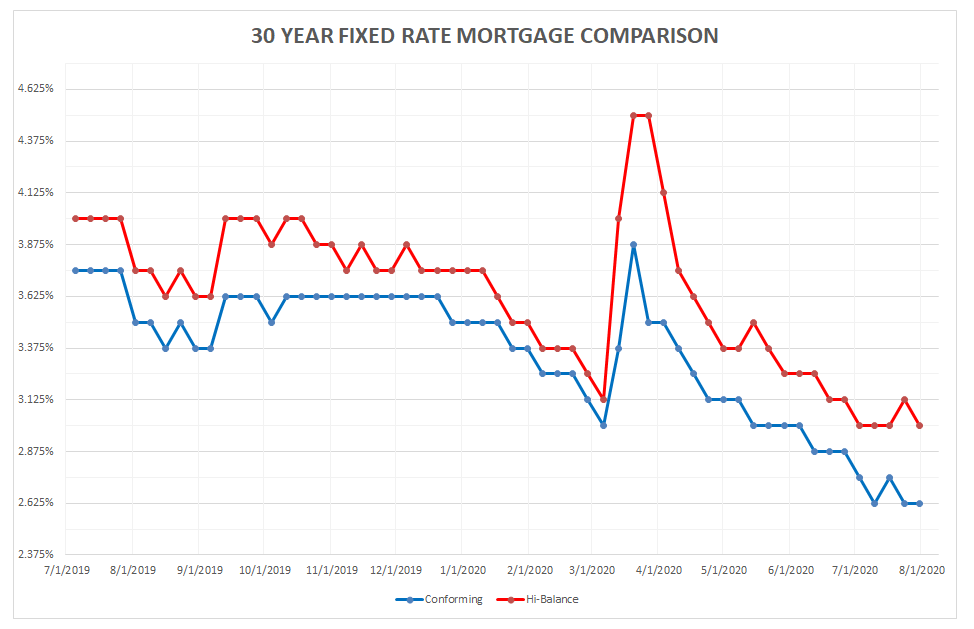
Rates for Friday July 24, 2020: Rates remain flat from last Friday, it appears we have reached our range for the current market as since the beginning of the month the conforming rate has drifted between 2.625-2.75%, while the high-balance has been between 3-3.125% for purchases with variables listed below.

The rate spread for cash-out, no point, higher loan-to-value and other factors for refinances still are historically higher than normal. Call for details and quotes as rates can vary significantly depending on the situation.

FIXED RATE MORTGAGES AT COST OF 1.25 POINTS LOCKED FOR 45 DAYS:

30 year conforming                                            2.625%   Flat

30 year high-balance conforming                   3.00%      Flat

Please note that these are base rates and adjustments may be added for condominiums, refinances, credit scores, loan to value, no impound account and period rate is locked. Rates are based on 20% down with 740 FICO score for purchase mortgages.
It appears Mollie’s suggestion to include the question of the week is very popular based on the feedback I received—such a good suggestion I wish she had made it several years ago!

The beginning of August is usually when families start getting ready to send their kids off to college—especially if their son or daughter is heading off to their freshman year. With many colleges and universities cancelling many, most or all in-class classes and moving to on-line, a lot of students who were part of the high class of 2020 are opting to take a “gap” year. With the high costs of attending college they are deciding that it is not worth the cost to sit in a dorm room watching classes on a screen, not being able to have social interactions to meet other students and benefit from the overall college experience. We have first hand knowledge of the colleges trying to sell that the education, even if on-line and not live in classrooms, is still worth the cost to attend, but it is apparent that the sell is hollow and almost desperate.

Next year will be interesting as there will be a good portion of the class of 2020 re-applying to schools while the class of 2021 will also be submitting applications—depending on the learning environment that will be available. This will make an already challenging process even more so. What will be the long-term impact on these young adults who have seen their high school and college years disrupted? How will it impact our labor markets, future leadership, and society and the economy as a whole? We will know in a decade or more as the sociologists and economists study this era and those involved.

Have a great week,

Dennis

Past Weekly Rate & Market Updates can be found on my blog page at my website www.DennisCSmith.com/my-blog

Can we remove our loan contingency?

Question of the week:  Can we release our loan contingency?

Answer: This is a question ever lender is asked on every purchase transaction mortgage package they are working on.

Section 3, Item J of the California Association of Realtors’ California Residential Purchase Agreement and Joint Escrow Instructions, aka “RPA” or “the offer,” has five clauses that deal with the loan terms of the offer to purchase a property.

  • Clause one deals with loan applications and requires that within three days, or other stipulated time frame, after acceptance of offer, the buyer needs to deliver to seller a letter from buyer’s lender stating that after receiving application and credit report buyer is prequalified.
  • Clause two is titled loan contingency and states that buyer shall act “diligently and in good faith” to obtain financing and that buyer’s qualification stipulated in clause 1 is a contingency.
  • Clause three are the terms regarding loan contingency removal and states that within twenty-one days, or other stipulated time frame, of acceptance of offer the buyer must remove the loan contingency or cancel the agreement.
  • Clause four gives the buyer the opportunity to declare that the offer is not contingent on the buyer’s ability to obtain financing.
  • Clause five deals with credits to the buyer and what happens if credits exceed limits imposed by buyers’ lender.

Our question of the week deals with clause number three, removal of loan contingency, and tangentially clause four, there is no loan contingency.

What is a contingency and why do is matter?

When you make an offer to purchase property you will almost always need to put up an initial deposit when you and the seller reach an agreement on price and terms. In the RPA where you indicate the price you are offering for the property, you also indicate how much of a deposit you will be sending to escrow should your offer be accepted. The amount of your deposit can vary, but generally the higher the deposit the stronger your offer is considered to be. Most offers are generally around 2% rounded to the nearest $5000 level. For instance, on a $300,000 offer you may have a $5000 deposit, on a $400,000 offer you may have a $10,000 deposit. If you have a $400,000 and your deposit is $25,000 then  you are telling the seller, “we feel really confident we will be able to close this transaction and are putting up $25,000 to show our confidence.”

The deposit really matters because if you cannot close your transaction after you have removed contingencies the seller has a claim on the deposit.

Notice “contingencies,” the loan contingency is mentioned above, other contingencies are for appraisal, physical inspection, documents pertaining to a homeowners’ association if applicable, sale of buyer’s current property, termite report and clearance are the most common and included in the purchase agreement’s boilerplate language.

The impact of removing contingencies is covered in Section 14, Item F, effect of buyer’s removal of contingencies, which basically says you are satisfied with all inspections and ability to obtain funds to close and are moving forward to close the transaction and accept liability if you cannot perform actions needed to close; i.e lose your initial deposit.

Item H of Section 14 contains the language regarding the effect of cancellation of the contract on deposits. Essentially, both parties must agree in writing to the cancellation and the disposition of the deposit. If one party refuses to agree to the cancelation and disposition of funds, then the clause addresses the steps to be taken due to the adversarial nature of the issue.

The bottom line is that removal of contingencies are a big deal if later in the transaction something happens that inhibits either party’s ability to close, but especially the buyer’s inability to close.

Circling back to our question regarding the loan contingency clauses stipulated in section J, within twenty-one days you have to inform the seller you are removing the loan contingency or are canceling the agreement.

If you choose to cancel the contract rather than removing the loan contingency then you are entitle to your deposit being returned, less any costs incurred on your behalf.

If you do not remove the contingency then the seller has the right to terminate the contract which generates a return of your deposit.

If you do remove the contingency and cannot obtain financing to close the transaction by the agreed upon close of escrow date, the seller can cancel the transaction and demand your deposit be transfer to them from escrow.

Can we release our loan contingency?

For many years our company has replied to this question based on advice from our legal counsel. Because California is a litigious state, we have been advised and follow the advice, that we will not tell clients, “Yes, remove your financing contingency.” If we say that we are telling our client that their loan will be funded and their deposit is secure based on the ability to fund that loan.

There have been many instances over the years where after a loan contingency has been removed a buyer has lost their job, has suffered some calamity that exhausted funds needed for closing, had an IRS or other tax lien appear that was not on a credit report, that precluded the ability for the buyer to obtain final loan approval and funding of their mortgage. In these instances, should we have told a client they were okay to remove their loan contingency and they lose their deposit we are open to action by the buyer to reimburse them for their lost deposit and possibly other expenses.

In our current environment, where many people are being laid off, furloughed, having salaries and wages reduced, due to the Covid-19 pandemic, increases the chances of something occurring that may prevent final loan approval and/or funding. This is one reason why the mortgage industry has dramatically increased employment and income verification after loan approval and before drawing loan documents and the day of funding.

What we can tell a client when asked if they can lift their loan contingency is that they were qualified when we took the application and are still qualified. However, funding of the loan will be contingent on no changes to their income, employment or other qualifying factors until the funding of the loan.

When the time comes for you to remove your loan contingency, consider all the factors in your employment, income, funds for closing, and objectively consider if there is a chance any of those may change enough to change your ability to qualify. If you feel there may be some change to your income then run it by your lender to see how that changes your qualifications and chances to close.

More importantly, before writing an offer, consider your employment, income and funds for closing and determine if there could be an impact on any of them before you close escrow that may change your ability to qualify. If so then you may wish to delay your home purchase until you are certain your ability to close has stabilized so as not to be put in a position to potentially risk several thousand dollars put on deposit.

In the end, your decision to remove your loan contingency or cancel the purchase contract is a risk assessment you need to make based on what you feel may happen after you make that decision.

Have a question? Ask me!

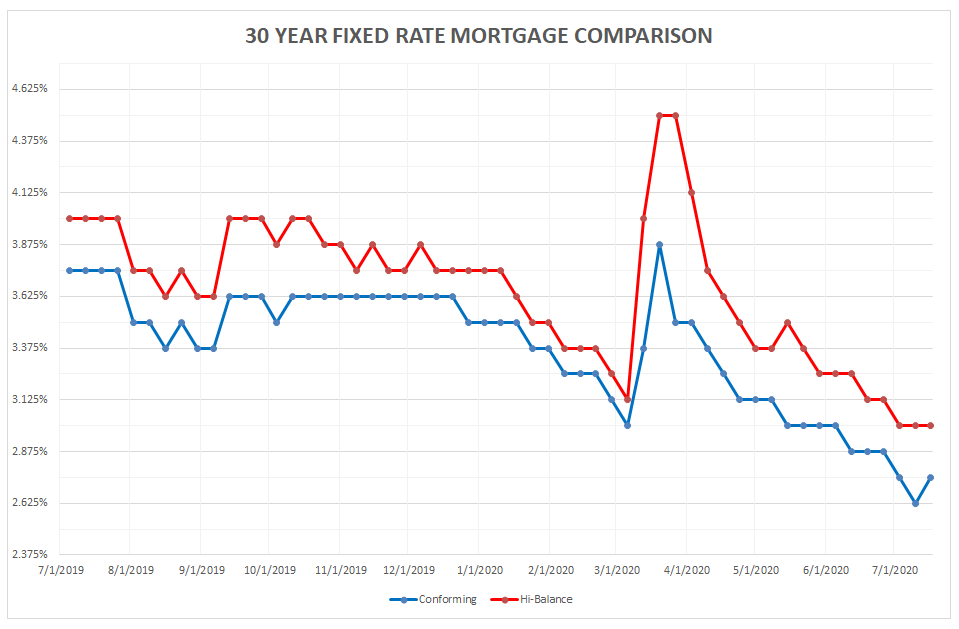
Rates for Friday July 17, 2020: Economic data a bit mixed this week as reports for June retail sales continued the gains seen in May, consumer prices increased on higher demand, both of which are good news for the general economy….but….initial jobless claims for the week ending July 11th were still over the 1 million mark and continuing jobless claims are over 17 million, which reflects a reset in many states as they close some parts of their economies that had opened in May and June.

For the week the high-balance rate remains flat from last Friday and we see a bit of a bump on the conforming rate from last Friday.

We are still seeing large disconnect in the high-balance market from purchases and refinances, as well the spread remains larger than it has historically between “no-point” transactions and those with one or fewer points. Call for details and quotes.

FIXED RATE MORTGAGES AT COST OF 1.25 POINTS LOCKED FOR 45 DAYS:

30 year conforming                                            2.75%   Up 0.125%

30 year high-balance conforming                   3.00%    Flat

Please note that these are base rates and adjustments may be added for condominiums, refinances, credit scores, loan to value, no impound account and period rate is locked. Rates are based on 20% down with 740 FICO score for purchase mortgages.

This is usually the time of the summer that Leslie and I are off on our annual summer road trip. We usually start talking about our possible trips in January or February. Even before Covid-19 was on the radar we still had not had any discussions about where we wanted to go. Probably because we still did not know the girls’ plans for the summer.

Our drive trips have been up to Northridge a few weeks ago to visit my brother’s family, and again tomorrow to see them and also my sister who is on her own drive trip from her home in Boise.

I miss the small roads and towns we won’t be seeing this summer.

Have a great week,

Dennis

Past Weekly Rate & Market Updates can be found on my blog page at my website www.DennisCSmith.com/my-blog

Will rates go lower?

Question of the week:  Will rates go lower?

Answer: {shakes Magic 8 Ball} I do not see rates being able to go much lower. There are several factors, but the primary one in my opinion is the cost of originating mortgages and the rate of return from the rates paid on the mortgages.

When looking at the flow of money through the mortgage process there are several slices taken out of a mortgage payment before it reaches the ultimate investor. For conventional loans, the loan servicer takes a small bite, then Fannie or Freddie take a bite and then the remaining amount of the interest is provided to the investor.

Who is the loan servicer? Commonly referred to as “the lender,” loan servicers are the entities that collect mortgage payments. Sometime the servicer is also the original lender, but very often it is a different company—and not always a bank. Mortgage servicing is a segment of the mortgage industry that is regulated and enables mortgage lenders to relieve themselves of the costs of a collections, or servicing, department by selling the servicing rights to the mortgages they fund.

Just as conventional mortgages are sold to Fannie Mae or Freddie Mac to provide liquidity, many mortgage lenders also sell the servicing of their mortgages to other companies. The servicing company then sets up the borrowers’ accounts and collects the monthly payment for principal and interest, and if the loan is so set up property taxes and insurance payments are collected as well.

The servicer then forwards the payments to Fannie or Freddie, and if collect the property taxes to county tax assessors and insurance premiums to insurance companies. If payments are not made the servicer has a collections department which will then proceed through the steps of attempting collection, working out a payment schedule with borrowers. If necessary, this department start the foreclosure process and see it through to conclusion—either foreclosure or all past due payments and charges paid in full by the borrower or from their sale of the property.

Servicing charges generally range from 0.25% to 0.50% of the loan remaining loan balance, so the longer the loan is serviced the less the servicer gets paid for the servicing as the principal drops.

Following the flow of the funds, as discussed through the years of the WR&MU, after lenders sell their loans to Fannie or Freddie, those entities package mortgages into big bundles called Mortgage Backed Securities (MBS) which are then sold to investors. You can purchase MBS through broker-dealers, depending on how much you can invest either into large pools, or purchase shares in mutual funds or ETFs that hold MBS in their portfolios.

Once the MBS are sold to investors the investors want to get paid, which they are as monthly principal and interest payments are made by borrowers to servicers who then pass funds along to Fannie or Freddie who then pass payments onto MBS investors. For this Fannie and Freddie take a slice of the payment as well, retaining a portion of the interest payment. I have been unable to find out how much this portion is, my assumption is that it is near 0.25% of the payment as well.

Let’s look at a $500,000 mortgage with a rate of 4% and a payment of $2387 per month. The payment is made and the servicer retains $104 of the payment and sends $2283 to Fannie Mae. Fannie retains $104 and sends $2179 to the investor. The principal part of the payment is $720, so the investor is collecting $1459 in interest. This reflects a return of 3.5%.

Now let’s look at the same mortgage with a rate of 3% and a payment of $2108 per month. The seller retains the same $104 and Fannie Mae its $104. Of the $2108 payment Fannie passes $1900 to the investor, of which $858 is principal, therefore the investor collects $1042 in interest. This is a return of 2.5%. 

How much demand will there be for 30-year investments with returns of 2.5% or lower?

As discussed in our May 1st WR&MU, mortgage servicers were on the brink of collapse in April after the CARES Act passed requiring servicers to grant forbearances to homeowners who requested them while still having to advance payments to Fannie and Freddie. This cash flow risk increases the return desired by everyone through the industry, which puts upward pressure on rates.

It is estimated that around 5 million homeowners across the nation are currently in forbearance, about 9% of outstanding mortgages. This has pulled billions of dollars per month out of cash-flow through the servicing industry, and to investors. What is next? These 5 million homeowners will be faced with a settlement statement from their servicers for a lump-sum amount that will be due when the forbearance period is over.

Most servicers will then proceed to contact borrowers to work out payment modifications that will pay down/off the outstanding balance that will be in addition to their contracted payment. Other servicers may, can, will, file notices of default and begin the process of foreclosing.

What will homeowners do? Will their income be sufficient to afford a higher mortgage payment for the next year or two? Will they have enough equity to sell their home to payoff the mortgage and back amounts due?

Whatever decisions are made, there are costs to servicers that are more expensive than normal mortgage payment collections. At a time when their receipts are down.

One more factor. Many of the mortgages being paid off in the current refinance cycle were made less than a year ago. It generally takes about one year for a loan servicer to recoup the acquisition costs. For all their mortgage clients that pay off in less than a year the company loses money.

As shown above, the very rough calculations on payments and the flow of funds from borrower to investor do not take into account many other variables such as purchasing the MBS at premium or discount. However, they show how investor return on investment is greatly impacted by payment collections.

As can also be seen, there is a tremendous amount of costs and decline in cash-flow for servicers that has them operating on razor thin margins with little room for more disruption.

As a result of these pressures, from investors to servicers, the mortgage markets should be at, or very near, the lowest rates can go and still have a functioning industry with smooth flow between investors, agencies, lenders, and borrowers of funds borrowed, funds loaned, payments made and payments collected.

Finally, there is very little left that the Federal Reserve, or the Federal government, can do to further reduce rates in the retail sector. Actions already taken by both the government and the Fed through the mortgage industry into disarray in March, when we saw mortgage rates spike around 1% in less than two weeks. There are no actions left they can take that would lead to lower rates.

As stated many times over the years, mortgage rates are not dependent on the Federal Reserve’s rates, but rather on investors and what they are willing to pay for Mortgage Backed Securities. As also mentioned through the years, in certain markets lenders keep rates higher than the MBS markets are willing to take to control their volume flow and also to mitigate their risk. With rates at their current levels both factors are in play as MBS investors are looking at extremely low returns and the mortgage industry is looking at reductions in payments, government policy enabling further reductions in payments. Not mentioned in the above is the very complex system of lenders hedging rate locks and pipelines being disrupted due to the Fed’s actions.

Finally, (thank goodness thinks the reader…) long time readers know that rates are dependent on the economy and overall economic activity. As well, they know that 65-70% of our nation’s economy is consumer spending. With the country opening up at different speeds across the company, consumers are beginning to spend, people are going back to work, economic activity is slowly increasing.

As this continues there will be upward pressure on rates. Maybe not enough to cause rates to increase to pre-Covid levels, but enough to provide a floor below which rates will not drop.

Can rates go lower? Yes, but if they do it is my opinion that any drop will be incremental from where we are today.

I hope I am right as if they do drop significantly more (one-half percent or more) that will mean our economy is in really bad shape.

Have a question? Ask me!

The big number this week was 17.7%. That was the growth in retail sales in May from April. Sales in April dropped 14.7% from March, and the consensus was for sales growth of 8.5% as commercial establishments across the country opened up. Auto sales were a big part of the jump in sales, up 44%. That increase is only about a quarter of the increase in clothing stores sales, which were up a staggering 188%. As a benchmark, May 2020 retail sales were 6% below sales in May 2019 so there is a way to go for the retail industries to get back to pre-Covid activity. In normal times this news would spike interest rates, but these are not normal times as you know.

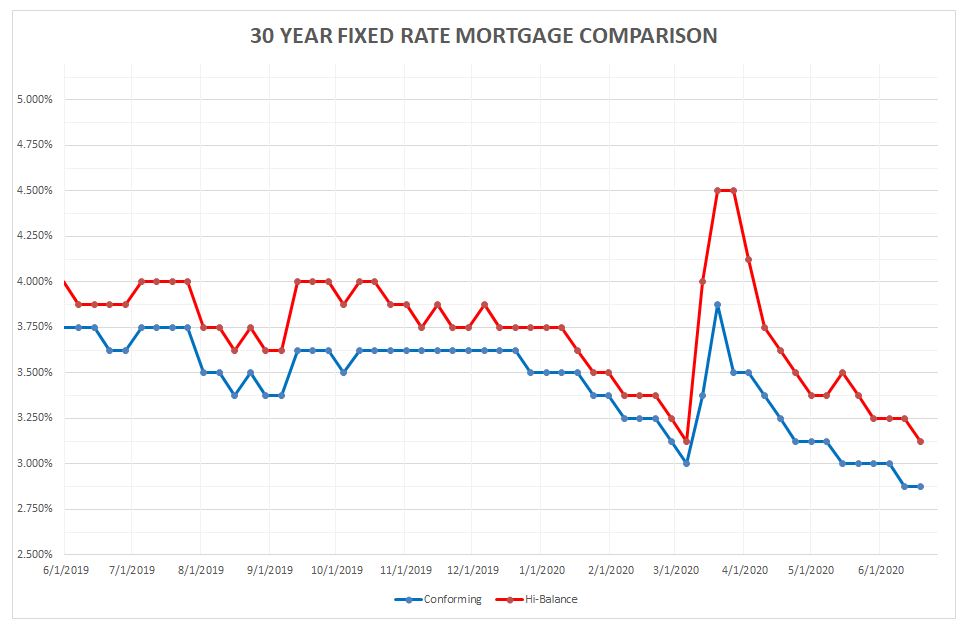
Rates for Friday June 19, 2020:  Thirty-year fixed rate mortgage rates are at their lowest since 1971, as discussed above will they go lower? Market indicators and projections are rates remain very close to today’s rates for the near future. We are still seeing large disconnect in the high-balance market from purchases and refinances. Call for details and quotes.

FIXED RATE MORTGAGES AT COST OF 1.25 POINTS LOCKED FOR 45 DAYS:

30 year conforming                                            2.875%   Flat

30 year high-balance conforming                  3.125%   Down 0.125%

Please note that these are base rates and adjustments may be added for condominiums, refinances, credit scores, loan to value, no impound account and period rate is locked. Rates are based on 20% down with 740 FICO score for purchase mortgages.

Monday, I went to my office for the second time in over 90 days, my last visit was very briefly, less than two hours around day 60 of being working from the home office. As I left for the office Monday morning I said to Leslie, “I think this is the first time in four weeks or more that I have long pants on.” I have no records or concrete proof, but it is likely the longest I went wearing only shorts since the last semester of my senior year in college (1984).

The work-at-home policies have killed the dry cleaning industry since no one dry cleans shorts, pajamas or sweats.

Have a great week,

Dennis

Past Weekly Rate & Market Updates can be found on my blog page at my website www.DennisCSmith.com/my-blog
Should we buy a property with a friend or family member?

Question of the week:  Should we buy a property with a friend or family member?

Answer:  Most questions of the week are the result of a topic coming up in conversations over the course of several weeks. This week’s question came up several times this week; which is not that unusual, especially if there is a big mortgage, real estate or interest event or news that week. This topic, owning property with someone other than your spouse, is a bit off-beat so it was surprising to me that I received several calls this week on the topic.

Back to our question, should you buy, or own, property with someone other than your spouse?

My short answer is “No.”

When consider most issues concerning real estate and mortgages, I look long-term as owning real estate is very rarely a short-term proposition. When looking at anything long-term a factor to consider is that no one lives forever, not you nor the individual(s) with whom you may own property.

Another long-term factor is that people’s lives undergo changes, some good and some bad. This is true for you and for your potential real estate partners.

Let’s dig into why I am not in favor of co-owning real estate.

The three most prevalent scenarios for co-ownership are purchasing a vacation home to share with a sibling’s family or close friends, purchasing investment property to share the acquisition and carrying costs, and inheriting property as a co-owner with your siblings or other relatives.

Each of these has some positive characteristics. Enjoying a mountain, beach or desert retreat with your family can create wonderful memories for siblings and cousins. The ability to purchase an investment in real estate with less cash out of your savings and less downside on months where expenses exceed revenue. Sharing legacy real estate owned by your parents, grandparents or other deceased relative can benefit you and other descendants.

One purpose of how title to real estate is held is what happens to ownership of the property when one of the title holders dies. Because of this there are several ways title to property can be held.

Self-explanatory is taking title as an individual. When the individual title holder passes away disposition of the property will depend on if s/he has a will, if not the property will go through probate and a judge will decide who receives the property.

If the property is held in trust and the trustee(s) pass away the disposition of the property is completed according to the instructions in the trust.

If the property is held by one or more individuals it gets a bit trickier. If title is held as joint with right of survivorship, when on owner dies the other owner gets full title to the property and will own as an individual. This is most common with married couples. With joint title ownership neither party can sell or encumber without the other party’s consent.

Title can also be held as tenants in common. Under this form of ownership does not have to be equal. For instance, Bill and George can own a condo in Mammoth as tenants in common each with a fifty percent interest, or as tenants in common with Bill having a seventy percent interest and George having a thirty percent interest. (Sidebar, I had a married couple purchasing their first home several years ago and the wife wanted title to be tenants in common with her having a 95% interest and her husband a 5% interest since her parents were gifting some of the down payment. As I recall they ended up owning as joint tenants…I am not sure if they are still married.)

Another aspect of tenants in common is that each owner can sell their interest without the consent of other owners, as well each owner can encumber their portion of the property.

Most partnerships to purchase property take title as either tenants in common with percentages of ownership, or form an LLC or S Corporation to own the property and the partners each have a certain number of shares in the corporation.

Back to our condo in Mammoth. Because they are pooling money Bill and George do the math and see they can buy a $450,000 three bedroom condo together, a bigger and better condo than either could buy individually. Bill and George buy the property as tenants in common each with a fifty percent share. They agree to a schedule to use the property themselves. Because of the desirability of condos in the area for short-term rentals (i.e. AirBnB), and the higher rental rate for a three-bedroom unit, they agree to have a schedule segmented into three weeks divided between Bill, George and renting the property. If either Bill or George decide to not use the condo on their week and rent the unit, they get credit for the rental revenue. They set up a checking account to handle the income and expenses and each agree to put in $10,000, if account runs below $5000 if rental revenue does not cover expenses they agree to each put in another $2500.

Bill is married with two children, one almost out of college and the other out of school and working. George, his best friend since grade school, has been divorced twice and has two kids from each marriage.

Being responsible, Bill puts his portion of the property in the living trust he has with his wife.

Possible scenarios, actually realistic as I have seen many of these occur:

  • George is killed in an accident driving home from Mammoth. He had no will or trust so his estate, which includes a fifty percent ownership of a condo in Mammoth, goes to probate. During the time it is in probate Bill has to maintain the property and has to stay in constant communication with the probate attorney for accounting for expenses and income. Eventually the probate is completed and George’s four children, who do not get along, are all given a share of the property, 12.5% each. Bill is now partners with four adults he barely knows, who do not all get along. Does/can Bill buy them out? What about being able to use unit, who gets to use it when? When will it be rented? Will all four new partners agree to share in expenses? What if Bill sees the light and wants to sell, but two of the children do not?
  • Bill passes away from a heart attack. His wife, Sally, is surviving trustee and is now partners with George. They have been cordial through the years but not real close. She does not want to be partners with George, but he does not want to sell the unit because he likes being able to spend time up there with his kids or his latest girlfriend. Because of some financial issues after his and Bill’s purchase of the property he cannot qualify for a refinance to buy Sally’s share. Sally makes inquiries to see if she can sell her portion of the property but any potential buyers want to pay a lot less than half market value. Sally is partners with George and then the above scenario occurs, George dies and Sally is partners with four others.
  • George has some financial challenges with his company. He has committed underhanded accounting and ends up in court on criminal charges, including unpaid taxes to the county, state and federal governments. George’s assets are seized by the IRS. The IRS investigates to see if Bill is somehow involved, if the 50-50 ownership was part of George’s financial scheming and Bill spends a lot of money, tens of thousands to pay for accountants and attorneys to prove his innocence.  Bill is now partners with the IRS on a condominium in Mammoth.
  • Bill and Sally get divorced. It is ugly and the division of assets results in Sally getting half of Bill’s share of the condo. George now has two ex-spouses who cannot speak to each other as partners. He proposes the sell the condo. Sally, to be spiteful, says she does not want to sell. Bill goes back to his attorney to open up the divorce to see if judge will force Sally to sell. Result is Sally gets a larger portion of Bill’s retirement accounts in exchange for her portion of the condo.

What about inherited property where siblings inherit one or more properties from their parents? The same issue above can occur, and do. Exacerbating the potential issues are the spouses of the brothers and sisters. While the inherited property is exempt from community property, that does not prevent any person from deeding their share into community property or a living trust—the result of which is that the other siblings can/will become partners with their brother/sister in-law or nieces and nephews.

Inherited property typically comes with some emotion. Attachment to the family home, a vacation home with happy memories from summers and holidays. In many instances even investment properties can carry positive emotions wanting some family members to retain them.

Other factors that cause some family members wanting to retain inherited property are financial. The step up in basis for tax purposes that can minimize future capital gains taxes. In California the retention of very low property taxes. And of course, the possibility of monthly income from rental properties.

Before deciding to enter into a co-ownership relationship you need to consider the what-ifs regarding title should one of the co-owners passes away, or gets divorced, or other major life event, but also some financial considerations.

One such consideration is that real estate has very expensive exit costs. Depending on real estate commissions, transfer taxes and other potential costs in your area, the cost can be as high as 8-10%. Add in acquisition costs, which depending on the price and loan amount can add another two, three or four percent, and you will need your property to increase in value ten to fifteen percent just to break even if the partnership is not working out and all parties agree to sell.

As for buying another party out, you will need to agree to the amount of the buyout. Is it based on market value for closed properties, which include commissions? Once an amount is agreed upon you need to qualify for a cash-out refinance transaction, which has higher rates and costs than a rate and term refinance.

One suggestion I have for those who do enter into a co-ownership relationship is both parties pay for an attorney to draw up a partnership agreement that spells out what happens if one party wants to sell, a time frame which the agreement is revisited and if one party does not agree to continue the relationship the property is put up for sale or one party can buy out another with the formula for calculating the price entered in the agreement.

I have not painted a real rosy picture for those interest in co-owning property, which was my intention. Before entering any co-ownership relationship, or continuing one if property was bequeathed to you and others, consider the possible negative consequences. There are many variables that can go wrong that can be very costly in time, money, energy and relationships.

All that said, if you are interested in entering a co-ownership transaction please give me a call to run through numbers and what-ifs for the costs, payments and prices.

Have a question? Ask me!

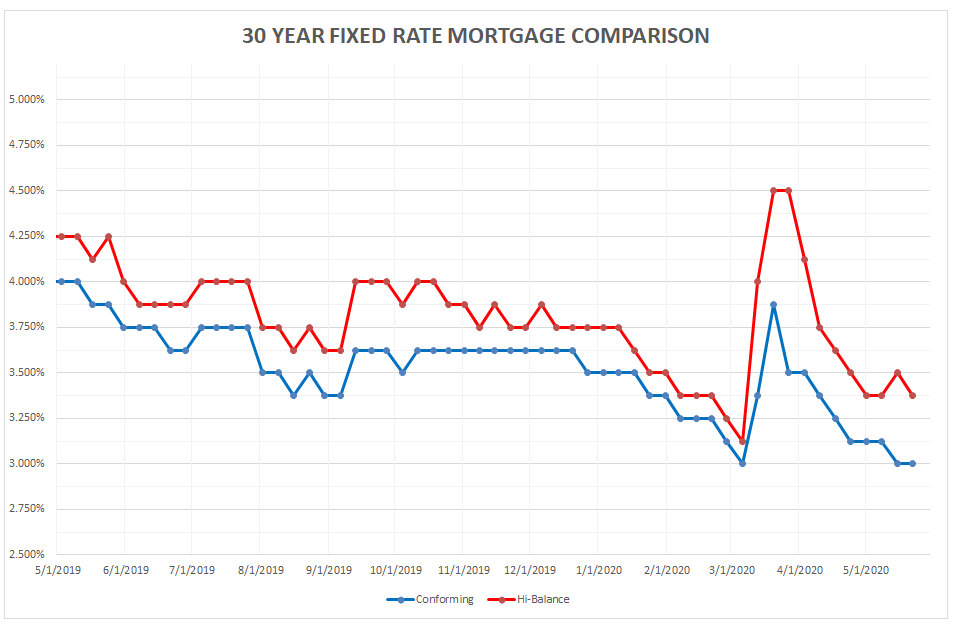
Rates for Friday May 22, 2020:  Rates are barely impacted by any economic news, everyone anticipates bad news so bad news is already priced into the markets. With tensions heating up between China and the United States we have seen some instability in equity markets, enough that I anticipated rates to drop today ahead of the three-day weekend. This did not happen and rates were flat for the day. For the week the conforming rate for purchases is flat from last Friday and the high-balance rate is down a tick. Note, these rates are for purchase transactions and refinance rates vary greatly depending on many variables for loan amount, loan to value, FICO scores, purpose of loan, etc., call for quotes.

FIXED RATE MORTGAGES AT COST OF 1.25 POINTS LOCKED FOR 45 DAYS:

30 year conforming                                            3.00%   Flat

30 year high-balance conforming                    3.375%  Down 0.125%

Please note that these are base rates and adjustments may be added for condominiums, refinances, credit scores, loan to value, no impound account and period rate is locked. Rates are based on 20% down with 740 FICO score for purchase mortgages.

Just because we cannot have parades or ceremonies does not mean we honor and respect those who have lost their lives wearing the uniforms of our nation’s military. For those who have lost a parent, child, sibling or close friends, I have greater sympathy for you this year as you may be impeded from visiting a grave site or attend a special memorial.

Having many of our freedoms restricted these past several months has given a greater appreciation for the freedoms we are so used to enjoying. Monday let’s all take a moment to honor those whose lives have been lost to protect those freedoms and the rights we enjoy that have always been, and will continue to be, a beacon for others who desire the same freedoms and rights.

Have a great week,

Dennis

Past Weekly Rate & Market Updates can be found on my blog page at my website www.DennisCSmith.com/my-blog

Will I be affected by the change in the credit scoring model?

Question of the week:  Will I be affected by the change in the credit scoring model?

Answer:  Most likely, yes, you will be affected. Will it affect you if you are applying for a mortgage? Most likely, no.

In January, Fair Isaac Corporation announced that it would roll-out a new credit scoring model this summer. Fair Isaac Corporation is the data company whose algorithms produce the FICO credit scores used by lenders for credit cards, auto and personal loans, and mortgages.

Before we get into the new credit scoring model and its impact, or no impact, on you, let’s look at what the credit score is and does. In credit parlance your credit score is known as your “FICO,” so named from the original score established by Fair, Isaac and Company. The FICO score started in 1989 and since then has had several versions as the company looks to better predict credit risk for lenders based on individuals credit history.

The model for scoring uses several different aspects of your credit data obtained from subscribing creditors. Some, but not nearly all, the information includes number of open accounts, accounts with balances, how long you have had credit, what percentage of your available credit is being used, what type of credit you have used and are using, and very importantly how have you paid your credit obligations. The data is broken down into five categories and each category is given a weight for calculating your credit score. The categories and weights are payment history (35%), amounts owed (30%), length of credit history (15%), new credit (10%) and credit mix (10%).

Credit scores are like bowling not golf, the higher your score the better. As you can see your payment history carries the most weight, so the better your payment history, i.e. payments made on time, the higher your score. Conversely, the more payments you have that were not on time the lower your score.

Please keep in mind that with all models so far, FICO scores have been generally positively impacted by having a good mortgage record. If mortgage payments are made in a timely fashion over a period of time there is a strong positive impact on your credit score. The same is generally true for auto loans. These credit obligations show that you have the ability, and history, to manage your finances such that you are a good credit risk for long term high balance credit obligations. A high balance mortgage does not impact your score as much as high balances on revolving credit, i.e. credit cards. For instance, a $400,000 mortgage is a lot to owe but will not negatively impact a credit score, whereas $50,000 owed on credit cards can, and in many instances will, negatively impact a credit score.

The new FICO Score 10 model is intended to give a more accurate numerical judgment of current credit risk to lenders than the current model.

Since the beginning, FICO scores have put the most weight in the model on payment history, the new model will increase the weight on delinquent payments, especially delinquencies in the past two years.

As noted above, the second highest weight in scoring is the amount owed on credit. To clarify, this amount owed weight is not necessarily the total dollar amount owed. Of great importance on the credit balances score is the percentage of credit outstanding to credit available, or credit utilization. In other words, how close to being maxed out are you on your credit cards? Someone owing $20,000 on credit cards with total available credit on those cards of $25,000 will likely have a lower score than someone with $20,000 on credit cards with total available balances of $50,000.

The third area that will see more weight on credit scores is personal loans. These are loans that are made by finance companies, have very high rates of interest and are considered high risk as many of the applicants for such loans are unable to get credit elsewhere. FICO Score 10 will weight these loans more heavily than previously.

FICO Score 10 will put more weight on not only missed payments over the past two years but also account balances. While Fair Isaac does not release the exact recipe for their algorithms, their release on the changes makes it easy to infer if your credit balances have been increasing the past two years your credit score will likely be lower than if your credit balances have been consistent or lower. Again, when addressing credit balances the impact is on revolving credit and personal unsecured obligations.

To sum up, the biggest changes made to the credit scoring model with FICO Score 10 are the weight given to recent history of delinquent payments, history of high credit utilization, and borrowers who apply for personal loans.

Estimates are that 110 million American consumers will be impacted by the new scoring system, seeing their scores either increase or decrease just by the change in the model. Many will see their scores increase, however an estimated 40 million will see their scores drop 20 points or more according the Fair Isaac.

Because the new model looks back twenty-four months of credit utilization (outstanding balances compared to available balances) it will be harder to increase your credit score. One of the actions we use to help mortgage applicants raise their credit scores is to pay down balances on credit cards to get below certain utilization percentages on individual cards. Recently I had a client who paid a total of $7500 down over two credit cards and we were able to raise his scores by 20 points, which enabled us to lower his interest rate. With FICO Score 10 it appears this will not be an action that can be taken as the change in current utilization percentages does not have the same impact due to the twenty-four month look back.

What about mortgage applicants, how will you be affected? In the short term not at all.

As mentioned above the FICO score was introduced in 1989. In 1995 Fannie Mae introduced its “Desktop Underwiter,” an Automated Underwriting System (AUS) that uses artificial intelligence to underwrite and approve mortgage applicants. A key factor in the success of Fannie’s Desktop Underwriter, and subsequently Freddie Mac’s Loan Prospector, was the ability to assess credit history and risk. FICO scoring enabled risk assessment of the part of an borrower’s application.

Over the next several years the AUS and FICO programs were refined to more accurately predict credit risk with the objective of approving mortgage applications within acceptable risk for the GSE, i.e. to enable wide spread lending with an acceptable amount of delinquencies and foreclosures.

The Federal Housing Finance Authority is the government overseer of Fannie Mae and Freddie Mac. As discussed in many WR&MU over the years, Fannie and Freddie (GSE) underwriting guidelines are the basis for most other lenders, whether government insured (FHA and VA) or jumbo mortgages. There are some differences but many guidelines and policies are the same.

One policy that is the same is the credit score criteria used by the GSE, which is the FICO model used by the GSE, and therefore most other mortgage lenders and products. The FICO model used today for mortgage applications was introduced around 2004 or 2005. Before the mortgage and real estate market melt downs and the Great Recession.

Because the FICO model we are currently using is not changing, yet, the impact on mortgage applicants of FICO Score 10 is currently no impact.

“Yet.” For several years VantageScore Solutions, LLC has been pressuring the FHFA to adopt, or at least enable, its VantageScore credit model to be used by Fannie and Freddie; which would likely open it to be used by other mortgage lenders and programs. The company is a joint venture of the three primary credit-reporting companies, Equifax, Experian and TransUnion. A lot of the resistance to allowing VantageScore to be an acceptable scoring model was due to the major credit bureaus ownership of the product’s company and concerns about conflicts of interest.

Last August FHFA issued a rule that Fannie and Freddie will have to consider credit-score alternatives to Fair Isaac Corporations’ FICO scoring model. The rule was huge for VantageScore as it provides an opportunity to compete for business in the mortgage industry.

Since the ruling last August Fannie and Freddie have been negotiating on joint guidelines for credit score acceptability and starting this month will allow credit scoring companies to begin submitting applications using their scoring models for assessment and comparison to determine if their models are acceptable alternatives to the current FICO models being used for mortgage approvals.

The results could have tremendous impact on the mortgage industry, and therefore mortgage applicants, as it may open up lenders to use more than one credit scoring model, enable borrowers to shop credit scoring models to provide the best score for underwriting (similar to high school students taking multiple SAT’s and using the best score for college admissions) or result in a scoring model that results in lower scores for many applicants and little opportunity to improve their scores in a short period of time. In other words, adoption of FICO Score 10 or something similar.

Any changes in the scoring models for mortgages will take quite a while to get through the testing and bureaucracy, but there is a strong chance that there will be some changes in the future.

Have a question? Ask me!

Employment data for April released today showed a 20 million jobs were lost for the month. The unemployment rate, which was at a 50 year low of 3.5% just two months ago, has surged to 14.7%, and is likely higher as furloughed employees are not counted in the figure. In an indication of who is losing employment, the average hourly income jumped $1.34, or 4.7%, in April. The income spike indicates workers in the lower wage end of the workforce are losing their jobs while higher-earners are retaining theirs. Which is not surprising since the vast majority of lost jobs are in the hospitality industries which shed 7.6 million jobs in April. Also showing large losses were retail (2.1 million) and health-care (1.5 million).

Job losses, savings gains. The Bureau of Economic Analysis released the personal income and savings rates for March. As stated many times in the WR&MU, consumer spending is 65-70% of our GDP. Covid-19’s shutdown of businesses, especially hospitality, has seen a dramatic drop in personal spending. In March personal incomes decreased 2.0%, when the stay-at-home orders first were issued across the country. At the same time personal spending decreased 7.5%. As a result of spending dropping a lot more than income dropped, the personal savings rate was 13.1%, the highest since 1981.

Looking down the road…with many cities, counties and states slowly opening up businesses this week, and a more open economy in sight in the distance, the question is how will consumers react? How much of their savings will they retain and now much will they spend to release their pent up desire for new shows, weekend trips, dinners out. Has Covid-19 changed our habits enough so that when the economy is open again consumers will return to old spending habits, or will spending change such that some industries will not see a return to prior sales and revenues?

Rates for Friday May 1, 2020:  We have found stability in the mortgage markets, for purchases at least. Purchase rates are the same for conforming rates for the third week in a row and for the second week for high-balance transactions. Refinances are case-by-case depending on your situation so call to go through your options.

FIXED RATE MORTGAGES AT COST OF 1.25 POINTS LOCKED FOR 45 DAYS:

30 year conforming                                            3.125%     Flat

30 year high-balance conforming                    3.375%     Flat

Please note that these are base rates and adjustments may be added for condominiums, refinances, credit scores, loan to value, no impound account and period rate is locked. Rates are based on 20% down with 740 FICO score for purchase mortgages.

How do you celebrate Mother’s Day without the requisite wait to get into the brunch buffet with your siblings’ families all toasting mom? Or the outing to the park with the kids so your wife can be pampered at the local spa? Or the nice dinner out after both of the above?

The Smith home is being transitioned to the Smith Resort on Sunday so Leslie can lounge and read by the pool while be served fancy drinks (pina coladas, mimosas, or anything else she desires), snacks, grilled shrimp tacos for lunch and poolside grilled steak dinner.

It appears that many families will be adding to their savings rates this Mother’s Day with stay at home creations to celebrate the moms.

Happy Mother’s Day,

Dennis

Past Weekly Rate & Market Updates can be found on my blog page at my website www.DennisCSmith.com/my-blog
What is happening with rates and economy?

Question of the week:  What is happening with rates and economy?

Answer: There is a proverb that is attributed to being a Chinese curse, “may you live in interesting times.” I have always taken the saying to be a positive, I hope my and our lives are interesting.

But as we know, and are currently experiencing, interesting can define many feelings, events and actions. We are certainly in interesting times.

In times of concern and worry some unrelated event to what people are concerned about can become the impetus for actions and events. Last week there were some large daily gyrations in financial markets. From Monday March 3rd to Friday March 6th the Down Jones saw choppy trading daily as investors were concerned about the global impact of the COVID-19 virus. For the week the index was down just over 3%.

Then came the unrelated event last weekend when Saudi Arabia’s state-owned oil company pushed up production. The reason for the large production increase was the breakdown in talks with Russia that were intended to reach an agreement on oil prices. Saudi Arabia’s actions were met by the Russians also increasing production, and a price war began. The immediate result was a drop of over 20% in crude oil prices in the United States. Investors, already concerned over the global economic impact of the COVID-19 virus hit the big red SELL buttons on the morning of Monday March 9th.

Why did a price war between the Saudis and Russians cause U.S. investors to sell? The price of oil per barrel in the United States fell 40% what shale producers need to break even. Such a large drop in oil prices ripples through the economy, and while good for consumers at the pump and heating their homes, investors concerns were more related to economic production and output.

As well, oil and gas sectors make up over 10% of high-yield bond markets, which would be impacted by the price war. Nervous about the COVID-19 impact, investors dumped stocks and bonds, causing prices in both to drop and interest rates to increase.

On Monday the Dow opened about 7% lower than Friday’s close and while gyrating through the day closed with a very small decrease. Tuesday it appeared stability had come to the front as after a mid-day drop the Dow climbed almost 7% in the final hours of trading, and only fractionally lower than Friday’s close. Wednesday saw a slow sell-off. Yesterday, following President Trump’s Wednesday night address to the nation indicating actions that would be taken to try to stabilize markets and stimulate the economy, investors again began selling as soon as the markets opened, dropping the Dow 7%. As I write this the Down is up almost 6% for the day, and down 5.5% from Monday’s open. Like every day this week the trading is choppy with swings up and down, but so far the trend is up for the day with an hour left in trading.

Usually interest rates follow stock prices, when stock prices drop so do rates and vice-versa. Because the impetus for the initial shock trades in the markets on Monday was the oil sector, which is a major influence on fixed rate markets, this week rates have been acting counter to their historical relationship with stocks and as stock prices have dropped rates have increased.

In uncertain times investors put their money in bonds, and mortgages, and the result is lower rates. The uncertainty in direction of the markets each day, the historical disconnect in the stock-bond relationship and the unsatisfaction with the Trump Administration’s announcement on economic action, investors have shown a willingness to sell investments and hold cash.

What’s next? My crystal ball has proven to be cracked, chipped, cloudy and at time myopic over the years. That said here are some things I have been looking at and considering.

When the Fed meets next week, perhaps before but I believe they want to all be in the same room when the announcements are made, it will announce a large cut in its rates—by large I mean 0.75-1.00% (keeping in mind Fed rate changes are infrequent and usually in 0.25% increments). Following the rate cut announcement, I would not be surprised if the Fed announces a Quantitative Easement policy reminiscent of the QE policies enacted after the 2008 real estate market collapse.

The policy will result in the Fed committing to buy billions, tens of billions, of dollars of mortgages and possibly Treasury bills and bonds. This will be to give confidence to investors, stabilize the fixed rate asset markets and provide liquidity so lenders can lend.

The huge unknown for all of us is the impact of the closing of sporting and entertainment events, colleges, and now schools (Long Beach Unified School District is closing classes from Monday until April 20th—one of those weeks was scheduled Spring Break), on the overall economy. Consumer spending is certainly very high right now**, which is very high right now as worried consumers stock up on household items and food. That is very good for the economy, but the untold billions of losses due to cancelled events and the ripple through the economy from the lost wages of workers and sales of tickets, concessions, parking, t-shirts, etc is of great concern.

Economic data from March, and January and December, showed the economy had a continuing strong job market with low unemployment and growth in the number of new hires monthly, and barely any layoffs across most sectors. Consumers were spending a bit more each month than the last, while inflation remained extremely low.

Post-COVID-19 impact is the uncertainty that will keep investors cautious, the actions by the Fed and others will determine how cautious.

In regards to the economy, I have heard many expressing concern that we are going down the same path as 2008, which was also precipitated by a single event. In February 2007, New Century Financial in Irvine could not find a buyer for its sub-prime mortgages. At the time it was the second biggest subprime lender in the country. When it could not sell mortgages to investors it had liquidity problems and stopped lending, eventually filing bankruptcy. Wall Street would not purchase the mortgages due to concerns in the underlying financial strength of the borrowers. This led to closer investigation of other subprime mortgage company offerings, which in turn led to spreading concern of the underlying mortgages that funded the housing bubble.

Back to today, I see the only comparison to 2008 being an event that led to a large drop in equity markets. The biggest difference is the underlying economies. Leading into the Big Recession we had an economy that was fueled by a single sector, housing, that was financed with weak mortgages with borrowers who were deemed “qualified” without verification of income, assets and very often appraisals of real estate. A tremendous percentage of homeowners were highly leveraged and when real estate prices softened many were quickly upside down, which created downward price momentum and we know how that story ended, millions of foreclosures resulting in banks and financial institutions going under.

Our economy since the Great Recession ended in June 2009 has been growing and growing and growing at an unprecedented rate—not in the size of the economic growth but the number of months, quarters and years.

Over the past decade we have seen families purchasing homes with larger down payments, with mortgages they can afford and the ability to lower their monthly payments have interest rates have declined. The housing markets are stable backed by homeowners in homes with a lot of equity and debt they can afford.

Over the past decade we have seen employment growth across all sectors and wages and salaries growing faster than inflation, and most months faster than consumer spending. The result has been a steady growth not only in the economy fueled by personal consumption (65-70% of our economy), but also a steady growth in personal savings rates and retirement accounts. Families are borrowing less on credit cards and saving more of their wages.

When, not if, when the current crisis of the COVID-19 virus is finished, when we get back to “normal” in our activities and actions, we have an economy that has sound fundamentals. This should be reflected in a much quicker recovery in financial markets that in the past when there have been major corrections as investors remember and realize these fundamentals.

In the moment we look around and worry about how we and our families are impacted by major events. In this case the worry is about something unseen that spreads without knowledge or warning until the spread has occurred. The most severe impact appears to be limited to a few demographics, severe enough to justify cancelling large gatherings to protect those most likely to be affected. Hopefully, the actions taken by federal, state and local governments, as well as organizations, to try to limit contact in large congregations of people will quickly “flatten the curve,” as we have been told and this will pass quickly.

As for mortgage rates…they are up significantly from last week as lenders have jumped ahead of the markets to limit their exposure should rates continue to rise—which of course causes rates to rise, which causes lenders to…

As mentioned last week, before this week’s tumultuous markets, lenders were raising rates off and on to control their volume depending on their capacity. The result was intraday jumps and drops in rates from lender to lender and in the market as a whole. I expect this activity to continue as lenders cautiously eye the markets, their pipelines and their competitors to see when they can return to market based rate decisions and more stability in the markets.

It is my contention that in the not too distant future we will see the “V-curves” rebound somewhat sharper than normal; i.e. rates will come down faster than normal and equity markets rise faster than they normally do after a correction. Investors hate “dead money,” or cash, and want their money to work for them.  For this to happen they must invest in stocks, bonds and mortgages.

Have a question? Ask me!

Rates for Friday March 13 2020:  This week the rates at 9:00 a.m. have not been the rates at noon which aren’t the rates at 2:00. As mentioned above, the past few days lenders have been pushing rates to protect themselves. Carefully scouring across many lenders we see some lenders dip down to pick up some rate locks and business and then quickly raise their rates later in the day, and the opposite with others. The increase from last Friday for high-balance conforming is the largest one-week jump I think I have ever seen—going back to 1987—and shows the risk-avoidance lenders have to expose themselves until there is some certainty in the market. The conforming rate increase from last week is largest since March 2012 when it also increased three-eighths of one percent (0.375%).

FIXED RATE MORTGAGES AT COST OF 1.25 POINTS LOCKED FOR 45 DAYS:

30 year conforming                                            3.375%    Up 0.375%

30 year high-balance conforming                      4.00%       Up 0.875%

Please note that these are base rates and adjustments may be added for condominiums, refinances, credit scores, loan to value, no impound account and period rate is locked. Rates are based on 20% down with 740 FICO score for purchase mortgages.

**One or two mornings a month I stop by our local Ralph’s on the way home from my workout class to buy milk. I am there usually around 7:00 a.m. and there are a few other shoppers in the store, also grabbing milk or breakfast items, what appears to be lunch, or items for lunch-time gathering or office celebration. As well, there are a lot of workers stocking shelves with many of the aisles blocked with cartons and pallets.

This morning as I pulled into the parking lot, I wondered why there were so many cars in the parking lot. Entering the store, I saw as many shoppers I would on a Saturday morning. They had carts filled with canned goods, everyone had toilet paper (shelves were empty) and there were a few people with carts filled with cases of bottled water. People doing “regular” shopping of meats, fruits, vegetables and canned goods where as prevalent of the doomsday-shoppers who evidently feel our water supplies are going to be contaminated and an epidemic of dysentery.

Like investors creating self-fulfilling prophecies with their actions to buy or selling thinking markets will go up and down, and thereby causing that to happen, we are seeing consumers behave and react in the same way. I am looking forward to when we have some semblance of reason return to the group mindset and behaviors.

In the meantime, we will have two kids at home due to my older daughter’s university sending all the students home and my younger daughter being home due to LBUSD cancelling classes.

We live in interesting times.

Sorry for the rather lengthy WR&MU this week, a lot I wanted to try to convey in some detail to provide some understanding, I hope.

Have a great week,

Dennis

Past Weekly Rate & Market Updates can be found on my blog page at my website www.DennisCSmith.com/my-blog

Why do we have to pay our property taxes now?

Question of the week:  Why do we have to pay property taxes now?

Answer: This is a question many homeowners are currently asking. These are homeowners who are in the process of refinancing their current mortgages and will be closing between the middle of February and April. As part of their escrow closing the second-half property tax installment will have to be paid.

Property tax bills are sent to property owners in California in October of every year. Property owners are given the option of paying the entire amount owed, or pay the amount due in two installments. The first installment is due by December 10th and the second installment is due by April 10th.

One condition every lender has for funding mortgages is a title insurance policy that protects the lenders lien position and discloses any liens and claims against the title of the property. When a new loan is initiated a preliminary title report is provided for review that shows, among other items such as the legal description of the property, liens and obligations that are secured by the property. The report will show any current mortgage(s) the property owner is still obligated to pay, and what the annual taxes are and whether they have been paid or not.

Government liens take precedence over any other lien, because of this, lenders want to make sure that when they do fund a loan and record the mortgage, a trust deed in California, against the property that all property taxes are paid current as a delinquency can undermine the lender’s position. Unpaid taxes can result in a government foreclosure on a property, or if the borrower defaults on the mortgage and the lender forecloses and the property is sold at auction the taxes are paid before the lender, which results in the lender possibly not receiving the full amount owed on the delinquent mortgage.

The title company is also insuring an existing mortgage that is being refinanced, or paid off through a sale, is paid in full and no longer a lien on the property. The policy provided insures that all property tax obligations are current and the lender funding the refinance, or purchase, mortgage is in first position with no other non-government lien ahead of it on title.

This time of year, with the second half taxes due relatively soon, title companies will not issue their property unless they have proof the second tax installment has been paid. If you pay your taxes yourself then you will need to account for this amount as part of closing. You can either bring the funds to escrow, which I recommend since you have likely saved the funds to make the payment. The other option is to add the amount due to your new refinance mortgage, which I do not recommend as then you are financing and paying interest on a tax bill.

If your current mortgage has an impound, or escrow, account whereby you include a monthly pro-ration of the property taxes in your monthly mortgage payment, the issue gets a little more complicated. Most lenders pay the second half installment sometime from mid- to late March.

When we are closing refinances from early February to this period the borrower will still have to have the second half taxes paid as part of the closing. The lender will have the funds in the borrower’s impound account, but will not have paid them yet, so the borrower will need to bring the funds to closing, or add to the loan amount. When this happens, when the loan is paid off the lender will refund the amount in the impound account to the borrower after their existing loan is paid off—a process that usually takes up to two to three weeks.

As an example, the Clock’s are refinancing their existing mortgage and have an annual tax bill of $5000 per year. Every month they have included $416.67 in their mortgage payment and the lender paid their taxes when due by December 10th and April 10th.  We are closing their refinance next week, on March 6th. The lender has not yet made the tax payment and has $2913.19 in the borrowers’ impound account.

In order to close the Clock’s need to transfer funds to the escrow for $2500 to cover the second half tax installment. After the loan funds, the old loan is paid off they will receive a check from their existing lender for the $2913.19 that is in their impound account that was not paid for taxes.

When all the dust settles and the accounting is complete, the borrower has not paid any more or less than what is due to the tax collector; the process however has had them pay the amount twice with a refund after closing to ensure they have only paid once.

Note, for a purchase transaction the taxes must also be paid and the amount due is pro-rated between the buyer and seller. The pro-ration is from the date of closing until the end of the tax period. For sales closing between July 1st and December 31st taxes are pro-rated on a daily basis to December 31st; for sales closing January 1st to June 30th the taxes are pro-rated between buyer and seller from the date of closing to June 30th.  If you are selling a home the pro-rated taxes are deducted from your sales proceeds, if you are purchasing a home the pro-rated taxes are added to the funds you will need to bring to escrow to close the transaction.

Not paying property taxes and want to, or know someone who would like to pay property taxes? Contact me to discuss loan and home purchase options and get pre-approved for your new home.

Have a question? Ask me!

Home sales slid in California from December to January, but are up significantly from January 2019. According to the California Association of Realtors the statewide median home price was $575,160, which was down 7.7% from December and total single-family sales we down 0.7% from December. Year over year the statewide sales were up 10.3% and the median price climbed 7.4%. Drilling down to the two primary Southern California Counties, Los Angeles saw a 22.3% drop in closed sales from December to January, but overall sales were up 16.7% for the year. The LA County median home price, while down 3.7% from the prior month was up 9.1% from last January to $617,520. Next door, Orange County median single-family home price was $855,000, a gain of 1.8% from December and 7.3% for the year. Sales volume in the OC dropped 23.7% for the month and the year over year increase in sales was a very strong 22.1% gain.

Some national economic news, the second estimate for 4th quarter 2019 Gross Domestic Product was the same as the first estimate showing the economy grew at a mild 2.1% pace. The news is mortgage rate neutral. With the estimate came was the expectation that the 1st quarter 2020 GDP may not show as much growth, if any, due to possible, some say probable, economic slow down globally due to the coronavirus. This news is somewhat mortgage rate friendly.

On a more micro- level, today the U.S. Bureau of Economic Analysis released personal income and consumer spending for January. Both reports showed positive growth from December, with consumer spending rising a very modest 0.2% for the month and personal incomes increasing a very strong 0.6% for January.  With income outpacing spending it is no surprise that the personal savings rate was 7.9% for the month. A key inflation index, the Personal Consumer Expenditure, rose 0.1% for the month, and is up only 1.7% for the year. With consumer spending still positive, strong gains in income and tepid inflation the news should be mortgage rate unfriendly. However….the impact on the coronavirus news and messaging, as well as how, when, if, the virus will spread through the United States with greater impact than the traditional flu, is not known and many in the media are predicting it will slow down consumer spending in the coming months.

My two cents on the coronavirus. Our daughter is currently travelling through Italy as she is on mid-winter break from her studies this semester in Grenoble, France. As you may be aware, several towns in Northern Italy have been quarantined. She and her friend were scheduled to travel to Venice, they changed their itinerary to avoid the area. Are we concerned? Yes, as parents we are naturally concerned about our daughter travelling thousands of miles away in a foreign country with a virus known to be present. Are we worried? Not that much as we know she has as much of a chance of catching the normal flu as the coronavirus. And that goes for everyone in the country. The flu is under-reported every year, not the actual numbers being provided under the actual cases, but the reporting by the media. According to the Centers for Disease Control (CDC), since 2010 influenza has caused between 9 to 45 million illnesses, 140-810,000 hospitalizations and 12-61,000 deaths annually. Those numbers are just for the United States. Every year we have a flu epidemic that is either extreme or severe with tens of thousands losing their lives as a result. The coronavirus fear is that there is not currently a vaccine and because of its unique make-up specific incidents can be tracked and traced. Meanwhile the traditional flu, which some years is immune from that year’s vaccines, is rampaging across the country as it does every winter. The CDC estimates for the current flu season to date, from October 1st to February 22nd, there have been 32-45 million illnesses, 310-560,000 hospitalizations and 18-46,000 deaths. Am I concerned about the coronavirus? Yes, as much as I am concerned about the traditional flu virus. Am I worried? Not that much. Every year up to 14% of our population gets the flu, and 0.01% die from the illness. I cannot recall any news reports from the past about the flu pandemic impacting 14% of our nation and the major economic slowdown and other impacts it has. Off my soapbox.

Rates for Friday February 28, 2020:  While I am not concerned that the economy will fall apart because of coronavirus, investors are following the news and reacting in a way to not lose money, which creates a domino effect on the markets. The stock markets are down about 14.5% in the past two weeks as investors flee to safety—which means they are buying bonds and mortgages. As a result rates are down from last Friday, until (when, if) investors get a better gauge on the national and international economic impact of the coronavirus there is little to suggest rates will climb in the near future.

FIXED RATE MORTGAGES AT COST OF 1.25 POINTS LOCKED FOR 45 DAYS:

30 year conforming                                            3.125%    Down 0.125%

30 year high-balance conforming                   3.25%      Down 0.125%

Please note that these are base rates and adjustments may be added for condominiums, refinances, credit scores, loan to value, no impound account and period rate is locked. Rates are based on 20% down with 740 FICO score for purchase mortgages.

In an effort to become relevant in the national election scene, California has moved its primary election date from June to March. In most counties in-person voting has already started, with the official election day being this coming Tuesday, March 3rd. I have always contended that local elections have a much greater impact on our lives than statewide and national elections. Local elections determine the public safety ability, the condition of the roads and sidewalks you use on a daily basis, and the types of businesses that are able to open and be successful in your community. Unfortunately, most people only vote in local elections when they are on the ballot with national candidates, i.e. Presidential election years.

One of the greatest, I venture to say the greatest, negative impact resulting from the decline in print media is the loss of local newspapers who used to report on local municipalities and elections. Many local reporters and editors would investigate candidates, elected officials, leaders at city halls and events that impacted their cities and communities, providing valuable information. Now many municipalities operate in media vacuums, which can lead to unscrupulous actions benefiting the few at the cost to the many.

It is my hope that more people pay attention to what is happening down the street at City Hall and less to across the country in the big white buildings in Washington. Examine those representing you locally and research those who are running to represent you who will decide how many members will be in your police force, how well funded is the fire department, will there be enough money to maintain and replace streets and sidewalks as needed.

Pay attention and vote accordingly.

I’m feeling pretty soap-boxy this Friday, thank you for indulging me!

Have a great week,

Dennis

Past Weekly Rate & Market Updates can be found on my blog page at my website www.DennisCSmith.com/my-blog
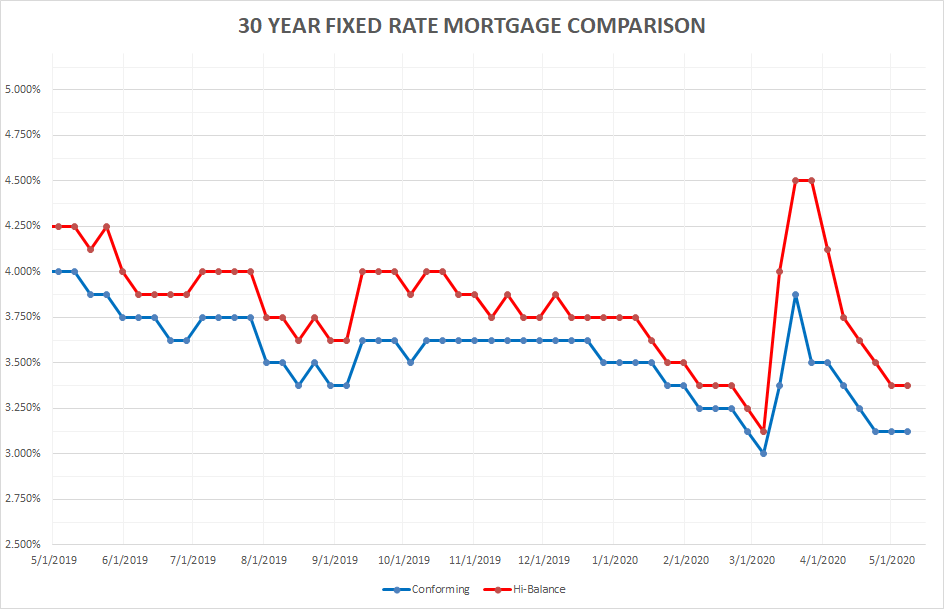
What are loan limits?

Question of the week:  What are loan limits?

Answer: Every mortgage program has limits as to how much of a loan the program is eligible to fund. The limits are dependent on several factors, depending on what type of mortgage is being approved. For example is it what is termed a “conventional” loan, is it a “government” loan, is it “non-conforming” or “jumbo?” Another factor is geographic location of the subject property, some programs will have higher loan limits in Long Beach, California than Long Beach, Mississippi. One more factor is what is the loan-to-value, i.e. what percentage of the value of the property is covered by the loan.

Conventional mortgages “Conventional,” or “conforming” loans refer to mortgages that are funded using guidelines established by Fannie Mae or Freddie Mac. These loans are funding by lenders who then sell the loans to Fannie or Freddie, who then package the loans into bundles and sell them as investments called Mortgage Backed Securities (MBS).

The conforming loan limits are set by Federal Housing Finance Agency (FHFA) based on the percentage increase, or decrease, in the average housing price. Mortgages that meet either Fannie or Freddie underwriting guidelines and fall within the established loan limits are eligible to be purchased by either entity depending which guidelines were used for approving and funding the mortgages.

Following the housing and mortgage markets melt-down starting in 2008 a “high-balance” loan limit was established for high cost areas across the United States. This enabled home buyers and owners in areas such as Los Angeles or Boston, where the median home price is higher than the conforming loan limit, to have easier access to low rate mortgages supported by Fannie and Freddie’s funding guidelines.

The high-balance loans have higher rates and pricing than standard conforming loans, as well as stricter underwriting guidelines.

For 2020 the conforming loan limit nationwide is $510,400. The high balance loan limits vary by county with the maximum being $765,600, which is the maximum limit for Los Angeles, Orange and several counties in Northern California. Here is a map that shows loan limits by county across the country.

Note that these are the limits for single family residences, there are different loan limits for two-, three-, and four- unit properties.

When I started in the mortgage industry in 1987 the maximum conforming loan amount was $153,100.

Government Loans that are insured by either the Veteran’s Administration (VA) or Federal Housing Authority (FHA) have separate underwriting guidelines. It should be noted that while conforming loans are sold to either Fannie or Freddie, government loans are insured by government entities.

VA loans are unique in that there is no limit on loan amounts based on location or imposed by the VA. The primary limit is the amount of the entitlement the veteran has from the VA, his/her ability to qualify, and what, if any, down payment or equity is in the property.

FHA has loan limits by county, the maximum loan in Tulare County is lower ($331,760) than the loan limit in Orange County ($765,600).

You probably noticed that the maximum loan limit in Orange County for FHA mortgages is the same as it is for conforming mortgages. Like the conforming high-balance mortgages, the FHA Jumbo mortgage is for those loans over $510,400 and have higher rates and prices with slightly different underwriting guidelines.

Non-conforming Generally labelled as “jumbo” mortgages, those loans that are funded outside of conventional or government channels have many different programs, and therefore limits and underwriting guidelines.

The most common non-conforming mortgages are traditional jumbo loans, which means they are used for applicants using underwriting standards that are close to those used by Fannie or Freddie; i.e. decent credit, verified income and funds to close, and properties that are “traditional.”

Non-conforming mortgage programs are funded by lenders and then sold to specific investors who establish the guidelines for underwriting and funding the mortgages. There are hundreds of different such investors who purchase mortgages from lenders, from major brokerage houses, to equity firms, to insurance companies, to regional banks. They establish mortgage products that run the gamut from traditional 30 year fixed mortgages to what are termed “hard money,” or “alternative” mortgages for those with credit or other challenges.

Most jumbo programs will fund mortgages under their guidelines down to the conforming loan limit plus one dollar. For example, if you are purchasing or refinancing a home with a loan amount of $525,000, because it is higher than the conforming $510,000 limit, you have the option of using either a high-balance conforming mortgage or a jumbo mortgage. Why would a borrower choose a jumbo loan instead of high-balance conforming? Some days the rates are lower on the jumbo option, or there may be something in the qualifying guidelines with a jumbo program that is more lenient and enables the borrower to qualify.

Most non-conforming loan limits are based on loan to value limits. For instance, a lender may go to 90% LTV to $1,000,000; 80% to $1.5 million, 75% to $2 million and 70% LTV to $2.5 million. Another lender may not lend above 80% LTV but at that limit lend to $2 million.

Loan limits come into play when we are working with clients as the loan amount, loan to value, and very importantly their ability to qualify, are factors as we determine loan product options and what rates and costs are associated with those options.

Want to know your loan limit? Give me a call!

Have a question? Ask me!

Rates for Friday February 21, 2020:  Rates are a little softer from last Friday, while the conforming rate is flat for the week the price is a bit lower, with either some closing credits or lower origination fee. The coronavirus still looms over markets as the length and breadth of its impact on commerce and populations is still not known.

FIXED RATE MORTGAGES AT COST OF 1.25 POINTS LOCKED FOR 45 DAYS:

30 year conforming                                            3.25%    Flat

30 year high-balance conforming                   3.375%  Flat

Please note that these are base rates and adjustments may be added for condominiums, refinances, credit scores, loan to value, no impound account and period rate is locked. Rates are based on 20% down with 740 FICO score for purchase mortgages.

We became childless this week. Our youngest had her eighteenth birthday and is now a legal adult. So, while we have adult children, we no longer have children that are childs!

Looking through the pictures of she and her sister through the years I get, as most parents likely do, a sense of how long ago it was she had her Dottie stuffed elephant and princess gown on, and also how it seems like just a year or so ago the picture was taken.

The passage of time is our blessing and curse. Blessed to be experiencing new adventures, relationships and, hopefully, more wisdom. Cursed as the experiences increase the time left to create more is lessening. We do not know how long we have for our new experiences, enjoy them and those you share them with every moment of every day!

Have a great week,

Dennis

Past Weekly Rate & Market Updates can be found on my blog page at my website www.DennisCSmith.com/my-blog

Is refinancing worth the short- or long-term cost?

Question of the week:  Is refinancing worth the short- or long-term cost?

Answer: With rates remaining very low we have been busy doing calculations for clients to determine if a refinance to lower their current mortgages rate and payment makes sense. This is a bit of a follow up from the WR&MU of August 30, 2019 (“When can we, should we, refinance?”) in which we discussed not only a refinance to lower the payment (a rate and term refinance) but also refinancing your current mortgage to consolidate a HELOC, other debt or pull-out equity for other purposes (a cash-out refinance). This week we will keep our discussion to a rate and term, or rate reduction, refinance.

Every transaction has costs, the question we explore with clients is how are the costs paid. The mortgage costs incurred when purchasing a home are similar to the mortgage costs incurred when refinancing a mortgage. There are several services that are involved, and no one works for free. Escrow, lender and title companies have fees. The transaction will have to be recorded so there will be fees paid to the county recorder. Not always but in most instances, there will be an appraisal, which requires a fee. Credit companies, companies that inform lender if your taxes are being paid on time and in the correct amount, companies that certify if your property does or does not require flood insurance, all have fees that need to be paid.

These are all known as “non-recurring costs,” the happen once and only happen because you are obtaining a mortgage. Depending on your loan amount and a few other variables, these costs range from about

Other costs involved are “recurring costs,” as you have guessed these costs recur over the life of your mortgage. Also known as “pro-rations,” these are amounts due to mortgage interest, property taxes and insurance that are prorated to the date of closing based on what has been paid or what will need to be paid.

There are three ways these costs can be paid in a refinance transaction (see below for fourth in a purchase). The costs can be paid with the borrower bringing funds to escrow at closing. The costs can be paid by adding them to the current mortgage amount, increasing the total amount of the new mortgage. The costs can be paid by the lender by increasing the rate on the new mortgage. (The fourth method of paying the costs in a purchase transaction is to have a credit from the seller or agent(s) for some or all of the costs you will be incurring.)

These costs are the short-term cost of refinancing, long-term if you add them to the loan amount. The question we answer is, do the costs associated with the refinance make sense? How do we determine what “makes sense?”

We have two litmus tests we use to determine if refinancing your current mortgage makes sense. First, your payment needs to drop by at least 5%. Second, if we divide the costs of the refinance by your monthly savings is the “pay-back” less than 36 months? The higher the percentage of savings and the lower the “pay-back” period the more it makes sense to refinance.

Real numbers: Client purchased a home in 2016 with a mortgage of $535,000 with a rate of 3.875% and a monthly payment of $2517 per month. The current balance on the mortgage is $500,000 and we are looking at a refinance at 3.5% with total costs for all fees of about $3500.

Client chooses to add the fees to the current loan balance so we have a loan for $503,000. The payment for a 30 year fixed rate $503,500 mortgage at 3.5% is $2261. This will lower the monthly payment by $256 per month, a savings of 10%–we meet the litmus test for monthly payment savings.

If we take the costs of $3500 and divide by the $256 monthly savings we get 13.67 months, which means that by the 14th payment the refinance has paid for itself.

After going through the math the client says, “but I have already paid on the mortgage for about 40 months, now I am starting all over again.”

There are several points to consider when extending your current mortgage with a refinance. How long will you be in the property? Will you be able to utilize your monthly savings to pay off other debt, increase your retirement savings, put aside for children’s college fund(s), or some other use that will benefit you?

Taking our client above, who says they intend on being in the home beyond thirty more years. Let’s look at the math between saving $256 per month versus adding 40 months to his payment. The next 320 months will be the time frame in which the original loan will be paid off if let alone. The savings during the 320 months from refinancing will be almost $82,000 (320 x $256 savings per month) and the payment on the additional 40 months due to refinancing is about $90,000 (40 x $2261 monthly payment from refinance). Over thirty years he will pay about $8000 more.

Is saving a total of $8000 over 30 years worth not saving almost $3100 per year for over 25 years? In economics there is a saying, “a dollar today is worth more than a dollar tomorrow;” essentially what you can buy with a dollar today is worth more than buying something for a dollar tomorrow for several factors, most importantly inflation eroding the value of your dollar over time. Having $256 more per month today and in the near future is worth more than spending $$2261 per month in twenty-five years.

If the client does not intend to stay in the home for more than the 320 months remaining on his mortgage the additional term is mute, the home will be paid off through your selling it before the final payment would be due, why spend more each month until you sell?

If the plan is to stay and keep the home then the better financial decision is still to refinance. Just keep making your same payment and your home will be paid of in about 300 months instead of the 320 months you have left on your mortgage. This will save you about $50,000 from not having any payments for 20 months at the end of your current mortgage. That said, I and many others contend that financially you would better off investing the monthly savings into an account for some future expenditure needs such as college tuition or retirement due to the economic principal of compound interest and dividend reinvestment and the tax deductibility of your mortgage interest.

Yes, there are short-, and possibly long-term costs to refinancing. There are also short- and long-term benefits from doing so. Doing the math will determine whether the benefit outweigh those costs for you and your family.

If you would like to do the math on your current mortgage as to whether it makes sense to refinance or not please give me a call!

Have a question? Ask me!

Slow news week, for economic data anyway. The primary news that impacts mortgage rates is the monthly jobs report released on the first Friday of every month. Today’s release shows that 225,000 jobs were added to the economy in January, well above the consensus estimate of 164,000 additional jobs. For the past three months the average has been 211,000 new jobs added per month. Some good news for workers, signifying how tight the labor markets are, wages increased 3.1% over the past twelve months, with inflation under 2% wage growth is outpacing prices for goods and services creating more disposable income for wage earners. More individuals entered the job search market in January resulting in the unemployment rate increasing in January from 3.5% to 3.6%. Overall the news is mortgage rate unfriendly as the data supports more economic growth and wages at some point pushing prices higher from the producers side.

Rates for Friday February 7, 2020:  Despite economic news that should put upward pressure on rates we dip this Friday from last to the lowest Friday rate we have had since October 2016—I had to adjust our rate chart as we were hitting bottom. How long they will stay at this level is not known, take advantage while you can.

FIXED RATE MORTGAGES AT COST OF 1.25 POINTS LOCKED FOR 45 DAYS:

30 year conforming                                            3.25%   Down 0.125%

30 year high-balance conforming                  3.375%  Down 0.125%

Please note that these are base rates and adjustments may be added for condominiums, refinances, credit scores, loan to value, no impound account and period rate is locked. Rates are based on 20% down with 740 FICO score for purchase mortgages.

Now that football is over, and I was right the red-team won!, many of us turn our sights to baseball. Spring training starts this coming week as pitchers and catchers report to major league camps in Arizona and Florida to get ready for the season. Underlying all the preparation and games will be the sign-stealing scandals that have embroiled World Series’ winners in Houston and Boston. My question as this has unfolded is how is it they are the only two teams that have done this? Sports are notorious for a) being copycats and b) trying to find any edge that can be had to get an extra bit of chance to succeed. Is using video to steal signs the steroid-advantage of this era and there are more instances of teams doing so yet to be discovered?

In the meantime, hoping this is the season my Phillies make it back to the playoffs and they are playing in November!

Have a great week,

Dennis

Past Weekly Rate & Market Updates can be found on my blog page at my website www.DennisCSmith.com/my-blog
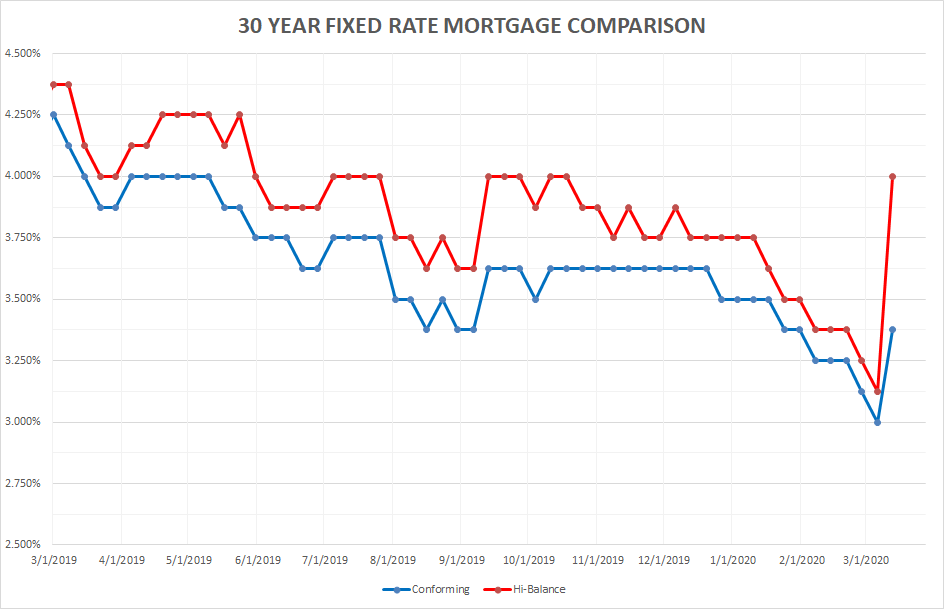
What should we offer?

Question of the week:  What price should we offer?

 Answer: This is a question we cover every couple of years and my answer has been pretty consistent. Offer what you can afford and what the seller will accept.

It is in our nature to want to negotiate and get a “bargain.” Why buy a pair of Nike Air shoes at one store for $100 when you can get the same shoe online or at another store for $95? Convenience?

The auto industry is set up to haggle, negotiate and make car buyers feel good when they can brag that they knocked several thousand dollars of the sticker price. Nobody brags around the office water cooler, “hey the guy would have taken $400 but I paid $500!”

Amazon, eBay and other internet vendors have reinforced, actually strengthened our primal instincts at getting a deal. Everything is more commoditized today than in the past.

But should this urge to buy as low as possible be followed when you are purchasing your new home?

Let’s look at the cost-benefit of haggling with a seller.

You have been prepping to purchase a home for several months. We have met and gone through your financial information and I am ready to provide a pre-approval package to your real estate agent when you find the right home and decide to write an offer.

You look at several properties in different areas of different sized and amenities, all within a defined price range. You finally find the property you want. It checks all your boxes and as you walk through you can imaging your family living in the home. The price is right in your qualifying range.  You know you can make the payments and you have more than enough in your accounts for down payment and closing.

So, what do you offer when you find the house you want to buy? My advice is always, offer what it takes to buy the home you want.

“But what if the seller would take less?”

What if they won’t and accept someone else’s offer?

Let’s take a look at the math of a sale for the buyer and seller on a property listed for $625,000.

For the seller, the costs of the transaction are about 7-8% depending on the commission he agreed to pay the real estate agents when he listed his home for sale, let’s use the higher amount. If he sells for $625,000 his costs are $50,000, his proceeds therefore are $575,000. If he sells his home for $600,000 his costs are $48,000 and his proceeds are $552,000. He sells his home for $25,000 less than his asking price and his proceeds are $23,000 less than had he sold the home for $625,000.

For a buyer on a $625,000 sales price, if he were to put 20% down that would be $125,000, and the loan amount would be $500,000. If the interest rate is 3.75% on a 30 year fixed rate his monthly payment would be $2316 per month.

The buyer however wants to see if he can get the property for a bit less and offers the seller $600,000. The buyer’s down payment would be $120,000, just $5000 less than if the offer was $625,000. His monthly mortgage payment would be $2326 on his $480,000 mortgage, $93 less per month than the $625,000 transaction.

The seller is out $23,000 with the lower price, while the buyer is saving only $5000 in cash. The buyer is also paying $93 less per month, a little over $1100 per month. The question for the buyer, is it worth losing the home you want for $5000 out of pocket and an additional $93 per month?

What do you spend $90 per month on? If you stop by an internationally known coffee purveyor you every morning on your way to work you are spending about $90 per month. If you don’t brown bag your lunch every day you are spending more than $90 per month.

There is another aspect beyond the cash in or out of pocket in the above scenario. There is good will. What is good will worth?

It is not uncommon in a real estate transaction on a previously owned home for the home inspector to present a report to the buyer with a list of issues with the property, many minor and a few less than minor. It is also not uncommon for the buyer to ask the seller for a credit to cover the costs to correct some of the issues with the property that they buyer will fix after he owns the home.

If the seller gives a credit to the buyer in escrow it is usually applied to offset closing costs, and not to lower the price. This is to the advantage of the buyer. For the seller it does not matter that much if the credit applies to buyer costs or sales price; as we saw above a reduction in sales price takes a lot of money out of the seller’s proceeds, about the same as a straight credit will.

For the buyer, as we saw above, any change in sales price has a small impact on the amount of cash needed to close, but a credit for costs is a direct dollar for dollar savings. For example, the buyer is putting 20% down, and the seller has agreed to a $5000 credit in lieu of making repairs requested by the buyer, the buyer is saving $1000 in cash—to make repairs that are estimate at $5000. If the $5000 is credited to offset closing costs the buyer saves $5000 in cash.

Back to goodwill. If the buyer was able to negotiate the seller down several thousand dollars from the price the seller really wanted, and then comes to the seller for several more thousand dollars, what is the mindset of the seller?

Yes, you may be able to purchase the home you want for less than the seller is asking. But before making that lower offer, consider the risk of not getting the home you want and the difference in how the math impacts you on a cash and payment basis. More often than not you will likely find the risk of losing the home you want is more than the cost of obtaining it.

Have a question? Ask me!

It was an interesting week. It was interesting in many respects, but I am referring to the news and information that impacts mortgage rates. In regards to economic data the Consumer Price Index for November showed strong growth at 0.3% for the month and pushed the annual inflation rate from 1.8% to 2.1%, the highest in twelve months. While rising prices are typically a push for higher rates, this weeks announcement did not have a large impact because the annual rate is in the Fed’s desired inflation rate. The other major piece of economic data was that retail sales in November were well below expectations at 0.2% growth from October (which was revised up to a very good 0.4% growth). A major reason for the somewhat disappointing showing was the late Thanksgiving this year, likely pushing a lot of holiday shopping into December. Since the consumer is 65-70% of our economy lackluster retail sales can be a concern, most investors held off on reacting to the news until they see how December sales go.

While the economic data is interesting to data geeks like me, political news has had more of an impact this week. As one commentator put it, “the news this week has been swirling like a dust storm making it hard to see where investors are going.” Early in the week Congress and the White House agreed on a new economic treaty with Mexico and Canada that will replace NAFTA, which is positive news for the economy. Yesterday the White House announced that the U.S. has signed a trade agreement with China resolving some of the disputed trade policies and not too long ago China followed with its own announcement that an agreement has been reached. Behind this backdrop of cooperation between Capitol Hill and Pennsylvania Avenue is the ultimate in non-cooperation as the House Judiciary Committee has sent articles of impeachment to the House for a vote, where it almost certainly pass on straight party lines initiating a trial in the Senate.

As mentioned often in the WR&MU, investors do not like uncertainty and when this happens they tend to flee to safety—which means fixed rate returns of bonds and investments like mortgages. The trade agreement announcements, being good for the economy pushed on rates to climb. Even though expected the breaking news of the impeachment proceeding has caused investors to pull back and they are pushing rates back down a bit.

Ignored in all the data, news and commentary is that earlier this week Fed Chairman Jerome Powell announcing that the Fed is looking to do nothing with rates in 2020. This takes pressure of rates for each economic announcement and creates stability, which is good news for those planning on purchasing a new home in 2020.

Rates for Friday December 13, 2019: After a spike yesterday and a gentle decent so far today rates are the same for conforming as there were last Friday, and the conforming rate is the same for the ninth consecutive Friday; I cannot recall this ever happening. The high balance rate slipped back down this week, continuing its see-saw course of the last few weeks.

FIXED RATE MORTGAGES AT COST OF 1.25 POINTS LOCKED FOR 45 DAYS:

30 year conforming                                            3.625%     Flat

30 year high-balance conforming                    3.875%    Up 0.125%

Please note that these are base rates and adjustments may be added for condominiums, refinances, credit scores, loan to value, no impound account and period rate is locked. Rates are based on 20% down with 740 FICO score for purchase mortgages.

I think one of my favorite parts of Christmas is walking in the house at the end of the day, or coming downstairs in the morning, and smelling the freshness of pine from the tree in our front room. That may be a major subconscious allure to the mountains as the olfactory memory we have smelling the pine trees and creating the memory of Christmas time with family and home.

Have a great week,

Dennis

Past Weekly Rate & Market Updates can be found on my blog page at my website www.DennisCSmith.com/my-blog