Posts

Why did you advise us to retain our home in California when we are moving out of state?

Question of the week:  Why did you advise us to retain our home in California when we are moving out of state?

Answer:  Last week we looked at options if you are purchasing a new home and wish to retain your current residence as a rental (link here). This week we take the question a bit further, what if the new residence is out-of-state?

It is no longer news that hundreds of thousands of Californians annually have been moving out of the state. Whether they are retirees or wage earners who have re-located when their employer moved out of state or have sought new employment outside of California, the primary factors for most of those relocating are cost of living and taxes.

When I am speaking with clients who own their homes in California who are relocating out of state a common refrain is, “you should see how much house we get for so much less…” Or, “we can sell our home here and buy one in fill in a state with no mortgage.” That is an attractive lure, especially since the greatest expense most families has is housing. What if your housing costs were eliminated, and your taxes were lower, and the costs of other goods and services were lower than what you are used to paying in California? How much more financial freedom and less stress would you have?

But should you sell your home in California to finance your new life in your new state?

Maybe, maybe not.

California is surrounded by states that have lower tax rates and lower property values. One popular destination is Nevada. There is no personal income tax in Nevada, its property tax is among the lowest in the nation, and while the sales tax is near or over 8% in most cities, that is offset by the other low tax rates.

There are many other states around the country with lower taxes, lower cost of living and much lower costs for homes. For those who are retired the ability to stretch retirement income and savings to live more comfortably financially, and use their equity from the sale of their home in California to purchase a comparable home in another state with a very small, or no, mortgage significantly helps stretch their retirement dollars.

For those still in their working years, with or without children, the lower cost of living and often lower congestion and density is enticing. Yes, their wages may be lower, but comparable when all other costs of living are factored into their home economics. If they are not homeowners, they see the opportunity to purchase a home that is out of reach in California. If they are homeowners they see that they too can sell their home in California and have a significant down payment for their home in their new state.

But what happens if you sell your home in California, move to Nevada, Washington, Texas or some other state, and you feel you made a mistake, you miss California and want to return?

We have had many clients of the years where this has happened. They sell their home in California, net a nice amount of cash from their home and purchase their new home with 30-40-50% down, or more. Be it the culture, the climate, their employment not being satisfying, or missing friends and family, after a few years they decide they want to return to California.

Then they do the math. Their home in Nevazonaexas has not appreciated much. It will cost them 7-8% to sell their home and are looking at netting about what they put into the home for down payment and closing costs—maybe.

Meanwhile, back in California, they find out they are having a hard time qualifying to purchase a home comparable to what they sold, or if they do they are paying a higher price and have a higher mortgage than they had when they sold their prior home.

It is a difficult conversation we have going through the math and telling past clients looking to move back to the state that what they qualify to purchase is smaller than the home they sold not too many years ago, or the same size home in a different neighborhood.

We have had clients who have moved out of state and retained their homes in California and converted them to rentals. Perhaps refinancing before they left the state to obtain some funds to purchase a home in their new state, or waiting to purchase until they know they are in Nevazonaexas to stay. If they do make the decision to stay they can either continue to rent their former home and retain as an investment, or they can sell the home and take the proceeds to either purchase a new home in their new state, or payoff their mortgage, or invest the money and perhaps shorten their time until they retire.

If they decide they do not wish to live in Nevazonaexas any longer, they simply need to give their tenants notice they are returning to California and need them to vacate their home. They gave relocation a shot, it did not work out for them and they are able to return to their former home without having to worry about if they can afford to purchase a home in California.

If you own your home in California and are moving out of state my advice is that you seriously consider the option of retaining your current home for a period of time after you move just in case it does not work out and you want to return to California in the future.

If you want me to help you with the math of relocation please do not hesitate to contact me.

Have a question? Ask me!

Is it needed? It appears to be a foregone conclusion that the Fed will lower its benchmark interest rate in July. The reasoning is to get ahead of a potential slow-down in the economy, as primarily shown in inflation numbers—data for May shows the annual rate of inflation dipped to 1.5% on a year over year basis, which is well below the Fed’s inflation target of 2.0%. But is the economy in need of any boost? Personal incomes in May grew 0.5% from the prior month, continuing a steady upward trend, consumer spending grew at a good rate for the third month in a row, up 0.4%. Since consumer spending is 65-70% of our economy, consumers are maintaining a foundation for continued, steady growth. Helping future economic growth, is personal savings growth, no surprise since income growth outpaces spending growth, which is at 6.1%. In a normal environment the data would support upward pressure on rates, but the Fed’s desire to lower rates based on their assumption the American consumer will slow consumption in the future takes that pressure off.

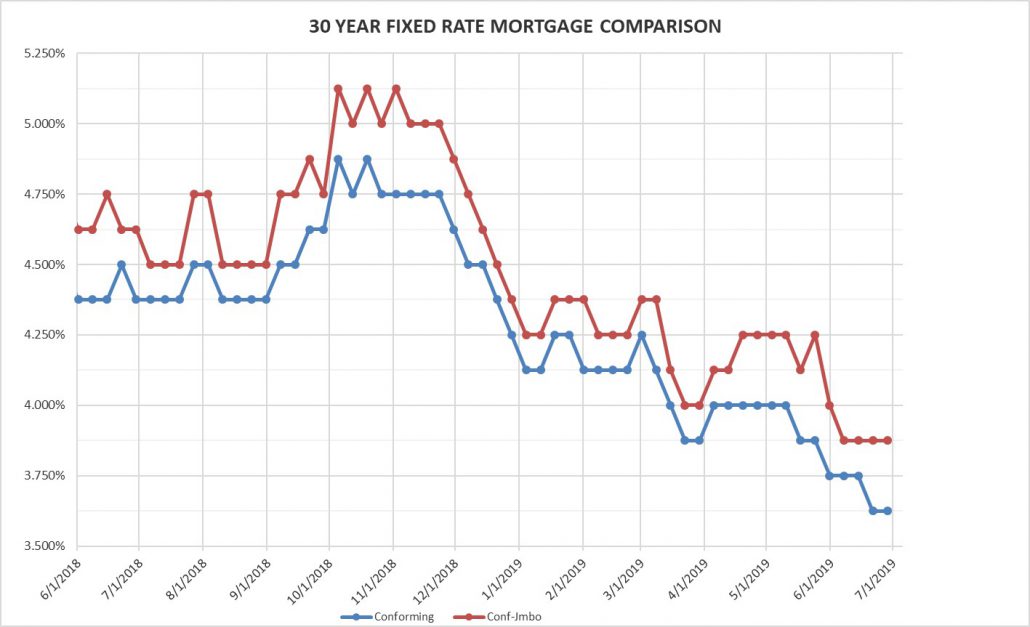
Rates for Friday June 28, 2019: As mentioned above, data supports rates not being at multi-year lows but the sentiment and actions of quasi-government organizations are keeping rates low. Looking forward, there is little room to the down side and markets have priced in a rate cut in July from the Fed. Now is a great time to get a mortgage!   

FIXED RATE MORTGAGES AT COST OF 1.25 POINTS LOCKED FOR 45 DAYS:

30 year conforming                                            3.625%     Flat

30 year high-balance conforming                      3.875%      Flat    

Please note that these are base rates and adjustments may be added for condominiums, refinances, credit scores, loan to value, no impound account and period rate is locked. Rates are based on 20% down with 740 FICO score for purchase mortgages.
When is Independence Day? July 4th is when we celebrate. John Adams, in a letter to his wife Abigail** dated July 3, 1776 described the events of the prior day in the Continental Congress during which the delegates from twelve of the thirteen colonies approved a motion for independence from England presented by Richard Henry Lee. In the letter he writes,

“The Second Day of July 1776, will be the most memorable Epocha, in the History of America…I am apt to believe that it will be celebrated, by succeeding Generations, as the great anniversary Festival. It ought to be commemorated, as the Day of Deliverance by solemn Acts of Devotion to God Almighty. It ought to be solemnized with Pomp and Parade, with Shews, Games, Sports, Guns, Bells, Bonfires and Illuminations from one End of this Continent to the other from this Time forward forever more.”

We celebrate July 4th as Independence Day, as that is the day the Declaration as we know it was adopted by the Continental Congress after two days of debate and revisions to Thomas Jefferson’s historic document. The next day, July 5th a printer made hundreds of copies that were then given to messengers to deliver throughout the colonies.

We all know the image of the Declaration of Independence, with the large header “In Congress, July 4, 1776” and adorned with signatures on the bottom, the most prominent being that of John Hancock, the President of the Congress. There is some dispute as to when the signatures were affixed to the document. July 4th is the commonly learned and believed date members of Congress signed, but later statements from those present brought up that not all the signatories were in Congress on that date, either as officials or physically. There is a strong argument that the document was signed by most members of Congress on August 2, 1776. One part of this argument being that it took some time for the adopted declaration to be clearly written in a steady hand on parchment.

Regardless of the dates, in 1870 Congress declared July 4th to be a national holiday as part of a bill that included other national holidays, including Christmas. And so it is, a wonderful national day to celebrate the humble beginnings of our great nation.

Two final thoughts, first I encourage everyone to read the actual text of the Declaration of Independence, it is a wonderful read, especially if you are able to consider that many of the sentiments have never been expressed before as a basis for creating a purpose of not only independence but governance. Here is a link to the Declaration of Independence.

**Second, the John Adams biography by David McCullough is a wonderful book on a fascinating man. One of my favorite parts of the book are the letters between John and Abigail Adams. Separated for much of their marriage, the letters show us not only the history of the era, but the love they had for each other and their family. I strongly recommend the book.

Have a great week and Happy Independence Day!

Dennis

Past Weekly Rate & Market Updates can be found on my blog page at my website www.DennisCSmith.com/my-blog

Can we keep our current home as a rental and buy a new home?

Question of the week:  Can we keep our current home as a rental and buy a new home?

Answer:  Perhaps, let’s look at the factors involved.

First and foremost, you need to be absolutely certain you are ready to be a landlord. Like any investment there are risks involved and since rental property is an active, not a passive, investment, there are more risks than loss of value.

The upside to being a landlord is having great tenants who always pay their rent on time, absorb occasional increases in rent, take great care of the property and rarely contact you with any issues. The downside is the opposite of each of these.

If you are going to convert your current residence into a rental you need to also shift your mindset that the property is no longer your home but an investment, which means you need to release emotion and accept your former home is now a business. I had a couple who had spent a lot of time and money over the years creating a beautiful home. When we had the conversation about converting it to a rental when they purchased a new home I looked at the wife, who was rightfully very proud of their home and the work they did, and said, “are you okay knowing strangers will live in your home, they will damage some of it, may paint rooms different colors and not maintain and care for as you have?” She looked at me with a pained expression and after a few moments said, “I don’t think I can do that.”

 She may have been ready to be a landlord, but not for the home she created. They ended up selling the home to buyers who loved it, and over the years cared for it as I notice when I drive by from time to time. The couple ended up purchasing a different property after they purchased their new home and still retain that property as a rental.

Are you ready, as a landlord, for the expenses that may not be covered by the rental income? One big benefit of converting your property to a rental is the tenant will be paying off your mortgage. When considering the possibility of conversion, the first math that is performed is how much rent can we charge and what is our monthly payment for mortgage, taxes and insurance. What also needs to be factored into the equation is maintenance, loss of rent and time. Will you retain a gardener, or if appropriate the pool service? Who will trim trees and bushes? How much longer before you need to replace the roof, the water heater or the garage door opener? Are the kitchen appliances warranties running out soon?

What happens when your tenant leaves the property? Will their one month deposit cover painting, re-carpeting, major cleaning and damage repair if they were particularly harsh on the home? What about the lack of rent income between their departure and the next tenant moving in, do you have funds for that?

Most importantly, can you absorb the expenses if you have a tenant who stops paying rent that  you need to evict which can take up to a year and cost you a lot of money?

Now that I have painted a wonderful picture of being a landlord…there are many advantages. As mentioned above, you have someone else paying for your investment—sort of like an employer contribution to your retirement plan. Depending on your situation you may have some tax advantages due such as depreciating the asset and expenses through the year that exceed income that can be deducted. As well, depending on your timing and how long you have had the property, you might be able to mitigate or eliminate capital gains with the two-in-five rule, if you live in the property two of the previous five years you can sell and not pay capital gains. (I am not a tax expert or CPA, before making any decisions regarding tax advantages or costs please consult your tax professional.)

Perhaps the biggest advantage of the conversion is you have an asset that can, probably will in Southern California and other areas, increase in value over time. For which someone else is paying the holding costs.  

Our question of the week was not “should we….” but, “can we…” I have covered some of the questions regarding should you consider converting your current home to a rental, now let’s look at the can you.

If you are not purchasing your new home with all cash then your ability to qualify for a mortgage to purchase your new home with the expenses of your existing home remaining.

Here are the basic guidelines used by most mortgage programs for qualifying when converting your home to a rental:

  • Borrower must supply a rental agreement and proof of deposit from tenant into borrower’s bank account
  • 75% of the rent will be considered for qualification purposes (i.e. if rent is $2000 per month, qualification rent will be $1500 per month)
  • Borrower must have up to six months PITI in reserves for each property owned, this includes property that is being retained and the new home being purchased (i.e. if your current mortgage, taxes and insurance are $2500 per month and your these payments on your new home are $3500 per month, you will need $2500 x 6 months, plus $3500 x 6 months, you will need $36,000 in reserves after the close on your new home). Depending on the program retirement accounts may be considered in this calculation.

Some loan programs, especially “jumbo,” or non-conforming have additional guidelines:

  • Borrower must have at least 25% equity in conversion property as determined by an appraisal
  • In addition to the rental agreement and deposit, borrower must provide a rent survey for the area that supports the rent on the rental agreement
  • Reserves could be as much as twelve months PITI for all properties owned and retirement accounts may not be considered

A big factor for many families considering the conversion of their current home to a rental is if they have the funds to purchase their new home without selling their current home. If your intention is to access funds from you current home through a refinance or obtaining an equity line your loan rate and amount of funds available can be impacted by the occupancy guidelines by lenders.

I am a big supporter of those who wish to retain their current home and convert it to a rental property when they purchase their new home. There are challenges in qualifying for the new home, from funds available for down payment, closing and reserves and debt-to-income ratios. However, going through all the options will determine the purchase price and payments on your new home for which you will qualify and from there you can decide how to move forward.

If you, or someone you know, is considering purchasing a new home and would like to retain your current home please give me a call so we can go through your situation and all the options available.

Have a question? Ask me!

Maybe, if, but…The Federal Reserve Open Market Committee (cleverly known as the FOMC) met this week. This is the group that determines if the Fed is going to change their fed funds rate or not. Going into the meeting the consensus was that the Fed would leave rates alone at this meeting in June and increase the rates at their meeting in July. The first part was correct, the Fed left rates alone. The second part is no longer a consensus based on the comments following the meeting.

Quick primer on the Fed and rates: if inflation is growing and the economy is running really hot the Fed will increase rates to slow things down and put a damper on inflation—the Fed likes inflation to be very close to 2% on an annual basis. If the economy is slowing and inflation is too low the Fed will lower rates to stimulate investment and growth. Last year the speculation was that the Fed would increase rates three times in 2019. As the year progressed and economic data showed inflation lowering, labor market growth being very tight but slowing, and concern about impacts from the trade and tariff dispute with China, statements from the FOMC meetings made it pretty clear that there would be no rate increases in 2019. After a few months the mummers from the FOMC were that a rate cut or two might occur.

Yesterday the information from the meeting was mixed. Yes, labor markets are tight with wages increasing which could result in higher inflation, and the economy is still strong—both of which support raising rates. Yes, inflation has declined and the Fed predicts it to drop to 1.5% for the year and the trade issues that could impact the economy still exist—both of which support lowering rates. With the FOMC members somewhat split on what’s next, with nine predicting no rate cut this year and eight predicting one or two rate cuts.

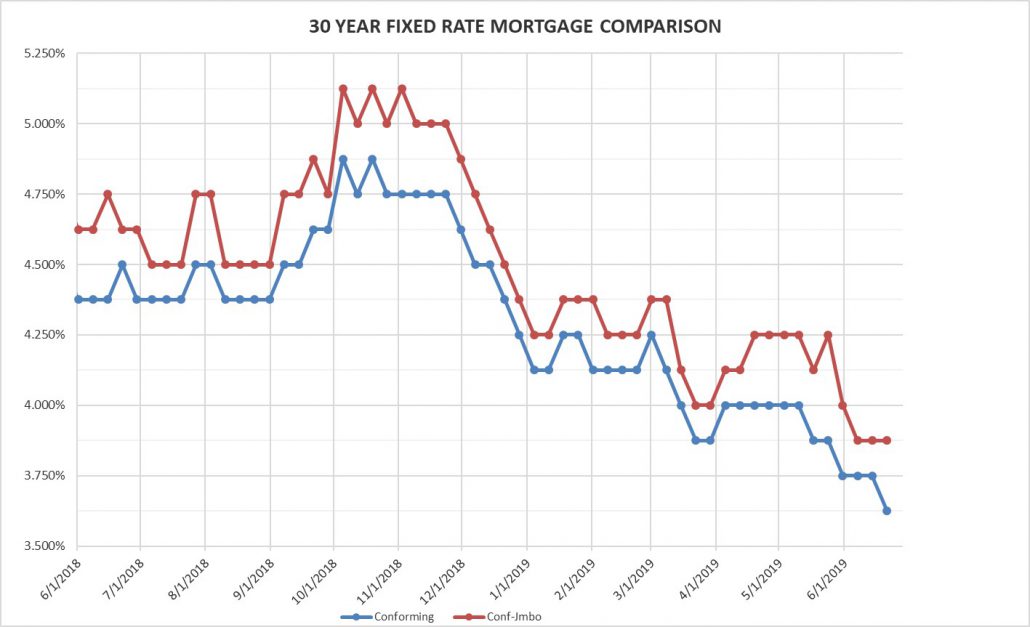
Rates for Friday June 21, 2019: Despite the Fed not lowering rates and a split within the Fed as to whether they will drop rates lower in the month, conforming rates have dropped from last Friday to the lowest they have been since October 2017. It feels like we are within sight, if not at or very near the bottom for this cycle—but I felt that way in April when we were at 4% for several weeks.   

FIXED RATE MORTGAGES AT COST OF 1.25 POINTS LOCKED FOR 45 DAYS:

30 year conforming                                            3.625%     Down 0.125%

30 year high-balance conforming                     3.875%      Flat    

Please note that these are base rates and adjustments may be added for condominiums, refinances, credit scores, loan to value, no impound account and period rate is locked. Rates are based on 20% down with 740 FICO score for purchase mortgages.

Historically the summer blockbuster has been “must see.” Certainly, “Jaws,” “Top Gun,” “Raiders of the Lost Ark” captured huge audiences across many demographics. So far this summer it looks like a cartoon, “Toy Story 4” is out today, it may be this summer’s blockbuster—we are seeing it Sunday.

One movie that will not be considered a blockbuster that I saw with my daughter last week is “Late Night.” She is a big fan of actress Mindy Kaling, who is one of the movie’s stars, and also wrote and produced the film; and could not wait to see it. We went up to Hollywood last week for an early screening before the film is widely released. I went thinking it would be okay and was more interested in spending time with her than watching the movie. About halfway through the show I leaned over and whispered, “This is really, really good.” And it is, in fact it is much better than really, really good in my opinion. Wonderful script, casting, acting and story. It is not on many people’s radar for “must see” summer movies, but I put it on mine.

Have a great week,

Dennis

Past Weekly Rate & Market Updates can be found on my blog page at my website www.DennisCSmith.com/my-blog

Our parents have left their home, it has a reverse mortgage, what are our options?

Question of the week:  Our parents have left their home, it has a reverse mortgage, what are our options?

Answer:  Reverse mortgages are one of the most misunderstood financial instruments available to consumers and inappropriately maligned because they are misunderstood. The latter primarily because of their history, we’ll explain this history a bit further in the WR&MU.

A very quick and broad overview of what a reverse mortgage is and how it works.

A standard mortgage is a loan secured by property, the borrower pays a monthly payment to the lender that is either only the interest owed for the amount outstanding on the loan and/or an amount that is the amount owed in interest for the loan plus a certain amount of principal. The overwhelming majority of mortgages are “amortized,” meaning that each month the payment on the mortgage is calculated so that the interest owed for the month plus a certain amount of principal is calculated so the mortgage is paid off at a known date in the future. If you take out a $300,000 30-year fixed rate mortgage with the first payment due July 1st 2019 and a $1500 payment per month, and make that $1500 payment every month on time for 360 months, on June 1, 2049 your last payment of $1500 will payoff the loan.

With each payment you make on a conventional mortgage the balance of your loan decreases, the decrease accelerates as the loan ages as you pay a smaller amount of interest with each successive payment since the balance is decreasing.

A reverse mortgage is the reverse of a conventional mortgage. There are several options for reverse mortgages, for simplification we will use the option where a lump sum is funded at closing on a reverse mortgage.

The primary benefit of a reverse mortgage is that there is no required monthly payment. If you obtain a $300,000 reverse mortgage you do not have to make any payments for interest, or principal, as long as you own and live in the home. When you “leave” the home the original principal, plus all the accumulated interest that was not paid, is due—in other words, the loan must be paid off.

The longer you own the home and have the reverse mortgage the higher the balance will be that needs to be paid to the lender to close the mortgage. Unlike a traditional mortgage where the balance due declines over time, the reverse is true as the balance increases.

I will not go into the benefits and detriments of reverse mortgages in this week’s WR&MU, but get back to our question of the week, and the clause in reverse mortgages that when the borrower(s) leave the property the loan must be paid off.

Several decades ago saw some major companies in the reverse mortgage market funding mortgages to seniors that were very lender friendly and often ended up in the family losing the home to the lenders when the borrowers passed away or needed to leave their homes for whatever reason. This is no longer the case. Federal regulations changed the rules governing reverse mortgages, enabling families the opportunity to either retain properties with reverse mortgages or sell the properties and retain the resulting equity.

Several times a year we have clients whose parents had a reverse mortgage on their primary mortgage and the parents have either passed away, or moved into assisted living or some other residence, perhaps with one of their children. Reverse mortgages have a clause that when the last borrower, assuming a husband and wife co-signed the mortgage, no longer has the subject property as their primary residence the mortgage must be paid off.

Let’s assume that Nancy, mother to Kyle and Susan, took out a reverse mortgage ten years ago that enabled her to payoff a conventional mortgage with payments she could no longer afford after her husband George passed away so she could remain in the home they shared and raised their children in for forty years. Nancy has passed away and the reverse mortgage has a balance of $300,000 and the home is valued at $500,000. Nancy and George were smart and put their home and other assets into a trust they created many years ago. When George passed away Nancy became the sole trustee and the children were the sole beneficiaries of the assets in the trust when she passed away.

Kyle and Susan, following the advice of the family attorney administering the trust, contact us as they are not sure what to do with the family home. They are fearful that the lender will foreclose on the property and they will lose not only the family home, but also the equity in the home. What are their options? Will they lose the home and equity? We ease their concerns and communicate the standard rules for most reverse mortgages upon the death, or leaving of the property by the borrower(s), is the lender needs to be notified within 30 days of the intention of whoever controls the property as to what will happen with the property and plans to payoff the mortgage. The person in control can be the borrower who has vacated the property, individual with power of attorney and legal guardian, executor of the estate, or if no estate the heirs and/or probate attorney. Typically, the plan communicated to the lender must be executed within six months.

Kyle and Susan have four options, nothing, sell, refinance, buy-out. Susan is the executor of her mother’s estate and will need to communicate to the lender which of these options will be taken to payoff the lender.

Doing nothing is always an option. Generally, not the best option, but an option nonetheless. In this case doing nothing will result in the lender going through the foreclosure process, which will result in more interest accumulating on the mortgage, fees and costs of foreclosure being added to the amount owed to the lender and the lender then auctioning the property at a foreclosure sale with the minimum bid being the total amount owed. Bidders will see a property worth $500,000 and perhaps $375,000 owed to the lender to clear the loan balance, principal owed and costs. Any amount over what is owed the lender will be paid to Nancy’s estate and available for Kyle and Nancy to split. For instance, if the winning bid is $425,000 then $50,000 will be paid to the estate. If there are no bidders then the lender will take possession of the property and the estate will lose the asset. It should be noted, if the amount owed on the reverse mortgage is at or above the value of the property then giving the property to the lender is not necessarily a bad option. Susan does not communicate this option to the lender.

Kyle and Nancy do not want to do nothing and risk the loss of equity and/or the property.

We are down to three options, sell, refinance or buy-out.

Kyle and Nancy must decide what they want. Does one, or both, wish to retain the property? If not then the obvious option is to contract with a real estate agent to list the property. Once the property is on the market Susan, as executor, should communicate the status of the property to the reverse lender, this will almost always put any action by the lender on hold. Continue to communicate. When an offer is made and accepted, Susan, again contacts the reverse mortgage lender; lets them know the property is in escrow and the scheduled close of escrow. She also provides the lender with the contact information for the escrow company and tris to get the name and contact information for an individual at the lender for escrow so they can communicate status and timing as closing nears. When the sale is concluded the net proceeds of the sale will be sent to Nancy’s estate to be disbursed according to the trust, typically evenly between Kyle and Susan.

Before deciding to sell the property, Kyle and Susan should discuss if they wish to retain the home. We discuss this option which will entail refinancing the reverse mortgage with a new loan to Kyle and Susan, and perhaps their spouses, and when the transaction is concluded they will jointly own the property. Typically, when this is the scenario the property is then held as an investment property and rented; providing income and appreciation of value for Kyle and Susan. If this is the option Kyle and Susan choose, then Susan, as executor, contacts the reverse mortgage lender, informs them of the intent to retain the property provides my contact information and escrow’s so everyone is communicating status and timing to ensure the lender does not file a notice of default or initiate a foreclosure process.

In discussing retaining the property, Kyle, who lives in Denver, does not wish to be a landlord, especially for a property so far away. He would rather receive his portion of the equity in cash as the part of the division of the estate. Susan, who has been renting her home sees an opportunity to become a home owner and wants to retain the property as her primary residence. Running the numbers, Susan qualifies for a mortgage needed for her to obtain title to the property after paying off the reverse mortgage and sufficient proceeds to buy-out Kyle.

Now our math can get a bit complicated as we must fund a mortgage to pay off the reverse mortgage, and extract enough equity to buy-out Kyle’s share of the property. If there are no other assets the simple math is the property is worth $500,000 and $300,000 is owed, leaving $200,000 equity to be split, therefore Kyle needs to receive $100,000. Our new loan would need to be $400,000 to cover paying off the reverse mortgage and Kyle. At this point we typically discuss “fairness,” as if the property were to be sold on the open market costs can range from 7-8%, or $35-40,000, for real estate commissions, transfer taxes, escrow, title, potential costs for repairs or other items. So, if the property were sold for $500,000 the net proceeds after paying off the reverse mortgage and costs can be around $160,000, or $80,000 each for Kyle and Susan.

Kyle and Susan get along very well, Kyle sees the math if the property were sold and agrees to accept $80,000 from the refinance that will transfer title to Susan. We will therefore fund a loan of $380,000 to clear the mortgage and Kyle.

Unless….when Nancy passed away there was approximately $120,000 in cash and investments. This would be split $60,000 each to Kyle and Susan. However, they agree that Kyle will get $80,000 of the liquid assets in exchange for any proceeds from the sale of the home. Nancy will get $40,000 from the liquid assets in the estate and the title to the property. We fund a mortgage of $300,000 to payoff the reverse mortgage, the other assets are distributed accordingly and everyone is happy.

If your parents, or a client, or you, have a reverse mortgage, there are several options available to heirs and estates when the time comes to payoff the reverse mortgage. Too often we hear from clients, attorneys, accountants, or financial advisors, stories of families panicking and selling a home because there was a reverse mortgage and they were misinformed that the loan had to be paid off and selling the property was to the way to pay it off without risking foreclosure. This is not the case!

If you, or someone you know, is in this situation a steady and calm approach reviewing all the options, the benefits and costs of each, will enable a sound decision to be made as to how to payoff the amount due to the reverse mortgage lender. The amount of equity in the property, other assets in the estate, desire of the heirs and their abilities to finance a new mortgage if that is the preferred option, will determine the best option for the property and paying off the reverse mortgage.

We handle many such situations every year, not just properties with reverse mortgages that need to be paid off but also properties in family estates that one, or multiple, heirs wish to retain. If you, or someone you know, is in this situation, please call me to go through all the options available.

Have a question? Ask me!

Like Mark Twain, the economy is saying, “The reports of my death are greatly exaggerated.” Twain made this comment in a cable to the press in the United States upon reading of his death in the papers while in London. The economy is making this comment with data on retail sales, industrial production and capacity utilization (how much is being produced compared to what could be produced) showing an economy that is not faltering as many reports and commentators have indicated, but rather continues to show steady growth and economic activity. Much of the reports are due to inflation remaining very low, typically an indicator of a slow economy, and slowing growth in the labor markets, due to scarcity of labor more than scarcity of job openings.

Retail sales are good and better. The Commerce Department’s report on retail sales for May showed a strong 0.5% increase from April, which would be discounted by many since last month the report showed April sales decreased 0.2% from March. However, the discount is voided when the report also shows April sales revised from the 0.2 decrease to a 0.3% increase in April, thus showing May to continue a string of months with American consumers consuming in solid numbers. This is important as consumer spending is 65-70% of our nation’s economy. The news is somewhat interest rate unfriendly.

Balancing the sales data were the releases for producer and consumer prices. Both indices showed growth of 0.1% in May, essentially indicating a lack of any substantial inflation in the market place. This data seems to support speculation that the Fed will lower rates at the July meeting of its Federal Open Market Committee, as for many it portends a slowing economy that will need a drop in rates to promote investment and growth.

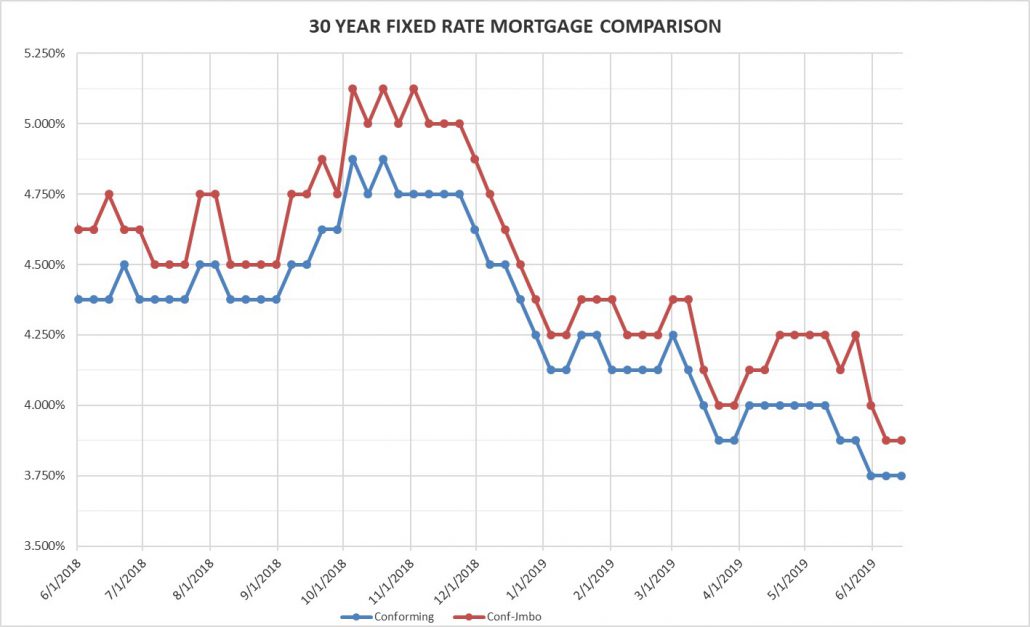
Rates for Friday June 14, 2019: Reports, commentary, speculation, these are what drive a lot of decisions for investors as they try to stay ahead of downturns and get in before upswings. The tariff issues with China, Mexico and other nations, lack of inflation, slowing job growth, the Fed lowering rates, all have investors anticipating lower rates—which creates lower rates as they influence the markets. Mortgage rates reflect this anticipation, a Fed rate drop is already priced into our market, as rates continue to sit at lows last seen in January 2018. If the Fed surprises the markets and lowers rates at its meeting next week instead of waiting for July, my expectation is that mortgage rates will bump up as investors move to stocks in anticipation of rising prices in the equity markets. Stay tuned, and lock in when you can.  

FIXED RATE MORTGAGES AT COST OF 1.25 POINTS LOCKED FOR 45 DAYS:

30 year conforming                                            3.75%        Flat

30 year high-balance conforming                   3.875%      Flat    

Please note that these are base rates and adjustments may be added for condominiums, refinances, credit scores, loan to value, no impound account and period rate is locked. Rates are based on 20% down with 740 FICO score for purchase mortgages.

Happy Father’s Day to the dads out there. If you are a golf fan, here is hoping you have a chance in being celebrated to watch the conclusion of the U.S. Open, especially if it is an exciting finish. For many years we started our summer family trip on  Father’s Day and I watched many holes of golf in airports or rushing to get to our accommodations to catch the finishes.

One of the primary lessons I learned from my dad that I hope my children adhere to as well is he used to say, “I’d rather lose a friend telling the truth that to keep or make one telling a lie.”  Of course, this also means do not penalize your friends for telling you the truth.

Happy Father’s Day!

Have a great week,

Dennis

Past Weekly Rate & Market Updates can be found on my blog page at my website www.DennisCSmith.com/my-blog
How can we help our children purchase their first home?

Question of the week:  How can we help our children purchase their first home?

Answer:  This question came up yesterday when I was having breakfast with Martin and Marc, two attorneys who between them have children between early to late 20’s. Concerned about the cost of residential real estate in California, they wondered how they could assist them get their foot in the door (haha, nice pun) of home ownership.

The concern Martin and Marc have is not unique, many parents with children entering the age they were when they were purchasing their first homes are concerned their children will either have to rent for a very long time, or move to another part of the country to purchase a home and raise their families—and grandma does not want to travel to Frisco, Texas or Nashville, Tennessee to visit her grandbabies!

There are three primary factors to loan qualifying: income, credit and cash to close. How a parent help a son or daughter with each of this areas of qualification, or can they?

Before we get into the different areas I will be addressing the two most common types of mortgages used by all home buyers and especially those purchasing their first homes, conventional mortgages, aka Fannie and/or Freddie, and FHA mortgages. Unless noted otherwise the guidelines will be pretty much the same.

INCOME

Conventional guidelines have loosened up on income assistance and now pretty much mirror the FHA guidelines. It is really hard to get your kid a raise, even if s/he works for you a sudden spike in income will have the underwriter arching eyebrows thinking, “this kid got a raise just to qualify,” which is why working for a family owned business typically requires a bit more history of earnings for qualifying.

A parent can assist with income qualifying by co-signing on the mortgage. When we have a co-signer combine all the borrowers’ income and all the borrowers’ debt obligations in the debt-to-income (DTI) calculation. When parents co-sign we must include their full housing payment, principal and interest on mortgage, property taxes, homeowner’s insurance and HOA dues if any. This inclusion of housing payment can sometimes be the barrier for a co-signer assisting as it throws off our DTI requirements.

It is important for anyone co-signing to know and acknowledge that they are 100% responsible for 100% of the payment. If the kids miss a payment it will reflect on your credit report. If the kids miss several payments and go into default, you are also in default. If the mortgage is foreclosed, you have a foreclosure on your record. Therefore, if you co-sign it is highly recommended you obtain on-line access to the lenders website so you can check in every month to make sure the payment has been made and all is well.

One concern many parents have when co-signing is how it will impact their ability to obtain credit in the future with another mortgage on their record. The current guidelines for mortgage qualification if an applicant has co-signed for another mortgage is if the applicant can show the primary borrower (a term I dislike using since all borrowers are equal) has made all the mortgage, tax, insurance and if applicable HOA payments over the past twelve months the housing payment will not be calculated in the qualifyinig for a new mortgage. For instance, you have co-signed for your kids and the total housing payment (PITI) is $3000 per month. You decide to purchase a vacation home in Palm Desert and are getting a mortgage, but with your current housing payment and your kid’s housing payment you do not qualify. You show proof that you kid has made all the payments for the house, mortgage, taxes, etc, for the past twelve months. Now the payment will not count in your qualifying and now you qualify for that 2500 square foot single-level in back of the golf course. “Proof” will entail obtaining bank statements from your children showing they have made all the payments required for the property, i.e. cancelled checks or direct payments to mortgage company, county tax collector, insurance agency. Note if there are systematic deposits into their account from you, this will be construed as assistance and therefore the payment will count. If there are even occasional deposits tracked to you for large sums there is a good chance this may disqualify the guideline as well.

CREDIT

The cliché in our business is, “you can’t co-sign bad credit.” This means if your credit scores are hovering around 800, and your kid’s credit score is mid-500’s, your 800 score is not relevant. For credit scores lenders use the lowest-middle score of all borrowers. Similarly if the situation is reversed and you have the low score and your kid has the high score, your score is the one that impacts the ability to qualify or the interest rate being higher.

The best way a parent can assist a child with the credit aspect of qualifying for a mortgage is to pay down or off some of the items on the credit report. In the short term paying an auto loan down to below 10 months of payments will have that payment not count in qualifying. If you son or daughter has an auto loan and the payment is preventing us from qualifying, if you are able to pay the account down to less than nine months that payment is not used in our DTI calculations and now they qualify.

The same can be done with other credit payments to lower total debt payments,  such as credit cards. As well, if your kid’s credit score is low, we can run an analysis to determine if there are any remedies to boost the score. Often times this can be done by paying off credit cards, or in many instances just paying them down below certain levels. Raising a score fifteen or twenty points can sometimes result in a lower interest rate and easier qualifying.

Before doing this make sure you consult with your mortgage professional (me!) to ensure it is done properly and does not create a situation that does not help in qualifying. Whenever there is “outside money” we have guidelines that must be followed. That leads us to….

CASH

This is the most common form of assistance that parents provide children looking to purchase their first home, a gift of cash for down payment, closing costs, credit relief, wherever needed.

Depending on when you make your cash gift to your children, there are specific guidelines that must be followed if there is a cash contribution to the borrowers to ensure the legitimacy of the funds are from a “acceptable donor,” essentially a relative or significant other (fiancé(e), domestic partner), and that the funds are not borrowed.

This entails a proof the donor had the funds to gift, proof the funds transferred from the verified donor account to the borrower’s account, a gift letter indicating there is no expectation of repayment.

Before making any cash contribution, or pay-off debt, or consider co-signing, please contact me so we can run through the specifics of the potential transaction and how you might help your children purchase their first home.

Have a question? Ask me!

Still strong. Early in the week the first revision to the 1st quarter Gross Domestic Product data lowered the estimate for growth in the quarter from 3.2% to 3.1%, not as strong as initially estimated but still a strong growth number for the nation’s economy. The news had no impact on mortgage rates.

Financially healthier households. That is the take-away from data released this morning by the government on personal income, consumer spending and inflation in April. Personal income grew at a very good rate of 0.5% for the month. While household revenue increased in the month, the additional funds were not being used for consumption, which grew at a rate of 0.3% from March—not a surprising number following March’s staggering 1.1% increase in consumer spending from the prior month. The Personal Consumption Expenditures index, a key gauge for inflation, increased only 0.3% for the month and is up 1.5% from last April, well below the Fed’s target inflation rate of 2.0%. With incomes up higher than spending it follows that the savings rate increased, from 6.1% in March to 6.2% in April. This is a bit of a mixed news data point, since consumer spending is 65-70% of our national economy, slowing growth in spending and higher rates of savings are great for long-term household finances but a bit of a damper on economic growth. Personally, I am fine with a bit of a slowdown in economic growth as a result of increased personal savings rates. Over all the news is neutral to rates.

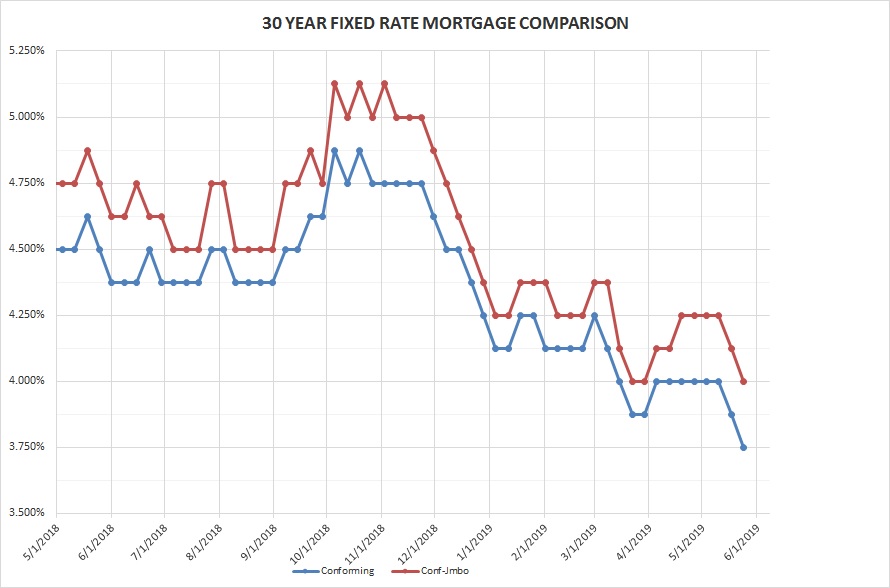
Rates for Friday May 31, 2019: A great line this morning form an article on the MarketWatch.com (a Wall Street Journal subsidiary) website regarding the economy, “The U.S. economy is basically sitting in the middle lane of a highway. It’s unlikely to generate enough speed to justify a shift into the fast lane or slow down so much that it will be shunted to an off-ramp.” This middle-lane economy is a bit swervy as investors concerns over the Trump Administration combining trade strategy with foreign policy has them nervous for potential long-term impact on not only the domestic, but also the global, economy. While the domestic economic news keeps rates in the middle lane, domestic politics and international economics has investors in a “flight to quality” today, leaving stocks and buying bonds and mortgages—which puts downward pressure on rates. All the movement of funds has resulted in our 30 year conforming rate being the lowest it has been on a Friday since January 5, 2018.

FIXED RATE MORTGAGES AT COST OF 1.25 POINTS LOCKED FOR 45 DAYS:

30 year conforming                                            3.75%        Down 0.125%

30 year high-balance conforming                    4.00%         Down 0.125%        

Please note that these are base rates and adjustments may be added for condominiums, refinances, credit scores, loan to value, no impound account and period rate is locked. Rates are based on 20% down with 740 FICO score for purchase mortgages.

It’s that time of year…near the end of school year but still not near enough for many kids. And parents. This morning as Leslie and I were walking the dog we crossed path with our neighbor who was returning to her home after loading a bunch of stuff into the minivan. “Almost there!” I greeted her. She turned to us with a smile, “I can’t wait. Lauryn (middle school) has a speech to give since she won a contest, a musical recital and then she’s in a play. All today!”

We wished her well and I told Leslie, “She embodies the Maycember song.”

What is Maycember? Click the link to the Holderness Family YouTube page for one of the most spot on, and funny, songs about the end of the school year that almost every parent—especially those with elementary and middle school kids–goes through.

For a great laugh for your Friday click here for “Maycember.” I’m thinking many of you will share this mom’s and dad’s you know can relate.

Have a great week,

Dennis

Past Weekly Rate & Market Updates can be found on my blog page at my website www.DennisCSmith.com/my-blog

Should I be concerned if my loan servicer changes?

Before we get to the question of the week, a small addition to last week’s piece on the impact of tariffs on mortgage rates, see below after the answer to question of the week for the update.

Question of the week:  Should I be concerned if my loan servicer changes?

Answer:  Yes. Concerned by not panicked.  

A quick recap on the path of most mortgages for newer readers of the Weekly Rate & Market Update, and a refresher for loyal readers. The vast majority of mortgages, after they are funded, are packaged into bundles by lenders and then sold on the secondary market to either Fannie Mae or Freddie Mac if they are conventional mortgages, or Ginnie Mae if they are government mortgages. The loans are then re-bundled into larger packages and sold to investors.

The actual loans are sold, but the servicing is maintained by the lenders. “Servicing” is the collection of the monthly mortgage payments, the principle and interest on the loan, and if set-up with an escrow (aka impound) account for taxes and insurance those payments as well. The servicer the retains a portion of the interest, generally 0.25-0.50%,  and forwards the rest of the interest and the principal to Fannie, Freddie or Ginnie, who then retain a small portion of the interest and forwards the remainder to the investors.

Mortgage servicing is a big business, a very big business. Consider that total mortgage debt in the United States is over $10 trillion dollars, of that amount Fannie and Freddie have about 60%, or $6 trillion, of the market. Assume an average interest rate of 4% and that amounts to $240 billion annually in interest payments, if servicers retain 0.25% of the payments that creates a $600 million industry.

Because of this steady volume of revenue mortgage servicing becomes a nice source of income, as well as a very nice asset that can be sold. Why would a bank or mortgage lender sell its servicing portfolio if it provides so much cash flow? If a bank needs cash to purchase another bank, pay off liabilities, build reserves, it may sell its servicing portfolio to another servicing entity. If a bank’s servicing portfolio becomes so large it will require more expenses to handle the volume, it may sell its servicing portfolio to another servicing entity. If a bank or mortgage lender is just not interested in setting up a division to service the mortgages it funds, it will sell it servicing portfolio.

It is not uncommon for property owners with conventional or government mortgages, or even jumbo mortgages, to receive a notice that their servicing is being transferred to another company and they will need to make payments to the servicing company at a certain date in the future.

Should this concern you if you get this notice. Concern may be too strong of a word, but you should definitely be aware of the possible issues that may occur due to the transfer of your mortgage servicing. Steps you should take if your servicing is being transferred:

  • If you have auto-pay setup with your bank to send out your mortgage payment, or setup with your lender to pull your payment from your account, make sure you cancel the payment to your soon to be old servicer.
  • Save your recent statements, this is especially important if you have an escrow/impound account for taxes and insurance. If you do not receive paper statements log into your account with your current mortgage servicer before the transfer is complete and print your most recent statements. Why?
    • Your current servicer may restrict access to their website in the future for non-clients
    • To have verification of outstanding mortgage balance.
    • To have verification of balance in your impound account for taxes and insurance.
    • To have verification of total interest paid to that servicer for your records for filing your tax returns you can match to the IRS form 1098 (mortgage interest paid).
  • After you have made your initial payment to the new servicer, verify the payment has cleared your bank account, once that has been verified contact the new servicer to confirm payment has been applied to your account.
  • If you have an impound account, when you call to verify your payment has been applied properly, ask what the balance is in your impound account before and after the payment.
  • Do not set up auto-pay until you have made one, and preferably two, payments to your new servicer and received statements confirming the payments have been properly applied.
  • If you have an impound account, when property taxes are due verify the new servicer has made the payment, and it was applied to your property. You can do this by logging onto the website for the tax collector for the county in which your property is located.
  • If you have an impound account, confirm with your insurance company that you have a new servicer and that you are to be notified when the payment has been made, and especially if it has not been received when due.
  • If you have issues requiring any phone communication keep a log of date and time of call, get identification of the individual you are communicating with regarding the problem, take good notes and confirm before the call is completed what was said and action to be taken. If you feel it necessary do not hesitate to thank the person for their assistance but that you would like to communicate with a supervisor as your issue has not been resolved, make sure you get the supervisor’s name and direct contact information if possible.

Not all borrowers have issues when their mortgage servicer is changed, in fact the over-whelming majority experience no issues at all. There are, however, issues with some accounts and to be aware of potential issues might make it easier for you to resolve should it happen to you.

The Smith Family Estate’s mortgage servicer is in the process of being transferred to a new company, one I have never heard of. Am I concerned? A bit, mainly because I know the issues that can occur; concerned but not overly worried as I know that the chances are all with go smoothly. But in case they do not, I am prepared. If you are notified your servicing is being transferred you should be prepared as well.

Have a question? Ask me!

Updating: In response to last week’s question of the week and answer, friend Conor asked, “I’m interested in the example of $5 on a $1,000 iPhone.   If there is, say, a 20% tariff placed on such electronic goods, wouldn’t there be a much larger impact?” Conor points out my need for an editor, especially when I write the WR&MU over several hours between more urgent client matters. He also asks a great question. In the WR&MU last week I averaged the cost of the tariffs imposed on Chinese goods across all goods and services consumers purchase, and failed to address the impact on specific goods on Chinese imports impacted. Conor is correct, the $1000 iPhone with a 20% tariff becomes a $1200 iPhone.

The impact of the tariff is for the consumer to either retain brand loyalty and purchase the more expensive iPhone, wait out the tariff and trade conflict for the tariff to be lower or go away, or purchase another brand of smartphone not manufactured in China.

There is another option however that will enable the consumer in the United States to purchase the new iPhone with no additional tariff cost. If Apple changes its supply lines and contracts with companies in Taiwan, India, South Korea, or any other country currently with the ability not subject to the Chinese tariffs to assemble iPhones for the American market and use the assembly plants in China to ship to other nations where there are no tariffs on the imports.

Starting before President Trump imposed tariffs on Chinese imports many companies with facilities in China have been shifting production to other countries so their products are not impacted. This transition has the effect of exacerbating the costs of the tariffs to China with the loss of jobs and revenue.

There are many products that will still be manufactured in China that American consumers purchase, and the consumer will need to make the choice to pay the tariff on the individual item or either not purchase or purchase a competing brand from another nation—perhaps the United States if such an option is available.

Thanks for the question Conor!

Bounce. What is one word to describe Southern California home sales in April, Alex? The California Association of Realtors April housing sales data showed a big bounce in sales for the month. Statewide the median price went from $565,880 in March to $602,920 in April, an increase of 6.5% for the month and 3.2% from April 2018. Prices may have increased statewide but units sold declined 0.1% for the month and 4.8% for the year. More locally Los Angeles and Orange Counties saw large spikes in sales volume, up 18.2% and 17.1% respectfully from March (with LA down 0.1% in units sold from last year and the OC up 0.5%). Prices for both counties also rose. The median price in LA increased 3.5% for the month to $544,170, which is 3.0% from March 2018. Further South, the $825,000 median price in Orange County was a 1.9% month over month increase and 0.9% bump from last April. One month does not make a trend, however it is a positive sign heading into the summer housing market to show some strength in the spring.

Rates for Friday May 24, 2019: China continues to be front of mind for investors this past week, but there has been little impact on the conforming rate, which is flat from last Friday. The high-balance rate skipped off last week’s dip and is up for the week. It is the Friday before a three-day weekend so the junior traders have been left in charge of the desks on Wall Street with the directive, “don’t lose,” which means a lot of equities and bonds being sold to hold cash and be protective of assets.

FIXED RATE MORTGAGES AT COST OF 1.25 POINTS LOCKED FOR 45 DAYS:

30 year conforming                                            3.875%       Flat

30 year high-balance conforming                      4.25%         Up 0.125%    

Please note that these are base rates and adjustments may be added for condominiums, refinances, credit scores, loan to value, no impound account and period rate is locked. Rates are based on 20% down with 740 FICO score for purchase mortgages.

Monday, we remember those who have lost their lives in service to our nation. This can be very difficult day for many active duty members of the military, veterans and families as they remember their comrades in arms, friends and family members who died in service. While we enjoy a day off we must also pause to acknowledge the sacrifices made by so many and give condolences to those who have lost their loved ones. From the beginning our nation has been one with many differences in opinions for almost every issue, but we come together to thank and acknowledge those who have stepped up to protect our right and ability to have those differences.

Our Lucky Charm for Boston sports (as explained last week), came home on Monday—the first time since January I have been able to hug her. Very wonderful to have her home for a bit before she takes off on Monday for Camp Birchwood in Minnesota where she was a camper for eight years and this summer will be a counselor for the next two months. She’s doing her job, growing up!

Have a great week,

Dennis

Past Weekly Rate & Market Updates can be found on my blog page at my website www.DennisCSmith.com/my-blog
What impact will the tariffs and trade with China have on mortgage rates?

Question of the week:  What impact will the tariffs and trade war with China have on mortgage rates?

Answer:  Great question, with a variety of possible answers, only three of which concern us: will the tariff tiff lead to higher rates, lower rates, or have no impact.

To recap for newer readers of the WR&MU, I have a degree in economics and political studies and have studied both since I walked on campus in August of 1980. There are plenty of jokes about economists not being able to give a complete answer to any question without a “but…” or “on the other hand…” which his some of what I will provide today, but also my personal opinion.

To recap the issue, in July 2018 President Trump imposed tariffs on China for what many consider unfair trade practices. There had been negotiations between China and the United States on trade issues since Trump and China’s President Xi Jinping visited the U.S. in April 2017 to meet with Trump, this was followed by Trump’s visit to China in November 2017. Following the visit negotiations on a broad range of trade issues were more circular than linear and the Trump Administration began implementing actions to pressure China into working to resolution of issues in the trade talks, and starting in March 2018 tariffs began to be imposed on certain goods entering the United States from China and other nations. China, in response, began imposing tariffs on certain goods imported from the United States.

Primary to the United States negotiations for a trade deal with China is the Chinese government doing nothing to stem, or preferably stop, the theft of intellectual property and the manufacturing of forged goods for sale into American and other international markets. The estimated costs of these actions by Chinese businesses, many of which are government controlled is from $250 to over $600 billion per year.

For more context, the trade imbalance with China in 2018 was $419.2 billion in China’s favor, in other words the United States imported $419.2 billion more from China than exported to China. From the numbers, the Chinese business and labor markets benefit more from trade between the nations than do American businesses and labor markets; on the other side American consumers benefit more from the imported goods from China than Chinese consumers from American imports.

Back to our question, what impact can this issue have on mortgage rates?

The issue can have the impact on increasing interest rates if the trade war is resolved in such a manner that results in loss of income to American businesses due to piracy and forgery of American intellectual property and products and a much wider opening to Chinese markets for United States goods. The result would be economic growth and expansion for the United States economy, which results in higher rates as strong economic expansion and growth tend to lead to inflation and higher rates. Rates or usually tied to stocks, if stock prices rise so do rates, besides higher prices and wages putting upward pressure, so will corporate earnings and profits sending stock prices higher pulling money out of fixed rate investments, like mortgages, creating more upward rate movement.

The issue can have the impact of lower interest rates if the trade wars continue beyond the United States and China to include other nations resulting in economic slowing in both nations and around the globe. This could create a recession, which is economic contraction instead of growth, which results in lower interest rates. Corporate earnings would drop, as would stock prices, which would have investors purchasing more fixed rate assets, leading to more downward rate movement.

The issue can have no impact on rates if either no new trade deal is put into place and the tariffs remain where they currently are or even increase some more.

Looking at the data, the last option is what I think will happen. It is important to separate the politics from the data of the trade between the United States and China. This is challenging since almost all of the information we receive is political in nature—just read all the adjectives, and the “could happen if…” “might happen if…” “may happen if…” in stories on any subject and in particular the trade issue, these statements color a story and ultimately inject politics. The impact of the issue so far has seen the stock market drop and climb and drop and climb, much of which I, and others, feel is unfounded as the impact of the tariffs on the overall economy and the amount of trade with China are both overstated.

Tariffs are taxes on imported goods that go to the federal government. From the beginning of our country until into the 20th Century, tariffs were the primary source of funding for our federal government. In 2018 Americans paid a total of $5.51 trillion in taxes (with a t-) to federal, state and local governments, of which $3.6 trillion when to Washington D.C. The most recent tariff hike on $200 billion in imports from China raised $30 billion a year in taxes for the United States, or about 0.8% (zero-point eight percent, or less than one percent) of total tax revenue last year. Certainly, a lot of money, but an additional $30 billion in tax revenue has zero impact on the government.

This also means that American consumers will pay $30 billion more for Chinese goods, absent inflation, due to the tariffs. In the first quarter of 2019 consumers in the United States spent $14.25 trillion, about 68% of our total Gross Domestic Product (GDP). If consumer spending drops 2% per quarter for the remainder of the year, a big if, total spending in the United States for the year would be over $55 trillion. The higher costs to consumers for the tariff costs are about one-half of one percent of their total spending (0.5%). Because iPhones and chargers are made in China, if we add 0.5% to the current cost of a high-end iPhone that is $1000, the price with tariff would be $1005.

Consumers are benefiting from the current situation in the grocery stores as food prices are down since China is importing less wheat, soybeans and other farm products. American farmers have crops ready to ship and while looking for other markets to take up the slack from the drop in exports to China an over-supply has led to lower prices at home. China importing less from the United States does not mean that China has stopped consuming wheat and soybeans, it means they are importing from other nations, which leads to higher prices in those countries, and also a vacancy in markets where they were exporting before selling to China.

In summation, the amount of trade between the United States and China is a very small percentage of our national economy, all exports to China amount to about 0.6% of our GDP so if all exports to China were to cease, while it would have a negative impact on some industries it would have a negligible impact across the whole economy. As well, the negative impact can, over time, be reversed with exports previously sent to China sent to other nations due to supply and demand in international markets.

Of greater impact to our domestic economy then the potential loss of trade is the historically higher tariffs on U.S. imports to China than Chinese imports to the United States, which has limited the Chinese markets to American companies while providing almost unlimited access to American markets by the Chinese. Combined with the loss of revenues due to theft of intellectual property and manufacture of forged goods, the trade situation with China is more costly to our GDP than the costs of the tariffs being imposed and loss of exports to China and higher prices for Chinese goods in the United States. Should an agreement be reached in which the Chinese government agrees to lower tariffs so they are somewhat in balance between the two nations and to crack down on forgeries and piracy the U.S. economy would see a very positive benefit due to an expanded marketplace for U.S. goods and retention of lost revenue.

Tariffs can be extremely harmful to both importers and exporters resulting in higher costs and/or lack of production. This is the case if the amount of trade and GDP impacted by the tariffs is a significant portion of either, or both, nation’s total trade and economy. While there is a lot of trade between the United States and China, the amount is not a significant portion of the American economy. Because of this the overall impact of the current tariffs, and potentially higher tariffs in the future, should not have a large impact on our economy nor interest rates.

Have a question? Ask me!

Speaking of American consumers, retail sales in April dropped 0.2% from March. Ordinarily this would be of some concern since consumer spending is 65-70% of our GDP, however since retail sales jumped 1.7% from February to March a slow down in April was expected following the torrid buying in March. Investors reacted to the news with a yawn and rates were not impacted.

Rates for Friday May 17, 2019: As stated, rather lengthily, above the perception of the impact of the trade dispute with China is worse than the actual economic impact. Perception however, is what moves markets and the markets will continue to be somewhat unstable until some sort of resolution occurs. After several weeks of rates being flat Friday-to-Friday we see a dip this week due to the instability in the markets and investors moving from stocks to bonds and mortgages.

FIXED RATE MORTGAGES AT COST OF 1.25 POINTS LOCKED FOR 45 DAYS:

30 year conforming                                            3.875%      Down 0.125%

30 year high-balance conforming                   4.125%       Down 0.125%

Please note that these are base rates and adjustments may be added for condominiums, refinances, credit scores, loan to value, no impound account and period rate is locked. Rates are based on 20% down with 740 FICO score for purchase mortgages.

If there are any fans of Boston teams reading this you may want to give me a call. The purpose of the call will be to ascertain your devotion to those teams and if it is enough to enable your Lucky Charm to remain in Boston for three more years. What Lucky Charm?

Last night the Boston Bruins advanced to the Stanley Cup Finals, where they will be the overwhelming favorite to beat either St. Louis or San Jose. If/when they do win the Stanley Cup, the Bruins will be the third team to win a championship for Boston since August 2018.

In August of last year our daughter showed up in Boston to begin her freshman year at Boston University. Her arrival was followed a few months later by the Red Sox winning the World Series and a few months after that the Patriots won the Super Bowl, and now the Bruins are four wins away from the Stanley Cup. Coincidence? Maybe. But if you are a Boston fan why take the chance? Why not make a donation to keep her in Boston as your Lucky Charm and bring more championships to your city?

For those who do not like Boston teams we may be able to negotiate what it would cost to get her to leave Boston and attend university where your favorite teams play. For your information, this Phillies, Eagles, Flyers, Sixers fan has struck out on her moving south….

Have a great week,

Dennis

Past Weekly Rate & Market Updates can be found on my blog page at my website www.DennisCSmith.com/my-blog

Why did my credit score drop?

Question of the week:  Why did my credit score drop?

Answer:  This question was posed to me by Bryan, with a Y, a young man who is starting his career, renting and already planning for his future which includes getting married and purchasing a home. He was concerned because he receives updates from his big Bank in America with whom he has a credit card about his credit score, and he received notification that his score had dropped about twenty points. Why?

Before I answered his question, I asked him another: why do you care?

My question was not meant to belittle Bryan, or to be sarcastic. I asked the question because I come across so many people who are very concerned about their credit score when they really do not need to be.

Bryan’s answer was typical, “because, I want to have a good score.” Well, even with the sudden decline in his credit score Bryan still has a really good score—the drop had no impact on his finances, credit or life in general. But still he was concerned.

In our conversation, I brought up when a credit score is important, when you are seeking credit.

By now everyone knows, or should know, that the cost you pay for credit depends to a large extent on your credit scores. The higher your scores the lower your costs for credit, the lower your scores the higher costs of credit.

When you are applying for a credit card, auto loan, a mortgage, your credit scores are important. When you are not applying for credit, or do not intend to for some time, your scores are not as important.

Does this mean you should not worry about your credit? As I told Bryan, live your life, buy what you need, use credit responsibly and you will have very good credit scores. If you use credit wisely and responsibly when it comes time for a large purchase you will have good scores.

Back to Bryan’s question: Why did his credit score suddenly drop?

  • Here are the primary factors that impact your credit score in order of importance:
  • What is your payment history—How you pay your credit obligations is the largest determinant of your credit score. The more serious any derogatory, i.e. late, payments are the more they hurt your score; a charge off or collection account is considerably more damaging than a 30 day late.
  • How much you owe and how much is available—While not as impactful on your score as your payment history, it is almost as important. Your debt utilization rate is more important than the total amount you owe. Debt utilization is the percentage of your available credit on an account that you have borrowed, the higher the percentage the higher the negative impact on your credit card. If you have a card that has a $10,000 limit and your balance is $9,350 the account will cost you points on your credit score; if on that same card you owe $4500 your score would be higher. For many clients we work with to improve credit scores this area is a primary focus as it is easier to lower credit balances than to get creditors to remove late payments.
  • How old is your credit—Having accounts that have been reporting for a longer period of time is better than having new accounts, especially revolving accounts such as credit and department store cards. If you are thinking of buying a home at the start of the year do not succumb to the department store discounts if you open a charge card with them during the Christmas season. As well, if you are considering purchasing a home do not close accounts until after you are in your new home.
  • What kind of credit do you have—Do you have a lot of installment debt or revolving debt or are you pretty balanced? The more broad the type of credit you have, mortgage, auto loan, student loan, credit cards, the better your score will be as long as they are within the parameters above. This factor is not a big impact on your credit score, but does have some influence.
  • Have you been shopping for credit—Multiple inquiries within a short period of time can hurt your credit score. That said some inquiries are worse than others. If you are purchasing a home or new car the scoring systems recognize you are shopping for installment debt, which if successful will most likely result in one auto loan or one home loan, and the impact of more than a few credit inquiries is not significant or perhaps have no impact. If there are multiple inquiries within a short period of time from credit card companies and department stores it is evident you are searching for credit which may signify some type of financial difficulty and the impact on your score could be several points.

Back to Bryan….It seems Bryan and his friends are going on a golf trip and Bryan fronted the funds for the reservations on his credit card. The total amount he charged to secure accommodations and tee times put his card balance over 80% of the card’s limit. Referring to factor two above, credit utilization, the high percentage of used to available credit on his card caused Bryan’s score to drop. When his friends repay their portion of the vacation expenses to Bryan and he uses those funds to pay down the credit card balance his score will increase to its prior level.

Credit scores are important as they are a very good indication of the risk a creditor takes when they lend money to someone. For individuals it is important to behave responsibly in credit use, but it is also important to not let concern about your credit score have too much influence on how you live your life.

Take Bryan, he is not buying a car or a home in the near future, so his credit score dropping twenty points for a short period of time is not very relevant. If he knew the credit score dip was going to occur would he have not made all the reservations for the guys’ golf trip? Probably not, Bryan’s a good guy and would make it easier for his friends, and himself, to secure the accommodations and tee times they needed so they can go ahead with their plans.  If Bryan was using a credit card that had “points” or other advantages, such a move was also very smart on his part.

In July of last year our Question of the Week was, “When should we have our credit report pulled when exploring the purchase of a new home.” If you missed this incredibly informative WR&MU you can read it here.

Have a question? Ask me!

Good timing award, goes to me for discussing personal debt and credit scores the same week the Federal Reserve released its monthly report on financial stability, in the report the Fed stated, “Household borrowing remains at a modest level relative to incomes, and the debt owed by borrowers with credit scores below prime has remained flat.” Consumer credit growth has slowed in recent months, while personal incomes have grown. It appears consumers are either increasing their purchases with cash and/or increasing their savings with their increased incomes.

Inflation remains tame. Both the Producer Price Index and Consumer Price Index increases in April were below expectations. Pushed higher by gas and energy prices the growth was only 0.2% for the PPI and 0.3% for the CPI (adjusted to 0.1% when food and energy stripped out of the data to obtain the “core” index). Year over year inflation for consumers edged up slightly from 1.9% to 2.0% in April, well within the Fed’s range of comfort. The news is rate neutral as it reinforces common sentiment that rates should remain stable for quite some time.

Rates for Friday May 10, 2019: This week was a good example of why watching financial data on an hour to hour, day to day, basis can be a bit maddening. As investors reacted to the comments by President Trump leading up to today’s trade negotiations with China and his then threat, now reality, to increase tariffs on Chinese goods by selling off in the stock markets, then buying back, then selling off we saw a similar see-saw in rate markets. Now that the words have become deeds, as I write this both credit and equity markets have rebounded. Over all the impact on rates from last Friday has been nil, we are flat for the fifth week in a row for conforming rates.

FIXED RATE MORTGAGES AT COST OF 1.25 POINTS LOCKED FOR 45 DAYS:

30 year conforming                                            4.00%        Flat

30 year high-balance conforming                   4.25 %       Flat

Please note that these are base rates and adjustments may be added for condominiums, refinances, credit scores, loan to value, no impound account and period rate is locked. Rates are based on 20% down with 740 FICO score for purchase mortgages.

We are a culture of hyperbole, everything is the best this, the worst that, the most awesome thing ever. Social media, if anything, has exacerbated our tendency to hyperbole—enhanced with pictures and comments from friends validating our hyperbolic opinions J!!

Where the word “best” is not hyperbolic is when used like this, “I have the best Mom ever…” Because for the overwhelming majority of people this is true—our Moms are/were the best ever. The best at hugs, the best at turning tears into laughs, the best at being your personal chef to cut off the crusts or leave off the mustard. The first and best at unconditional love.

To all the Moms, you are the best! Thank you for being the best for all of us sons and daughters! (And from us husbands, thanks for being the best Moms for our children as well!)

One final note, a special happy birthday wish to my big sister who has spent many years filling some of Mom’s roles for my brother and I. We love you.

Have a great week,

Dennis

Past Weekly Rate & Market Updates can be found on my blog page at my website www.DennisCSmith.com/my-blog
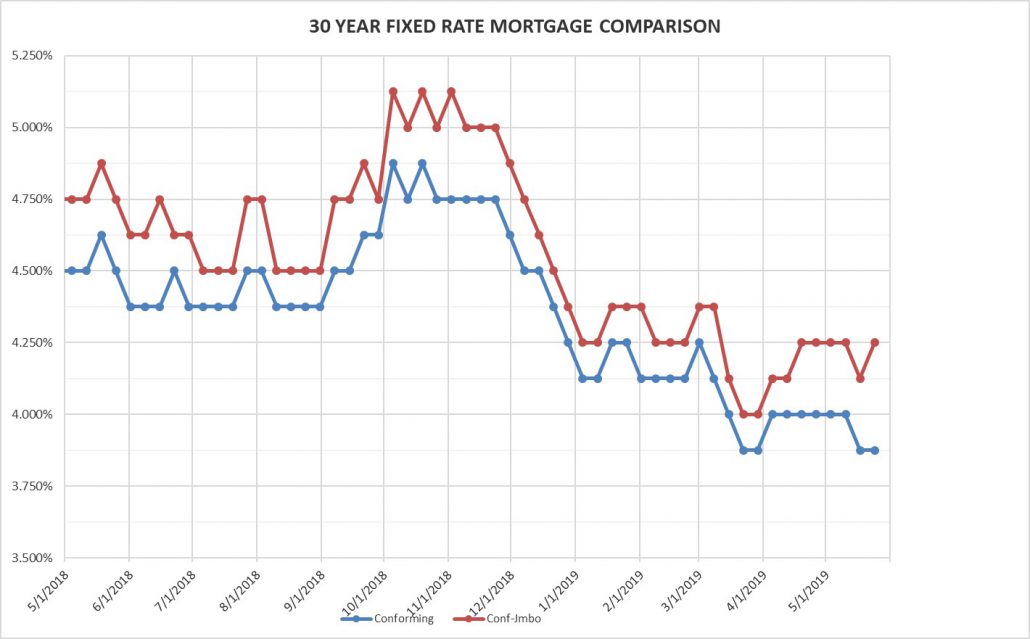
What happens if the appraisal or home inspection present a problem?

Question of the week:  What happens if the appraisal or home inspection present a problem?

Answer:  In last week’s Weekly Rate & Market Update we covered the difference between an appraisal and a home inspection. To recap, an appraiser’s duty is to set the value of the property for the buyer, and the lender if a mortgage is funding part of the purchase price; the inspector’s duty is to inform the buyer as to the condition of the property and improvements.

Not all appraisal and inspection reports are green lights to continue with the transaction, some are yellow lights to proceed with caution and occasionally a bright red blinking light telling the buyer to Stop! What happens if you are not getting a green light from the appraiser’s or home inspector’s reports?

The standard purchase contract contains several very important clauses, at the top of the list are the time frames during with buyers can complete necessary investigations to determine if they wish to continue the transaction. These dates are known as contingency periods.

Within this period the buyer obtains an appraisal and completes any necessary inspections. If, after review of the reports, the buyer has concerns about the property and/or the price to purchase the property as agreed to with the seller, the buyer has the ability to cancel the transaction and receive a full refund of their good faith deposit, provided such notification is made during the contingency time frames in the purchase contract.

But is cancelling the only option?

Here are the options should your appraisal or home inspection report not support the sales price or reveal concerns regarding the condition of the property.

Appraisal

There are two primary issues in an appraisal report that could create an issue for a borrower. The most obvious issue is the value provided by the appraiser is lower than the sales price. The other issue is the appraiser notates issues with the property that need to be corrected.

We will cover the property condition issue first. In last week’s WR&MU when discussing the role of the appraiser we mentioned that the appraiser does not perform an in-depth inspection of the property, but will notate visible conditions that could impact the health and safety of the occupants or lead to future deterioration of condition; items such evidence of leaky roof, missing flooring, etc. If there are such conditions noted the underwriter will require that these conditions are corrected prior to final loan approval. Prior to issuing the approval the appraiser will need to return to the property and provide a written statement and pictorial evidence of the correction to the underwriter.

If this occurs then the loan is contingent on the repairs being made and the buyer can notify the seller that unless the conditions are correct they will cancel the transaction. The seller can then decide that they will make the corrections, or reply to the buyer no corrections will be made and they are fine with the transaction being cancelled. If the latter occurs the buyer has two options, first, move forward with cancelling the sale. Second, inquire if the seller will allow the borrower to make the corrections at their own cost after initial loan approval and before the close of escrow.

If the seller will not allow the borrower to make any repairs during escrow we move to another option to enable the sale to close. In some instances, the lender will allow the repairs to occur after close of escrow if there is a bid from a licensed professional to make the corrections and the funds plus contingency reserve (usually fifty to one hundred percent of the bid) is left in escrow to fund the cost of the repairs.

Quick recap: Appraisal report notates conditions on the property that need to be completed. Options are a) seller repairs noted conditions b) seller allows buyer to make the repairs before close of escrow c) lender allows buyer to make repairs after close of escrow d) neither party wishes to make the repairs and the transaction is terminated. Which option is decided upon between the buyer and seller depends on the market, seller’s motivation and ability, and the buyer’s motivation and ability.

The other issue that occurs with appraisals, and the one of greatest concern to all parties involved is what happens if the appraised value is lower than the sales price.

Before we get in to the options for the buyer and seller should an appraisal come in under sales price it should be noted that the first action when this happens is a very thorough review of the appraisal and the comps utilized. We then contact the agents for the buyer and seller notifying them of the low value and provide them with the comparables used and ask them to come up with other sales we can ask the appraiser to use that would support a higher value. Since I have access to the Multiple Listing Service, I research the properties used for the comparables in the appraisal report to see if any should not have been used. Perhaps one of the comps was a flip, or the previous owner died in one of the comps, a comp is on a very busy intersection and this was not accounted for, etc. I then research the area for better comps to see if we can find any that would enable the appraiser to increase the value. With the comps from the agents and my own research I write an appeal and submit it requesting the appraiser reconsider the value based on the new information provided. We have a fairly high success rate in having adjustments to the value on low appraisals. There are, however, some properties that are sold at values higher than the current market supports, or there is a lack of comparables available to justify the appraiser increasing the value on the report. In these instances, or if an appraiser rejects our appeal, we must go through the options for having a value lower than the sales price on the appraisal report.

Most home purchases involve the buyer getting a mortgage to enable the purchase to close. A major part of the rate and cost of the loan is the loan-to-value, or LTV, which is what percentage of the purchase price is the loan? If you are putting 10% down the LTV is 90%, If you are putting 25% down the LTV is 75%. The lender calculates the LTV based on the lower of the sales price or the appraised value. If you are putting 10% down on a $500,000 purchase obtaining a 90% loan for $450,000 and the appraised value is $490,000 you LTV has gone from 90% to 91.8% LTV. This move up from 90% LTV changes the rate and/or price of your loan and the premium on any mortgage insurance.

In this scenario, not only are you potentially paying more of your mortgage but you may be more concerned that you are over-paying for the property. So, what are your options. It should be noted that the impact on a low appraisal is of greater concern to those with lower down payments than those with higher down payments as the impact on the cost of the mortgage is less, or none, the lower the LTV; i.e in above scenario there will be a higher rate/cost moving above 90% loan to value with the low value, if the original LTV was 55%, the low appraisal moving the LTV to 56.1% will have no impact on the rate or terms of the mortgage.

There are four basic options when an appraised value is less than the sales price.

The first option is you notify the seller of the lower appraised value and you wish the sales price of the contract to be lowered to the appraised value. The seller agrees to lower the price and you continue with the transaction at $490,000 and you put 10% down for a new loan of $441,000 at 90% of the appraised value and purchase price.

The second option, which occurs if the seller refuses to lower the purchase price to $490,000 you can agree to retain the purchase price of $500,000. If you choose this option you can either put an additional $9,000 down and obtain a loan of $441,000 to retain the 90% LTV rate and terms; or you may decide to retain the $450,000 loan amount with the $50,000 down payment and accept the rate and terms that would be available at the 91.8% LTV. In this scenario, we often go with the lower down payment scenario and move forward with the higher LTV mortgage as the math works in the buyer’s favor; however it depends on the buyer’s cash situation and preference of cash in the bank or higher monthly payment.

The third option occurs if the seller does not want to come down to the appraised value and the buyer does not want to pay the original sales price. Buyer and seller find a price between the appraisal and contact sales price. Usually, but not always the amount is cut in half, in this case the buyer and seller agree to complete the transaction at a price of $495,000. The buyer can then decide to increase the down payment to $54,000 or obtain a low at 90.9% loan to value.

The fourth option is the buyer does not want to pay more than the appraised value and the seller does not want to sell for less than the original sales price and the sale is cancelled. We usually see this option when there is a very wide spread between the sales price and the appraised value, and/or there are significant conditions with the property that will need to be addressed per the appraiser and/or home inspector. If the spread between the appraised value and the sales price is not too wide we rarely see neither side willing to move of their perceived value of the property. From the seller’s side, even if they had multiple offers they may not want go back to a previous buyer and chance another appraisal or worse go back on the open market. For the buyer, long term a few thousand dollars, while a lot of money, will likely make little to no difference in the long run of owning the home.

Of the four options when an appraisal value is lower than sales price in order from most often to least option outcomes we see Options 3 (meet in the middle), Option 2 (buyer pays sales price), Option 1 (seller lowers price to appraised value, Option 4 (transaction is cancelled). Most buyers and sellers want to complete the transaction.

Inspection

Not every home is perfect. Correction, no home is perfect. How unperfect are you willing to accept when you purchase your new home?

In the WR&MU update we discussed how a home inspector will go through, above and under a home and complete a report detailing the condition of the property, notating what is in working condition, what is not, what needs to be corrected now, soon or later, and what is in good condition and will not need to be replaced for quite some time.

Too often buyers are overwhelmed by the report and the list of items that are noted as, let’s say flawed. Cracked or broken switch plates? No home is perfect, move on. Cabinet under the sink damp and pipes rusted? No home is perfect, but this may cost quite a bit to fix and cure.

Upon receipt of the inspection report the buyer should go through the report to determine what falls under routine maintenance and are minor issues, such as the cracked switch plates and walls that need painting, and what issues are somewhat major and need to be addressed fairly soon to prevent further damage to the home or create a health and safety issue, like out of date electrical or plumbing.

After receiving the report and within the contingency period the buyer can provide the seller a list of items that they would like corrected before the close of escrow. In this instance we are discussing repairs that have come up from the inspectors report, we dealt with options for items on the appraisal that underwriting would require to be fixed above.

When this happens we typically see three replies from the seller: a) okay we will do the repairs b) sorry, we will not do the repairs c) we will not do the repairs but we will give you a credit of X thousand dollars so you can make the repairs after escrow closes.

If Option A is the reply to the repair request, woo-hoo! you are saving money on repairs. If Option B is the reply you have a decision to make, cancel the transaction, get your deposit back and start looking again for you new home, or stay in escrow and make the needed repairs yourself after escrow closes.

Which brings us to Option C, the seller offers to provide a credit so the buyer can correct the items themselves after escrow closes. When these credits arise we typically do not lower the sales price, but rather have the credit go through escrow to pay for closing costs for the borrower. This is usually because our clients are leveraging their purchase with a relatively high loan to value mortgage, 75% or more, and a credit for closing costs puts the funds into their pocket dollar for dollar as opposed to lowering the sales price. Huh?

In the above example with a $500,000 sale and the borrower putting down $50,000, or 10%, total cash to close can approach $70,000 when the cost of the loan, escrow, title, recording fees, funds for pro-rated interest and to establish an impound account for taxes and insurance. Let’s assume that the inspection report showed the electrical and plumbing systems needed to be upgraded or replace and the buyer received and estimate of $10,000 for the work to be completed. The seller does not want to live through the work being done while they are working, sending kids to school and packing for moving to their new home so they have agreed to pay for the $10,000 through the sale.

If the buyer agrees to lower the sales price by $10,000 for the credit the amount of cash they will need to close will be close to $70,000 still as the only real cash they are saving is the 10% on the $10,000 reduction (10% of original $500,000 sales price is $50,000; 10% of the reduced sales price of $490,000 is $49,000). There are incremental savings on the other fees but the total will likely be $500 or less. So the buyer saves $1000 in cash to close but will need $10,000 to make the repairs.

If the seller credits the buyer $10,000 in closing costs the buyer needs $60,000 to close the transaction instead of $70,000, a savings of $10,000—the amount to make the repairs.

If the credit is listed in escrow as “$10,000 credit to buyer for repairs listed on home inspection report” the underwriter will ask to see the report and may decide more items need to be fixed, as well the $10,000 plus a cost overrun contingency of 50-100% will need to be left in escrow and released only when proof is provided that the repairs were completed.

It is important to note that very rarely (very rarely) does an underwriter see the report from the home inspector. This enables the buyer and seller to negotiate regarding any repairs the buyer would like to see completed without having the lender mandate any corrections not notated on the appraisal report.

No home is perfect. A low appraisal or discoveries of flaws by a home inspector need not kill your purchase transaction if both parties are committed to closing. If one party is more intent on getting “a deal” than purchasing or selling a home then the opportunity increases for the transaction to no move forward, however if both parties are willing to negotiate and be open to a solution more often than not the buyer will be getting the keys to their new home and the seller will be receiving their net proceeds to move onto their next home or bank account.

Following last week’s update Cathy, real estate agent extraordinaire in the Central Coast, sent me this message, “The biggest difference between an appraiser and an inspector…if you get a stupid appraiser, it is not your fault. If you get a stupid inspector, it is.”  Which is why we have an appeal process.

Have a question? Ask me!

Positive news keeps coming. This week we had some important economic data released and all of it was positive. Monday we learned that consumer spending in March had its biggest one month increase, 0.9%, in nearly a decade, and 2.9% increase in spending over the past twelve months. Perhaps fueled by continued increases in personal incomes continuing to rise and having gained 3.8% from last March to this. This data suggests another strong quarter of growth in the second quarter. Strong growth in spending and wages is traditionally mortgage rate unfriendly it supports economic growth which leads to inflation which leads to higher rates. However the core inflation rate released with spending and wage reports showed no increase in prices in March and a dip in the annual rate to 1.6%, just above the Federal Reserve’s floor for what it considers acceptable inflation of 1.5%.

The week started and ended with positive news, as today the Labor Department released employment data for April showing 263,000 new jobs in the economy for the month and a drop in the unemployment rate to 3.6%, the lowest rate since the month my 58 year old brother turned 9 (December 1969). In a separate measure of income from the report on Monday, the Labor Department reported hourly wages increased in April for annual increase of 3.2% from the prior year. Over all the news is also negative for mortgage rates.

Rates for Friday May 3, 2019: Based on the economic data, or most of it, rates should be higher this week. However the tame inflation numbers have investors backing off expectation for higher rates, and this sentiment was supported by the Fed which this week announced…nothing. No movement expected for the rest of 2019 by the Federal Reserve which has investors sitting tight on fixed rate investments. Week over week we are flat for the fourth week in a row for conforming rates.

FIXED RATE MORTGAGES AT COST OF 1.25 POINTS LOCKED FOR 45 DAYS:

30 year conforming                                            4.00%        Flat

30 year high-balance conforming                      4.25 %       Flat    

Please note that these are base rates and adjustments may be added for condominiums, refinances, credit scores, loan to value, no impound account and period rate is locked. Rates are based on 20% down with 740 FICO score for purchase mortgages.

I guess this Marvel Avengers movie thing is a pretty big deal. Who knew? My daughter did and does. Like many others she saw the latest, and last, of the series on opening night and then again, a few nights later. Reading the receipts for the movie domestically and internationally it seems I might be missing out on something. Can’t wait for it to be on Netflix so I can pause it several times during its three hour run time for some refreshments and subsequently needed bathroom breaks.

I’m pretty old fashioned when it comes to movies, and other things. I like the old Westerns, dramas, mysteries and musicals and have never been a big fan of the Star Wars, comic book genres.

Have a great week,

Dennis

Past Weekly Rate & Market Updates can be found on my blog page at my website www.DennisCSmith.com/my-blog

What is the difference between an appraisal and a home inspection?

Question of the week:  What is the difference between an appraisal and a home inspection?

Answer:  This is a great question that comes up frequently with first time buyers, and some experienced homeowners purchasing for the first time in a long time.

The first difference is one is usually required and the other is optional.

Appraisal

If you are getting a mortgage to purchase the property the chances are very high the lender will require an appraisal. (In some instances, Fannie Mae or Freddie Mac may allow a “waiver” for the appraisal, this could happen for transactions with a low loan to value. Waivers are not rare, but are not common either.) The primary purpose of the appraisal is for an uninterested, licensed, professional to ascertain the value the property used as collateral for the mortgage on the date the offer from the buyer was accepted by the seller. The secondary purpose of the appraisal report is to notify the lender if there are any noticeable defects that could impact the value and/or salability of the property or present health and safety concerns for occupants.

Many people are surprised at how little time most appraisers spend at the actual property. They spend so little time because most of the work to prepare the appraisal report is done before the appraiser goes to the property for his/her inspection.

An appraiser will receive a copy of the purchase contract and any counter-offers for the transaction at the time the order is made. Before heading out to the property the appraiser, using the Multiple Listing Service and public records, will research the area looking for comparable properties. A comparable property is one that is similar to the subject property in type of dwelling, size, number of bedrooms and bathrooms and other amenities that impact value such as a pool. The appraiser will look at recent sales to determine prices for the closed sales, how long the properties were on the market, and the condition of the properties at time of sale. Properties that have been recently sold but have not yet closed escrow (called “pending sales”) will also be noted to determine if there is current activity for comparable properties to the subject. Finally, the appraiser will look at active listings on the market to determine what other options did the buyers have at the time they purchased the subject property and at what price and condition.

Once the appraiser knows the terms of the transaction and has an idea of the comparable properties in close proximity, s/he will inspect the subject property. The appraiser will measure the property’s interior room by room to make a sketch showing the overall size of the property and rooms. While measuring the appraiser will visually inspect the property to ascertain the overall condition, and not any noticeable issues that may impact value or the health and safety of inhabitants. Any noticeable water stains in the ceilings will be noted as they indicate a leak in the roof at some point, if there are missing window panes, flooring that is missing or has holes, missing sinks or toilets, anything that deters from the property being fully habitable or that could be evidence of a bigger issue is photographed and noted. In California the appraiser will also photograph and take note that the property meets state law by having smoke and carbon monoxide detectors properly installed and that the water heater has earthquake straps and is on a stand or platform so it is off the ground.

The appraiser will not test the plumbing or electrical systems, test windows for their ability to open, or otherwise perform a very close and detailed inspection.

The appraiser will drive by the comparable properties that are being used to establish value and take photos for them from the street.

After all the data is collected the appraiser will prepare the report. The report will compare the comparable properties and make adjustments to the sales price of those properties for size, condition of property, amenities, location (such as on a busy street), etc to arrive at an opinion of value.

Inspection

When you and the seller agree to a sales price one of the clauses you will likely agree upon is the opportunity for you, at your cost, to engage a professional to inspect the property, what the industry calls a “home inspection.” You may choose whomever you desire to perform the inspection, it is recommended that you choose someone certified by the California Real Estate Inspection Association (CREIA). In California there is not state licensing or regulations for real estate inspectors, CREIA a professional organization that has requirements for its members that include continuing education and following codes of ethics.

It is important to note that the inspector works for you. Not the seller or the real estate agents, but for you. The objective of the inspector is to perform as thorough and examination of the subject property as possible, the result of which will be a very detailed report.

The inspector will grade everything examined from needs replacing to estimated longevity to in fair-good-excellent condition. It is not the inspectors concern if the report “blows the sale” or “makes the sale” but to provide an objective, honest report of the property’s condition.

A thorough inspection will include inspecting the roof, and if possible the attic and/or crawl space below the roof. If on a raised foundation, crawling under the property. Inspecting the electrical panel and testing outlets and switches. Testing the plumbing by flushing toilets and turning on taps to gauge water pressure. Appliances that use gas  will be tested to determine if they are functioning properly with appropriate hook-ups and safety features. These are the major areas of concern and cost to repair or replace, but all aspects of the property will be inspected and put into the report for the buyer.

Not included in the report will be the cost to correct any defects noted, and it is not ethical for an inspector to quote, bid on or complete any repairs noted as needed on the report.

Once completed the report will provide the buyer with a very good indication as to the condition of the property. It should be noted that there is not “perfect” home in regard to condition; even brand-new homes can have faults and issues that need to be corrected. The important issues to consider on a home inspection report are the major, “big ticket” items that may need to be replaced or repaired in a short period of time. If there are any such items listed, say the electrical needs to be updated, it is encouraged for the buyer to obtain a bid from a licensed contractor for the cost to correct, and then make a decision how to move forward.

It is highly recommended that you accompany the inspector when s/he visits the property for the inspection. Note that this inspection is much more thorough, and therefore time consuming, than the visit from the appraiser, in some cases a few hours. By attending the inspection you can learn a lot about your new home, where is the gas shut off valve, education on the electrical panel, where are the clear-outs for plumbing, and most importantly get a verbal report and detail form the inspector that will shed more light on the condition than just reading a formatted report.

The primary difference between an appraisal and an inspection is their purpose. While the appraiser will note some condition items the primary purpose is to let the lender know if the sales price is supported by the market in the area, the purpose of the inspection is to inform the buyer of the condition of the property and its components. Both are very important because of their purpose.

Next week what happens when appraisal is low or inspection shows major issues?

Have a question? Ask me!

“Well, that’s surprising.”  This was the thought of many investors, analysts and watchers of the economy this morning when the government released the data for the Gross Domestic Product for the 1st quarter of 2019. Expectations at the end of the 4th quarter in 2018 was for growth this past quarter and as the quarter progressed and economic data was received for January, February and March the consensus expectation rose to 2.3%. Today, the first report for GDP growth in the 1st quarter was 3.2% growth, well above expectations. Besides strong economic growth in the quarter inflation eased from the prior quarter’s annualized rate of 1.9% to 1.4%. Of concern in the data was a slowing in consumer spending to 1.9% growth, the lowest in a year. The report should have no impact on the Federal Reserve’s decision to change its current policy to hold firm on rates through the year. Overall the report should be negative for rates as a growing economy leads to higher rates, however the tame inflation segment of the report and consumer spending data is positive for steady or lower rates.

Rates for Friday April 19, 2019: Will the GDP report cool the speculation about a recession later in 2019? That is the major question investors will be analyzing moving forward as investors react on what they feel may happen, or what others may feel will happen directing their actions. For now rates remain flat from last week.

FIXED RATE MORTGAGES AT COST OF 1.25 POINTS LOCKED FOR 45 DAYS:

30 year conforming                                            4.00%        Flat

30 year high-balance conforming                     4.25 %       Flat    

Please note that these are base rates and adjustments may be added for condominiums, refinances, credit scores, loan to value, no impound account and period rate is locked. Rates are based on 20% down with 740 FICO score for purchase mortgages.

Earlier this week we began the Great College Search II with our youngest daughter. We spent a few days in Seattle seeing the sites with the primary site being University of Washington as a possible landing spot. A very successful trip on all accounts. I like Seattle a lot, similar in many respects to San Francisco, but a nicer, cleaner, seemingly safer place to visit the last several years, in my opinion.

Next week is back to regular schedule in the house as spring break ends and the grind to the last day of school begins. I like regular schedules…

Have a great week,

Dennis

Past Weekly Rate & Market Updates can be found on my blog page at my website www.DennisCSmith.com/my-blog
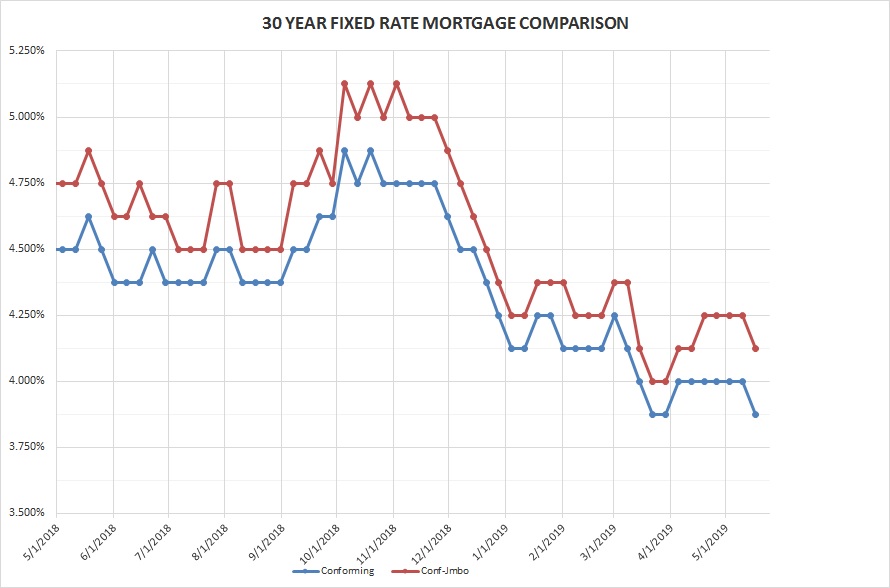
Should we buy a fixer for our new home?

Question of the week:  Should we buy a fixer for our new home?

Answer:  I have always been a strong believer of buying the worst house in the best area that you can afford. There are some qualifications that I will get into, but in general the quickest way to create value in real estate is to improve a property.

Getting a loan on a “fixer” can be easy, or quite the challenge, depending on what makes the property a fixer. Before we discuss the mortgage aspect of a fixer, let’s take a look at some other factors to consider.

Every neighborhood has a price range, the lowest part of the range is the value of the dirt. What is a vacant lot worth in the neighborhood? There are some properties that may be worth less than the lot value, consider a home that was gutted by fire and the lot must be scraped before any new structure can be built, in this type of instance it will cost a buyer significantly to get the permits and pay for the demolition and removal of the old structure.

The highest part of the price range in a neighborhood is a bit harder to determine, but generally not too far above the highest price of the home that has sold in the recent past. There are some exceptions in very high price areas where cash is common for the purchase transactions and the lot values alone have two commas in them. However, in most neighborhoods there is a ceiling above which it will be hard to get an appraisal to support a sales price—and since we are talking about using a mortgage to purchase a property the appraisal is critical.

Consider a neighborhood where most of the homes are somewhat similar, with about six or seven different floor plans ranging from three to five bedrooms and square footages up to 4,000 square feet. The most recent sale of a five bedroom, 4,000 square foot home with a pool that has is in excellent condition and modernized in terms of fixtures and appliances was for $750,000. This is the top of the market, the only other sale near this one was a similar size home without a pool that sold for $725,000.

Can you breach the highest sale in the neighborhood? If you own the exact same model, with a pool, how much more than $750,000 can you sell your home for if you make improvements? If you remodel your kitchen to a smart-kitchen with talking appliances, put in the latest Japanese toilets in all four of your bathrooms, convert the family room into a home theater experience with remote screen, window coverings, dimming lights and of course ultimate sound, plus the highest quality carpets and flooring, if you did all this and spent $100,000 or more how much more will your home sell for than the home that sold for $750,000? Will you get the entire $100,000 you invested plus costs of sale? Will you get more?

You possibly can, but to do so your buyer will likely need to bring a lot of cash to the table as even with all the money you put into the home and the improvements you made, an appraiser will be limited on how much higher than $750,000 s/he will be able to support in value given the neighborhood and other sales. You will have a home that is very nice, but still in the same neighborhood with values within a certain range. If you want to recoup the costs of your improvements, plus costs and some profit so want $900,000 for your fantastic home, the reality is that an appraiser may cap the value at $800,000 to $850,000 leaving your buyer needing to come up with $50-100,000 cash if they are getting financing to purchase.

A property is worth what someone is willing and able to pay for it; if the “able” part requires a loan then the value becomes what an appraiser tells the lender the property is worth.

Back to buying a “fixer.”

When looking at properties there are generally two conditions available, turn-key and needs TLC, aka a “fixer”. Some sellers spend some money before putting their homes on the market to freshen landscaping, paint the interior and possibly exterior and update floor coverings to make the property look as clean and fresh as possible to capture the highest price possible for the size in the neighborhood. These homes are perfect for the family that wants to just have to unpack boxes, purchase some new wastepaper baskets and plug in their entertainment devices.

The second type of property condition, the fixer, has a very broad range of what “fixing” is needed. From a lending stand-point, this is where things can get interesting.

Homes in the non-turn-key condition range can go from needing interior paint and new floor coverings to replacing electrical and plumbing systems, roofs, foundation repairs or other major work. There is generally a direct correlation between the amount of work needed to bring a home to the average, or beyond, for the neighborhood and the price to purchase. Factored into the price is often the ability to obtain a loan based on the condition, the more loan friendly a home generally the higher a buyer will, and can, pay as leveraged markets enable higher prices than cash markets.

What difference does it really make to a lender if a property is not in the greatest of shape? This is a question that comes up with buyers looking at properties that need some work to get them into decent living condition. It is important to remember when getting a loan that two entities are being evaluated for approval, the borrower to ascertain payments will be able to be made on a time basis, and the property to ascertain that not only is the value sufficient to support the applied for mortgage without significant costs to bring the property to reasonable standards and condition. Some clients argue, “well it will be once we fix what needs to be fixed.” What if in doing your repairs and upgrading it is discovered there are deeper issues than you were able to account for and because of this you run out of money trying to bring the property up to snuff?

From a lender’s perspective, the primary concerns are health and safety. If when an appraiser is inspecting a property sees something that s/he feels is of concern that will either cost a tremendous amount of money to fix or is a health and safety factor it will be noted on the appraisal. When reviewing the appraisal the underwriter will make final loan approval conditional on the items listed being corrected.

What are some examples?

A property last sold in 1985 and nothing has been done to the home since. The electrical and plumbing work, the roof still looks good and there are not leaks but the place is dirty with walls showing where pictures hung for over thirty years, the carpets are stained and show a clear path through every room, window coverings are dated and need replacing. None of these are health and safety issues, nor take a considerable amount of money to fix. Depending on the size of the home and whether the buyers can do the work themselves or need to hire others, the house can be spruced up pretty quickly for less than $10-15,000. The buyers of this home putting in some sweat equity will be able to purchase a home at the bottom of the range of value because of the condition and quickly bring the value to the average or above average of the neighborhood.

If you are willing to spend your evenings and weekends peeling decades old wallpaper and painting walls and ceilings this is very good type of property to purchase. The challenge is finding a home with the potential on the market and then being able to outbid other buyers with the same objective in mind.

A property last sold in 1985 and has the same conditions as above but also several other issues:

  • Several of the window panes are cracked or missing; these will need to be replaced as broken and missing glass are health and safety issues.
  • The electrical system in obviously faulty, there are extension cords running from outlets in one room to lights, etc in another room; an obvious safety issue as patchwork electrical is a fire hazard.
  • The roof is visually very worn and sagging, inside the house there are water stains on the ceiling; it appears the roof needs to be replaced as it is leaking.
  • In one of the bathrooms there is a bucket under the sink that is full and the shower head is missing; another health issue as there are obvious plumbing issues.
  • Under the window in the family room the wall is bubbly, evidence of prolonged water damage and the wood flooring below the window has rotted through so the subflooring support is visible; another obvious health issue with a leaky window and unstable flooring.

This home is very much a “fixer” and the type of property that can likely be purchased at the lower end of the price range in the neighborhood and after tens of thousands of dollars are spent to fix the many issues in the home can be brought up to well above the average condition and value.

This property would need the above items to be corrected before any traditional conventional, FHA or VA mortgage would receive final approval and be able to fund. This type of property typically would sell to a cash investor as the seller would not want to take the property off the market while a buyer tries to get loan approval, as well the seller will not be willing to spend the money to correct the items before the buyer gets loan approval—otherwise the work would have been done before putting the house on the market.

Homes in this type of condition can get mortgages from Fannie Mae or FHA using a home improvement loan. These loans are a bit more complicated than the standard loan but for the right amount of patience and effort can be effective in helping potential homeowners with the purchase and repairing of properties that otherwise would not be able to obtain loan approval.

Should you buy a fixer for your new home? If the right opportunity arises a fixer may be the perfect situation for you and your family. If you do find a property that is in disrepair before you commit to a contract give me a call so we can discuss the condition and the options that may be available to you based on your financial situation and ability to qualify.

Have a question? Ask me!

Inflation continues to not be a concern. Consumer and Producer Price Index data released this week shows that absent energy costs inflation both the CPI and PPI are favorable for consumers and the economy. Both indexes were high in March when the complete basket of goods and services were measured, primarily due to higher costs for gas and electricity—nationally gas prices were up 10% in March. Stripping out the volatile energy and food costs, what is known as the “core” rate of inflation, was up only 2% year over year for the PPI and only 1.9% for the CPI. Overall the news is friendly for rates as the higher inflation goes the higher rates go, tame prices lead to tame rates.

Rates for Friday April 12, 2019: A little upward pressure on rates this week, but we end the week flat from last Friday. Investors have been selling their fixed return assets, i.e. bonds and mortgages, for equities this week looking to profit from low inflation, strong labor markets and the Fed taking any rate increases for the rest of the year off the table. We have a very stable rate market and absent any major event rates should drift up and down from current levels no more than an eighth of a percent (0.125%) in the foreseeable future.

FIXED RATE MORTGAGES AT COST OF 1.25 POINTS LOCKED FOR 45 DAYS:

30 year conforming                                            4.00%        Flat

30 year high-balance conforming                      4.125 %      Flat   

Please note that these are base rates and adjustments may be added for condominiums, refinances, credit scores, loan to value, no impound account and period rate is locked. Rates are based on 20% down with 740 FICO score for purchase mortgages.

Sunday will wrap up one of my favorite weeks of the year. No, not the week before the April 15th tax deadline. The week of enjoying announcer Jim Nance as we move from the Final Four and Championship game in the NCAA basketball tournament to Augusta, Georgia for the Masters golf tournament. Mr. Nance is fortunate enough to be the lead announcer for both of these events, and we are fortunate to have him describing the action for us.

I love golf, my passion much better than my ability, and really enjoy watching the major golf tournaments. The impossible dream for me would be watching a tape of Jim Nance after the final round of the Masters saying, “And Dennis Smith drains the five footer for par on 18 to win the Masters!” I think I look good in green, especially a green jacket with a lovely logo on the breast. My rooting interest this weekend is for Ricky Fowler, one of the nicest men in golf, to win his first major. As it looks as I write this he has a long way to go as he is six strokes behind the leaders.

Have a great week,

Dennis

Past Weekly Rate & Market Updates can be found on my blog page at my website www.DennisCSmith.com/my-blog