Posts

Do we have to pay closing costs?

Question of the week:  Do we have to pay closing costs?

Answer:  Frequent readers of the WR&MU know the standard answer to the majority of questions of the week: Yes. No. Maybe.

 All real estate and mortgage transactions have costs, the question being asked is does the borrower have to pay them or can someone else?

Everyone has heard the ads, “no closing costs…” This is semi-truth in advertising. There are always closing costs, and someone is paying them, who and how?

Before we dig into who and how the closing costs can be paid we need a look at what closing costs are present in mortgage transactions.

Closing costs is usually a general term for any funds collected during the transaction. In reality, there are actual costs and recurring payments that combine to be called closing costs, we define these as non-recurring and recurring costs.

Non-recurring costs are fees you are paying only because you are in this transaction, fees for the appraisal, escrow, title, lender, county recorder are paid once, i.e. they do not happen again until the next time you enter into a transaction to purchase or refinance real property.

Recurring costs are funds that are collected to pro-rate mortgage interest, homeowner’s insurance and property taxes. These are costs that you pay because you own a home and have a mortgage. The funds to cover these costs will depend on three primary factors: whether you will have an impound or escrow account set up for the lender to collect and pay your property insurance and taxes, what day of the month your transaction closes, and what month of the year your transaction closes.

Closing costs are different for purchase transactions and refinance transactions, typically costs for purchases are higher due to the escrow and title fees being higher than for a refinance. If your transaction is a refinance there are two options for closing costs to be paid, if you are purchasing a new home you have those two options plus one more.

The first option is the most obvious one, you pay the closing costs. In refinance, you usually can add them to the new loan, which means you will be paying the costs over the life of the loan. If you are purchasing a home it does not make sense to add them to the loan amount as it would change your down payment, and that would change your loan to value, and that could change your rate. For example, you are purchasing a property for $450,000 with 10% down and your closing costs total $10,000, you add the costs to your loan increasing the loan amount from $405,000 to $415,000, this increases your loan to value from 90% to 92.2% which can impact your interest rate and mortgage insurance. For most refinance transactions, we encourage clients not to add the recurring costs for interest, insurance and taxes to their loan balance so they are not paying interest on those fees they would be paying whether they refinanced or not.

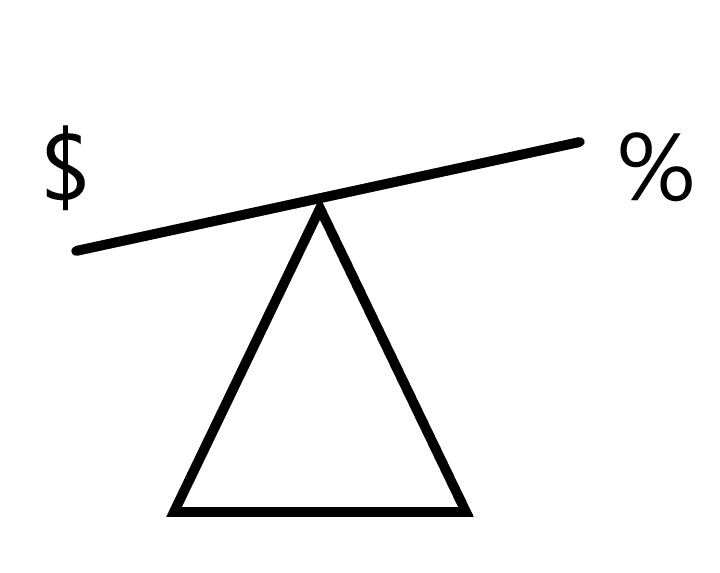
The second option is for the lender to pay the costs. This option occurs very frequently in refinance transactions where we close “no points” transaction and the other costs are either paid by the borrower or added to the loan. The lender can pay part or all of the closing costs for borrowers in a refinance or purchase transaction, on paper. In reality, the borrower is paying for the closing costs through a higher interest rate. Long-term readers of the WR&MU know the teeter-totter relationship between costs to close and monthly payments. The higher the interest rate, and therefore your payment, the lower the costs to close. This is because the higher rate a lender has on a mortgage the more money it can sell that loan for in the secondary market. If you are an investor with $100,000 looking for a relatively safe long term fixed rate investment and you have the choice for either a 4% return or a 4.5% return which would you want? If the cost for both is $100,000 you would obviously take the 4.5% return, but because of the way the market works the 4% investment would be offered to you for less than $100,000 because you will receive $500 less per year, conversely you would pay more for the 4.5% option because the return is higher. Here is the simple way to understand the relationship between costs and interest rates:

Higher Rate
Lower Costs

When locking in a loan for either a purchase or a refinance we will give a range of interest rates and their corresponding payments and what the total costs for each of those options will be. Some borrowers prefer spending more money for a lower rate and others are looking to minimize costs to them out of pocket and opt for the higher rate and payment. As a rule the breakeven point for having lender paid fees due to a higher interest rate is between five to seven years depending on the loan amount and costs; i.e. if you are saving $3500 out of pocket on a refinance by taking a rate that is 0.25% higher costing you about $45 more per month, it will take you about six and a half years to pay for the costs due to the higher payment (3500 divided by 45 = 77.78 months); or the other way if you pay the $3500 up front and reduce your payment by $45 per month you save the $3500 in 77.78 months. Long term you pay more for the costs being added to your rate, short term you do not have to pay the $3500.

The third option, available for those purchasing a property, is to have someone else involved in the transaction pay some or all of your costs for you—most typically the seller. I have always thought this a great option for homebuyers, but it is more popular during periods when the home sales market is slower. Here is how it works. You find a home you like for $525,000. We go through the numbers and with 10% down all your costs for the transaction including points to buy down the loan, escrow, title, etc total $13,000. You have a total of $56,000 in your accounts, so not enough for the down payment and closing costs. You write your offer to the seller for $538,000 with the seller to credit you $13,000 at closing for costs. The seller is going to net almost the same amount at closing—a bit less since if typically costs sellers about 8% to sell their home on the open market using real estate agents. Yes, you pay more for the property, but you save $13,000. Instead of $52,5000 down payment and a much higher rate to cover the $13,000 you do not have, your down payment is $53,800 and your loan amount goes from $472,500 to $484,200; at a 4% rate your payment is $56 more per month. Your “payback” for the $13,000 you did not pay at closing is almost twenty years; if you purchased the home for $525,000 and pay the closing costs of $13,000 and put $56 every month into a coffee can in the kitchen it will take you twenty years to save the $13,000 you could have saved when you purchased the home. I really like this option for home buyers even if they have the funds to pay their own closing costs, unfortunately not many agents encourage their clients to write such offers, or if they are representing sellers to accept such offers.

Like most mortgage questions there is no simple answer to whether you should pay the closing costs of your transaction, it depends on your situation and what makes you the most comfortable in trading off costs and payments. Not being a cookie-cutter lender, I always run through all the options with my clients for their purchase and refinance transactions so they can choose the option that works best for them and their families. Call me to explore the options for your transaction.

Have a question? Ask me!

Playing catch-up from the shutdown, the federal government economic data releases are giving us a picture of the economy in January as well as February. Combining the first and second revisions to the Gross Domestic Product for the 4th quarter of 2018, the initial 2.6% growth in the quarter was revised down to 2.2% and the overall growth in 2018 was 2.86% for the economy. This news is somewhat neutral for rates as the growth is of moderate strength, which should put upward pressure on rates, but with the revision being lower than the initial announcement showing slowing growth that is positive for rates to remain stable.

Consumers still in good shape, per the reports on income, spending and inflation. We will get the February data in the future, but for January consumer spending rebounded 0.1% to the positive after the surprising decline, and very surprising amount of decline, in December. The Price of Consumer Expenditures (PCE), the primary guage of inflation for the Fed, also should 0.1% growth for the month. The annual PCE increase dropped from 1.8% in December to 1.4% in January. The large drop in prices year over year from the prior month is positive for rates as it is well below the target 2% inflation rate. Overall this news is positive for rates as it portends a slowing economy and supports the Fed’s announcement at it most recent meeting that it is backing off on the number of rate increases in 2019.

Possibly putting upward pressure on rates, personal incomes continue to grow as they rose 0.2% in the month of February. Higher personal income reflects a strong labor market, which combined with low inflation should lead to higher consumer spending and economic growth. Overall the news is somewhat mixed for the economy with labor markets signaling a stronger economy than inflation and spending have shown.

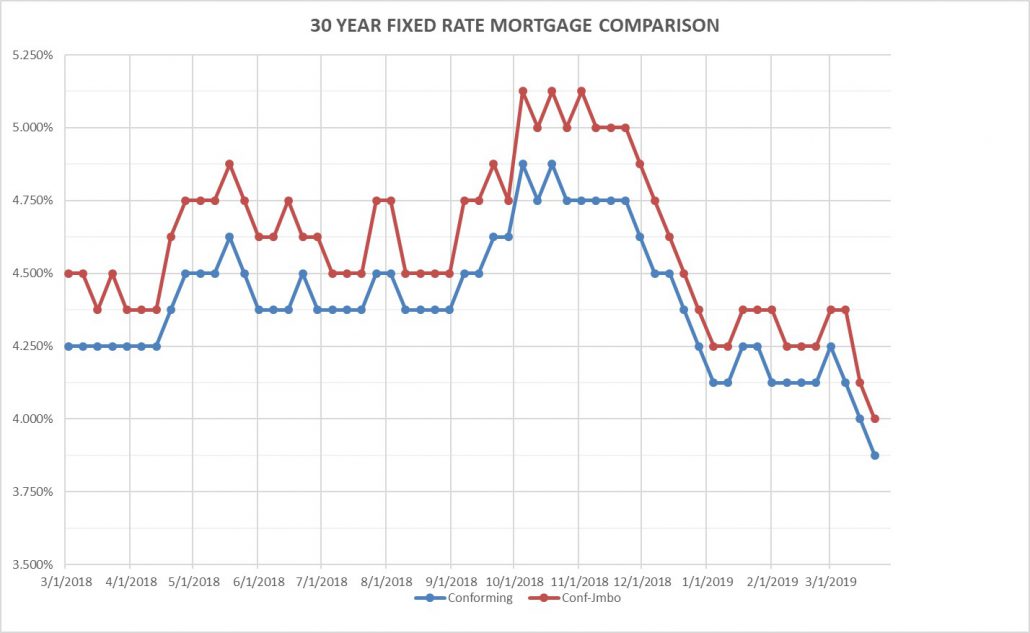
Rates for Friday March 29, 2019: Rates tried to break a bit lower early in the week but are flat today from last Friday and the conforming rate is below 4% for back to back weeks for the first time in fourteen months. Now is a great time to explore your options for refinancing to lower your payment, consolidate a HELOC or other debt or purchase a new home—Call me!

FIXED RATE MORTGAGES AT COST OF 1.25 POINTS LOCKED FOR 45 DAYS:

30 year conforming                                            3.875%        Flat

30 year high-balance conforming                    4.00 %         Flat  

Please note that these are base rates and adjustments may be added for condominiums, refinances, credit scores, loan to value, no impound account and period rate is locked. Rates are based on 20% down with 740 FICO score for purchase mortgages.
The great thing about yesterday was despite losing half of my Final Four in my bracket contest with my friends from college (we estimate the core group has been together in this pool since 1985 or 1986) was that it was Opening Day for baseball. That alone would have taken some of the tarnish off Michigan and Tennessee’s horrible shooting, but a shine was put on because the Phillies won convincingly and optimism abounds in the City of Brotherly Love—as much as any Philly fan can be optimistic.

The best $20 I spend every year is for my mlb.com subscription which gives me access to every radio broadcast of every major league game and playoffs for the year. If you call me between now and October, depending on the time of day, you will likely hear a baseball game in the background as I prefer that to music as the sound in the office. If the Phillies are not playing I will dial up whatever game is on the air, often looking for the smaller market broadcasts as I love the local advertising—for instance last summer listening to a Kansas City Royals broadcast during the weekend while crawling around pulling weeds I heard an ad for Popsicles. Popsicles! When was the last time you heard an ad for Popsicles!

Go Phillies, ring the bell!

Have a great week,

Dennis

Past Weekly Rate & Market Updates can be found on my blog page at my website www.DennisCSmith.com/my-blog

Should we co-sign for our son or daughter’s home purchase?

Question of the week:  Should we co-sign for our son or daughter’s home purchase?

Answer:  Yes. No. Maybe.

As we have seen in the news lately, many parents will do anything they can to help their children get a leg up, to get a strong start, to ensure a more comfortable life. Some parents do it by trying to help their kids get into certain colleges, some parents do it by helping their children with the purchase of their first home. We all want the best for our children, the question is how far are we willing to go, or for many parents how far can we go?

It is hard for most families to purchase their first home, especially in Southern California. Our question this week is courtesy of long-time friend Andy who was inquiring, not for California real estate but in Central Pennsylvania—where home prices are also challenging for first time buyers given the average incomes and real estate prices. Andy’s daughter and son in-law want to purchase a home, but need a bit of help to do so sooner rather than later. I received an email from Andy with the question above, which after speaking about the situation boiled down to not should he help, but what is the best way to help.

There are several ways parents can help their children purchase a home. Each has different consequences, short and/or long term. A primary factor I have parents consider when we are having these conversations is what will be the impact on their lives today, and in retirement, or if they are retired their future.

Let’s explore the different ways parents can help their children obtain their own home.

SCENARIO ONE: One way some parents help is by purchasing the house themselves. They provide the down payment, they qualify for the mortgage, and they are the only ones on the title and mortgage. Their child moves in and the agreement is that at some point the parents will give the house to their son or daughter.

Typically, under this type of arrangement the child will make all, or some, of the payments for mortgage, taxes and insurance, either directly to lender, tax collector and insurance company. However, we have seen this situation where they do make the payments but pay their parents directly . If the latter the parents can then claim the payments as rent and then, if eligible, write off certain expenses. In this set-up, the parents essentially purchased an income property and rented to their child.

If the agreement is that the child will make the payments for the mortgage, taxes and insurance it is advisable for the parents to add the children to the title of the property. If it can be shown they have made those payments then they should be able to deduct the mortgage interest and property taxes (checking with tax professional first). In this scenario, the parents purchase the home, but essentially turn the home over to their child. In the future, by showing they have been making the payments and living in the property it will be easier for them to refinance in the future, should it be beneficial, and remove the parents from a mortgage obligation and obtain full title.

In this scenario, the consequences for the parents are that they are obligated on a mortgage and the tax liability of owning property. If there is some issue between the parents and kids and the children move out then the parents have to determine what to do with the house, sell it, rent it, make amends so the child moves back in. Having the children participate by making the housing payments to those owed directly creates more of an ownership mentality for them and makes it easier to transition the home later on. The risk here for the children is the parents still control the property and can sell it without the children’s consent—unless the children are on title.

In my opinion, this is the least desirable way to help your children obtain home ownership.

SCENARIO TWO: A more desirable way to assist your children in the purchase of their own home is to co-sign for them on their mortgage application. Most loan programs will allow family members to co-sign for mortgages for owner occupied purposes—what we call “non-occupant co-borrowers.” In this scenario, the child cannot qualify for the mortgage, usually because their debt-to-income ratio is too high. Depending on the parent’s total income and debt obligations, including their own housing payment, they may be able to co-sign for their child and enable loan qualifying. The parents would be on the mortgage and on title to the property.

The parents are still liable for the loan payment, as they are in Scenario One above, however the child is also responsible and have a lot more control over the situation than they do in Scenario One. Some parents are concerned, rightfully, how their being on the loan may impact their ability to get a loan in the future; most loan programs have a guideline for such a situation, known as “contingent liability.” If the parents can show the child has made the last twelve payments in a timely fashion then most mortgage programs will not count the payment for their qualifying.

In the future if it makes sense for the child to refinance then it is easier in this scenario than Scenario One as they are on title and on the loan so there is less to verify for the lender.

SCENARIO THREE: Show me the money! Or in this scenario, show your kids the money. As mentioned in the Weekly Rate & Market Update on March 1st, lack of funds for down payment is the primary reason most families wait to purchase a home. Many parents help their children purchase their homes by giving them the funds needed for down payment and/or closing costs. Many families have the income to qualify for a mortgage, but are short in the amount of cash they need. Enter Mom and Dad who can provide a gift for the funds required.

The process is simple, we only need three items for this scenario: proof of funds to gift, proof funds have transferred to the child, a gift letter signed by donor and recipient.

There are loan programs that allow for gift funds for all of the down payment and closing costs, some programs as low as 3.5% down, other five or ten percent.

If the resources are available this is the easiest scenario to enable parental assistance, and the one that has no long-term consequences other than not having those funds available for the parents own use in the future.

After some conversation, this was the route that Andy and his wife have taken to help their daughter and son in-law purchase their new home in Pennsylvania.

If you are considering helping your children with the purchase of their home in the future, or you are wanting to purchase a home but may need parental assistance, please call me so we can develop a strategy that works the best for everyone in the family and results in that homeownership.

Have a question? Ask me!

Fed says what? After spending part of 2017 and all of 2018 broadcasting they would very likely, extremely likely, raise their Federal Funds Rate three times in 2019. Over the past few months three rate increases became less likely based on the minutes from the Fed’s meetings and this week three increases become not likely at all and even one may not happen. This news was very interest rate friendly.

Existing home sales had their biggest one month increase nationally since 2015 in February. The National Association of Realtors reported today that nationwide sales of existing homes were up 11.8% from January, a huge jump for one month. Total sales were down 1.8% from last February per the report and the nationwide median price of $249,500 was up 3.8% from a year ago. The market is still being held back by lack of first time buyers, in recent history first timers have been about 40% of the market and last month only 32% of homes closed were first time buyers. Over all the news is slightly negative for mortgage rates as higher sales puts more demand on mortgages and shows signs of positive economic news.

Closer to home for most readers, data for California and Southern California was a bit mixed. Statewide total sales also eclipsed 11% for the month, with sales 11.3% higher than January, but down 5.6% from last February. The median price across the state dropped 0.6% for the month and showed a 2.2% increase over the past twelve months with a price of $534,140. The two biggest counties in Southern California showed no consistency between them. Median prices were down in both counties from January, with LA County down 4.3% and Orange County down 0.5%. LA’s median price of $541,390 was up 2.7% from last February, while Orange County’s $792,500 price was down 1.6% for the year. Total sales in Los Angeles Country dropped 2.5% from the prior month and 10.9% from 2018, while the OC saw total sales increase for the month by 1.0% but a sharp drop of 16.5% from last February.

What does this mean?  Year over year sales being down sharply in the region are obviously a concern for long term real estate activity, however prices are holding fairly well against the declining sales. With rates looking to stay low for some time the housing market, in my opinion, should move sideways with slight ups and downs neighborhood by neighborhood, city by city, county by county, for the year. Again, in my opinion.

Rates for Friday March 22, 2019: With the Federal Reserve news this week showing a lack of interest to raise interest rates in 2019 rates improved this week and we see the conforming rate drop for the third week in a row and the 30 year conforming rate dipping below 4% for the first time since the second week of January last year when it climbed to 4%. Time for a rate check? Call me.

FIXED RATE MORTGAGES AT COST OF 1.25 POINTS LOCKED FOR 45 DAYS:

30 year high-balance conforming                      4.00 %         Down 0.125%       

30 year conforming                                            3.875%        Down 0.125%

Please note that these are base rates and adjustments may be added for condominiums, refinances, credit scores, loan to value, no impound account and period rate is locked. Rates are based on 20% down with 740 FICO score for purchase mortgages.

College athletes in major sports are provided a scholarship that includes tuition, room, board and stipends for books and incidentals. The NCAA Men’s Basketball Tournament tipped off this week with teams from 68 colleges competing in a one-and-done contest to determine the national champion, also known as March Madness for the many games that are decided on the final shot and small schools knocking big schools out of the contest.

In 2016 the NCAA signed an eight year contract with some networks that will be worth $1.1 billion per year.

This year it is estimate that one-in-five Americans will participate in some type of pool or bracket challenge for the tournament. According to the American Gaming Association these pools will have about $4.6 billion in wagers on the line. Since the Supreme Court ruled that the it was unconstitutional for Congress to prohibit sports betting several states have passed laws allowing sports betting, as a result of all the new legal betting opportunities in around 25 states it is estimated that almost $4 billion will be bet on the games—40% more than on the Super Bowl in February.

Excluding ticket sales, merchandising and other revenue, the gambling and television revenues total almost $10 billion for the tournament which is held in ten days over three weeks.

But at least the players get a chance to go to college for free.

I have Duke beating North Carolina in the final game. Surprisingly, given the great history of both these teams and their intense rivalry, they have never met in the tournament.

Have a great week,

Dennis

Past Weekly Rate & Market Updates can be found on my blog page at my website www.DennisCSmith.com/my-blog
Should we wait until we have a 20% down payment to purchase our new home?

Question of the week:  Should we wait until we have 20% down payment to purchase our new home?

Answer:  No. 

I have covered this topic throughout the years answering various questions that invariably lead to down payment, be it my thoughts on mortgage insurance (I like it, I will reprise reasons in coming WR&MU), cost of waiting to buy (covered last November), or borrowing from your 401(k) to help with your purchase, and many other questions of the week. We will cover it again today.

In a survey conducted by the California Association of Realtors the number answer to the question “Why didn’t you purchase a home sooner?” was “Needed to save for a down payment.”

Anecdotally, within my own and my co-workers’ experience the past several years, this is also a prime barrier we see with many of our clients who wish to purchase homes. The want to save more money for a down payment.

A bigger down payment.

It takes a lot of money to purchase a home in California, especially Southern California. Combine that with the prevailing sentiment of avoiding mortgage insurance and we have many families who could purchase a home today but are delaying doing so in order to save more money for a larger down payment.

It has always been my opinion that if you are able to purchase a home with the funds you currently have available you should do so. As I covered last November  with a very detailed comparison of two families purchasing homes in September 2017 versus 2018 the cost of waiting for accumulating a higher down payment to avoid mortgage insurance can, and usually does, costs you more in the long run.

The counter-argument is that he housing market is slowing. Last week the WR&MU had the home sales statistics for California showing the number of sales declining and prices, while flat year to year, were down from the prior month. If the market is slowing and prices may come down, does it not make sense to wait to purchase and let prices fall further and while waiting save more money for a down payment?

Only if your crystal ball is correct, if interest rates stay near their current levels and do not increase, if you are able to correctly predict the market, if you are certain the home in the neighborhood you want will still be available when you determine the timing is right.

Perhaps the biggest shift in homebuyers’ attitudes from the pre-2008 real estate bubble burst to the post-20008 real estate bubble burst has been their reason for purchasing a house. Many in the period of the real estate price balloon expansion prior to 2008 were purchasing houses, they were looking to make money on a real estate investment, they were using the value increase to obtain equity to finance consumer consumption. They were not buying homes so much as investments, as such price was what mattered most.

I have found that the homebuyers we have been speaking to and working with the past decade have been more interested in purchasing a home. They are looking for a place to raise their families, spend their retirement and hold for a long term rather than hoping for prices to climb so they can cash in.

This shift in mentality negates, somewhat, market conditions. If you are in a home for a long period of time, ten, fifteen, twenty years, minor market corrections are not of as much importance as if you were looking to purchase and then sell in the next three or five years.

If you have three, five, ten percent of the purchase price of the home you want to purchase available, and you can afford the mortgage payment buy the home. Buy the home today with the funds you have available and begin creating the home for your family. Yes, there may be a dip in the future of your home’s value, but does it matter if you will not be selling?

Our nature is to get what we want for the lowest price possible, but often while looking for the lowest price we are missing out on the best quality, best service or best product for ourselves and our family. Have you ever been shopping different airlines for ticket prices for your family vacation and see a good price but then take five or ten minutes more to see if there is a better price, then gone back to the site with the lower price and find there are no more seats available? You lost out on a potential bargain by looking for a better one. This happens to homebuyers as well, even in a soft market.

If you have funds available for a down payment, but are wanting to save more, please call me so we can discuss all your options for today and tomorrow when you have the funds saved you feel you will need. Those who know me know that I am not a “hard-sell,” I merely present options for you to make the decision you feel is best for you and your family, I cannot make you purchase a home, but I would like to show you the options of how you can—or if you are not able to show you what you need to do so you will be able to purchase your new home.

Find out your home buying options today, even if you want to wait until tomorrow.

Next week I will again answer the why I like mortgage insurance question, the week after I will cover the second reason families give for delay their home purchase as it coincides with work we do with our clients.

Have a question? Ask me!

Due to the partial government shutdown several economic reports for December are being released along with January data. One of these is personal income and consumer spending for December. December was an interesting month, personal incomes rose a very strong 1% for the month, but consumer spending dropped 0.5%, the largest drop since 2009. As a result of the increase in income and decline in spending personal savings jumped to 7.6%. Overall the news is mixed for its impact on mortgage rates, higher incomes should lead to higher spending and inflation, but the decline in spending and increase in savings should lead to a slowing in the economy.

Despite the drop-off in spending in December the 4th quarter Gross Domestic Product still grew by 2.6%. The rate of increase was slower than the 2nd (4.2%) and 3rd (3.4%) quarters but not enough to prevent 2018 to be the fastest growing economy since 2005. Holding back 4th quarter growth were a myriad of factors including housing and the trade deficit—and late in the quarter spending by consumers. Inflation for the quarter was 1.7% and year over year right at the Fed’s target inflation rate of 2.0%. Overall the news is negative for mortgage rates, a strong economy usually portends higher interest rates. However despite the strong growth in the year we have seen rates from recent highs in the fall of 2018.

Looking ahead, consumer confidence surveys released this week saw a surge, increasing for the first time in four months as most surveyed see better conditions ahead for themselves and their families. Will this confidence lead to increased spending and continued GDP growth above 2% and possible 3%?

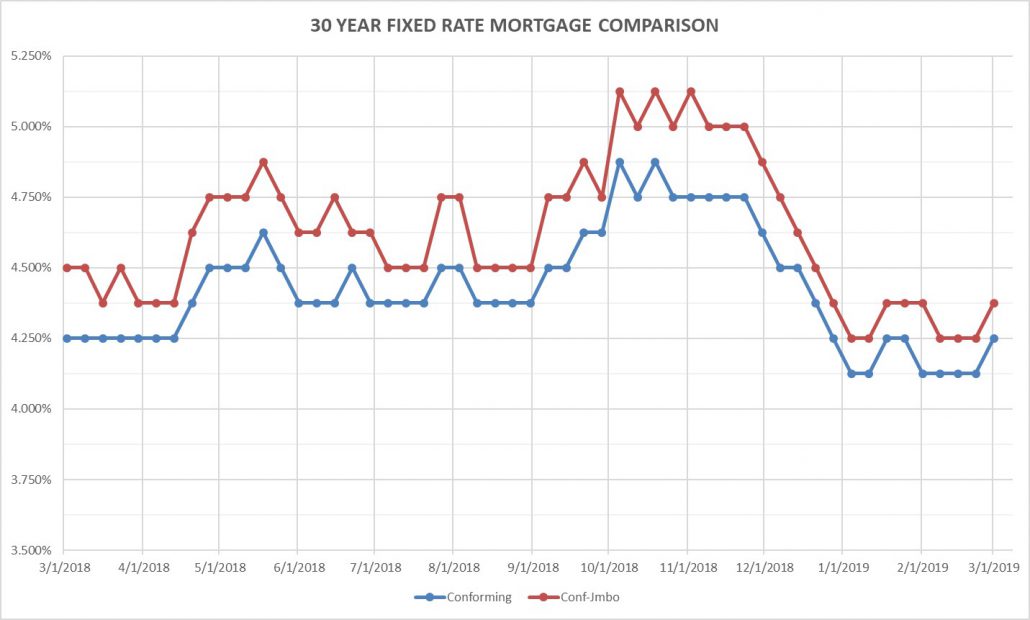
Rates for Friday March 1, 2019: After three weeks of steady rates we see a slight bump in interest rates from last Friday. There are many small reasons why this has occurred, mostly investors chasing higher yields elsewhere which puts a damper on prices and therefore higher returns, i.e. rates, in the market. I do not see this as a trend.

FIXED RATE MORTGAGES AT COST OF 1.25 POINTS LOCKED FOR 45 DAYS:

30 year conforming                                            4.25        Up 0.125%

30 year high-balance conforming                   4.375%   Up 0.125%       

Please note that these are base rates and adjustments may be added for condominiums, refinances, credit scores, loan to value, no impound account and period rate is locked. Rates are based on 20% down with 740 FICO score for purchase mortgages.

Sometime during our first year of marriage I got a bad head cold and Leslie said, “My dad has always said it takes three days to get a cold, three days to have it and three days to get rid of it.” Over the years I have noticed Don is right about this. Today is day one of the three part series for me, which means the last three days have been the wonderful, sneezy, snuffling, achy, sleepy portion of the cycle. Blech. Despite Don’s wisdom that this too shall pass, I am one of those who takes everything available, DayQuil, Mucinex, Emergen-C, Afrin, NyQuil, Ibuprofen, water, soup, whiskey…some day I’ll learn that I should just stick to one and ride it out.

I hope your week was spent in better health and that you are able to have the three-three day cycle avoid you and your household this year!

Have a great week,

Dennis

Past Weekly Rate & Market Updates can be found on my blog page at my website www.DennisCSmith.com/my-blog

What do you need to pre-qualify us for our new home purchase?

Question of the week:  What do you need to pre-qualify us for our new home purchase?

Answer:  There are three legs to the pre-qualification stool: Money, Credit, Income. To get pre-qualified, or pre-approved which takes the same amount of time and information, I need information on each of the three legs. 

Money How much money do you have for down payment and closing costs? Is all the money your money and in your bank account right now? Are you getting a gift from a family member to cover some, or all, of the funds needed? Copies of your most recent bank, investment accounts and retirement account statements will let us know how much money you will have for your purchase and any reserves your particular loan program may require. I have had clients in the past who have not shown me all their asset statements because, as one client put it, “If I show it to you then you will spend it.” Not true and not possible. I cannot spend any of your money, but I can show you different options for sales prices, loan amounts and monthly payments if I know about all your asset accounts and in what manner they are held.

Credit This category covers not only your current outstanding credit obligations, such as auto loans, student loans and credit cards; but also, if you have any spousal or child support payments or other court ordered payments. We need to know how much you owe, how much you have to pay on a monthly basis and your history of making payments. The quickest and easiest way for us to get this information is from a credit report (which will not show spousal or child support payments). “Is it necessary?” is a very common question when we request the authorization to run a credit report. The answer is, yes if you want to make sure you are getting an accurate pre-qualification for how much of a house you can buy. We can put in the information you provide us and provide some price and loan options, however unless we are viewing a recent credit report the information is not fully reliable for the basis of being pre-qualified. “If you run a credit report you will hurt my credit score,” is a common objection we hear. Running a credit report for the purposes of obtaining a mortgage, or getting pre-qualified, will very likely not have any impact on your credit score—if you have had several (by which I mean more than four or five) such reports run in the last few months one more inquiry may take a few points off your score. If you have had no inquiries run in the last few months for mortgages then our obtaining a report will not have an impact.

Income How are you paid? Are you self-employed? Do you have investment property? Do you have multiple streams of income? How long have you been receiving your income from its current source? Do you have overtime or bonuses? For most clients, this is a fairly easy question to answer. Most people are salaried employees who receive a W2 at the end of the year and we can easily and quickly calculate income. If this is the case then we need recent paystubs and most recent W2. If this is not the case then we will want to see at minimum the most recent federal income tax return that has been filed, and very likely returns for the past two years.

With all of this information we can usually pre-qualify, or pre-approve, you very quickly for a sales price and mortgage amount—by very quickly I mean less than fifteen minutes. If your income is a bit more complicated then we may need a bit more time and information.

What is most typical however, is a conversation that will take more than a few minutes, ideally in person but over the phone is also effective, so I can learn what you are looking for, your tolerances for payments and funds to spend, and making sure you have a full understanding of the transaction you are about to enter into, how the process works and most importantly that you are comfortable with the figures I am providing for price, loan amount, cash to close and monthly payment.

If you, or someone you know, if considering purchasing a home in the future please contact me to go through your options. If the potential purchase is not schedule for several months I strongly recommend having the initial conversations about how to purchase your new home sooner rather than later so that if there are any areas that need to be worked on to ensure approval you can start right away and not delay your purchase in the future.

Have a question? Ask me!

It has been ten years since real estate sales in California were as low as they were in January. The California Association of Realtors released home sale data for January and total sales were the lowest statewide since April 2008, with volume dropping 3.9% from December and down 12.6% from January 2018. The median price is up from last January by 2.1% statewide, but off 3.4% from the prior month with a value of $538,690. In Southern California both the LA and Orange County markets so drops in sale volume month-to-month and year-to year; LA down 25.5% for the month and 14.2% for the year while the OC saw sales drop 17% monthly and 13.2%. The median price in LA County in January was $588,140, down 3.8% from December’s $566,010 and up 0.3% from last January’s $564,100. Across the border in Orange County the median price was $796,500, up 1.5% from the prior month’s median price of $785,000 and up 2.1% from last year’s $780,000. January is historically a slow closing month for real estate as not a lot of escrows are opened between Thanksgiving and Christmas, that said this January was particularly slow. Anecdotally, our office has seen an upswing in purchase business so far this month from prior months—we will see if that is a regional and/or a statewide trend as well.

Rates for Friday February 22, 2019: With not a lot of economic news this week rates are flat from last Friday. There is a bit of possible long-term softening as the Federal Reserve Open Market Committee (the FOMC, who sets the direction for the Fed on rates and monetary policy) minutes from their last meeting indicated they will be slowing down their sale of assets consisting of Mortgage Backed Securities and U.S. Treasuries, this will put less supply on the  market and less upward pressure on interest rates in the markets.

FIXED RATE MORTGAGES AT COST OF 1.25 POINTS LOCKED FOR 45 DAYS:

30 year conforming                                            4.125    Flat

30 year high-balance conforming                    4.25%   Flat        

Please note that these are base rates and adjustments may be added for condominiums, refinances, credit scores, loan to value, no impound account and period rate is locked. Rates are based on 20% down with 740 FICO score for purchase mortgages.

This is a joyous and remembrance week in our family as on the 19th our youngest celebrates a birthday and on the 21st we remember my father who passed away on that date in 2014. Many people over the years have told me they may not read all of the WR&MU, but always ready this third section, the personal bit. This always causes me to smile as my dad did not like that I included this segment, “who wants to read that stuff? You have some good information and then put in that your daughter dances ballet.” I told him many times over the years, “Dad, this is the only section some people read and the only section almost everyone reads.”

Thank you for reading this and validating my stance with Dad.

Have a great week,

Dennis

Past Weekly Rate & Market Updates can be found on my blog page at my website www.DennisCSmith.com/my-blog
Why are there different rates or costs for the same mortgage product?

Question of the week:  Why are there different rates or costs for the same mortgage product?

Answer:  This is a question that is asked often, and one I typically answer every year to eighteen months in the Weekly Rate & Market Update.

Essentially why does a 30 year fixed rate mortgage of $400,000 have different costs for the family buying a condo versus a family purchasing a single family home versus a family refinancing and paying off an equity line versus….whatever other mortgage scenario is occurring?

Using the conforming mortgage as an example, defined as a loan that is eventually sold to Fannie Mae or Freddie Mac and that has been underwritten to their guidelines, the simple answer is “tiered pricing.”

If the most basic economic principle is supply and demand to determine prices, the second most basic investment principle is the greater the risk, the greater the return (the first most is fairly obvious, buy low and sell high); if there is little risk then you should not expect a very great return, conversely if there is greater risk then you should expect a greater return. If  you have a $10,000 deposit in a savings account at a federally insured bank that guarantees you will will get your money back if the bank collapses you should expect a very small return; if you invest your $10,000 in a start-up typewriter company you should expect a very high return should the venture become profitable.

Mortgages are investments. Your conventional mortgage is funded by a lender. The lender bundles your mortgage with others totaling tens of millions of dollars in mortgages. This bundle is then sold to Fannie Mae or Freddie Mac. Fannie or Freddie then puts the bundle with other bundles and issues investment vehicles called Mortgage Backed Securities (MBS). Investors across the country and around the world purchase MBS as part of their portfolios and investment strategies receiving regular payments, that are your interest payments, when you loan payoffs off investors receive a portion of the payoff in proportion to the investment.

The greater the risk the greater the return. Some mortgages are riskier than others, so investors in MBS will want a higher return on those mortgages.

What makes one mortgage more of a risk than other if they are being underwritten to the same guidelines? This is where tiered based pricing comes into play for mortgage consumers.

For different aspects of risk Fannie and Freddie charge more for the same rate. For example, a loan applicant for a loan with 5% with a very low credit score may pay up to two points (two percent of the loan amount) more for his mortgage than an applicant for a loan with 5% down who has an extremely high credit score. The lower credit score indicates a history of making credit payments on time, hence a higher risk, hence a higher cost for the loan than someone with outstanding credit.

Credit scores are just one of several risk factors that go into pricing a loan. Risk and risk pricing is determined by the historical defaults for mortgages with similar factors. Over the years, mortgagors with lower credit scores have defaulted on their mortgages more frequently than mortgagors with high credit scores, there for they are a greater risk, therefore their costs for the mortgage will be higher.

Here are the most common factors that result in tiered pricing:

  • Owner Occupancy: If you are living in the property being collateralized you will have lower pricing than someone purchasing for investment, an owner occupant is less likely to let a property go to foreclosure than an investor.
  • Number of Units: Most multi-unit properties purchased as primary residences eventually become investments, and multi-unit properties have a higher incidences of foreclosure as the mortgage payments are usually dependent ontenants making payments. Multi-unit properties have higher costs than single family units.
  • Condominium: Condominium owners are business partners with everyone else in their homeowners’ association, the quality of the complex is dependent on the HOA maintaining the property and a high degree of owner occupants living in the complex. Historically, condos have higher incidence of foreclosure. Because of these factors condos with greater than 75% loan-to-value (LTV) have higher costs than single family detached residences (i.e. a traditional house) or loans on condos with less than 75% LTV.
  • Loan-to-Value (LTV): The tiered pricing on LTV gets interesting. The common wisdom would be that the less equity a homeowner has in their property the greater the risk he will walk away and let a property go to foreclosure. And this is true, therefore with one exception the higher the LTV the higher the cost of the loan. The exception is LTVs between 75.01-80.00%, which have a higher cost than loans less than 20% equity. The reason is because loans with LTVs greater than 80% have mortgage insurance which covers the investors should the property go through foreclosure, properties with LTVs of 80% or less do not. If a borrower with 10% equity and a borrower with 22% equity both go through foreclosure, the loss for the investor is greater for the latter due to the lost interest and costs of foreclosure not being insured, as opposed to the 10% equity borrower who would have had mortgage insurance covering the losses.
  • Credit Score: We covered this above but to add to the cost, there is a matrix that has loan-to-value down one axis and FICO credit scores across the other. The higher the LTV the more the cost as credit scores drop, conversely the lower the LTV the lower the impact of the lower FICO score. In the example above the difference in cost for very low FICO borrower was two points higher than a very high FICO borrower if both were putting 5% down. The same very low FICO borrower putting 40% or more down payment would have loan costs that are two and a quarter points (2.25% of the loan amount) lower than the very low FICO borrower putting just 5% down. Your credit score impacts your mortgage costs depending on the LTV of the mortgage.
  • Cash-Out Refinance: Like credit scores the impact of the cost of pulling cash out of your property is dependent on the LTV of the mortgage. The higher the LTV the higher the cost of the mortgage. It should be noted that purchase and rate and term refinances are treated the same and both have lower costs than cash-out refinances.
  • Term of the Rate Lock: After all the factors have been sifted through the final cost differential is how long will the loan rate be guaranteed, how long is the rate locked. The longer the lock period the more expensive the loan, which makes sense as the lender is guaranteeing the rate if all factors input for the rate lock are shown to be valid for a longer period of time, protecting against higher rates. Most rate lock periods are in 15 day increments and the vast majority of our locks are either 30 or 45 days depending on the transaction type, complexity of the transaction and volume of business in the mortgage industry pipelines.

The costs are not paid in cash by the borrower, for instance if someone with a lower FICO score is purchasing a three unit building to rent with 25% down for a mortgage of $500,000 and the costs added by Fannie Mae are 4.125 points the borrower will not, probably not, come in with $20,625 more to close, but rather the interest rate would increase to off-set those additional costs, today that would be close to 5.5%.

The lowest cost mortgage is going to be a low LTV, high FICO purchase or rate and term refinance of a primary single-family residence; among the highest would be a low FICO, maximum LTV, cash-out non-owner occupied refinance. The first is relatively low risk, the second is relatively high risk.

There are more factors that go deeper into the weeds than I have gone with my examples, but you can see that with so many factors in play rate quotes can be risky proposition unless all the details and factors of the borrower and property are known. This is why when someone asks, “what are interest rates?” my response is, “well that depends….”

My weekly rate chart is based on the purchase of a detached single-family home for a borrower with a 740 FICO score putting 20% down payment into the transaction and locked for 45 days; a fairly normal transaction. If you have any of the factors above that are different then your rate may be different.

Let me know what your mortgage need is and allow me to provide you an accurate rate and cost for your transaction.

Have a question? Ask me!

Rates for Friday February 8, 2019: Very little economic data of interest to rate markets released this week, as a result mortgage rates were fairly flat for the week. Had the Treasury not had three large sales of bonds rates likely would have dropped. Note that high-balance rates have drifted back closer to the conforming rate, which was flat from last Friday. Next week we get data on inflation, expectations are for very low increases in prices, should that not be the case and prices increased more than expected we may see a bounce in rates. Of greater impact on rates could be the negotiations with China on trade policies, if talks turn sour rates may react by climbing. For now the market is quiet and stable.

FIXED RATE MORTGAGES AT COST OF 1.25 POINTS LOCKED FOR 45 DAYS:

30 year conforming                                            4.125%     Flat

30 year high-balance conforming                   4.375%     Up 0.125%      

Please note that these are base rates and adjustments may be added for condominiums, refinances, credit scores, loan to value, no impound account and period rate is locked. Rates are based on 20% down with 740 FICO score for purchase mortgages.

Did whomever had 3-3 in your office pool buy lunch for everyone? For those with those numbers in the Super Bowl pool, especially a forward and backward score pool, the final minutes of the fourth quarter resulted in a nice payday. In recent years, we have been fortunate to have very exciting Super Bowls with fantastic finishes; for much of the history of the big game this was not the case and unfortunately Sunday’s NFL finale reverted to history with a dull game. What really aggravated many more than the punting contest on the field was the lack of excitement in the commercials. The only one I liked was the NFL’s ad with the Hall of Famers and All-Pros playing a game through the fancy dining room. What I really liked was the follow up on the commercial, a piece on Sam Gordon, the young lady seen towards the end of the advertisement. Click on the links and check them both out.

Now that football is over we can turn to baseball. Pitchers and catchers report to their teams’ training camps this week, to be followed four to five days later by position players. I am looking forward to my prediction of a few years ago of the Phillies having completed their rebuilding process and competing for their division title and hopefully making the playoffs—it all starts this coming week!

Have a great week,

Dennis

Past Weekly Rate & Market Updates can be found on my blog page at my website www.DennisCSmith.com/my-blog

1-18-19: Will the federal government shutdown impact the timing of my loan approval?

Question of the week:  Will the federal government shutdown impact the timing of my loan approval?

Answer:  No, well very, extremely likely no.

Unless you are in a rural area and obtaining a USDA or perhaps waiting for FHA to approve a condominium complex in which you are purchasing or refinancing one of the units.

At the start of the shutdown there was some delay for borrowers with properties in areas that required flood insurance, which is available only through the National Flood Insurance Program, however Congress passed legislation and the President signed into law a bill authorizing the program to May 2019 so the policies could be written.

For the vast majority of mortgages for residential mortgages there is minimal interaction with the federal government during the loan process.

One requirement for many mortgages is verification of your income by a review of your tax transcripts as filed with the IRS (to see why we need this form here is the WR&MU from April 2018 on the subject. For this process, we use IRS Form 4506-T, during a government shutdown the requests for a copy of your returns are not processed. Having experienced such delays in the past, in recent years lenders have eased the burden by allowing some work arounds to the Form 4506-T requirement, typically a copy of the cancelled check or other proof you paid taxes owed on the tax returns provided, or a copy of a bank statement showing the deposit of your refund that matches the refund on your tax returns provided.

Government insured loans, such as VA or FHA, are not impacted by the shutdown as the processing and underwriting is performed by private companies and not government agencies. While Fannie Mae and Freddie Mac are quasi-government agencies they are operated as private companies and are unaffected by the shutdown.

The primary area of impact during government shutdowns, once flood insurance is authorized, are inquiries for loan issues in which a response is required from either VA or FHA. It is very rare that a situation arises in which a lender will require a response from either of the agencies in order to approve a loan, but they do arise from time to time and any such cases arising during the shutdown will likely face delays until someone is available to reply.

In a broader view, the impact of the shutdown on mortgages is the impact it may have on the economy and subsequent impact on interest rates. Fundamentally, if there is an impact on rates it would be for rates to decline. A very prolonged shutdown could result in negative economic impact and regular readers of the WR&MU know that poor economic performance usually leads to lower interest rates.

If you are concerned that the government shutdown will impact your current loan in process, or a home mortgage you are contemplate, do not be concerned.

Have a question? Ask me!

With the government shutdown some key economic data that could impact mortgage rates is not being release. This week we would have had retail sales data for December, a key piece of information for gauging economic activity since consumer spending comprises 65-70% of the nation’s economy. With no data on how the Christmas shopping season went for retailers investors are left to speculate whether the 4th quarter GDP data will show 2018 ended strong and total growth over 3% or slowed down with growth being under 3%. The lack of information had no impact on rates as investors looked to other bits of news to guide their decisions.

Rates for Friday January 18, 2019: Stocks and bonds are in their traditional relationship, if stocks go up so do rates, if stocks go down so do rates. Stocks climbed this week, much of the increase on speculation that the trade dispute with China is cooling down and on rumors the United States may lower some tariffs. Investors fled their prior “flight to safety” of bonds and invested their sales proceeds in stocks. After thirteen weeks of rates being flat or down from the previous Friday we see mortgage rates tick up this week—the first Friday to Friday increase in rates since October 19th.

FIXED RATE MORTGAGES AT COST OF 1.25 POINTS LOCKED FOR 45 DAYS:

30 year conforming                                            4.25%      Up 0.125%

30 year high-balance conforming                    4.375%     Up 0.125%      

Please note that these are base rates and adjustments may be added for condominiums, refinances, credit scores, loan to value, no impound account and period rate is locked. Rates are based on 20% down with 740 FICO score for purchase mortgages.

After four weeks it is time for our daughter to return to Boston to finish her freshman year. Always a bit of a weather nut, looking at the national weather maps in the paper every day, something I got from my dad, I am much more so concerning weather in the Northeast these past five months. My weather-nerdness has us on somewhat of a concerned profile as a very big winter storm is on track to hit the Boston area late Saturday and into Sunday—include her 2:30 landing time at Logan Airport. Part of going to school back east, or anywhere that winter weather is not 50 degrees and some rain, is dealing with weather delays at the airport.

Not all lessons are learned in the classroom. Our plan tomorrow is to spend a bit of time at the bookstore to get some “old fashioned” books in case her Kindle runs out of juice.

Have a great week,

Dennis

Past Weekly Rate & Market Updates can be found on my blog page at my website www.DennisCSmith.com/my-blog
1-11-19: What are our mortgage options for remodeling our home?

Question of the week:  What are our mortgage options for remodeling our home?

Answer:  There are several options for paying for major home improvements or remodeling. Most commonly used for paying for major home projects are cash, a home equity line of credit or fixed rate second trust deed, new primary loan with cash out, new renovation loan, or possibly tap other resources. Here are some basic guidelines for the various financing options.

Cash: Depending on the scope of your project you may have enough money saved to pay for your construction project. The obvious advantage is lack of any interest costs and monthly payments. Keep in mind that many remodel/renovation projects can end up costing more in time and money so make sure you have enough to cover cost over-runs as well as whatever post-project expenses you may have—such as new furniture, floor coverings, etc. If you are using cash for your remodel you may want to obtain a home equity line of credit for a small amount to cover over runs to ensure you do not run out of funds during the project and then may be unable to obtain financing because part of your house is torn apart and not yet put back together. If you do not need to access the available funds that is great, but if you do you will be prepared and seamlessly be able to continue and finish your project.

Home Equity Line of Credit (HELOC): A HELOC is like a credit card, you are approved for a maximum amount of credit and then you can access as much of the funds as you need up to the credit limit, you make payments based on the amount of the outstanding balance. A big advantage of HELOCs and remodeling is you only pay for the amount of money you need when you need it. For instance, your project is estimated to be $50,000 with 20% paid upfront to get started and then other funds paid to the contractor at certain points of completion with the final amount due when all is complete. You sign the contract and access $10,000 and pay the contractor, you bill comes the next month and you owe the payment due based on $10,000. The next month you pay another $15,000 to the contractor and not having paid any principal on the first payment, you made an interest only payment, your next bill will be based on the $25,000 balance. This gives you flexibility based on how you use the funds available.

Another advantage of HELOCs is many lenders will provide lines of credit at a higher loan-to-value (LTV) than you may be able to obtain with a fixed rate loan or traditional mortgage. This enables you access to more funds than you would otherwise be able to obtain.

The disadvantages to HELOCs are the rates are variable, tied to the prime rate so over time it is hard to budget total costs; for example, since December 2016 the rate has increased 2%, while during this period the 30 year fixed conventional rate is only up 0.25% (after being higher by 0.75% a few months ago). The other disadvantage is self-imposed by the borrower—interest only. The minimum payment due on most HELOCs is an interest only payment, many borrowers fall into the habit of paying interest only which results in a large balance remaining on the loan which has to be paid at some point in the future either through a refinance or sale of the home.

Fixed rate Second Trust Deed: This financing instrument operates like a traditional fixed rate mortgage, however because it is in second position the rate is higher than available primary mortgages at the time of the transaction. The advantages of the fixed rate second are the ability to budget exactly what the payment will be for the period of the loan (generally available in fifteen or twenty year options) and if your current mortgage has a rate that is significantly lower than your current rate you can retain that rate and payment.

The disadvantages of the fixed rate second are many lenders restrict the LTV to 80% (same as most primary mortgages) and the higher interest rate.

Cash-out Refinance: This option is pretty straightforward, you refinance your existing mortgage and increase the amount borrowed to cover the funds you need up to the LTV allowed by the loan program. Most cash-out programs limit the loan balance to 80% of the appraised value of the home so if you are going with this option it is a good idea to have a good estimate of the value of the property.

The advantages of the cash-out refinance option are that you have a 30 year fixed rate mortgage. This provides you the lowest possible payment due to the long amortization, a fixed rate throughout the term of the mortgage which enables you to budget your monthly housing payment with certainty. Another benefit for many homeowners is depending on how long you have had your current mortgage and the increase in monthly payment may not be as high as you would expect; for instance we are closing a loan with a borrower accessing $75,000 and their payment is going up only about $275 per month, whereas their option on a fixed second increased their payment by almost $700.

Disadvantages of the fixed rate option are you are provided all the funds at closing and begin making payments on funds that may be sitting in the bank waiting for your project to begin and through the finish. Another is your interest rate may increase from your current mortgage rate.

It needs to be noted that when pricing mortgages a cash-out refinance are costlier than a rate and term refinance and a purchase transaction. The higher the LTV the more expensive the loan, conversely if you have a lot of equity in the property your costs would be lower if you LTV falls below certain price points based on the appraised value and how much your are borrowing.

Renovation Loan: This option is a combination of a traditional fixed rate mortgage and a HELOC and can be used to purchase a home you wish to remodel or as a refinance of your existing home for major renovations. We will use as an example a refinance.

Your current home is worth $550,000 and you owe $325,000. You wish to add a bedroom, a full bathroom and remodel the kitchen. The total costs are $125,000 and after the work is completed the value of the property will be $645,000. We complete the loan application for a mortgage of $450,000, $325,000 to pay-off your existing mortgage and $125,000 for costs to remodel. With our loan package besides the standard information we would need to show you qualify we will also need plans and estimates of costs from your contractor. During the loan processing we will make sure your contractor is approved by the lender and have an appraisal completed that includes the current value and the value of the home after the project is complete.

All goes well and the loan is approved and we fund the mortgage, your existing mortgage is paid off and the excess funds are placed in an escrow account controlled by the lender. After certain parts of the project are completed you request a draw from the account, the completion of that part of the project is verified and funds are transferred and you can pay the contractor. At the end of the project you have used all the money on the mortgage and your contractor is paid.

Advantages of this option are that you have a 30-year fixed rate mortgage upon completion of the project and the rate is competitive with a traditional mortgage or cash-out transaction. Another advantage is your contractor is vetted by the lender—which in our experience has resulted in some borrowers needing to change contractors after issues arose regarding insurance, licensing or past issues with the contractor that the lender discovered the borrowers were unaware of when they selected the contractor. This may sound like a negative, however should something occur with the contractor during the project it is a nightmare; knowing a contractor had issues in the past decreases the opportunity for such nightmares to occur.

 A disadvantage for many borrowers is the process to get to loan approval, which is longer and significantly more thorough than the traditional approval process—it is a bit more time and effort but understandable due to the nature of the project. Another disadvantage for some is the draw process where the contractor is not paid until certain completion points in the construction. Many contractors want funds before they start the process, using the renovation process they may not get the funds until after the process; some borrowers mitigate this issue by fronting the funds to the contractor and then getting reimbursed through the draw process.

Piggy-back: Some homeowners do their own version of the renovation loan by maximizing their funds available with a traditional 30 year fixed rate mortgage and then add a HELOC onto the property for additional funds. For instance you need $80,000 for your project and a cash-out refinance will enable you to obtain $65,000, you obtain the additional $15,000 needed on a HELOC—what we call a piggy-back transaction as your HELOC piggy-backs on your first mortgage. The advantage of the fixed rate 30 year loan for the bulk of the funds needed combined with the higher LTV of the HELOC lets you complete your project with the best of both options.

Reverse mortgage: Yes, reverse mortgages can be used for home improvements if the borrower qualifies and enough equity is in the property.

Other options can include borrowing from the bank of mom and dad, possibly borrowing against your 401(k) or a margin account on an investment account.

One of my favorite books we used to read to the kids was If You Give A Pig A Pancake. I usually encourage any family looking to do an extensive remodel to read the book as it is a good metaphor for many such projects. A major pitfall for most homeowners is underestimating the amount of work and costs that will need to be done to accomplish their goal of another bedroom and bath and a remodeled kitchen. Once walls are open what will the contractor find? Out of date and code electrical? Inadequate framing? Foundation issues? A rotted out floor under the shower? The original choices for cabinets or fixtures are not available adding time, and/or costs, to the process? You forgot that with the newly remodeled home that you now need furnishing?

A high percentage of the time when I have clients undergoing a remodel they let me know that even though they thought they were being somewhat liberal in the costs they still were short of what was needed. Read the book and imaging instead of a pig going through your home in search of a pancake it is your remodeling project needing more and more done to ensure completion.

Be very thorough in your plans, go deep into your interviews with contractors as to typical issues that come up, and possible issues given the age of your home, location (for instance we are on expansive clay soil which causes foundation issues—not all contractors are aware of this) and scope of your project.

All that said, I usually counsel clients that are considering extensive home improvements that before they commit to explore the options of what homes are on the market that would achieve the same objective. If you are looking to add a bedroom, bathroom, modernize your kitchen or other work that entails a lot of time and money, evaluate the current value of your home, what your net proceeds would be if you were to sell, what loan amount and sales price you will be able to qualify for and feel comfortable paying and then look at the local market to see if it makes sense for you to purchase what you want.

You may find that you prefer to remain in your current home and endure the remodel process, or you may find that you would benefit by purchasing a home that meets your needs.

Whichever route you choose to take please contact me to go through all your options and the advantages and disadvantages of each.

Have a question? Ask me!

Words matter, especially when they are the words of the Federal Reserve Open Market Committee (FOMC)—the group that sets the Federal Reserve borrowing rates which impact other rates such as the prime rate. The minutes from the last FOMC meeting were released this week and they showed that while all the voting members say “yes” to increasing rates at the last meeting there was some discussion by some to not raise rates. As well the minutes showed that future rate increases are not guaranteed. This is positive news for mortgage rates.

More positive rate news today as the Consumer Price Index dropped in December for the first time in nine months, primarily due to lower gasoline prices. Also declining was the year over year cost of living, dropping to 1.9% growth from the annualized growth of 2.2% in November. The 1.9% price increase was the first time since August 2017 the important data point was below 2%. The news is very mortgage rate friendly as the Fed uses the data for their gauge of inflation and the desired price increase for the Fed is 2% per year. If the price decrease remains below 2% moving forward it puts pressure on the Fed to not increase rates.

Rates for Friday January 11, 2019: For the first time in six weeks rates have not declined, and prior to today’s CPI data we might have seen them bump up a little bit. Upward pressure on rates this week was caused by gains in stock markets as investors felt confident about the on-going trade talks with China. At this point the government shutdown is not have much, if any, impact on financial markets.

FIXED RATE MORTGAGES AT COST OF 1.25 POINTS LOCKED FOR 45 DAYS:

30 year conforming                                            4.125%      Flat

30 year high-balance conforming                    4.25%        Flat    

Please note that these are base rates and adjustments may be added for condominiums, refinances, credit scores, loan to value, no impound account and period rate is locked. Rates are based on 20% down with 740 FICO score for purchase mortgages.

Since the end of the last football season my ring tone has been the Philadelphia Eagles fight song, “Fly Eagles Fly.” Starting in March of last year our youngest has asked me, “how long are you going to have that as your ring tone?”

“As long as they are the reigning champions.”

On Sunday I thought I would have to change my ringtone, thankfully the left-hand of the Eagles defensive tackle deflected the Bears’ kicker’s field goal attempt just enough to cause it to hit the upright and the cross bar so I retain the ringtone at least for one more week.

Not overly positive with this week’s game against Drew Brees and the Saints, but hopeful that next week at this time when you call I will still hear, “Fly Eagles fly, on the road to victory….”

Have a great week,

Dennis

Past Weekly Rate & Market Updates can be found on my blog page at my website www.DennisCSmith.com/my-blog

1-4-19: What is 2019 looking like for Stratis Financial?

Question of the week:  What is 2019 looking like for Stratis Financial?


Answer:  Exciting! We spent the last quarter of 2018 adding some new lender partners to expand our portfolio of mortgage products well beyond our foundational products of conventional and jumbo 30-year fixed rate mortgages. Our new lenders bring alternative products that can benefit self-employed borrowers, borrowers with extremely high-net worth and borrowers looking to secure housing through retirement. With our growth in lending options we can cover pretty much any mortgage need for residential homeowners or home buyers in the state of California.


Personally, I am excited to add a new relationship referral source that will enable me to be assist more families with their mortgage needs as well as strengthen my connections with past clients and referral sources.


From you I am looking for inquiries for your mortgage needs and plenty of questions to answer for you in 2019, please ask and I will answer and help you with solutions and options!


Have a question? Ask me!


Job growth and economic growth seem to be going in different directions. In the last revision for 3rd quarter 2018 Gross Domestic Product output the rate of growth was 3.4%, down from the prior quarter’s growth of 4.2%, current forecasts for the 1st quarter of 2019 are economic growth in the U.S. economy growing less than 3%. The data shows economic growth is slowing. In a seeming anomaly, during this slowing growth period employers have not been slowing their hiring practices, as evidence by today’s report on December employment from the Department of Labor. Blowing away forecasts, employers added 312,000 new jobs in December, the consensus forecast of economists surveyed by MarketWatch was an addition of 182,000 jobs. Also included in the report were upward revisions to the job growth data for October and November. The most reported employment number is always the unemployment rate, in December it rose from 3.7% to 3.9%, not due to layoffs but due to more people entering the job market seeking work.


This is very positive data, but the most important data in the report was that average hourly earnings for workers increased 0.4% for the month and year over year the increase was 3.2% in wages, matching the post-recession high of earlier this year. With wages growing over 3% and inflation growing right around 2% workers have more residual income to either spend on goods and services or put into savings, or both.


Today’s data has created confusion amongst the “experts” as to the short and long-term future for rates and the economy. Will the increase in hiring and wages spur economic growth? Will it push back, or push off, an expected recession in late 2019 to early 2020 or not at all? Will the job markets create inflation that will cause the Fed to react with more rate increases? Or is the labor market surge, a final movement before international markets seep into domestic markets causing economic slowing to accelerate to the point that the economy shrinks into recession? The economic data the past several months has been inconsistent with the employment showing growing strength while growth has been losing strength.


What does it all mean for interest rates? The hundred-billion-dollar question, literally. Quick recap: good economic news means higher interest rates; bad economic news means lower interest rates. What we see from our economic data is a combination. Good news: more workers working earning more income allowing them to spend more and sustain economic growth. Bad, or less than good, news: Economic growth has been slowing, international markets are slowing and in turmoil due to the ongoing tensions due to tariffs and negotiations between major trade partners, home sales slowing down nationwide. Rates have been dropping consistently for six weeks and are well down from their seven-year high in October. Last month the Fed indicated instead of three rate hikes in 2019 it would probably initiate two rates hikes, and the common wisdom has become that the Fed may not raise rates at all in 2019. What it means for rates in the short-term is likely continued volatility in equity markets, i.e. stock markets, which typically results in investors putting their money in the “safe havens” of fixed rate assets, such as bonds and mortgages. More money invested in fixed rate assets leads to lower returns on those assets, in other words lower rates, or lack of rising rates.


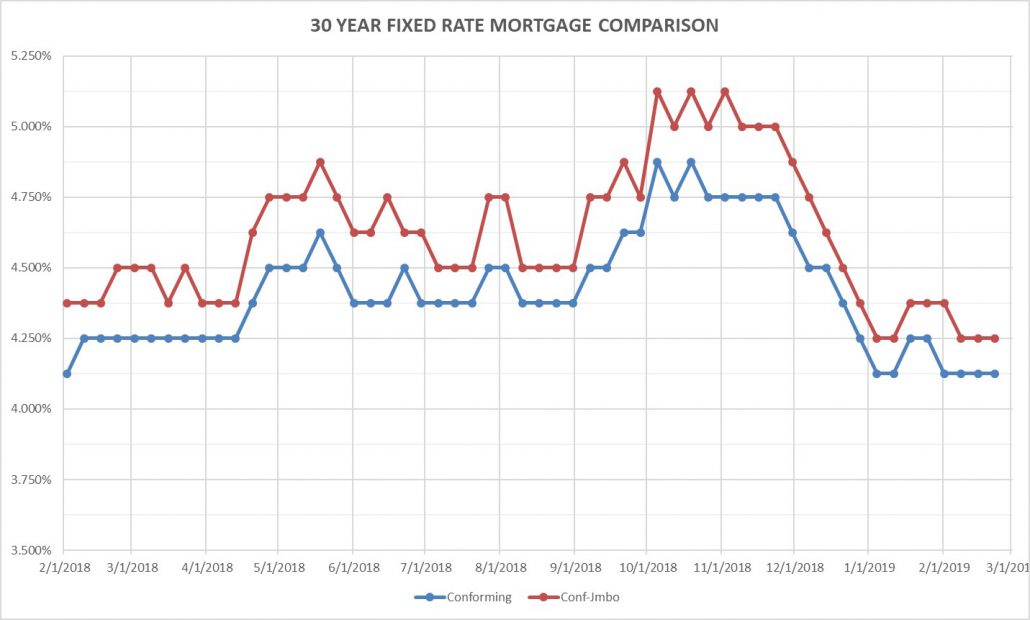
Rates for Friday January 4, 2019: Interest rates and stock markets continue their intra- and inter-day surges and falls, with the trend being lower rates through the volatility. Should there be resolution to the tariff/trade disputes, an agreement to open the closed portions of the federal government and positive news for the 4th quarter GDP the turmoil will subside and rates will rebound higher. If the confusion continues and the GDP news shows continued decline in growth rates will stabilize at current or lower levels. Take advantage of the current rate market while you are able to do so. Rates are down again this Friday from last.


FIXED RATE MORTGAGES AT COST OF 1.25 POINTS LOCKED FOR 45 DAYS:

30 year conforming                                            4.125%      Down 0.125%

30 year high-balance conforming                     4.25%        Down 0.125%


Please note that these are base rates and adjustments may be added for condominiums, refinances, credit scores, loan to value, no impound account and period rate is locked. Rates are based on 20% down with 740 FICO score for purchase mortgages.


The Smith family is on its annual post-Christmas/pre-back-to-school trip to a desert, this year returning to our favorite p-C/p-b-t-s location of Scottsdale, Arizona where the temperatures have been very cool, the skies clear and the relaxing fantastic.


We return to our familial abode tomorrow and back to mostly normal schedules on Monday (exception being our college freshman who is wondering what to do for the two more weeks before she returns).


Looking forward to a wonderful 2019 and helping you, your family, friends, neighbors and co-workers with your mortgage needs!


Have a great week,


Dennis


Past Weekly Rate & Market Updates can be found on my blog page at my website www.DennisCSmith.com/my-blog
12-28-18: Happy New Year! Rates Drop Continues

Question of the week:  Are you having a nice holiday?


Answer:  We are, and I hope your family is as well. It is nice having our oldest home and the family all together for a while.


A break this week from the Weekly Rate & Market Update, should have a regular missive next week.


Have a wonderful New Year!


Have a question? Ask me!


Rates for Friday December 28, 2018: You may have noticed the markets have been a bit schizophrenic this week, continuing the ups and downs from last week but with much bigger swings. The volatility in the equity markets (stock markets) has created a flight to safety for investors, which means they are leaving the uncertainty of equities and purchasing fixed rate investments to lock in returns—i.e. bonds and mortgages. As a result rates continue to drop, the fourth Friday to Friday drop out of the past five weeks for conforming and the fifth Friday in a row for high-balance rates. The 30 year conforming rate is the same as it was on April 13th and down five-eighths of a percent (0.625%) from its high of the year in October. If you have an equity line with a large balance now may be a good time to start doing the math and looking to lock in that variable rate.


FIXED RATE MORTGAGES AT COST OF 1.25 POINTS LOCKED FOR 45 DAYS:

30 year conforming                                            4.25%      Down 0.125%

30 year high-balance conforming                   4.375%     Down 0.125%


Please note that these are base rates and adjustments may be added for condominiums, refinances, credit scores, loan to value, no impound account and period rate is locked. Rates are based on 20% down with 740 FICO score for purchase mortgages.


A year and a half in age and one grade apart, we spent a lot of time together as we moved five times growing up through three states and a foreign country. A handful for our mom, and many neighbors as we were prone to create a bit of havoc, we stood by and behind each other and took what we deserved in terms of discipline. Happy birthday to my big brother Michael as he spends it on another road trip through the state—though this time in a car with his lovely (and tolerant) wife instead of on his beloved motorcycle. Safe travels on your trip and through 2019. Cheers!


Have a wonderful New Year’s celebration, and if you have a lot of fun please use Lyft or Uber (a tip I received a few years ago from my friend and millennial Jerry, rates jump very high for ride-shares on New Years. Before ordering a car go to a nearby hotel and see if you can work out a cash deal with a driver dropping someone off to take you to your destination; you save money and the driver makes more than if they were getting the ride through their car service. And you can probably get a car faster.)


Happy New Year and thank you for your support in 2018!


Dennis


Past Weekly Rate & Market Updates can be found on my blog page at my website www.DennisCSmith.com/my-blog