


Cautionary tale about student debt relief
Question of the week: Why were local and federal law enforcement at your office complex last week?
Answer: Today the Question of the Week is meant to be a bit sensationalist and provocative to entice you so I can give everyone a warning and head’s up, for themselves and family members.
Last Wednesday, as I was leaving for my weekly meeting of the Rotary Club of Long Beach, I passed on my way down the stairs to the parking lot an Orange County Sherriff’s Deputy and a man in a suit who were headed up. The Deputy’s Sherriff’s Department SUV was parked in front of the building and in the parking lot was another marked SUV and a few generic sedans with government plates. I asked the Deputy if I could help him find an office and he replied, “we have it under control sir.”
Since they were standing on the outside walkway outside our office I was a bit curious, wondering if someone in our company was being served for some reason, and called a colleague asking him to let me know if there was anything I needed to know and continued to Rotary.
When I returned there were still some vehicles in the parking lot that we obviously government issue. I immediately went to our bullpen area and asked, “what was that all about?”
Evidently the company, Arete Financial, with offices next to us had been raided by the law enforcement officers. I was told employees were leaving the office one at a time, some with and some without boxes with what was likely their personal effects.
The raid was due to a suit filed in U.S. District Court by the Federal Trade Commission against the company for multiple counts of fraud and deceit. Essentially the company would market via telemarketing, mail and the internet student loan relief. Per the complaint, customers would pay an upfront fee for services, then would also pay monthly payments to the company that were intended to go to their student loan companies after Arete negotiated lower payments and/or balances. Except the payments in many, or most, instances never made it past the company’s own bank accounts and owners. The estimated total they collected is $43 million.
I write about this week because many of the readers of the WR&MU have student loans, have children who have, or will have, student loans, or have other family members or co-workers with student loans. I want to make sure that there is hyper-awareness in the market place about companies soliciting debt-relief services, not just for student loans but consumer debt such as credit cards as well. Some of these companies are legitimate and make honest efforts to assist their clientele, some are not and prey on individuals facing stress and anxiety of their debt and the challenges they may have making payments.
It is easy for us to understand the appeal for consolidating student loans. When we pull credit reports for clients who have financed most of their college costs we see multiple student loan accounts. If someone went to a school on the quarter system and received federal loans as well as obtained private lending from a bank, they could have two loans per semester on their credit report; one for each quarter from both loan sources for a total of up to twenty-four different accounts. It can get confusing as to what is owed on what loan and the statements they receive from some lenders are not the easiest to read. It often makes sense to consolidate all their loans into one new loan and payment.
My advice to clients in this situation is to do some homework and investigate traditional lenders to see what options they have for student loan consolidation. There are many legitimate banks and lenders that can assist with consolidating student loans with very good rates and terms for repayment that can reduce your payments.
As for complete relief, there are circumstances whereby federal student loans may be reduced or eliminated. Someone who meets these circumstances can work directly with the Department of Education, for free, to apply and obtain the relief—DO NOT go to a debt relief company for this service. Many will charge to see if you are eligible and charge to complete paperwork that is supplied by the Department of Education.
We saw many companies pop-up after the 2008 market meltdowns who were advertising “consulting” services to assist homeowners in negotiating short-sales, forbearances or other relief from their mortgages who have owners that later went to jail and/or paid huge fines for fraud and deceit. Today, instead of targeting underwater homeowners many “debt relief” companies are targeting young adults with student loans.
Today student loan debt is over one trillion dollars and growing, which creates a huge market for those looking to take advantage of others for their own financial gain. I have likened the extraordinary increase in college tuitions to the increase in the housing bubble prior to its popping in 2008, cheap money is offered to those who want something of which there is a limited quantity which forces prices up due to supply and demand. The target market for defrauding debtors with student loans is growing and it is a numbers game for the crooks, more calls made equates to more potential victims.
An aspect that makes it difficult to assist someone who may be vulnerable to a credit scam is that most people who are in financial trouble to do not talk about it to parents, siblings, friends, co-workers or even spouses. They may be embarrassed about having financial challenges, or feel the situation is too private and intimate to speak to others. Because of this I encourage sharing information about debt relief scams and fraud, not in a manner suggesting someone may be in trouble but as a heads up to be very wary if considering consolidating debt.
Clichés become clichés
because there is a lot of truth in them, one is, “if it seems too good to be
true it usually is not true.” This is very true with offers to assist you with
reducing loan payments or eliminating debt.
Here
is the link to the Federal Trade Commission website describing their action
against Arete Financial.
For those interested in more of the details, here is a link to the complaint filed in Federal Court—where you can read how the company obtained powers of attorney and used them to change email addresses, log-in names and passwords so victims could not sign into their student loan accounts to see what was happening.
If you, or someone you know, has any questions about debt consolidation, credit issues or options please contact me and I will see if I am able to assist.
Have a question? Ask me!
After last week’s lack significant economic data, this week we have had several important data releases. Price data was released this week, with both the Consumer and Producer Price indices both jumped 0.4% in October, the highest in seven and six months respectively. The increase was mainly due to higher gasoline prices in the month. Regular readers of the WR&MU know that when looking at prices the “core” rate (strips out food and energy from the data) is the rate the Fed and other use to gauge inflation. In October, the core CPI rate was up 0.2% and the year over year rate was up 2.3%, down from 2.4% in September. Overall the news is mortgage rate friendly as it shows an absence of inflation to the extent that rates should increase.
Rates will be on hold, was the message from Federal Reserve Chairman Jerome Powell this week. Last year at this time the sentiment was the Fed would increase rates two to three times in 2019 after it raised rate four times in 2018 for a total of a 1% increase. As we got into the year the pundits and hand-wringers kept up a concern that the economy was headed to a recession by the end of the year and the sentiment was that the Fed would lower rates at least three times by the end of the year—the Fed has lowered rates three times for a total of a 0.75% decrease. Powell now says that absent significant decline in the economy. Powell stated the Fed’s outlook, “of moderate economic growth, a strong labor market and near our 2% objective” supports having a neutral policy on rates. The statement was neutral for rates since it called for the status quo.
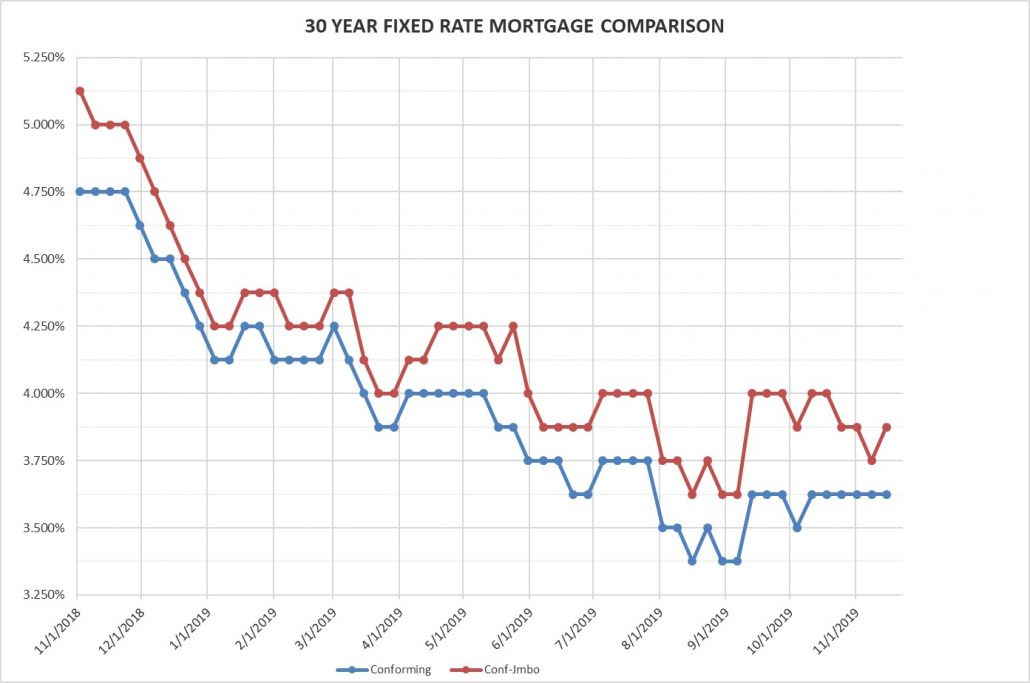
Rates for Friday November 15, 2019: While the Fed announces steady rates that they control, in the open market there is a sense of a bit less stability. Stock markets continue to set new highs, but for how long and if/when there is a correction will funds flow into fixed rate investments and push rates lower? Maybe. For now, the 30 year conforming rate extends its Friday-to-Friday streak of no change to five weeks and the high-balance conforming rate bounces off its nine week low. There is more risk for loss should rates increase then the potential benefit from a chance rates drop further—do the math and you will likely want to lock your rate when possible.
FIXED RATE MORTGAGES AT COST OF 1.25 POINTS LOCKED FOR 45 DAYS:
30 year conforming 3.625% Flat
30 year high-balance conforming 3.875% Up 0.125%
Please note that these are base rates and adjustments may be added for condominiums, refinances, credit scores, loan to value, no impound account and period rate is locked. Rates are based on 20% down with 740 FICO score for purchase mortgages.
Recognizing long ago what I strongly feel is false inflation in the college and university tuition markets, I have been waiting, and very much hoping from about ten years ago when the costs really began to jump, for the tuition bubble to pop. I contend that the increase funds are not going into classrooms to better educate the students than the education prior generations of students received. If a school wants to build a fancy new science lab, or a new school of sociology, they do not use tuition funds, but undergo tremendous capital campaigns. Most colleges with the highest tuitions are sitting on endowments of billions of dollars, and continue to raise tuitions. Growing in proportion to tuitions have been the size of the bureaucracies and administrations (redundant?) on campuses by adding new “Deans of ____.”
Part of the issue is the mantra that every kid needs to go to college. Many kids wash out of college very early on because it is not for them. Freshman dropout rates are growing exponentially, and not because of the costs so much as not being able to handle the workloads, independence and not being interested in what they are supposed to be learning. This increases the number of kids applying, which in turn enables the schools to raise tuitions. I have a lot of sympathy for these students who feel forced to go to college so as not to have the stigma as a non-college student, but at the same time wish their advisors, mentors and others who have influence encourage them to attend a local community college or state school to get their feet wet instead of tossing them into a foreign environment with highly competitive kids and academics.
As the parent of a student in her sophomore year in college and a student in her senior year of high school applying to colleges, I am pretty familiar with the financial challenges of students and families and the somewhat hypocritical position of colleges continually soliciting billions of dollars a year across the country while increasing the cost of their product with no tangible benefit to their clients, the students.
I listen to podcasts and one of my favorites is Malcom Gladwell’s “Revisionist History.” He had two excellent shows on college costs and financing, the first is “Food Fight,” which explores how two similar colleges use their funds differently, and the other is “My Little Hundred Million,” in which he looks at one man’s donation that altered a school’s history and compares it to other schools raising money just because they can. I encourage you to listen to them both (and all of his podcasts!)
Off my soap box…..for this week!
Have a great week,
Dennis
Past Weekly Rate & Market Updates can be found on my blog page at my website www.DennisCSmith.com/my-blog


