


Why didn’t rates go down when rates went down?
Question of the week: Why didn’t rates go down when rates went down?
Answer: Because the Federal reserve does not control mortgage rates, or any other rates besides the federal funds rate.
The federal funds rate is the rate banks charge each other to loan money overnight.
Why would a bank lend, or borrow, from another bank overnight?
If one bank is short on its cash reserves requirement, and another bank has reserves in excess of the requirement, the flush bank can lend the bank with the deficit enough money to cover its reserve.
The group within the Fed that sets the fed funds, or the benchmark, rate, the Federal Open Market Committee, lowered the rate 0.50% (one-half of one percent). At close of business on Tuesday that rate was 5.25% to 5.50%. After Wednesday’s cut by the Fed of the fed funds rate, the rate on that overnight loan is 4.75% to 5.00%.
No interest rate in the world attracts as much attention as the fed funds rate. Movement by the FOMC to raise or lower the rate is preceded by weeks, often months, of speculation of when the move will be made, how much the move will be, how many moves in the same direction before a pause. Over the past few decades the FOMC has become the primary influencer of markets worldwide as investors try to anticipate all of the above and trade ahead of any rate changes.
Yes, other events, such as a pandemic, a war, energy crisis, etc, influences markets. Those are one-off events that are often unpredictable. Whereas FOMC committee meetings are held on a regularly scheduled basis. Every month, or more frequently, the Federal Reserve Board of Governors, from whom member of the FOMC are selected, meets. The minutes of the meetings are released to the public, the Chair, currently Jerome Powell, makes statements, holds press conferences, and testifies before Congress, detailing what the Governors see happening in the economy, if there is too much strength or inflation in the economy (portending higher rates), or if there is too much weakness, high unemployment, lack of consumer spending (lower rates).
Reading these tea leaves provided on a regular basis by the Fed, along with the constant economic data released showing inflation, labor participation, wages, consumer spending, imports and exports, manufacturing, and a myriad of other factors that make up an economy, investors and governments around the world make decisions in anticipation if rates for banks in the United States will be paying more or less to borrow money overnight.
Back to the question please.
Do you want the stereotypical parent answer, “because…?”
From the fed funds rate banks adjust the rates they charge their borrowers, from auto loans to commercial real estate, to credit cards, and the rates they pay depositors for savings accounts, certificates of deposit, etc.
The overwhelming majority of mortgages are funded through Fannie Mae or Freddie Mac. Their rates are determined by what investors are willing to pay to purchase mortgages from the Siblings in the form of Mortgage-Backed Securities (MBS). Fannie and Freddie will package millions of dollars of mortgages into bundles that they then sell on the open market. Because MBS pay a fixed rate return and have maturity dates, they track with other fixed rate investments, more specifically bonds, even more specifically U.S. Treasury issued bonds.
If investors anticipation of where rates are headed in the future determines if they are buying or selling their fixed rate investments, therefore causing those rates, including mortgages to go up or down.
After that background, if investors see rates going down in the future, why did mortgage rates not drop, and drop a lot with the feds half-point rate cut?
For a few reasons. Primarily, because Wednesday’s rate cut has been priced into the market for quite some time. Since the Fed cut its rate, and that is what investors thought would happen, there is no need to react.
However, priced in was a one-quarter percent (0.25%) rate cut, and the Fed cut was one-half percent (0.50%), so why was there no drop with the higher rate cut? Many investors thought the cut may be a half-point, so part of the higher rate cut was priced in.
The somewhat weird reason is that looking long term, investors are speculating as to how far the Fed will cuts its benchmark rate. Will it drop it to 3.00-3.25%? 4.00-4.25%? Somewhere in between?
Somewhat consensus projections are that the Fed will lower its rate to 4.00-4.25% by the end of the year, another half a percent, and to 3.25-3.5% by the end of 2025.
With the large rate cut Wednesday, the projections are that the Fed will make fewer rate cuts in the future to reach their supposed targeted rates. Because there are fewer rate cuts to come pricing in those rate cuts will come in the future are economic data and information from the Fed and its members becomes known. If inflation suddenly takes off, if labor markets tighten up with large scale hiring and growing wages, those rate cuts will be pushed into the future.
In the short term, mortgage rates should not have a large, or sharp drop, as the markets digest this week’s cut by the Fed. As the consequence of the rate drop is seen by the data on the economy, i.e. that inflation continues to decline, albeit at a slower rate, and employment steadies or contracts more slowly, mortgage rates should start moving back down.
This correlation between mortgage rates staying stagnate, or going up, after a rate cut by the Fed is not unusual and has more frequently than not after cuts.
Looking ahead, with the expected rate cut through the end of this year, and for all of next year, by the Fed lowering its benchmark rate by 2.00%, starting with Wednesday’s cut, mortgage rates should trend lower over this time. Likely not matching the 2% reduction the Fed will be making, but half that amount or a bit more. There will be some blips along the way, but absent any major unexpected events, domestically or internationally, the trend should be slowly lower for mortgage, and other, interest rates for debtors and savers.
Schedule an appointment to discuss your options if you are considering purchasing a new home or property, or refinancing an existing one and want to know the mortgage options available to you.
Have a question? Ask me!
Quieter stores, bars and restaurants throughout the country in August as retail sales were up only 0.1% for the month, after 1.1% growth in July. Part of the slower pace was decrease in inflation, much of it was less spending in stores and restaurants. Retail sales are about one-third of consumer spending, which accounts for 65-70% of our economy. Slower retail sales, especially in August when back to school shopping and summer vacation spending is a driver for many retailers, is an indicator that 3rd quarter GDP growth should be lower than last quarter’s 3.0% growth.
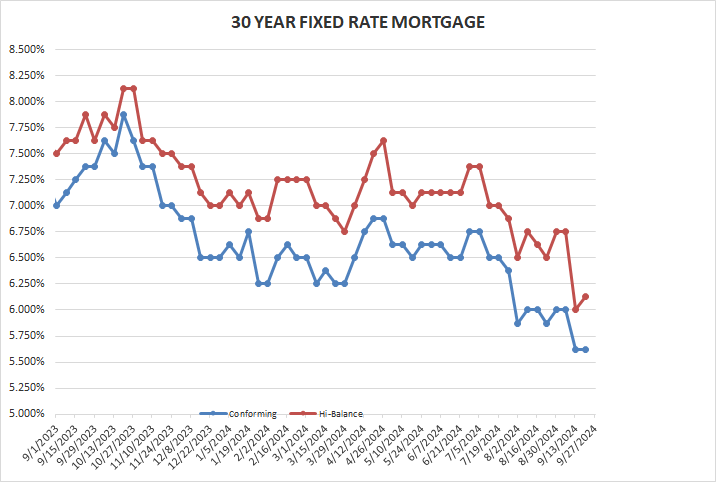
Rates for Friday September 20, 2024: As mentioned, the conforming rate is flat from last Friday and the hi-balance rate up slightly.
FIXED RATE MORTGAGES AT COST OF 1.25 POINTS LOCKED FOR 45 DAYS FOR PURCHASE TRANSACTIONS:
30-year conforming 5.625% Flat
30-year high-balance conforming 6.125% Up 0.125%
Please note that these are base rates and adjustments may be added for condominiums, refinances, credit scores, loan to value, no impound account and period rate is locked. Rates are based on 20% down with 740 FICO score for purchase mortgages.
Long time readers of the WR&MU are aware that I am a big fan of baseball, “big” might be too passive an adjective.
Yesterday was an amazing for baseball. For those unaware, Dodger Shohei Ohtani has been chasing “50-50,” for the last month. Fifty home runs and fifty stolen bases in the same season has never been done.
It was thirty-six seasons ago that the Oakland A’s Jose Canseco became the first do make the 40-40 club. In August Shohei became the sixth member of the 40-40 club when he stole his 40th base in the 4th inning, then hit a doubly dramatic home run for his 40th of the season. Doubly dramatic in that it not only was his 40th, but it was a grand slam in the bottom of the 9th inning for a walk off victory for the Dodgers.
His 40-40 game was dramatic with the walk off homer. It pales in comparison to his game yesterday, many calling it the greatest game by any hitter in the 155 years of professional baseball.
Shohei started the game in Miami against the Marlins with 48 home runs and 49 stolen bases. He was perfect at the plate, six at bats, six hits. In the 1st inning he stole his 50th base of the season. In the 2nd inning he stole his 51st.
He had half his 50-50. In the 6th inning he hit his 49th homer of the season to left field. The next inning he made history with a homer to right field. He put a cherry on the sundae, a bow on the present, in his final at bat in the 9th with his 51st home run of the season.
Perfect at the plate, two stolen bases, three home runs, ten runs batted in, seventeen total bases. Never before in baseball history has a player amassed all those stats in one game. Each of which is a dominant one game performance. Combined and they are the best ever.
Not only did he become the first, and likely only ever, member of the 50-50 club, Shohei also set the records for most home runs in a season and most RBI in a single game for the 141-year-old Dodger franchise.
Oh, historic night came part of the Dodgers complete drubbing of the Marlins (20-4) which clinched a playoff spot for the Dodgers as they look to finish the season winning their division and possibly having the most wins in baseball to have home field advantage in the playoffs.
Every fan of the game, regardless of which team the support, is tipping their cap to Shohei and a most remarkable night.


