

What is the taxpayer protection initiative and how does it affect us?
Question of the week: What is the taxpayer protection initiative and how does it affect us?
Answer: It is a measure that has qualified for the November ballot that, if passed, repeals a 2017 ruling by the California Supreme Court that created a loophole in Proposition 13 that made it easier for taxes to be enacted in the state.
Last week the Question of the Week was about parcel taxes, and delved into property taxes in general for Californians.
In the response to the question, we mentioned that some taxes are able to be enabled, i.e. charged and collected, by a 55% majority, instead of the previous, and long standing two-thirds majority.
The two-thirds threshold was a result of Prop. 218 in 1996, in which voters clarified that any tax designated for a specific purpose, i.e. to fund homeless services, requires two-thirds of the votes to pass. The wording of Prop. 218 was such that it would apply to all specific taxes, regardless of whether they were put on the ballot by legislatures or by voters.
An ambiguous threshold has been in effect as a result of the state Supreme Court ruling in California Cannabis Coalition v. City of Upland. The actual ruling did not adjudicate the threshold by which taxes could be paid, instead it ruled when that vote for the tax could be held. Prop. 218 requires any tax being imposed by “local government” be voted on in a regularly scheduled election. The argument that won the court case was that the scheduling provision in Prop. 218 does not apply to initiatives put on the ballot by petition of voters. In other words, if a group wants to put an initiative on the ballot to generate a tax of $1 for every property to fund housing and care for 3-legged dogs and tailless cats, and it receives enough signatures to qualify for a ballot, a special election can be held for the initiative for voters to decide the fate of these poor deformed animals.
By a 5-2 vote, the court decided that a ballot measure initiated by organized citizens in not an act of “local government.” This distinction, that the definition of “local government” is only elected officials, not political action committees, trade associations, non-profit organizations, cracked Prop. 218, enabling other rulings to further puncture Prop. 13 and its original intention and purpose.
The special interest groups mentioned above seized on this crack and drove a wedge through it to further alter Prop. 13. If citizen-based initiatives are not acts of “local government,” then it would seem that other rules in Prop. 218 are also invalid when it comes to citizen-based initiatives; primarily the two-thirds of the vote requirement to pass taxes.
The court’s decision did not mention any other provisions beyond the timing of an election, and when inquired for clarification by attorneys involved in the litigation of the Upland decision, the justices declined to respond.
If one is qualified to be appointed to, and confirmed for, the California Supreme Court, one is certainly astute enough to know that the ruling in Upland would extend to other rules in Prop. 218, unless specifically protected by the decision.
Following the decision numerous tax increases were placed on ballots across the state, many sponsored by public employee unions, that needed only a simple majority to pass and enact the tax—because they were “citizen” generated initiatives. There were many challenges to these ballot measures and subsequent passes, and in 2020 the state Supreme Court upheld their validity, not by a decision in any specific case, but by refusing to consider any challenges to them. Essentially, by denying to hear arguments the court was establishing that Prop. 13 rules were not valid because Prop. 218, which was meant to harden Prop. 13 provisions, was only applicable to “local government” initiatives.
Confused? So are most voters—but the politicians and organizations that are always looking for more public funds are not.
Where we are today for new taxes in California:
- Statewide increases
- A two-thirds majority of Legislature must vote to put a tax measure on the ballot
- Requires 50% + one vote to pass
- Local Taxes (cities, counties, special districts
- General taxes the go into the general fund 50% +1 and must be on regularly schedule election ballot
- Special taxes (earmarked for specific purpose(s)) two-thirds voter approval required unless
- Citizen initiative placed on the ballot 50% + 1
Last year Prop. 5 was put on the ballot to lower the threshold for taxes from two-thirds to 55%, but it was rejected by voters.
This brings us to the answer to the Question of the Week, what is the taxpayer protection initiative (TPI) and how does it affect us?
Primarily, the TPI will reverse the loophole created by the court and require at two-thirds vote requirement for local special taxes. As well, it will restore limitations on real estate transfer taxes which Prop. 13 prohibits, “any transaction tax or sales tax on the sale of real property.” Despite this, the courts have created a series of decisions enabling these taxes to be imposed.
Prior to Prop. 13, and continuing for decades post-Prop.13, transfer taxes paid on the sale of property was $1.10 per $1000 in sales value. Cities began imposing higher transfer taxes, some as high as $45 per $1000, which increased costs of sale for buyers and sellers. An example of the combination of the Upland case and cities looking for more revenue is Measure ULA in Los Angeles which resulted in taxes of 4% or 5.5% of the sales price on the sale of residential or commercial property for prices over $5.3 million.
How does the TPI affect you? As a property owner it protects your property tax basis and amount of taxes that can be added to your tax bill by requiring a super-majority approval by voters to increase those taxes. As a renter, it protects your landlord from paying higher taxes, which in turn becomes higher rents to pay for the higher taxes. As a consumer, it protects your costs for goods and services as merchants and vendors either own the property where their business is located and would have higher costs to pass onto consumers, or if they lease, it is very likely a triple-net lease whereby they are responsible for property taxes.
Property owners, and all Californians, should be very grateful to the Howard Jarvis Taxpayers Association, names for the person primarily responsible for 1978’s Prop. 13, for their continued efforts to fight of taxpayer, and property owner, rights and protections in a state where state and local governments have shown an inability to be financially responsible to the extent they see only solutions based on higher taxes from citizens and businesses.
The TIP does not yet have a number for the proposition, when it does my sincere hope is that all who receive the WR&MU, and an overwhelming majority of those who do not, vote “yes.”
To schedule an initial meeting by phone or Zoom, click here for my calendar, please feel free to forward to a friend or family member!
Have a question? Ask me!
Economic growth, wage growth, price growth, every economic indicator is moving up, some of which is good, some of which is not so good…
GDP—the economy grew at a 2.0% rate in the first quarter, below 2.2% expectations, but well above anemic (no) growth at the end of 2025
PERSONAL INCOME AND SPENDING—both up in March. Spending was up 0.9% for the month, energy costs primarily driving the increase, and income was up 0.6% per month. Not a great ratio as it shows Americans growth in spending outpacing growth in income, which leads to a draw down in savings or increase in personal credit.
INFLATION—the Personal Consumer Expenditures index, the Fed’s preferred inflation gauge, was up 0.7% for the month and 4.4% year over year, the highest level since early 2023. The spike in energy costs is impacting other goods and services as the core PCE rate (food and energy stripped out) was up 0.3% for the month, but 3.2% year over year.
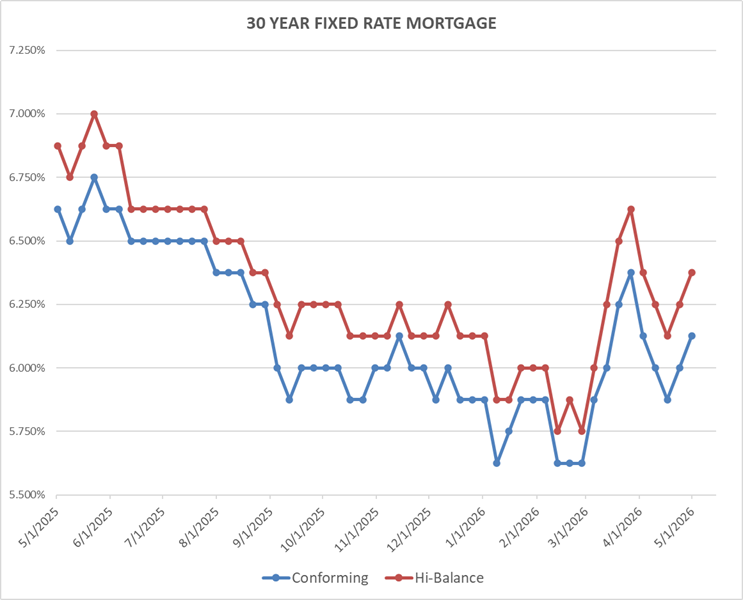
Rates for Friday May 1, 2026: It was no surprise that the Fed held its benchmark rate steady at its meeting this week, but given the economic news yesterday, as outlined above, odds are starting to climb for a rate hike before another rate drop. Rates react to the economic data and go up again this week.
FIXED RATE MORTGAGES AT COST OF 1.25 POINTS LOCKED FOR 45 DAYS FOR PURCHASE TRANSACTIONS:
30-year conforming 6.12% Up 0.125%
30-year high-balance conforming 6.375% Up 0.125%
Please note that these are base rates and adjustments may be added for condominiums, refinances, credit scores, loan to value, no impound account and period rate is locked. Rates are based on 20% down with 740 FICO score for purchase mortgages.
It’s that time of year. On our morning walks through the neighborhood with Sammy we are picking up jacaranda blooms on our shoes, our cars are changing colors with the various white and yellow blooms falling off the trees on our street, and are doormat is not completing the job of getting all the flora detritus from the soles of our shoes.
Bring on your preferred allergy medicines!
Dennis


