


Why did rates go up after the Fed lowered rates?
Question of the week: Why did rates go up after the Fed lowered rates?
Answer: Two weeks ago our question of the week was, “What is the impact of the Federal Reserve cutting rates?” The answer section discussed how the surprise rate cut made by the Fed on March 3rd impacted mortgage rates with investors buying up Treasuries and mortgages pushing rates lower, and why they had this reaction.
In the commentary I included a link to my WR&MU from October 2018 “How Does the Federal Reserve Impact Mortgage Rates?”.
The simple one-word answer to that question was, “Indirectly.” That is because, contrary to many people’s belief, the Federal Reserve does not control mortgage rates. The only rate the Federal Reserve directly controls is the Federal Funds rate, the rate banks charge each other to lend over-night. Banks borrow money from each other over night so they can have the reserve amounts they are required to have depending on the amount of their deposits. Dennis’ Bank is required to have $2 billion in reserves, as the day is closing it has only $1.85 billion in reserves. The bank borrows $150 million dollars from Bank of Smith at the Federal Funds rate. The next day the loan is re-paid with interest.
As discussed in prior editions of the WR&MU, when the Fed changes its rate there is typically a ripple effect though the financial industry with other rates changing. The rate that most often moves in conjunction with the Fed Funds rate is the “prime rate.”
The prime rate is the rate banks charge their best commercial clients, usually very large corporations. There is no universal prime rate as every bank can determine this rate for themselves, however historically they all use the same rate. The prime rate as a rule is 3% above the Fed Funds rate.
The prime rate is the base rate used for most commercial and consumer loans, but not mortgages. If the prime rate goes up or down your credit card rate, student loan rate or auto loan rate may change. As well, if you have a Home Equity Line of Credit, that rate changes with prime as almost every bank’s rate for a HELOC is “prime + x.” As the prime rate goes up and down so does you HELOC rate.
Back to our question of the week, why did rates go up after the Fed lowered its Fed Funds rate to zero on Sunday?
There are many, many factors impacting financial markets in the current environment. As discussed many times, of the different areas for investment the two most closely related historically are equities (stocks in corporations) and fixed-rates (bonds and mortgages). The historical relationship is that investors either engage in some risk and purchase equities, or buy assurance and purchase fixed-rate assets with a fixed return.
An investor has one-million dollars. The economy is going well so the investor purchases stock in one or more companies with the expectation that they will have strong growth and profits making their companies more valuable. There is risk that something may happen to impact the economy, or specific companies or sectors where those companies operate, that could cause the companies to lose business, see declining profits and lose value.
An investor has one-million dollars. The economy appears to not being doing as well as it was and there is some question as to whether companies will grow and continue to show as much profit, so the investor purchases a combination of bonds issued by different government agencies and Mortgage Back Securities (MBS) which are provided a fixed return at a certain percentage of the investment. As long as the investor holds the bonds and MBS they know they will receive the same return every year.
The Federal Reserve raises rates when the economy is growing rapidly, or the Fed anticipates it will grow rapidly in the not-to-distant future, in an effort to keep inflation at an acceptable level so the growth does not suddenly get choked off by consumers not being able to afford to purchase as many goods and services.
Conversely, when the Fed feel the economy is slowing, or will slow, it lowers rates to encourage borrowing and spending.
On Sunday the Fed cut its Fed Funds rate to zero. As part of the announcement it also stated it would purchase $700 billion in U.S. bonds and Treasury note, and mortgages. The latter action is known as “Quantitative Easing,” which was done by the Fed several times during and following the Great Recession. The purpose of the QE programs is to put liquidity into the markets to keep cash flowing through the economy. As mentioned above, banks have reserve requirements. If they cannot sell some of their loans they cannot make any more loans. If banks cannot make loans the economy stops. The Fed is telling investors, “we are absorbing $700 billion in fixed rate assets.” The Fed is putting $700 billion into the economy.
There were some other more in the weeds actions announced by the Fed on Sunday which dealt with banks borrowing money and exchanging debt. All the actions had the same intent, keep funds flowing and calm investors with the goal of flattening markets and getting investors to follow the Fed and purchase fixed-rate assets. Which ideally would then cause them to re-enter the equity markets as well.
When the markets opened on Monday investors thumbed their noses at the Fed. Why?
The primary commentary was that the Fed did too much. While the Fed thought a huge move, cutting rates to zero and funneling almost one-trillion dollars into the markets, would have a positive result, investors wondered what was left?
The phrase I read that best described the market reaction was that the Fed fired all its bullets and don’t have any left.
What investors wanted from the Fed was a measured response with the announcement that it was prepared to act in the future if necessary. Last week I commented that I thought the Fed would lower rates by three-quarters to one percent (it lowered by 1%) and begin a QE policy. They did both of these, but investors were looking for a lower rate cut and not as large of a QE purchase program.
Why? Investors feel that if the impact of the COVID-19 on the economy ripples deeper and longer the Fed does not have any more moves it can make along the way to ease the slide and support the flow of funds in the economy.
The Fed Funds rate after the cuts is 0%-0.25%. The only rate cut left is to go into negative rates whereby banks are paid to borrow money. Huh? “Dear Bank of America, we will pay you 1% to borrow $1 billion from us so you can lend that $1 billion out to your clients at a rate of 1%.”
That is one reason rates have jumped since the Fed announcement. Another reason is lenders are crammed to the gills with mortgages shoved into the pipelines starting in mid-January when rates began to drop. One analyst estimated that the mortgages locked with lender from mid-January to the first week of March was as much or more than the industry has funded in some years. I mentioned in a WR&MU a few weeks ago that lenders were raising and lowering rates throughout the day to control the amount of loans they could take in. With rates significantly higher over the past two weeks loan volume has declined accordingly.
Another reason rates have increased is because there are liquidity issues in the market. Lenders are running up against their limits on warehouse lines; lines of credit used to borrow money to fund loans that are then sold. The secondary market is where mortgages are packaged and sold in bulk as Mortgage Backed Securities. As mentioned above, investors are not fleeing to the safe returns of bonds and mortgages, so the MBS market is sluggish making it challenging for lenders to sell their mortgages.
These are the some of the reasons the Fed made the moves it made, to loosen up the markets and get the funds flowing. However, investors are not satisfied.
On the other side of the coin, equities, investors have been waiting for a very bold move by Congress with a stimulus package. As I write this there are bi-partisan negotiations for such a package that could top $1 trillion. Will that be bold enough? It might be as the Dow has improved very slightly since Wednesday as talks on the package have neared conclusion to lead to a bill for President Trump’s signature.
The big concern is obviously the “R-word,” recession. It was over a decade ago that the Great Recession occurred, one that many Americans were too young to understand, and one that too many remember all to well. That is the question everyone is asking, “will this be like 2008?”
The definition of a recession is two or more consecutive quarters with a shrinking economy.
There are three primary components to a recession that determine its impact: length, depth and breadth. How long will the recession last? How deep will it go, i.e. how negative will be economic activity? How wide will it extend, i.e. how many and what industries will be primarily impacted?
The Great Recession covered a period of eighteen months, December 2007 to June 2009. At its depth the Gross Domestic Product, the measure of our economy, was 4.3% lower than when the recession started. The breadth of the recession was very wide, primarily because the cause was the collapse of the housing markets across the country. Close to 65% of Americans own their own home. Because of this no area of the country was spared a drop in home values, and a loss of personal wealth as a result.
If COVID-19 does initiate a recession the three questions are vital to the economic impact and the recovery. Length, depth and breadth will determine how long, once the recovery begins, it will take for the economy and markets to be back to where they were before any such recession began—lets say March 1st if this quarter is the first quarter of two successive quarters of negative GDP.
The amount of change week-to-week, day-to-day, even hour-to-hour has created tremendous uncertainty, which creates raw emotions and concern. I am amazed at what has transpired over the past two weeks, like I am sure everyone reading this is as well.
Looking forward, I feel that when the quick reactions over the past two weeks or so are over, when a large stimulus package is passed, and nerves calm down, we will see a flattening in the markets. As well, when the rebound happens it could, should in my opinion, be fairly strong. Our economy was very strong going into March. Consumer confidence was high, job markets were high with wages outpacing inflation. Homeowners had growing equity secured by low rate, low risk mortgages that they qualified for using their real income. All these factors support, in my opinion, short, shallow and narrow.
Have a question? Ask me!
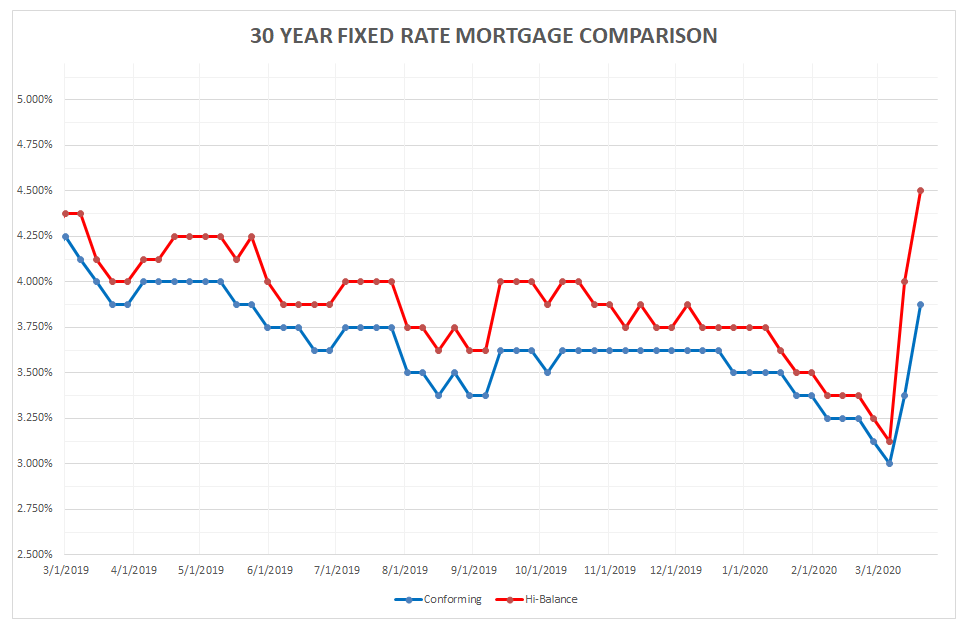
Rates for Friday March 20 2020: As mentioned above, rates jump again this week. I pulled rates about 11:00 this morning, and the conforming rate was at its highest since last May and the high-balance rate was at its highest since December 2018. The last time rates climbed this high from a bottom was in 2018 when it took from January to October for the high-balance rate to climb from 3.875% to 5.125% and the conforming to climb from 3.75% to 4.875%.
FIXED RATE MORTGAGES AT COST OF 1.25 POINTS LOCKED FOR 45 DAYS:
30 year conforming 3.875% Up 0.50%
30 year high-balance conforming 4.50% Up 0.50%
Please note that these are base rates and adjustments may be added for condominiums, refinances, credit scores, loan to value, no impound account and period rate is locked. Rates are based on 20% down with 740 FICO score for purchase mortgages.
I have a topic that I have been wanting to share as a few people have asked about it regarding the new credit scoring algorithms. I have been holding off to provide some insight on what is happening that I hope is helpful. My primary intent for the WR&MU is to educate, hopefully through the environment we are in now that is the case.
This morning on our walk with the dog I told Leslie I am thinking about a regular Lunch and Learn about Loans. My idea is to on a regular basis convene a meeting using Zoom to talk about topics I discuss in the WR&MU. Using Zoom would enable an interactive environment and those who participate being able to ask questions. Let me know if this interests you and I will look to put something together.
Part of the idea is from a few Zoom meetings I have had and knowing that we are all social distancing so many of us gregarious types are looking for contact with others outside the home.
Click here with a quick reply if you would be interested.
What are you doing while staying at home with the family? Here is a really neat site that have virtual visits to many attractions around the world, from museums to aquariums to classes for you and the kids. Virtual school activities. The other day I got lost in the Musee D’Orsay site looking at paintings.
For the Smith household, Leslie has decided that she is converting our stay-at-home situation into a Bed and Breakfast. This evening there will be mulled wine and a cheese plate in the living room. Tomorrow I think there will be watercolor painting by the pool before lunch and in the afternoon a walk through the neighborhood with a contest to see who spots the most number of different types of birds.
Reach out to those you haven’t seen or spoken to in a while. Check in with neighbors. Look forward when it is okay to shake hands or even better hug one another.
Have a great week,
Dennis
Past Weekly Rate & Market Updates can be found on my blog page at my website www.DennisCSmith.com/my-blog


