


What types of mortgages are available?
Question of the week: What types of mortgages are available?
Answer: Before we get into more specific types of mortgages on the residential market, almost every type of mortgage has two options, fixed rate or adjustable rate. Actually three, as there are hybrids that are a bit of both.
Fixed rate mortgages have the same interest rate for the life of the loan. In most “normal” markets, fixed rate products generally have higher rates than adjustable rate products. The primary advantage of a fixed rate loan is you know what your payment will be throughout the loan.
Adjustable rate mortgages (ARMs) come in many varieties as to how often and how much the interest rate on the mortgage will adjust. Some adjust every six months, others annually. Lenders must disclose to borrowers at application, and with loan documents, not only when the rate will adjust, but also the maximum amount the rate can adjust per adjustment and over the life of the loan. Industry standard for most ARMs are maximum 2% increase per year (or 1% per six months) and 5% for the life of the mortgage.
Example, a one-year ARM with 2/5 caps that has start rate of 6.25% will be fixed at that rate for the first year, at the end of year one the maximum rate can be 8.25%, over the life of the loan the maximum rate can be 11.25%.
The adjustable in an ARM rate is based on an index that adjusts on a regular basis and the borrower has the ability to easily look up the rate. Common indexes are the SOFR (secured overnight financing rate), and 6-month or 1-year U.S. Treasury Bills.
The total rate on the mortgage when it starts adjusting is the index plus a margin that is fixed throughout the term of the loan. Example, today’s SOFR rate is 5.34%, if the margin on the loan is 2.75% and you funded your one-year ARM a year ago with a start rate of 6.25%, the fully-indexed rate for the adjustment would be 5.34% + 2.75% = 8.09%. Your adjustment in 2025 cannot exceed a 2% increase, so the maximum rate can be up to 10.09%.
Hybrid ARMs are loans that are fixed for longer period of time than one year. Typically available are 3-, 5-, 7-, and 10-year products whereby the initial rate is fixed for that number of years and then the rate becomes adjustable. One big difference between a traditional ARM and a hybrid ARM is that the maximum adjustment at the first adjustment (when loan transitions from fixed to ARM) is the lifetime cap. For instance, if you funded a 5-year ARM in July 2019 with a start rate of 4% and with same index and margin as above, your rate for the next twelve months will be 8.09%, and increase of 4.09%. If rates climb over the next year, the maximum rate on your loan cannot exceed 9% due to the lifetime 5% cap over the initial rate of 4%.
Those are mortgage products that are differentiated by the stability of the interest rate, and payments, for your loan. Here are various products that are differentiated in underwriting guidelines, loan limits, and eligibility among other factors.
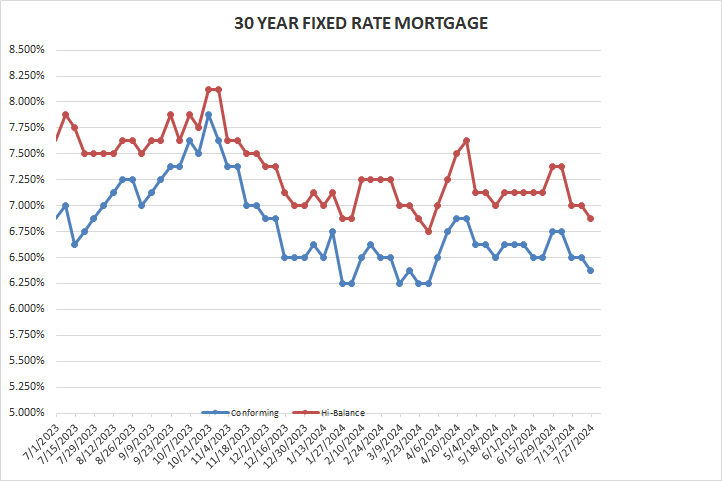
Conventional, or Conforming, mortgages describe loans that are underwritten to the guidelines established by Fannie Mae or Freddie Mac. The vast majority of these mortgages are 30-year fixed, though ARMs are available. These mortgages are the Wonder Bread of the mortgage industry as approximately 70% of total mortgages funded in the United States every year are conventional. These loans have two loan limits. The base loan limit nationwide in 2024 is $766,550. For some parts of the country the maximum loan limit is $1,149,825—these are termed high-balance loans, and have a higher interest rate (see weekly rate chart).
The guidelines are fairly similar for both standard and high-balance mortgages in regards to how to calculate qualifying income for salaried, self-employed, retired, etc borrowers. Depending on loan amount, borrowers can put as little down as 3%.
Jumbo, or non-conforming, mortgages generally follow must of the conforming underwriting guidelines, but have much higher loan limits that are generally based on the percentage of the sales price as down payment. For instance, some lenders may fund up to $2 million loan with 20% down, other may max out with 20% down at $1.5 million.
An example of different underwriting guidelines, depending on other factors, some underwriting requirements for a self-employed borrower may require only the most recently filed federal tax return to qualify income. Most jumbo guidelines require two years returns, and will average the income between the two years. If you filed taxes for $125,000 in 2022 for your self-employed income and $185,000 in 2023; for a conventional loan if the income verification is most recent tax return, your income is $185,000 ($15,400 per month). For jumbo loan, averaging the two years of income, the amount is $155,000 ($13,000 per month). Using 33% of income for your housing payment, the difference is almost $800 per month that can be used for your mortgage qualifying—more than $100,000.
Government mortgages, the general term for FHA and VA mortgages, generally have looser guidelines than conventional loans, and the rates can be more attractive.
For FHA mortgages, the primary reason most loan originators recommend a conventional mortgage instead of a FHA mortgage is because of the higher mortgage insurance costs. For conventional mortgages with loan amounts greater than 80% of the sales price, the mortgage insurance is fairly inexpensive, and have opportunity to be removed when certain conditions are met. Mortgage insurance for FHA loans have an upfront fee added to the loan amount as well as a monthly payment that stays in place through the life of the loan.
VA, or Veteran’s Administration, loans are restricted to borrowers who are active in the military or have been honorably discharged with benefits. Misunderstood by many in the real estate industry (i.e. too many agents discourage sellers from accepting offers with VA financing as they perceive the loans are hard to close), VA mortgages have fairly easy qualifying for applicants in regards to debt to income ratios, and can finance very large loan amounts with little to no down payments. As an example, depending on location, a veteran may be able to purchase a $1.25 million home with no down payment.
The rates on VA loans are lower than conforming rates, and while there is no mortgage insurance, there is an upfront “funding fee” of up to 3.3% of the loan amount that is added to the loan depending on down payment, if any, how many times the Veteran has utilized their VA loan benefits, and whether loan is for purchase or refinance.
Limited income qualifying mortgages are available, most typically for self-employed borrowers. These mortgage products usually are used for borrowers where tax returns are not used for income qualifying. Instead of tax returns lenders will use most recent year’s 1099, or bank statements, to determine income.
For these loans the lender will use a formula to determine to calculate expenses to determine qualifying income. For some bank statement programs, the lender will average the deposits over the period of time, average the debits, and the result will be qualifying income.
Depending on lender, there are programs that use 3-, 6-, 12- or 24-months of statements to determine qualifying income. The fewer statements used, the higher the interest rate.
One advantage these mortgages can have, beside avoiding producing tax returns that may have disproportionate amount of expenses to income, is that they can often be underwritten faster as negotiating with underwriters, appealing to management for exceptions, etc can be avoided.
Construction loans, are what they say, they finance construction. Construction can be a new home from foundation up, or a major remodel. These loans require a lot of documentation, and typically take longer to approve and fund than most other loans. Trying to stay out of the weeds, application file, besides the standard items for employment, income, credit, funds to close, etc., will need to provide a detailed cost estimate for intended construction, information on the licensed contractor, an appraisal that provides current market value and the estimated value when construction is completed based on the scope of the work done.
Loans are funded in stages. The initial funding is for the purchase of the property, then the lender releases funds to and escrow account that will release the funds to the contractor upon completion, and inspection, work completed.
For instance, you are buying a property for $750,000, putting 20% down, and have construction costs of $250,000 to remodel the property, and the completed value of the property is estimated to $1.2 million. The lender approves a total loan amount of $850,000.
At closing the lender funds $600,000, the deal closes and construction begins. After the contractor has completed necessary demolition and framing, a request if put in for $35,000. An inspector signs off on the work and the funds are sent to the escrow account to pay the contractor. A few weeks later the walls and cabinets are completed and a request for $80,000 is made, signed off on and funded. This happens until the project is complete and the local authorities sign off on final permits and occupancy when the final funds are released to the contractor.
Reverse mortgage, in my opinion the most misunderstood financial product available to consumers. You likely have seen Tom Sellek promoting reverse mortgages while watching Wheel of Fortune or reruns of The Golden Girls; but what are they?
Reverse mortgages are tailored to those 62 years old, or older, with some exceptions. The primary purpose for reverse mortgages is to enable seniors to stay in their current home, or purchase a new one (yes! You can use a reverse mortgage to purchase a home.) without having a mortgage payment.
Instead of paying a mortgage payment every month and reducing your mortgage balance, a reverse mortgage accrues the interest owed on the mortgage and increases your mortgage balance.
The mortgage balance is determined by the age of the youngest borrower and the value of the property. The younger the borrower the lower the mortgage amount.
If you, or your parents, have a $400,000 balance on a mortgage funded ten years ago at 4% with a payment of $2300 per month, the current value of the home is $900,000. Income is down to social security payments of $4300, so tapping into retirement accounts to fund other expenses, travel, entertainment etc. The funds from the retirement account are taxed by the state and federal governments, which is effectively about 25%.
Instead of paying the $2300, you fund a reverse mortgage. With no mortgage payment there is either no need to pull funds from retirement every month, or a lot less is needed. Instead of paying taxes for living expenses, you are using your equity to eliminate your housing payment and reduce the income needed every month.
The biggest concern we hear about reverse mortgages is, “we don’t want to lose our home.” Except in certain extenuating circumstances, foreclosure on a reverse mortgage is extremely unlikely. Even if the balance due on the mortgage exceeds the value of the home, the lender cannot foreclose and make the borrowers move.
It is my opinion that more people in retirement, or heading into retirement, take at least a look at the reverse mortgage option as part of an overall financial examination.
Second mortgages, are loans that are placed as liens on your home after your current mortgage has funded. There are two types of loans considered second mortgages, fixed and equity line.
A fixed second mortgage has a fixed term, interest rate and payment. Terms are generally for 10-, 15- or 20-years, fixed rate mortgages have rates higher than primary mortgages, and depending on the rate environment, higher than what the current rate on an equity line will be.
An equity line, or Home Equity Line of Credit (HELOC) has a maximum amount that can be borrowed and has an adjustable rate based on the prime rate. HELOCs offer tremendous flexibility as the minimum payment is often interest only, and is based on the amount outstanding on the loan, not based on the maximum amount available—just like a credit card operates. Like a credit card, you can pay the balance down to zero at any time and eliminate payments (though many HELOCs do have a nominal annual fee).
Because of their flexibility, ease of qualifying and relatively low costs compared to traditional mortgages, HELOCs are useful tools for home remodeling and other projects, debt consolidation, short-term cash needs that may come up over the years.
While the above cover much of the mortgage market, there are other products available that get more “nichey” which is why it is important you consult an experienced mortgage professional at the beginning of your home search, or considering refinancing to obtain cash for any reason.
Schedule an appointment to discuss your options if you are considering purchasing a new home or property, or refinancing an existing one and want to know the mortgage options available to you.
Have a question? Ask me!
While not the biggest unexpected announcement this past week, the Bureau of Economic Analysis release of GDP for the second quarter vied for second or third place. With expectations of around 2.1% growth in the economy in the 2nd quarter the announcement that the economy grew at a fairly strong 2.8% pace, doubling 1st quarter GDP of 1.4%, was a surprise. Pushed by a 2.3% annualized growth in consumer spending over the quarter, which would have been higher were it not for the computer hacking that slowed car sales in June, the data pushes out the prospective time frame for when the economy may slow enough to be close to, or in, recession. A few signs that the economy may slow in the 3rd quarter was a slow down in business spending and a drop in consumer spending on services—typically an area where most discretionary income is spent. While the Federal Reserve is still likely to drop its benchmark rate in September, the data does put a bit of a head-tilt on prognostications.
As mentioned above, consumer spending grew in the 2nd quarter, in large part because of the 0.3% increase in spending in June—which, as mentioned, would have been higher had auto dealers been able to process more car sales. Consumer spending is 65-70% of our economy, and strong spending keeps the economy have steady growth, and raises barriers for inflation to ease. What may slow spending, and economic, growth is sluggish growth in incomes, up only 0.2% in June, and a drop in the personal savings rate to 3.4%. Consumers will stop, or at least slow, dipping into their savings, slowing their spending, unless incomes catch up to inflation and consumers’ need to by essentials.
The Fed’s preferred inflation index, the Personal Consumer Expenditures (PCE) was positive for a Fed rate cut as it increased only 0.1% in June, and was up 2.5% year over year, down from 2.6% the month before. The all important “core” index (food and energy stripped from data) was up 0.2% for the month, and was also up 2.6% over the past year.
Rates for Friday July 26, 2024: With the PCE showing a slow down in inflation, strengthening the chances of a September rate cut, we see rates tick down from last Friday.
FIXED RATE MORTGAGES AT COST OF 1.25 POINTS LOCKED FOR 45 DAYS FOR PURCHASE TRANSACTIONS:
30-year conforming 6.375% Down 0.125%
30-year high-balance conforming 6.875% Down 0.125%
Please note that these are base rates and adjustments may be added for condominiums, refinances, credit scores, loan to value, no impound account and period rate is locked. Rates are based on 20% down with 740 FICO score for purchase mortgages.
I’ve spent the past week working with my daughter and her roommate to secure a new apartment for them in Brooklyn. They have to be out of their current apartment where they have lived with two other roommates for the past two years by the end of the month. Challenges include finding a place this is affordable, in a somewhat decent area, and enables a move in not later than August 1st. All the challenges were met, with leases signed and deposits made, not without Dad experience more than a little stress considering he’s about 2800 miles away with a 3-hour time difference waiting for others to execute contracts and make decisions. Much like homeowners going through escrow….
Leslie is headed to the Big Apple tomorrow morning to help them move, and spend some time with our daughter, and a friend of hers (Leslie’s) that moved to Connecticut several years ago.
The dog and I will be staring at each other wondering her misses her most.
Have a great week,
Dennis
Past Weekly Rate & Market Updates can be found on my blog page at my website www.DennisCSmith.com/my-blog


