


How can we help our children purchase a home?
Question of the week: How can we help our son or daughter’s purchase a home?
Answer: Yes. No. Maybe.
This is a question we repeat every two or so years as parents and their children age and more of my clients now have children of home-buying age. As well, with the ever increasing property values in the region, many young families need the help parents may be able to provide.
Many parents will do anything they can to help their children get a leg up, to get a strong start, to ensure a more comfortable life. Some parents do it by trying to help their kids get into certain colleges, some parents do it by helping their children with the purchase of their first home. We all want the best for our children, the question is how far are we willing to go, or for many parents how far can we go?
There are several ways parents can help their children purchase a home. Each has different consequences, short and/or long term. A primary factor I have parents consider when we are having these conversations is what will be the impact on their lives today, and in retirement, or if they are retired, their future.
Let’s explore the different ways parents can help their children obtain their own home.
SCENARIO ONE: One way some parents help is by purchasing the house themselves. They provide the down payment, they qualify for the mortgage, and they are the only ones on the title and mortgage. Their child moves in and the agreement is that at some point the parents will give the house to their son or daughter.
Typically, under this type of arrangement the child will make all, or some, of the payments for mortgage, taxes and insurance, either directly to lender, tax collector and insurance company. However, we have seen this situation where they do make the payments but pay their parents directly. If the latter, the parents can then claim the payments as rent and then, if eligible, write off certain expenses. In this set-up, the parents essentially purchased an income property and rented to their child.
If the agreement is that the child will make the payments for the mortgage, taxes and insurance it is advisable for the parents to add the children to the title of the property. If it can be shown they have made those payments then they should be able to deduct the mortgage interest and property taxes (checking with tax professional first). In this scenario, the parents purchase the home, but essentially turn the home over to their child. In the future, by showing they have been making the payments and living in the property it will be easier for the kids to refinance in the future, should it be beneficial, and remove the parents from a mortgage obligation and obtain full title.
In this scenario, the consequences for the parents are that they are obligated on a mortgage and the tax liability of owning property. If there is some issue between the parents and kids and the children move out then the parents have to determine what to do with the house, sell it, rent it, make amends so the child moves back in. Having the children participate by making the housing payments to those owed directly creates more of an ownership mentality for them and makes it easier to transition the home later on. The risk here for the children is the parents still control the property and can sell it without the children’s consent—unless the children are on title.
In my opinion, this is the least desirable way to help your children obtain home ownership.
SCENARIO TWO: A more desirable way to assist your children in the purchase of their own home is to co-sign for them on their mortgage application. Most loan programs will allow family members to co-sign for mortgages for owner occupied purposes—what we call “non-occupant co-borrowers.” In this scenario, the child cannot qualify for the mortgage, usually because their debt-to-income ratio is too high. Depending on the parent’s total income and debt obligations, including their own housing payment, they may be able to co-sign for their child and enable loan qualifying. The parents would be on the mortgage and on title to the property.
The parents are still liable for the loan payment, as they are in Scenario One above, however the child is also responsible and have a lot more control over the situation than they do in Scenario One. Some parents are concerned, rightfully, how their being on the loan may impact their ability to get a loan in the future; most loan programs have a guideline for such a situation, known as “contingent liability.” If the parents can show the child has made the last twelve payments in a timely fashion then most mortgage programs will not count the payment for their qualifying.
In the future if it makes sense for the child to refinance then it is easier in this scenario than Scenario One as they are on title and on the loan so there is less to verify for the lender.
SCENARIO THREE: Show me the money! Or in this scenario, show your kids the money. Lack of funds for down payment is the primary reason most families wait to purchase a home. Especially in the current interest rate market where less income is needed to purchase the same value home today than to purchase it a few years ago.
Many parents help their children purchase their homes by giving them the funds needed for down payment and/or closing costs. Many families have the income to qualify for a mortgage, but are short in the amount of cash they need. Enter Mom and Dad who can provide a gift for the funds required.
The process is simple, we only need three items for this scenario: proof of funds to gift, proof funds have transferred to the child, a gift letter signed by donor and recipient.
There are loan programs that allow for gift funds for all of the down payment and closing costs, some programs as low as 3.5% down, other five or ten percent.
If the resources are available this is the easiest scenario to enable parental assistance, and the one that has no long-term consequences other than not having those funds available for the parents own use in the future.
If you are considering helping your children with the purchase of their home in the future, or you are wanting to purchase a home but may need parental assistance, please call me so we can develop a strategy that works the best for everyone in the family and results in that homeownership.
Have a question? Ask me!
A small bump in new jobs in January was a bit of a disappointment as the 49,000 jobs created was lower than hoped for after the 227,000 jobs lost in December. Making headlines in some media may be the reduction in the primary unemployment rate from 6.7% to 6.3%. There are two factors in this reduction, one is fewer people looking for jobs, the other is that there has been a revision downward of 200,000 individuals in the population base used for calculating the unemployment rate. Overall the news is slightly mortgage rate friendly as the data points to slower than expected job growth, and therefore economic recovery.
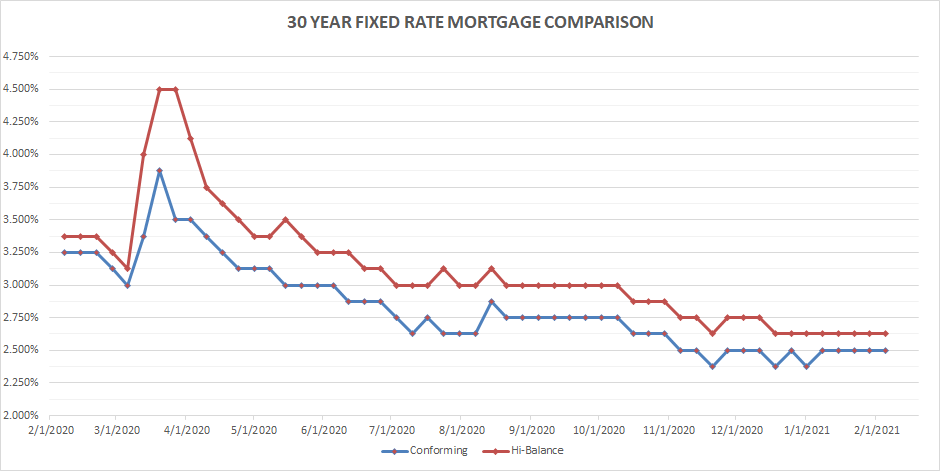
Rates for Friday February 5, 2021: We have the environment we like best, a very stable rate market with rates flat over the past month. I still feel like there is upward pressure on rates and markets waiting for reason to have rates start to move upward.
FIXED RATE MORTGAGES AT COST OF 1.25 POINTS LOCKED FOR 45 DAYS FOR PURCHASE TRANSACTIONS:
30 year conforming 2.50% Flat
30 year high-balance conforming 2.625% Flat
Please note that these are base rates and adjustments may be added for condominiums, refinances, credit scores, loan to value, no impound account and period rate is locked. Rates are based on 20% down with 740 FICO score for purchase mortgages.
The original intention was that the WR&MU for February 5, 2021 would be sent from a hotel room in Austin, Texas. Some readers may recall that in October 2019 they received a WR&MU sent from Chattanooga, Tennessee where I was attending the Large Club Conference as one of the representatives from the Rotary Club of Long Beach. As the President-Elect of our Rotary Club, I am again a representative to the Large Club Conference, which is being “held” in Austin. As with many other events over the past year, the conference which gathers representatives from clubs across the country that are classified as “large” (membership near 300) for several days of seminars, talks and engagement with other Rotarians on the issues, solutions and projects in their cities.
Instead of enjoy the food, beverages and entertainment of Austin, I will be sitting at home staring at a screen all day today, Friday, and tomorrow. Maybe I’ll wear my Stetson, eat brisket and put in a case of Shiner beer to make me feel like I’m in Texas.
Have a great week and I hope we have a great game on Sunday!
Dennis
Past Weekly Rate & Market Updates can be found on my blog page at my website www.DennisCSmith.com/my-blog


