Posts

What do you think will happen to housing prices?

Question of the week:  What do you think will happen to housing prices?

Answer: This is a question I, and anyone even tangentially involved in real estate, get asked all the time no matter the economic environment. When we are in abnormal economic times the question is comes up more frequently.

It is an obvious question, and one being asked by everyone, homeowners, potential homeowners, real estate agents, mortgage professionals, economists, media pundits. The answers vary from collapse to boom, depending on the how the answer is approached, and in the case of the media how many clicks they are trying to get for their advertisers.

Prices in any market are determined by the most basic economic equation of supply and demand. If there is more supply than demand prices will fall, if there is more demand than supply prices will increase—go to Amazon and check out the price of Lysol disinfectant spray. Oops, there is no price because the nation’s biggest retailer has none in stock. It is available Ebay, the leading secondary market in the country, at about $30 per can, plus shipping which pushes the cost to around $40.

The overwhelming majority of homes that are sold are in the secondary market—homes that are “pre-used” in developed neighborhoods as opposed to homes newly built. As such, the majority of real estate markets are very sensitive to supply and demand pricing.

Supply and demand are often influenced by outside factors, consider the plot device in the movie Trading Places. The main plot is the social experiment to ruin one successful man and make another man who is on the fringe of society economically and otherwise a big success. The device used bring the story to conclusion is the cost of frozen concentrate orange juice, more specifically future prices. The government is issuing a crop report for Florida oranges. If the crop is very good then there will be an abundance oranges and the price of orange juice will drop; if the crop is bad there will be a scarcity of oranges and the price of orange juice will climb.

Outside factors determine the quality and quantity of the Florida orange crop, primarily weather. Other factors can include labor, cost of fuel for harvesting oranges, distribution chain to get oranges to market, government regulations that determine if it is profitable to harvest oranges, are just a few.

Trading Places shows what happens when people act on poor information that would determine supply.

A factor that enters real estate markets that impacts the price formula is interest rates for mortgages as they help determine demand. Lower interest rates mean lower housing costs mean more families can afford to purchase homes, or families can afford higher priced homes. Higher rates mean the opposite, less affordability or able to purchase lower price homes.

A quick example for a family making $90,000 per year. We will assume that the mortgage payment will be 33% of their gross income. For mortgage qualifying we break all the numbers down to monthly instead of annual amounts.

This family’s income is $7500 per month, if they are to pay 33% of their income just for the monthly mortgage to purchase a home that is $2475 per month.

If the 30-year fixed rate 5% the total mortgage amount for a payment of $2475 per month is $461,000.

If the 30-year fixed rate is 4% the mortgage climbs to $518,400. At 3% the mortgage is $587,000.

Less than 20 months ago the 30-year fixed rate for high-balance conforming mortgages was at 5%, today it is at 3%. A family that purchased a home in late 2018 with a $461,000 mortgage can buy a home today that is worth at least $126,000 more (I say at least because we are leaving down payment out of the equation) with the same monthly mortgage payment.

That drives demand, drives it very fast.

Housing supply is also impacted by interest rates. As mentioned above, if rates are low current homeowners discover they can purchase a bigger home or a home in a better area. Another option is to refinance their existing home to save money every month on their housing costs, and/or reduce the term of their mortgage debt without significantly changing their monthly payment.

Currently, the coronavirus is an outside factor that is impacting the supply of homes coming to market. Many families who would had planned to sell their homes this Spring and Summer have decided to delay their plans to relocate because they do not want people coming through their homes who may be infected, as well, they do not wish to walk through other people’s homes as they search for their new home.

Leading into the pandemic housing supply was already low, many articles in February had data showing declining housing supply, which combined with dropping rates in early 2020 started a rise in home prices.

Now, five months into the pandemic, supply has constricted to two months or less in several markets and six months or less in most.

Low interest rates and limited supply have created more than supply in the housing markets. Rates are the primary factor, but rates are not the only factor driving families into the real estate market.

Surveys have shown that many families, after spending several months working, studying, living, at home since stay-at-home regulations went into effect in March are finding they want, and need, more room for their families. The pandemic has changed how we picture the use of our homes in the future. Instead of being a place the family is all together from after work to before work and on weekends, it is now a place where we are together 24/7 and it is hard to close a sale on  Zoom while your spouse is conducting a webinar on  Zoom, both of which are interfering with a child’s math test.

Conclusion to the short story made long, prices are climbing as new listings are bid on sight unseen (grammarians help me, sight or site?), multiple offers are being made and very often homes are selling over list price. Anecdotally, my clients looking to buy have experienced losing out on their offers due to multiple overbids in Lakewood, La Mirada, Corona, Mission Hills, and the Los Altos, Los Cerritos, Belmont Shore and Plaza areas of Long Beach in the past few months.

The question was not what is happening to prices, but what will happen to home prices?

In March and April, the media was full of articles stating that the pandemic would severely impact housing markets, in a negative way. At the time the CARES Act had passed enabling homeowners to obtain forbearances on their mortgage payments just by making the request. The common wisdom by the media was that this would lead to a spate of foreclosures in the future creating over-supply. Also contributing to harming the market would be the tremendous rise in unemployed workers creating an under-supply of buyers.

Now that the pandemic has aged several months there are several factors that I see that will result in most real estate markets not crashing nor seeing significant decline in prices (I equate 10% or more decline in prices as significant).

First, regarding the forbearance issue. Traditionally if a lender agrees to a forbearance the agreement with the borrower is that at the end of the forbearance period the borrower will make up the amount of payments that were deferred in a lump sum.  This policy would certainly create tremendous challenges for most families and result in the mortgage going into default. What I have seen is that most mortgage services have been extending the term of the mortgage for the number of months payments that are deferred. If you have a six-month deferment on a mortgage that was due to be paid off in April 2040 the forbearance agreement extends the loan so it will be paid off in October 2040. This lessens the economic hardship on the borrower to bring their deferred payments current in one payment.

Second, regarding foreclosures increasing nationwide. Many of those who predicted, or are predicting, a large increase in foreclosures are using the 2008 housing crash as the basis of knowledge and prediction.

The increase in home prices leading into the crash was fueled by cheap money, which we have now, but more importantly cheap underwriting. Fannie Mae and Freddie Mac underwriting guidelines enabled borrowers to purchase homes and/or refinance pulling out equity their homes with no money down, no income qualification, no asset verification and in many instances no appraisals. As a result, millions of families owned homes with loans that they could not afford and in which they had no equity. When they fell behind on their payments they had no ability to sell their home and pay off their mortgages (it costs between 7-8% to sell your home in most markets).

As the economy spiraled down it wiped out jobs that are the foundation of the housing markets, causing a hole in the demand side of the market. The result was over-supply as homeowners had homes for sale that required short-sales, or foreclosures being priced low by lenders to get rid of inventory. At the same time there was an under-supply of demand are supervisors, managers, high wage hourly workers and others were out of work and unable to qualify for mortgages.

Finally, with little to no money invested in their homes, many families found it easy to hand their keys to the bank and find a place to rent.

The profile for the overwhelming supply of homes sold since 2010 is buyers who not only qualified for their purchase mortgage with verifiable income, but likely qualified for a higher mortgage. The average down payment on a home purchase has been around 12%, closer to 6% for first-time buyers. Homeowners are staying in their homes longer, which combined with steady increases in prices, has resulted in equity growth.

Because of the interest rate environment, the past several years most homeowners have very low interest rates, and presuming their incomes have been increasing, even modestly, during their tenure of homeownership their monthly payment is more affordable today than it was a few years ago.

What does this all this mean? The initial equity at time of purchase, plus steady increase in prices while paying down mortgages means that if a family is in trouble and needs to sell their home they can do so and likely receive some equity from the sale. At worst, most would break even and avoid a foreclosure.

The lower rates make it somewhat easier for a family that has a job loss of one spouse, or a reduction in income, to retain their home and continue making payments.

Third, the majority of those who have lost their jobs due to the pandemic do not have the income to purchase homes. Looking at the jobs reports, as the employment numbers have dropped average weekly wages have increased. Why? Because the job losses are coming at the entry level wage jobs not the middle and upper level wage jobs. Conversely, when we have seen employment spikes after the economy opened up we saw the average weekly wages decline because those being hired are the entry level wage positions. We are seeing job losses creeping into higher wage jobs, the airlines for instance are laying off workers, most of whom earn more than minimum wages. Should job losses spread to industries not dependent on travel, entertainment, dining, we will see an impact on the supply of qualified buyers. At this time, however it appears that the areas of the economy most impacted remains industries largely dependent on consumers discretionary spending.

Fourth, the is such an imbalance now between demand and supply that it would take a major shift, a very major shift, in either supply increasing tremendously and/or demand declining tremendously for home prices to decline significantly.

Because of these factors I do not see a significant decline in home prices occurring in most markets. Across the Southern California region there may be pockets of decline, most likely the upper ends of the markets as jumbo mortgages are still in short supply, lack of foreign buyers and smaller pool of eligible buyers that always exist for this range of the market. For the rest of the price ranges, when we have widely available vaccinations for Covid-19, when the economy re-sets to its new normal, we will likely have the same or increased demand and a growth in supply as those families who have delayed selling their homes come to market. The increase in supply however, should be met by demand.

The outside factor that could alter my opinion, and the actual actions in the markets, is the length of the pandemic and how soon we are able to achieve the new normal with few, if any, segments of the economy being restricted due to the coronavirus.

Have a question? Ask me!

The big economic news this week was the data on 2nd quarter Gross Domestic falling at an annualized 32.9%, the largest single quarter drop since the government started tracking GDP following World War II. On a quarterly basis the decline was 9%, and was less than anticipated by Wall Street. Combined with a drop in the 1st quarter GDP, the decline puts the economy in a recession (defined by two consecutive quarters of declining GDP). The news had little to no impact on mortgage rates due to the expectation of a historic decline, and that there is little economic news at this point that can push rates much lower.

A bit of a bright spot in economic news was that consumer spending in June provided the second consecutive monthly increase, growing 5.6% from May’s spending. July may show another increase in spending, even with many states re-shutting businesses due to increases in infections. All eyes will be on August as the additional unemployment compensation of $600 per week that was part of the CARES Act expires today.

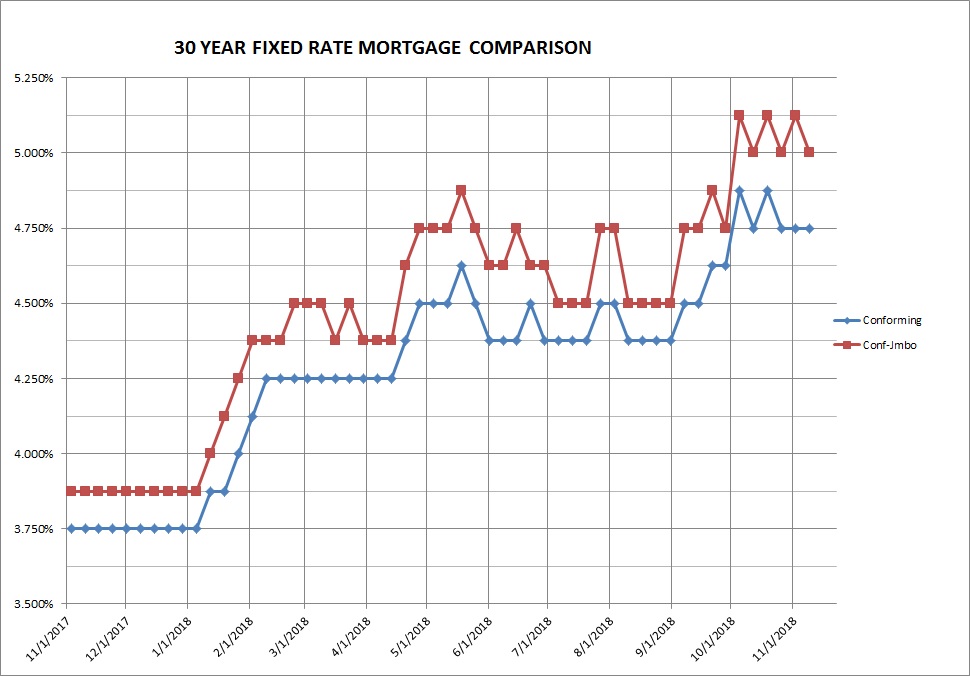
Rates for Friday July 24, 2020: Rates remain flat from last Friday, it appears we have reached our range for the current market as since the beginning of the month the conforming rate has drifted between 2.625-2.75%, while the high-balance has been between 3-3.125% for purchases with variables listed below.

The rate spread for cash-out, no point, higher loan-to-value and other factors for refinances still are historically higher than normal. Call for details and quotes as rates can vary significantly depending on the situation.

FIXED RATE MORTGAGES AT COST OF 1.25 POINTS LOCKED FOR 45 DAYS:

30 year conforming                                            2.625%   Flat

30 year high-balance conforming                   3.00%      Flat

Please note that these are base rates and adjustments may be added for condominiums, refinances, credit scores, loan to value, no impound account and period rate is locked. Rates are based on 20% down with 740 FICO score for purchase mortgages.
It appears Mollie’s suggestion to include the question of the week is very popular based on the feedback I received—such a good suggestion I wish she had made it several years ago!

The beginning of August is usually when families start getting ready to send their kids off to college—especially if their son or daughter is heading off to their freshman year. With many colleges and universities cancelling many, most or all in-class classes and moving to on-line, a lot of students who were part of the high class of 2020 are opting to take a “gap” year. With the high costs of attending college they are deciding that it is not worth the cost to sit in a dorm room watching classes on a screen, not being able to have social interactions to meet other students and benefit from the overall college experience. We have first hand knowledge of the colleges trying to sell that the education, even if on-line and not live in classrooms, is still worth the cost to attend, but it is apparent that the sell is hollow and almost desperate.

Next year will be interesting as there will be a good portion of the class of 2020 re-applying to schools while the class of 2021 will also be submitting applications—depending on the learning environment that will be available. This will make an already challenging process even more so. What will be the long-term impact on these young adults who have seen their high school and college years disrupted? How will it impact our labor markets, future leadership, and society and the economy as a whole? We will know in a decade or more as the sociologists and economists study this era and those involved.

Have a great week,

Dennis

Past Weekly Rate & Market Updates can be found on my blog page at my website www.DennisCSmith.com/my-blog

What is Escrow?

Question of the week:  What is escrow?

Answer:  We have a lot of first time buyers entering the real estate market, which means a lot of people unfamiliar with the terminology and different services in the industry. This question was asked to me this week by a young couple purchasing their first home. They have heard, “when you open escrow, when you close escrow,” but what is this “escrow” they will be opening and closing? 

Dictionary.com defines escrow as “a contract, deed, bond, or other written agreement deposited with a third person, by whom it is to be delivered to the grantee or promisee on the fulfillment of some condition.” 

By this definition escrow is a third person with whom a contract is deposited.  For a contract to be valid it needs two parties, so part of the contract must be that both parties agree who will be the escrow, the holder of their contract.

In real estate, escrow is a third party that buyer and seller, or in the case of a refinance the borrower and the lender, use to transact funds from one party to the next; escrow is also referred to as the settlement agent.  Given instructions agreed to by both parties, the escrow holder agrees to accept funds from the buyer, and the buyer’s lender if necessary, and then after paying costs for other services involved in the transaction, deliver the funds to the seller once all promises are fulfilled in exchange for a grant deed from the seller that is delivered to the buyer.

Escrow is neutral and has no agency contract with the buyer or seller, its agency is with the transaction.  A simpler way to look at this is that the Smiths are selling their home to the Joneses.  The Smiths are represented by Mary as their real estate agent and the Joneses are represented by Joe as their real estate agent.  Once an agreement to price and terms is made an escrow account is opened with Sally at the escrow company, at that point Sally is the agent of the transaction representing the agreement the Smiths and the Joneses made.

If the Joneses wish to make a change to the agreement, say have $3000 credited to them to off-set some repair costs discovered during their home inspection, they notify Sally at the escrow company.  Sally cannot just change the terms of the transaction, she first must get consent from the Smiths for the credit.  Once both parties agree to any changes then Sally can amend the transaction.

Escrow plays a vital role in real estate transactions.  Large sums of money flow through escrow companies on a daily basis for purchase and refinance transactions.  Escrow is not only charged with making sure the initial instructions are followed but also that neither party is able to change the transaction without the consent of the other.  At closing, escrow is responsible for disbursing funds to all the parties and services involved in the transaction, refunding overages to buyers or borrowers, pay fees to termite, title, home warranty, lender and themselves, payoff any liens currently on the property such as the seller’s mortgage or tax obligation and transmit the net proceeds to the seller.  After the closing escrow provides a very detailed accounting of all funds received and disbursed to all parties.

Escrow companies and officers in California can be independent of any other affiliation or may be part of a title company or owned and operated by a real estate brokerage.  If the escrow company for a purchase transaction is owned by the real estate broker representing the buyer or seller this must be disclosed to all parties.

Agents and lenders cannot require that a particular escrow company be used on any transaction; buyers and sellers have the opportunity to request a specific company if they choose, though it is customary in our marketplace the seller, or the seller’s agent, is given the choice of this service.

A good escrow officer and company is like a good umpire in a baseball game, you don’t always know how good they are until you get a bad one; thankfully the latter are very few and far between these days.

For the first-time buyers, all buyers, opening escrow is great news as it means your offer to purchase your new home was accepted. Closing escrow is even greater news as it means you now own your new home!

Have a question? Ask me!

No worries here. The Consumer Price Index for July showed that prices for consumers rose 0.3% for all goods and services and also for the “core” rate (gas and food are stripped out). For the past twelve months, the CPI is up 1.8%, which could be labelled a very benign inflation number. If price growth continues to decline there will be more support for the Fed to lower rates, however the last several CPI releases have shown a pretty steady rate of price growth just below 2%. The news is mortgage rate neutral.

What me worry? Says the American economy after the Commerce Department released retail sales data for July. July saw the largest one month increase in retail sales in four months at 0.7% above June’s sales. Taking out car and gasoline sales for the month and sales increased 0.9% for the month, with on-line sales jumping a staggering 2.8% from June—likely boosted (shoved up?) by Amazon’s Prime Day and its competitors also pushing their own deals available. Evidently the trade dispute with China is not preventing consumers from buying products, nor is it increasing the prices paid for those products. Overall the news should be negative for lower interest rates as consumer spending is 65-70% of our economy and strong retail sales should portend economic growth and higher rates.

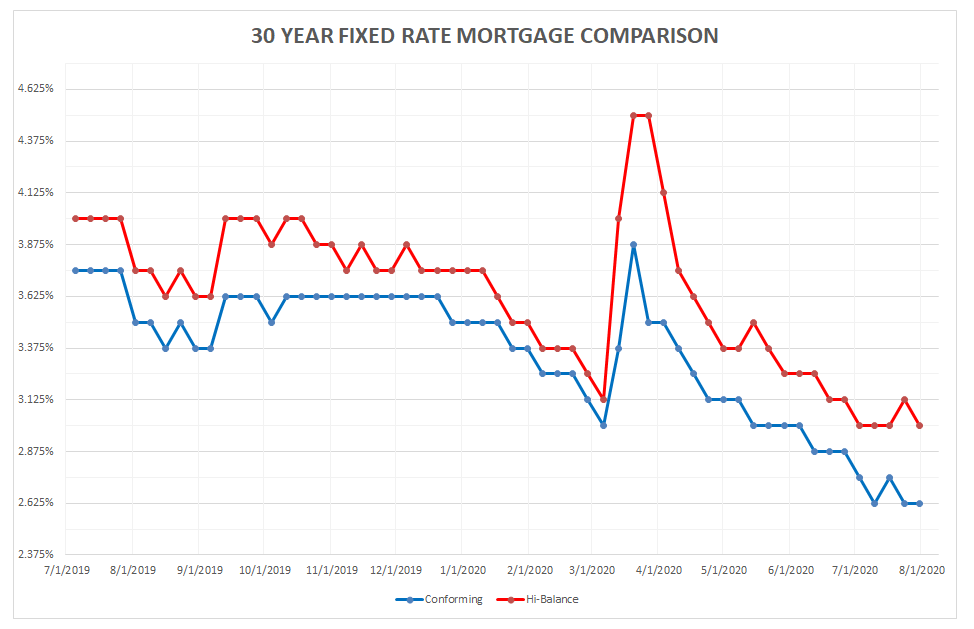
Rates for Friday August 16, 2019: Look at the pretty charts! Chart makers who track stocks and bonds had a fun week as they created what looked like silhouettes of mountain ranges with peaks and valleys. As I write this the Dow is down about 0.875% for the week and the S&P is down 3.67% since Monday’s open. In between we say a large peak on Tuesday and a deep valley on Thursday. All the while the rate on the 10-year Treasury dropped into mid-week before bouncing a bit today. Why all the activity? Concerns about a recession and European economies caused investors to sell of their equity holdings and purchase bonds and fixed rate investments—engaging in flight to safety (as discussed in the July 26th WR&MU). As discussed above, the concerns appear to be unfounded, however the result of the recession concerns is a dip in rates this week from last Friday, and the conforming rate at its lowest since the week ending December 9, 2016. Can they go lower?

FIXED RATE MORTGAGES AT COST OF 1.25 POINTS LOCKED FOR 45 DAYS:

30 year conforming                                            3.375%     Down 0.125%

30 year high-balance conforming                   3.625%     Down 0.125%       

Please note that these are base rates and adjustments may be added for condominiums, refinances, credit scores, loan to value, no impound account and period rate is locked. Rates are based on 20% down with 740 FICO score for purchase mortgages.

Long time readers of the WR&MU know that this is the space I use to comment on personal events in me and my family’s life—for some I know this is the only part you read! (As an aside, my dad was very old school and could not understand why I always wrote this final segment—when I informed him it was probably the most read section, “Oh, then you should probably keep it.” Good advice.) This week these section is for parents of new adults.

Do you have a son or daughter who recently turned 18, or any children you still provide for over 18? Then please read on. Last year when our oldest daughter, then 18, flew off to Boston for college, before she left I had her sign two copies of a HIPAA Release Form (link below). Because she is an adult, no medical provider can provide either my wife or I any medical information about her. Should she have an accident or emergency and we are contacted that an event has occurred, federal law prohibits the medical provider from releasing any details.

With she and us each having signed copies of the HIPAA release form that we can provide the medical provider authorizing them to communicate with Leslie and I, they will be able to provide us with details of her condition, etc. We also have an electronic copy that we can quickly send to a healthcare facility across the country to expedite the information collection.

If you have any children 18 or older I encourage you to have them complete the form linked below and provide you with an original or copy. As well, if they are in college and/or living with roommates, encourage them to inform their roommate(s) of the form and where it is located (and to have them complete one for their parents). Privacy laws are very important to protect us, the HIPAA laws however can be detrimental for parents who need information and be able to be pro-active in their adult children’s healthcare.

Here is a link to the HIPPA Release Form we use. I hope none of us ever need to use it.

Have a great week,

Dennis

Past Weekly Rate & Market Updates can be found on my blog page at my website www.DennisCSmith.com/my-blog

Why are there different rates or costs for the same mortgage product?

Question of the week:  Why are there different rates or costs for the same mortgage product?

Answer:  This is a question that is asked often, and one I typically answer every year to eighteen months in the Weekly Rate & Market Update.

Essentially why does a 30 year fixed rate mortgage of $400,000 have different costs for the family buying a condo versus a family purchasing a single family home versus a family refinancing and paying off an equity line versus….whatever other mortgage scenario is occurring?

Using the conforming mortgage as an example, defined as a loan that is eventually sold to Fannie Mae or Freddie Mac and that has been underwritten to their guidelines, the simple answer is “tiered pricing.”

If the most basic economic principle is supply and demand to determine prices, the second most basic investment principle is the greater the risk, the greater the return (the first most is fairly obvious, buy low and sell high); if there is little risk then you should not expect a very great return, conversely if there is greater risk then you should expect a greater return. If  you have a $10,000 deposit in a savings account at a federally insured bank that guarantees you will will get your money back if the bank collapses you should expect a very small return; if you invest your $10,000 in a start-up typewriter company you should expect a very high return should the venture become profitable.

Mortgages are investments. Your conventional mortgage is funded by a lender. The lender bundles your mortgage with others totaling tens of millions of dollars in mortgages. This bundle is then sold to Fannie Mae or Freddie Mac. Fannie or Freddie then puts the bundle with other bundles and issues investment vehicles called Mortgage Backed Securities (MBS). Investors across the country and around the world purchase MBS as part of their portfolios and investment strategies receiving regular payments, that are your interest payments, when you loan payoffs off investors receive a portion of the payoff in proportion to the investment.

The greater the risk the greater the return. Some mortgages are riskier than others, so investors in MBS will want a higher return on those mortgages.

What makes one mortgage more of a risk than other if they are being underwritten to the same guidelines? This is where tiered based pricing comes into play for mortgage consumers.

For different aspects of risk Fannie and Freddie charge more for the same rate. For example, a loan applicant for a loan with 5% with a very low credit score may pay up to two points (two percent of the loan amount) more for his mortgage than an applicant for a loan with 5% down who has an extremely high credit score. The lower credit score indicates a history of making credit payments on time, hence a higher risk, hence a higher cost for the loan than someone with outstanding credit.

Credit scores are just one of several risk factors that go into pricing a loan. Risk and risk pricing is determined by the historical defaults for mortgages with similar factors. Over the years, mortgagors with lower credit scores have defaulted on their mortgages more frequently than mortgagors with high credit scores, there for they are a greater risk, therefore their costs for the mortgage will be higher.

Here are the most common factors that result in tiered pricing:

  • Owner Occupancy: If you are living in the property being collateralized you will have lower pricing than someone purchasing for investment, an owner occupant is less likely to let a property go to foreclosure than an investor.
  • Number of Units: Most multi-unit properties purchased as primary residences eventually become investments, and multi-unit properties have a higher incidences of foreclosure as the mortgage payments are usually dependent ontenants making payments. Multi-unit properties have higher costs than single family units.
  • Condominium: Condominium owners are business partners with everyone else in their homeowners’ association, the quality of the complex is dependent on the HOA maintaining the property and a high degree of owner occupants living in the complex. Historically, condos have higher incidence of foreclosure. Because of these factors condos with greater than 75% loan-to-value (LTV) have higher costs than single family detached residences (i.e. a traditional house) or loans on condos with less than 75% LTV.
  • Loan-to-Value (LTV): The tiered pricing on LTV gets interesting. The common wisdom would be that the less equity a homeowner has in their property the greater the risk he will walk away and let a property go to foreclosure. And this is true, therefore with one exception the higher the LTV the higher the cost of the loan. The exception is LTVs between 75.01-80.00%, which have a higher cost than loans less than 20% equity. The reason is because loans with LTVs greater than 80% have mortgage insurance which covers the investors should the property go through foreclosure, properties with LTVs of 80% or less do not. If a borrower with 10% equity and a borrower with 22% equity both go through foreclosure, the loss for the investor is greater for the latter due to the lost interest and costs of foreclosure not being insured, as opposed to the 10% equity borrower who would have had mortgage insurance covering the losses.
  • Credit Score: We covered this above but to add to the cost, there is a matrix that has loan-to-value down one axis and FICO credit scores across the other. The higher the LTV the more the cost as credit scores drop, conversely the lower the LTV the lower the impact of the lower FICO score. In the example above the difference in cost for very low FICO borrower was two points higher than a very high FICO borrower if both were putting 5% down. The same very low FICO borrower putting 40% or more down payment would have loan costs that are two and a quarter points (2.25% of the loan amount) lower than the very low FICO borrower putting just 5% down. Your credit score impacts your mortgage costs depending on the LTV of the mortgage.
  • Cash-Out Refinance: Like credit scores the impact of the cost of pulling cash out of your property is dependent on the LTV of the mortgage. The higher the LTV the higher the cost of the mortgage. It should be noted that purchase and rate and term refinances are treated the same and both have lower costs than cash-out refinances.
  • Term of the Rate Lock: After all the factors have been sifted through the final cost differential is how long will the loan rate be guaranteed, how long is the rate locked. The longer the lock period the more expensive the loan, which makes sense as the lender is guaranteeing the rate if all factors input for the rate lock are shown to be valid for a longer period of time, protecting against higher rates. Most rate lock periods are in 15 day increments and the vast majority of our locks are either 30 or 45 days depending on the transaction type, complexity of the transaction and volume of business in the mortgage industry pipelines.

The costs are not paid in cash by the borrower, for instance if someone with a lower FICO score is purchasing a three unit building to rent with 25% down for a mortgage of $500,000 and the costs added by Fannie Mae are 4.125 points the borrower will not, probably not, come in with $20,625 more to close, but rather the interest rate would increase to off-set those additional costs, today that would be close to 5.5%.

The lowest cost mortgage is going to be a low LTV, high FICO purchase or rate and term refinance of a primary single-family residence; among the highest would be a low FICO, maximum LTV, cash-out non-owner occupied refinance. The first is relatively low risk, the second is relatively high risk.

There are more factors that go deeper into the weeds than I have gone with my examples, but you can see that with so many factors in play rate quotes can be risky proposition unless all the details and factors of the borrower and property are known. This is why when someone asks, “what are interest rates?” my response is, “well that depends….”

My weekly rate chart is based on the purchase of a detached single-family home for a borrower with a 740 FICO score putting 20% down payment into the transaction and locked for 45 days; a fairly normal transaction. If you have any of the factors above that are different then your rate may be different.

Let me know what your mortgage need is and allow me to provide you an accurate rate and cost for your transaction.

Have a question? Ask me!

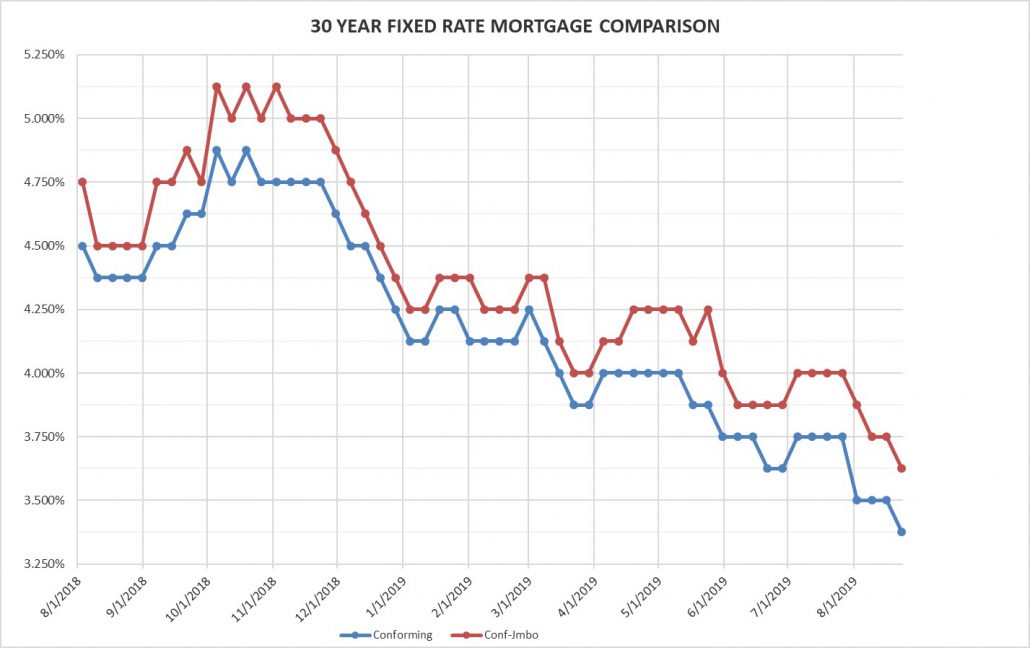
Rates for Friday February 8, 2019: Very little economic data of interest to rate markets released this week, as a result mortgage rates were fairly flat for the week. Had the Treasury not had three large sales of bonds rates likely would have dropped. Note that high-balance rates have drifted back closer to the conforming rate, which was flat from last Friday. Next week we get data on inflation, expectations are for very low increases in prices, should that not be the case and prices increased more than expected we may see a bounce in rates. Of greater impact on rates could be the negotiations with China on trade policies, if talks turn sour rates may react by climbing. For now the market is quiet and stable.

FIXED RATE MORTGAGES AT COST OF 1.25 POINTS LOCKED FOR 45 DAYS:

30 year conforming                                            4.125%     Flat

30 year high-balance conforming                   4.375%     Up 0.125%      

Please note that these are base rates and adjustments may be added for condominiums, refinances, credit scores, loan to value, no impound account and period rate is locked. Rates are based on 20% down with 740 FICO score for purchase mortgages.

Did whomever had 3-3 in your office pool buy lunch for everyone? For those with those numbers in the Super Bowl pool, especially a forward and backward score pool, the final minutes of the fourth quarter resulted in a nice payday. In recent years, we have been fortunate to have very exciting Super Bowls with fantastic finishes; for much of the history of the big game this was not the case and unfortunately Sunday’s NFL finale reverted to history with a dull game. What really aggravated many more than the punting contest on the field was the lack of excitement in the commercials. The only one I liked was the NFL’s ad with the Hall of Famers and All-Pros playing a game through the fancy dining room. What I really liked was the follow up on the commercial, a piece on Sam Gordon, the young lady seen towards the end of the advertisement. Click on the links and check them both out.

Now that football is over we can turn to baseball. Pitchers and catchers report to their teams’ training camps this week, to be followed four to five days later by position players. I am looking forward to my prediction of a few years ago of the Phillies having completed their rebuilding process and competing for their division title and hopefully making the playoffs—it all starts this coming week!

Have a great week,

Dennis

Past Weekly Rate & Market Updates can be found on my blog page at my website www.DennisCSmith.com/my-blog
Are we headed to another collapse in real estate?

Question of the week:  Are we headed to another collapse in real estate?

Answer:  In last week’s Weekly rate & Market Update I wrote that this week I would compare the real estate market prior to the collapse in the industry that led to the Great Recession with the current market. The impetus for the comparison is the slowdown in real estate sales in number of units sold and in some areas decline in prices, this has many wondering if we are heading to another major market “correction,” i.e. large drop in values for homeowners.

It is a valid question for many who experienced the market collapse that started in 2007 and continued for more than a year. The anxiety and fear of the future and other negative emotions many experienced are easily brought forth when it appears that a similar lead up may be occurring in our current economy and real estate markets.

For those who do not wish to read through my reasoning (which in typical fashion is a bit extensive) I will give you my answer to the question of the week: No.

No, we are not headed to another collapse in real estate.

There are several reasons why I do not see a significant decline in real estate on the horizon, defining “significant” as a decline in prices of more than 10% year over year.

The California Association of Realtors report on December 2018 sales notes that units sold declined for the eighth straight month, while active listings increased statewide for the ninth straight month. Statewide there was drop from December in the median price, but the median price was higher from the prior year. The data statewide and regionally throughout the state certainly shows a slowing real estate market. The question is how long and severe will such a slowing be?

Prior to the market collapse a decade ago the market went from hot and steamy to slowing, similar to what we have experienced over the past several years statewide and in Southern California, with prices increases up to 10% or more year over year in most regional markets and increasing total sales. The difference as to why the next steps will not mirror the collapse a decade ago is the basis of the run up in prices—the expanding of the balloon that eventually popped. No, not popped. Exploded.

Most real estate market slowdowns occur when price increases outpace the ability for consumers to afford to purchase homes in the markets they desire, which led to decreased demand. Eventually demand decreases to the point that sellers must lower their prices if they want to sell their homes. The amount of decline in the overall market depends on how many sellers need to sell and how far they are willing to drop the price of their homes to attract buyers.

Factored into the demand feature is not only the cost of the product, a home, but also the costs to obtain the home in terms of financing. If there were not thirty-year fixed rate mortgages with low down payment requirements available to finance homes our prices would be up to 90% less than they are today. Because of the increase in rates over the past year to cost to finance a new home purchase has exacerbated the increase in home prices putting a bigger damper on ability to purchase, which decreases demand. So not only are rising prices dampening demand, but increasing rates also kept buyers out of the market.

Having to pay more to finance an asset that also costs more reduces the amount of qualified buyers. Fewer buyers leads to less demand leads to softening prices. Simple economics.

If this is similar to what occurred starting in 2007, why should the result not be the same?

Three major reasons: Ability to finance, purpose of purchase and refinances.

The first reason, ability to finance, is by far the primary factor in the market collapse and the biggest reason our current market slowdown is in no way similar to the collapse. Last week in the WR&MU I discussed QM and non-QM mortgages, a distinction created by the Consumer Financial Protection Bureau in reaction to the part the mortgage industry played in the creation of the housing bubble and ultimate explosion.

Starting around 2000 Fannie Mae and Freddie Mac developed and continually refined Automated Underwriting Systems for loan approvals. As more and more data was available to Fannie and Freddie their AUS became looser and looser—meaning it became easier and easier to obtain loan approval for residential mortgages. By around 2003 lenders were guaranteed to have their conventional mortgages purchased by Fannie or Freddie is there was an AUS approval in the mortgage application file as long as the required documentation as listed by the AUS approval was in the file. After around 2003 the required documentation became less and less. Eventually, Fannie Mae and Freddie Mac were enabling mortgage fundings on the vast majority of loans funded in the country that today would be labelled as “Alternative,” or non-QM mortgages.

Example of less and less. In 2001 Susan and James purchase a $350,000 home with 10% down and a 90% conventional fixed rate mortgage. We run their information, credit report, monthly income, employment history, liquid assets and the sales price through the AUS for Fannie Mae. We receive a result of “approve-eligible,” meaning the loan is approved and eligible for purchase from Fannie Mae provided the conditions listed in the approval are met. The conditions in 2001 would call for proof of income as exhibited by most recent two years’ W2s and recent paystubs covering 30 days showing year to date income. Proof of down payment showing at least two months bank statements with any deposits that are significant and not from employers sourced and explained. Debt obligations and history as shown on a tri-merge credit report (Equifax, TransUnion and Experian). Value of property supported by a licensed appraiser providing a complete report including inspection of the property.

In 2006 Susan and James what to purchase a $550,000 home with no money down, obtaining a loan covering 80% of the price with a Fannie Mae loan and 20% with a Home Equity Line of Credit from the same lender. The lender guidelines for the HELOC are that they will accept whatever documentation is required by Fannie Mae’s AUS system. We interview the clients and obtain their income and assets, pull a credit report and have the purchase price. We upload the information to the AUS and receive and “approve-eligible.” The approval conditions require we perform a verbal verification of employment to ensure the borrowers are employed. Require that the funds required for closing are brought to escrow. Since the purchase price of the property is consistent with the values in Fannie Mae’s property valuation software for the zip code no appraisal is required.

In 2001 Susan and James with 10% down had to prove their income, funds for closing and their source and the value of the property is market value with an appraisal.

In 2006 Susan and James with no money down did not have to verify their income, funds for closing or that the purchase price was market value.

By 2006, Susan and James were a declining part of the market, they wanted a 30-year fixed rate mortgage. By 2006 a large portion of the market consisted of borrowers looking for adjustable rate mortgages so they could buy very expensive homes with very low mortgage payments—in the first year(s) of ownership. In the years of the bubble expansion more and more borrowers were purchasing and refinancing using adjustable rate mortgages.

In the run-up to the housing bubble explosion most borrowers did not go through any type of even quasi-rigorous approval process. Fannie and Freddie, and therefore lenders, were funding stated income, stated asset, stated value loans. Anyone with decent credit could buy a home. Many purchased homes with adjustable rate mortgages ignoring that in the future their payments would be higher.

The CFPB’s Quality Residential Mortgage (or QM) guidelines created the primary reason a future major real estate collapse is less likely because in the past ten years borrowers have had to prove income, verify assets and have the value confirmed by a licensed appraiser.* As well, many adjustable rate products are no longer available, and those that are available are very rarely used by home buyers. When you have a real estate market where the buyers are fully qualified to show they have the ability to make their mortgage payments your incidence of foreclosure will decline astronomically compared to a market where a significant portion of buyers were not adequately qualified to show they could make monthly mortgage payments.

*In recent years “property valuation waivers” have once again been issued by Fannie and Freddie through their AUS approvals. As well, as discussed last week, alternative mortgages are a growing sector of the market which depend more on assets than verifiable income for approvals. While growing, this segment of the market is a very small percentage of the total market.

Reason number one the current market is not mirroring the exploded market: Almost everyone who has purchased a home in the last ten years has the ability to make the mortgage payments as long as they are employed.

A not insignificant portion of the market were not buying “homes,” they were buying investments and doing so with very little or no down payments.

Because financing was easy the market became crowded with home buyers. More demand leads to higher prices. As prices climbed and qualifying became easier, and cost to enter the market dropped, more buyers entered the market and many began chasing home purchases so they could cash in, buying a home then reselling in a short period of time and purchasing a more expensive home, and repeating the process.

Then the perfect storm hit. With prices rising demand began to slow. On Wall Street, investors discovered that the mortgages they were buying were not as high a quality as they were told; the mortgages were not underwritten to high standards to show borrowers’ ability to repay, but rather were very risky. Investors stopped buying mortgages. Lenders started going out of business. Inventory climbed. As inventory climbed prices started to decline and homeowners found themselves with property in which they owed more than the property was worth. They could barely make their mortgage payments. Why struggle to pay a loan for a property that is worth less than you owe? Homeowners walked away from their properties, creating a flood of foreclosures and banks putting homes on the market at lower and lower prices.

Boom.

Reason number two our current market will not continue to mirror the collapsed market, there is a strong emotional connection to the property, it is a home not an investment. If there is a decline in value, while concerning, it will not create a reason to sell because the homeowner has a long term plan and still have equity in their property.

The third reason, refinances, were no small contributor to the market collapse. As prices rose many homeowners took advantage of their increased equity by refinancing, under the same easy qualifying guidelines, to pull out their equity either with cash-out refinances with fixed or adjustable rate mortgages, and/or with Home Equity Lines of Credit. Some homeowners engaged in multiple cash-out transactions from the early 2000’s into 2007, pulling hundreds of thousands of dollars in cash from their properties. What happened when prices dropped and they owed a lot more than the value of their property? Yet more inventory on the market pushing prices down more and more.

The real estate market that has grown over the past decade has done so due to very solid fundamentals. Buyers have had down payments, a stake in the property. They have financed their purchases with mainly 30-year fixed rate mortgages that they have shown are within their ability to pay based on their income, debt obligations and history of making credit payments. They have purchased homes for their families for the long term, not short term investments intended to create profit.

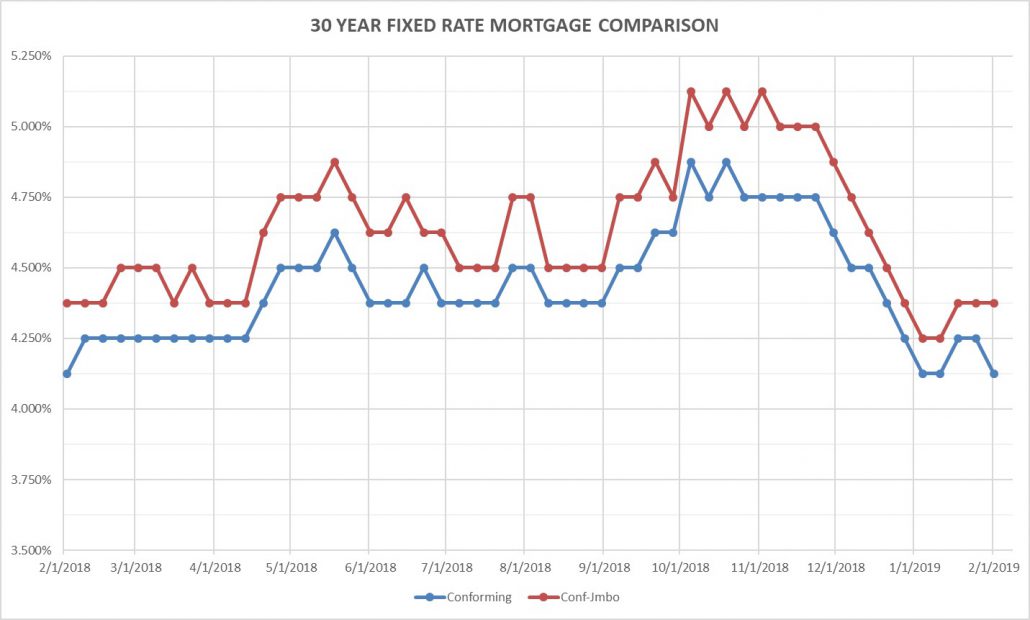
As well, the underlying interest rates for most homeowners are very low. From 2005 to 2006 conventional fixed rates climbed as high as 6.5%. Since 2010 the highest the conforming fixed rate has been is 5.125% in the first week of January 2010, dropping to 3.125% in the last quarter of 2012 and reaching a high of 4.875% for two weeks in October 2018.

Our housing stock is owned by homeowners who can qualify for their mortgage payments, have mortgages with very low fixed rates, have equity in their property—in most cases significant equity, and are staying in their homes for the most part until a life changing event like having children, kids graduating from high school, change in jobs or retirement.

After price run-ups all markets will have periods of no to negative growth, i.e. prices flatten or drop. We are experiencing this in the current market. Will it lead to another collapse? Because of the very strong fundamentals of homeowners the answer is “No.”

The greatest risk to the real estate market is the overall economy and job and income loss. Should we experience very high amount of unemployment in the region, state and country that can, and will, impact the real estate markets. But even then I cannot foresee any type of collapse in prices near what we experienced a decade ago.

Have a question? Ask me!

No bump now or maybe later. This week the Federal Reserve Open Market Committee had a meeting, this is the group that raises and lowers the Fed’s rate charged to member banks to borrow money. It was not a big surprise that the FOMC did not raise rates. What did catch everyone off guard were statements by Fed Chair Jerome Powell at a press conference. Powell’s comments indicated that the Fed may not increase rates two or three times in 2019 as previously intimated. This alone would be enough have investors believe low/er rates are in store for 2019, add in his comments about the Fed’s balance sheets and belief becomes reality.

Looking to help stimulate economic growth after the Great Recession, the Fed purchased over three trillion dollars of fixed rate assets comprised of U.S. Treasury bonds and conventional mortgages from Fannie Mae and Freddie Mac. In 2018 the Fed announced that it would be selling these assets from its balance sheet in systematic, “automatic” as described by the Fed, way. This news, and subsequent going to market with billions of dollars of fixed rate assets to sell put upward pressure on rates. The news from the Fed that it would be looking to curtail sales in the future was welcomed by investors and resulted in stocks climbing and rates decreasing.

The direction was reversed on labor news released today. As reported by the Department of Labor payrolls increased by 304,000 workers in January and job growth continues to be very strong. The headline unemployment rate edged up to 4.0%, mainly due to filings by some federal workers during the shutdown, aided by more individuals entering the market looking for work. Wages and salaries continue to increase as well, not surprising as employers seek more employees—supply and demand works for wages as it does for home prices. Overall the news is mortgage rate unfriendly as higher labor costs should lead to higher inflation, which should lead to higher rates. For the time being inflation is within the range of 2%, the Fed’s target.

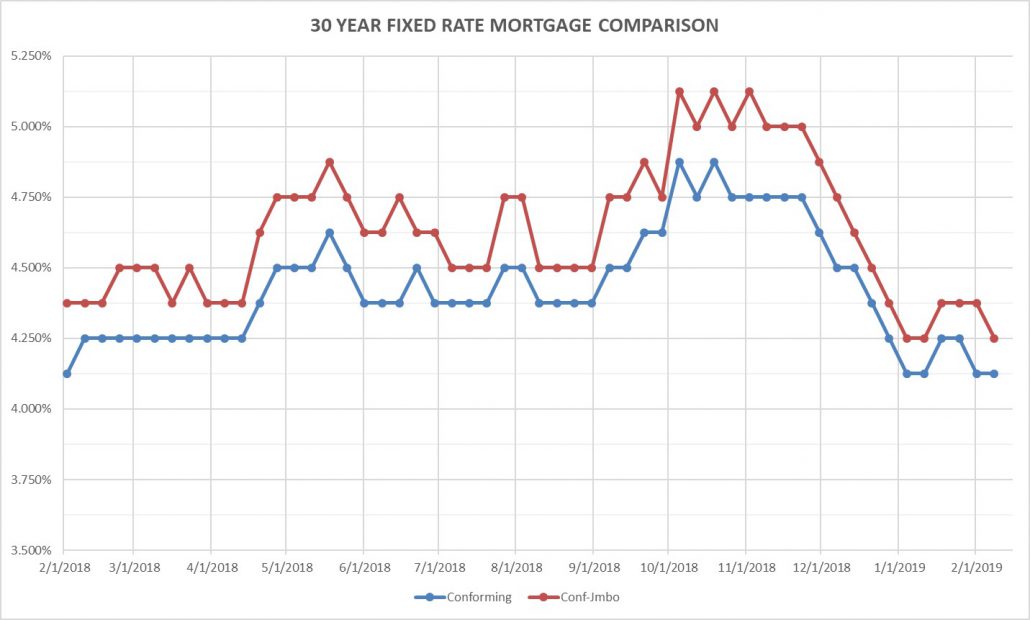
Rates for Friday February 1, 2019: Even with a bit of an uptick today following the jobs data the conforming rate is down slightly from last Friday with high balance rates remaining flat for the week.

FIXED RATE MORTGAGES AT COST OF 1.25 POINTS LOCKED FOR 45 DAYS:

30 year conforming                                            4.125%     Down 0.125%

30 year high-balance conforming                     4.375%      Flat    

Please note that these are base rates and adjustments may be added for condominiums, refinances, credit scores, loan to value, no impound account and period rate is locked. Rates are based on 20% down with 740 FICO score for purchase mortgages.

Anyone send any selfies playing golf, strolling on the beach or enjoying a beautiful sunset earlier this week to friends and family in the Midwest or East Coast? It is weeks like this that make the “weather tax” to live in Southern California worth the cost.

Once again, the New England Patriots are in the Super Bowl, entrenching themselves in the most reviled professional team in the country for those not living north of Connecticut. Love them or hate them an objective view must be that they are perhaps the greatest spots dynasty in American history during the Belichick-Brady era. Unlike the Yankees or Celtics of yore who controlled their players throughout their careers and contracts, the Patriots like other teams in the NFL must create a new team every year due to players leaving through free agency and looking for replacements through free agency and the draft. Despite all the roster change over, like many teams face, owner Robert Kraft has provided outstanding leadership to enable the team to be by far the most successful over the past seventeen plus years.

Perhaps the Rams can duplicate what my favorite team, the Eagles, did last year and beat the Patriots. I am of the opinion that they will not but that is why they play the game. Brady is 5-3 in Super Bowls, his only three losses coming to NFC East teams, the Giants twice and the Eagles last year. One thing about Patriot Super Bowl games, they are always close. Of their nine games with Brady at QB the largest point spread is eight points, last year and three games have been decided by only three.

Enjoy the game and have a great week,

Dennis

Past Weekly Rate & Market Updates can be found on my blog page at my website www.DennisCSmith.com/my-blog

12-14-18: Should we use auto-pay for our mortgage payment?

Question of the week:  Should we use auto-pay for our mortgage payment?


 Answer:  Yes, but…


One of the biggest benefits I derived from the advent of everyday web availability for the common citizen was on-line banking. My desire to not have to write a bunch of checks every month and put in the mail was so strong that I left the bank I had been with for almost twenty years, and my first job out of college, that I closed my account and went to a big bank just because I could pay bills on-line. Subsequently, my preferred local bank that is strong, friendly and conservative (and Long Beach’s oldest family owned bank) established on-line banking and I immediately switched back.


Very few people write and mail checks for their monthly bills anymore. Most people pay their bills using their banks’ on-line service. That said, many people still log on one, two, three times a month and fill out their payments and then hit send. This is understandable as credit card balances and utility payments change every month. However, many still log on every month to fill out payments for accounts that have the same payment every month for house payment, mortgage or rent, auto loans, student loans, etc.


I strongly advise that if you have a payment that is the same amount every month that you establish an automatic payment every month. There are a few reasons for this. First, you do not need to remember while you are on vacation in Yellowstone, “oh shoot it’s the 14th and I need to log-on and pay the mortgage.” Second, well, there is no second. The reason to do this is to ensure your biggest payments—house, auto, other loans—are made on time all the time.


The next question I get from a lot of clients, or if they do not bring it up I try to when we close their loan, is “should I set up auto-pay with our new mortgage lender?”


My response is always, “No.”


Almost every creditor has the option to set up on their site for making payments. You input your banking information and then can set up for them to automatically pull the payment from your bank account, or you can log in and tell them how much money you want to transfer from your bank to your credit account.


I am not a big fan of having your creditors pull funds from your bank account and strongly recommend you push your payments from your bank account to your creditors.


There are several reasons I prefer the “push” over the “pull.” First, you are in total control. Once you set up the automatic payment from your bank every month you can quickly and easily make changes if necessary. If your bank account is compromised most banks will quickly assist you in setting up a new account and many will also enable the transfer of your existing autopayments to your new account. You immediately know if your payment has been made and applied to your account.


Recently one of our clients was setting up his first payment, and subsequent auto-pays, after we funded his mortgage. He input his banking information, input the payment amount and clicked, “confirm” on making the payment and having subsequent payments pulled on the same day every month in the future. After a few days he noticed his payment was showing “paid” on the lender website, but the funds had not left his bank. After several days, we conferenced called the lender and discovered he had entered his account number incorrectly. Because the lender’s computer software did not know the account number was incorrect it assumed the payment had been made. It took about ten days before the software discovered no payment was coming and marked the account as still due. Simple mistake, but had he not checked his bank account to see if the payment had been taken out by the lender he would not know for quite some time—long enough that he may have been subject to a late penalty.


Had he set up for the payment to be sent from his bank every month he would have been notified immediately by his bank had he incorrectly input his mortgage account number and been able to make the correction. He has cancelled his auto-pay with the mortgage company and set up auto-pay from his bank.


It is not uncommon for us to receive notifications that our personal data may have been compromised, hotel chains, retailers, even the IRS have been hacked and data taken on account holders. Should this happen to your mortgage company they will obtain some very critical information, name, address, social security number, date of birth. However, if you do not have your auto-pay set up for the lender to pull your payment every month the hackers will not have your bank accounts routing and account numbers.


Yes, your account information can be compromised from your bank. However, if this happens and your accounts are accessed and funds transferred your bank will very, very likely reimburse the funds taken and set up a new account. Will this be the case if someone obtains your account information from a mortgage, credit card or student loan lender? Perhaps, perhaps not.


I strongly encourage you use auto-pay, and strongly recommend as well that you set up the auto-payments to initiate from your bank and not from your creditors.


Have a question? Ask me!


Tame. That is the one word to describe prices for wholesalers and consumers in November. The Producer Price Index rose only 0.1% in November, after climbing 0.6% in October, and increased 2.5% from last November after year-over-year increase of 2.9% in October. Consumer prices rose at the same pace in November as October, up 0.2% and the annual increase from last year is up 2.2%. Both the PPI and CPI were strongly influenced by gas prices dropping 4.2% for the month, however stripping out food and energy the “core” CPI increase was still only 0.2% from the prior month. Overall the news is interest rate friendly as the price increases are close to the Fed’s target and provide some foundation to speculation the Fed may not go through with three rate increases in 2019.


Not as tame. Retail sales as a whole increased 0.2% from October, however taking out spending on gasoline and sales were up 0.5% for the month a strong increase, evidently consumers took their savings at the pump and logged on to buy stuff. On-line sales in November were up 2.3%, department sales increases at a much smaller rate but were still up 0.4% from the prior month. Further showing the strength of the retailers was the revision to a 1.1% increase in October sales from the prior release stating sales increased 0.8%. The strong November sales and very strong October sales indicates the Gross Domestic Product for the 4th quarter of 2018 should come in at a pretty high number. The retail sales data is not real friendly to lower rates. Since consumer spending is 65-70% of our economy strong sales puts upward pressure on prices as well as on the labor pool


Where are we going? That is the question investors are asking and there is no consensus—which typically indicates an economy in transition. On the one hand, some are predicting inflation will rise through 2019 due to higher prices for wholesalers and consumers due to higher tariffs as well as higher costs for wages and salaries due to tight labor markets. If this is the case rates will continue to increase in 2019. On the other hand, some are predicting that inflation will remain flat near current levels or decline due to the economy slowing due to rising rates.


Rates for Friday December 14, 2018: Rates are retaining their levels after the recent dip, mainly due to investors pulling money out of stocks and putting into long-term fixed rate investments, such as bonds and mortgages. It appears that with inflation somewhat benign that the mortgage rates in the near future will be strongly influenced by the U.S. government. How? Because the Treasury has announced its borrowing needs and they are significantly higher than last year. Because the government can print money to pay its bills it is not very rate conscious, therefore if it needs to pay higher rates to borrow in order to finance operations it will borrow at higher rates. Between the government coming to market to borrow and the Federal Reserve putting its assets on the market to unwind its balance sheet from it Quantitative Easing programs starting in 2008, there is a lot of supply in the fixed rate markets. Over supply leads to higher interest rates. The economic data indicates somewhat stable rates, the financial markets indicate upward pressure. In the meantime rates have dropped in recent weeks—time to take advantage.


FIXED RATE MORTGAGES AT COST OF 1.25 POINTS LOCKED FOR 45 DAYS:

30 year conforming                                                4.50%       Flat

30 year high-balance conforming                       4.625%     Down 0.125%


Please note that these are base rates and adjustments may be added for condominiums, refinances, credit scores, loan to value, no impound account and period rate is locked. Rates are based on 20% down with 740 FICO score for purchase mortgages.


On my Facebook page I have been running a “Best Christmas Movie” poll for several weeks. I started by asking people to nominate their favorite films. The following week I posted the top sixteen nominees and every week since people have voted for their favorites to whittle the contestants down to the final two, posted today. It has been interesting as throughout there has been a balance between “old” (made prior to 1960’s) to “new” (made 1980’s or later). Our final two mirror the balance with “It’s a Wonderful Life” (1946) in a run-off against “A Christmas Story” (1983). Interesting, though both are widely considered two of the best Christmas movies of all time, neither did well at the box office and gained their popularity several years after their releases.


Like types of cookies, pie, whiskeys or kids, it is very hard to pick a favorite Christmas movie; but it is always fun to experience them all while trying to decide!


Have a great week,

Dennis


Past Weekly Rate & Market Updates can be found on my blog page at my website www.DennisCSmith.com/my-blog
12-7-18: I have tax liens; will that prevent me from purchasing a new home?

Question of the week:  I have tax liens; will that prevent me from purchasing a new home?


Answer:  Liz is an attorney and specializes in negotiating settlements with federal and state tax authorities, and a friend of mine. We were having a few weeks ago and this question came up as we often have clients that have state and/or federal tax liens and it was great to get some input on some options for tax liens.


Before we answer the question of whether tax liens will prevent you from obtaining a mortgage to purchase a new home, let’s answer the question: What is a tax lien?


A lien is the right to keep possession of someone’s property until a debt or obligation is paid. In the case of the government it is the right to take possession of someone’s property until a tax debt is paid—i.e. a tax lien.


If you have unpaid taxes and a lien has been filed against you the guidelines for all loans are that until the obligation is paid a loan will not be funded and closed.


Example: You are purchasing a new home for $575,000 and applying for a mortgage of $517,500 and are qualified to obtain loan approval. You have a lien for unpaid state taxes of $5000 from 2014 that is recorded in the county where you lived when the lien was filed. We submit your loan and the underwriter approves the application with a condition that we must show proof that the state tax lien from 2014 is satisfied and show evidence of where the funds for satisfying lien came from before the loan will be able to close. In many instances we coordinate satisfying the lien with the title company so you can pay the amount owed, initial amount plus penalties and interest, as part of the total funds needed for closing. Title will then guarantee to the lender, and you, the lien is paid and record the deeds needed for closing.


There are some instances with FHA mortgages where if you have established a payment plan to satisfy a lien recorded against you and are making payments on a constant and consistent basis. These situations are approved on a case-by-case basis, so if you are in such a situation do not assume you are automatically able to be approved. Before you write an offer and open escrow we would want to run your situation and any evidence through an underwriter for an opinion as to whether the lender would approve the loan with your payment agreement.


For unpaid taxes, or other debts, to become liens or judgments the obligation has to be outstanding for a fairly significant period of time. If you are aware of an unpaid obligation, especially taxes, it is strongly recommended you contact the public agency to which the obligation is owed and establish the amount owed and if necessary a payment plan. Many tax debtors are fearful of contacting the public tax authority thinking they may attach bank accounts or employment income to repay the back taxes due. This is not the case, these measures happen if a lien is filed and there has been no communication from you for a long period of time. Generally, for most private citizens for what the tax authorities would consider small amounts owed, the agency is willing to wait until you are forced to pay the tax obligation because you are purchasing a home or some other event.


Should you have an outstanding tax obligation it is strongly recommended you contact the agency to which the taxes are owed and negotiate a settlement amount and if you are unable to pay the full amount do at that time to set up a payment plan to pay off the taxes and retire the debt. In almost all cases, if you set up a payment plan and make the payments on time for the amount owed the agency will not file a lien against you. Depending on the loan type for which you are applying some lenders will approve and fund a loan if you show you are making consistent and timely payments on your obligation—counting the monthly payment amount as part of qualifying.


If you are having your pay garnished to collect a judgment or other obligation the garnishment is not considered a payment plan since it was not voluntary. Before a mortgage can be approved and funded the total obligation must be paid and the garnishment removed.


Prior to this year when running credit reports public records would show on the report that would impact whether we would be able to obtain loan approval, or what steps we would need to take to obtain loan approval: Federal and state income tax liens, county property tax liens, judgments from lawsuits or court cases, unpaid child or spousal support and bankruptcy being the most common. Beginning earlier this year these types of public records were no longer reported on credit reports, with some exceptions if a case somehow fell through the cracks.


Because a lien or judgment is not on your credit report does not mean we will not find out about it. As part of the mortgage process we obtain title insurance, part of the title insurance process is your completing a Statement of Information that includes name, addresses and employment for the past ten years, spouse(s), etc. The title companies runs this information through their data bases to determine if there are any public records filed in your name and notify us if that are any.


When there is a public record filed it needs to be addressed before we can obtain final loan approval and fund your mortgage. Because this is now the only way any public records will be discovered it is highly recommend you inform us at the beginning of the transaction if you have any public records for taxes, support payments, bankruptcy etc so we can begin working on the issue at the beginning of the transaction instead of waiting to find out from title closer to our scheduled closing date.


We have had transactions that have fell apart because borrowers delayed in completing their Statement of Information until close to closing, a lien popped up with title and we were unable to solve the issue in a timely fashion to satisfy the seller.


If you know, or suspect, there may be a lien let us know up front, complete a Statement of Information right away for title to run it through databases and if there is something filed we will have to ability to determine our best options and proceed accordingly.


Ignoring tax or other public record obligations thinking they will go away is not a long term success strategy. We have helped many families over the years with serious debt delinquency get their debt paid and in a position to purchase a home. The longer you wait to begin the process of satisfying the debt and clearing your public record the longer before you are free and clear. Start the process today, you will have a tremendous mental weight lifted just by beginning the process.


As always, if you or someone you know has public records and feel they will prevent obtaining a mortgage please contact me to discuss your situation and potential solutions we can begin to work on so you can become a homeowner.


Have a question? Ask me!


Higher loan limits for 2019 were announced by the Federal Housing Finance Agency. Starting for loans funded after January 1st, 2019 the conforming loan limit for single family residences (including condos) will increase from $453,100 to $484,250; for “high-balance” areas (LA and Orange Counties for example) the limits for Fannie and Freddie mortgages increase from $679,650 to $726,525. Will the loan limit increases have a dramatic impact on the housing markets? Not so much, at any given time the rate difference between the conforming loan amount and the high-balance amount is from one-eighth to one-quarter of one percent (0.125% or 0.25%). There will be some advantage to those borrowing more than the prior limit and at or below the new limit for high-balance as qualifying for the high-balance mortgage is generally easier than for “jumbo” or non-conforming mortgages.


November employment report contains no news that impacts rates. First Fridays are a big event for economic data geeks such as myself and investors as the Department of Labor releases job reports for the prior month. Today’s reports are nothing too exciting. The economy created 155,000 new jobs last month, significantly less than the 237,000 in October and below the expectations of most investors; however the total jobs added is not insignificant and still reflect a healthy employment market. Enough jobs were added to keep the unemployment rate at a near 50 year low at 3.7%. Wages continue to grow, up 3.1% over the past year—a factor in whether the Fed will increase rates later this month.


Rates for Friday December 7, 2018: Last week’s WR&MU mentioned that Presidents Trump and Xi were meeting at the G20 summit to discuss the tariff disputes. Following the meeting they announced a 90 day moratorium on new tariffs and agreed to negotiate the recent tariffs enacted by both countries. The news was well met by investors and stocks and bonds improved. As the week has progressed many have noticed the decline in stock markets, due in large part to continued uncertainty as to the trade war truce. Rates have benefited from this  uncertainty as the funds pulled out of stocks have flowed into long-term fixed assets, i.e. mortgages. As a result rates drop for the second Friday in a row and are at their lowest in three months.


FIXED RATE MORTGAGES AT COST OF 1.25 POINTS LOCKED FOR 45 DAYS:

30 year conforming                                            4.50%      Down 0.125%

30 year high-balance conforming                   4.75%     Down 0.125%


Please note that these are base rates and adjustments may be added for condominiums, refinances, credit scores, loan to value, no impound account and period rate is locked. Rates are based on 20% down with 740 FICO score for purchase mortgages.


For the past year I have been listening to an incredibly detailed podcast about World War II. To give you an idea how detailed, the podcaster began the podcast in December 2011, this past week he finally got to Pearl Harbor—seven years to cover three to four years. As a history buff I love the detail, he spends about ten episodes just on Churchill, but now that I am caught up I will have to wait a week or more (he is great at putting together information and his commentary, not so great at sticking to a schedule) before his next podcast. I anticipate his completing the war in around 2026.


I bring this up because today is the anniversary of Pearl Harbor and I feel its importance in our nation has declined over the years—not surprisingly. When the Japanese planes approached Oahu and began their bombing and strafing many on the island, civilian and military, thought the planes were part of a drill—even as bombs exploded many thought there must have been some mistake made. Once reality hit the general attitude went from disbelief to anger very quickly. Sentiments quickly echoed across the country as the news was broadcast that Sunday.


In Gilmore, Iowa seventy-seven years ago a boy named Don had turned twelve that morning, and the radio told his parents and the community what had occurred in far off Hawaii earlier that day. I asked Don several years ago what was his memory of that birthday and Pearl Harbor. His response was, “I didn’t get a chance to ride the pony.” They lived on the farm and he had eleven brothers and sisters and before it was his turn to ride the family pony they were all called into the house.


Happy 89th birthday to Don McCormick, my father in-law.


On a final note, thank you to everyone who bore with my very long WR&MU last week and those who replied with positive comments!


Have a great week,


Dennis


Past Weekly Rate & Market Updates can be found on my blog page at my website www.DennisCSmith.com/My-Blog

11-9-18 What kinds of loans do you and your company handle?

Question of the week:  What kinds of loans do you and your company handle?


 Answer:  This is a common question I am asked when meeting people, be it in a casual social setting or with professionals in other industries.


The broad answer is: almost any mortgage on residential property for one to four units in the State of California.


More specifically Stratis Financial excels at working with our clients to fund the following types of mortgages:


Conventional:  By far the most mortgages funded every year for residential mortgages in the United States. Broadly referred to as “conventional,” these are mortgages that are underwritten and approved to the guidelines as set forth by Fannie Mae and/or Freddie Mac. Once mortgages approved under these guidelines are funded they are sold by the lender in bundles of tens of millions of dollars to either Fannie or Freddie. While very similar with their guidelines, each of these agencies have some slight differentiation that dictates a loan can only be approved under one of their guidelines or the other. For instance in many instances Freddie Mac may only require the most recent year of Federal income tax returns for income verification for a self-employed borrower, whereas the guideline for Fannie Mae is two years of tax returns.


Conventional mortgages have two different loan tiers, labeled conventional and high-balance, which have different loan amounts, pricing and some different guidelines for qualifying and approval. These are the loans I put in the WR&MU rate quotes below. The maximum loan for single family residences for 2018 is $453,100, the maximum loan limit for “high-cost areas,” aka high-balance loans, for 2018 is $679,650. It is important to note that while Los Angeles and Orange County are considered high-cost areas, other counties in Southern California are not and have varying maximum loan amounts; for instance the maximum loan amount for Fannie or Freddie in Riverside County is $453,100 and in San Diego $649,850 in 2018.


The loan limits are established by the Federal Housing Finance Agency (FHFA) and can be adjusted annually. New loan limits for 2019 have not yet been announced, usually the loan limits for the following year are published in late November—you can be sure I will have the new limit announcement in the WR&MU the Friday we are made aware if the limits are changed.


Conforming mortgages can be used for one to four unit properties for primary residence, second homes and investment properties, different guidelines will apply depending on property use. As well fixed and adjustable rate programs are available.


Jumbo: Also referred to as non-conforming. These loans vary greatly from lender to lender as far as underwriting guidelines, loan amounts and pricing. Many lenders will start their jumbo loan programs at $453,101—just over the conforming limit—and go to several million dollars. The higher your loan amount the lower the loan to value you will have to have. For instance a lender may fund a loan up to one million dollars with a maximum loan to value (LTV) of 80%, another lender may fund up to $1.5 million with a maximum LTV of 80%. With a low LTV, say 60%, some lenders may have maximum loans of two million dollars, others may go up to ten million, or higher.


Most lenders in our market do not retain their jumbo mortgages but sell them to investors after funding, it is the investors who create the guidelines and determine the loan limits. Because different lenders use different jumbo investors we are able to fit specific criteria for clients to the jumbo programs available through different lenders.


A rule of thumb for jumbo loans is that the underwriting guidelines are stricter, how much stricter depends on the investors. As an example, one program may require any income to show it has been paid on a monthly basis for six months or more, say for payments from a retirement account, whereas another lender may use the annual distribution from the account, or show that an automatic payment has been set up. Reserve requirements, property features, income calculations, and other quirky guidelines differ from lender to lender and from Fannie and Freddie that may help one borrower or hurt another.


Another rule of thumb is that jumbo loans are higher priced than conforming; however this is not always the case. Not infrequently we will find a jumbo program that has a lower rate than other lenders high-balance conforming rates, when this is the case we ensure that the clients meet the more restrictive guidelines of the jumbo program and if so we lock them in at the lower rate and fund the jumbo mortgage. It makes no difference to the borrower that they do not have a Fannie Mae or Freddie Mac loan, especially if they are able to save money on a lower interest rate or cost of the mortgage.


Jumbo mortgages can be used for one to four unit properties for primary residence, second homes and investment properties, depending on investor, different guidelines will apply depending on property use. As well fixed and adjustable rate programs are available.


FHA: The original 30 year fixed rate mortgage for homeowners in the United States. The Federal Housing Administration was created in 1934 as part of the National  Housing Act that established the Department of Housing and Urban Development (HUD) as part of President Franklin D. Roosevelt’s New Deal agencies, also referred to as his Alphabet Soup. The New Deal Agencies were created by Roosevelt as part of his plan to pull the nation out of the Great Depression and besides HUD and FHA included the Securities and Exchange Commission (SEC), National Labor Relations Board (NLRB) and many other more specific purpose agencies such as the Tennessee Valley Authority (TVA) and national agencies like the Public Works Administration (PWA).


Homeownership prior to the Depression was very low and most homeowners had short term mortgages held by banks. The terms of the mortgages were very much in favor of the lenders and as a result foreclosure was relatively easy and could occur quickly, often with only one missed payment. The Depression caused a significant percentage of homeowners to lose their homes and farms to foreclosure.


The purpose of FHA was to insure mortgages funded by banks and lenders to encourage and enable lending to potential homeowners. It created 30 year mortgages, which resulted in lower monthly mortgage payments and established guidelines that made foreclosure a more difficult process for lenders to enable homeowners to recover from a brief set-back and retain their homes.


FHA still does not fund or purchase mortgages, instead the agency insures mortgages against default provided the mortgages follow the underwriting guidelines established by the agency.


Guidelines for FHA mortgages are generally more lenient than for conforming or jumbo mortgage products, especially for down payment requirements, income to debt ratios for qualifying and use of co-borrowers and gifts for assisting in qualifying. Looser guidelines mean riskier loans, but because the mortgages are fully backed by the United States government lenders are willing to make these loans at rates very near, often below, conforming lending rates.


The insurance the mortgages are paid by the borrower in two manners. There is the upfront mortgage insurance premium that is added to the loan amount at closing, plus a monthly mortgage insurance payment that is paid for the life of the loan. This adds to the cost of the loan, which depending on the rate markets could cause it to be more expensive than a conforming mortgage, however due to the looser guidelines it is often the best opportunity for many families to purchase or refinance their home.


It is important to note that the loan limits for FHA mirror those of Fannie Mae and Freddie Mac.


FHA mortgages can be used for one to four unit properties for primary residence, second homes and investment properties, depending on investor, different guidelines will apply depending on property use. As well fixed and adjustable rate programs are available.


VA: Congress passed the Servicemen’s Readjustment Act of 1944 and signed into law by Roosevelt. The law is more commonly known as the G.I. Bill and among the many benefits included in the Act was the establishment of the VA loan to enable active duty members of the military and qualified veterans to purchase homes with no down payment.


Like the FHA, the Veterans’ Administration does not fund mortgages but does insure them, which is why lenders will provide mortgages to those eligible with no down payment. The insurance, known as the funding fee, is added to the loan amount which would result in a loan above the value of the property, or if agreed upon the seller may pay the funding fee for the borrower. Due to the ability to finance the funding fee over the period of the loan a VA mortgage of the same amount and interest rate will have a lower monthly payment than a FHA mortgage.


There are similarities to FHA in guidelines for VA loans; however the biggest difference in the qualifying guidelines is that VA is not dependent on the debt-to-income ratio for loan approval. Residual income is the underlying guideline for VA loan qualifying. Instead of having a hard debt-to-income ratio of 50% of your gross income for total housing payment and debt obligations, the VA uses a minimum residual income amount for qualifying if necessary.


For instance in qualifying for a mortgage the applicant may have a debt-to-income of 55%, above most loans qualifying limit. However using residual income calculations the new housing payment including taxes and insurance, federal and state withholdings and payment for debt obligations, including but not limited to car and student loans, credit cards, alimony and/or child support are added up and subtracted from the applicant’s gross income. Depending on the amount of residual income the veteran can be approved. The amount of residual income required depends on the where the property is located and the number of family members; a single veteran purchasing in eastern Georgia will have a $441 residual income requirement whereas family of four in Southern California will have a $1003 requirement.


There are some criteria to be eligible for a VA loan, primarily the veteran must be honorably discharged from the service. There is a calculation for the maximum eligible loan amount based upon the entitlement available to the applicant from the VA. If a veteran has not used any of his or her entitlements the maximum loan amount, if qualified, could exceed one million dollars—there would be a down payment required, but significantly less than what would be required for FHA, conventional or jumbo loans for the same property.


VA loans are only available for the purchase or refinance of the veteran’s primary residence. In some instances a second property can be purchased using a VA mortgage, but it is a rare set of circumstances that would allow this.


VA loans can be used to purchase 2-4 unit properties as well as single family residences as long as the veteran will be occupying one of the units. Different guidelines may apply regarding loan amount calculations. As well fixed and adjustable rate programs are available.


Non-Qualified Mortgage: Also known as Non-QM, non-traditional, asset-based, or hard money, these loans practically disappeared following the passage of Dodd-Frank in 2010. The Wall Street Reform and Consumer Protection Act, commonly known as it Dodd-Frank after its sponsors Senator Christopher Dodd and Representative Barney Frank, was enacted following the 2008 housing and mortgage market melt downs.


One of the provisions of the law is that residential mortgages must meet certain guidelines to be considered a “qualified residential mortgage”. Among the qualifications are that the borrower must show evidence of income to support repaying of the mortgage; note not cash or assets, but evidence of income, the loans not be amortized for more than 30 years, do not have total points and fees in excess of 3% of the loan amount and cannot have interest only or negative amortization features.


These guidelines was in response primarily to the proliferation of no-income-verification mortgages that were funded by banks and lenders and either held in private portfolios or for the bulk of such mortgages purchased by Fannie or Freddie. The other factors such as negative amortization and interest only features in loans certainly contributed to the ease of credit that created the market collapses, but were secondary to the stated income mortgages as the primary cause.


If a lender funds mortgages that do not meet the guidelines of the qualified mortgage (QM) rule then the lender must retain at least 5% of the loans they sell into the secondary markets. This 5% rule creates a risk-retention factor for lenders in the Non-QM sector, or mandating they have some skin in the game.


Over the past few years we have seen an exponential growth in the number of Non-QM programs and lenders in the market offering loans using bank statements or other methods to determine ability to qualify for mortgages. Qualifying income is not the only reason these products are utilized for residential borrowers, others include issues with credit, subject property or chain of title and ownership history that do not meet the guidelines for conforming or jumbo products available. These loans are often part of a long term plan of obtaining funds for the purchase or refinance of a property with the intention to replace with a conventional or jumbo mortgage with more favorable rates or terms in the future.


Due to the considerably looser underwriting guidelines and the retention requirements for the loans these mortgage products have higher interest rates than conforming and jumbo mortgages.


Non-QM mortgages can be used for one to four unit properties for primary residence, second homes and investment properties, depending on investor, different guidelines will apply depending on property use. As well fixed and adjustable rate programs are available.


Stratis Financial has many other mortgage and home loan products available depending on the needs of property owners. If we do not offer a product, or I feel we are not competitive with a product, I routinely refer out to other lenders who have those products and meet the service levels we require for our clients.


What is your mortgage need? If you are uncertain please give me a call to discuss your needs and we can determine the options available for you.


Have a question? Ask me!


A few economic bits of news this week that investors key off of when making decisions which could impact mortgage rates. Consumers charged less in September than in August but borrowed more. For the fifth month out of the last eight, credit card use declined, which can be of some concern if the reduced credit card purchases result in lower consumer spending—which accounts for 65-70% of our nation’s economic activity. Total consumer debt continues to grow, at a slower rate than prior months but still growing, however much of the borrowing is for long term purchases such as vehicles and homes. The other somewhat significant piece of news was the release of the Producer Price Index for October.  If investors digested their news like many individuals do, i.e. just read the headlines without reading the details, they would have sold, sold and sold mortgages and bonds today causing interest rates to spike. The headline was that wholesale prices jumped in October for the highest increase in the PPI since 2012, climbing 0.6% for the month. Reading into the data we see that the increase was primarily due to higher gas prices. When the “core” rate of wholesale inflation is examined, with gas and food stripped out of the index, the rate of increase drops to 0.2% for the month, which is what investors expected.  Year over year the wholesale inflation rate is 2.9%, up 2.6% from September.


The Federal Reserve met this week. As expected there was no change in interest rates, what most followers of the Fed were interest in was the statement following the meeting regarding policy and future expectations. The statement on the economy was pretty much the same as it has been, mentioning the positive job growth and economic growth and that the Fed expects to gradually increase the federal funds rate in the future. Absent some major change in the economy from its current path, or a major non-economic event, we can expect the Fed to increase rates by one-quarter of one percent (0.25%) in December and then three times in 2019.


Rates for Friday November 9, 2018: Mortgage rates bounced around a bit this week but we finish with the conforming rate being flat from last Friday and the high-balance rate declining one-eighth (0.125%). Rates have been within a tight range of one-eighth of a percent for the past six weeks, any news positive or negative could prompt a break out of to higher or lower rates. In other words we continue to have a volatile somewhat unstable rate market.


FIXED RATE MORTGAGES AT COST OF 1.25 POINTS LOCKED FOR 45 DAYS:

30 year conforming                                            4.75%       Flat

30 year high-balance conforming                   5.00%      Up 0.125%


Please note that these are base rates and adjustments may be added for condominiums, refinances, credit scores, loan to value, no impound account and period rate is locked. Rates are based on 20% down with 740 FICO score for purchase mortgages.


Another milestone in the Smith household as our youngest passed her driver’s test and drove herself to school on Tuesday instead of taking the bus. It also has resulted in the big car shuffle as she took my 2006 Pilot, I am now in the 2010 Odyssey and Leslie moves into what was our oldest daughter’s 2001 Infinity until we decide it is time to get her a more recently manufactured set of wheels. We’re not real big on buying new cars in our family on a very frequent basis.


Have a great week, and drive carefully—especially around Bixby Knolls!


Dennis


Past Weekly Rate & Market Updates can be found on my blog page at my website www.DennisCSmith.com

10-26-18 Why can’t you use my bonus income to qualify me for my new home?

Question of the week:  Why can’t you use my bonus income to qualify me for my new home?


 Answer:  Income must be of a constant and continuing nature.


What constitutes “constant and continuing?” Generally, at least a two year history of receiving the income fulfills the requirement. There are some exceptions which I will cover below, but the question of the week specifically addresses bonus income, and much of this will apply to overtime and commission income as well.


Bonus income typically fluctuates from year to year depending on the matrix upon which the bonus is based. Because of the fluctuation there must be a guideline for the lender to consider the income for qualification purposes for your mortgage application. The industry standard is that if you have received a certain type of income for two years are more then we have reached the threshold of constancy. To reach the continuing nature policy we generally need a statement from your employer that the bonus will in all probability continue; this guideline is usually met with a letter from the employer or with a Verification of Employment (VOE) that we send your employer to complete. The VOE has sections for your employer to complete stating the length of employment, income for each of the past two years plus year to date broken down into base, bonus, overtime and commission. As well there is a place to indicate whether the continued payment of bonus, overtime and commission is likely to continue in the future.


Whether your bonus is paid annually, quarterly, monthly or per pay period does not matter for qualifying, we will convert the amount received into a monthly amount based on the amount received for the past two years, and if applicable year to date. The rule of thumb for bonus income, as well as overtime and commissions, is to use at least a two year average, unless the most recent year is lower than the prior year in which case the lower amount is taken.


Example: You have been with your company for five years and have received bonuses every quarter for the past three years and the bonus is paid on the first paycheck after the end of the quarter. In 2016 your bonuses totaled $12,000, in 2017 $12,600 and on your October 15th pay period your total bonuses year to date including September totaled $9700. The total amount received in bonuses is $34,300 over the past 33 months (two full years plus nine months in 2018), so we divide the total amount received by the time period over which it was received and get $1039.39, this is the amount of bonus income we will use for your qualifying for your mortgage—provided your employer verifies that you are likely to continue to receive bonuses in the future.


Example 2: Same employment scenario as above, however in 2016 you received $12,000 bonus, in 2017 you received $10,000 bonus and through September you have received $9000 in bonus income as reflected on your recent paycheck. It is evident you received $1000 per month in 2016 and so far in 2018. However, in 2017 your bonus was $833.33 per month—this is the bonus income that most lenders will use for income qualifying as it follows the standard guidelines from Fannie Mae and Freddie Mac. Even with a letter from your employer regarding 4th quarter bonus the lender will take the worst case scenario when calculating income.


All this covers how we do calculate and count your bonus income, back to our question, why is your bonus income not allowed? Reading through the above it is likely because of any or all of the following:


  • You have not received your bonus for at least two years
  • Your bonus has been inconsistent, i.e. you received bonus income in 2016 but not 2017
  • Your employer will acknowledge that your bonus is likely to continue, which we saw not infrequently during the recession with employers very hesitant to put in writing bonuses are guaranteed or likely to continue creating a legal document an employee may use against the employer should bonuses be canceled.


Any non-wage employment income is generally treated in a similar manner, most prevalent being overtime, commission and self-employment income.


As mentioned above there are some exceptions to the two year income rule:


New job—If you are starting a new job, depending on the circumstances, we can generally count your income with a short, or perhaps no, history of employment at the new job. Typically, showing at least thirty days of income is needed. If you are transferring from working for Dennis Sprockets to Smith Widgets and in somewhat the same type of work, we can use your new income—but not overtime or bonus unless expressly addressed and quantified in an employment contract and if you received similar amounts in your prior job. New professionals can also have “young” income used for qualifying with proof of education in the field and an employment contract. If transferring geographically and a new job with a new company we can usually use your new employment income before you start on your job with an employment contract and separate letter from a senior executive at the company.


Spousal support—If you have a divorce decree or separation agreement that is recorded that includes your receiving alimony or child support we can use that income once you can prove you have received six monthly payments in a timely fashion. Note the income must be received as one payment every six months and not six months’ worth of payments upfront. As well the agreement must indicate the income will be received for at least three years after the date of your mortgage application; for instance, if you are receiving $800 per month for each of your two children until they are 18 and your son is 16 then we will only accept $800 for qualifying for your youngest child.


Retirement income—If you receive a pension or social security income you do not need to show a two-year history. Provide your award letter stating the amount of income you are to receive and we will use the current income for social security; for a pension, we must show that the pension income will continue for at least three years.


Asset accounts—Most individuals and couples have their financial assets in a retirement account and/or taxable investment and bank accounts. Depending on several factors these accounts could be used for qualifying income. Retirement accounts can be used for income if you are taking regular withdrawals from the account. Depending on your age and the type of retirement account you may be having to take mandatory distributions on an annual basis, this can be used for income. Or if you are taking regular distributions we can use those amounts as income as well. If you have funds in non-retirement accounts there are some cases where we can perform a calculation called “asset depletion” so we can achieve qualifying income.


Rent—If you are purchasing a new home and renting out your existing home there are guidelines we can follow to use the rental income from your current residence as qualifying income to offset the mortgage, tax and insurance payments.


Bonuses, commissions, retirement, wages, there are many different sources of income; whether yours is eligible for use as qualifying income can depend on different factors. If you, or someone you know, if looking to purchase or refinance property please contact me to ensure you are fully qualified for the transaction you want to make.


Have a question? Ask me!


Don’t bury the lead. A couple of big pieces of economic news, since weekly update is primarily about mortgages and real estate we will start with the major news on home sales. This week the California Association of Realtors released its housing report for September. Based on the data I am of the opinion the real estate markets have become a buyer’s market. Los Angeles County saw the median home price increase 4.5% from August and 4.7% from 2017 to a value of $634,680. While the median price increased there was a dramatic drop in total sales. Sales volume for the month was down 18.3% from the prior month and 22% from last year. Neighboring Orange County saw both the median price and total sales volume drop in September. The county median price of $825,000 was down 1.6% for the month and 3.3% for the year, total volume was down 20.3% from August and 21.8% from September 2017. The data that supports my contention of our regional market being a buyer’s market is the increase in the number of active listings on the market and the time a home is on the market before it is sold and enters escrow. Basic premise, more supply leads to lower prices. Supply is growing and demand is not due to several factors, primarily higher interest rates.


Impacts sales and refinances. The softening market not only impacts sellers as they see values slowly erode, but also can have an impact on homeowners looking to refinance to lower payments, consolidate equity lines or obtain equity for various reasons. How? With a softer market there is more downward pressure on appraisals and therefore values needed for refinancing, or the rate and cost of the refinance due to potentially higher loan to value based on potentially lower appraised values.


The national economy is not following housing. This morning the initial estimate for the Gross Domestic Product was released and it showed growth in the quarter of 3.5%, slower than the 4.2% GDP growth in the second quarter. The expectation is that 2018 will end with total economic growth of 3% or greater, the first year with such growth since 2005. The report was, as you can expect, sprinkled with good news most notably the decline in inflation from 2% in the second quarter to 1.6% in the third quarter. That is good for consumers, but is it good for the economy? With some weakness in business spending and investment, slowing inflation and the equity markets dropping in recent weeks the signals are there for economic growth slowing, or reversing in 2019. It is quite possible, probable?, that a mild recession will begin in the third or fourth quarter of 2019. Overall the GDP news was market neutral as the growth figures met expectations.


Rates for Friday October 26, 2018: With stocks falling this week investors have been moving their funds to bonds and mortgages resulting in rates falling from last Friday. We remain in a volatile market and caution is strongly advised when thinking about floating your rate.


FIXED RATE MORTGAGES AT COST OF 1.25 POINTS LOCKED FOR 45 DAYS:

30 year conforming                                            4.75%     Down 0.125%

30 year high-balance conforming                       5.00%     Down 0.125%


Please note that these are base rates and adjustments may be added for condominiums, refinances, credit scores, loan to value, no impound account and period rate is locked. Rates are based on 20% down with 740 FICO score for purchase mortgages.


Few things are better than a short trip that feels like a very long trip. That was the experience Leslie, our daughter and I had last week when we flew out to Boston to see our college freshman. Leslie and I walked about 13 miles on Saturday, mostly up the Charles River while the internationally famous Head of the Charles rowing regatta was going on, watched a performance by the marching band, where ironically our daughter is the tallest in the flute section as she was in high school, then we all enjoyed a fantastic and leisurely lunch/dinner at an Italian restaurant, topped off with the ubiquitous visit to Mike’s for some pastries. Another long walk to LL Bean to get our girl squared away with duck boots for the coming winter and it was back to our hotel for a few hours of catching up and just being together. A packed day, with plenty of needed hugs, mostly for me, and just seeing how happy she is with her friends, college and new city and mom and dad have come home at ease.


Now we are looking forward to our next time seeing her when she is home for four weeks at Christmas!


Have a Happy Halloween and don’t get too spooked by the gremlins and goblins showing up on your doorstep…I’ve noticed they leave you alone if you bribe them with some sugary treats!


Have a great week,


Dennis


Past Weekly Rate & Market Updates can be found on my blog page at my website www.DennisCSmith.com

10-5-18: How does the Federal Reserve impact mortgage rates?

Question of the week:  How does the Federal Reserve impact mortgage rates?


 Answer:  Indirectly.


Long time readers of the WR&MU know I mention the Federal Reserve, aka the Fed, a lot in updates, usually in the section covering news of the week that impacts mortgage rates. Whenever the Fed changes rates I usually get inquiries from different sectors of my life as to what it means for mortgage rates. This week the Fed raised its Federal Funds Rate by 0.25% and at two different meetings subsequent to the rate increase I had conversations regarding what it means for mortgages.


Before we cover the impact that the Fed has on mortgage rates let’s cover what rates the Fed does impact directly. There are two interest rates that are directly associated with the Federal Reserve and the Fed does not directly control either. The Federal Funds Rate is the rate at which member banks charge each other for over-night loans so they can cover their required minimum reserves, the Federal Discount Rate is the rate at which the Fed loans money over-night to member banks so they can cover their reserves.

What reserves? Depending on its size a bank in the United States must retain either 10% of their total deposits (banks with more than $122.3 million in deposits) or 3% of their deposits (banks with $16 to $122.3 million in deposits) in their banks. If a bank slips below this requirement due to making loans that total more than the either 90% or 97% that can be out in loans, the bank must borrow money to add to its reserves to meet the requirement. The bank can either go to the Fed’s discount window and borrow the needed funds, or it can borrow the funds from another bank that has reserves above the reserve requirement. Depending on whether it goes to the discount window or another bank will be determined by the rate each is charging.


How are those rates set? The Federal Reserve sets the rate it charges at the discount window, and this changes daily based on the market, demand and objectives of the Fed as to what it wants to do with its assets—loan them out to member banks or retain them for its own reserves. The rate that gets all the publicity is the Fed funds rate, the rate banks charge each other to lend money over-night.


This week the Fed was in the news and it was reported that the Open Market Committee of the Federal Reserve (aka the FOMC) raised the Fed funds rate by 0.25% (one-quarter of one percent). So to the casual observer with some knowledge of the Fed the presumption is that the Fed is telling its members that it must increase the rate it charges other banks to borrow money over-night by 0.25%. Somewhat accurate, but not entirely. What the FOMC announces when it “increases” rates is the target rate it would like to see banks charging each other, but the actual rate is determined by supply and demand each night and what lending banks are willing to charge and what member banks are willing to pay.


Confused? Example: Fred’s Bank at the close of the day has $150 million in deposits, but only $15 million in reserves on hand, it is short $1 million to meet the reserve requirement. Fred’s Bank’s reserve requirement manager goes on-line and sees the Fed is willing to lend the million dollars over-night at a rate of 2.25% (the Fed discount rate), the manager then checks the member bank website and sees that Jane’s Bank, which also has $150 million in deposits but $19 million in reserves, or $4 million above the requirement, is willing to lend one million dollars over-night for 2.23% under the Federal Funds agreement between member banks. The manager at Fred’s Bank can save 0.02% borrowing from Jane’s bank and initiates the transaction. In reality the amount borrowed over-night is in the billions, tens of billions so the savings for small differences such as 0.02% become pretty big.


The only rate set by the Fed is the discount rate it charges for over-night loans, but it influences the funds rate by making a strong suggestion to member banks as to what rate it would like see them use for making over-night loans. The two are usually very close, but again determined by the market.


Back to our question, how does the Fed impact mortgage rates?


As you can see there is no consumer rate that the Fed manages or dictates. However, but by impacting the rate at which banks can borrow money it is also impacting the rate at which banks will loan money to consumers. If a bank can make enough loans so that it is constantly below the reserve requirement, borrow money from the Fed at 2.25% to cover the required reserves and then lend the money it is borrowing at 2.25% to clients at say 5.25% it is making 3% on the money it is borrowing.


The 5.25% in my example is what the current prime rate is after the Fed rate increase last week. This impacts homeowners with Home Equity Lines of Credit directly, and the increase in the prime rate was a direct result of the action by the Fed’s Open Market Committee to raise its target for the funds rate.


However, long term mortgage rates, the 30-year fixed rate the majority of borrowers obtain, is not impacted by the FOMC decision. Directly.


Indirectly, the Fed’s move impacted mortgage rates months ago. And the current actions, and statements, by the Fed are impacting future mortgage rates. How?


Mortgage rates are determined by the open market. Investors, and think hundreds of billions of dollars daily, have many choices to make that balance their desire for high returns for their funds and minimizing risk that those funds will decline in value due to the wrong investment decision. Investors are also gamblers. They are constantly research the economy, markets, industries and hundreds of other factors with the sole objective of trying to predict what will happen tomorrow, next week, next month and next year. Based on their information they make the decision to invest in equities, aka stocks, which means you own part of a company; or fixed rate assets that pay a specified rate of return for a specified period like bonds, or mortgages.


The most basic piece of information to determine whether to invest in equities or bonds is information that shows how the general economy is doing. If the economy is doing really well, or looks like it will be doing really well, money will go into stocks, causing stock prices to increase, and money will go out of bonds and rates will go up. Why? If the economy is doing well companies will earn more money and therefore be worth more in the future, investors are buying today, low, and looking to sell in the future, high. They leave fixed rate assets like bonds because as the economy improves rates will increase so the rates they are fixing today by buying a bond will be worth less money in the future after rates increase. Conversely, if it appears the economy is slowing down, or contracting, investors will sell equities as companies will be earning less or be losing money in the future, and buy fixed rate invests instead locking in higher rates today with the presumption rates will decline as the economy declines; the higher rates they lock into today will be worth more money in the future when rates are lower.


Example: Investor reads the economic tea leaves and sees a growing economy. The option is to purchase a fixed rate investment paying guaranteed 4% for the next five years, or purchase a shares in a mutual fund that focusses on growth. Based on the economy growing, rates will increase so in one or two years the same fixed rate investment may be 5% or higher, or 25% more than the current return, but the money would be locked in at 4%, missing out on the opportunity for the higher rate of return. The mutual fund with companies that experience growth in strong economies is expected to return 6-7% over the next one or two years. If the investor is correct the money will be invested in the mutual fund, and then in a year or two the decision will be made with that money to either sell the mutual fund and re-invest in fixed assets now paying over 5% or leave the money in the fund. Because the 4% fixed rate is not enough to attract investors to invest the rate will increase until investors are attracted.


Move ahead two years and the economic growth is losing, or has lost, steam. Rates have gone up to encourage investors, which has also been a factor in slowing economic growth. The investor has made an average of 6.5% by investing in the growth fund but sees the economy has slowed. Looking at the markets there is a fixed rate bond that is guaranteed to pay 6.25% for the next five years. Knowing a bad market will cause rates to decline, and also slow the growth of companies, the investor sells the growth fund holdings and purchases the fixed rate bond. As the economy does slow down the investor is collecting a higher rate of return on the fixed asset than newer bonds coming to market are paying, as well as a lot more than the growth fund that is now losing value.


The Fed indirectly impacts mortgage rates as it provides a look into the future for investors as to which way interest rates are headed, often by broadcasting in advance its future intentions with rates. The rate increase last week had no impact on mortgage rates because the Fed told the world in 2017 its intention to increase rates through 2018, how often and by how much. We know that the Fed will increase its target for the funds rate by December 31st by another 0.25%, if it does then there will be no impact on mortgage rates as investors have already priced this increase into bonds and mortgages. If however, the target is increased by 0.50% instead of 0.25% mortgage rates will jump as the rate increase was higher than expected and investors will have been caught off-guard and will sell off holdings they purchased anticipating only a 0.25% increase.


What impacts mortgage rates is the expectation for what rates will be in the future. What rates will be in the future is determined by economic activity. This is why I include a brief economic report every week in the WR&MU, so readers can get an idea of the strength, or weakness, of the economy and from that get a good idea if rates will be going up, going down, or holding steady.


Even with economic activity it is still somewhat of a guessing game as at any time rates can bounce up or fall down based on national or international events. The rule of thumb for mortgage rates is bad news means low rates and good news means high rates.


I hope this was not too much deep in the weeds in describing the Fed’s impact on your mortgage rate, but it is hard to make a simple explanation on a somewhat complex issue.


Have a question? Ask me!


First Friday means jobs. On the First Friday of every month the Labor Department releases the labor statistics for the prior month. Today’s release contained a huge headline number that will cause a stir and details that need further examination. The important data is that non-farm payrolls increased by 134,000 for the month, well below the expectations of 168,000 and below the average of over 200,000 new jobs for month for the first nine months of the year. It is unknown if the lower than expected number of new hires was impacted by Hurricane Florence, or if it is signifying a slow-down in hiring that will continue. Employers are having a hard time finding workers, as indicated by the headline unemployment rate dropping 0.2% from August to 3.7%, the lowest unemployment rate since December 1969. Wages grew 0.3% for the month and are up 2.8% from last August. The news is not positive for rates. With unemployment dropping employers will need to continue to increase wages to fill vacancies, which will in turn require prices to increase to cover the higher labor costs. This can start a wage and price inflation spiral that can be difficult to control. This leads to expectations for higher rates, which puts very strong upward pressure on interest rates.


Rates for Friday October 5, 2018: Several months ago, I wrote about the Fed selling off its accumulation of mortgages and U.S. Treasury bonds it purchased over the years following the recession. At the same time these assets are hitting the market the U.S. Treasury is also selling short and long term debt to finance the operations of the government. With increased supply on the market, which drives down prices and rates up, plus economic data indicating there is a strong possibility of higher inflation, and therefore higher rates, it is not surprise that the U.S. Treasury 10 year bond yield is at its highest since July 2011 and that 30-year fixed mortgage rates today hit their highest levels since April 2011. There is some over-reaction from investors this week to the employment data, however when they make adjustments to their behavior, any decrease in rates will be much more modest than the increase we have seen since the end of August. Now is the time to lock in your mortgage rates.


FIXED RATE MORTGAGES AT COST OF 1.25 POINTS LOCKED FOR 45 DAYS:

30 year conforming                                            4.875%    Up 0.25%

30 year high-balance conforming                    5.125%    Up 0.125%

Please note that these are base rates and adjustments may be added for condominiums, refinances, credit scores, loan to value, no impound account and period rate is locked. Rates are based on 20% down with 740 FICO score for purchase mortgages.


Thanks to my wonderful wife Leslie, PR consultant extraordinaire, and her terrific team, my website is fully functional and includes past Weekly Rate & Market Updates through 2016. The posts from 2016 and 2017 will see some changes, hopefully over the weekend, as I tighten up the titles. The posts from this year are listed by date and also show the Question of the Week to help visitors find topics they are interested in learning more about. There is still some cleaning up and beautifying to go but I am excited that archives of past updates are now available.


To visit the website, go to www.DennisCSmith.com or directly to the page with the WR&MU history go to www.DennisCSmith.com/MyBlog .


Thank you to everyone who got back to me on last week’s topic regarding the Propositions on the California ballot in November, it was the most feedback I have had on a Question of the Week in some time. If you missed it click here.


Have a great week,


Dennis

9-14-18: Can we afford this payment?

Question of the week:  Can we afford this payment?


 Answer:  Statistically, yes you can.


Statistics dictate the underwriting guidelines when determining how much of a mortgage and housing payment a family can afford to get loan approval to purchase a new home, or refinance an existing home. The key number is the debt-to-income (DTI) ratio which is your new housing payment (mortgage, property taxes, insurance and homeowners association dues if applicable, collectively referred to as PITI) divided by your adjusted gross income (income before taxes). Depending on the loan program this percentage of your total income for your total new debt obligations inclusive of housing payment cannot exceed between 43 and 50% of your gross income. (Note, VA mortgages do not adhere strictly to DTI guidelines for qualifying.)


For instance, if you are purchasing a new home and the total housing payment is $3,000 and you have car payment, student loan payment and credit cards with monthly payments reported on your credit report totaling $1275 per month, your total obligations are $4275 per month. If your gross monthly income is $10,000 per month you have a DTI of 42.75%, generally good enough to qualify for most programs.


Statistically. The debt-to-income guidelines were created based upon data from millions of property owner’s history of making payments in a timely fashion, and more important those that have not. Mortgage data is analyzed to see the percentage of defaults for debt-to-income ratios and there is a breaking point at which the percentage of defaults become untenable risk for lenders and that is where the DTI guidelines are set. It is important to note that the default data is also analyzed for occupancy, type of property and credit scores among other criteria and this is how rates are priced (sounds like a good question for next week).


Back to if you can afford the payment that we have given you which would be approved by underwriting.


I tell almost all clients purchasing a new home when we are going through the qualification process, “there are three things that are very true regarding your new home purchase. One, I will not use my savings to purchase the home. Two, I will use my income to help you make the monthly payment. Three, I will not spend any time sleeping or living in your home.” This is to say, while I may feel comfortable with the payment I am giving you for your potential new mortgage, property taxes and insurance, I am not making the payment so it is important that you are comfortable with what you feel you can afford.


That said it is also important to stretch a little of your comfort if your comfort level is well below your income ability, unless there are some exceptions. One gauge many first-time buyers, and some move up buyers, use for their new housing payment is what they are currently paying in rent. If you make $10,000 per month and are paying $2200 per month, using the $2200 per month to be what you would like your new housing payment to be you will be looking at homes that are significantly below your ability to qualify, and from my experience frustrated in the homes you will be looking to purchase as few, if any, will feel “right” for you and your family.


If the payment I am quoting feels too high for a client I ask that they take a look at where they spend their money, and is this likely to continue once they become homeowners. Purchasing a home is not just purchasing a place to live, it is also entering a new lifestyle, that of homeowner. For most first-time buyers, purchasing a home occurs before they start a family, or with younger children. This changes your lifestyle dramatically and the stability of owning a home and fixing your housing payment pairs perfectly with a growing family. Most meals will be made at home, changing your budget if you eat out a lot. Weekends will likely be spent with the family at different events, games and activities involving the children, which means fewer weekends travelling to the wine country or Vegas.


Essentially, is your expectation that your lifestyle and spending habits that make your potential new housing payment seem uncomfortable to remain the same? Chances are very, very high that it will not. When considering your new home and the cost also consider the changes you will be making in your lifestyle, and therefore expenses.


Finally, why are you buying a home? Is it to change your life in a positive manner? If so what other changes are you willing to make so you can experience the value of homeownership?


Pretty much everything decision in life has trade-offs and consequences, even not making a decision. One area at which I will immodestly say I do very well is explaining to my clients the positives and negatives of the options available to them when purchasing a home. If you think owning a home is not in your budget please contact me so we can discuss your financial situation and options.


Have a question? Ask me!


August economic data was interesting. The Producer Price Index dropped 0.1% in August, the first month over month decline in 18 months and read by many as a sign that inflation may be easing. Supporting the read was the Consumer Price Index for August that showed prices rose 0.2% for the month, however up only 0.1% for the “core” rate (minus fuel and food). The monthly increase was the fifth straight increase, however the size of the CPI increase lowered the year over year inflation for the core index to 2.2% from 2.4%. Gas and rent were the primary factors putting upward pressure on the index, many other consumer sectors fell, primarily clothing which saw prices drop for the third month in a row—good news if you have growing children. The news is mostly positive for interest rates as any easing of inflation releases pressure for rates to go higher.


Retail sales also grew at a slower pace in August from the prior month, however the slow down was not unexpected given the surge in sales in July. Supporting future increases in sales was the Michigan Consumer Sentiment Index which continues to rise, reaching it second  highest level since 2004, and highest since March of this year. Positive consumer sentiment leads to consumer spending, which drives the economy and can lead to higher rates.


Rates for Friday September 14, 2018: A large drop in Mortgage Backed Security (MBS) prices in the middle of the week put strong upward pressure on rates. Some easing later in the week saw us with rates this Friday flat from last Friday. I have been asked a lot lately what I thought rates will do, my standard response is that I feel they should be higher than they are currently given the economic data.


FIXED RATE MORTGAGES AT COST OF 1.25 POINTS LOCKED FOR 45 DAYS:

30 year conforming                                            4.50%             Flat

30 year high-balance conforming                      4.75%      Flat


Please note that these are base rates and adjustments may be added for condominiums, refinances, credit scores, loan to value, no impound account and period rate is locked. Rates are based on 20% down with 740 FICO score for purchase mortgages.


Thankfully Hurricane Florence started losing power earlier in the week and when it made landfall this morning in North Carolina had lost enough power to be designated a tropical storm instead of a hurricane. Even with the winds at less power the amount of water that will be dropped in the southeast will be significant, especially if the storm remains in place. As always when nature becomes fierce the Red Cross is there to help residents through the event and after. We are truly fortunate to have such a wonderful organization looking after people negatively impacted around the globe by human and natural acts that displace and harm people.


Many communities are also grateful they have a Waffle House or two in their communities. The butt of many jokes, mostly from those not in the Waffle House regions, the company does great work when disasters are about to hit. So great in fact that FEMA follows the company’s “Waffle House Index” to help determine the severity of a storm. Waffle Houses rarely close, they want to stay open as long as possible as the company knows in many communities it may be the only place for residents and emergency personnel to get a meal. The company also assists with employees from other stores in nearby, less effected, regions to go into disaster zones and fill the jobs at Waffle Houses so those employees can take care of their families and situations as a result of the hurricane, tornado or other event.


Here is a good article on the Waffle House Index. Just so you know, Stage Yellow probably means no bacon—you can get sausage because it takes up less grill space and takes less time to cook so the restaurant can serve more people faster by taking bacon of the restricted menu.


Have a great week,


Dennis