Can we remove our loan contingency?
Question of the week: Can we release our loan contingency?
Answer: This is a question ever lender is asked on every purchase transaction mortgage package they are working on.
Section 3, Item J of the California Association of Realtors’ California Residential Purchase Agreement and Joint Escrow Instructions, aka “RPA” or “the offer,” has five clauses that deal with the loan terms of the offer to purchase a property.
- Clause one deals with loan applications and requires that within three days, or other stipulated time frame, after acceptance of offer, the buyer needs to deliver to seller a letter from buyer’s lender stating that after receiving application and credit report buyer is prequalified.
- Clause two is titled loan contingency and states that buyer shall act “diligently and in good faith” to obtain financing and that buyer’s qualification stipulated in clause 1 is a contingency.
- Clause three are the terms regarding loan contingency removal and states that within twenty-one days, or other stipulated time frame, of acceptance of offer the buyer must remove the loan contingency or cancel the agreement.
- Clause four gives the buyer the opportunity to declare that the offer is not contingent on the buyer’s ability to obtain financing.
- Clause five deals with credits to the buyer and what happens if credits exceed limits imposed by buyers’ lender.
Our question of the week deals with clause number three, removal of loan contingency, and tangentially clause four, there is no loan contingency.
What is a contingency and why do is matter?
When you make an offer to purchase property you will almost always need to put up an initial deposit when you and the seller reach an agreement on price and terms. In the RPA where you indicate the price you are offering for the property, you also indicate how much of a deposit you will be sending to escrow should your offer be accepted. The amount of your deposit can vary, but generally the higher the deposit the stronger your offer is considered to be. Most offers are generally around 2% rounded to the nearest $5000 level. For instance, on a $300,000 offer you may have a $5000 deposit, on a $400,000 offer you may have a $10,000 deposit. If you have a $400,000 and your deposit is $25,000 then you are telling the seller, “we feel really confident we will be able to close this transaction and are putting up $25,000 to show our confidence.”
The deposit really matters because if you cannot close your transaction after you have removed contingencies the seller has a claim on the deposit.
Notice “contingencies,” the loan contingency is mentioned above, other contingencies are for appraisal, physical inspection, documents pertaining to a homeowners’ association if applicable, sale of buyer’s current property, termite report and clearance are the most common and included in the purchase agreement’s boilerplate language.
The impact of removing contingencies is covered in Section 14, Item F, effect of buyer’s removal of contingencies, which basically says you are satisfied with all inspections and ability to obtain funds to close and are moving forward to close the transaction and accept liability if you cannot perform actions needed to close; i.e lose your initial deposit.
Item H of Section 14 contains the language regarding the effect of cancellation of the contract on deposits. Essentially, both parties must agree in writing to the cancellation and the disposition of the deposit. If one party refuses to agree to the cancelation and disposition of funds, then the clause addresses the steps to be taken due to the adversarial nature of the issue.
The bottom line is that removal of contingencies are a big deal if later in the transaction something happens that inhibits either party’s ability to close, but especially the buyer’s inability to close.
Circling back to our question regarding the loan contingency clauses stipulated in section J, within twenty-one days you have to inform the seller you are removing the loan contingency or are canceling the agreement.
If you choose to cancel the contract rather than removing the loan contingency then you are entitle to your deposit being returned, less any costs incurred on your behalf.
If you do not remove the contingency then the seller has the right to terminate the contract which generates a return of your deposit.
If you do remove the contingency and cannot obtain financing to close the transaction by the agreed upon close of escrow date, the seller can cancel the transaction and demand your deposit be transfer to them from escrow.
Can we release our loan contingency?
For many years our company has replied to this question based on advice from our legal counsel. Because California is a litigious state, we have been advised and follow the advice, that we will not tell clients, “Yes, remove your financing contingency.” If we say that we are telling our client that their loan will be funded and their deposit is secure based on the ability to fund that loan.
There have been many instances over the years where after a loan contingency has been removed a buyer has lost their job, has suffered some calamity that exhausted funds needed for closing, had an IRS or other tax lien appear that was not on a credit report, that precluded the ability for the buyer to obtain final loan approval and funding of their mortgage. In these instances, should we have told a client they were okay to remove their loan contingency and they lose their deposit we are open to action by the buyer to reimburse them for their lost deposit and possibly other expenses.
In our current environment, where many people are being laid off, furloughed, having salaries and wages reduced, due to the Covid-19 pandemic, increases the chances of something occurring that may prevent final loan approval and/or funding. This is one reason why the mortgage industry has dramatically increased employment and income verification after loan approval and before drawing loan documents and the day of funding.
What we can tell a client when asked if they can lift their loan contingency is that they were qualified when we took the application and are still qualified. However, funding of the loan will be contingent on no changes to their income, employment or other qualifying factors until the funding of the loan.
When the time comes for you to remove your loan contingency, consider all the factors in your employment, income, funds for closing, and objectively consider if there is a chance any of those may change enough to change your ability to qualify. If you feel there may be some change to your income then run it by your lender to see how that changes your qualifications and chances to close.
More importantly, before writing an offer, consider your employment, income and funds for closing and determine if there could be an impact on any of them before you close escrow that may change your ability to qualify. If so then you may wish to delay your home purchase until you are certain your ability to close has stabilized so as not to be put in a position to potentially risk several thousand dollars put on deposit.
In the end, your decision to remove your loan contingency or cancel the purchase contract is a risk assessment you need to make based on what you feel may happen after you make that decision.
Have a question? Ask me!
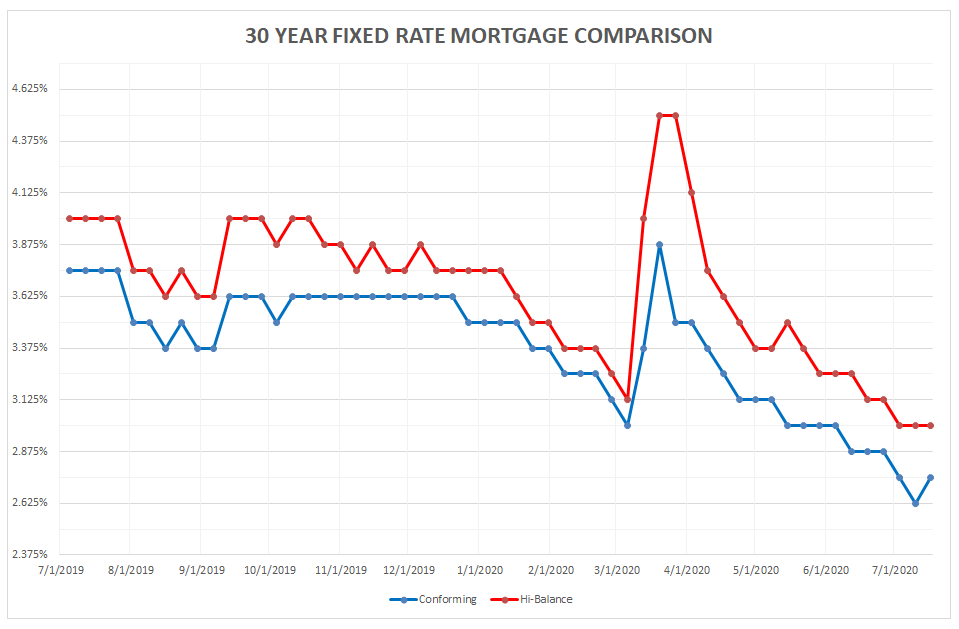
Rates for Friday July 17, 2020: Economic data a bit mixed this week as reports for June retail sales continued the gains seen in May, consumer prices increased on higher demand, both of which are good news for the general economy….but….initial jobless claims for the week ending July 11th were still over the 1 million mark and continuing jobless claims are over 17 million, which reflects a reset in many states as they close some parts of their economies that had opened in May and June.
For the week the high-balance rate remains flat from last Friday and we see a bit of a bump on the conforming rate from last Friday.
We are still seeing large disconnect in the high-balance market from purchases and refinances, as well the spread remains larger than it has historically between “no-point” transactions and those with one or fewer points. Call for details and quotes.
FIXED RATE MORTGAGES AT COST OF 1.25 POINTS LOCKED FOR 45 DAYS:
30 year conforming 2.75% Up 0.125%
30 year high-balance conforming 3.00% Flat
Please note that these are base rates and adjustments may be added for condominiums, refinances, credit scores, loan to value, no impound account and period rate is locked. Rates are based on 20% down with 740 FICO score for purchase mortgages.
This is usually the time of the summer that Leslie and I are off on our annual summer road trip. We usually start talking about our possible trips in January or February. Even before Covid-19 was on the radar we still had not had any discussions about where we wanted to go. Probably because we still did not know the girls’ plans for the summer.
Our drive trips have been up to Northridge a few weeks ago to visit my brother’s family, and again tomorrow to see them and also my sister who is on her own drive trip from her home in Boise.
I miss the small roads and towns we won’t be seeing this summer.
Have a great week,
Dennis
Past Weekly Rate & Market Updates can be found on my blog page at my website www.DennisCSmith.com/my-blog