Question of the Week: How Does Our Industry Use Artificial Intelligence?
Artificial intelligence (AI) is broadly defined as computer systems that can perform tasks that normally require human intelligence.
While “AI” has become a buzzword in recent years, the mortgage industry has quietly used AI‑type systems for decades—long before the label existed.
Below are the major areas where AI shapes our world today.
Credit
Credit scoring has existed as long as banking itself. Even before numeric scores, lenders evaluated character, capacity, collateral, and credit history to determine whether someone was a good risk.
1956 — The Birth of Modern Credit Scoring
In 1956, Bill Fair and Earl Isaac founded Fair, Isaac and Company (FICO). (Fun fact: many people assume “Fair” refers to fairness in scoring—it’s just Bill Fair’s last name.)
Their innovation was applying data analytics to estimate credit risk, assigning numeric values to borrower behaviors. Lenders subscribed to their scoring system, which brought consistency to an otherwise subjective process.
Late 1950s–1980s — Computerization
Using punch cards and early computers (cue one of your favorite movie/acting duos), lenders began automating credit scoring. As credit bureaus grew and consolidated, consistent scoring became essential.
1989 — The First Standardized FICO Score
FICO released a score based on data from all three major credit bureaus. For the first time, lenders across the country could use the same standardized measure of credit risk.
AI’s Role in Credit Today
Over time, scoring models evolved by analyzing millions of accounts, identifying patterns in repayment behavior, and predicting future risk.
This is where AI became foundational—learning from past and current behavior to assign risk with far more accuracy than manual review ever could.
Underwriting
When I started in the industry in 1987, underwriting was a very different world.
We relied on couriers and the U.S. Postal Service.
Fax machines weren’t standard.
Underwriters required original documents—tax returns, bank statements, everything.
A loan decision typically took two weeks.
Even credit reports could take up to two weeks, and processors eagerly awaited the daily delivery of reports.
The Fax Machine Revolution
The fax machine was a game‑changer. Suddenly we could send documents to underwriters in minutes. Direct communication improved, and when we finally got a printer that could print credit reports in‑office, it felt like magic.
Then came the internet and email, which transformed communication entirely.
1995 — The Leap to Automated Underwriting
In 1995, our industry took a massive step forward. Fannie Mae and Freddie Mac introduced Automated Underwriting Systems (AUS)—statistically based models that could analyze a loan file and issue a decision.
At first, underwriting departments entered the data manually. Even that cut turn times dramatically.
1999 — AUS Goes Online
In 1999, Fannie and Freddie made AUS available via the internet. Brokers, lenders, and wholesalers could input borrower information and receive decisions in minutes.
Today
A single conversation with a borrower can produce:
a credit report
a complete application
an AUS decision
…all during the phone call.
What once took an underwriter hours to review, calculate, and decide, AUS now does in under a minute.
Rates
AI does not set mortgage rates. But it plays a major role in how lenders interpret the data that influences rates.
Mortgage rates are shaped by:
inflation
bond yields
Federal Reserve policy
labor markets
investor demand
risk
consumer behavior
global events
Even with all this information, rate setting ultimately comes down to educated forecasting—what lenders and investors believe the economy will do next.
Where AI Fits In
AI excels at:
analyzing massive datasets
monitoring markets in real time
identifying patterns in economic releases
comparing current conditions to historical movements
As markets shift throughout the day, AI helps lenders decide whether to raise, lower, or hold rates. In today’s volatile environment—energy prices, geopolitical conflict, instant news—we’re seeing more intraday rate changes as lenders try to stay ahead of the curve.
The Future of AI in the Mortgage Industry
AI performs tasks traditionally done by humans. If the technology continues to advance, parts of the mortgage process could become fully automated—and the industry could contract significantly.
Imagine this future:
Dennis and Leslie need a mortgage. They log onto a website, create an account, and complete the standard application. They click a button—their credit report is pulled. They click another—their application is uploaded to Fannie Mae or Freddie Mac. Seconds later, they receive a loan decision.
Next, they click a button to put their application on the market. Their account begins filling with lender offers, each with rates and terms. They choose a lender, lock their loan, and upload income and asset documents.
The lender’s AI system:
analyzes the documents
issues disclosures
determines whether an appraisal is needed
clears conditions
prepares the file for funding
…all in a matter of days.
Will humans still matter?
Absolutely—but fewer of us.
There will always be borrowers who need guidance, problem‑solving, and human expertise. But many will choose the fully automated path, especially as lenders continue offering direct‑to‑consumer digital mortgage platforms.
Sorry to my fellow mortgage professionals—but we all know this future is coming.
https://www.denniscsmith.com/wp-content/uploads/2026/05/AI-WRITTEN-WRMU.png198286Dennis C Smithhttps://www.denniscsmith.com/wp-content/uploads/2024/06/dennis-c-smith2.pngDennis C Smith2026-05-08 12:58:502026-05-08 12:58:51AI VERSION OF 5-8-26 WEEKLY RATE & MARKET UPDATE
Question of the week: What is the taxpayer protection initiative and how does it affect us?
Answer: It is a measure that has qualified for the November ballot that, if passed, repeals a 2017 ruling by the California Supreme Court that created a loophole in Proposition 13 that made it easier for taxes to be enacted in the state.
In the response to the question, we mentioned that some taxes are able to be enabled, i.e. charged and collected, by a 55% majority, instead of the previous, and long standing two-thirds majority.
The two-thirds threshold was a result of Prop. 218 in 1996, in which voters clarified that any tax designated for a specific purpose, i.e. to fund homeless services, requires two-thirds of the votes to pass. The wording of Prop. 218 was such that it would apply to all specific taxes, regardless of whether they were put on the ballot by legislatures or by voters.
An ambiguous threshold has been in effect as a result of the state Supreme Court ruling in California Cannabis Coalition v. City of Upland. The actual ruling did not adjudicate the threshold by which taxes could be paid, instead it ruled when that vote for the tax could be held. Prop. 218 requires any tax being imposed by “local government” be voted on in a regularly scheduled election. The argument that won the court case was that the scheduling provision in Prop. 218 does not apply to initiatives put on the ballot by petition of voters. In other words, if a group wants to put an initiative on the ballot to generate a tax of $1 for every property to fund housing and care for 3-legged dogs and tailless cats, and it receives enough signatures to qualify for a ballot, a special election can be held for the initiative for voters to decide the fate of these poor deformed animals.
By a 5-2 vote, the court decided that a ballot measure initiated by organized citizens in not an act of “local government.” This distinction, that the definition of “local government” is only elected officials, not political action committees, trade associations, non-profit organizations, cracked Prop. 218, enabling other rulings to further puncture Prop. 13 and its original intention and purpose.
The special interest groups mentioned above seized on this crack and drove a wedge through it to further alter Prop. 13. If citizen-based initiatives are not acts of “local government,” then it would seem that other rules in Prop. 218 are also invalid when it comes to citizen-based initiatives; primarily the two-thirds of the vote requirement to pass taxes.
The court’s decision did not mention any other provisions beyond the timing of an election, and when inquired for clarification by attorneys involved in the litigation of the Upland decision, the justices declined to respond.
If one is qualified to be appointed to, and confirmed for, the California Supreme Court, one is certainly astute enough to know that the ruling in Upland would extend to other rules in Prop. 218, unless specifically protected by the decision.
Following the decision numerous tax increases were placed on ballots across the state, many sponsored by public employee unions, that needed only a simple majority to pass and enact the tax—because they were “citizen” generated initiatives. There were many challenges to these ballot measures and subsequent passes, and in 2020 the state Supreme Court upheld their validity, not by a decision in any specific case, but by refusing to consider any challenges to them. Essentially, by denying to hear arguments the court was establishing that Prop. 13 rules were not valid because Prop. 218, which was meant to harden Prop. 13 provisions, was only applicable to “local government” initiatives.
Confused? So are most voters—but the politicians and organizations that are always looking for more public funds are not.
Where we are today for new taxes in California:
Statewide increases
A two-thirds majority of Legislature must vote to put a tax measure on the ballot
Requires 50% + one vote to pass
Local Taxes (cities, counties, special districts
General taxes the go into the general fund 50% +1 and must be on regularly schedule election ballot
Special taxes (earmarked for specific purpose(s)) two-thirds voter approval required unless
Citizen initiative placed on the ballot 50% + 1
Last year Prop. 5 was put on the ballot to lower the threshold for taxes from two-thirds to 55%, but it was rejected by voters.
This brings us to the answer to the Question of the Week, what is the taxpayer protection initiative (TPI) and how does it affect us?
Primarily, the TPI will reverse the loophole created by the court and require at two-thirds vote requirement for local special taxes. As well, it will restore limitations on real estate transfer taxes which Prop. 13 prohibits, “any transaction tax or sales tax on the sale of real property.” Despite this, the courts have created a series of decisions enabling these taxes to be imposed.
Prior to Prop. 13, and continuing for decades post-Prop.13, transfer taxes paid on the sale of property was $1.10 per $1000 in sales value. Cities began imposing higher transfer taxes, some as high as $45 per $1000, which increased costs of sale for buyers and sellers. An example of the combination of the Upland case and cities looking for more revenue is Measure ULA in Los Angeles which resulted in taxes of 4% or 5.5% of the sales price on the sale of residential or commercial property for prices over $5.3 million.
How does the TPI affect you? As a property owner it protects your property tax basis and amount of taxes that can be added to your tax bill by requiring a super-majority approval by voters to increase those taxes. As a renter, it protects your landlord from paying higher taxes, which in turn becomes higher rents to pay for the higher taxes. As a consumer, it protects your costs for goods and services as merchants and vendors either own the property where their business is located and would have higher costs to pass onto consumers, or if they lease, it is very likely a triple-net lease whereby they are responsible for property taxes.
Property owners, and all Californians, should be very grateful to the Howard Jarvis Taxpayers Association, names for the person primarily responsible for 1978’s Prop. 13, for their continued efforts to fight of taxpayer, and property owner, rights and protections in a state where state and local governments have shown an inability to be financially responsible to the extent they see only solutions based on higher taxes from citizens and businesses.
The TIP does not yet have a number for the proposition, when it does my sincere hope is that all who receive the WR&MU, and an overwhelming majority of those who do not, vote “yes.”
To schedule an initial meeting by phone or Zoom, click here for my calendar, please feel free to forward to a friend or family member!
Economic growth, wage growth, price growth, every economic indicator is moving up, some of which is good, some of which is not so good…
GDP—the economy grew at a 2.0% rate in the first quarter, below 2.2% expectations, but well above anemic (no) growth at the end of 2025
PERSONAL INCOME AND SPENDING—both up in March. Spending was up 0.9% for the month, energy costs primarily driving the increase, and income was up 0.6% per month. Not a great ratio as it shows Americans growth in spending outpacing growth in income, which leads to a draw down in savings or increase in personal credit.
INFLATION—the Personal Consumer Expenditures index, the Fed’s preferred inflation gauge, was up 0.7% for the month and 4.4% year over year, the highest level since early 2023. The spike in energy costs is impacting other goods and services as the core PCE rate (food and energy stripped out) was up 0.3% for the month, but 3.2% year over year.
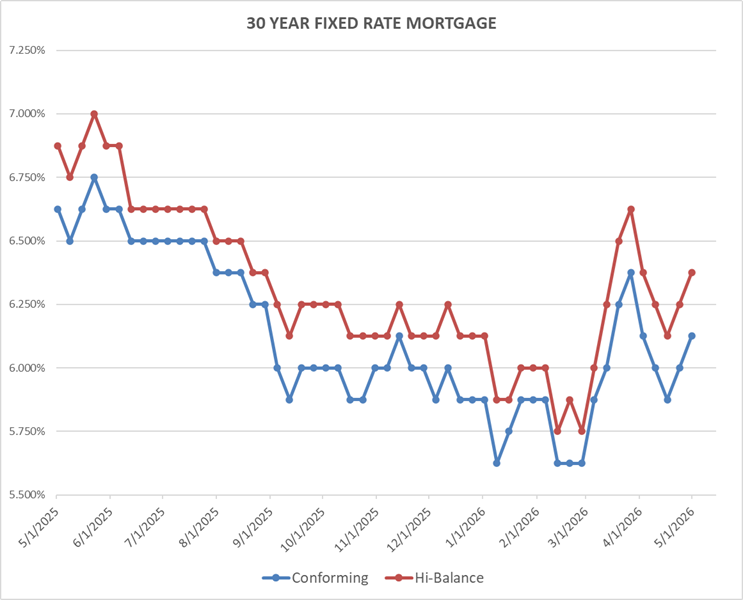
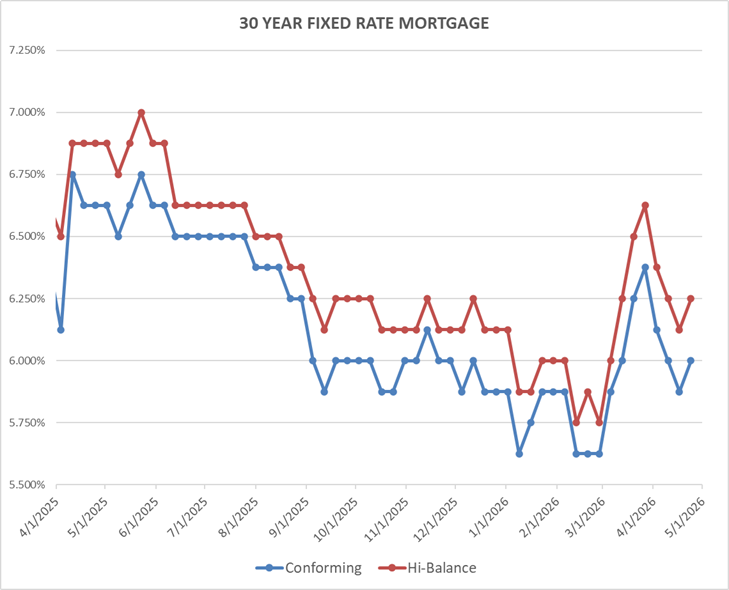
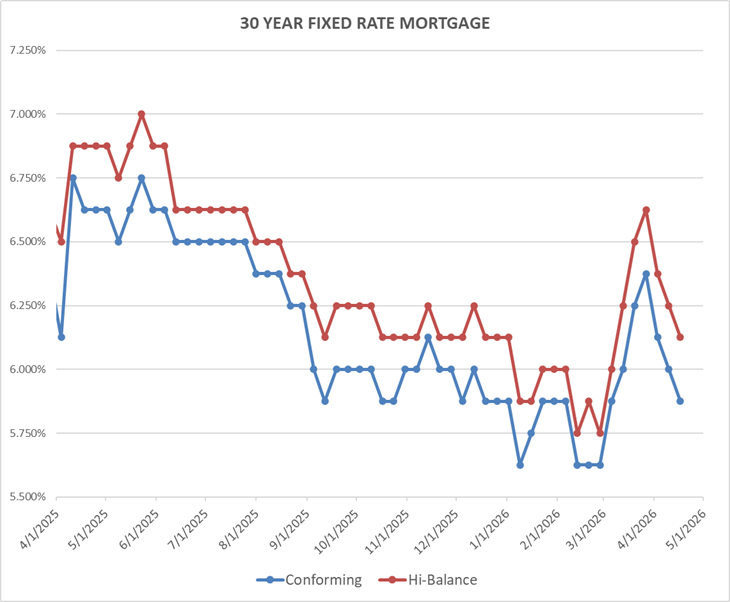
Rates for Friday May 1, 2026: It was no surprise that the Fed held its benchmark rate steady at its meeting this week, but given the economic news yesterday, as outlined above, odds are starting to climb for a rate hike before another rate drop. Rates react to the economic data and go up again this week.
FIXED RATE MORTGAGES AT COST OF 1.25 POINTS LOCKED FOR 45 DAYS FOR PURCHASE TRANSACTIONS:
30-year conforming 6.12% Up 0.125%
30-year high-balance conforming 6.375% Up 0.125%
Please note that these are base rates and adjustments may be added for condominiums, refinances, credit scores, loan to value, no impound account and period rate is locked. Rates are based on 20% down with 740 FICO score for purchase mortgages.
It’s that time of year. On our morning walks through the neighborhood with Sammy we are picking up jacaranda blooms on our shoes, our cars are changing colors with the various white and yellow blooms falling off the trees on our street, and are doormat is not completing the job of getting all the flora detritus from the soles of our shoes.
Bring on your preferred allergy medicines!
Dennis
https://www.denniscsmith.com/wp-content/uploads/2026/05/ca-tax-props.png243370Dennis C Smithhttps://www.denniscsmith.com/wp-content/uploads/2024/06/dennis-c-smith2.pngDennis C Smith2026-05-01 13:20:412026-05-01 13:20:42What is the taxpayer protection initiative and how does it affect us?
Question of the week: What is a parcel tax, how is it different than property taxes?
Answer: California, like all states, has property taxes. In California, property taxes are collected by the counties and fund public schools, infrastructure, police and fire services and government operations.
The general tax levy is 1% of assessed value. The assessed value, in most cases, is established by the purchase price of the property, and then can increase by no more than 2% per year.
In addition to the general tax levy of 1%, additional taxes can be added by voters, agencies, or by legislation.
State law requires a two-thirds majority vote for additional payments to be added a property tax bill; however, bonds to support education, i.e. school districts, community colleges, require 55% if they meet conditions set forth by Proposition 39, passed by voters in 2000.
Voted indebtedness calculates the amount of tax owed based on assessed value.
Parcel taxes are determined either by set dollar amount, or an amount based on square footage of the parcel.
For instance, a school district may have a flat $200 per parcel for residential property and $500 per parcel for non-residential property.
The other method, a local government may have on the ballot a parcel tax to pave streets and improve park facilities, for $0.15 per square foot of the size of a residential parcel and $0.45 per square foot for non-residential and vacant parcels.
While a good portion of California’s population continually attempts to see all, or part, of Prop 13 repealed to enable higher property taxes—which have thankfully been defeated—parcel taxes are a way to increase property taxes without having to alter Prop 13.
A real-life example of trying to raise money using property taxes is an attempt by several groups in Long Beach to raise money for a variety of issues with a parcel tax. The actual language on the measure for which they are collecting signatures, is such to define a very clear target voter base that would be unimpacted by the parcel tax, making it easier to obtain passage.
It is my hope that some day our electorate will realize those they elect do not have a shortage of revenue problem, but an abundance of wasteful and unnecessary spending problem.
To schedule an initial meeting by phone or Zoom, click here for my calendar, please feel free to forward to a friend or family member!
Retailers had to replace POS payment hardware after consumers wore them out in March as retail sales surged 1.7% over February’s numbers. A large part of the spike in spending was the 15% increase in gas costs, however, almost every sector in the data showed strong increases in sales. Energy costs, inflation staying above 2.5%, any concerns about expansion of the Iran conflict, are seemingly being ignored by Americans who are buying not only discretionary items like $25 Old Fashions and $15 cheesesteaks with onions, but also new living room and bedroom furniture, cars, and satisfying late night (unsober?) binge buying from on-line retail sites. Ordinarily, this surge would push rates higher as investors look ahead to higher inflation and faster economic growth.
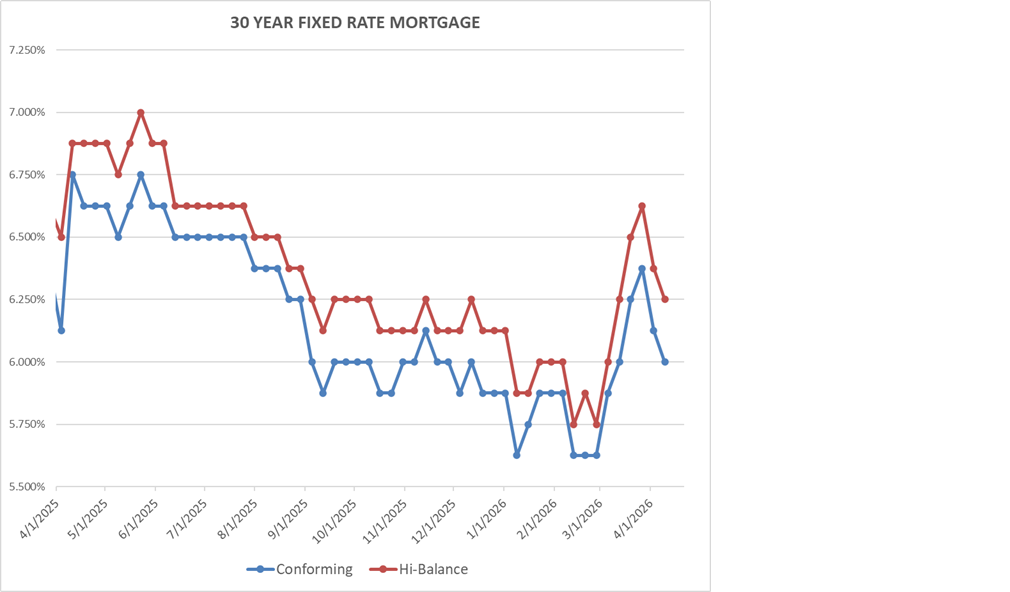
Rates for Friday April 24, 2026: Rates have succumb somewhat to the economic data and international events, ramping up slightly from last Friday.
FIXED RATE MORTGAGES AT COST OF 1.25 POINTS LOCKED FOR 45 DAYS FOR PURCHASE TRANSACTIONS:
30-year conforming 6.00% Up 0.125%
30-year high-balance conforming 6.25% Up 0.125%
Please note that these are base rates and adjustments may be added for condominiums, refinances, credit scores, loan to value, no impound account and period rate is locked. Rates are based on 20% down with 740 FICO score for purchase mortgages.
Apologies for those who I have interacted with the past week or so and found me despondent, distracted, a bit testy. Our dog Sammy is trying to help me out of the funk. However, there is not much he can do unless he is able to pitch and hit for the Phillies and get them out of their 8-game losing streak and start a very long winning streak.
Sigh, baseball.
Dennis
https://www.denniscsmith.com/wp-content/uploads/2026/04/taxes.png305438Dennis C Smithhttps://www.denniscsmith.com/wp-content/uploads/2024/06/dennis-c-smith2.pngDennis C Smith2026-04-24 09:44:332026-04-24 09:44:34What is a parcel tax, how is it different than property taxes?
Question of the week: Should we move to another state?
Answer: This was a question a neighbor said they asked their tax preparer last week. The impetus for the question, of course, was the amount of taxes they were paying to the California Franchise Tax Board.
It is a question that thousands, tens of thousands, of families have asked over the years, and many have answered, “yes.”
Taxes are burdensome in the state with the, or near the, top of all states in individual income tax, sales tax, gas tax, utility taxes, and fees for licensing and registrations for those in the many businesses for which they are required. Ignoring that insurance is not a tax, but due to its necessity is like a tax, even before paying for groceries, clothes, dining out, dry cleaning, etc, Californians pay a lot of their incomes to the State of California, and the various counties and cities charging their own taxes.
So the questions become, would we be better off financially if we moved to another state, can we adjust to wherever that may be in regards to culture, weather, activities and entertainment available and general quality of life, can we leave family and friends we live near (the former may be harder than the latter in some instances)? If the answers are “yes,” the final questions are when and how.
Ignoring the non-financial factors in such a decisions, math can be our friend in determining the basis for getting to yes, or no.
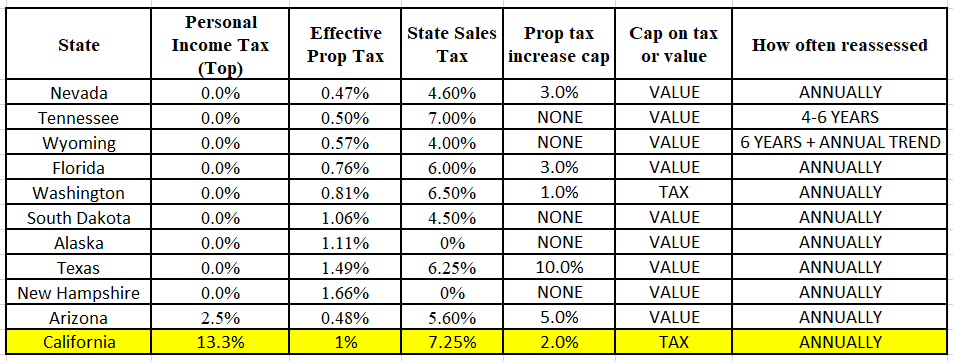
Instead of comparing all the 49 other states (and ignoring Washington D.C. as an option), I looked at the ten states with the lowest personal income tax levels, since the highest amount of taxes most of us pay is income tax. Note that nine of the ten states have no (zero, zip, nada, none) personal income tax.
Besides income tax, I looked at property and sales taxes, to cover the three common taxes for every state. No income tax is a great advantage, but that generally means tax revenue for the state, and counties and cities, are coming from other sources.
One tax that many California transplants are shocked by is the property tax for their new state. The shock is generally not immediate, but builds over the years as only a few states have a Prop 13 type cap on property taxes to prevent extreme increases in the tax as property values grow. Prop 13 caps our property tax increases each year at 2% of the prior year’s taxes, regardless of the increase in value.
Consider the almost 50% increase in property prices we have seen in Southern California over the past six to seven years (see chart in last week’s WR&MU). Because of Prop 13 while your property may have increased in value almost $300,000, your property taxes only increased about twelve-and-a-half percent (12.5%)—if you were paying $5600 per year, your taxes went up to about $6300 per year.
Most states do not have caps on property tax increases, they reassess the property ever year, either using trending statistics or actual value assessments, and adjust property taxes accordingly. If in Nashville you purchased a home in 2020 for $565,000 your property tax to the state (not including county, city taxes, special assessments, etc), the tax would be $2825 per year. Assuming the property increased as the median price in LA County did from 2020 to September 2024, when the median value was $960,400, your property tax would climb to $4800 per year.
Is that enough to make a difference, doubtful since your income tax will go from, likely, almost 10% of your income to 0% of your income.
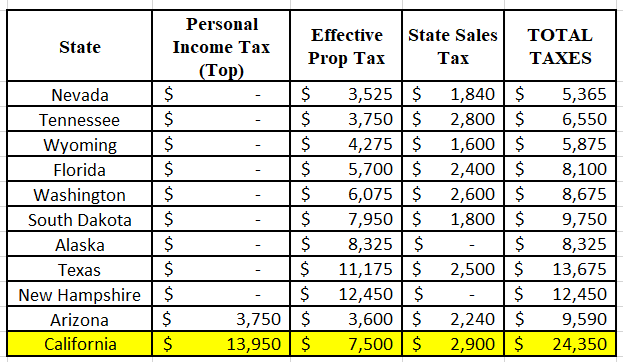
Below are charts that show the taxes the ten states with the lowest personal income rates, with the rates for property and sales taxes; as well as a chart that shows tax calculations based on:
$150,000 in personal income
$750,000 property value
Spending $40,000 per year on taxable transactions
Note that Alaska and New Hampshire are the only states that have no income nor sales taxes.
Based on the tax rates and assumptions I made, the lowest amount of taxes you will pay for states with no income taxes is Nevada. The highest, due to high property taxes, is Texas.
For those who have never lived anywhere but Southern California with its near perfect weather twelve months a year, after year, after year…there are other expenses you may not know about when moving to states with seasons that are distinctly different.
Two of the states with no income tax, Alaska and South Dakota, have very severe winters, others have various degrees of winter, from bitter cold and major snow storms, to very cold, freezing rain and fog. Winter has costs that come to bear on your household. Winter clothing, storm windows, snow tires, salted roads eroding car parts, cost to clear snow and ice, heating costs—often oil, and other “winterizing” actions add costs that we are fortunate not to bear in our Mediterranean climate.
Quality of life, weather, friends, family, how you spend leisure and entertainment time, cannot be assigned monetary values, they do have psychological and emotional values that would need to be weighted against the financial savings you may benefit from a move to another state.
IMPORTANT NOT REGARDING RELOCATING!
For the several times relocating to different states has been a topic in the WR&MU, a strong bit of advice has been included: unless you have to, do not sell your current California home for at least one, and preferably two or more, years after you move.
You may have visited your new state and area several times over the years and think you know all you need to know about living there, but until you spend all day every day through every season you do not really know as much as you may need to. Take the above information about costs due to weather, have you lived through a major winter storm, a spring storm with severe thunderstorms, tornado warnings/sightings, 95% humidity, and the costs to endure the weather conditions? Visting an area is a lot different than living there. Shopping, entertainment, neighborhoods, religious centers, schools, medical care, are all factors you learn more about the longer you live there.
If you sell your home, move to Other State, relish that you can purchase the same, or bigger/better, home for less than what you sold your home for, and will be saving money on taxes and other expenses, your ability to return to California and buy a similar home that you sold will likely be very difficult, and expensive.
You purchased your home in 2000 after the crash with three kids in elementary school, for $400,000. One of your children has children and moved to Other State a few years ago.
You sell your home for $1.1 million and purchase your new home near your child for $500,000, with no mortgage. You have retired and your income is social security, retirement savings, and of course the “windfall” from the sale of your home.
It’s not working for you. You miss your friends, the weather is more than you expected, for major medical care you have travel and hour each way, you feel like you just don’t fit in.
A home in the neighborhood you sold in will cost $1.2 million. You have funds for down payment, but that reduces funds you were counting on for retirement. You cannot qualify for a conventional mortgage, but you can buy using a reverse mortgage with a large down payment. Adding to the issues, your property tax bill when you sold was $6,000 per year due to Prop 13, for the new home the bill is $21,000 per year with the assessments added to the base tax.
If you had not sold your home, and rented it out, earning some additional income, and rented when you first moved, if you want to move back you can and it will only cost you moving costs, and carpet, paint, etc after your tenants move. As well, you retain your property tax base.
Keep in mind, if you move to Other State and really like it, you can sell your home in California and buy a new home, or pay off any mortgage you may have, at a later date. Note: be in touch with your tax preparer to make sure you are within the time frame that enables you to sell your California home and retain your capital gains exclusion (must live in home two of the previous five years).
If you are considering relocating to Other State, call me to run your scenarios and options—we are licensed in most states.
To schedule an initial meeting by phone or Zoom, click here for my calendar, please feel free to forward to a friend or family member!
Rates for Friday April 17, 2026: Not a lot of rate moving data this week, we see rates drop for the third straight week.
FIXED RATE MORTGAGES AT COST OF 1.25 POINTS LOCKED FOR 45 DAYS FOR PURCHASE TRANSACTIONS:
30-year conforming 6.00% Down 0.125%
30-year high-balance conforming 6.25% Down 0.125%
Please note that these are base rates and adjustments may be added for condominiums, refinances, credit scores, loan to value, no impound account and period rate is locked. Rates are based on 20% down with 740 FICO score for purchase mortgages.
Long time readers of the WR&MU know that I am an avid reader and an amateur American history buff. Being the month of April, I am reminded of an excellent book by Jay Wink, April 1865: The Month That Saved America.
Since reading the book several years ago, I have become very observant, perhaps too much so, as to the number of major historical events that have occurred in the month of April. Besides those detailed in April 1865, in no particular order:
The first battles of the Revolutionary and Civil Wars
NATO was created
First modern Olympic games
Martin Luther King assassinated
The Pony Express began
First handheld mobile phone call
The Titantic sank on its maiden voyage
Thomas Jefferson, William Shakespeare, Leonardo da Vinci, were born
Apollo 13 launched
The internet was born
The 1906 San Francisco earthquake struck
I got a bit caught up in making my list—there are many other events that I find fascinating, but in deference to your time and patience I shall refrain from continuing the list!
Dennis
https://www.denniscsmith.com/wp-content/uploads/2026/04/move-from-cali-1.png363544Dennis C Smithhttps://www.denniscsmith.com/wp-content/uploads/2024/06/dennis-c-smith2.pngDennis C Smith2026-04-17 11:51:172026-04-17 11:51:18Should we move to another state?
Question of the week: Are home prices going to “pop?”
Answer: This is a question that has been batted around a few times in the past several years, and a bit more so lately.
The impetus for the question is the extremely high home values we have seen, a slow sales market, continued high rates, and economic uncertainty. Reminiscent, for some, of two decades ago when home prices spiked and eventually crashed, leading to the Great Recession. The housing bubble popped.
For reference, and those who may be too young to know, or to old to recall (slight dig at our aging audience….), a very quick recap of the bubble expansion and burst in the mid- to late-2000’s is in order.
In the early part of the century (how is that for making us seem old?), very easy mortgage lending led to a glut of homebuyers who forced housing prices up. Mortgages were very easy to obtain with very little down, resulting in an inordinate percentage of homeowners who were very highly leveraged into properties they would very likely not have been qualified to purchase under prior, traditional, mortgage underwriting.
“Very easy” defined as a tremendous amount of mortgage products, including those backed by Fannie Mae and Freddie Mac, that required no verification of one, some, or in some cases none of the following: income, assets to close, appraisal. As well, some products that were available with no down payment, limited income review. The primary basis for many of these products was the borrowers’ credit scores.
The mortgages were not just used to purchase homes, they were also available to those who wanted to cash-out a lot of the equity that had built up in their homes during the bubble expansion.
Highly leveraged, under-qualified borrowers are, as you can imagine, extremely at risk for foreclosure in the future.
Which is what happened when a domino in Irvine, California tumbled.
That domino was First Century Mortgage whose business model was to fund easy-to-get “subprime” mortgages and then sell them to investors on Wall Street. In February, 2007, First Century could not sell a bundle of their mortgages as potential investors dug into the collateral value of the investment and found it grossly insufficient. This led to investigations of other subprime mortgage company’s offerings, which resulted in those companies being unable to sell their portfolios.
We had a crisis in the “subprime” market. If contained to the subprime market the damage would have been heavy, but not extremely damaging to the mortgage and housing markets. But, given the extent of traditional, non-subprime mortgages that were funded using subprime underwriting, it just took a little breeze to blow down the housing market.
Values began to drop in some markets, which put a significant number of homes upside down, many with loans that homeowners were barely able to afford.
Your home you purchased, or refinanced, with a value of $500,000 and has loans totaling $450,000, or $500,000, was now worth $450,000 after a 10% drop. You are struggling to make the payment as the adjustable rate has increased, or perhaps you have been laid off. Solution: give the keys to the bank and walk away.
Banks are now selling properties well below what homeowners are listing their properties for on the market, undercutting them, leading to more foreclosures…and a vicious cycle is building momentum.
The result was home prices in many markets collapsing 20%, or more, banks and investors losing hundreds of billions of dollars, and economic recession.
Back to our question, are home prices going to “pop?”
Maybe someday, but not in the near future unless there is a major event causing economic collapse, and even then it is very likely there will be no pop or repeat of the 2000’s collapse.
Why?
Equity. Historically low interest rates as a result of actions by the Federal Reserve led to the Covid home value boom. Families could qualify for much higher home prices than they thought possible, which exploded the first time buyers’ market. Move-up buyers accelerated their move-up by several years due to lower rates and the growth in the equity in the homes they were selling.
As well, I’m not sure of the exact data, but going back to my start in the industry in 1987, the amount of all cash buyers, at all price points, was historic—meaning a lot of homes with 100% equity and no mortgages.
Because of the very competitive market sellers were accepting the highest and least risky offers, those with all cash or higher down payments—good luck getting an offer accepted with low down payments.
Many families, instead of selling and moving up, took advantage of the historic rates to refinance and reduce their mortgage payments significantly, it was not unusual to have clients reduce their mortgage payments by up to 50%.
During the pandemic, refinances were a major part of the market, the highest percentage of the industry in my career.
The result was a high percentage of homeowners with no mortgage, new homeowners with very low interest rates and higher amounts of initial equity, and existing homebuyers with significant equity and mortgage payments lower than market rents in their neighborhoods.
Housing market “pops” are almost always caused by high foreclosure rates. Because of the amount of equity in the housing, the incidences of foreclosures are low as most homeowners who are in trouble can sell their home before they are foreclosed on.
We have seen a decline in real estate values from their highs, but values are still far higher than they were at the start of the pandemic.
The chart shows the date each of the areas (statewide, LA and Orange Counties) reached their highest median home values, what the median values were in February, and what the values were in March 2020, the start of the pandemic. Many people purchased as values climbed, however, as stated, many of those purchases were cash, or high down payments.
Values have declined from their highs, over 12% in Los Angeles County, but they are still showing unprecedented growth in the past six years, creating enormous equity, and wealth, for homeowners in the state.
Because of the affordability issue in the state, California leads, or is near the top, of the amount of time homeowners staying put for 15-years or more, the latest data shows LA County “stay-put” is around 20 years.
High equity, low-rates, long time residency, reduces the risk of a glut of properties on the market through homeowner sales or foreclosures, thereby precluding a “pop” in the property values.
To schedule an initial meeting by phone or Zoom, click here for my calendar, please feel free to forward to a friend or family member!
The situation with Iran has many consequences and impacts. One is how markets are reacting to economic news—which is not in the traditional way. This week data showed that inflation was flat in February using one index (PCE—the Fed’s preferred inflation gauge), before the conflict; and significantly higher in March with the other major price index (CPI) as oil prices spiked pushing other costs higher. This data, historically, would have rates moving up, and anticipation of the Fed not only not looking to lower its benchmark rate, but increase it. Instead, markets are ignoring economic data and fluctuating on an hourly basis based on news of cease-fires, cease-fires but…, oil flow and production, and comments from Pennsylvania Avenue and wherever whoever is speaking for Iran.
Rates for Friday April 10, 2026: Rates drop for the second week in a row, despite war, inflation and Twitter, or X.
FIXED RATE MORTGAGES AT COST OF 1.25 POINTS LOCKED FOR 45 DAYS FOR PURCHASE TRANSACTIONS:
30-year conforming 6.00% Down 0.125%
30-year high-balance conforming 6.25% Down 0.125%
Please note that these are base rates and adjustments may be added for condominiums, refinances, credit scores, loan to value, no impound account and period rate is locked. Rates are based on 20% down with 740 FICO score for purchase mortgages.
From a work perspective that is non-workish, one of my favorite benefits of the internet is streaming. Streaming sports while working—my office music if you will.
Long time readers of the WR&MU know I love baseball, and thus if a game is being played it is on, either radio or tv broadcast, while I work. Last month it was the NCAA March Madness. This week The Masters.
You can have your jazz, classical, yacht rock, for your background, I’ll take Jim Nantz commentating with the “whack” of a well struck iron into the green at #14 at Augusta in my background!
Dennis
https://www.denniscsmith.com/wp-content/uploads/2026/04/BUBBLE-POP.png476554Dennis C Smithhttps://www.denniscsmith.com/wp-content/uploads/2024/06/dennis-c-smith2.pngDennis C Smith2026-04-10 12:40:352026-04-10 12:40:36Are home prices going to “pop?”
Question of the week: Are condos getting harder to sell?
Answer: Maybe.
Likely.
The primary source of residential mortgages are Fannie Mae and Freddie Mac (henceforth, GSE, for Government Sponsored Entity), they fund approximately 70% of all mortgages in the United States.
The GSE are under the umbrella of the Federal Housing Finance Agency (FHFA), which provides many of the rules and regulations for underwriting and purchasing mortgages.*
*The GSE do not fund mortgages, they purchase them from mortgage companies, banks, credit unions that underwrite and fund mortgages using the GSE criteria. After purchasing mortgages, they bundle them into batches called Mortgage Backed Securities, and sell them in the financial markets. You can purchase MBS through your investment advisor or institution.
Recently FHFA rolled out new rules for condominium associations to follow if they wish to be eligible for funding from the GSE; if they do not follow the rules they will be on the “do not lend list.”
Keep in mind, these rules apply to all GSE mortgages in condominium complexes, whether purchase or refinance mortgages.
Since 70% of mortgages are from GSE, being ineligible for their financing greatly restricts the market for those selling properties.
Some of the new rules that will impact the ability of condo HOAs to remain, or become, eligible:
Higher reserves After decades of requiring HOAs to maintain 10% of their budgets in reserve, as of July 1st they will need to carry a 15% reserve.
Budgeting reserves is meant to build a savings account that can be used for capital improvements and repairs, as well as emergency needs.
If a roof last 15-years and the estimated cost to repair the roof in 15-years is $1 million, the HOA will need to set aside a little over $65,000 per year to have the funds. Or, assess all the units at the time the roof is replaced for their share of the cost of the roof, to be paid at once or over a defined period of time.
If there are 20-units in a complex and their monthly HOA dues are $500 per month, the total collected by the association is $120,000 per year. This is used to pay insurance, maintenance, servicing of pools, elevators, landscaping, and management.
Of the $120,000 the HOA must now set aside $18,000 per year for reserves instead of $12,000, a 50% increase. The result will be an increase in HOA dues to cover the additional reserve requirement, along with increases for other costs.
Since the rule takes effect on July 1st, if HOAs want to stay eligible this year they will need to increase their reserves from budgets already enacted, which may result in special assessments.
This rule can, will, push many associations from eligible to ineligible.
Questionnaire One of the aspects of becoming eligible is the completion, by the HOA, of a questionnaire. The questionnaire covers a wide range of topics, from total number of units, to how many unsold units if a newer projects, to percentage of units that are not owner-occupied, current reserve balance, to how many owners are delinquent in dues, to any repairs or replacements needed that exceed $10,000 per unit, to any litigation.
For many years, a “limited review” was available for some mortgage applications if the loan was considered a low enough risk in an established project. No longer.
A waiver from the questionnaire has been part of the loan approval process, however to qualify for the waiver, the complex would typically have a small number of units, or recently had a full review that passed with flying colors. Unfortunately for borrowers, it is not until a loan application is inputted into the GSE’s automated-underwriting system that we know if the HOA is eligible for a waiver.
Completion of HOA questionnaires add costs and time to transactions. Most HOAs have outside management companies that act as property managers and complete the questionnaires. Depending on the management company and the size of the complex, we have seen fees for completing the paperwork range from $300 to over $500, and take up to two to three weeks for completion. To “rush” the completion there can be an additional fee of several hundred dollars. Note, the fees are almost always paid by the borrower.
Insurance Lack of adequate replacement coverage in insurance policies has been a major factor in many HOAs across the country losing their eligibility for GSE funding. Raising coverage costs, especially in the California insurance market, means raising premiums, which means raising HOA dues, and reserve requirements.
One change in insurance requirements that may make it easier for staying, or becoming eligible, if a bit complicated, but it comes down to the replacement cost of the roof and how it is insured. The new FHFA rules allow for coverage what the actual cash value of the roof is today; i.e. the original cost minus the depreciated value.
The premiums for covering the current cash value is significantly less than premiums for covering replacement costs of a new roof. Think of insurance for the 2010 Honda Odyssey van being for the current cost of the vehicle versus insuring it for the value of a 2026 Honda Odyssey so if the car was totaled the insurer would payout the cost to buy the new edition.
Therefore, some HOAs may opt for the lower premium option, this not only makes it easier to retain/obtain eligibility for GSE mortgages, but also reduces increases to HOA dues.
Taking this route essentially kicks the financial can down the road, as if there is a roof incident through storm or other factor, the lower insurance may barely cover the cost of a new roof—resulting in special assessments or higher HOA dues to cover the difference.
Unit insurance Over the decades I have been in the industry, I have seen a dramatic decline in the number of associations whose master insurance policies cover the interior of the units. For those who own units in complexes where their individual units are covered for fire and other eligible claims, they likely pay higher HOA dues, but the higher payment is likely less than the premium for a HO6 policy.
The HO6 covers the interior of the individual unit and each owner must obtain their own policy. The new regulations, effective July 1st, require all new condo mortgages be listed as loss payees on HO6 policy for the unit in the transaction.
If you own a condo in a complex whose master policy currently covers the interior of your unit, and you want to refinance, you will need a HO6 policy to complete your transaction.
I have always encouraged clients purchasing condos to insist on complete financial statements, board minutes (to see what discussions have occurred regarding financing, capital improvement costs and funding options, etc), and a full physical inspection of the unit and complex—including roofs, basements and all common areas.
The latter to determine likeliness of major costs approaching for repairs or replacements, that will likely lead to higher dues or assessments. Unless, the balance sheet and income statements show the association has done an excellent job creating reserves to cover major improvements.
Last June, our question of the week was, “What should we look out for when buying a condo?” If this question were to be re-visited today, first on the list would be to see if a complex is on the GSE eligible list. Even if it is currently on the list, dig into the financials for the association, is the association strong enough to remain on the eligible list?
Is the association prepared to replace roofs, pool equipment, sprinkler systems, any major physical component of the common areas that inevitably will need to be replaced.
What are financing options for condo units that are not eligible for Fannie Mae or Freddie Mac financing?
If you have 20% or more for down payment, there are several lenders in the “non-warrantable” (lender speak for not eligible for conventional financing). The rates are typically a bit higher than for a conventional loan through a GSE, however, not drastically so.
If the down payment is lower than 20%, options are mainly a VA loan is you are a veteran, or FHA. For the former, an association must be approved by the U.S. Department of Veteran Affairs. For a FHA loan, if the association is not on the FHA approved list, it is possible to get a “spot approval” for a single unit. The spot approval process adds some time and cost to the loan approval process, but if the association can meet the guidelines, it can be worth the cost and effort for a down payment as low as 3% of the purchase price.
What if you own a unit in a complex that is not on the eligible list? Be flexible with your price and terms to make your unit as attractive as possible to potential buyers who will not be able to utilize conventional financing, i.e. typically 70% of the buyers on the market.
If you do own a condo unit(s), I encourage being engaged with the board of directors, ideally having a seat. Read the minutes, read the financials, go to meetings and ask questions. How engaged is the management company? Are they fulfilling their contract? Are they managing finances, repairs and maintenance?
As mentioned last June, owning a condo means you are in a business relationship will all the other owners, as well as the management company. The value of your unit, the desirability to buyers, is strongly subject to the governance and financial stability and oversight of the complex.
To schedule an initial meeting by phone or Zoom, click here for my calendar, please feel free to forward to a friend or family member!
Rate cuts are moving further away, not closer. That is the likely outlook based on economic data this week. February saw very strong retail sales, showing economic strength heading into the Iran conflict and subsequent spike in fuel and energy costs. Up 0.6% from January, taking out auto and gas sales, spending was still up 0.5%. A strong indicator of consumer sentiment is luxury spending, strongly gauged by going out to eat rather than saving money and eating at home, restaurant sales were up 0.4% from January and up 4.5% year over year.
Surprise! was the reaction today when the Labor Department announced that 178,000 jobs were added to the economy in March, the most new jobs in more than twelve months. The unemployment rate dropped from 4.4% to 4.3%, however a significant factor in the drop was the labor force shrinking by 400,000 for the month. A concern looking forward is that only 61.9% of those 16 years old and up are either employed or seeking work, known as the labor participation rate; this is the lowest since the fall of 2021.
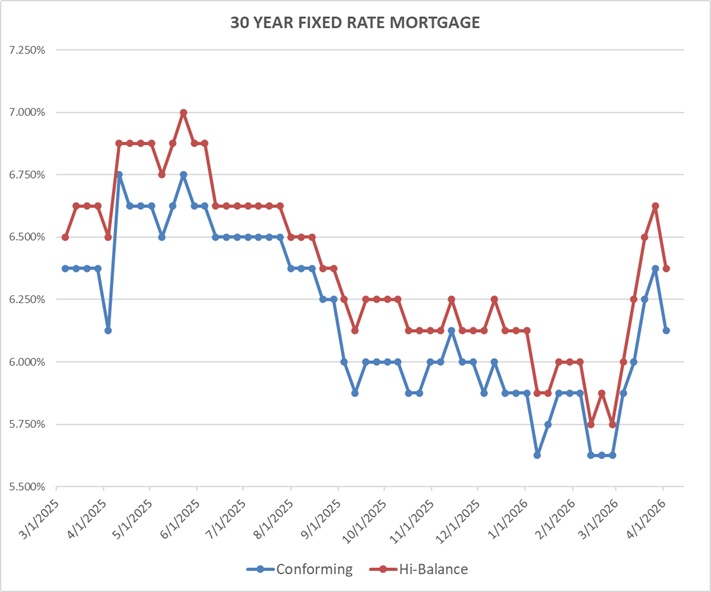
Rates for Friday April 3, 2026: The Federal Reserve’s mandate is the lowest possible rate of inflation for the maximum amount of employment. Prices are going up in response to higher fuel costs, which counters the first part of the mandate, the labor markets appear to be getting stronger, or weaker, depending on what data is being analyzed. With the uncertainty about future costs for consumers, and businesses, the Fed is unlikely to put an increase for their benchmark rate in the near future. As we enter Easter weekend, mortgage rates drop after four straight weeks of climbing.
FIXED RATE MORTGAGES AT COST OF 1.25 POINTS LOCKED FOR 45 DAYS FOR PURCHASE TRANSACTIONS:
30-year conforming 6.125% Down 0.25%
30-year high-balance conforming 6.375% Down 0.25%
Please note that these are base rates and adjustments may be added for condominiums, refinances, credit scores, loan to value, no impound account and period rate is locked. Rates are based on 20% down with 740 FICO score for purchase mortgages.
Happy Easter or Passover to those who observe those holidays. For those with young ones in school, enjoy your spring breaks!
Dennis
https://www.denniscsmith.com/wp-content/uploads/2026/04/condo-sell.png502553Dennis C Smithhttps://www.denniscsmith.com/wp-content/uploads/2024/06/dennis-c-smith2.pngDennis C Smith2026-04-06 09:36:362026-04-06 09:36:37Are condos getting harder to sell?
Vacation, or 2nd homes, can come in many forms, including per tax regulations, boats and RVs. For the latter to be included, the must contain sleeping area, cooking facilities and toilet facilities.
Whether a condo in Rancho Mirage, a cabin in Big Bear, a sloop in Marina Del Rey, or an RV which spends most of the time at an RV storage lot in Long Beach*, if you use the space for personal use, or 10% or more days than you have it rented for fair market value, the property is eligible for tax deductions.
*The pop ads and other companies that show up when I am on different sites on the internet are very interesting, in part, due to the Googling I do while preparing the WR&MU. I am certain over the next week I will be deluged with ads and opportunities to store my RV or boat, as well as dealers in both with opportunities for ownership.
Please consult tax professional before filing taxes regarding eligible deductions for your primary and secondary properties.
The explosion of opportunity to rent second homes when not using for personal visits due to on-line companies such as AirBnB and Verbo have enabled owners of secondary property to off-set the mortgage, tax, insurance, HOA, maintenance costs of their vacation homes. This off-set has lessened the holding cost of the property, by trading off having strangers occupy your property.
From a mortgage perspective, prior to 2022 second homes were treated the same as primary homes by Fannie and Freddie in regards to costs and fees. In 2022, the Federal Housing Financing Authority (FHFA), the regulatory authority over Fannie Mae and Freddie Mac, increased the pricing adjustments that must be charged for second homes, greatly increasing the rate/price difference between primary and secondary mortgages.
Quick example, purchase a home for $750,000 with 20% down, you have a 740 FICO score and paying 1.25 points for the $600,000 loan. For your primary residence the rate today is 6.375% for a monthly payment of $3743 per month. Using the same price and down payment for a second home your rate is 6.75% with a payment of $3892 per month, or about $150 more per month.
What can get sticky with the mortgage is the line between a second home your rent out from time to time to a rental, and your using it for personal use two weeks a year, or 10% of the days it is rented.
Per the underwriting guidelines, a second home property a lender needs to document the property must be occupied for personal use, available to the borrower’s exclusive use year-round, not subject to a rental or timeshare arrangement, and not intended to be used as an investment property.
If any of the above restrictions cannot be met, the mortgage should be priced and funded as an investment property loan, which raises the rate even further (to 7.125%, or $4043 per month).
“How will they know?” Good question, but if they do an audit and find out the loan is in default and must be paid off. This comes into play if refinancing a property that has been used as both a second home and investment property, i.e. short-term rental when not in personal use, and your tax returns show rental income for the loan submission.
Back to us. We do not have a vacation home, but we do have a few different timeshare contracts with the same company that has enabled us to travel and enjoy comfortable “private space” with our family, friends, or just Leslie and I, throughout the year. Timeshares have a negative connotation for many, and I get that in some/many instances. However, we have been very good about managing our options for time and location, and conversion to enjoy hotel stays domestically and abroad.
This is being written from Palm Desert, where we have been all week. The last time we were here and we were going to one of our “go-to” restaurants for dinner we spoke about how this is our vacation home, due to its familiarity, etc, without year-round costs for mortgage, taxes, etc we would be paying when not using. Plus, we can take our vacation home to other locations some years at no additional cost other than airfare and possibly car rental.
Vacation homes are fantastic for creating memories for families, many are generational, we know many families that are third, even fourth, generations of the family going to the “family cabin” with its memories and traditions.
The important part about second homes and vacations, are less about where they are, than about who you are with and that you are taking vacations to relax, and create those family memories. Whichever option chosen, purchasing a property, timesharing, or picking different places to visit and explore, make sure you take the time to use and enjoy the time and place.
To schedule an initial meeting by phone or Zoom, click here for my calendar, please feel free to forward to a friend or family member!
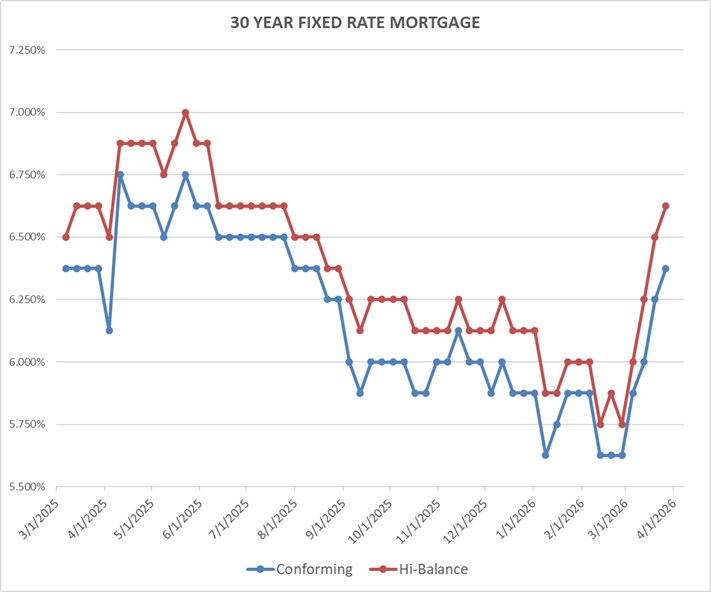
Rates for Friday March 27, 2026: Without major economic news this week, markets are moving based on comments from the White House, and elsewhere, as to what may or may not happen next in the conflict with Iran. The current market reactions to the war are ahistoric, as typically in times of international conflict, especially when the United States is involved, result in lower equity values and lower interest rates. Because of the focus on oil and energy costs rising due to the conflict, investors are worried about inflation, pushing rates higher. The 30-year reaches its highest point since August, the high-balance is at its highest since July.
FIXED RATE MORTGAGES AT COST OF 1.25 POINTS LOCKED FOR 45 DAYS FOR PURCHASE TRANSACTIONS:
30-year conforming 6.375% Up 0.125%
30-year high-balance conforming 6.625% Up 0.125%
Please note that these are base rates and adjustments may be added for condominiums, refinances, credit scores, loan to value, no impound account and period rate is locked. Rates are based on 20% down with 740 FICO score for purchase mortgages.
Thank you in advance to all those who will be replying with comments about my picks for the men’s NCAA basketball tournament getting bounced out last night. I appreciate your thoughts!
It’s back! After what seems like an eternity, but has been 168 days, since the Phillies were eliminated from the playoffs last October, I was able to listen to the radio broadcast of their open day yesterday. Baseball is back and the fans of almost every team have hope to be cheering on their teams in October, and hopefully into November.
Go Phils!
https://www.denniscsmith.com/wp-content/uploads/2026/03/2nd-home.png390618Dennis C Smithhttps://www.denniscsmith.com/wp-content/uploads/2024/06/dennis-c-smith2.pngDennis C Smith2026-03-27 10:50:182026-03-27 10:50:19Do you own a vacation home?
Question of the week: Is 2% inflation a reasonable goal?
Answer: This week’s question comes from an interesting conversation I had with a few friends, my age (63) who have, like me, closely followed economics, politics, and have a pretty good historical knowledge base.
In January 2012, the Federal Reserve under Chairman Ben Bernanke explicitly stated that the Fed’s objective was 2% inflation (using the Personal Consumption Expenditures index, PCE) for the economy. Prior to this the Fed saw 2% or below as a desired rate of inflation but not a hard target.
The mission of the Fed is to support maximum employment, stable prices and moderate long-term interest rates, referred to as the “dual mandate.”
Historically, meaning prior to, up to, and a bit beyond my 1984 graduation with a degree in economics, the relationship between inflation and employment have an inverse relationship; i.e. lower employment drives up price as employers must pay higher wages which results in them charging more for their goods and services. Higher inflation results in fewer sales which leads to higher unemployment.
With this in mind, the Fed’s dual mandate is a balancing act of the highest employment that can be achieved in the economy with the lowest amount of inflation.
With that in mind, is 2% the right target for “maximum” employment?
This may get a bit wonky, as long time WR&MU readers are used to. Note that “nominal” rates, prices, etc are the actual price, rate, etc; “real” rates, prices, etc are adjusted for inflation. If a wage increase is from $10 to $11, that is a 10% nominal increase; if inflation is 2%, the real increase is decreased by 2%, so 7.84%. Confusing but “nominal” is the real price and “real” is the adjusted for inflation price.
There are several arguments for the “hard” target of 2% inflation. It anchors expectations. A defined target, in theory, enables businesses, households, and governments, to make plans for the long-term. Negotiations for wage increases can, should, center around the 2% target. If the 2% target is trusted, or believable, the expectations for higher prices are reduced, which decreases chances of spiraling costs.
Inflation does not just increase current prices, it also erodes value for savers, retirees and investing in fixed incomes. If $100 today is worth $82 in ten years at 2% inflation, that slow erosion of value is manageable; at 5% inflation, $100 is worth $61 in 2036.
The 2% rate is believed to be high enough to avoid deflation risk (falling prices), in which case consumer delay spending, debt costs are higher in real terms, and risk of long-term recession or depression.
As with 2% being the right target, the are several arguments that the 2% target may be too low.
One argument is that a hard 2% target is too restrictive, it requires nominal rates to be lower, and limits how far the Fed can cut rates during recessions. The lack of flexibility on downturns necessitates other actions by the Fed to drive economic growth, which have consequences in the future. If it lowers its benchmark rate to zero, which creates subsequent issues for growth, as it did between December 2008 to December 2015 and from March 2020 to March 2022.
Since the pandemic, we have seen fewer cheap imports, labor shortages in some industries and abundance in others, an aging population with many retiring younger than in past years due to explosion of growth in wealth and personal assets, and energy costs pushing prices up for all goods and services. Pushing a hard target against these forces creates false expectations for outcomes and future costs and rates of return; i.e. investors and markets anticipating moves to get to 2% inflation when several forces/influences are extremely resistant.
Government spending and debt decisions are independent of Fed policy and actions. What does happen, is the Fed reacts to these decisions and their consequences.
Government spending, and resulting borrowing, pumps money into the economy that is “empty.” Yes, it creates employment in the private and government sectors, and purchases of goods and services from the private sector. But…every dollar the government spends is either paid for with taxes from the private sector (government employees tax payments ultimate are derived from the private sector), printing money, or borrowing money. Adding money to an economy creates inflation as more cash is available to chase the same goods and services. The national debt is closing in on $40 Trillion, for fiscal 2025, the federal government collected $5.23 Trillion and spent $7.01 Trillion (I capitalize Trillion on purpose, many people have a hard time fathoming the size of the number).
Back to “other actions” the Fed must take to stimulate the economy if its benchmark rate is at zero. Adding money to the economy stimulates it, more money to spend, more money spent, more goods and services purchase, more companies and businesses hiring workers, who have more money to spend… The action to take is to purchase debt; which since the Great Recession began in 2008 involved purchasing mortgages and U.S. Treasury debt to lower rates in those markets. Once that money is in the economy, the only way it slows growth is growing inflation reducing spending and borrowing power.
For the past two years, PCE has been between 2.6-2.9% (core rate taking out volatile fuel and food costs has been from 4% to 2.6% up to 3.0% as the price of oil has gone up and down and up). During that period the Fed was lowering its benchmark rate as inflation cooled.
The cost to the economy to push inflation down that final one- to a half-percent can be very costly in terms of higher employment, slower growth and even higher borrowing costs. The cost to go lower may be more than the benefit of getting there.
My opinion is that the 2% target is too low, or instead of a hard target, the 2% value should be a value to trend towards enabling flexibility to make decisions.
Mortgage rates have been dropping, slowly, since they peaked in 2024 and 2025 (after spiking due to inflation caused in large part—soft terminology—due to excessive and unnecessary government spending). The decline in mortgage rates has been much lower than the drop in the Fed’s benchmark interest rate, and looking forward, this is likely the case for the rest of 2026 and into 2027, absent an event that creates a recession or major economic event, such as the pandemic.
For those planning for future home purchase or refinance, my advice is to do so based on rates between 5.5% to 6.00%–I hope I am wrong and we see rates between 5.0-5.5%, but my tea leaves are not lining up that way.
Positive, not positive, however, as demand slows and supply increases, housing prices should slow, likely decline, off-setting the current rate environment and what it has done to affordability.
To schedule an initial meeting by phone or Zoom, click here for my calendar, please feel free to forward to a friend or family member!
Rates for Friday March 20, 2026: As expected the Fed held its benchmark rate steady at its meeting on Wednesday. In comments post-announcement, the chances of a rate cut this year is looking a lot less likely than it did coming into the year due to concerns of inflation rising due to higher oil prices moving through local, national and global economies. Rates have their highest one week jump since last April when President Trump announced his tariff agenda. The conforming rate is at its highest since last August.
FIXED RATE MORTGAGES AT COST OF 1.25 POINTS LOCKED FOR 45 DAYS FOR PURCHASE TRANSACTIONS:
30-year conforming 6.25% Up 0.375%
30-year high-balance conforming 6.50% Up 0.375%
Please note that these are base rates and adjustments may be added for condominiums, refinances, credit scores, loan to value, no impound account and period rate is locked. Rates are based on 20% down with 740 FICO score for purchase mortgages.
For many years I loved the NCAA March Madness basketball tournament for the games, the trips to Las Vegas, trying to beat my friends in our annual pool. For the past several years, decades?, my enjoyment comes from not only the games and competition, but the guaranteed connection with friends from across the country at least once a year.
In college we started our first pool on the tournament, when there were 48 teams. After we graduated, my friends would mail their brackets to me, with the post mark having to be the day before the first games. I would make copies of everyone’s picks and mail them out so they could keep track. At that time the five of us in the pool would see each other somewhat regularly and depending on timing some, or all, of us would get together to watch games.
Fast forward to fax machines and getting and sending brackets and updates, and moving time stamp to before first tip-off of first game. As well, growth in disposable income resulting in annual trip to Las Vegas for the first rounds, before it became too crowded.
Now, forty-years after we first started our little game, we are married, have kids out of college, and have grown to seven players in six states and unfortunately gather mostly for weddings and funerals. Of the seven, four are original members and the two were added to replace two who have passed away.
Watching Georgetown throw away the ball with seconds left in the 1982 final after freshman Michael Jordan hit the shot to put his North Carolina Tarheels in a dorm room in Claremont, California, I had no idea how much the tournament would mean to me through the years, keeping me connected to many of the people watching and yelling with me.
For those interested my Final Four is Michigan State, Houston, Arkansas; then Houston beating Arkansas in the finals. My records of our pool going back to 1995 show that I am the biggest overall loser…but given what the tournament brings together, am I really losing?
https://www.denniscsmith.com/wp-content/uploads/2026/03/inflation-housing.png174542Dennis C Smithhttps://www.denniscsmith.com/wp-content/uploads/2024/06/dennis-c-smith2.pngDennis C Smith2026-03-20 12:41:462026-03-20 12:41:47Is 2% inflation a reasonable goal?
Question of the week: What are the tax advantage of home ownership*?
Answer: *I am not a tax professional, please contact your tax preparer to determine what deductions you can or cannot claim.
With the tax filing deadline approaching, the question of the week may have you looking through your records to see if you have additional savings available for your 2025 tax returns.
The tax advantages of home ownership in high-cost/tax states are not as beneficial as they were before the Tax Cut and Jobs Act (TCJA) of 2017 was passed; that said, there are still benefits for home owners.
Here is a rundown of some of the deductions available to those who will have more itemized deductions (those shown below) than the standard deduction (for 2025, $15,750 for individual filers and $31,500 for married filing jointly):
Mortgage interest:
Federal: can deduct the interest up to $750,000 of acquisition debt. If you have $800,000 loan with a rate of 5% and paid $40,000 in interest in 2025, on your federal return you can deduct $750,000 x 5% = $37,500
California: interest on up to $1 million of acquisition debt; you can deduct the full $40,000 you paid in interest in 2025
HELOC: provided the Home Equity Line of Credit is used to buy, build, or substantially improve the home, the interest is deductible depending on the loan amounts. The $750,000 cap on mortgage interest deduction (or $1,000,000 for California) is total of all loans on property used to buy, build or improve the property. For federal filing, if your primary loan is $700,000 and you have a balance on our HELOC of $75,000, there is interest on $25,000 of principal that cannot be deducted. This is where your tax professional can help calculating a pro-rata amount of interest on both loans to use to take partial advantage of the higher rate on the HELOC.
Property tax:
Federal: a major negotiating point in the TCJA was the SALT deduction, State And Local Taxes. Prior to the TCJA all state and local income taxes, and all property taxes were deductible. The TCJA limited the total of these deductions to $10,000. A California couple who pay $8500 in state income taxes and have property taxes of $7,500 per year, for a total of $16,000 in SALT paid, can only deduct $10,000.
California: the full amount of income and property taxes are deductible; the $6,000 “lost” on the federal return is included for a $16,000 deduction.
Medical home improvements: ramps, wider doorways, walk-in showers, elevator*…
Federal and state guidelines are the same for these improvements as medical expenses. If the cost of the improvements exceeds the value they add to the home, and your total medical expenses exceed 7.5% of your income.
You are ADA-proofing your home so you can prolong how long you can live in it for your Golden Years. You spend $50,000 on the improvements and the local realtor indicates your value has increased by about $30,000. You have another $25,000 in other medical expenses, and your income is $200,000. The cost of improvements above increased home value is $20,000, that puts your total medical costs at $45,000, well above 7.5% of your income.
*Must be medically necessary for you, spouse or dependent; a note from doctor indicating the necessity would be very helpful.
Points paid on mortgage: Points paid for purchase or refinance mortgages are deductible on federal and state tax filings.
Home Office (self-employed):
State and federal guidelines also follow suit on deduction space for home office “used exclusively for business.”
If your deductions based on homeownership total more than the standard amount given by the taxing authorities, you should consider itemizing deductions, which may include additional deductions from other payments, costs, or fees you have paid.
Again, I advise you consult with a tax expert before assuming any of the above deductions are 100% accurate, or even 10%…
To schedule an initial meeting by phone or Zoom, click here for my calendar, please feel free to forward to a friend or family member!
Consumer prices increased as expected in February, 0.3%, slightly more than January’s 0.2% increase. Year over year, the Consumer Price Index was up 2.4%, matching the annual increase in January. Core prices (gas and food removed from the calculation) matched January’s 2.5% increase for the year, and were down slightly, 0.2% compared to 0.3%, from the month before. The index is expected to rise significantly this month due to the spike in oil prices due to the Iran conflict and the choke-point in the Gulf of Hormuz.
What to do? This morning economic data supported a Fed rate cut, a Fed rate increase, and the Fed leaving its benchmark rate alone. Supporting a rate cut was the first revision to 2025’s 4th quarter GDP cutting economic growth from 1.4% to 0.7%. Less than one-percent growth is just below anemic, and trending towards negative growth.
Supporting a rate increase was inflation data that has rate hawks want to focus on for determining rates; the Personal Consumption Expenditures index remains very sticky. The numbers are for January (delayed two weeks due to catching up after government shutdown), and show prices increased 0.3% in January from December, and 2.8% year-over-year; down from December’s 2.9% rate, but higher than desired by the Fed. Stripping out energy and food, the core rate year-over-year rose 3.1%.
Supporting no action, personal income rose slightly more than inflation, up 0.4% for the month, with personal spending increasing the same as wages; consumers are not dipping, or dipping less, into savings to keep up with their expenditures.
Uncertainty is causing some turmoil in the markets, today’s data is not helping as none of the data has been impacted by the Iran conflict and the jump in oil prices to over $100 per barrel, the highest since 2022 when Russia invaded Ukraine. Expectations are overwhelming that inflation for March will go up, how much and for how long? That is the primary question for Fed watchers. And consumers.
Rates for Friday March 13, 2026: Rates continue to rise this Friday to their highest so far in 2026, and highest since the end of November.
FIXED RATE MORTGAGES AT COST OF 1.25 POINTS LOCKED FOR 45 DAYS FOR PURCHASE TRANSACTIONS:
30-year conforming 6.00% Up 0.125%
30-year high-balance conforming 6.25% Up 0.125%
Please note that these are base rates and adjustments may be added for condominiums, refinances, credit scores, loan to value, no impound account and period rate is locked. Rates are based on 20% down with 740 FICO score for purchase mortgages.
The Oscar’s are Sunday, which I am less interested in that I was many years ago. Primarily because it was fairly easy to see the five movies nominated for best picture. With the increase in the number of nominees to ten I feel it watered down the category and I lost interest in wanting to see the nominees.
That said, I have seen four of the nominees, Marty Supreme, Hamnet, Frankenstein, F1—which is the order I enjoyed them from most to least, though they were all somewhat good.
Based on those movies, my best actress would be the wife in Hamnet and the Marty in Marty Supreme (I’m not great at knowing actors’ and actresses’ names).
If you are a fan of the Oscars, I hope you enjoy the show.
https://www.denniscsmith.com/wp-content/uploads/2026/03/tax-benefit-homeowrn.png312225Dennis C Smithhttps://www.denniscsmith.com/wp-content/uploads/2024/06/dennis-c-smith2.pngDennis C Smith2026-03-13 08:22:272026-03-13 08:22:28What are the tax advantage of home ownership*?
Question of the week: A walkway and shrub can improve my home value?
Answer: Very early in my career, around 1987 or 1988, when my territory was Fullerton and Yorba Linda, I was visiting open houses on a weekend to meet real estate agents to build my referral network. I saw a sign for an open house that was being held by an older agent I had met earlier in the week in his office. I was 25 or 26 at the time, so “by older” I mean in his late 50’s or early 60’s, as well he had told me when we first met he had been in the industry for almost thirty years.
The house was a very nice, traditional white wood siding, two-story, in a neighborhood with similar, what I called then “Midwest homes.” As I was walking in the door the agent said, “would you like to buy it?”
“Hi ____,* I can’t afford this house. My name is…”
“Yes, Dennis we met earlier, I figure you cannot afford it, but would you like to buy it?”
“No, I don’t think I would.”
“I ask everyone who walks into a house if they want to buy it, it’s my three-step rule. Three steps into a house you know if you want to buy it or not. Over the years, I have found this to be true almost always.”
*I regret I do not remember his name, as I have spoken with hundreds of clients over the years about the three-step rule, and like him, it is almost always true. Think about your home, and previous homes you have bought, does the three-step rule hold true?
If you are selling your home, before most potential buyers get three steps in they have a sense of if they wish to purchase your home or not. Before they take those three steps, they must walk to your front door from the street.
What are they seeing, how does it make them feel? Special? Ordinary?
In Southern California distinguishing between the end of mild winter and spring is rather vague. That said, Spring officially begins in a few weeks, so now is the perfect time to engage in landscaping that can improve your homes value, possibly save you money, and perhaps, more inviting, or appealing to see.
You have very likely seen more and more homes in your neighborhood and throughout the region that have converted their yards from traditional grass and bushes to low-water, native, grasses, plants and bushes. Often with walkways and paths that are decorative with flagstone or other materials instead of concrete. When well maintained, which I can say from over a decade of experience it not very challenging, homes with this type of landscaping tend to sell faster and for higher values than similar homes nearby with traditional grass and bush front yards.
The change-over from traditional to native, low-water, does not have to be complete, there can be different areas with bushes or plants through the lawn with connecting paths or borders. Some start this way with a plan to slowly convert the entire space away from grass.
Crushed gravel, stone pathways, low water ground covers, can all be used as accents and filling space between plants and bushes to create a new look for your home to increase value.
Regarding saving money, keeping grass green and lush in Southern California takes a lot of water—which is becoming more and more expensive. Selecting the right flora for your yard can greatly reduce water usage for your home.
Besides saving water, using less water can also be beneficial for your home’s structure. Our neighborhood, like many in the region, is built on expansive clay soil. It gets wet, it expands, it gets dry, it contracts. The result is a continual cycle of push and retract against foundations or slabs. This movement results in cracks in walls and ceilings over the years.
To minimize this impact, it is important to try to keep as much water as possible as far from possible from the side of your house. This is done with gutters to direct the water away from your foundation, ideally a concrete skirt around the home slanted away from the home—more ideally having French drains that collect the run off and directs the water further from your home towards the street and the back of the property.
Most money for home improvements are made to interiors, kitchens (the most), bedrooms, bathrooms, living areas. Exterior improvements are typically done several years between projects, painting, new roof, windows. Other than paying a gardener to mow-and-blow, and replacing a bush or replanting flowers, less attention is typically paid to the area of your home that is seen the most by the most people.
A full redo of your landscaping, and hardscaping, can be expensive. Most water districts and departments, across Southern California has budgets to provide property owners with funds to convert their lawns from high-water grass to low-water plants and vegetation.
To answer our question, yes, a walkway and shrub(s) can improve the value of your home!
To schedule an initial meeting by phone or Zoom, click here for my calendar, please feel free to forward to a friend or family member!
Labor Department data today showed the economy lost 92,000 jobs last month, well short of the 126,000 jobs gained in January and a big miss from the 50,000 gain in jobs economists expected. With the job drop, the unemployment rate increased to 4.4%. Aided by strikes by healthcare workers in California, the sector, which had been propping up job gains, saw a significant drop in jobs. Overall, the private sector saw a drop of 86,000 jobs across the country. With a soft labor market, drops in five of the last nine months, strikes, bad weather, and increasing use of artificial intelligence and technology to replace workers—or not replace workers who leave, Americans are finding fewer opportunities for employment.
The Director of the White House’s National Economic Council attributed the large downturn in jobs to “one-offs,” citing a change in how the Department of Labor’s Bureau of Labor Statistics accounts for businesses opening and closing, along with some of the reasons above. For this to be so, a one-off, we will need to see rebounds in hiring in the coming months.
Positive, or not negative news for those working, wages rose 0.4% in February, which kept pace with December’s rate of inflation. Not as rosy, was the 0.2% decline in retail spending in January, the largest decline since May. Less spending by consumers, 65-70% of our economy, leads to fewer jobs.
Today’s news would normally give fuel to a Fed rate cut, but…while the economy lost jobs, the unemployment rate increased only 0.1%, not enough to cause concern for many Fed watchers. As, or more, importantly, the spike in oil prices due to the conflict with Iran, carries a lot more weight as oil is a primary impact on prices. Higher fuel costs lead to higher wholesale prices lead to higher consumer prices, which is inflationary. Keep in mind, the Fed’s charter is maximum employment with the lowest level of inflation.
Rates for Friday March 6, 2026: Economics gets pushed aside in times of armed conflict. Historically, international conflict results in lower rates as investors engage in “flight to safety.” As mentioned, investors are more concerned with oil prices and inflation, apparently feeling the conflict with Iran will not extend to other nations. Rates spike this Friday, the most in one week since last April.
FIXED RATE MORTGAGES AT COST OF 1.25 POINTS LOCKED FOR 45 DAYS FOR PURCHASE TRANSACTIONS:
30-year conforming 5.875% Up 0.25%
30-year high-balance conforming 6.125% Up 0.25%
Please note that these are base rates and adjustments may be added for condominiums, refinances, credit scores, loan to value, no impound account and period rate is locked. Rates are based on 20% down with 740 FICO score for purchase mortgages.
Don’t forget to set your clock ahead tomorrow night or you will be late for church, or your golf tee time, or brunch appointment. Or will you be late? I can never remember which way makes us late and which makes us early. Either way, I’ll be awake just before sunset regardless what the clock tells me!
https://www.denniscsmith.com/wp-content/uploads/2026/03/Before-and-after-dro.png228253Dennis C Smithhttps://www.denniscsmith.com/wp-content/uploads/2024/06/dennis-c-smith2.pngDennis C Smith2026-03-06 11:28:382026-03-06 11:28:40A walkway and shrub can improve my home value?