
Posts

What is the difference between an appraisal and a home inspection?

Question of the week:  What is the difference between an appraisal and a home inspection?

Answer:  This is a great question that comes up frequently with first time buyers, and some experienced homeowners purchasing for the first time in a long time.

The first difference is one is usually required and the other is optional.

Appraisal

If you are getting a mortgage to purchase the property the chances are very high the lender will require an appraisal. (In some instances, Fannie Mae or Freddie Mac may allow a “waiver” for the appraisal, this could happen for transactions with a low loan to value. Waivers are not rare, but are not common either.) The primary purpose of the appraisal is for an uninterested, licensed, professional to ascertain the value the property used as collateral for the mortgage on the date the offer from the buyer was accepted by the seller. The secondary purpose of the appraisal report is to notify the lender if there are any noticeable defects that could impact the value and/or salability of the property or present health and safety concerns for occupants.

Many people are surprised at how little time most appraisers spend at the actual property. They spend so little time because most of the work to prepare the appraisal report is done before the appraiser goes to the property for his/her inspection.

An appraiser will receive a copy of the purchase contract and any counter-offers for the transaction at the time the order is made. Before heading out to the property the appraiser, using the Multiple Listing Service and public records, will research the area looking for comparable properties. A comparable property is one that is similar to the subject property in type of dwelling, size, number of bedrooms and bathrooms and other amenities that impact value such as a pool. The appraiser will look at recent sales to determine prices for the closed sales, how long the properties were on the market, and the condition of the properties at time of sale. Properties that have been recently sold but have not yet closed escrow (called “pending sales”) will also be noted to determine if there is current activity for comparable properties to the subject. Finally, the appraiser will look at active listings on the market to determine what other options did the buyers have at the time they purchased the subject property and at what price and condition.

Once the appraiser knows the terms of the transaction and has an idea of the comparable properties in close proximity, s/he will inspect the subject property. The appraiser will measure the property’s interior room by room to make a sketch showing the overall size of the property and rooms. While measuring the appraiser will visually inspect the property to ascertain the overall condition, and not any noticeable issues that may impact value or the health and safety of inhabitants. Any noticeable water stains in the ceilings will be noted as they indicate a leak in the roof at some point, if there are missing window panes, flooring that is missing or has holes, missing sinks or toilets, anything that deters from the property being fully habitable or that could be evidence of a bigger issue is photographed and noted. In California the appraiser will also photograph and take note that the property meets state law by having smoke and carbon monoxide detectors properly installed and that the water heater has earthquake straps and is on a stand or platform so it is off the ground.

The appraiser will not test the plumbing or electrical systems, test windows for their ability to open, or otherwise perform a very close and detailed inspection.

The appraiser will drive by the comparable properties that are being used to establish value and take photos for them from the street.

After all the data is collected the appraiser will prepare the report. The report will compare the comparable properties and make adjustments to the sales price of those properties for size, condition of property, amenities, location (such as on a busy street), etc to arrive at an opinion of value.

Inspection

When you and the seller agree to a sales price one of the clauses you will likely agree upon is the opportunity for you, at your cost, to engage a professional to inspect the property, what the industry calls a “home inspection.” You may choose whomever you desire to perform the inspection, it is recommended that you choose someone certified by the California Real Estate Inspection Association (CREIA). In California there is not state licensing or regulations for real estate inspectors, CREIA a professional organization that has requirements for its members that include continuing education and following codes of ethics.

It is important to note that the inspector works for you. Not the seller or the real estate agents, but for you. The objective of the inspector is to perform as thorough and examination of the subject property as possible, the result of which will be a very detailed report.

The inspector will grade everything examined from needs replacing to estimated longevity to in fair-good-excellent condition. It is not the inspectors concern if the report “blows the sale” or “makes the sale” but to provide an objective, honest report of the property’s condition.

A thorough inspection will include inspecting the roof, and if possible the attic and/or crawl space below the roof. If on a raised foundation, crawling under the property. Inspecting the electrical panel and testing outlets and switches. Testing the plumbing by flushing toilets and turning on taps to gauge water pressure. Appliances that use gas  will be tested to determine if they are functioning properly with appropriate hook-ups and safety features. These are the major areas of concern and cost to repair or replace, but all aspects of the property will be inspected and put into the report for the buyer.

Not included in the report will be the cost to correct any defects noted, and it is not ethical for an inspector to quote, bid on or complete any repairs noted as needed on the report.

Once completed the report will provide the buyer with a very good indication as to the condition of the property. It should be noted that there is not “perfect” home in regard to condition; even brand-new homes can have faults and issues that need to be corrected. The important issues to consider on a home inspection report are the major, “big ticket” items that may need to be replaced or repaired in a short period of time. If there are any such items listed, say the electrical needs to be updated, it is encouraged for the buyer to obtain a bid from a licensed contractor for the cost to correct, and then make a decision how to move forward.

It is highly recommended that you accompany the inspector when s/he visits the property for the inspection. Note that this inspection is much more thorough, and therefore time consuming, than the visit from the appraiser, in some cases a few hours. By attending the inspection you can learn a lot about your new home, where is the gas shut off valve, education on the electrical panel, where are the clear-outs for plumbing, and most importantly get a verbal report and detail form the inspector that will shed more light on the condition than just reading a formatted report.

The primary difference between an appraisal and an inspection is their purpose. While the appraiser will note some condition items the primary purpose is to let the lender know if the sales price is supported by the market in the area, the purpose of the inspection is to inform the buyer of the condition of the property and its components. Both are very important because of their purpose.

Next week what happens when appraisal is low or inspection shows major issues?

Have a question? Ask me!

“Well, that’s surprising.”  This was the thought of many investors, analysts and watchers of the economy this morning when the government released the data for the Gross Domestic Product for the 1st quarter of 2019. Expectations at the end of the 4th quarter in 2018 was for growth this past quarter and as the quarter progressed and economic data was received for January, February and March the consensus expectation rose to 2.3%. Today, the first report for GDP growth in the 1st quarter was 3.2% growth, well above expectations. Besides strong economic growth in the quarter inflation eased from the prior quarter’s annualized rate of 1.9% to 1.4%. Of concern in the data was a slowing in consumer spending to 1.9% growth, the lowest in a year. The report should have no impact on the Federal Reserve’s decision to change its current policy to hold firm on rates through the year. Overall the report should be negative for rates as a growing economy leads to higher rates, however the tame inflation segment of the report and consumer spending data is positive for steady or lower rates.

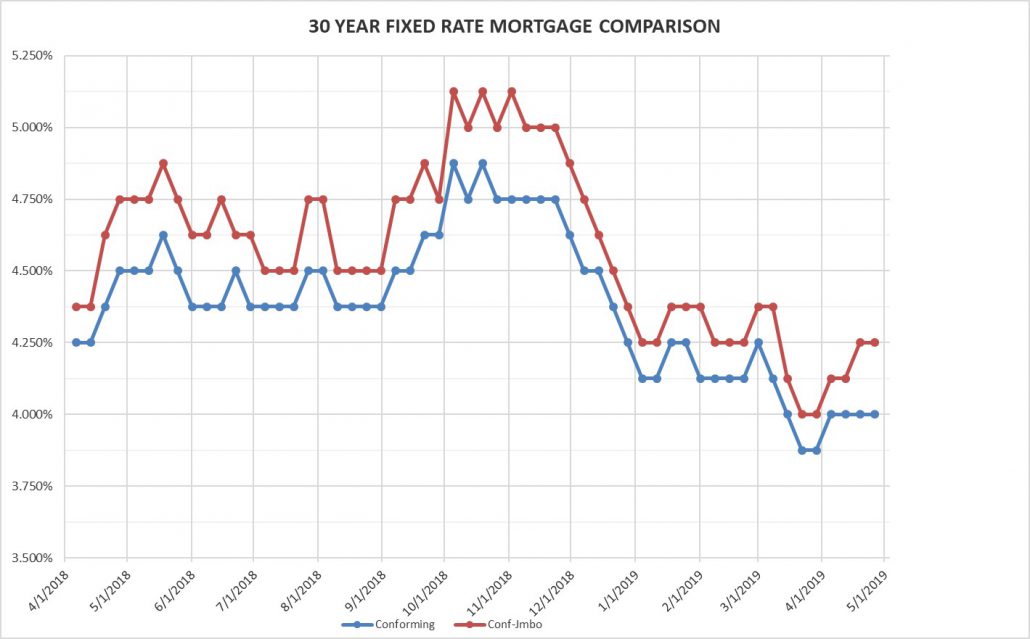
Rates for Friday April 19, 2019: Will the GDP report cool the speculation about a recession later in 2019? That is the major question investors will be analyzing moving forward as investors react on what they feel may happen, or what others may feel will happen directing their actions. For now rates remain flat from last week.

FIXED RATE MORTGAGES AT COST OF 1.25 POINTS LOCKED FOR 45 DAYS:

30 year conforming                                            4.00%        Flat

30 year high-balance conforming                     4.25 %       Flat    

Please note that these are base rates and adjustments may be added for condominiums, refinances, credit scores, loan to value, no impound account and period rate is locked. Rates are based on 20% down with 740 FICO score for purchase mortgages.
Earlier this week we began the Great College Search II with our youngest daughter. We spent a few days in Seattle seeing the sites with the primary site being University of Washington as a possible landing spot. A very successful trip on all accounts. I like Seattle a lot, similar in many respects to San Francisco, but a nicer, cleaner, seemingly safer place to visit the last several years, in my opinion.

Next week is back to regular schedule in the house as spring break ends and the grind to the last day of school begins. I like regular schedules…

Have a great week,

Dennis

Past Weekly Rate & Market Updates can be found on my blog page at my website www.DennisCSmith.com/my-blog

Why is mortgage insurance a good thing?

Question of the week:  Why is mortgage insurance a good thing?

Answer:  Last week in the Weekly Rate & Mortgage Update we discussed if home buyers should wait until they have 20% for down payment before purchasing (you can read the WR&MU, and I encourage you to, but the short answer is “No.”).  The primary reason many clients give us for wanting to wait until they have 20% down is to avoid paying mortgage insurance.

To which I always counter, mortgage insurance is a good a thing and not something you may want to avoid.

Which leads to the question of the week, why is mortgage insurance a good thing?

The quick and simple answer is because it can enable you to purchase your home a lot faster.

As discussed last week, the number one cause of delay for families purchasing homes, according to a California Association of Realtors survey, is waiting to save for down payment and closing costs. A significant number of these delayed purchases are due to wanting to have 20% down to avoid mortgage insurance. But is the delay worth it? We covered the potential cost and missed opportunity last week of waiting, what is the cost of not waiting and buying when you can?

Before we begin the conversation of why mortgage insurance is good, let’s examine what mortgage insurance is. For those new to the conversation, mortgage insurance is not insurance that pays off the loan if you pass away or become disabled—there are life insurance and/or disability insurance policies you can get to cover the mortgage to protect your home and family should something happen.

The purpose of mortgage insurance is not to insure you, but to insure your lender should you default and go into foreclosure. Between the missed payments, legal fees, professional fees, loss of value due to foreclosure sale and other costs, a lender will average about 35% of the value of the property. Because of this if you have less than 20% down the lender will require mortgage insurance that covers the difference between your initial down payment and 35% of the purchase price.

For example, if you are purchasing a home with 5% down the lender will require 30% coverage from a mortgage insurance company, if you put 10% down coverage of 25% will be required, and if you put 15% down coverage will be 20%.

Even with this protection, should a home go into foreclosure there will likely be losses to the lender. Consider the process and losses. It typically takes about eight to nine months for a home in California to be foreclosed on after the first missed payment. Once you miss a payment by more than 30 days, i.e. you do not make your March 1st payment by April 1st, you are in default of the note. To cure the default, you need to make all payments due plus late payments. So, if you miss the March payment you have until April 30th to make the March payment plus the late fee and the April payment plus the late fee, if applicable.

If you are unable to cure the default at some point the lender must make a foreclosure avoidance assessment to discuss with you the circumstances that led to your default and if there is any way to avoid foreclosure. If there is no agreement between you and the lender to continue with the mortgage, i.e. a modification, the lender can then record a Notice of Default (NOD) with the county recorder in which the property is located no sooner than 30 days after the initial contact for the assessment. After 90 days or more have passed since the filing of the NOD the lender can then record a Notice of Sale informing you that the lender intends to sell the property at auction in 21 days or more. At auction, the lender will sell to the highest bidder who must have cash or a cashier’s check, it is very likely that the first bid will be placed by the lender for the outstanding balance due plus foreclosure costs. At the fastest a foreclosure can occur within about 200 days of the first missed payment, however they generally take about 60 to 90 days longer—or depending on circumstances can take much, much longer.

If you purchased a home for 5% down and a $400,000 mortgage with mortgage insurance and are foreclosed on the lender will be reimbursed for losses up to 30% of the loan amount, $120,000, by the mortgage insurance company.

There are different methods of paying for mortgage insurance. You can pay monthly, a full premium upfront, or fund a “no PMI” mortgage that is a loan that is self-insured by the lender due to a higher interest rate on the mortgage. Of the different types of payments, the most popular is the monthly payment, primarily for two reasons. First and foremost, it is able to be removed from the mortgage for most transactions after you have made 24 consecutive on-time payments and can show evidence (lender approved appraiser’s valuation) that you have at least 20% equity in the property you can request the PMI and its payments be removed from you loan—caution, do not just engage an appraiser, contact your lender with your request and get a list of approved appraisal management companies to contact for an appraisal. When your loan balance become 78% of the original purchase price, or appraised value, of the property when the loan funded the lender must drop the mortgage insurance without a new appraisal. The second reason payments are popular is that for the past several years mortgage insurance has been deductible for federal income taxes depending on your income.

That is the purpose of the mortgage insurance, what is your benefit.

That you can purchase a home with as little as 3% down, or 5%, 10%… In California, and most real estate markets, being able to purchase a home without having to save 20% of the payment is tremendous benefit. Doing the math, for a $500,000 home you can purchase a home with only 3% down payment (higher sales prices qualify for 3.5% down payments using FHA, or no down payment if you are an eligible Veteran).

What is the advantage to purchasing a home with less than 20% down? Not having to wait to save the 20% down payment and missing the opportunity of home ownership for perhaps several years—or ever. Consider how long it will take you to save a 20% down payment on your current income, even if you are able to eliminate all your debts—which delays your ability to save. Two years? Three? Five? Ten? During this period will housing prices be stagnant, or increasing faster than your income increases? As you try to save the amount you need to save will continue to increase creating a longer delay in your ability to purchase.

If you know you are going to receive a large financial windfall in the very near term, which I define as less than six months, from a lawsuit settlement, sale of a major asset such as a company, boat or other property, or an inheritance, you may be able to shorten your ability to gather the 20% down. But for most families this is not the case and they should be open and favorable to purchasing a home using a lower down payment and mortgage insurance.

The monthly cost of mortgage insurance is a lot less than most potential homebuyers think it will be, and MI is cheaper today than for non-government loans than in the past (MI for government loans is higher today than it was several years ago).

For a $400,000 here are the monthly costs for a borrower with 740 credit score in California purchasing a home with a 30 year fixed rate mortgage for different down payment amounts:

  • 5% down has a monthly PMI payment of $177
  • 10% down has a monthly PMI payment of $127
  • 15% down has a monthly PMI payment of $67

If this loan has a 4.125% interest rate having a monthly payment of $1939, the 10% PMI payments effectively add one-half of one percent (0.50%) to the payment rate, lifting it effectively to 4.625%.

Consider purchasing a $445,000 house. To purchase with 20% down you will need a down payment of $89,000 and will have a payment, at 4.125%, of $1725 per month.

Purchase the same home with 10% down and you need $44,500 for down payment, easy math tells us you need $44,500 less. The monthly payment including mortgage insurance will be $2068, or $343 more per month. You are spending $343 more per month as long as you have the mortgage insurance, but saving $44,500 in funds needed to close.

Let’s assume the scenario above is a brand-new home and there are two that are identical at the same price next door to each other. James and Monica purchase one of the homes with the 20% down scenario and Jeffrey and Maria purchase next door with the 10% down scenario and they close on the same day. Every month on the they meet for cocktails on one of their porches, and before the mixing begins James and Monica put the $343 savings they have from not purchasing with 10% into a safe. The couples will have to have 129 evening cocktail gatherings before James and Monica have save the $44,500 in cash that Jeffrey and Maria did not put into the down payment for their home. That’s over ten years, but which time statistics show one of the homes will likely be sold due to job transfer, purchasing a bigger home or divorce.

The obvious drawback to the additional payment is the ability to qualify, with a higher monthly payment you will qualify for a lower loan amount and purchase price. Taking a look at this using the above scenario of an additional $343 added to your payment putting 10% down instead of 20% down and assuming that based on other debt obligations our borrower can qualify with 32% of their gross income can support the monthly loan, or monthly loan and PMI payment.

For the 20% down scenario with a cost for the loan payment of $1725 income of about $5400 per month will be needed to qualify.

For the 10% down scenario with the cost of the loan payment plus the PMI payment of $2068 income of about $6460 will be needed to qualify, about 20% more income for the same property.

That said, what is more likely for the average family, that a family making $5400 per month can save $89,000 at the same rate that a family making $6460 can save $44,500 or vice-versa?

Not waiting to save 20% down and using PMI to purchase a home may reduce the amount of home and mortgage you may qualify for, but it can greatly reduce the amount of time it will take for you to purchase your new home.

The best time to contact me about your ability to qualify for purchasing a new home is as soon as you decide you would like to purchase a new home. The sooner we discuss your financial situation the sooner we can work on a plan to homeownership that encompasses your available funds, if any, your income, debts, credit rating and what will need to happen, if anything, so you are able to purchase your new home. Perhaps it is a savings plan, or a debt reduction plan, or a credit rehabilitation plan, whatever may be holding you back from purchasing a new home the sooner we discuss your options the sooner you will be able to purchase your new home. Call me and let’s set up an appointment!

Have a question? Ask me!

 An interesting report today from the Labor Department. The February employment report was released today and it overwhelmingly missed expectations, with 20,000 new jobs created in the month versus the expectation of 175,000 new jobs. While interesting, the very interesting parts of the data was despite only 20,000 jobs being created the headline unemployment rate dropped from 4.0% to 3.8%, indicating a saturated job market higher creating fewer jobs, but fewer people looking for jobs. This rate of unemployment counts only those who indicate they have been looking for a job, the data geeks like myself like what is labelled the U-4 rate which includes those too discouraged to look for work, plus part time workers who would like to work full time. The U4 rate fell from 8.1% to 7.3%, a solid indicator of a very strong labor market. Adding more interestingness (sidebar: this is weird, I thought I made that word up but spell-check didn’t flag it) to the report, total hiring for December and January were both revised substantially higher. At first blush, the sharp decline in new hires should be good for mortgage rates as the data may signal a slowing of the labor market, however the other data in the report shows a very strong labor market that should put upward pressure on mortgage rates.

The report had good news for existing workers as wages climbed again month over month and are up 3.4% from last February, the biggest annual gain since the end of the recession in 2009. The concern with higher wages is that the costs trickle into the economy as employers raise prices to pay the wages, as we have seen in recent inflation data this has not been the case. Labor is a key factor for the Fed when considering increases to interest rates, it appears more of a factor than inflation, and rising wages should put upward pressure on rates, but with an absence of inflation investors reactions today to the Labor Department report were to maintain the status quo and rates did not pop today as might be expected.

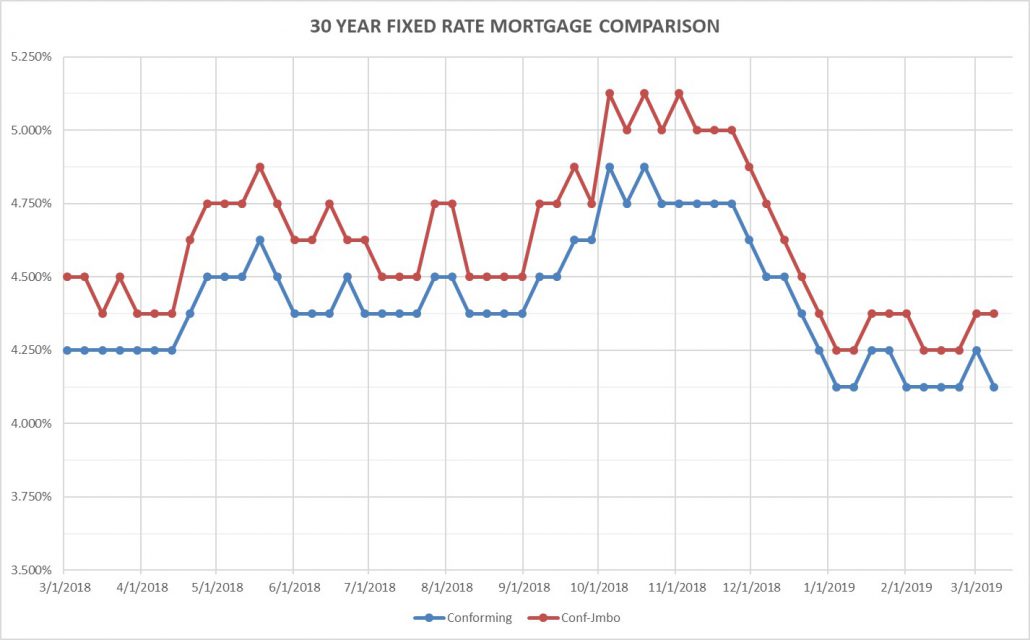
Rates for Friday March 8, 2019: For the week investors looked to move money into fixed rate markets such as Treasury bills and mortgages, as a result the conforming rate ticks back down after its bump last week and high-balance rates remain flat.

FIXED RATE MORTGAGES AT COST OF 1.25 POINTS LOCKED FOR 45 DAYS:

30 year conforming                                            4.125       Down 0.125%

30 year high-balance conforming                     4.375%    Flat     

Please note that these are base rates and adjustments may be added for condominiums, refinances, credit scores, loan to value, no impound account and period rate is locked. Rates are based on 20% down with 740 FICO score for purchase mortgages.

Ten years ago, I started working out of the house on most Fridays. My routine at home is to write some, most, or all of the Weekly Rate & Market Update and try to schedule some meetings for prospecting and networking, and of course communicate with the office and clients. Today as I sat working I heard and saw a large SCE truck in our alley and a few guys went up in a cherry picker to do whatever they do on the pole across from our home. As I was typing “The quick and simple answer…” I heard of loud noise and the house shook. “Oh, ‘goodness’,” I thought, did they hit the house? I looked up and saw the cherry picker halfway down and still in the alley. Which led to my going outside to see what the heck happened.

In lowering their bucket, they came down on a communication line and pulled the facia board the line was attached to off the house. Yippee! One of the workers went up on the roof and nailed it somewhat back into place and we completed a report and I received information about making a claim.

You can imagine my excitement in knowing my future will get to include interacting with a major utility company and tradesmen to get the repair completed and paid for by SCE. I hope you are not too jealous of this wonderful opportunity I have and you, likely do not.

Have a great week,

Dennis

Past Weekly Rate & Market Updates can be found on my blog page at my website www.DennisCSmith.com/my-blog

1-11-19: What are our mortgage options for remodeling our home?

Question of the week:  What are our mortgage options for remodeling our home?

Answer:  There are several options for paying for major home improvements or remodeling. Most commonly used for paying for major home projects are cash, a home equity line of credit or fixed rate second trust deed, new primary loan with cash out, new renovation loan, or possibly tap other resources. Here are some basic guidelines for the various financing options.

Cash: Depending on the scope of your project you may have enough money saved to pay for your construction project. The obvious advantage is lack of any interest costs and monthly payments. Keep in mind that many remodel/renovation projects can end up costing more in time and money so make sure you have enough to cover cost over-runs as well as whatever post-project expenses you may have—such as new furniture, floor coverings, etc. If you are using cash for your remodel you may want to obtain a home equity line of credit for a small amount to cover over runs to ensure you do not run out of funds during the project and then may be unable to obtain financing because part of your house is torn apart and not yet put back together. If you do not need to access the available funds that is great, but if you do you will be prepared and seamlessly be able to continue and finish your project.

Home Equity Line of Credit (HELOC): A HELOC is like a credit card, you are approved for a maximum amount of credit and then you can access as much of the funds as you need up to the credit limit, you make payments based on the amount of the outstanding balance. A big advantage of HELOCs and remodeling is you only pay for the amount of money you need when you need it. For instance, your project is estimated to be $50,000 with 20% paid upfront to get started and then other funds paid to the contractor at certain points of completion with the final amount due when all is complete. You sign the contract and access $10,000 and pay the contractor, you bill comes the next month and you owe the payment due based on $10,000. The next month you pay another $15,000 to the contractor and not having paid any principal on the first payment, you made an interest only payment, your next bill will be based on the $25,000 balance. This gives you flexibility based on how you use the funds available.

Another advantage of HELOCs is many lenders will provide lines of credit at a higher loan-to-value (LTV) than you may be able to obtain with a fixed rate loan or traditional mortgage. This enables you access to more funds than you would otherwise be able to obtain.

The disadvantages to HELOCs are the rates are variable, tied to the prime rate so over time it is hard to budget total costs; for example, since December 2016 the rate has increased 2%, while during this period the 30 year fixed conventional rate is only up 0.25% (after being higher by 0.75% a few months ago). The other disadvantage is self-imposed by the borrower—interest only. The minimum payment due on most HELOCs is an interest only payment, many borrowers fall into the habit of paying interest only which results in a large balance remaining on the loan which has to be paid at some point in the future either through a refinance or sale of the home.

Fixed rate Second Trust Deed: This financing instrument operates like a traditional fixed rate mortgage, however because it is in second position the rate is higher than available primary mortgages at the time of the transaction. The advantages of the fixed rate second are the ability to budget exactly what the payment will be for the period of the loan (generally available in fifteen or twenty year options) and if your current mortgage has a rate that is significantly lower than your current rate you can retain that rate and payment.

The disadvantages of the fixed rate second are many lenders restrict the LTV to 80% (same as most primary mortgages) and the higher interest rate.

Cash-out Refinance: This option is pretty straightforward, you refinance your existing mortgage and increase the amount borrowed to cover the funds you need up to the LTV allowed by the loan program. Most cash-out programs limit the loan balance to 80% of the appraised value of the home so if you are going with this option it is a good idea to have a good estimate of the value of the property.

The advantages of the cash-out refinance option are that you have a 30 year fixed rate mortgage. This provides you the lowest possible payment due to the long amortization, a fixed rate throughout the term of the mortgage which enables you to budget your monthly housing payment with certainty. Another benefit for many homeowners is depending on how long you have had your current mortgage and the increase in monthly payment may not be as high as you would expect; for instance we are closing a loan with a borrower accessing $75,000 and their payment is going up only about $275 per month, whereas their option on a fixed second increased their payment by almost $700.

Disadvantages of the fixed rate option are you are provided all the funds at closing and begin making payments on funds that may be sitting in the bank waiting for your project to begin and through the finish. Another is your interest rate may increase from your current mortgage rate.

It needs to be noted that when pricing mortgages a cash-out refinance are costlier than a rate and term refinance and a purchase transaction. The higher the LTV the more expensive the loan, conversely if you have a lot of equity in the property your costs would be lower if you LTV falls below certain price points based on the appraised value and how much your are borrowing.

Renovation Loan: This option is a combination of a traditional fixed rate mortgage and a HELOC and can be used to purchase a home you wish to remodel or as a refinance of your existing home for major renovations. We will use as an example a refinance.

Your current home is worth $550,000 and you owe $325,000. You wish to add a bedroom, a full bathroom and remodel the kitchen. The total costs are $125,000 and after the work is completed the value of the property will be $645,000. We complete the loan application for a mortgage of $450,000, $325,000 to pay-off your existing mortgage and $125,000 for costs to remodel. With our loan package besides the standard information we would need to show you qualify we will also need plans and estimates of costs from your contractor. During the loan processing we will make sure your contractor is approved by the lender and have an appraisal completed that includes the current value and the value of the home after the project is complete.

All goes well and the loan is approved and we fund the mortgage, your existing mortgage is paid off and the excess funds are placed in an escrow account controlled by the lender. After certain parts of the project are completed you request a draw from the account, the completion of that part of the project is verified and funds are transferred and you can pay the contractor. At the end of the project you have used all the money on the mortgage and your contractor is paid.

Advantages of this option are that you have a 30-year fixed rate mortgage upon completion of the project and the rate is competitive with a traditional mortgage or cash-out transaction. Another advantage is your contractor is vetted by the lender—which in our experience has resulted in some borrowers needing to change contractors after issues arose regarding insurance, licensing or past issues with the contractor that the lender discovered the borrowers were unaware of when they selected the contractor. This may sound like a negative, however should something occur with the contractor during the project it is a nightmare; knowing a contractor had issues in the past decreases the opportunity for such nightmares to occur.

 A disadvantage for many borrowers is the process to get to loan approval, which is longer and significantly more thorough than the traditional approval process—it is a bit more time and effort but understandable due to the nature of the project. Another disadvantage for some is the draw process where the contractor is not paid until certain completion points in the construction. Many contractors want funds before they start the process, using the renovation process they may not get the funds until after the process; some borrowers mitigate this issue by fronting the funds to the contractor and then getting reimbursed through the draw process.

Piggy-back: Some homeowners do their own version of the renovation loan by maximizing their funds available with a traditional 30 year fixed rate mortgage and then add a HELOC onto the property for additional funds. For instance you need $80,000 for your project and a cash-out refinance will enable you to obtain $65,000, you obtain the additional $15,000 needed on a HELOC—what we call a piggy-back transaction as your HELOC piggy-backs on your first mortgage. The advantage of the fixed rate 30 year loan for the bulk of the funds needed combined with the higher LTV of the HELOC lets you complete your project with the best of both options.

Reverse mortgage: Yes, reverse mortgages can be used for home improvements if the borrower qualifies and enough equity is in the property.

Other options can include borrowing from the bank of mom and dad, possibly borrowing against your 401(k) or a margin account on an investment account.

One of my favorite books we used to read to the kids was If You Give A Pig A Pancake. I usually encourage any family looking to do an extensive remodel to read the book as it is a good metaphor for many such projects. A major pitfall for most homeowners is underestimating the amount of work and costs that will need to be done to accomplish their goal of another bedroom and bath and a remodeled kitchen. Once walls are open what will the contractor find? Out of date and code electrical? Inadequate framing? Foundation issues? A rotted out floor under the shower? The original choices for cabinets or fixtures are not available adding time, and/or costs, to the process? You forgot that with the newly remodeled home that you now need furnishing?

A high percentage of the time when I have clients undergoing a remodel they let me know that even though they thought they were being somewhat liberal in the costs they still were short of what was needed. Read the book and imaging instead of a pig going through your home in search of a pancake it is your remodeling project needing more and more done to ensure completion.

Be very thorough in your plans, go deep into your interviews with contractors as to typical issues that come up, and possible issues given the age of your home, location (for instance we are on expansive clay soil which causes foundation issues—not all contractors are aware of this) and scope of your project.

All that said, I usually counsel clients that are considering extensive home improvements that before they commit to explore the options of what homes are on the market that would achieve the same objective. If you are looking to add a bedroom, bathroom, modernize your kitchen or other work that entails a lot of time and money, evaluate the current value of your home, what your net proceeds would be if you were to sell, what loan amount and sales price you will be able to qualify for and feel comfortable paying and then look at the local market to see if it makes sense for you to purchase what you want.

You may find that you prefer to remain in your current home and endure the remodel process, or you may find that you would benefit by purchasing a home that meets your needs.

Whichever route you choose to take please contact me to go through all your options and the advantages and disadvantages of each.

Have a question? Ask me!

Words matter, especially when they are the words of the Federal Reserve Open Market Committee (FOMC)—the group that sets the Federal Reserve borrowing rates which impact other rates such as the prime rate. The minutes from the last FOMC meeting were released this week and they showed that while all the voting members say “yes” to increasing rates at the last meeting there was some discussion by some to not raise rates. As well the minutes showed that future rate increases are not guaranteed. This is positive news for mortgage rates.

More positive rate news today as the Consumer Price Index dropped in December for the first time in nine months, primarily due to lower gasoline prices. Also declining was the year over year cost of living, dropping to 1.9% growth from the annualized growth of 2.2% in November. The 1.9% price increase was the first time since August 2017 the important data point was below 2%. The news is very mortgage rate friendly as the Fed uses the data for their gauge of inflation and the desired price increase for the Fed is 2% per year. If the price decrease remains below 2% moving forward it puts pressure on the Fed to not increase rates.

Rates for Friday January 11, 2019: For the first time in six weeks rates have not declined, and prior to today’s CPI data we might have seen them bump up a little bit. Upward pressure on rates this week was caused by gains in stock markets as investors felt confident about the on-going trade talks with China. At this point the government shutdown is not have much, if any, impact on financial markets.

FIXED RATE MORTGAGES AT COST OF 1.25 POINTS LOCKED FOR 45 DAYS:

30 year conforming                                            4.125%      Flat

30 year high-balance conforming                    4.25%        Flat    

Please note that these are base rates and adjustments may be added for condominiums, refinances, credit scores, loan to value, no impound account and period rate is locked. Rates are based on 20% down with 740 FICO score for purchase mortgages.

Since the end of the last football season my ring tone has been the Philadelphia Eagles fight song, “Fly Eagles Fly.” Starting in March of last year our youngest has asked me, “how long are you going to have that as your ring tone?”

“As long as they are the reigning champions.”

On Sunday I thought I would have to change my ringtone, thankfully the left-hand of the Eagles defensive tackle deflected the Bears’ kicker’s field goal attempt just enough to cause it to hit the upright and the cross bar so I retain the ringtone at least for one more week.

Not overly positive with this week’s game against Drew Brees and the Saints, but hopeful that next week at this time when you call I will still hear, “Fly Eagles fly, on the road to victory….”

Have a great week,

Dennis

Past Weekly Rate & Market Updates can be found on my blog page at my website www.DennisCSmith.com/my-blog

7-20-18: What is the process for our mortgage application when we purchase a home?

Question of the week:  What is the process for our mortgage application when we purchase a home?


Answer:  Mortgage application packages are very deadline oriented. For a purchase this is because we have a closing date that is agreed upon by the buyer and seller, for a refinance the deadline is when the rate lock expires.


Here is a not so detailed look at the timeline on a purchase, much of it is the same as with a refinance.


Ideally the first step in your mortgage process when purchasing a home is we have detailed conversations and review your records to determine your ability to qualify for a mortgage to purchase at a certain price with a certain amount down. This is the pre-qualification, or pre-approval, stage. We review your income by looking at paystubs and tax documents. We obtain a credit report to see you credit score and confirm your balances and payments on outstanding credit. We look at your asset statements so we know how much we have in funds for down payment, closing costs and reserves if necessary. And we discuss your objective, long term plans and other factors that may influence the amount and type of mortgage that would be ideal for you and your family. This step can take an hour or several days depending on the complexity of your finances or issues we need to address. Next step: Look at houses and write offers.


You have your offer accepted and we begin the formal application process. At this stage we complete any information for the loan application so you can sign the application and disclosures. We collect necessary documents supporting income, credit, obligations, funds being used for closing and other items we discuss as necessary. Once we have the signed application and necessary items we lock in your loan rate for a specified period of time that matches your escrow time frame but in 15 day increments (i.e. lock for 30 or 45 days). As well, we communicate with both your agent and the seller’s agent to establish clear lines of communication, confirm who will be the person for the appraiser to contact to set up inspection of the property. We also initiate contact with the escrow officer to make sure s/he and our staff have each other’s contact information as they will be sending a lot of information and documents back and forth. Finally in this stage, we order the appraisal. This stage is generally one to two days depending on how quickly you get the required items to us. Next step: Processing.


During the processing period our staff is collecting the necessary information to ensure underwriting will approve your loan as applied for. All your information will be reviewed and verified. During the review our staff will ask questions that may need additional information to support answers: what is this large deposit, there are some statements in the tax return that indicate another business or sources of income to verify. At this time they are also collecting necessary documents for the approval. The appraisal report will be completed and reviewed. We will obtain a copy of the preliminary title report on the property. Escrow will send us the escrow instructions which detail the agreement between you and the seller. We will communicate with your insurance company to ensure there will be sufficient coverage of the property to protect the lender should there be fire or other major damage. Any loose ends or issues that may arise as all this information is collected and reviewed are addressed and the necessary parties are contacted and additional information requested to cover the issue so underwriting will approve the file. The timing for this stage depends on the how quickly others respond to our request for items. If the listing agent puts off the appraisal inspection for a week or ten days that slows us down. If we request additional statements on an account, tax returns on a business entity, source of funds, this can slow us down if the information is not forthcoming. If everything is into us in a very timely manner this step should be about 10 business days. Next step: Underwriting.


The mortgage application package, at this point several inches thick (our record is over 1 foot high with clients who had multiple companies and properties resulting in about ten tax returns for various entities). All the documentation, disclosures, reports are then sent to the underwriting department. Once received it is assigned to an underwriter who reviews the file and issues an approval, usually “conditional” approval as the underwriter generally asks for items to complete the file, an updated paystub, a letter of explanation for some issue, clarification on the appraisal, support for continuing income from commissions, overtime or bonus, a myriad of items may come up. The underwriting period is generally two to three business days. Depending on the additional conditions requested the time frame from initial approval to final approval can be as short as 3 to 4 days or considerably longer depending on conditions requested and ability to provide them. Next step: Loan Docs.


Once we get the approval and are moving into the final stages of the transaction we will issue to you the Closing Disclosure (or CD). We usually like to issue this via DocuSign as when you acknowledge the CD will start a timer on when you can sign loan documents, which is three days not counting Sundays and holidays. So if we issue the CD on Friday and you open the link and “sign” on Sunday you cannot sign loan documents until Wednesday, if you had signed on Friday you could sign docs on Tuesday. Does one day make a difference? Next step: Funding.


The loan documents will be sent to escrow and available for you to sign the day you are eligible to sign after the CD rescission period is up. Escrow will contact you to set up a time to sign in their office, or if more convenient set up a mobile notary. At this time we will know the amount of funds needed to complete the closing of the transaction. Escrow does not take personal checks, the funds for closing need to be either via a cashier’s check or a wire (see important note below). After you sign loan docs and your funds are in escrow we fund the loan. If we have the loan docs in our office in the morning and all is in order we can fund the day we get the loan docs, the time from doc signing to funding can be as short as one day. Next step: Closing.


Closing occurs when the deeds are recorded by the title company at the county recorder where the property is located. The grant deed conveying title from the seller to you is recorded first, then the trust deed securing the property as collateral for the mortgage is recorded. Depending on what county you live in recording happens either the same day (Orange County is a same day recording county), or it occurs the next day (Los Angeles County will not allow funding and recording on the same day). This is where that one day difference on the CD can impact closing. Since we cannot fund and record on the same day in some counties we very rarely fund a loan in those counties on a Friday for many reasons, for one you are paying interest for two additional days on a property you do not own. Second, if something happens to the property, or the current owner, we have two loans on the property and two insurance policies (your policy must be in effect before we can fund). As you can imagine this creates several issues that need to be unwound. While something could happen to the property between funding on Wednesday and recording on Thursday, it is less likely than something happening between funding Friday and recording Monday. So the closing step is either same day or next day. Next step: Move In!


NOTE, VERY IMPORTANT! There has been a wire fraud scheme occurring with real estate closings. The scam works like this. You are in escrow to purchase a property and you receive an email from what looks like your escrow officer. It is instructing you to wire your funds for closing and provides the necessary information. The email has the escrow company’s email address, signature on the email looks the same and by all accounts is from the escrow company. This email will come near closing but before funds are usually asked for from escrow. What has occurred is that at some point your email was hacked, it could have been last month or last year or even longer ago. The hackers run your emails through their filters which are set to look for keywords in your emails, such as “escrow,” “mortgage,” “purchase home,” etc. When any keyword occurs the account is monitored to determine is you are engaging in a real estate transaction. The next step is to determine who is who in the communications and then spoof the email account for the closing agent, i.e. escrow, and send you the email requesting you wire the funds into the scammers account. Do not reply to the email, do not send the funds to the account listed in the email and do not call the number listed in the email as chances are it is not the escrow company you are using. Before sending funds call the escrow officer from the number printed on the escrow instructions you have, or by getting the number from us or your agent, and verify the amount of funds required and ask them to send you an email with the wire instructions, then call back to verify the information is correct.


As you can see the time frame for closing an escrow on a purchase can be 30 days or a little less, or longer depending on everyone having the information needed and requested and providing it in a very timely fashion. Closing times are dependent on many actors all performing together and when needed.


Have a question? Ask me!


Consumers appear to be happy. Retail sales for June were reported on Monday and showed a 0.5% increase from the prior month. This is good news, what was pretty incredible news was that May retail sales were revised upward 0.5% for a total increase of 1.3% from April, that is a very rare number to reach. Auto sales had strong months in May and June, up almost 1% each month, and restaurants also showed strong increases, up 1.5% in May and 2.6% in June. This news indicates consumers willing to increase their discretionary spending, what’s more discretionary than eating out instead of at home? The news is somewhat negative for rates as higher consumer spending supports stronger economic growth, which leads to higher interest rates.


Historic is the word to describe yesterday’s jobless claims report. Last week 207,000 initial jobless claims were filed, the lowest weekly amount since December 1969. Continuing jobless claims, as sign of length of unemployment, are at 1.738 million which is at a level last seen in the early 1970s. The news is interest rate unfriendly as a tight labor market can, should, lead to some wage inflation which will lead to higher interest rates.


Rates for Friday July 20, 2018:  The economic data suggests rates should be higher than they are, especially with the Fed selling off billions of dollars of mortgages and bonds every month. However investors, who ultimately control interest rates, do not look at just American economic data when making their decisions on what to buy and sell for long range profits, the also look at foreign economies, and as importantly domestic and international politics. It is the latter that has investors holding onto their fixed return investments (i.e. mortgages and bonds) as a hedge against some major event that could trigger a run on bonds and therefore lower rates. It is a strange set of market circumstances we have been experiencing. Thankfully we have benefited from flat rates for the past two months.


FIXED RATE MORTGAGES AT COST OF 1.25 POINTS LOCKED FOR 45 DAYS:

30 year conforming                                            4.375%            Flat

30 year high-balance conforming                      4.500%             Flat


Please note that these are base rates and adjustments may be added for condominiums, refinances, credit scores, loan to value, no impound account and period rate is locked. Rates are based on 20% down with 740 FICO score for purchase mortgages.


We have been down to one kid in the house since early in the month as the younger one is spending her annual month in Minnesota at camp, unfortunately for the older one she is basically termed out this year and must spend the summer at home. It has been nice to have her home with us since she leaves in 4-5 weeks to Boston for college and then we will be a one kid home for a few years before the younger ones decides to leave as well. We are in that period when our oldest is still our daughter and little girl but our relationship is slowly transitioning to daughter and adult. Certainly a unique summer for our family, and one that we will fondly remember for years to come. I hope you and your family are having a great, and unique, summer as well!


Have a great week,


Dennis