
Posts

12-14-18: Should we use auto-pay for our mortgage payment?

Question of the week:  Should we use auto-pay for our mortgage payment?


 Answer:  Yes, but…


One of the biggest benefits I derived from the advent of everyday web availability for the common citizen was on-line banking. My desire to not have to write a bunch of checks every month and put in the mail was so strong that I left the bank I had been with for almost twenty years, and my first job out of college, that I closed my account and went to a big bank just because I could pay bills on-line. Subsequently, my preferred local bank that is strong, friendly and conservative (and Long Beach’s oldest family owned bank) established on-line banking and I immediately switched back.


Very few people write and mail checks for their monthly bills anymore. Most people pay their bills using their banks’ on-line service. That said, many people still log on one, two, three times a month and fill out their payments and then hit send. This is understandable as credit card balances and utility payments change every month. However, many still log on every month to fill out payments for accounts that have the same payment every month for house payment, mortgage or rent, auto loans, student loans, etc.


I strongly advise that if you have a payment that is the same amount every month that you establish an automatic payment every month. There are a few reasons for this. First, you do not need to remember while you are on vacation in Yellowstone, “oh shoot it’s the 14th and I need to log-on and pay the mortgage.” Second, well, there is no second. The reason to do this is to ensure your biggest payments—house, auto, other loans—are made on time all the time.


The next question I get from a lot of clients, or if they do not bring it up I try to when we close their loan, is “should I set up auto-pay with our new mortgage lender?”


My response is always, “No.”


Almost every creditor has the option to set up on their site for making payments. You input your banking information and then can set up for them to automatically pull the payment from your bank account, or you can log in and tell them how much money you want to transfer from your bank to your credit account.


I am not a big fan of having your creditors pull funds from your bank account and strongly recommend you push your payments from your bank account to your creditors.


There are several reasons I prefer the “push” over the “pull.” First, you are in total control. Once you set up the automatic payment from your bank every month you can quickly and easily make changes if necessary. If your bank account is compromised most banks will quickly assist you in setting up a new account and many will also enable the transfer of your existing autopayments to your new account. You immediately know if your payment has been made and applied to your account.


Recently one of our clients was setting up his first payment, and subsequent auto-pays, after we funded his mortgage. He input his banking information, input the payment amount and clicked, “confirm” on making the payment and having subsequent payments pulled on the same day every month in the future. After a few days he noticed his payment was showing “paid” on the lender website, but the funds had not left his bank. After several days, we conferenced called the lender and discovered he had entered his account number incorrectly. Because the lender’s computer software did not know the account number was incorrect it assumed the payment had been made. It took about ten days before the software discovered no payment was coming and marked the account as still due. Simple mistake, but had he not checked his bank account to see if the payment had been taken out by the lender he would not know for quite some time—long enough that he may have been subject to a late penalty.


Had he set up for the payment to be sent from his bank every month he would have been notified immediately by his bank had he incorrectly input his mortgage account number and been able to make the correction. He has cancelled his auto-pay with the mortgage company and set up auto-pay from his bank.


It is not uncommon for us to receive notifications that our personal data may have been compromised, hotel chains, retailers, even the IRS have been hacked and data taken on account holders. Should this happen to your mortgage company they will obtain some very critical information, name, address, social security number, date of birth. However, if you do not have your auto-pay set up for the lender to pull your payment every month the hackers will not have your bank accounts routing and account numbers.


Yes, your account information can be compromised from your bank. However, if this happens and your accounts are accessed and funds transferred your bank will very, very likely reimburse the funds taken and set up a new account. Will this be the case if someone obtains your account information from a mortgage, credit card or student loan lender? Perhaps, perhaps not.


I strongly encourage you use auto-pay, and strongly recommend as well that you set up the auto-payments to initiate from your bank and not from your creditors.


Have a question? Ask me!


Tame. That is the one word to describe prices for wholesalers and consumers in November. The Producer Price Index rose only 0.1% in November, after climbing 0.6% in October, and increased 2.5% from last November after year-over-year increase of 2.9% in October. Consumer prices rose at the same pace in November as October, up 0.2% and the annual increase from last year is up 2.2%. Both the PPI and CPI were strongly influenced by gas prices dropping 4.2% for the month, however stripping out food and energy the “core” CPI increase was still only 0.2% from the prior month. Overall the news is interest rate friendly as the price increases are close to the Fed’s target and provide some foundation to speculation the Fed may not go through with three rate increases in 2019.


Not as tame. Retail sales as a whole increased 0.2% from October, however taking out spending on gasoline and sales were up 0.5% for the month a strong increase, evidently consumers took their savings at the pump and logged on to buy stuff. On-line sales in November were up 2.3%, department sales increases at a much smaller rate but were still up 0.4% from the prior month. Further showing the strength of the retailers was the revision to a 1.1% increase in October sales from the prior release stating sales increased 0.8%. The strong November sales and very strong October sales indicates the Gross Domestic Product for the 4th quarter of 2018 should come in at a pretty high number. The retail sales data is not real friendly to lower rates. Since consumer spending is 65-70% of our economy strong sales puts upward pressure on prices as well as on the labor pool


Where are we going? That is the question investors are asking and there is no consensus—which typically indicates an economy in transition. On the one hand, some are predicting inflation will rise through 2019 due to higher prices for wholesalers and consumers due to higher tariffs as well as higher costs for wages and salaries due to tight labor markets. If this is the case rates will continue to increase in 2019. On the other hand, some are predicting that inflation will remain flat near current levels or decline due to the economy slowing due to rising rates.


Rates for Friday December 14, 2018: Rates are retaining their levels after the recent dip, mainly due to investors pulling money out of stocks and putting into long-term fixed rate investments, such as bonds and mortgages. It appears that with inflation somewhat benign that the mortgage rates in the near future will be strongly influenced by the U.S. government. How? Because the Treasury has announced its borrowing needs and they are significantly higher than last year. Because the government can print money to pay its bills it is not very rate conscious, therefore if it needs to pay higher rates to borrow in order to finance operations it will borrow at higher rates. Between the government coming to market to borrow and the Federal Reserve putting its assets on the market to unwind its balance sheet from it Quantitative Easing programs starting in 2008, there is a lot of supply in the fixed rate markets. Over supply leads to higher interest rates. The economic data indicates somewhat stable rates, the financial markets indicate upward pressure. In the meantime rates have dropped in recent weeks—time to take advantage.


FIXED RATE MORTGAGES AT COST OF 1.25 POINTS LOCKED FOR 45 DAYS:

30 year conforming                                                4.50%       Flat

30 year high-balance conforming                       4.625%     Down 0.125%


Please note that these are base rates and adjustments may be added for condominiums, refinances, credit scores, loan to value, no impound account and period rate is locked. Rates are based on 20% down with 740 FICO score for purchase mortgages.


On my Facebook page I have been running a “Best Christmas Movie” poll for several weeks. I started by asking people to nominate their favorite films. The following week I posted the top sixteen nominees and every week since people have voted for their favorites to whittle the contestants down to the final two, posted today. It has been interesting as throughout there has been a balance between “old” (made prior to 1960’s) to “new” (made 1980’s or later). Our final two mirror the balance with “It’s a Wonderful Life” (1946) in a run-off against “A Christmas Story” (1983). Interesting, though both are widely considered two of the best Christmas movies of all time, neither did well at the box office and gained their popularity several years after their releases.


Like types of cookies, pie, whiskeys or kids, it is very hard to pick a favorite Christmas movie; but it is always fun to experience them all while trying to decide!


Have a great week,

Dennis


Past Weekly Rate & Market Updates can be found on my blog page at my website www.DennisCSmith.com/my-blog

11-7-18 Should I refinance and payoff my HELOC?

Question of the week:  Should I refinance and payoff my HELOC?


 Answer:  My most frequent response to questions of the week definitely applies to this question: It depends.


There are several factors to consider when deciding if now is the time for you to refinance and fix the rate on you Home Equity Line of Credit (HELOC).


Before we get into various factors to discuss, let’s take a quick look at why the question is being asked. Your HELOC has three components that determine your current payment, the balance, the prime rate and the amount added to the prime rate (called the margin) that results in the rate you are being charged.


Of the three factors the only one you somewhat control is the balance; you can impact your payment by paying down the balance on the HELOC. Obviously, the more you pay towards the balance the lower your payment will be on a monthly basis. Most HELOCs have two periods of repayment. The initial payment period usually has a minimum payment requirement that is the interest accrued on the loan since the last payment. The next stage of payments is usually a fully amortized period for the remaining life of the loan; if you may have a HELOC that is a twenty year loan, in this case typically the first ten years of the loan have an interest only payment, at the start of the eleventh year the loan will be fully amortized based on the remain ten years of the loan.


Example: You have a $150,000 balance on your HELOC that you obtained in December 2008 and the current rate is the prime rate, currently 5.25% plus one-half of one percent (0.500%) for a payment rate of 5.75%. Your minimum payment for November is the interest on the balance, $718.75 (balance times rate divided by twelve months). Next month you begin your eleventh year and the loan payment is now fully amortized using the rate that month plus the remaining term of 120 months. The rate for the December payment is the same as November, since the prime rate has not moved, at 5.75%, since you paid the interest only payment in November balance is still $150,000 but now instead of interest only the payment is amortized to include principal reduction and the payment will be $1646.54. Since the Federal Reserve is expected to increase its funds rate by 0.25% in December that means the prime rate will increase by 0.25% as well so the January payment will be calculated at 6.00%** and your payment will be $1655.00 for the month.  **Since the Fed will increase rates into the month the rate will only be for part of the month with the earlier part of the month being calculated at the 5.75% rate, but for demonstration purposes easier to show as one complete month.


The lower your balance when you enter the fully amortized payment portion of the repayment of your HELOC the lower your required payment will be.


If you have a HELOC for three years or more you have seen your rate increase by two percent since 2015 and one percent since last November. The chances are you will see at least another one percent increase in the next year, with a 0.25% in December when the Fed is expected to increase rates again.  (To see why the Fed increasing rates impacts your HELOC rate here is link to WR&MU from a few weeks ago addressing the issue.)


With rates having climbed one percent or more in the past twelve months the decision to refinance is a lot harder than it was one year ago, or even two to three months ago and moving forward the decision might not get easier.


The first consideration is if you are risk averse or not. The risk averse individual would be more inclined to want to refinance to avoid future increases in rates on their HELOC as well as for long term fixed rate mortgages that would be used to refinance. The person more comfortable with risk might be less inclined to refinance. Why?


The person who is willing to accept more risk may take the stance that their underlying primary mortgage has an interest rate that is lower than the rate available to refinance their primary loan plus their HELOC and will accept the higher rates on their HELOC in the future and if need be make interest only payments with the hope that rates decline in the future so refinancing makes more sense, or to enable easier paying down of the mortgage.


The risk averse person does not want the uncertainty of not knowing how high their rate and payment will go on their HELOC and is more willing to trade off what would probably be a higher payment in the short term for what may be a lower payment in the long run. The risk averse person knows if rates do drop in the future they can likely refinance and lower their payment.


What are the factors in terms of payment that need to be considered? First and foremost is the payment differential between doing nothing and refinancing. There are four primary factors that will determine the payment at which the interest rate for your refinance will be calculated: balances, credit score, loan-to-value and whether the transaction would be considered cashout or not.


The first three factors are pretty elementary; the combined balances of your existing primary mortgage and your HELOC will determine the refinance loan amount, your credit score is determined when we pull a credit report, the loan-to-value is determined by the estimated value of your home and the refinance loan balance.


The fourth factor, whether the refinance transaction is considered a cashout transaction or a rate and term transaction. For conventional mortgages unless the HELOC can be proven to be part of the purchase price of the property the transaction is considered to be a cashout transaction, if your HELOC was used to purchase your property the transaction is considered to be a rate and term refinance, and will have lower costs than the cashout. If the loan is a jumbo loan we have several programs that will consider the refinance a rate and term transaction is you can prove you have not accessed any funds from the HELOC in the past twelve months.


Once we know the four factors we go to our rate sheets and determine the rate, and also your what your new payment would be after refinancing. With this information you can determine if you want to refinance and payoff your HELOC into a fixed rate mortgage, or continue as you are with your current primary mortgage and HELOC.


Since the minimum payment for most HELOCs is interest only even if you were able to refinance near what your current mortgage rate is the chances are you will see some increase in total payment as you move from interest only to paying down principal on your HELOC. With rates higher and most homeowners with rates closer to 4.00% than today’s rates the chances are that your payment will likely increase a few hundred dollars per month, or more, when refinancing to pay off your HELOC. And this is the basis for the hard decision, is the extra monthly payment worth it to remove future risk based on rising interest rates, or is the cost too much for you to want to remove the risk?


This is a question I am very willing to help you answer by running the numbers and options for you and your particular situation. For several years we have been encouraging homeowners with HELOCs to refinance to fix their rate and payment on their mortgage debt, while I still feel it is a good idea for most homeowners, it may not be your choice, however I encourage you to run the numbers and know the options. If your HELOC is converting from an interest only payment to fully amortized in the next few years you may want to give refinancing even more consideration due to the sharp increase in your monthly payment when that occurs.


If you, or someone you know, has a Home Equity Line of Credit please contact me to go through your information so you have the information needed for making a decision on whether to refinance.


Have a question? Ask me!


Better economy, higher rates. That correlation is something long time readers of the WR&MU have learned over the years. This week we have positive economic news released every day, some data a lot more positive than others. Here are the data releases that have the greatest impact on rates.


Households made more and spent more in September. Income growth for the month was slower than August but still positive at 0.2% matching the core inflation rate for the month. Holding back income growth was a slow down for self-employed businesses. Savings rates dropped as consumer spending increased in September by 0.4%, the seventh month in a row with spending increasing by 0.4% or more. The disparity in spending and income growth may have been impacted by Hurricane Florence. The very good news for the economy inside the data is that there was a sharp increase in the purchase of new cars and recreational goods—the sort of spending that occurs when the economy is strong and consumers are optimistic. The news is not good for interest rates, though tempered a bit as the year over year inflation index of 2.0% is in line with the Federal Reserve’s target.


My oldest was one the last time the American consumer was has confident as s/he was in September, as the consumer confidence rose to its highest level since 2000. The cutoff date for the survey was mid-October, before the stock market slump so the expectation is that the index will drop in November. This news also puts upward pressure on interest rates.


Continuing the short term historic gains was the Employment Cost Index which showed wage gains in the private sector reached their highest level in ten years in the third quarter, with wages, salaries and benefits increasing 0.8% for the period. The gains reflect the lowest unemployment rate since 1969. A very big concern for economists is wage inflation, higher prices driven not by demand but by the cost of production of goods and services being driven higher by employment costs. The ECI report puts that concern very much in the center of the inflation and rate conversation. While this news is good for workers it is bad for those wanting lower interest rates.


Today’s data just piles on. The jobs report was released by the Labor Department today showing the labor situation in September. The news shows a very strong labor market, stronger than expected. Nonfarm payrolls increased by 250,000 in September, well above the forecast of 208,000 jobs. Included in the report was year over year growth in wages of 3.1%, the highest gain in one year since 2009 when the recession ended, the average hourly pay is now $27.30. This report fully supports future rate hikes from the Federal Reserve and continued upward pressure on mortgage and other long term rates.


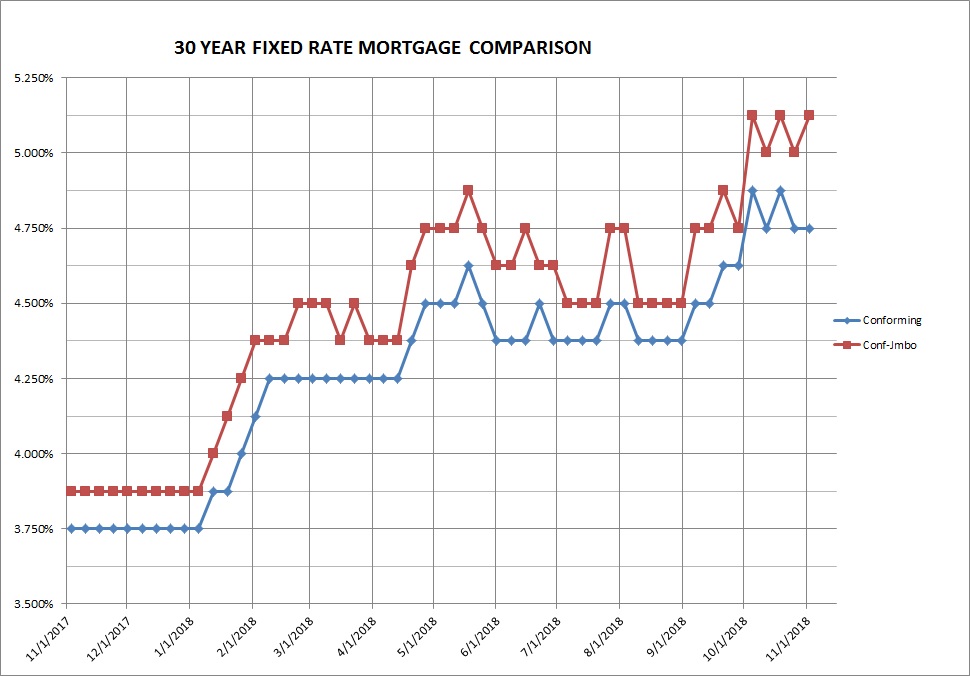
Rates for Friday November 2, 2018: Despite the quantity and quality of positive economic news conforming rates hold on from last Friday, high-balance loans ($453,101 to $679,650) increased from last week back to seven year high first reached in early October. The only reason I can see for rates to undergo a migration down would be a catastrophic event causing investors to flee to the safety of long term fixed rate returns available in U.S. Treasury bonds and mortgages.


FIXED RATE MORTGAGES AT COST OF 1.25 POINTS LOCKED FOR 45 DAYS:

30 year conforming                                                4.75%       Flat

30 year high-balance conforming                       5.125%     Up 0.125%


Please note that these are base rates and adjustments may be added for condominiums, refinances, credit scores, loan to value, no impound account and period rate is locked. Rates are based on 20% down with 740 FICO score for purchase mortgages.


As many of you know I love baseball. During the season most afternoons I have the Phillies radio broadcast, or some other game back east playing on my computer and on weekends I listen to games from Philly or around the country while driving around or doing chores. Last Friday night’s game between the Dodgers and Red Sox that went 18 innings was pure heaven for me and I was thrilled the way it ended, not necessarily because the Dodgers won but that it was won on a great home run and not an error. Every inning was thrilling and had fans on the edge of their seats. While mildly upset the Red Sox won another championship and the Dodgers drought is now thirty seasons, I admire the Sox for the way they played this season and through the playoffs; the best team hoisted the trophy to end the season.


Now we wait until the end of February when Spring Training starts!


Have a great week,

Dennis


Past Weekly Rate & Market Updates can be found on my blog page at my website www.DennisCSmith.com

10-5-18: How does the Federal Reserve impact mortgage rates?

Question of the week:  How does the Federal Reserve impact mortgage rates?


 Answer:  Indirectly.


Long time readers of the WR&MU know I mention the Federal Reserve, aka the Fed, a lot in updates, usually in the section covering news of the week that impacts mortgage rates. Whenever the Fed changes rates I usually get inquiries from different sectors of my life as to what it means for mortgage rates. This week the Fed raised its Federal Funds Rate by 0.25% and at two different meetings subsequent to the rate increase I had conversations regarding what it means for mortgages.


Before we cover the impact that the Fed has on mortgage rates let’s cover what rates the Fed does impact directly. There are two interest rates that are directly associated with the Federal Reserve and the Fed does not directly control either. The Federal Funds Rate is the rate at which member banks charge each other for over-night loans so they can cover their required minimum reserves, the Federal Discount Rate is the rate at which the Fed loans money over-night to member banks so they can cover their reserves.

What reserves? Depending on its size a bank in the United States must retain either 10% of their total deposits (banks with more than $122.3 million in deposits) or 3% of their deposits (banks with $16 to $122.3 million in deposits) in their banks. If a bank slips below this requirement due to making loans that total more than the either 90% or 97% that can be out in loans, the bank must borrow money to add to its reserves to meet the requirement. The bank can either go to the Fed’s discount window and borrow the needed funds, or it can borrow the funds from another bank that has reserves above the reserve requirement. Depending on whether it goes to the discount window or another bank will be determined by the rate each is charging.


How are those rates set? The Federal Reserve sets the rate it charges at the discount window, and this changes daily based on the market, demand and objectives of the Fed as to what it wants to do with its assets—loan them out to member banks or retain them for its own reserves. The rate that gets all the publicity is the Fed funds rate, the rate banks charge each other to lend money over-night.


This week the Fed was in the news and it was reported that the Open Market Committee of the Federal Reserve (aka the FOMC) raised the Fed funds rate by 0.25% (one-quarter of one percent). So to the casual observer with some knowledge of the Fed the presumption is that the Fed is telling its members that it must increase the rate it charges other banks to borrow money over-night by 0.25%. Somewhat accurate, but not entirely. What the FOMC announces when it “increases” rates is the target rate it would like to see banks charging each other, but the actual rate is determined by supply and demand each night and what lending banks are willing to charge and what member banks are willing to pay.


Confused? Example: Fred’s Bank at the close of the day has $150 million in deposits, but only $15 million in reserves on hand, it is short $1 million to meet the reserve requirement. Fred’s Bank’s reserve requirement manager goes on-line and sees the Fed is willing to lend the million dollars over-night at a rate of 2.25% (the Fed discount rate), the manager then checks the member bank website and sees that Jane’s Bank, which also has $150 million in deposits but $19 million in reserves, or $4 million above the requirement, is willing to lend one million dollars over-night for 2.23% under the Federal Funds agreement between member banks. The manager at Fred’s Bank can save 0.02% borrowing from Jane’s bank and initiates the transaction. In reality the amount borrowed over-night is in the billions, tens of billions so the savings for small differences such as 0.02% become pretty big.


The only rate set by the Fed is the discount rate it charges for over-night loans, but it influences the funds rate by making a strong suggestion to member banks as to what rate it would like see them use for making over-night loans. The two are usually very close, but again determined by the market.


Back to our question, how does the Fed impact mortgage rates?


As you can see there is no consumer rate that the Fed manages or dictates. However, but by impacting the rate at which banks can borrow money it is also impacting the rate at which banks will loan money to consumers. If a bank can make enough loans so that it is constantly below the reserve requirement, borrow money from the Fed at 2.25% to cover the required reserves and then lend the money it is borrowing at 2.25% to clients at say 5.25% it is making 3% on the money it is borrowing.


The 5.25% in my example is what the current prime rate is after the Fed rate increase last week. This impacts homeowners with Home Equity Lines of Credit directly, and the increase in the prime rate was a direct result of the action by the Fed’s Open Market Committee to raise its target for the funds rate.


However, long term mortgage rates, the 30-year fixed rate the majority of borrowers obtain, is not impacted by the FOMC decision. Directly.


Indirectly, the Fed’s move impacted mortgage rates months ago. And the current actions, and statements, by the Fed are impacting future mortgage rates. How?


Mortgage rates are determined by the open market. Investors, and think hundreds of billions of dollars daily, have many choices to make that balance their desire for high returns for their funds and minimizing risk that those funds will decline in value due to the wrong investment decision. Investors are also gamblers. They are constantly research the economy, markets, industries and hundreds of other factors with the sole objective of trying to predict what will happen tomorrow, next week, next month and next year. Based on their information they make the decision to invest in equities, aka stocks, which means you own part of a company; or fixed rate assets that pay a specified rate of return for a specified period like bonds, or mortgages.


The most basic piece of information to determine whether to invest in equities or bonds is information that shows how the general economy is doing. If the economy is doing really well, or looks like it will be doing really well, money will go into stocks, causing stock prices to increase, and money will go out of bonds and rates will go up. Why? If the economy is doing well companies will earn more money and therefore be worth more in the future, investors are buying today, low, and looking to sell in the future, high. They leave fixed rate assets like bonds because as the economy improves rates will increase so the rates they are fixing today by buying a bond will be worth less money in the future after rates increase. Conversely, if it appears the economy is slowing down, or contracting, investors will sell equities as companies will be earning less or be losing money in the future, and buy fixed rate invests instead locking in higher rates today with the presumption rates will decline as the economy declines; the higher rates they lock into today will be worth more money in the future when rates are lower.


Example: Investor reads the economic tea leaves and sees a growing economy. The option is to purchase a fixed rate investment paying guaranteed 4% for the next five years, or purchase a shares in a mutual fund that focusses on growth. Based on the economy growing, rates will increase so in one or two years the same fixed rate investment may be 5% or higher, or 25% more than the current return, but the money would be locked in at 4%, missing out on the opportunity for the higher rate of return. The mutual fund with companies that experience growth in strong economies is expected to return 6-7% over the next one or two years. If the investor is correct the money will be invested in the mutual fund, and then in a year or two the decision will be made with that money to either sell the mutual fund and re-invest in fixed assets now paying over 5% or leave the money in the fund. Because the 4% fixed rate is not enough to attract investors to invest the rate will increase until investors are attracted.


Move ahead two years and the economic growth is losing, or has lost, steam. Rates have gone up to encourage investors, which has also been a factor in slowing economic growth. The investor has made an average of 6.5% by investing in the growth fund but sees the economy has slowed. Looking at the markets there is a fixed rate bond that is guaranteed to pay 6.25% for the next five years. Knowing a bad market will cause rates to decline, and also slow the growth of companies, the investor sells the growth fund holdings and purchases the fixed rate bond. As the economy does slow down the investor is collecting a higher rate of return on the fixed asset than newer bonds coming to market are paying, as well as a lot more than the growth fund that is now losing value.


The Fed indirectly impacts mortgage rates as it provides a look into the future for investors as to which way interest rates are headed, often by broadcasting in advance its future intentions with rates. The rate increase last week had no impact on mortgage rates because the Fed told the world in 2017 its intention to increase rates through 2018, how often and by how much. We know that the Fed will increase its target for the funds rate by December 31st by another 0.25%, if it does then there will be no impact on mortgage rates as investors have already priced this increase into bonds and mortgages. If however, the target is increased by 0.50% instead of 0.25% mortgage rates will jump as the rate increase was higher than expected and investors will have been caught off-guard and will sell off holdings they purchased anticipating only a 0.25% increase.


What impacts mortgage rates is the expectation for what rates will be in the future. What rates will be in the future is determined by economic activity. This is why I include a brief economic report every week in the WR&MU, so readers can get an idea of the strength, or weakness, of the economy and from that get a good idea if rates will be going up, going down, or holding steady.


Even with economic activity it is still somewhat of a guessing game as at any time rates can bounce up or fall down based on national or international events. The rule of thumb for mortgage rates is bad news means low rates and good news means high rates.


I hope this was not too much deep in the weeds in describing the Fed’s impact on your mortgage rate, but it is hard to make a simple explanation on a somewhat complex issue.


Have a question? Ask me!


First Friday means jobs. On the First Friday of every month the Labor Department releases the labor statistics for the prior month. Today’s release contained a huge headline number that will cause a stir and details that need further examination. The important data is that non-farm payrolls increased by 134,000 for the month, well below the expectations of 168,000 and below the average of over 200,000 new jobs for month for the first nine months of the year. It is unknown if the lower than expected number of new hires was impacted by Hurricane Florence, or if it is signifying a slow-down in hiring that will continue. Employers are having a hard time finding workers, as indicated by the headline unemployment rate dropping 0.2% from August to 3.7%, the lowest unemployment rate since December 1969. Wages grew 0.3% for the month and are up 2.8% from last August. The news is not positive for rates. With unemployment dropping employers will need to continue to increase wages to fill vacancies, which will in turn require prices to increase to cover the higher labor costs. This can start a wage and price inflation spiral that can be difficult to control. This leads to expectations for higher rates, which puts very strong upward pressure on interest rates.


Rates for Friday October 5, 2018: Several months ago, I wrote about the Fed selling off its accumulation of mortgages and U.S. Treasury bonds it purchased over the years following the recession. At the same time these assets are hitting the market the U.S. Treasury is also selling short and long term debt to finance the operations of the government. With increased supply on the market, which drives down prices and rates up, plus economic data indicating there is a strong possibility of higher inflation, and therefore higher rates, it is not surprise that the U.S. Treasury 10 year bond yield is at its highest since July 2011 and that 30-year fixed mortgage rates today hit their highest levels since April 2011. There is some over-reaction from investors this week to the employment data, however when they make adjustments to their behavior, any decrease in rates will be much more modest than the increase we have seen since the end of August. Now is the time to lock in your mortgage rates.


FIXED RATE MORTGAGES AT COST OF 1.25 POINTS LOCKED FOR 45 DAYS:

30 year conforming                                            4.875%    Up 0.25%

30 year high-balance conforming                    5.125%    Up 0.125%

Please note that these are base rates and adjustments may be added for condominiums, refinances, credit scores, loan to value, no impound account and period rate is locked. Rates are based on 20% down with 740 FICO score for purchase mortgages.


Thanks to my wonderful wife Leslie, PR consultant extraordinaire, and her terrific team, my website is fully functional and includes past Weekly Rate & Market Updates through 2016. The posts from 2016 and 2017 will see some changes, hopefully over the weekend, as I tighten up the titles. The posts from this year are listed by date and also show the Question of the Week to help visitors find topics they are interested in learning more about. There is still some cleaning up and beautifying to go but I am excited that archives of past updates are now available.


To visit the website, go to www.DennisCSmith.com or directly to the page with the WR&MU history go to www.DennisCSmith.com/MyBlog .


Thank you to everyone who got back to me on last week’s topic regarding the Propositions on the California ballot in November, it was the most feedback I have had on a Question of the Week in some time. If you missed it click here.


Have a great week,


Dennis

Weekly Rate & Market Update 11-3-17: Should we be worried about the new tax plan that will cut the mortgage deduction?

 Question of the week:  Should we be worried about the new tax plan that will cut the mortgage deduction?


Answer:  With the biggest tax reform plan working its way through the House of Representatives and the Senate it is no surprise that various aspects of what have been released and talked about so far have been a hot conversation topic. Last week at meeting with a group of professionals from family law attorneys to CPAs to business owners we discussed various parts of what had been floated through the media for almost an hour. The only consensus was that we were debating what we don’t know since until both houses in Congress agree on a bill, pass it and present it to the President everything is negotiable.


That said….the two features of the plan presented to the House of Representatives that impacts the housing markets are deductions for mortgage interest and property taxes; under the plan released this week both would be reduced from the current tax code allowable deductions.


Currently if you own a home with a mortgage you have the opportunity to deduct the interest paid on the mortgage and property taxes. “Opportunity” basically means there are limitations on the deductions. First, in order to claim deductions for property taxes and mortgage interest on your primary (and possible second/vacation home) residence you must itemize your deductions and they must exceed the standard deduction given to tax filers (for married couples $12,700 in 2017). If you meet these criteria then you can deduct all property taxes paid to the local tax authority. Second, a married couple can deduct interest paid on a mortgage used to acquire, build or substantially improve the property up to one million dollars of mortgage liens. For example if you own a home with a $1.3 million mortgage at 4% interest you can deduct $40,000 in interest paid, not the full $52,000 you actually paid in interest.


The current plan that will be debated in the House and put through many separate committees before a final bill is presented for a vote increases the standard deduction to $24,000 for married couples and limits the mortgage interest deduction to interest paid on mortgages up to $500,000 and the property tax deduction to a total of $10,000.


What does this mean in plain English and simple math?


Before we do some math, let’s answer the question: What is a tax deduction? Many people confuse a tax deduction with a tax credit, the difference is that deduction is an amount that reduces your taxable income and a credit is an amount that reduces your tax obligation.


Note I am not a tax professional, all examples are very fundamental calculations and used for comparative purposes only.


For example if you and your spouse make $80,000 and file your taxes with the standard deduction of $12,700 for 2017. Before the deduction your tax bracket is the 25% tier based on your $80,000 taxable income. After the tax bracket your taxable income drops to $67,300, and your top out at the 15% tax bracket. The deduction saves you approximately $2300 in federal income tax from about $11,500 without any deduction to approximately $9200 after the standard deduction is applied.


The deduction lowers your income, which can change your upper tax bracket and lowers your tax liability.


A tax credit is applied to your income tax liability directly after your taxes are calculated. Using the same couple above, during the year they installed energy efficient rated windows for a total of $4000. The federal tax code allows a credit of 10% of qualified windows installed on a primary residence, up to a maximum of $200. This lowers the tax obligation from about $9200 to $9000—the credit results in a direct reduction of taxes owed.


Back to the tax proposal.


Currently if you have a mortgage used to purchase your home with a balance of $600,000 and a rate of 4% you will pay approximately $24,000 in mortgage interest. Since this exceed the standard deduction for a married couple, is a mortgage on your primary residence and the mortgage is under $1 million you can deduct the $24,000 from your income when you file your taxes.


To qualify for the $600,000 you may make around $140,000 as a couple. Taking the interest deduction you taxable income drops from $140,000 to $116,000. You are still in the 25% tax bracket, absent any other deductions, so you save 25% of $24,000 in taxes, or $6,000.


Under the new proposal you will only be able to deduct the interest on the first $500,000 of the mortgage, $20,000, so you lose $4000 in deductions from your income. In this scenario your tax obligation will drop $5000 instead of $6000 so the tax proposal as written costs you $1000 more in taxes for the year.


Similar calculations can be made for property taxes if your annual tax bill exceeds the proposed $10,000 limit.


A couple of points regarding this discussion. First, tax reform is constant in our nation’s history. Every President and Congress from 1789 has passed changes to the tax code, some small and some quite major. Any changes in the tax code made by the current 115th Congress and signed into law by President Trump will be subject to future changes as a result of elections changing members of Congress and residents of the White House.


Second, at this stage in the process everything is negotiable. What is in the tax plan today may not be in the tax plan tomorrow. What items in the plan are in there for purposes of negotiation? If some members of Congress want the mortgage interest and property tax deductions levels to increase what are they willing to give up to get their way? Increase the proposed corporate tax rate? Change the elimination of the estate tax to a higher level of tax exemption?


Third, in California we look at taxes in a whole different light than most of the country for a couple of reasons. Our property values are significantly higher than most of the country so our mortgages are higher and our property taxes are higher in dollars paid (several states have higher percentage of property taxes) so limiting those deduction will impact Californians more than those who own homes in Oklahoma, Utah or Kentucky. So, while collectively we may be against the reduction in the deduction limits for interest and property taxes in California, through much of the country the limitations have little to no impact and is more than offset by the increase in the standard deduction. We are represented by 53 Representatives (12% of the total) and two Senators (2% of the total), and while it is the largest state contingent in Congress it still represents just 12% of the population and many Representatives and Senators representing the 88% of the population see more advantages to their constituents than detriments.


Taxes are the ultimate political tool and tax reform is only political. As the plan works through Congress I am going to assume that the mortgage interest and property taxes proposals will be amended—maybe trade a higher mortgage deduction for eliminating the property tax deduction, or raise both limits and trade for something else, or…..the Republican majority cannot keep the party members together and the plan collapses completely and we see no changes to the tax code.


At this point it is all speculation, I hope I have been able to present a fairly clear and understandable example of the potential impact of the proposed changes to the tax plan that could impact California homeowners that you can use to sort out future proposals and potential personal impact.


Have a question? Ask me!


Remember, with Dennis it’s not just a mortgage, it’s your complete financial picture.


The first week of the month means labor data. October saw Americans earning more and spending more—both good news for the economy—but prices are stagnant—which is not great news. Workers saw income increase 0.4% for the month and led by a surge in durable good spending due to hurricanes increased spending by 1% from September. Prices were flat going up only 0.1% for the month and 1.3% from last October, well below the Fed’s inflation rate. The news is mixed for mortgage rates as the stronger earnings and spending would tend to push rates up but the low prices keep rates down.


More workers, a lot more, is the news from the Labor Department’s October report. Total payrolls increased by 261,000 workers, 252,000 in the private sector. This is a very large increase, however much of it is the result of those displaced by hurricanes going back to work. For example, restaurants lost 98,000 workers in September and gained 89,000 in October. There was a dark cloud in the report and that is wages not increasing for the month. Overall the report is mortgage rate neutral.


Big news for the Federal Reserve yesterday when Trump nominated Jerome Powell to replace Fed chief Janet Yellen when her term expires in February. Powell is considered a moderate and unlikely to change any current policies of the Federal Reserve is confirmed for the post by the Senate.


Rates for Friday November 3, 2017: Rates are flat for conforming and dip back down on high balance loans after ticking up last week. All eyes, ears and noses are focused on Congress and the debates, negotiations and horse-trading over the tax bill. Depending on what moves through the process investors may react by fleeing to safety, rates drop, or loading up on equities in private companies, rates increase. Stay tuned, there should be plenty for office water cooler and weekend barbecue discussions.


FIXED RATE MORTGAGES AT COST OF 1.25 POINTS LOCKED FOR 45 DAYS:

30 year conforming                                            3.75%           Flat

30 year high-balance conforming                   3.875%        Down 0.125%

Please note that these are base rates and adjustments may be added for condominiums, refinances, credit scores, loan to value, no impound account and period rate is locked. Rates are based on 20% down with 740 FICO score for purchase mortgages.


What was more depressing for you, the outcome of the Game 7 or the amount of candy left over in your bowl for Trick-or-Treaters on Tuesday night? My disappointment was less in the outcome of the game on Tuesday than the lack of a great game that kept us on the edge of our seats all night. Congratulations to the Astros. Two things for baseball fans, right now every team is tied for first place, including my Phillies, and its only 102 until pitchers and catchers begin to report for Spring Training!


Have a great week,


Dennis