
Posts

Should we consolidate our credit?

Question of the week:  Should we consolidate our credit?

Answer:  With interest rates so low this is a question many people are asking themselves, and me. Like many financial questions there is no uniform answer, and possibly no “right” answer. If you are asking this question the best course of action is to try to make an objective analysis and do the math to determine whether you feel consolidating your credit is right for you and your family.

What does it mean to “consolidate credit?” In its simplest form, consolidating credit is paying off existing credit obligations with an existing, or new, credit account. For instance, you have likely received solicitations in the mail from a credit card company offering you a very low rate of interest, possibly zero percent, for twelve months if you transfer balances from other credit cards. If you make the transfers and pay off other credit card accounts you are consolidating your credit obligations from several accounts to one account.

Here is how the math may look. You have three credit card accounts with five to eight thousand dollars one each account, let’s say the total owed is $20,000. The average rate on credit cards is about 15%. If your accounts are average you are paying $250 per month in interest on your cards. Your minimum payments are probably $400 per month for all the cards, which means you are only paying down $150 per month on the cards. If you transfer the $20,000 to a zero percent account and make the same $400 per month payment you will lower the balance on the account by $4800 in twelve months, versus only $1800 if you had maintained your cards and payment pattern.

Of course, after the initial twelve-month period the interest rate will go up and you will likely be paying 15%, or more, in interest—just on a lower balance.

I am asked the “should we consolidate our credit” question with another objective in mind, the question is really, “should we refinance our home and pull out equity to pay off other debt?”

Using a mortgage for debt consolidation is known as a “cash-out refinance.” Using a cash-out refinance to consolidate debt can the math a bit more complicated.

The most common debt consolidation with a refinance is to pay-off a Home Equity Line of Credit (HELOC) or other second mortgage. Typically, this type of refinance is undergone to fix the rate on a HELOC and force amortization of the balance; most HELOCs have a minimum payment of interest only and therefore many/most homeowners with HELOCs do not pay much, if any, principle on the debt. It us usually the case when a HELOC is refinanced into a new primary mortgage that the mortgage payment will increase, this is in part due to the amortization.

When dealing with consumer debt such as credit cards, student loans, auto loans or other non-mortgage debt, a big factor is the extension of the debt being paid off. Most of these credit obligations have installment periods of less than five to seven years, and while credit card balances can last seemingly forever, if no balance is added making the minimum payments will generally pay off the card within ten years.

If consumer debt is rolled into a new cash-out mortgage transaction  consider that most mortgages are thirty year mortgages, so if you do consolidate credit debt you are extending that debt to a thirty year payment plan—unless you sell the home before the mortgage is paid off.

Depending on your situation a cash-out refinance to consolidate debt may make financial sense for you and your family.

Consider a family that has owned their home for ten years and owe $250,000 on their mortgage with a 3.75% interest rate and their current home value is $525,000. They did some remodeling on their home a few years ago so in addition to the mortgage they have a HELOC with a $100,000 balance and the rate is Prime + 1%, or 6.25%. They also had a medical emergency with a child and needed to help a parent with relocating and have accumulated about $30,000 in credit debt they are having a difficult time paying down.

Their total payments are about $1400 for the mortgage, $525 for the interest on the HELOC and $600 for the credit cards. They have two car payments totaling $700 per month but those will be paid off within the year and will not be part of any consolidation plan.

The balances being considered for being paid off total $380,000 with payments of $2525 per month.

When considering interest rates long-term readers of the WR&MU know that two major factors are the purpose of the loan and the Loan-To-Value (LTV), which is the loan amount divided by the value of the property. The lower the LTV the better the rate, to a certain level. Purchases and rate and term refinances (refinancing just to lower the rate and payment with no equity being pulled out of the property) have better rates and pricing than a cash-out refinance*.

In this case we have a cash-out refinance at 72% loan to value. Let’s assuming the market rate for this loan scenario is 4%, which would result in a monthly payment of about $1815 per month.

With monthly savings of $710 per month it seems to make sense to proceed with the transaction and pay off the debts with a new mortgage. But is this the right decision?

What if instead of paying off the credit card debt just the HELOC was paid off with a new mortgage? Now the mortgage balance is $30,000 less at $350,000 and the monthly payment will be $1670 per month, a savings of $855 per month.

With this scenario, instead of putting revolving credit into a thirty year loan the savings from consolidating the HELOC into a new mortgage are used to pay down/off the credit cards.

If the family keeps their total monthly credit payments, absent the auto loans, the same at $2525 per month, pay $1670 on the new mortgage, they have $855 per month to pay on the credit cards. Instead of paying about $2700 per year in principle on their credit cards they will be paying almost $5800 per year—cutting in half the amount of time to pay them off.

This is just one scenario out of many that we can, and do, run for homeowners who feel their debt is becoming more and more challenging and may be able to take advantage of the current low rates to provide some financial relief and monthly savings.

A few points I need to make in conclusion. First, I do not advocate using one’s equity in their home to finance spending sprees and living above one’s means. People do get in trouble and we can help them out, but I always council that if your credit situation has gotten such that you need to refinance your home to pay off accounts that were used for trips, clothes, eating out, etc then you need to change your spending habits and lifestyle to leave within your means.

Second, make sure you have a plan for the money you will be saving every month. Put it in savings, start an investment account, put the money in 529 college plan accounts for your children, increase your retirement contributions. Have a plan.

*If your loan amount will be over the Fannie Mae/Freddie Mac conforming loan limit of $484,350 then the difference in rate between a purchase/rate-term refinance and a cash-out refinance will be a lot more than the difference for loan amounts at or below $484,350. The “high-balance” conforming (loan limit of $726,525 in many Southern California areas) and jumbo loan programs have fairly significant price add-ons for cash-out refinances, especially those with higher LTV’s. Call me for details.

If you are interested in running “what-if” scenarios to see what your options are for consolidating a HELOC and/or other debt please give me a call and we can do the math for various options. You may be fine with how you are currently set up regarding debt and we can put together a plan to help you payoff some of your debt without having to tap into your equity.

Have a question? Ask me!

Over the last month or so I have gone on some mini-rants about the Fed lowering interest rates to boost an economy that I, and others, see as not needing a boost. The Fed got a little “told-you-so” this week at the Producer Price Index (prices wholesalers pay for goods and services) was up only 0.2% in July and 1.7% from July 2018. The “core” price index (food and energy costs are taken out of the calculation due to their volatility) declined in July by 0.1%. This news is moderately positive for rates, we will see next week when consumer price data is released, and supports those in the Fed who feel soft prices can drag down the economy. I remain unconvinced.

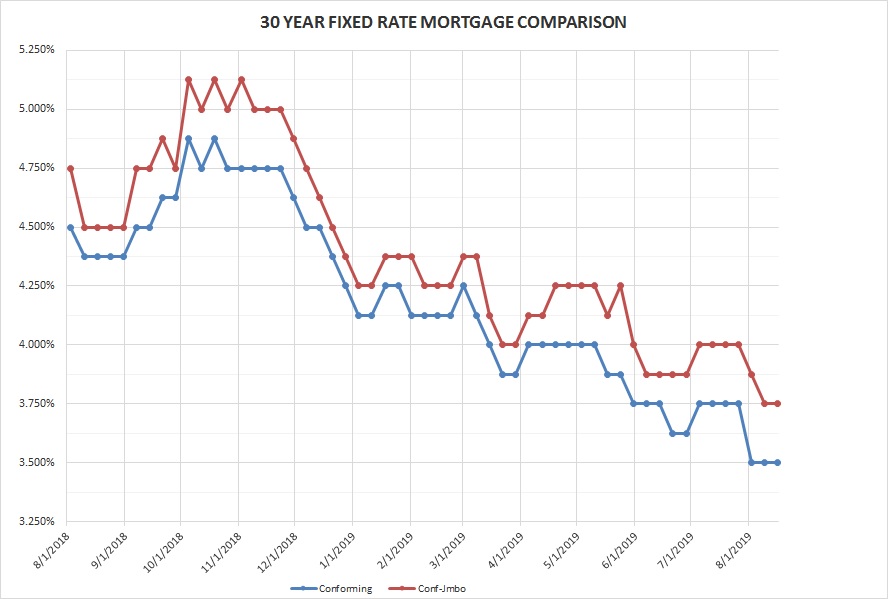
Rates for Friday August 9, 2019: After a price spike on Monday that pushed rates down a bit from last Friday rates bounced back to where we closed a week ago. It appears that we are at the bottom of the most recent range of rates, which means lower rates will be hard to come by—if at all—in the short term, or medium, or long.

FIXED RATE MORTGAGES AT COST OF 1.25 POINTS LOCKED FOR 45 DAYS:

30 year conforming                                            3.50%     Flat

30 year high-balance conforming                    3.75%    Flat      
Please note that these are base rates and adjustments may be added for condominiums, refinances, credit scores, loan to value, no impound account and period rate is locked. Rates are based on 20% down with 740 FICO score for purchase mortgages.

Well it was a lot easier writing the Weekly Rate & Market Update this week from a desk than it was from the passenger seat of a Hyundai Tuscon last week! Leslie and I had a great trip traveling to the Midwest and back and are glad to be home with both of our girls. At least for the next few weeks before the eldest heads back to her sophomore year in Boston.

I hope you summer is going well!

Have a great week,

Dennis

Past Weekly Rate & Market Updates can be found on my blog page at my website www.DennisCSmith.com/my-blog

11-7-18 Should I refinance and payoff my HELOC?

Question of the week:  Should I refinance and payoff my HELOC?


 Answer:  My most frequent response to questions of the week definitely applies to this question: It depends.


There are several factors to consider when deciding if now is the time for you to refinance and fix the rate on you Home Equity Line of Credit (HELOC).


Before we get into various factors to discuss, let’s take a quick look at why the question is being asked. Your HELOC has three components that determine your current payment, the balance, the prime rate and the amount added to the prime rate (called the margin) that results in the rate you are being charged.


Of the three factors the only one you somewhat control is the balance; you can impact your payment by paying down the balance on the HELOC. Obviously, the more you pay towards the balance the lower your payment will be on a monthly basis. Most HELOCs have two periods of repayment. The initial payment period usually has a minimum payment requirement that is the interest accrued on the loan since the last payment. The next stage of payments is usually a fully amortized period for the remaining life of the loan; if you may have a HELOC that is a twenty year loan, in this case typically the first ten years of the loan have an interest only payment, at the start of the eleventh year the loan will be fully amortized based on the remain ten years of the loan.


Example: You have a $150,000 balance on your HELOC that you obtained in December 2008 and the current rate is the prime rate, currently 5.25% plus one-half of one percent (0.500%) for a payment rate of 5.75%. Your minimum payment for November is the interest on the balance, $718.75 (balance times rate divided by twelve months). Next month you begin your eleventh year and the loan payment is now fully amortized using the rate that month plus the remaining term of 120 months. The rate for the December payment is the same as November, since the prime rate has not moved, at 5.75%, since you paid the interest only payment in November balance is still $150,000 but now instead of interest only the payment is amortized to include principal reduction and the payment will be $1646.54. Since the Federal Reserve is expected to increase its funds rate by 0.25% in December that means the prime rate will increase by 0.25% as well so the January payment will be calculated at 6.00%** and your payment will be $1655.00 for the month.  **Since the Fed will increase rates into the month the rate will only be for part of the month with the earlier part of the month being calculated at the 5.75% rate, but for demonstration purposes easier to show as one complete month.


The lower your balance when you enter the fully amortized payment portion of the repayment of your HELOC the lower your required payment will be.


If you have a HELOC for three years or more you have seen your rate increase by two percent since 2015 and one percent since last November. The chances are you will see at least another one percent increase in the next year, with a 0.25% in December when the Fed is expected to increase rates again.  (To see why the Fed increasing rates impacts your HELOC rate here is link to WR&MU from a few weeks ago addressing the issue.)


With rates having climbed one percent or more in the past twelve months the decision to refinance is a lot harder than it was one year ago, or even two to three months ago and moving forward the decision might not get easier.


The first consideration is if you are risk averse or not. The risk averse individual would be more inclined to want to refinance to avoid future increases in rates on their HELOC as well as for long term fixed rate mortgages that would be used to refinance. The person more comfortable with risk might be less inclined to refinance. Why?


The person who is willing to accept more risk may take the stance that their underlying primary mortgage has an interest rate that is lower than the rate available to refinance their primary loan plus their HELOC and will accept the higher rates on their HELOC in the future and if need be make interest only payments with the hope that rates decline in the future so refinancing makes more sense, or to enable easier paying down of the mortgage.


The risk averse person does not want the uncertainty of not knowing how high their rate and payment will go on their HELOC and is more willing to trade off what would probably be a higher payment in the short term for what may be a lower payment in the long run. The risk averse person knows if rates do drop in the future they can likely refinance and lower their payment.


What are the factors in terms of payment that need to be considered? First and foremost is the payment differential between doing nothing and refinancing. There are four primary factors that will determine the payment at which the interest rate for your refinance will be calculated: balances, credit score, loan-to-value and whether the transaction would be considered cashout or not.


The first three factors are pretty elementary; the combined balances of your existing primary mortgage and your HELOC will determine the refinance loan amount, your credit score is determined when we pull a credit report, the loan-to-value is determined by the estimated value of your home and the refinance loan balance.


The fourth factor, whether the refinance transaction is considered a cashout transaction or a rate and term transaction. For conventional mortgages unless the HELOC can be proven to be part of the purchase price of the property the transaction is considered to be a cashout transaction, if your HELOC was used to purchase your property the transaction is considered to be a rate and term refinance, and will have lower costs than the cashout. If the loan is a jumbo loan we have several programs that will consider the refinance a rate and term transaction is you can prove you have not accessed any funds from the HELOC in the past twelve months.


Once we know the four factors we go to our rate sheets and determine the rate, and also your what your new payment would be after refinancing. With this information you can determine if you want to refinance and payoff your HELOC into a fixed rate mortgage, or continue as you are with your current primary mortgage and HELOC.


Since the minimum payment for most HELOCs is interest only even if you were able to refinance near what your current mortgage rate is the chances are you will see some increase in total payment as you move from interest only to paying down principal on your HELOC. With rates higher and most homeowners with rates closer to 4.00% than today’s rates the chances are that your payment will likely increase a few hundred dollars per month, or more, when refinancing to pay off your HELOC. And this is the basis for the hard decision, is the extra monthly payment worth it to remove future risk based on rising interest rates, or is the cost too much for you to want to remove the risk?


This is a question I am very willing to help you answer by running the numbers and options for you and your particular situation. For several years we have been encouraging homeowners with HELOCs to refinance to fix their rate and payment on their mortgage debt, while I still feel it is a good idea for most homeowners, it may not be your choice, however I encourage you to run the numbers and know the options. If your HELOC is converting from an interest only payment to fully amortized in the next few years you may want to give refinancing even more consideration due to the sharp increase in your monthly payment when that occurs.


If you, or someone you know, has a Home Equity Line of Credit please contact me to go through your information so you have the information needed for making a decision on whether to refinance.


Have a question? Ask me!


Better economy, higher rates. That correlation is something long time readers of the WR&MU have learned over the years. This week we have positive economic news released every day, some data a lot more positive than others. Here are the data releases that have the greatest impact on rates.


Households made more and spent more in September. Income growth for the month was slower than August but still positive at 0.2% matching the core inflation rate for the month. Holding back income growth was a slow down for self-employed businesses. Savings rates dropped as consumer spending increased in September by 0.4%, the seventh month in a row with spending increasing by 0.4% or more. The disparity in spending and income growth may have been impacted by Hurricane Florence. The very good news for the economy inside the data is that there was a sharp increase in the purchase of new cars and recreational goods—the sort of spending that occurs when the economy is strong and consumers are optimistic. The news is not good for interest rates, though tempered a bit as the year over year inflation index of 2.0% is in line with the Federal Reserve’s target.


My oldest was one the last time the American consumer was has confident as s/he was in September, as the consumer confidence rose to its highest level since 2000. The cutoff date for the survey was mid-October, before the stock market slump so the expectation is that the index will drop in November. This news also puts upward pressure on interest rates.


Continuing the short term historic gains was the Employment Cost Index which showed wage gains in the private sector reached their highest level in ten years in the third quarter, with wages, salaries and benefits increasing 0.8% for the period. The gains reflect the lowest unemployment rate since 1969. A very big concern for economists is wage inflation, higher prices driven not by demand but by the cost of production of goods and services being driven higher by employment costs. The ECI report puts that concern very much in the center of the inflation and rate conversation. While this news is good for workers it is bad for those wanting lower interest rates.


Today’s data just piles on. The jobs report was released by the Labor Department today showing the labor situation in September. The news shows a very strong labor market, stronger than expected. Nonfarm payrolls increased by 250,000 in September, well above the forecast of 208,000 jobs. Included in the report was year over year growth in wages of 3.1%, the highest gain in one year since 2009 when the recession ended, the average hourly pay is now $27.30. This report fully supports future rate hikes from the Federal Reserve and continued upward pressure on mortgage and other long term rates.


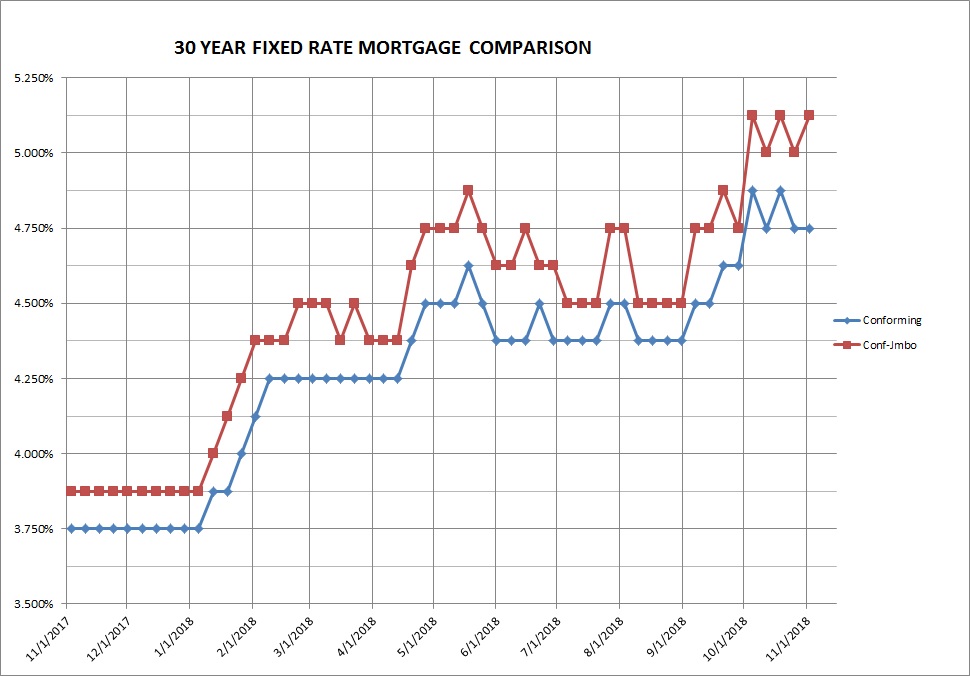
Rates for Friday November 2, 2018: Despite the quantity and quality of positive economic news conforming rates hold on from last Friday, high-balance loans ($453,101 to $679,650) increased from last week back to seven year high first reached in early October. The only reason I can see for rates to undergo a migration down would be a catastrophic event causing investors to flee to the safety of long term fixed rate returns available in U.S. Treasury bonds and mortgages.


FIXED RATE MORTGAGES AT COST OF 1.25 POINTS LOCKED FOR 45 DAYS:

30 year conforming                                                4.75%       Flat

30 year high-balance conforming                       5.125%     Up 0.125%


Please note that these are base rates and adjustments may be added for condominiums, refinances, credit scores, loan to value, no impound account and period rate is locked. Rates are based on 20% down with 740 FICO score for purchase mortgages.


As many of you know I love baseball. During the season most afternoons I have the Phillies radio broadcast, or some other game back east playing on my computer and on weekends I listen to games from Philly or around the country while driving around or doing chores. Last Friday night’s game between the Dodgers and Red Sox that went 18 innings was pure heaven for me and I was thrilled the way it ended, not necessarily because the Dodgers won but that it was won on a great home run and not an error. Every inning was thrilling and had fans on the edge of their seats. While mildly upset the Red Sox won another championship and the Dodgers drought is now thirty seasons, I admire the Sox for the way they played this season and through the playoffs; the best team hoisted the trophy to end the season.


Now we wait until the end of February when Spring Training starts!


Have a great week,

Dennis


Past Weekly Rate & Market Updates can be found on my blog page at my website www.DennisCSmith.com

9-21-18: Should we refinance and use proceeds to payoff debt?

Question of the week:  Should we refinance and use proceeds to payoff debt?


 Answer:  Not if you can payoff your debt without tapping into your equity.


With rates still low many families are looking at their accumulated consumer debt and wondering if they should refinance, or get a home equity loan, to payoff their debt and lower their monthly credit payments. Being able to get a rate for a cash-out refinance possibly somewhere around 5% for a 30 year fixed rate mortgage seems better than paying high, possibly as high as 20%, on credit cards. But is it a good idea?


On paper, the math seems really good, but a deeper look shows it probably is not for most families.


Take a scenario where you have a home worth $550,000 and you have a balance of $365,000 on your current mortgage with a rate of 3.75% and your payment is $1850 with about 25 years left on the loan. You do not intend to move anytime in the future as your kids are in, or just about in, middle school.


For various reasons, some emergency, some just consumer spending, you have accumulated about $35,000 in revolving debt (credit cards) with minimum payments totaling about $700 per month, have a few collections from past medical expenses for another $2000, a car payment of $560 with a balance of $20,000 and you need to replace your roof which will cost about $20,000. You have about $10,000 in savings and are making maximum contributions to your retirement accounts. You have been trying to pay down your credit cards but have not seem to be able to make a dent in the total balances and are at the stage where you make minimum payments and pay off most of what you charge each month.


Recapping, you have about $57,000 in debt costing you $1260 per month in minimum payments, this includes collection accounts with no payments being made, and you need about $20,000 for a roof. Should you either refinance and add $77,000 to your mortgage or get a home equity line for close to that amount, to payoff all your debt, fix the roof and start over with only a mortgage payment? To do so would require about $442,000 for a mortgage balance, or your current mortgage with a home equity line.


We would want to keep your new loan amount at or below 80% loan to value, which would be a new mortgage for $440,000, a bit short of what you require but you would be able to pay that off quickly with your new financial obligation shift.


Taking a look at a new mortgage of $440,000 for a cash-out refinance at 80% loan to value you would be looking at a rate of about 5% depending on credit score and other factors. This would make your new mortgage payment about $2350 per month, or $500 more per month than what you are spending now on your credit obligations plus replacing your roof. With the new loan and $500 per month higher payment you are getting rid of $1260 in monthly payments for a net savings of $760 per month.


Sounds pretty good, payoff debt, get a new roof and save $1260 per month. But is this something you should do?


Scenarios I run by clients before initiating the application for such a debt-relief refinance are as follows:


Reconsider including your vehicle loan in any debt consolidation scenario. Auto loans are generally lower rates than credit cards, and in the past several years with decent credit rates below mortgage rates. They are also fully amortized, meaning with every payment you are paying down the loan balance until it reaches zero. In the above scenario, you have about three years left on the loan and you are paid off. If you include it in a mortgage refinance you will be paying for the car as part of a thirty year mortgage. Taking the loan out the new mortgage balance would be $420,000, your payment on the mortgage would drop to about $2245. You would now have a mortgage payment that is just over $400 per month higher than your current mortgage, you are paying off debt with payments of about $700 month for net savings of $200 plus have funds to replace your roof.


Consider a home equity line of credit (HELOC) instead of refinancing your mortgage. The rate will be higher, and adjustable with it going up the next few years, however you will have the opportunity to save on monthly payments, or not depending on how you handle the repayment of the HELOC. If you go this route, you obtain a HELOC for $50,000 (following advice above and leaving vehicle loan out of the consolidation plan) at a rate of Prime plus one-half of one percent. Prime is at 5.00% today giving you a rate of 5.5% on the HELOC. The minimum payment for most equity lines is interest only, in this case that would be about $230 per month which looks like a big savings over what you are paying now—and that is the debt trap. If you pay interest only you are in worse position than you are now. Yes, your monthly cash flow is better but you are making no reduction in the balance. If you get a HELOC my very strong recommendation is you continue making the same total of payments you were making before, except instead of paying minimum payments on credit cards you are paying down your HELOC balance. Currently you are paying $700 on the cards, so pay $700 on the HELOC, this will decrease the balance $470 per month at the current rate. If the rate never changes and you make $700 per month payments you will have the HELOC paid off in about seven years. However, the rate will very likely be going up at least one percent in the next year, and perhaps more in the future. When calculating long term HELOC rates I usually use an average Prime rate of about 8% to be safe, at this average rate and a payment of $700 per month your time frame to payoff the loan for your credit card debt and roof repair is about eight years.


Equity lines often have balloons. One factor to consider with the equity line is the repayment terms. Many are “open” for ten years, meaning you can reuse them as the balance is paid down/off, and during this period they require only interest only. After ten years HELOCs are either fully amortized for the remaining term, or are due with a balloon payment. Because of the change in terms later in the loan it is important to have a payoff plan on the HELOC when you obtain it so you are not in a position in the future where you need to potentially refinance again in the future.


Create a realistic plan to payoff you consumer debt yourself and just borrow to pay for the new roof. Make a very realistic budget of your net income and expenses, including debt payments. See what adjustments you can make to your lifestyle and how much those adjustments will save you per month. Take the savings and dedicate them to paying off your credit cards. Many years ago, before Dave Ramsey became a multi-millionaire by counseling families on paying off debt I would help clients with debt payoff plans that pretty much matches Ramsey’s plan. I called my plan Stop, Drop and Roll. Stop using credit. Drop your credit card balances one at a time, starting with the lowest balance. Roll the payments into the next lowest card when one is paid off. It takes commitment to the payments and whatever austerity measures you put in place but if followed will enable you to payoff your consumer debt without refinancing your mortgage and adding tens of thousands of dollars and years to your existing mortgage.

I am in the debt business, a mortgage after all is a debt—the largest debt for almost every homeowner. If you are feeling overwhelmed with your debt please contact me and I can help you, at no obligation or cost, work through options for paying down/off your credit obligations.


Have a question? Ask me!


August home sales are a bit of a mixed bag. While the total number of sales are down in the state from last year prices continue to rise and days on the market are stretching out in most areas as inventory on the market has grown for the past five months. Looking at the data it looks like the market is trending towards equilibrium between buyers and sellers after we have experienced several years of a sellers’ market. Statewide total sales in August were down 1.8% from July and off 6.6% from August 2018. The statewide median price, $596,410, is up 0.8% for the month and 5.5% from last year. Sales and prices locally are in line with the statewide direction on prices and units sold. In LA County, the median price in August was $607,490, up 1.7% from July and 6.4% from last August, the total number of sales were up 5.5% for the month but down 8.9% from last year. Orange County’s median price in August of $838,500 was 1.1% jump from July and 6.3% increase from 2018 with total sales showing 2.9% drop month to month from July and a 9.7% fall from 2018.


Rates for Friday September 21, 2018: Rates are up from last Friday as investors put money into the equity markets (i.e. stocks) and hedge against next week’s Federal Reserve Open Market Committee meeting—these are the folks that set the Fed rates that impact consumer rates, such as the prime rate that determines equity line rates. The Fed will bump their funds rate by 0.25%, that is expected and priced into the markets. Hedging is occurring because of what the FOMC members say about the future of short term rates, how many future increases, how soon, how high? While they will not directly answer these questions those who can read the Fed tea leaves will discern much from the minutes of their meeting. The consensus appears to be that the Fed will raise rates faster and higher than previously thought. Lock your rate when you can!


FIXED RATE MORTGAGES AT COST OF 1.25 POINTS LOCKED FOR 45 DAYS:

30 year conforming                                            4.625%    Up 0.125%

30 year high-balance conforming                      4.875%     Up 0.125%


Please note that these are base rates and adjustments may be added for condominiums, refinances, credit scores, loan to value, no impound account and period rate is locked. Rates are based on 20% down with 740 FICO score for purchase mortgages.


Long time readers of the WR&MU know I can be a bit of a data geek…well more than a bit. So I found it interesting that the link to the Waffle House index last week had one of the highest click rates I can recall from readers. For those in Southern California the nearest Waffle House is in Goodyear, Arizona, 337 miles away from the Smith abode in Long Beach. There have been plenty of trips home in the family van from Scottsdale that have begun with breakfast at Waffle House, but have not been to the one in Goodyear as I recall. I do love me some waffles!


Looks like a perfect fall weekend, which commences tomorrow (fall and the weekend) in Southern California with great weather, playoff implication baseball plus college and pros going at it on the gridirons. Enjoy your weekend and the first days of fall!


Have a great week,


Dennis

6-1-18: Our loan is going to start adjusting in 2019, should we refinance and fix the rate now or wait?


Question of the week:  Our loan is going to start adjusting in 2019, should we refinance and fix the rate now or wait?


Answer: Many families purchased or refinanced their homes several years ago with intermediate adjustable rate mortgages, or intermediate ARMs. The type of ARMs have a period where the rate is fixed and at the end of that period enter a period where the rate adjusts, usually annually. If you have a 5/1 ARM the rate is fixed for five years and then adjusts annually for the remaining 25 years; if your loan is a 7/1 it is fixed for seven years and then adjusts for the remaining 23 years.


Why would anyone get an adjustable rate mortgage after all the issues with ARMs leading into the housing crisis and meltdown of the mortgage industry? Everyone has different motivations and objectives with their homes and therefore different mortgages are attractive and beneficial to different property owners. The primary reason for most who choose an ARM for their mortgage is they often have lower interest rates than a 30-year fixed rate mortgage. The lower rate for a period of time is attractive to those who need the lower rate to qualify, or have reasonable certainty that they will be out of the loan before it adjusts.


Not an insignificant number of borrowers who get intermediate ARMs are still in those mortgages when the fixed rate period is ending, either the plans to pay-off the balance did not come to fruition, or their plan was to stay in the property and deal with the issue of an adjustable mortgage later. And later is today or in the near future.


Back to our question, if you have an intermediate ARM on your property and are approaching the end of the fixed rate period should you retain the ARM or refinance to a fixed rate mortgage?


As with almost all questions regarding mortgages and finances there is not one answer that fits everyone. The answer to the question differs depending on individual circumstances and comfort levels of risk. Factors to consider when deciding if you should refinance from your current ARM mortgage or stick with it:


What is your loan balance?


What is the current fixed interest rate on the loan?


What is the index and margin on the mortgage that will take effect when it becomes adjustable?


Realistically, how long do you think you will remain in the property?


With the answers to these questions we can help you determine if it makes sense for you to refinance or retain your current mortgage.


With recent dip in rates we are seeing many homeowners able to refinance to lower rates than the rate it appears their intermediate ARM will be after the initial adjustment. If you have a loan that is going to adjust in the future call me to run through the numbers with you to see if it makes sense to refinance and fix your rate and avoid future rate increases.


Have a question? Ask me!


Mille grazie! That was the message from borrowers this week who were able to lock in rates that dipped this week thanks to another political fiasco in Italy. This past week the Italian President rejected the Prime Minister and Finance Minister submitted by a coalition of far-right and far-left parties that together represent a majority of seats in Parliament after elections in March. This veto by the President spooked markets and investors. As unlikely as it seems for a far-right and a far-left part to come together to form a ruling coalition, it seems less likely when the primary issue for both parties was throwing out the parties that have ruled Italy for decades, desire to leave the European Union and enact reforms to grow employment and the economy. Essentially, both the left and right appealed to the populist majority using the same issues.


How does this affect mortgage rates? A basic principle in investing is “flight to safety.” Italy has created a flight to safety environment with its political instability. With the President vetoing new leadership for Parliament and the nation he has also vetoed the will of the majority of voters in Italy. This has, not surprisingly, upset the populist politicians and leaves the country in limbo. Italy has had financial issues for more than a decade—long-time WR&MU readers will recall the series of posts over the years on Italy, Greece and Spain and the financial challenges they have put on the European Union and other nations as they faced defaulting on their loan payments. The turmoil has created a very uncertain economic environment, for Italy, the European Union (think Brexit) and possibly spilling over into other economies in Asia and North America. When there is uncertainty investors sell riskier investments, i.e. stocks, and purchase safe investments with fixed rates of return, which are bonds and mortgages. When there is uncertainty and risk the flight to safety causes the prices of fixed rate investments to rise and therefore rates to drop.


While foreign politics impacted rates this week, domestically there was some important data on the economy released this weekend. Midweek the second estimate of Gross Domestic Product growth for the first quarter was released and total growth was revised slightly downward to 2.2% growth from initial 2.3% estimate. Also, slightly downgraded were the price index, from 2.0% inflation to 1.9%, and consumer spending for the quarter from 1.1% to 1.0% increase for the quarter. Overall the news was expected and had no impact on mortgage rates.


Coming it at expectations, personal income and spending data for April released on Thursday showed not a lot of strength or weakness in either category. Income was up 0.3% for the month and consumer spending rose 0.6%, mostly due to rising gas prices. With spending outpacing in come for the second month in a row the signs are there for second quarter GDP growth to be stronger than the first quarter. The data alone is mortgage rate neutral, the long-term look regarding prices and economic growth is somewhat rate unfriendly.


Historic data this morning from the Labor Department as the headline unemployment number for May came in at 3.8%, tying the lowest unemployment rate for the past 46 years (2000). The economy added 223,000 jobs in the month, with 218,000 being in the private sector. The gains in jobs lowered the participation rate to 62.7%, matching a low hit several times since 2015. With increased employment and hours worked stagnant it is not surprising that average hourly earnings increased a respectable 0.3% for the month and 2.7% from May 2017—outpacing inflation annualized at 1.9%. The news is mortgage rate unfriendly.


Rates for Friday June 1, 2018:  Thanks to the Italian, and possible European, political and economic turmoil this week rates dropped for the second Friday in a row—the last time we had back to back rate drops reflected in the Weekly Rate & Market Update was March 31s to April 14th 2017. The dip is a surprise to many, including myself. My suggestion is to take advantage of the dip.


FIXED RATE MORTGAGES AT COST OF 1.25 POINTS LOCKED FOR 45 DAYS:

30 year conforming                                            4.375%     Down 0.125%

30 year high-balance conforming                      4.625%      Down 0.125%


Please note that these are base rates and adjustments may be added for condominiums, refinances, credit scores, loan to value, no impound account and period rate is locked. Rates are based on 20% down with 740 FICO score for purchase mortgages.


According to the meteorologists in the house, and what teenagers with iPhones are not constantly in touch with local weather, it appears as if our spring weather is slowly leaving and much warmer summer weather is approaching. They are excited, I have told them don’t get in too much of a hurry for the hot weather, once it comes we will have it until October.


Me, I’m very content with high 60’s, low 70’s, slight breezes and some clouds.


Have a great week,


Dennis

4-20-18: Why do you want me to put 21.2% down?


Question of the week:  Why do you want me to put 21.2% down?


Answer: This question came from a new client last week who had been speaking with a representative of a major national lender about loan options for purchasing a new home and called me on the advice of her tax preparer.


She is a first-time buyer who was getting ready to write an offer on a condominium unit and began the call the way many do, “I was given your name by my tax person when I told her I was buying a condo. I’m writing an offer tonight, have spoken to my bank already and will be putting 20% down.”


After getting the necessary information for income, credit, funds for closing I asked about the property she wanted to purchase, price, if she was sure it was a condominium (a great question for next week) and the homeowners’ association fees.


After getting all the information I said, “Everything looks great, you definitely qualify, however instead of putting 20% down I think you should put a bit more down, $6,900 more to be precise, which is 21.2% down.”


This prompted our question of the week.


Because we look at the big picture and have over 30 years’ experience that allows us to quickly sort through options my suggestion was an automatic response.


The offer my client was going to make was for $575,000. If she put 20% down, $115,000, her loan amount would be $460,000. Following my advice putting down 21.2%, which would be $121,900, her loan amount will be $453,100.


Why is that important? Look at the rates for today below. The conforming rate today is 4.375%, the high-balance rate is 4.625%, one-quarter of one percent higher (0.25%). Usually, the difference between the two is one-eighth of one percent (0.125%), however the high-balance rate is always higher by 0.125% or higher.


What is the difference between a conforming loan and a high-balance loan? One dollar.


The maximum conforming loan amount is $453,100. This amount happens to be 78.8% of the $575,000 offer my client wanted to write. The payment on today’s conforming rate for $453,100 is $2262.26 per month. If the client put down 20% the loan amount would be $460,000, which would have a payment of $2365.04 per month. By putting down the extra $6900 she is saving $102.78 per month ($1233 per year).


Having inherited money from her recently deceased father she has the funds to put down the extra 1.2% without any financial harm, and with her income situation the extra $102.78 per month makes her a little more comfortable with the monthly housing payment.


To be fair most lenders would bring up this option to a client in a situation like this, however we find time and again options with small changes to the what the client may pay in closing or monthly payment or manipulating credit or other factors that can provide another option that may be more beneficial in the long run.


Several decades experience enables us to look at a transaction and present several different options to consider so our clients can determine which they feel is the best for them and their family. Experience matters!


(The client’s offer on the condo was not accepted, but she is probably writing another offer this weekend, keep your fingers crossed for her!)


Have a question? Ask me!


The most significant economic news this week was the retail sales report for March, which was very strong. American consumers spent 0.6% more in March than February with auto sales leading the charge. The news was a bit of surprise and put a bit of upward pressure on rates.


Rates for Friday April 20, 2018:  With a lack of economic news this week the increase in mortgage rates was a bit unexpected. Some of the increase can be attributed to investors pricing in a rate hike from the Fed in June, and some speculation of perhaps two more increases in the second half of the year instead of the anticipated one. With a lot of government debt hitting the markets this week, and two major foreign buyers of our debt (China and Japan) not real thrilled with the Trump tariffs, plus the Fed putting bonds and mortgages from its portfolio into the market rising rates should not be a surprise. With a lot of supply coming to market prices are going to drop, when prices drop interest rates go up. The conforming rate increases for the first time in eleven weeks and we see the high-balance rate hit its highest level since January 2014.


FIXED RATE MORTGAGES AT COST OF 1.25 POINTS LOCKED FOR 45 DAYS:

30 year conforming                                            4.125%       Up 0.125%

30 year high-balance conforming                      4.625%      Up 0.25%


Please note that these are base rates and adjustments may be added for condominiums, refinances, credit scores, loan to value, no impound account and period rate is locked. Rates are based on 20% down with 740 FICO score for purchase mortgages.


I love the cool Spring weather we have been having and hope it lasts for a few more weeks. My weather sweet spot is low to mid-70’s with breezes, exactly what we have been having!


Have a great week,


Dennis

4-13-18: What is the IRS Form I have to sign with my mortgage application?


Question of the week:  Why do some of the creditors on my credit report say, “Affected by Natural or Declared Disaster” when I live nowhere near a natural disaster that has occurred?


Answer: Because creditors were not all A+ students in geography class.


Last year saw many natural disasters across the country, from hurricanes in Texas and Florida to wildfires up and down the state of California. Many people were severely impacted by the disasters, some of the more fortunate only lost some days at work and had the financial burden of cleaning up after the disaster, however many lost their homes, cars, places of work and neighborhoods. While trying to recover from the disasters, dealing with the emotion of such tremendous loss they also had the reality of bills still due, negotiating with insurance companies to cover losses and added costs of where to stay and how to get there.


Understanding that financial disasters create tremendous financial burden on those in the impacted areas more and more credit companies are automatically putting into their reports to the three major credit bureaus that the debtor resides in a natural disaster area. The purpose of this statement is to let those reviewing the credit report for the possibility of extending credit will understand if there are any late payments on the account that the natural disaster could be responsible for the late payments. Essentially letting future creditors know there is likely a very good reason for the late payments that should be taken into account when extending credit.


So why are these notices popping up on credit reports for people who have not been affected by a natural disaster? Because the notices are put on credit reports using computer models and the computer models, from what we have seen, are using counties or regions when determining which accounts to label.


For instance, a couple in Long Beach, which has not been impacted by any natural disaster in decades, has a couple of accounts labelled with the natural disaster language. While Long Beach has not had a natural disaster declared, within the last twelve months there have been severe fires in both Los Angeles and Orange Counties; Long Beach is in LA County and borders Orange. It appears the creditor plugged in LA County as having a natural disaster and tagged all its accounts in the county, not realizing the size of the county and how geographically distant Long Beach is from any of the fires that occurred.


In Texas and Florida people are facing similar reporting, while they were not severely impacted by any of the storms they live near enough, or are in counties, declared natural disaster areas that they have had accounts tagged with the natural disaster warning.


Does this impact your credit? No, it does not. Does it impact your mortgage underwriting? As this reporting is relatively new on credit reports we have had some underwriters request appraisers note on the report if the property was impacted by a natural disaster.


At this point we have not seen any impact on credit scores, positively or negatively. Meaning if you have an account that has a 30-day late payment on the credit report and that same account is labelled “Affected by Natural or Declared Disaster,” we have not seen your credit score not impacted by the late payment—meaning your score is still depressed due to the late payment.


If this label is on some of  your accounts do not be concerned that it is in any way impacting your credit or ability to obtain a mortgage or other applied for credit such as an auto loan. It is merely a head’s up to other creditors that if you do have any late payments in the recent past there may be a very good reason why—if you in fact did live in a natural disaster area and were negatively impacted.


If you have any questions about your credit report please do not hesitate to contact me.


Have a question? Ask me!


A few reports this week that can impact rates. On Wednesday, the final revision to Gross Domestic Product for the 4th quarter of 2017 was released, and the revision was up 0.4% from the prior revisions. Strength in the increase was mainly attributed to consumer spending, which increased 4.0% from the 3rd quarter. The news was somewhat mortgage rate unfriendly as stronger economic data portends higher interest rates in the future.


While consumer spending led the way in 2017, so far in 2018 that has not been the case, causing expectations for GDP growth in the first quarter to be lower than it was in 2017. On Thursday data was released on Personal Income and Consumer Spending. The good news is that wages continue to increase, up 0.4% in February, matching January’s increase. And like January, consumer spending in February was up a lackluster 0.2%. Workers are earning more but spending less, so it is no surprise that the personal savings rate has increased to 3.4%. With the flat growth in consumer spending prices were up 1.8% from February 2017, still below the Fed’s 2% inflation rate target. The increase in earnings is negative for mortgage rates as it creates expectations for wage inflation, however workers putting more of their earnings into savings instead of spending is positive for mortgage rates. Since consumer spending is approximately 65-70% of GDP, a slow-down in spending could slow down GDP growth, keeping upward pressure on rates at bay.


Rates for Friday March 30, 2018:  A short week for markets as stock and commodity exchanges are closed today for Good Friday. Conforming rates continue to hold steady from Friday to Friday, seven weeks in a row now with the same rate. Lenders continue to bounce up and down on the high-balance conforming rates (loans from $463,451 to $679,650) and we are down 0.125% from last Friday. Markets continue to be volatile, and there is more turbulence ahead as indicated by the stock markets down in the first quarter of 2018 after nine consecutive positive quarters. My advice remains to lock through your escrow closing when you can.


FIXED RATE MORTGAGES AT COST OF 1.25 POINTS LOCKED FOR 45 DAYS:

30 year conforming                                            4.25%       Flat

30 year high-balance conforming                      4.375%      Down 0.125%


Please note that these are base rates and adjustments may be added for condominiums, refinances, credit scores, loan to value, no impound account and period rate is locked. Rates are based on 20% down with 740 FICO score for purchase mortgages.


For parents on young ones I will give you this Easter tip learned from my mom, count the number of eggs you hide so you make sure they are all found. My mom learned this lesson when her young sons found an egg or two in the middle of August, in Tulsa, that had been rotting in the sun and heat since March. There was a special kind of scent and cleaning her boys after they found the putrid little bombs and did what boys do (throw at each other) taught to always make sure all the eggs were found on Easter…


Spring Break begins for our kids and many others, after this next week the next stop is summer. Seems like forever for the kids and tomorrow for the parents.


Have a great week,


Dennis

3-23-18: What should I look for in a Home Equity Line?


Question of the week: What should I look for in a Home Equity Line?


Answer: With equity building, rates rising and prices continuing to climb we are getting more and more inquiries from clients looking for Home Equity Lines of Credit (HELOC) to remodel homes or for other purposes.


Before getting a HELOC some questions I have clients answer to be sure that is the correct route for them to go to meet their needs:


  • Can you accomplish what you want with a cash out refinance? The rate on a refinance may be lower than a HELOC, and depending on your current rate and payment may be better in the long run. Yes your rate may go up but it will be fixed and over time you may be paying less for the funds you need.


  • If you are looking to remodel and/or add on to your home is what you want in your home available on the market? Instead of converting your two bedroom one bath to a three bedroom two bath home, can you buy the home you want in today’s market? What is the cost of the new home? How do the payments compare to your final costs after the remodel? Do you want to live with a contractor handing you coffee and a newspaper every morning for several months?


  • Do you know how a HELOC works?


If you go through your due diligence and a HELOC is what you need, what should you look for when comparing different options on the market?


Before we discuss what to look for a quick primer on how a HELOC works. This is not a fixed rate loan, it is adjustable and it can adjust at any time. As a rule the base rate for your HELOC is the Prime Rate (what a bank charges its clients with the lowest risk is the standard definition). Prime is not tied to anything, in the past different banks have had different Prime Rates and they were all published in financial media, today most banks have the same Prime Rate. When does the Prime Rate move? Whenever a bank feels it needs a better return on its loans, typically when one major bank changes its rates all other follow.


For the past few decades banks have moved their Prime Rate in conjunction with the Federal Reserve’s Federal Funds Rate, the rate banks charge to borrow from each other through the Federal Reserve. This week when the Fed increased the funds rate by one-quarter of one percent (0.25%) banks immediately increased their Prime Rates, as a result the Prime Rate went from 4.5% to 4.75%. As the Prime Rate increases and decreases so does the rate on your HELOC.


HELOCs then operate like a credit card, you have a credit limit and can borrow within that limit and pay back as much as you like at any time, and you have a minimum payment due every month based on your balance. If you have a HELOC with a $100,000 limit and borrow $25,000 then you owe at minimum the interest on the $25,000 every month (some banks have a 1% repayment rule, or interest only whichever is greater). As long as your HELOC line is open to drawing against it you can run the balance up and down as often as you like within the credit limit.


If you get a HELOC is your rate the Prime Rate? Maybe, but most likely not. This leads to one of the important factors about a HELOC you need to know when comparing options:


  • What is the margin? We discussed that your rate is tied to the Prime Rate, but that is not necessarily your rate. Your rate will be the Prime Rate plus a margin. The margin is a fixed amount throughout the loan. Perhaps the bank is running a special and you can get Prime with no margin, but generally there will be a margin anywhere from a quarter percent (0.25%) to one and a half percent (1.5%) or higher depending on many factors. What is important to you is what is the margin. If Prime is at 4.75% and you have a 1% margin to start your rate is 5.75% on whatever balance you have outstanding—until the next time the Prime Rate moves at which point your rate will adjust. Whatever your margin is added to Prime is your rate, the margin will remain fixed but your rate adjusts with Prime.


  • What determines the margin?
    • First and foremost your margin will be determined by your credit score. The higher your score the lower the margin, which makes sense. If you have a lower credit score you are considered a higher risk than someone with a higher score, so your margin maybe 1.5% while someone with a much higher score may have a margin of 1%.
    • Second, what is the amount of money you are looking for? It seems counter-intuitive but generally the more you want as your maximum limit the lower your margin may be. If you get a line for $50,000 the margin maybe as high as 2%, but if you get $250,000 it may be 1%.
    • Third, what is the total loan to value? If your home is appraised at $600,000 and you owe $300,000 then the loan to value (LTV) is 50%. If you want an equity line for $100,000 the total LTV will be 67% (300,000 + 100,000 = 400,000 divided by value of 600,000 is 66.66666% or 67%). If you want an equity line of $180,000 then the LTV is 80%. Generally, the higher the LTV the higher the margin.


  • What are the terms of the HELOC draw and repayment period? Is your line open and available for use for ten years, fifteen, twenty? If the line is shut down for use before the balance is due what are the repayment terms for the final years of the loan? Can you continue to make interest only payments? Does the loan become fully amortized for the remaining term of the loan? Is there a potential balloon payment? These are very important terms to know as they will dictate what your financial obligations will be in the future. If the loan begins to fully amortize for five years after you use it for ten will you be able to make those payments (for instance you have $80,000 balance and your rate is 6% when the HELOC shuts down and is fully amortized your payment at that rate would be about $1550 per month)? What if it has a balloon and you did not do a good job of making principal payments, where will you come up with $80,000, $125,000 or even $25,000, when the time comes.


Before getting into a HELOC look at what will happen in the future, know how your rate will be determined by knowing the margin, know how you will have to repay the debt in the near term but equally important later in the loan when the repayment terms may change.


HELOCs can be very beneficial financial instruments, but like all financial tools they work best when used properly.


If you have any questions about HELOCs or want some help deciphering different options being presented to you please do not hesitate to contact me for assistance.


As well, if you currently have a HELOC and are concerned about your rising interest rate and possible repayment challenges in the future (i.e. fully amortized payment and/or balloon payment) please call me to discuss options for refinancing and if that is an option that makes sense for you and your family.


Have a question? Ask me!


Rate moving news this week did not come from our usual sources of economic reports from various government or private agencies. The first announcement was the Federal Reserve Open Market Committee (FOMC) that it was raising the fed funds rate by one-quarter of one percent (o.25%), which as discussed above resulted in an increase in the Prime Rate to 4.75%. The rate increase alone had no impact on mortgage rates as the markets had fully anticipated the move and it was already priced into our rates a long time ago. What can move mortgage rates are comments from the meeting and Fed Chair Jerome Powell that may indicate the Fed will engage in three more rate increases this year instead of the previously announced two more increases. There were no comments or statements that indicated a change in the rate increase schedule for 2018 and markets reacted somewhat favorably.


Yesterday the Trump Administration announced tariffs of about $50 billion worth of certain Chinese imports. The immediate announcement caused stock markets to drop about 2% and the sell-off proceeds were put into bonds and mortgages, leading to a dip in rates. Later as considerations were given to possible retaliation from China one target stands out—U.S. debt. China is the largest holder of United States Treasury bills and bonds, with almost $1.2 trillion. Should China start a significant sell off of their holdings it will cause rates to climb, how much would depend on how much debt China wants to bring to market. The potential retaliation from China caused rates to reverse yesterday into correction mode after their initial dip.


Rates for Friday March 23, 2018: Some movement in the price of conforming rates this week, but we end the week steady from last Friday. On the higher side we saw the high-balance conforming rate (loans from $453,101 to $679,650) gave back their brief dip from last week. Rates are volatile for many reasons and I expect rates to have more pressure to move up than down, I retain my mantra of locking as soon as you can through your escrow period.


FIXED RATE MORTGAGES AT COST OF 1.25 POINTS LOCKED FOR 45 DAYS:

30 year conforming                                            4.25%       Flat

30 year high-balance conforming                      4.5%         Up 0.125%


Please note that these are base rates and adjustments may be added for condominiums, refinances, credit scores, loan to value, no impound account and period rate is locked. Rates are based on 20% down with 740 FICO score for purchase mortgages.


Regular readers of the WR&MU know this last section is usually something personal going on in my life. It is a bit longer than the usual short paragraph or two, but I hope you indulge me and give it a read.


Many of you know I am a member of the Rotary Club of Long Beach. I am proud of my membership, not only in our local club that contributes tens of thousands of dollars to assist local non-profits every years, has purchased hundreds of thousands of dollar in books for local schools and every year provides hundreds of thousands of dollars in scholarships to students at Long Beach City College and Cal State Long Beach; but also proud to be part of Rotary International.

Rotary International could be looked at as the primary organization responsible for the nearly complete eradication of polio around the world. Taken on as a primary mission in the 1950’s, Rotary clubs around the world raised funds and volunteers to vaccinate children from Boise to Bangkok, Tulsa to Tunisia. Today there are only a few new cases of polio every year and Rotarians continue to administer the vaccine around the globe to the disadvantaged.


Lack of easily accessible clean water is incredibly debilitating to a community. Disease denies children to opportunity to go to school or adults to work, lack of sanitation and ability to properly clean increases the spread of disease. Some villagers, almost always women and their daughters, spend hours each day walking to and from the nearest source of water—not clean but water. Agriculture is poor, if existent, due to lack of water available for irrigation. In sum, it is practically impossible to turn around a community that is under-educated, in poor health and lacking economic activity if it has no clean water source.


With the overwhelming success in fighting polio the organization began to look at how it could impact the world again. Water. Clean water for everyone has become a universal cause for Rotarians. Millions of people around the world do not have access to clean water to drink, cook or clean with. Our club is very active in this effort and this past year some of our members were key players in raising funds and partnering with Water Underground to drill wells for four villages in Mozambique.


Below is link to  a video of one village on the day its well was tapped and fresh water came shooting from the ground. This was one of the wells our club was primarily responsible for funding. Watch these villagers and consider how so very fortunate we are to have some we consider so simple, getting water to drink, cook or clean with, from a tap.


After this video was shown at our club meeting Wednesday those present quickly made donations to pay for one more well in Mozambique. Sometime next year another village of a few thousand people will dance in the water shooting from the ground.


Here is the video (click on the “Watch our 2017 film” box embedded in the bottom of the video on the home page). Take a few minutes to watch it, you will be glad you did.


Have a great week,


Dennis

1-5-18: With the new tax laws should I keep my Home Equity Line of Credit


Question of the week: With the new tax laws should I keep my Home Equity Line of Credit?


Answer:  With the calendar turning to 2018 we are now under the new tax codes signed into law by President Trump in December. There is still plenty of confusion about how the IRS will treat many of the changes, among them is the interest paid by home owners if they have a Home Equity Line of Credit (HELOC) and if it is deductible on the federal tax return. Reading through many articles and communicating with tax professionals, lenders that specialize in HELOCs and other research I am not entirely clear on how HELOC interest will be treated moving forward—and until the IRS issues a clear ruling I don’t think anyone else is either.


Some people may use the deduction, or lack thereof, to determine how they wish to move forward with their current HELOC, or to obtain one for purposes of home improvement, debt consolidation, college costs, etc. Here are some items to consider if you have, or are considering, a HELOC.


DISCLAIMER: I am not a tax professional, if you have a HELOC please consult with your tax preparer regarding the impact it has on your taxes.


There is a lot of information out that none of the interest on your HELOC will be deductible, regardless of when you obtained it or how the funds were spent (home improvement, debt consolidation, medical expenses, college, etc). Under this line of reasoning, if you have a $100,000 HELOC you obtained when you purchased the home in 2011, the interest is no longer deductible.


However, there are some “experts” that are stating that if your HELOC was used for the acquisition of your primary, or second/vacation home, then the interest paid on the HELOC is still deductible. These are contrary opinions, and if you have a HELOC that you have only used to purchase your home it obviously has an impact on your tax preparation in the future. If acquisition HELOCs will remain deductible then you are fine and continue as you have in the past, if they are not then you will want to meet with your tax and mortgage professionals to determine your best course of action moving forward.


If you obtained a HELOC to put in a pool, remodel your home or do other home improvements, in the past you probably had an interest deduction. Under the new law, based on almost everything I have read and heard, you will no longer be able to deduct that interest from your federal taxes.


If you have a HELOC that you used for medical expenses, college tuition and/or debt consolidation you will also not be able to deduct the interest moving forward.


Back to our question of the week, if you have a HELOC should you keep it? Especially if the interest you pay is no longer deductible?


As with most questions involving mortgages and personal finances, there is no standard answer for everyone. The factors you need to consider are:


How much is the tax deduction you are losing? If you have a balance of $50,000 and are paying $2500 per year in interest, is losing that deduction costing you a lot of money?


What are your options to pay off the HELOC? Do you have cash or assets you can liquidate to pay off the balance? If you do what is your trade off? What has been your return on investment for those assets and what is the rate on your HELOC? Are you making more in interest and/or dividend payments than you are paying for the HELOC?


Or perhaps you pay off the HELOC with a refinance of your primary mortgage and consolidate the two loans. Once again, we do the math, what is your current rate on your primary mortgage, what are your payments, what is the value of your home and the total balances we would be consolidating? And finally, and very importantly, what will be your new rate of interest and monthly payment?


One big factor to consider if you have a HELOC and are considering paying off or refinancing to consolidate the payment is your future interest rates. Almost every HELOC has its interest rate tied to the prime rate. The prime rate tends to move up and down when the Federal Reserve moves its lending rate up and down. In the past year the Fed has hiked its rates three times, each time 0.25% (one-quarter of one percent), resulting in the prime rate also going up 0.25%  three times for a total of 0.75% (three-quarters of one percent) in the past year. If you had a $100,000 HELOC in December 2016 and retained the same balance through the year your interest payment at the end of 2017 was $62.50 per month ($750 per year) more. The Fed has announced it intends to increase rates three more times in 2018, which will increase the rate on your HELOC another 0.75%.


With increases in the prime rate known to be coming in 2018, does it make sense to fix the rate on your HELOC balance and consolidate it with your primary loan?


When making a decision regarding your HELOC keep in mind the tax laws started on Monday, and the longer you wait to make that decision the more impact it could have on your tax returns for 2018 that you will file in 2019.


When you meet with your tax professional to prepare your 2017 taxes if you have a HELOC ask for advice about your interest deduction options for 2018. And before you meet with your tax professional do not hesitate to give me a call to discuss your options if refinancing and consolidating your HELOC is an option for you.


Should you keep your HELOC? Maybe, maybe not, but do your research and explore your options, contact me to discuss some of those options.


Have a question? Ask me!


The final employment report for 2017 was released this week showing the economy added 148,000 jobs in December and the unemployment rate was steady at 4.1%. The total hires in December were down from November and below expectations of those economists polled. A positive news in the report was a 0.3% increase hourly earnings from December, up 2.5% from December 2016. With inflation running below 2%, average wages increasing more than 2% is positive for workers. Within the report there was strength in construction and manufacturing hires and there are signs that scarcity of skilled labor in these sectors could be hindering growth. Overall the news is mortgage rate neutral.


Rates for Friday January 5, 2018: Ending our first week of the new year rates continue the steady pattern of the last few months with no change from last Friday’s rates. Conforming rates start 2018 one-quarter of one percent below (0.25%) what they were the first Friday on 2017.


FIXED RATE MORTGAGES AT COST OF 1.25 POINTS LOCKED FOR 45 DAYS:

30 year conforming                                            3.75%           Flat

30 year high-balance conforming                   3.875%        Flat


Please note that these are base rates and adjustments may be added for condominiums, refinances, credit scores, loan to value, no impound account and period rate is locked. Rates are based on 20% down with 740 FICO score for purchase mortgages.


Today’s WR&MU is being composed from Palm Desert where the Smith family has been compounded for the week. I will admit to feeling no guilt as we have enjoyed very enjoyable weather, getting in a few rounds of golf and spells by the pool, as other parts of the country are digging out of their front doors and wondering which mound of snow in the street is their car. California is not flawless, with perhaps the exception of weather throughout the year and especially weeks like this.


I hope everyone had a wonderful New Year’s celebration and wish you all a very healthy and prosperous 2018!


Dennis


10-27-17: Should I use a “piggy-back” to buy my new home?


Question of the week:  Should I use a “piggy-back” to buy my new home?


Answer:  We start our answer to the question with a question many of you may be asking, “what is a ‘piggy-back’?”


Last week we discussed mortgage insurance and how conventional mortgages require mortgage insurance for loans that are over 80% loan-to-value. If you are buying a home for $600,000 (the median price for a home in LA County) and getting a mortgage for more than $480,000 then you need mortgage insurance.


Using a piggy-back enables you to put less than 20% down and avoid mortgage insurance, because the piggy-back is a second loan that bridges the amount between your down payment and your mortgage of 80% of the purchase price.


For example, you want to purchase a home for $600,000 but you only have $60,000 down. Traditionally you would get a mortgage for $540,000 and pay mortgage insurance. Using a piggy-back you would put down $60,000 and get a 2nd loan for $60,000 and have your primary loan be $480,000, which is 80% of the purchase price and therefore you do not need mortgage insurance.


Not all, but almost all, piggy-back mortgages are Home Equity Lines of Credit (HELOC). What is a HELOC? It is very similar to a credit card, you have a maximum credit limit and you only make payments on the balance you have outstanding. The interest rate on a HELOC is an adjustable tied to the prime rate goes up and down so will the rate on your HELOC.


Another feature of many HELOCs is that the minimum payment is interest only, which makes them very enticing as the interest payment can be very low, however you are not paying down any of the outstanding principal which becomes an issue in later years when you have a very large balance that has to be paid off.


Since the HELOC is used to purchase the home the interest paid on the loan is tax deductible under the current tax code. This is a positive for many families, especially those who are unable to deduct mortgage insurance premiums.


As you can see there are some positive aspects to using a HELOC to purchase your new home, but back to our question of the week: should you use a HELOC to buy your home?


Let’s compare getting a HELOC with using mortgage insurance to purchase the median priced home in LA County of $600,000 with 10% down and you have a credit score of 740.


Let’s start with purchasing with a HELOC. You will have a primary mortgage of $480,000 (80% of purchase price) and a HELOC of $60,000.  The rate on the primary mortgage this morning is 4.00%, the average rate on a HELOC up to 90% total loan to value (combined 80% primary plus 10% HELOC) is Prime Rate plus 2%, today prime is 4.25% so the rate would be 6.25%.


Payment on the primary mortgage is $2292 per month.

The minimum payment on the HELOC is interest only which would be $313 per month*.


The minimum payment you must make is $2605 per month, until the prime rate increases and then your payment will increase as well.


Last year the prime rate was 3.5%, your rate would have been 5.5% for a minimum payment of $275 per month, if the rate increases another three-quarters of a percent in the next year your rate will increase to 8.00% for a payment of $400 per month.


*Most HELOCs are for twenty years, if you want to amortize the payment and include principal the payment at 6.25% would be $439 until the rate changes.


If you purchase using mortgage insurance your primary mortgage will be $540,000 at a rate of 3.875%** and your mortgage insurance premium will be 0.41% of the loan amount.


Primary mortgage payment is $2539 per month.

Your mortgage insurance premium is $185 per month.


Your total payment is $2724 per month as long as you have mortgage insurance, $119 more per month than if you used a HELOC to purchase the home and paid the minimum payment. If you pay additional payments on the HELOC to pay down the principal then you payment purchasing with a HELOC would be higher. As well when the prime rate increases in the future your “savings” with the HELOC will decline.


** It seems counter-intuitive that putting 20% down has a higher rate than putting 10%, however rates are lower for mortgages with mortgage insurance than those without as the lenders are insured for losses should you default. If you default on a mortgage that is 80% of the value of the property the lender will lose 10-20% of the loan amount. If you have mortgage insurance on a 90% loan the lender is covered on losses up to 25% of the value of the mortgage. Even though the risk of loss may be higher with 10% down, the amount of loss to the lender should you go to foreclosure is less than if you had mortgage insurance.


Note the statement above, “as long as you have mortgage insurance…” Those who read last week’s WR&MU will recall that after you make 24 consecutive payments on time and can show you have 20% equity in the property then you can have your mortgage insurance premium released. So between your mortgage principal declining through your payments and the market increasing you let’s assume you will have that 20% in four years (had you purchased the median priced home in LA County in 2015 you would be able to remove your MI this year) after purchasing your property. At that time you go through the process and have your MI payment removed, saving $185 per month, or $2220 per year.


The only way to remove your HELOC payment is to pay it off, and unless you have the ability to make very large payments over the years it will likely take you quite some time to pay off the loan.


Depending on your financial situation, and ability to pay down/off the HELOC rather quickly through sale of another property, large bonuses, etc, for most families the long term best option is to purchase their home using mortgage insurance that will have fixed payments, and the ability to remove the MI premium payments in the future, as opposed to a large equity line tied to a rate, the prime rate, that will be going up over the next few years.


Please call me to discuss your situation and determine the best way for you to purchase your new home. And if you have a HELOC, or mortgage insurance, from a  previous transaction call me to see what your options are to possibly lower your monthly payments, or keep them the same and fix your total monthly payment.


Have a question? Ask me!


Remember, with Dennis it’s not just a mortgage, it’s your complete financial picture.


Economic data released this week for September shows strength building. Durable goods orders in September showed a nice gain, even trying to account for Hurricane Harvey. Showing even more strength was the initial Gross Domestic Product numbers for the 3rd Quarter, increasing 3.0%, a strong following from the 2nd Quarter’s 3.1% growth. Inside the numbers we saw strong growth in consumer spending and durable goods purchases-led by vehicle replacement post hurricane. The soft spot was residential real estate, which has been supporting economic growth for the past several years. Inflation was at 2.2% annualized with is within the Fed’s target range. Overall the report is fairly rate unfriendly and puts upward pressure on rates for the long term.


Rates for Friday October 27, 2017: We see the conforming and high-balance conforming rates un-linked this week. For the first time in almost a year the separation between the two rates is greater than one-eighth of one percent (0.125%) as the high-balance rate increased an eighth of a percent this week and the conforming rate remains flat. The last time we saw the one-quarter percent gap between the two mortgages was the week ending November 11, 2016 when we saw rates increase three-quarters of a percent in six weeks following the election. There is upward pressure on rates, the advice is to lock when you can.


FIXED RATE MORTGAGES AT COST OF 1.25 POINTS LOCKED FOR 45 DAYS:

30 year conforming                                            3.75%           Flat

30 year high-balance conforming                   4.00%          Up 0.125%

Please note that these are base rates and adjustments may be added for condominiums, refinances, credit scores, loan to value, no impound account and period rate is locked. Rates are based on 20% down with 740 FICO score for purchase mortgages.


Well baseball fans are getting a treat, at least two treats so far with the first two games of the World Series, I am hoping we get five more similarly exciting games.


I will go out on a limb and presume that many (most? all?) of your households are like ours and the Halloween candy purchased in preparation for Tuesday evening has been thoroughly tested and perhaps the testing has gone so well as to require another purchase of candy for the witches, princesses, firefighter and bumble-bees on Tuesday night. Halloween candy, the official start to the end of the year belt-tolerance limit as we flow from the candy to Thanksgiving to Christmas and the non-stop treats, pies, cakes, etc for the next sixty plus days.


Stay strong, say no to yourself and Think Blue,


Dennis